
How to Structure a Digital Marketing Team for the Technical SEO Challenge
Table of Contents
Most marketing departments are currently running technical SEO like a support desk, submitting requests into an engineering black hole where priorities are determined by whoever shouts loudest. The result is predictable: critical rendering issues sit unresolved for months, Core Web Vitals targets are missed quarter after quarter, and the gap between what your SEO team identifies and what actually ships grows wider. This isn’t a talent problem or a budget problem. It’s a structural failure that treats your website as a marketing channel rather than a product that requires dedicated engineering resources and proper governance.
The shift to Headless CMS architectures, Edge computing, and AI-generated content has changed the technical complexity of ranking. Your competitors who still operate under the old model, where SEO exists as a separate function that occasionally gets a seat at the table, are accumulating technical debt faster than they can address it. Meanwhile, organisations that have restructured around an SEO operating model are shipping technical improvements at velocity, treating SEO requirements with the same rigour as security patches or performance optimisations.
This guide shows you how to build that operating model to overcome the technical SEO challenge. You’ll learn the three-pillar governance structure that puts SEO at the centre of your development cycle, the POD framework that embeds technical SEO into engineering sprints, and the specific roles needed to bridge the gap between marketing strategy and production code. By the end, you’ll have a blueprint for restructuring your team to treat technical SEO as what it actually is: a foundational product requirement, not an afterthought.
Beyond the Marketing Silo: Why Traditional SEO Teams Fail
The traditional structure places technical SEO within the marketing department, reporting to a Head of Growth or CMO. This creates an immediate problem: the people who identify technical issues have no authority over the engineering resources needed to fix them. They become request-makers rather than decision-makers, submitting tickets into project management systems where SEO work competes against feature builds, bug fixes, and infrastructure upgrades.
This siloed approach fails for three specific reasons. First, there’s a priority gap where engineering teams view SEO requirements as marketing requests rather than site health issues. When a technical SEO specialist identifies that your React framework is blocking critical content from crawlers, that ticket gets deprioritised because it doesn’t have a clear business owner with engineering credibility.
Second, there’s a knowledge vacuum where developers ship code that damages SEO because there’s no oversight in the CI/CD pipeline. URL structures change, middleware accidentally blocks crawlers, and JavaScript rendering breaks, all because SEO isn’t part of the deployment process. Third, there’s tooling overlap where marketing buys Semrush whilst engineering uses New Relic, creating two teams that measure “page speed” with conflicting metrics and speak entirely different languages.
The cost of this disconnection shows up in your deployment velocity. In a recent analysis of UK scale-ups, organisations using the traditional siloed model took an average of 147 days to deploy a technical SEO fix from identification to production. That same analysis found that companies using an integrated operating model reduced this to 23 days. The difference isn’t in the quality of the technical SEO talent but is in whether that talent sits inside or outside the engineering decision-making structure.
The financial impact is substantial. When Core Web Vitals issues remain unresolved, mobile conversion rates drop by an average of 12% according to recent e-commerce data. When schema markup sits in a backlog for six months, you’re losing rich snippet visibility to competitors who can deploy faster. When server-side rendering configurations are incorrect, you’re burning crawl budget on pages that provide no search value. These aren’t hypothetical costs. They’re measurable revenue losses that compound every day the structural problem remains unaddressed.
The solution requires moving from a Service Model to a Product Model. In the Service Model, SEO asks for changes. In the Product Model, SEO owns specific site requirements. This means your technical SEO talent needs to sit in a position where they co-author technical specifications, attend sprint planning sessions, and have equal standing with engineering leads when prioritising work. They don’t just recommend schema, they write the acceptance criteria for it. They don’t just audit page speed but they define the performance budget that becomes a deployment gate as well.
“The organisations that are winning in 2026 aren’t necessarily the ones with the biggest SEO budgets,” says Ciaran Connolly, Director at ProfileTree. “They’re the ones who’ve restructured so that technical SEO has the same governance authority as security or performance. When you treat SEO as a product requirement rather than a marketing nice-to-have, your deployment velocity transforms overnight.”
This restructuring doesn’t mean moving your SEO team out of marketing entirely. It means creating a matrix structure where technical SEO reports both to the Head of Marketing (for strategy and content alignment) and to the Head of Engineering (for technical prioritisation and deployment). The SEO Product Manager becomes the bridge between these two worlds, translating business requirements into technical specifications and technical constraints into marketing strategy adjustments.
The Three Pillars of Modern Technical SEO Governance
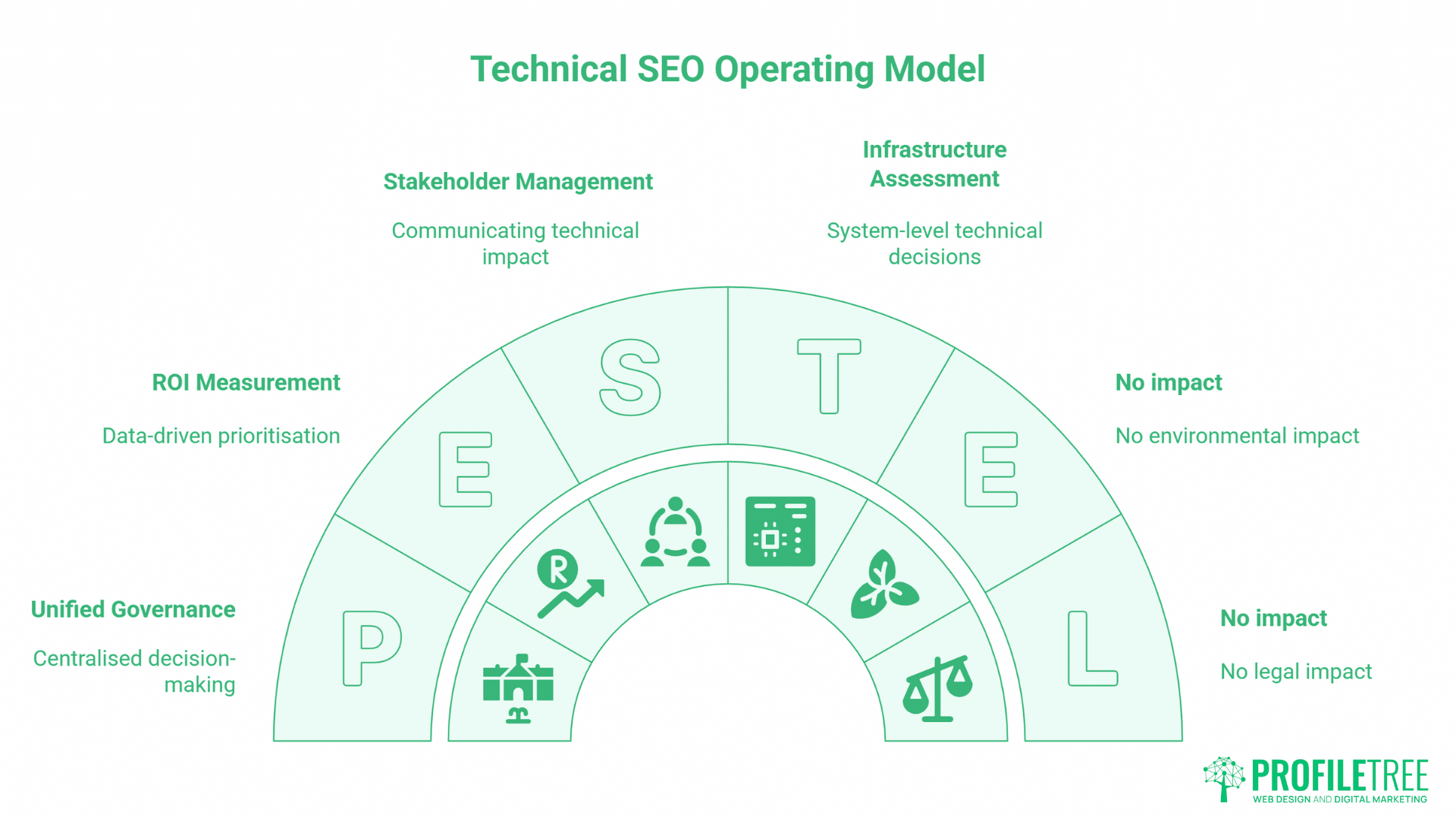
Building an effective operating model requires three distinct capability areas, each with specific responsibilities and reporting structures. These pillars work together to address the full scope of technical SEO: strategic direction, engineering execution, and data validation. Most organisations have pieces of these pillars scattered across teams, but success requires bringing them together under unified governance.
The SEO Product Manager: The Bridge
The SEO Product Manager role is fundamentally different from a traditional SEO Manager. This person owns the technical SEO roadmap and sits in product planning sessions alongside other product managers. They translate search algorithm updates into engineering requirements, manage the prioritisation of technical SEO work in Jira or Azure DevOps, and serve as the single point of accountability for technical search performance.
Their day-to-day responsibilities include writing technical specifications for SEO requirements, attending sprint planning to allocate engineering capacity, and managing stakeholder expectations when technical SEO work competes with feature development. They need to speak both languages fluently: they can discuss LCP and CLS with engineers whilst also explaining to the CMO why addressing render-blocking resources will improve conversion rates. This bilingual capability is what makes them effective bridges.
The skills required go beyond traditional SEO knowledge. They need product management experience, familiarity with agile methodologies, and the ability to write clear acceptance criteria. When a Core Web Vitals issue is identified, they don’t just flag it, they create a detailed ticket that includes the technical root cause, the expected impact on search visibility, the proposed solution, and the definition of done. This level of specification allows engineering teams to work autonomously without constant back-and-forth clarification.
In terms of structure, the SEO Product Manager typically reports directly to the Head of Product or CTO, with a dotted line to the CMO. This dual reporting addresses both the technical execution side and the marketing strategy side. They manage a budget for technical SEO tools and have hiring authority for technical specialists. At ProfileTree, we’ve seen this role reduce the average time-to-resolution for technical SEO issues by 64% compared to organisations where SEO reports solely to marketing.
The Technical SEO Architect: The Visionary
The Technical SEO Architect is your infrastructure specialist who thinks in terms of systems rather than individual fixes. This role focuses on the foundational technical decisions that affect search visibility: server architecture, rendering strategies, schema implementation frameworks, and Edge computing configurations. They’re looking three to six months ahead, anticipating how upcoming infrastructure changes will impact crawlability and indexation.
Their primary responsibility is conducting architectural reviews before major technical decisions are made. When engineering proposes migrating to a new CMS or adopting a Headless architecture, the Technical SEO Architect assesses the SEO implications and proposes mitigation strategies. They create technical documentation that becomes part of your engineering wiki, detailing things like canonical tag strategies, hreflang implementation patterns, and JavaScript rendering best practices.
This person needs deep technical knowledge that goes beyond SEO tools. They should understand server-side rendering versus client-side rendering, how CDNs affect crawl behaviour, and how to implement structured data at scale. They often have a background in software engineering or DevOps, bringing that technical credibility to SEO discussions. When they explain why a particular rendering strategy will cause indexation problems, engineering teams listen because they speak the same technical language.
The Technical SEO Architect typically reports to the SEO Product Manager but works closely with the Head of Engineering and infrastructure teams. They attend architecture review meetings, participate in technical design sessions, and have veto power over infrastructure changes that would create significant SEO risks. This isn’t about blocking progress but it is about identifying problems early when solutions are still cheap and straightforward rather than expensive emergency fixes after launch.
The SEO Data Analyst: The Validator
The Data Analyst moves beyond standard Google Analytics reporting into custom data analysis that validates whether technical changes are working. This role builds dashboards in BigQuery, creates custom crawl analysis scripts, and measures the actual impact of technical SEO work on business metrics. They’re responsible for proving ROI and identifying which technical improvements should be prioritised based on data rather than assumptions.
Their work includes log file analysis to understand how search engines are actually crawling your site, cohort analysis to measure how technical improvements affect user behaviour, and attribution modelling to connect technical SEO changes to revenue outcomes. When the engineering team deploys a Core Web Vitals fix, the Data Analyst creates a before-and-after analysis that shows the impact on bounce rates, conversion rates, and organic traffic.
This role requires statistical knowledge and programming skills, typically in Python or R. They build automated reporting that alerts the team when technical issues emerge, create forecasting models to predict the impact of technical changes, and develop custom metrics that matter to your business. Standard SEO tools provide surface-level data, but the Data Analyst digs deeper to understand causation rather than just correlation.
The Data Analyst reports to the SEO Product Manager and works closely with the broader data science team. They have access to the full data warehouse, not just marketing analytics tools. This positioning allows them to connect technical SEO improvements to metrics that matter to the CFO, customer acquisition cost, lifetime value, and revenue attribution, rather than just vanity metrics like keyword rankings.
The “SEO POD” Framework: Integrating with Engineering
The POD (Point of Delivery) framework is how you operationalise the three-pillar structure within your engineering workflow. A POD is a cross-functional unit that brings together the people needed to identify, specify, build, and deploy technical SEO improvements. It works within your existing agile framework, whether you’re using Scrum, Kanban, or a hybrid approach.
Building Your Cross-Functional Team
A standard SEO POD includes the SEO Product Manager, a frontend engineer, a backend engineer, and the Data Analyst. Depending on the work, you might also pull in a UX designer, a content strategist, or an infrastructure specialist. The key principle is that this group has everything needed to take a technical SEO requirement from concept to production without external dependencies. They own a specific part of the technical SEO roadmap and are measured on deployment velocity and business impact.
Operating Within Sprint Cycles
The POD operates on two-week sprints aligned with your engineering cycles. At the start of each sprint, the SEO Product Manager presents prioritised technical SEO work. The engineers estimate the effort, and the team commits to what they can complete. During the sprint, the team works collaboratively, the Technical SEO Architect provides specifications, the engineers implement solutions, and the Data Analyst prepares measurement frameworks. At the end of the sprint, completed work is deployed and measured.
Solving Core Structural Problems
This structure solves the priority problem because the POD has dedicated engineering capacity. There’s no competition with feature work because this capacity is ring-fenced for technical SEO. It solves the knowledge problem because engineers working in the POD develop deep understanding of SEO requirements and begin proactively identifying issues. It solves the measurement problem because the Data Analyst is embedded in the process, measuring impact in real-time rather than retrospectively.
Establishing Clear Governance
The governance model is critical. The POD has a clear product owner (the SEO Product Manager) who makes prioritisation decisions. They have defined capacity (typically 2-4 engineers depending on organisation size) that can’t be borrowed for other work. They have clear success metrics, usually around deployment velocity (number of technical fixes shipped per sprint) and business impact (organic traffic growth, conversion rate improvements, crawl efficiency gains).
Scaling Your Implementation
Implementation typically starts small. You might begin with a single POD focused on Core Web Vitals improvements or schema implementation. Once the model proves successful, you can scale to multiple PODs handling different aspects of technical SEO, one for rendering and crawlability, another for international SEO, a third for structured data and rich features. The key is maintaining the cross-functional structure and dedicated capacity that makes the model work.
Organisations using the POD framework report significant improvements in both speed and quality. Technical SEO fixes that previously took months now ship in weeks. Engineering teams develop SEO expertise that helps them avoid creating new problems. The marketing team has visibility into what’s being worked on and when it will ship. Most importantly, the business sees measurable improvements in organic performance because technical issues get resolved systematically rather than remaining in a perpetual backlog.# The SEO Operating Model: Structuring Your Team for the 2026 Technical Challenge
Scaling for the AI Challenge: Governance and Automation
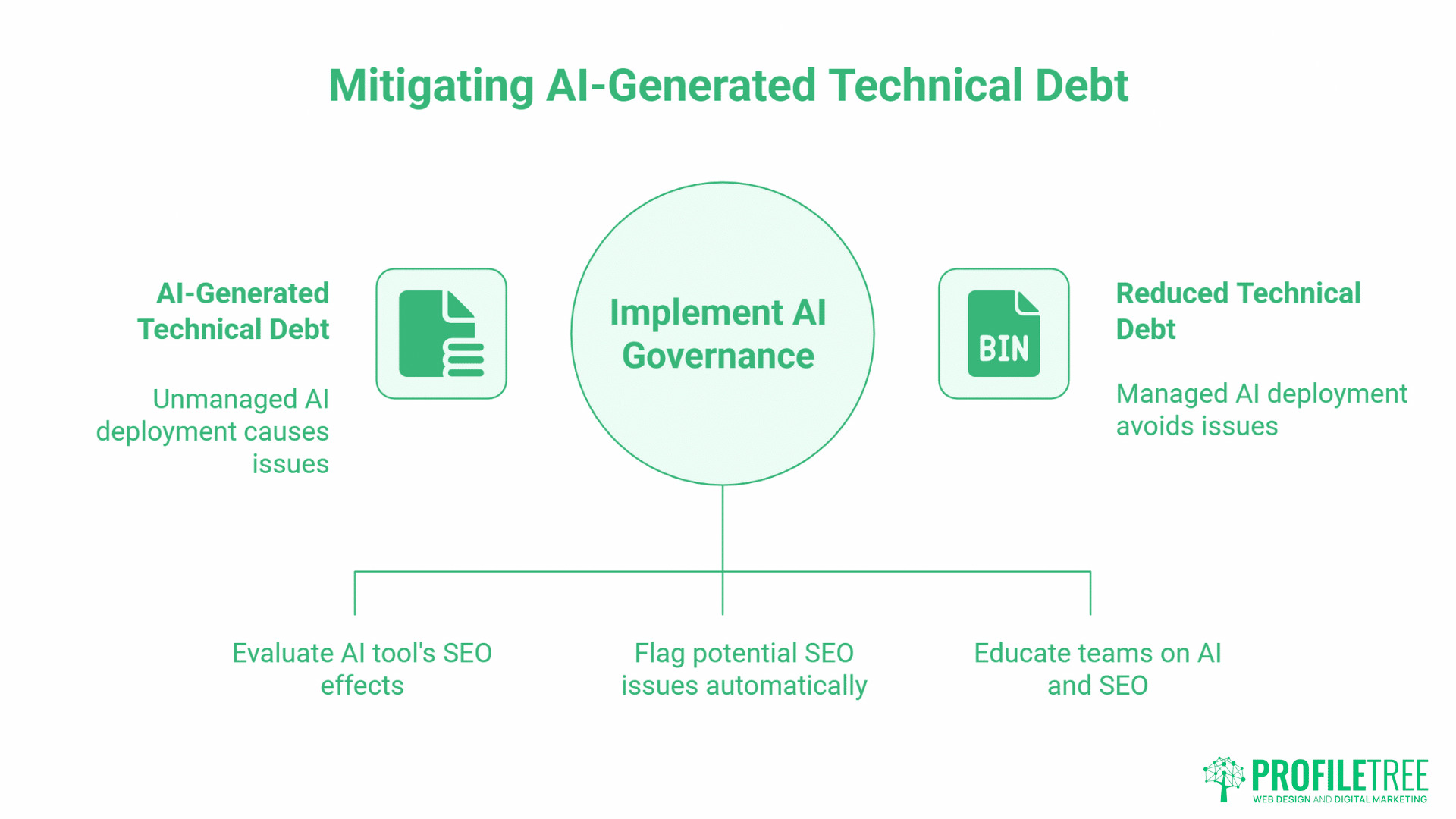
The rapid adoption of AI-generated content and AI-powered site features creates a new category of technical debt that traditional SEO structures struggle to address. When marketing teams deploy AI content tools without technical oversight, they create crawl budget problems, duplicate content issues, and thin content at scale. When engineering teams implement AI features without SEO consultation, they often create indexation problems or fragment user experience in ways that harm search visibility.
Building governance around AI implementation requires extending your operating model to include AI-specific protocols. Before any AI tool is deployed that affects public-facing content, it goes through an SEO impact assessment conducted by the Technical SEO Architect. This assessment looks at how the tool affects page structure, whether it creates duplicate or near-duplicate content, how it impacts Core Web Vitals, and whether it introduces crawlability issues.
The assessment framework should include specific checkpoints. Does the AI tool create unique URLs for every generated variation? How does it handle meta tags and structured data? Does it introduce client-side rendering that blocks content from crawlers? What’s the plan for quality control to prevent thin or low-value content from being indexed? These questions need answers before deployment, not after you’ve noticed organic traffic declining.
Automation is the counterbalance to AI-generated technical debt. Your Data Analyst should build monitoring systems that automatically flag potential issues: sudden increases in indexed pages, degradation in Core Web Vitals scores, spikes in crawl errors, or patterns indicating duplicate content. These automated alerts allow the POD to respond quickly before small issues become major problems.
The governance structure also needs to address training. Engineers implementing AI features need to understand SEO implications. Marketing teams deploying AI content tools need technical guardrails. This education happens through documentation, regular training sessions, and post-deployment reviews where the team analyses what went well and what created unintended SEO consequences. At ProfileTree, we’ve found that organisations with formal AI governance protocols avoid 80% of the technical SEO issues that emerge when AI tools are deployed without oversight.
Measuring Success: From Rankings to OKRs
Traditional SEO measurement focuses on rankings, organic traffic, and backlinks. Whilst these metrics matter, they don’t measure the effectiveness of your operating model. When you restructure around technical SEO as a product requirement, your success metrics need to reflect deployment efficiency and business impact.
The primary metric is Deployment Velocity: what percentage of identified technical SEO issues are actually resolved and deployed? In the old model, this number is typically 15-30%. In a well-functioning operating model, it should exceed 75%. You track this by maintaining a technical SEO backlog where every issue has a status: identified, specified, in development, deployed, or validated. The ratio of deployed to identified over a rolling 90-day period tells you whether your structure is working.
The second metric is Time to Resolution: how long does it take from identifying a technical issue to having the fix live in production? Track this at the median rather than the average to avoid outliers skewing the data. Organisations with effective operating models achieve median resolution times under 30 days. If your median is over 60 days, you likely still have structural problems, either insufficient capacity in your POD or prioritisation issues where technical SEO work keeps getting bumped.
The third metric is Business Impact per Technical Fix. The Data Analyst should be tracking organic traffic changes, conversion rate shifts, and revenue attribution for major technical deployments. When you fix Core Web Vitals issues, what happens to mobile conversion rates? When you implement structured data, what’s the impact on click-through rates from search results? This data validates whether you’re working on the right problems and builds the business case for continued investment in technical SEO capacity.
You also want to measure Engineering Satisfaction, typically through quarterly surveys of the engineering team. Are they clear on SEO requirements? Do they feel they have the information needed to implement technical SEO correctly? Do they see SEO as a partner or an obstacle? High satisfaction scores indicate that your bridge-building is working, engineers understand SEO needs and technical SEO understands engineering constraints.
Finally, track Technical Debt Accumulation. Are you creating new technical SEO problems faster than you’re fixing existing ones? This happens when architectural decisions are made without SEO input. If your identified backlog is growing faster than your deployment rate, you need more capacity in your POD or better integration into architectural planning.
These metrics should be formalised as OKRs (Objectives and Key Results) that the SEO Product Manager owns. For example: Objective: Establish technical SEO as a core product capability. Key Results: Deploy 80% of critical technical SEO fixes within 45 days, reduce median time-to-resolution to under 30 days, achieve 85% engineering satisfaction score, generate £500,000 in attributed revenue from technical SEO improvements.
The UK Landscape: Fractional vs In-House vs Agency

Building this operating model requires specific talent, and the UK market presents unique opportunities and challenges. The rise of fractional executives, the impact of IR35 on contractor relationships, and the maturity of the UK’s digital sector all affect how you source the capabilities needed.
The in-house model works best for organisations with sufficient scale to justify dedicated roles. If you’re deploying more than 30 technical SEO improvements per quarter, you likely need a full-time SEO Product Manager. If your site has complex rendering challenges or operates at significant scale, a full-time Technical SEO Architect makes sense. The Data Analyst role can often be shared with the broader data science function, with a portion of their time allocated to SEO measurement.
Fractional leadership has become increasingly popular in the UK market, particularly for the SEO Product Manager role. A fractional Head of Technical SEO might work 2-3 days per week, providing strategic direction and governance whilst you handle execution through a combination of in-house engineers and specialist contractors. This model works well during transformation periods when you’re building the operating model but don’t yet have the scale to justify full-time leadership. It also addresses the IR35 challenges by creating a clearly defined role that falls outside scope.
The agency model can supplement internal capacity, particularly for specialised technical work. An agency like ProfileTree might conduct the initial technical audit that identifies your priority backlog, provide the Technical SEO Architect capability on a retained basis, or offer training to upskill your internal engineering team on SEO best practices. The key is that the agency works within your operating model rather than operating as a separate silo. They should attend your sprint planning sessions, contribute to your technical specifications, and measure their success by your deployment velocity.
Hybrid models are increasingly common in the UK market. You might have a fractional SEO Product Manager providing strategic oversight, in-house engineers handling implementation as part of their broader responsibilities, an external specialist providing the Technical SEO Architect capability, and your internal data team providing the measurement function. This approach gives you the capabilities of the three-pillar model without the overhead of multiple full-time specialist roles.
The talent market in the UK offers strong technical SEO capabilities, particularly in London, Manchester, and Belfast. When recruiting, prioritise technical depth over tool knowledge, someone with strong engineering fundamentals who can learn SEO is often more valuable than someone with deep SEO knowledge but limited technical capability. Look for candidates with experience in product management, familiarity with agile methodologies, and the ability to write technical specifications. These skills are what make the operating model work.
Building a Resilient Technical Future
The structural change from SEO-as-service to SEO-as-product represents the most significant shift in how technical search marketing operates since the rise of mobile. Organisations that make this transition systematically address technical issues, deploy improvements at velocity, and build competitive advantages that compound over time. Those that maintain siloed structures continue accumulating technical debt whilst watching deployment timelines stretch and organic performance stagnate.
Implementation doesn’t require a complete organisational restructure overnight. Start with a single POD focused on your highest-priority technical SEO challenge. Measure deployment velocity and business impact. Once the model proves successful, expand capacity and scope. Build the governance structures that prevent new technical debt whilst systematically addressing existing problems. Most importantly, stop treating technical SEO as something marketing requests from engineering and start treating it as a fundamental product requirement that deserves dedicated resources and proper prioritisation.
Conclusion
The transition from siloed SEO to an integrated operating model represents a fundamental rethinking of how technical search capabilities fit within modern organisations. Organisations that implement this model build sustainable competitive advantages that compound over time, with technical issues resolved systematically and new problems caught early.
Start with a single POD focused on your highest-priority technical SEO challenge, measure deployment velocity and business impact, then expand capacity and scope. Stop treating technical SEO as something marketing requests from engineering and start treating it as a fundamental product requirement that deserves dedicated resources and proper prioritisation.
FAQs
How long does it take to implement an SEO operating model?
Most organisations see initial results within 6-8 weeks of launching their first POD. The complete transformation typically takes 4-6 months. Start with a pilot POD focused on high-priority technical issues, measure success over two sprint cycles, then scale based on proven results.
Do we need to hire new people or can we restructure existing teams?
Both approaches work. Many organisations successfully restructure by reassigning existing talent into the three-pillar framework. New hires are typically only needed for the SEO Product Manager role if you lack product management experience internally.
How does this model work for smaller organisations?
The POD framework scales down effectively. A small organisation might have a fractional SEO Product Manager working 2 days per week, one engineer dedicating 40% of their time to technical SEO, and analytics handled by your existing marketing analyst.
What’s the typical ROI of implementing this operating model?
UK organisations report 3-5x improvements in deployment velocity within the first quarter, translating to measurable organic traffic increases of 25-40% over six months. The model typically pays for itself through improved conversion rates within 6-9 months.
How do we handle resistance from engineering teams?
Address resistance by starting with quick wins that demonstrate value, involving engineers in prioritisation decisions, and providing detailed technical specifications. When engineers see SEO requirements treated with the same rigour as performance or security, resistance typically transforms into collaboration.
Ready to transform your technical SEO from a backlog to a competitive advantage? ProfileTree specialises in helping UK organisations build effective SEO operating models, from fractional leadership to complete team restructuring. Contact us to discuss how we can support your transition to a product-led approach that delivers measurable results.