
Visual Search SEO for Ecommerce: A Practical SME Guide
Table of Contents
Visual search SEO is reshaping how consumers discover and buy products online. Rather than typing keywords into a search bar, shoppers can now photograph an item and instantly find where to purchase something similar. For SMEs in e-commerce across Ireland and the UK, understanding and implementing visual search SEO represents one of the most significant untapped opportunities in digital marketing today.
This guide provides a technical, actionable framework from image optimisation and structured data to platform-specific strategies and performance measurement, giving your business the tools to compete in an increasingly visual search landscape.
Visual Search SEO vs. Image SEO: Understanding the Difference
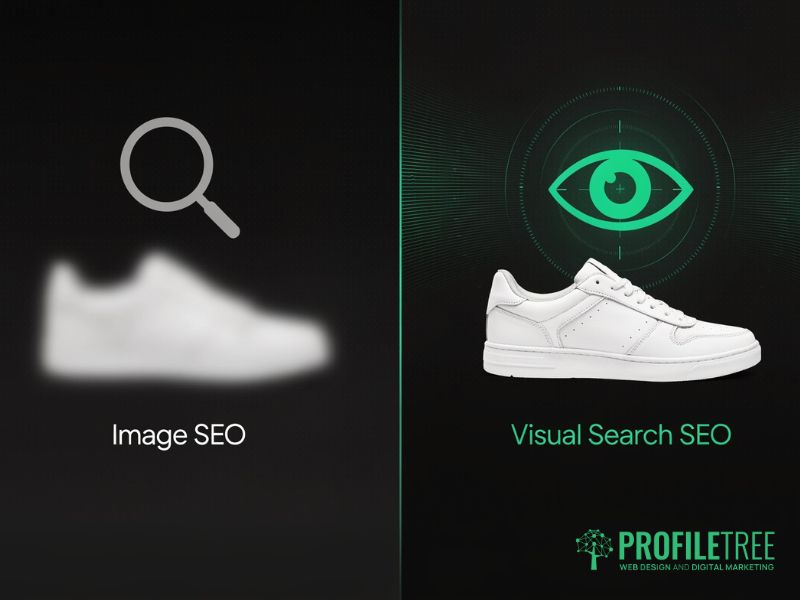
Before investing in visual search SEO, it is worth being clear on what separates it from conventional image SEO. Many e-commerce businesses assume that having images on their product pages is sufficient for visual discoverability. It is not.
Traditional image SEO is the practice of making existing images more accessible to search crawlers by adding alt tags, compressing file sizes, and including images in a sitemap. Visual search SEO goes considerably further. It involves optimising the entire visual data layer of your product pages so that AI-powered platforms can understand, categorise, and surface your products when a user searches with a photograph rather than a text query.
The distinction matters because the technical requirements are fundamentally different. A basic alt tag tells Google what an image contains in words. A properly executed visual search SEO strategy combining high-resolution imagery, descriptive file naming, image sitemaps, and platform-specific configuration tells the AI what your product is, what it looks like, and where to buy it. Moving beyond the alt tag is no longer optional for e-commerce businesses that want to compete in visual discovery channels.
Why Visual Search SEO Matters for UK and Irish Ecommerce
The case for investing in visual search SEO in the UK and Irish market is grounded in how mobile shopping behaviour has changed. Consumers increasingly encounter products they want on social media, in a shop window, or from a friend and reach for their phones to find where to buy something similar. Visual search SEO positions your products directly in the path of that intent.
The UK Retail Context
UK-based retailers are well-placed to benefit from visual search SEO. The domestic e-commerce market is one of the most advanced in Europe, with mobile commerce accounting for a growing share of transactions. Platforms like ASOS have built proprietary visual search features, Style Match, demonstrating that visual discovery is no longer a niche capability but a mainstream consumer expectation.
For SMEs that cannot build proprietary visual search tools, optimising for the major platforms through a structured visual search SEO approach offers a practical route to capturing this traffic. The key advantage for regional businesses is local discovery: visual search results can be tied to proximity and Google Business Profile data, giving well-optimised local retailers an edge over national competitors.
Key Platforms Where Visual Search SEO Has Impact
Understanding which platforms to prioritise is essential when building your visual search SEO strategy.
Google Lens integrates directly into Google Search and is accessible via any Android or iOS device. It can identify products, read text in images, and surface direct purchasing links. Performance in Google Lens is closely tied to Product Schema implementation and the quality of crawlable product imagery.
Pinterest Lens is particularly effective in fashion, home décor, furniture, and lifestyle categories. Users can photograph physical objects and find visually similar products across Pinterest’s catalogue. Rich Pins, which pull live product data, including price and availability, significantly improve visual search SEO performance on this platform.
Bing Visual Search mirrors much of Google Lens’s functionality and is integrated into Microsoft’s search engine. It is frequently overlooked by UK businesses despite contributing meaningful search volume, particularly among desktop users.
TikTok Visual Search is an emerging channel, especially relevant for fashion and beauty SMEs targeting under-35 consumers. Including TikTok in your visual search SEO planning is increasingly worthwhile as the platform’s in-app product discovery capabilities expand.
The Technical Framework for Visual Search SEO
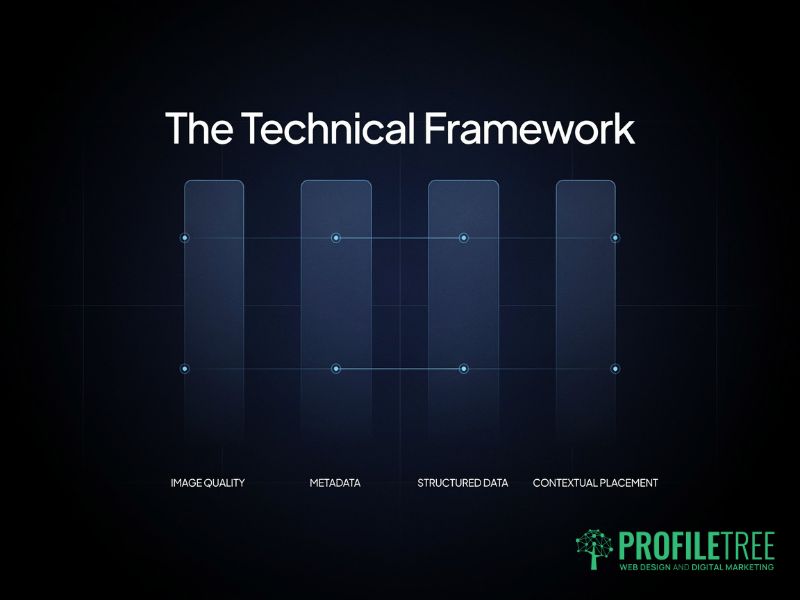
Effective visual search SEO rests on four technical pillars: image quality, metadata, structured data, and contextual placement. Each layer builds on the last, and weaknesses in any one area will limit the overall performance of your strategy.
Image Quality: The Foundation of Visual Search SEO
The AI systems that power visual search, including Google’s Vision AI and Pinterest’s image recognition engine, require high-resolution, clearly lit, distortion-free images to accurately identify and categorise products. Poor image quality is a fundamental barrier to visual search SEO performance, not merely a user experience issue.
For primary product images, a minimum resolution of 1,500 × 1,500 pixels is recommended, with 2,000 × 2,000 pixels preferable for products with fine detail such as textiles, jewellery, or ceramics. Backgrounds should be clean and neutral, typically white or light grey, to allow the AI to isolate the product without visual interference. Lifestyle images showing the product in context are valuable but should supplement, not replace, clean product shots.
Multiple angles are essential. Each product should include front, side, and detail shots as a minimum. For apparel, on-model photography significantly improves visual match accuracy. For furniture and home goods, room-setting images contextualise the product’s scale and style in ways that improve both visual search matching and conversion rates.
Image file format should be WebP, which, where possible, offers superior compression at equivalent quality, improving page load speed without sacrificing the resolution that visual search SEO requires. JPEG remains appropriate for product photography where WebP is not supported; PNG is best reserved for images requiring transparency, such as logos and icons.
Descriptive File Naming and Alt Text
File naming is one of the most consistently overlooked elements of visual search SEO. Generic filenames IMG_4521.jpg provide no semantic information to the crawlers that index your images. A descriptive filename blue-ceramic-teapot-floral-pattern-1.2-litre.jpg contributes directly to the AI’s understanding of the product before it even processes the visual content.
Follow a consistent naming convention: product-category-colour-material-distinctive-feature.jpg. Use hyphens to separate words rather than underscores, keep filenames under 70 characters, and avoid special characters.
Alt text should complement the filename without duplicating it. Write it as a concise, accurate description of what is visible: “Blue ceramic teapot with hand-painted floral pattern and bamboo handle, 1.2-litre capacity.” Include key product attributes colour, material, pattern, and size and keep alt text under 125 characters to meet accessibility guidelines while supporting visual discoverability.
Structured Data: Powering Visual Search Across Platforms
Structured data is the engine that connects your product images to the broader information graph that platforms like Google Lens and Pinterest Lens use to identify and surface products. Without it, your visual search SEO strategy is incomplete regardless of image quality.
Product Schema (using schema.org markup in JSON-LD format) should be implemented on every product page. Key attributes to include are product name, description, price, currency, availability, brand, SKU or GTIN, and a direct image reference. The ImageObject A property within the Product Schema allows you to link images explicitly to the product they represent, including image dimensions and captions, a detail that meaningfully improves visual search performance.
For Pinterest specifically, Rich Pins read directly from your Product Schema, automatically pulling live product data into pins. Correctly implemented structured data, therefore, serves double duty: it supports Google Lens discoverability and Pinterest Lens performance simultaneously. Validate your implementation using Google’s Rich Results Test and monitor for errors in Google Search Console, as structured data issues are one of the most common causes of visual search SEO underperformance.
Our guide to technical SEO for e-commerce product pages provides further detail on building the structured data foundation that underpins effective visual search SEO.
Platform-Specific Implementation: Shopify, WooCommerce, and Magento
The practical steps for visual search SEO vary depending on your e-commerce platform. Understanding the strengths and limitations of your platform is essential to building an efficient workflow.
Shopify has reasonable out-of-the-box image handling but limited native support for advanced structured data. Apps such as JSON-LD for SEO and SEO Manager can inject Product Schema automatically. Shopify’s built-in image processing handles WebP conversion, but file naming and alt text must be managed manually at upload. Ensure product images are not blocked in your robots.txt file.
WooCommerce on WordPress offers greater flexibility. Plugins such as Rank Math and Yoast SEO support Product Schema generation. Image alt text can be set in the WordPress Media Library and should be populated for every product image, not just featured images. Image sitemaps should be generated and submitted to Google Search Console.
Adobe Commerce (Magento) requires more technical configuration. Extensions such as Magento 2 SEO Suite handle structured data but require careful setup to ensure image URLs are correctly referenced. Magento’s default image handling produces multiple resized versions of the same product image; ensure the canonical version is the highest-resolution one to avoid indexing conflicts.
Regardless of platform, image sitemaps should be created and submitted via Google Search Console. Include all product images with their corresponding page URLs, captions, and title attributes, and update sitemaps whenever new products are added.
Google Lens and Pinterest Lens: Visual Search SEO in Practice
Understanding the technical requirements is one thing; applying them to the platforms where your customers are searching is another. Both Google Lens and Pinterest Lens reward businesses that go beyond generic best practices in their visual search SEO approach.
Optimising for Google Lens
Google Lens draws on the same signals as traditional Google Image Search but applies computer vision to identify products at a granular level. To maximise performance in Google Lens results, product pages must be mobile-responsive, images must be crawlable, and Product Schema must be correctly implemented across your catalogue.
For local SMEs in Ireland and the UK, Google Business Profile integration strengthens visual search SEO at a local level. Uploading high-quality product images to your Business Profile increases the likelihood of those products appearing in Lens results when users photograph similar items nearby. Accurate business information, address, opening hours, and product categories reinforce the local signals that support discoverability for regional businesses.
Monitor your image performance in Google Search Console under the Search appearance filter for image results. Google Lens referrals are currently captured within Google Images traffic in analytics platforms.
Optimising for Pinterest Lens
Pinterest Lens operates within its own ecosystem, meaning discoverability depends on how well your products are indexed within Pinterest’s image database rather than Google’s.
The foundation is a verified Pinterest Business account with Rich Pins enabled. As noted above, Rich Pins pull live product data directly from your Product Schema, meaning your structured data investment supports Pinterest visual search SEO without additional configuration.
Pin images should be vertical with an aspect ratio of 2:3 (ideally 1,000 × 1,500 pixels). Include keyword-rich descriptions on each pin, add 5–10 relevant hashtags, and pin directly from your product pages rather than uploading images manually to preserve the link back to the purchase page.
For SMEs in fashion, home décor, food, and lifestyle categories, Pinterest Lens can generate meaningful conversion traffic. The platform’s user base skews towards purchase-intent browsing, making visual discovery on Pinterest qualitatively different from passive social scrolling.
Privacy and Compliance: Visual Search SEO and UK GDPR

This is an area almost entirely absent from most visual search SEO guides, yet it carries real compliance risk for UK and Irish businesses implementing visual search features on their own platforms.
When users upload images to your website through a visual search feature, a “find similar” tool, or any image-based interaction, those images may constitute personal data under UK GDPR if they contain photographs of identifiable individuals. Businesses implementing on-site visual search must ensure that image data is not retained beyond the duration of the search session without explicit user consent. Privacy policies must disclose what image data is collected, how it is processed, and with which third-party services it may be shared.
For most SMEs using third-party platforms, such as Google Lens and Pinterest Lens, rather than building proprietary tools, the compliance responsibility rests primarily with those platforms. However, businesses remain responsible for the terms under which they embed these tools and for ensuring their cookie and consent frameworks accurately reflect the data processing involved.
“The intersection of AI-powered visual search and data privacy is one of the most rapidly evolving areas of UK digital compliance. Businesses that treat user-uploaded images as a routine technical feature rather than as personal data with associated consent obligations are taking on significant regulatory risk. Getting the consent framework right at the outset is far less costly than remediation after a complaint.” Ciaran Connolly, Director, ProfileTree.
Measuring the ROI of Your Visual Search SEO Strategy
Investing in visual search SEO requires a measurement framework that goes beyond standard web analytics. Without the right tracking in place, it is impossible to attribute conversions accurately or justify continued investment.
Key Metrics to Track
Image search referrals from Google Images, Pinterest organic traffic, and direct visual search conversion rates form the core measurement set. In Google Analytics, create a custom segment filtering sessions where the source/medium is google / organic , and the landing page matches your product URLs. Compare conversion rates against text search traffic to the same pages to establish the incremental value your visual search SEO is delivering.
For Pinterest, the native Pinterest Analytics dashboard provides Lens-specific data under “impressions from visual search.” Track saves, link clicks, and conversions attributed to Pinterest traffic as a discrete channel.
Set up enhanced ecommerce tracking to capture add-to-cart rate, average order value, and revenue by traffic source. Visual search visitors typically exhibit different shopping behaviour from text search visitors, with higher engagement with product galleries, longer session duration, and a tendency towards impulse purchasing, so channel-specific benchmarks are more informative than site-wide averages.
Reporting Cadence
Weekly monitoring of traffic and conversion metrics from visual search sources is sufficient for most SMEs. Monthly reviews should assess image indexation status in Google Search Console, check for structured data errors, and confirm that new product images have been submitted via the image sitemap. Quarterly strategy reviews should evaluate whether investment in image quality and platform optimisation is generating measurable return, and whether emerging platforms such as TikTok Visual Search warrant inclusion in the strategy.
ProfileTree’s ecommerce SEO services provide structured support for SMEs looking to build these measurement frameworks alongside their broader search optimisation strategy.
Future-Proofing Your Visual Search SEO

The trajectory of visual search SEO points towards deeper AI integration and an increasingly blurred boundary between search and commerce. Businesses that act now will be better placed than those who wait.
Google’s AI Overviews are already incorporating visual content, with image carousels appearing in generative search results for product-related queries. As Google’s Vision AI becomes more sophisticated, the gap between basic product photography and properly optimised visual search SEO will widen, favouring businesses that have invested in high-quality, well-structured visual content early.
Augmented reality is the next frontier. Virtual try-on features already available in Google Search for certain fashion and beauty products allow users to visualise products on themselves before purchasing. The groundwork for AR-enabled visual search is laid through the same structured data and image quality standards that underpin current best practice.
Shoppable video is an adjacent development worth incorporating into your planning. Pinterest and TikTok both support product tagging within video content, allowing users to purchase directly from video without leaving the platform. Optimising video thumbnails and embedding video content within product pages strengthens visual search signals whilst supporting conversion.
Our guide to image optimisation for Core Web Vitals performance explores how to balance the visual quality that visual search SEO demands with the page speed requirements that underpin strong search performance overall.
Visual Search SEO by Industry
Visual search SEO strategies need to be tailored to the specific visual characteristics and consumer behaviours of each product category. A one-size-fits-all approach rarely delivers the best results.
Fashion and Apparel
Fashion retailers benefit most when on-model photography is prioritised for all wearable items. Accurate colour reproduction across different device screens is critical, as colour is one of the primary matching signals used by visual search AI. Include close-up shots of fabric texture, stitching, and distinctive design elements. Create lookbook-style galleries with shoppable Pinterest pins, and ensure outfit combination pages are internally linked to individual product pages with descriptive anchor text.
Home Décor and Furniture
For home goods retailers, context and placement drive visual search performance. Show products in realistic room settings with consistent styling, and provide close-up shots of materials and finishes. Implement “shop the room” functionality where possible, linking every visible product in a lifestyle image back to its product page. Include scale references in at least one image per product, a person, or a standard household object to help both visual search AI and users assess dimensions accurately.
Food and Grocery
Food products benefit from both packaging shots and prepared or served photography. Include serving suggestion images and recipe contexts where appropriate. Ensure packaging design elements are clearly visible and accurately reproduced, as these are often the primary visual match signal for grocery products in visual search results.
Conclusion
Visual search SEO is no longer an emerging trend reserved for large retailers; it is a practical, measurable channel for e-commerce SMEs across Ireland and the UK that are willing to invest in the right foundations. High-quality imagery, correctly implemented structured data, and a deliberate presence on the key visual discovery platforms collectively open traffic channels that text-based SEO alone cannot reach.
Treating visual data as a strategic asset rather than a technical afterthought positions SMEs to benefit not only from current platforms but from the AI-driven shopping experiences that are rapidly becoming the norm across Google, Pinterest, and social commerce channels.
ProfileTree works with e-commerce businesses across Ireland and the UK to implement technical SEO strategies that deliver measurable results. If your product pages are not yet optimised for visual search SEO, now is the time to build that foundation.
FAQs
1. What is the difference between image search and visual search SEO?
Image search uses text keywords to find pictures. Visual search SEO is the practice of optimising product pages so that AI-powered platforms such as Google Lens and Pinterest Lens can accurately identify and surface your products when a user searches with a photograph rather than typed text.
2. Does visual search SEO affect my traditional Google ranking?
Indirectly, yes. High-quality images with correctly implemented structured data improve overall entity understanding for your product pages, contributing to topical authority. Strong image indexation also generates referral traffic that signals to Google that your content is useful and engaging, supporting broader SEO performance.
3. How do I start implementing visual search SEO on my e-commerce site?
Begin with three fundamentals: high-resolution product photography (minimum 1,500 × 1,500 pixels), descriptive file names and alt text for every product image, and correctly implemented Product Schema on all product pages. Ensure images are not blocked from crawling and that your image sitemap is submitted to Google Search Console.
4. Which image file type is best for visual search SEO?
WebP offers the best balance of compression and quality for web delivery and should be used where browser support allows. However, the AI systems that power visual search prioritise resolution and image clarity over file format. A high-resolution JPEG will outperform a low-quality WebP for visual search matching purposes.
5. Is visual search SEO relevant for B2B ecommerce?
Yes. Procurement and maintenance teams increasingly use mobile visual search to identify components and parts from photographs of existing equipment. A visual search SEO strategy that prioritises clear, high-resolution product photography and comprehensive structured data can meaningfully reduce friction in the B2B purchasing process.