
Technical SEO Challenges for Growing Businesses: A Practical Framework for Scaling Websites
Table of Contents
As a business grows, its website grows with it, often faster than anyone planned for. New product lines, new locations, new content, new team members all adding pages. What started as a manageable brochure site can turn into a sprawling structure of thousands of pages within a couple of years. That growth is a good problem to have, but it brings a set of technical SEO challenges that most small business owners never had to think about at an earlier stage.
This article walks through the most common technical SEO challenges facing growing and scaling businesses, why they tend to appear at this stage of growth specifically, and a practical framework for deciding which ones to fix first.
Why Technical SEO Challenges Multiply as Your Website Scales
A website with 50 pages behaves very differently to one with 5,000. At smaller scale, most technical SEO challenges are easy to spot and quick to fix manually. Once a site crosses a few hundred pages, particularly with product categories, location pages, or blog archives, the same small issues start compounding.
Growing businesses typically encounter technical SEO challenges around:
- Duplicate or near-duplicate pages created by filters, tags, or category structures
- Multiple people publishing content without a shared technical standard
- Legacy pages left over from old site sections or previous redesigns
- Search engines struggling to find and prioritise the newest, most important pages
None of this means technical SEO challenges are unsolvable for a growing business. It simply means they need a structured approach rather than ad hoc fixes whenever something looks wrong in Google Search Console. Getting the foundations right often starts with the site itself, which is why many growing businesses bring in professional web design support alongside their SEO work rather than treating the two as separate problems.
Crawl Budget Inefficiency: A Recurring Technical SEO Challenge
One of the most common technical SEO challenges for scaling websites is wasted crawl budget. Search engines only allocate a limited amount of crawling activity to any one site. When that activity gets spent on low-value or duplicate pages, your best content can get overlooked or crawled less frequently than it should be.
What Typically Causes It
Growing sites usually run into this through:
- Filter and sort options on category or product pages generating endless URL variations
- Session IDs or tracking parameters creating duplicate versions of the same page
- Poorly managed pagination across blog archives or product listings
How to Address It
Fixing crawl budget waste, one of the more solvable technical SEO challenges on this list, usually comes down to parameter handling in Google Search Console, tightening internal linking so priority pages are easy to reach, and reviewing server log files to see what search engines are actually spending time on. For a growing business without a dedicated technical team, this is exactly the kind of issue where working with a partner offering search engine optimisation support can save months of trial and error.
Indexation Issues at Scale
Indexation is one of the sneakier technical SEO challenges because the symptoms are often invisible until traffic quietly declines. Pages get indexed that shouldn’t be, or important pages get excluded, and neither shows up unless someone is actively checking.
Common causes include incorrect canonical tags, outdated noindex directives left on templates, and inconsistent rules across different page types. Without regular monitoring, these technical SEO challenges tend to go unnoticed for months.
The fix is straightforward in principle: regular indexation audits using Search Console’s coverage reports, consistent canonical rules applied across every template, and a habit of checking new page types before they go live at scale. Growing businesses that get ahead of this early, often through ongoing SEO services, avoid one of the more painful and preventable technical SEO challenges further down the line.
Site Architecture and Internal Linking Challenges
As a website expands, its structure often becomes fragmented without anyone intending it to. Deep page hierarchies, orphan pages with no internal links pointing to them, and inconsistent linking patterns are all technical SEO challenges rooted in architecture rather than code.
For a scaling business, internal linking isn’t just about navigation. It’s one of the clearest signals you can give search engines about which pages matter most. A flat, well-linked structure consistently outperforms a deep, disorganised one, even with similar content quality.
Mapping your current site structure, identifying orphan pages, and building clear links from high-authority pages down to newer content addresses this category of technical SEO challenges directly. This is also where working with a website development services team pays off, since architecture decisions are often baked into how the CMS itself is built. A custom website development approach makes these fixes far easier to implement than working around a rigid template.
“Most growing businesses don’t need an enterprise-level rebuild to fix their technical SEO. They need someone to map what’s actually happening on their site and fix the structural issues that are quietly capping their growth,” says Ciaran Connolly, founder of ProfileTree.
JavaScript and Rendering Issues
Modern websites increasingly rely on JavaScript frameworks to deliver smoother user experiences, but this introduces rendering related technical SEO challenges that catch out even well resourced teams.
Where This Bites Growing Businesses
Rendering related technical SEO challenges typically show up as:
- Content that loads after a delay, meaning search engines may not wait for it
- Internal links hidden behind JavaScript interactions rather than plain HTML
- Inconsistent rendering between what a bot sees and what a visitor sees
Practical Fixes
Auditing how your site renders using Google’s URL Inspection tool helps identify blocked resources, and moving toward server-side or static rendering where feasible resolves most of these technical SEO challenges. You don’t need a full framework migration. Often a targeted fix to how key pages render is enough, particularly when handled as part of ongoing website hosting management rather than a one-off project.
Managing Technical SEO Challenges Across a Growing Team
Once a business scales past one or two people managing the website, technical SEO challenges start coming from a new direction entirely: coordination. Developers, marketers, and content writers all touch the same site without always talking to each other, and that’s when technical SEO challenges reappear after every update.
Without some shared process, the same issues get fixed and then quietly reintroduced a few months later by an unrelated change. Growing businesses that avoid this usually put a few simple things in place: a documented technical SEO checklist that any team member can follow before publishing, a habit of flagging major site changes to whoever owns SEO, and periodic reviews rather than waiting for a problem to surface in traffic figures.
Bringing in outside support through digital strategy support can help formalise this before it becomes a recurring source of technical SEO challenges. Upskilling the wider team through digital training programmes also reduces how often basic technical SEO mistakes get introduced in the first place.
A Practical Priority Framework for Solving Technical SEO Challenges
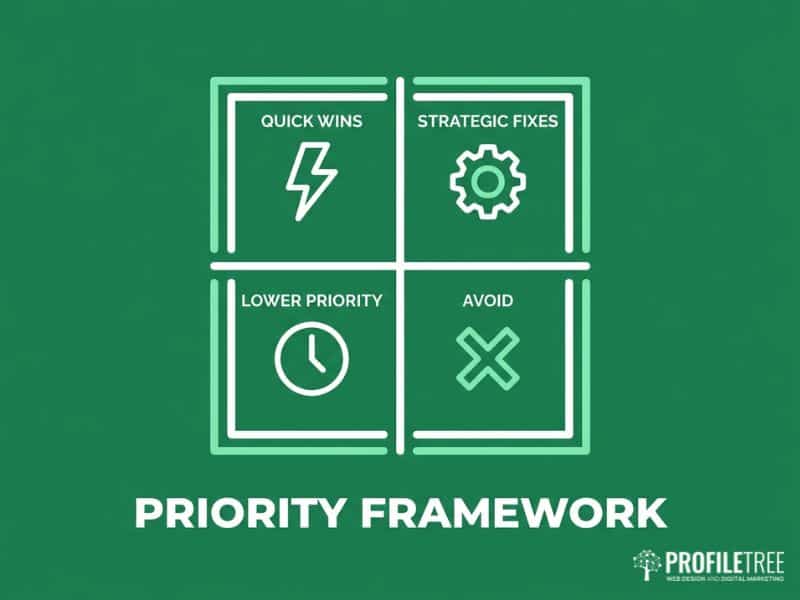
Not every technical SEO challenge deserves equal attention, and this is where many growing businesses get stuck, spending weeks on a minor rendering quirk while a much bigger issue sits untouched. A simple prioritisation model solves this.
Scoring Each Issue
Score every technical SEO challenge on your list across three factors: search impact (how many pages or how much traffic is affected), fix effort (developer time and complexity), and business value (whether the affected pages actually drive leads or sales). Issues scoring high on impact and business value but low on effort should always be tackled first.
Quick Wins Versus Strategic Fixes
High impact, low effort technical SEO challenges, like a misconfigured robots.txt file or a messy XML sitemap, are usually the fastest wins available. High impact, high effort challenges, such as Core Web Vitals problems or a full migration to server-side rendering, need dedicated time but deliver the biggest long-term return.
Revisiting this priority list every quarter, or after any redesign or platform change, keeps your technical SEO challenges aligned with where the business is actually heading rather than where it was six months ago. Many growing businesses fold this review into their broader digital strategy support, so technical fixes stay connected to actual business goals rather than becoming an isolated checklist.
Preparing for AI Search: Technical SEO Challenges in the Age of LLMs
A newer category of technical SEO challenges has emerged as AI driven search tools like Google’s AI Overviews and other AI assistants become part of how people find businesses. Being crawlable is no longer enough. Your content needs to be structured so AI systems can understand and cite it confidently.
This introduces technical SEO challenges around fragmented content, where thin pages or poor internal linking make it hard for an AI system to piece together a coherent answer. It also raises rendering related technical SEO challenges specific to AI crawlers, which may be less capable than Googlebot at handling JavaScript heavy interactions like “load more” buttons.
Addressing these emerging technical SEO challenges early, through clear semantic HTML, consistent entity naming, and content that answers one question thoroughly rather than several questions shallowly, positions a growing business well ahead of competitors still treating this as optional. Businesses already using AI marketing automation tend to have a head start here, since much of the underlying data structure work overlaps. The same thinking applies to customer-facing tools like AI chatbot development, which depend on the same clean, well-structured content to work properly.
How ProfileTree Helps Growing Businesses Solve Technical SEO Challenges
Solving technical SEO challenges at scale isn’t a one-off project. It’s an ongoing discipline that needs to grow alongside the business. ProfileTree works with scaling businesses across Belfast, Northern Ireland, and the wider UK to identify, prioritise, and fix the technical SEO challenges that are quietly limiting organic growth, combining hands-on SEO support with practical website design services and development.
Technical fixes rarely work in isolation from the rest of a business’s marketing. A site that ranks well but has weak social media marketing, no video marketing services, or an outdated email marketing strategy will still struggle to convert the traffic technical SEO work brings in. Rather than a generic audit that lists problems without context, the goal is to give you a clear, prioritised plan you can actually act on, the kind of technical SEO challenges framework outlined throughout this article, applied directly to your own site.
FAQs
What’s the difference between technical SEO challenges for a small business and a large one?
The underlying issues, crawlability, indexation, site structure, are the same. The difference is scale: a 50-page site can be checked manually, while a growing site with thousands of pages needs a repeatable process and regular monitoring.
How often should a growing business review its technical SEO challenges?
At minimum, quarterly, with a deeper review after any redesign, migration, or platform change.
Which technical SEO challenges cause the most damage?
Crawl budget waste, incorrect canonical tags, and poor internal linking, since they tend to affect large numbers of pages at once rather than a single page.
Can tools alone fix technical SEO challenges?
No. Tools surface the data, but prioritising fixes and aligning them with business goals still needs someone who understands both the technical and commercial side.
How does a site migration affect technical SEO challenges?
Migrations are one of the highest-risk moments for technical SEO. Without careful redirect mapping and post-launch monitoring, a business can lose years of accumulated search visibility within days.