
Sustainability in Digital Marketing: A Practical UK Guide
Table of Contents
Sustainability in digital marketing has moved from a reporting line in an annual CSR document to a working requirement for UK marketers. Consumers ask harder questions about environmental claims, regulators check those claims, and the technical choices behind a campaign now carry a measurable carbon cost. This guide sets out what sustainability in digital marketing actually involves, where the regulatory lines sit, and the practical steps a business can take across web design, advertising, content, and AI use.
The work splits into two parts: reducing the environmental impact of your digital activity, and communicating that work honestly. Get the second part wrong and you risk a misleading-claims investigation. Get both right and you build the kind of trust that holds up under scrutiny.
Why Sustainability in Digital Marketing Matters Now
Sustainability in digital marketing matters because the internet is not the clean alternative it was once assumed to be. Data centres, transmission networks, and end-user devices all draw power for every page view, video stream, and programmatic bid. As digital budgets grow, so does the energy behind them, which puts environmental responsibility on the same table as cost and performance. For most UK businesses the practical question is no longer whether to act, but where the quickest wins sit.
The Shift in Consumer Expectations
Buyers increasingly weigh environmental credentials alongside price and quality, and they expect proof rather than slogans. A brand that talks about sustainability without showing the work invites the kind of scepticism that costs sales. The safer route is to lead with specifics: what you changed, by how much, and how you measured it.
Trust as a Commercial Asset
Environmental trust is fragile and slow to rebuild once lost. Customers who switch to a more credible competitor rarely switch back, so the cost of an exaggerated claim is long-term, not a one-off. Treating sustainability in digital marketing as a trust signal, backed by evidence, protects that relationship.
Sustainability and SEO Pull in the Same Direction
A faster, leaner website ranks better and burns less energy, so technical work serves both goals at once. That overlap is the reason sustainability in digital marketing often pays for itself: the changes that cut emissions are usually the changes that lift performance. The specifics sit in the website design section below.
The UK Green Claims Code and Honest Communication
The single biggest legal risk in sustainability in digital marketing is the unsupported claim. In the UK, the Competition and Markets Authority’s Green Claims Code and the Advertising Standards Authority set clear expectations for any environmental statement in marketing. Getting the messaging right is as important as the underlying work, because a true effort described loosely can still breach the code.
What the Green Claims Code Expects
Claims must be truthful, clear, and capable of being substantiated. Vague terms such as “eco-friendly” or “carbon neutral” need supporting evidence and a stated methodology, not just an offset purchase. The whole lifecycle counts too: a service marketed as green cannot ignore the grid powering the servers behind it.
Stronger Enforcement Since April 2025
The regulatory teeth behind the code have sharpened. From 6 April 2025, the Digital Markets, Competition and Consumers Act gave the CMA power to fine businesses up to 10% of global turnover for misleading consumer claims, including greenwashing, without going through the courts first. The regulator has said it will tackle the most serious breaches first, which raises the stakes for any business making loose environmental claims. Treating sustainability in digital marketing as a compliance matter, not just a creative one, is now the safer position.
The direction of travel was clear before the powers landed. In September 2024 the CMA published sector-specific guidance for fashion and wrote to 17 well-known brands asking them to review their green claims, following earlier investigations into ASOS, Boohoo, and George at Asda that ended with formal undertakings to clarify wording. The lesson for any UK business is that vague terms attract scrutiny, and the scrutiny now carries real financial risk.
Lessons From Asa Rulings
The ASA has acted against major brands for leaving out material information about environmental impact. For digital marketers, the practical takeaway is that every green campaign landing page should link to a clear, accessible explanation of how the claim was reached. Honesty in sustainability in digital marketing is partly a documentation exercise.
Building a Claim That Holds Up
Before any sustainability claim goes live, write down the source, the measurement, and the date. If you cannot point to that evidence, soften the claim or remove it. This discipline runs through good SEO services, and it is the cleanest defence against a greenwashing complaint.
A short checklist helps here. State the claim in plain terms, name the metric behind it, record where the figure came from, and note when it was measured. Comparative claims such as “greener than before” need a stated baseline; absolute claims such as “carbon neutral” need a methodology a reader can follow. Keeping that record current is part of treating sustainability in digital marketing as an ongoing commitment rather than a launch-day message.
The Principles of Credible Green Branding
Credible green branding rests on three principles that work together: transparency, authenticity, and consistency. Sustainability in digital marketing fails when any one of them is missing, because audiences quickly spot a gap between what a brand says and what it does. The principles below give a simple test to run against any campaign before it ships.
Transparency
Back every environmental statement with data the reader can check. If you claim a reduction, show the figure and the period it covers. Transparency turns a marketing line into a verifiable fact, which is exactly what regulators and customers now expect.
Authenticity
Operational change should come before the communication, not after it. Measurable steps such as cutting page weight, moving to renewable hosting, or reducing wasted ad spend give you something real to talk about. Authenticity in sustainability in digital marketing means the action precedes the announcement.
Consistency
The message should hold across every touchpoint, from the website to social posts to email. A brand that runs an energy-efficient site but blasts out daily low-value content sends a mixed signal. Consistency keeps the story coherent and the credibility intact.
Sustainable Web Design and Technical SEO
Sustainable web design is where sustainability in digital marketing becomes concrete, because page weight maps almost directly to energy use. Every kilobyte transferred draws power at the data centre, across the network, and on the user’s device. The encouraging part is that the same work that reduces that load also improves Core Web Vitals, so the environmental and commercial cases line up. This is core to ProfileTree’s web design services, and it carries through to careful website development.
Cutting Page Weight
The average web page has grown heavier year on year, and most of that weight is recoverable. Moving images from JPEG and PNG to next-generation formats such as WebP or AVIF can cut image payload sharply without a visible drop in quality. Minifying CSS and JavaScript, and removing unused scripts, trims the rest.
Hosting and Efficiency
Choosing a host that runs on renewable energy reduces the grid impact of every visit. Beyond the power source, an efficient site loads fewer resources per page, so the gains compound. Reliable website hosting on a renewable provider gives a measurable starting point, and you can check a provider’s energy basis through the Green Web Foundation directory.
Cleaner Crawling and Structure
Every time a search bot crawls a thin or duplicate page, it consumes energy for no return. Tidying your site structure, fixing crawl traps, and pruning low-value pages saves crawl budget and reduces load at the same time. Sustainability in digital marketing benefits from a site that is lean by design, which is part of how good technical SEO supports the wider goal.
Caching and a content delivery network reduce repeated work by serving stored copies closer to the user, which cuts both load time and the distance data travels. Lazy-loading images and deferring non-critical scripts means the browser only fetches what a visitor actually needs. None of these are exotic techniques; they are standard build practice, and the environmental benefit comes free with the performance gain. That overlap is what makes sustainable web design an easy case to make to a client.
The AI Paradox: Responsible Use and Its Carbon Cost
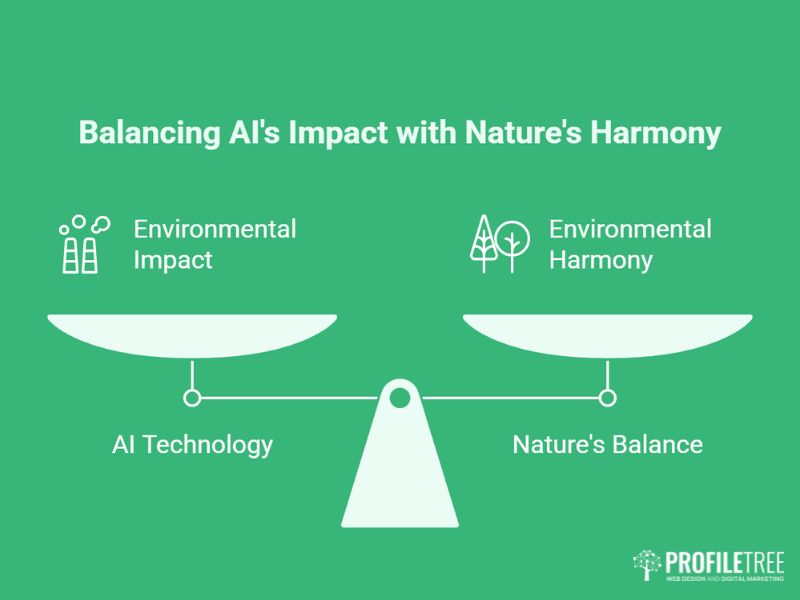
Generative AI has become central to marketing workflows, and it carries an environmental cost that sustainability in digital marketing can no longer ignore. Large models consume significant energy for training and for each query, so heavier use means a larger footprint. The responsible position is not to avoid AI, but to use it efficiently and to be honest about its impact. This connects directly to ProfileTree’s digital training and to using AI in marketing responsibly.
Human and AI Content, Weighed Honestly
An AI draft produced in seconds still draws on energy-intensive infrastructure, and repeated regeneration multiplies that cost. The practical answer is fewer, better prompts rather than dozens of throwaway attempts. Treating compute as a resource with a real cost keeps AI use aligned with sustainability in digital marketing.
Ethics and Responsible AI Use
How can ethics guide responsible AI use for environmental sustainability? By making efficiency, transparency, and necessity part of the decision to use a model at all. That means asking whether the task needs generative AI, choosing right-sized tools, and being open with clients about both the benefits and the footprint.
A Simple Responsible-use Framework
Set internal rules: define when AI adds genuine value, cap redundant regeneration, and record where AI contributed to a piece of work. These habits keep AI use efficient and defensible, and they apply just as much to AI chatbots as to content tools across ProfileTree’s approach to AI for SMEs.
Practical Sustainability in Digital Marketing Strategies
Sustainability in digital marketing works best as a set of routine habits rather than a one-off campaign. The strategies below span advertising, content, and social media, and each one reduces waste while improving results. A clear digital strategy ties them together so effort and energy are spent where they count, and none of them require a large budget.
Low-impact Advertising
Broad, untargeted campaigns waste both budget and energy on impressions that never convert. Tightening audience targeting and trimming the programmatic supply chain cuts the carbon behind every served ad, and a measured marketing strategy keeps spend aimed at audiences that respond. Measuring the footprint of media buying, then acting on it, turns sustainability in digital marketing into a cost saving as well as an environmental one.
Content Marketing With Less Waste
Publishing fewer, stronger pieces beats flooding a site with thin content that drains crawl budget and rarely ranks. Repurposing a strong asset across formats, including video marketing and email marketing, extracts more value from work already done. Quality over volume is the content principle that best serves sustainability in digital marketing.
Sustainable Social Media Practice
Reusing high-performing content rather than producing constant new posts reduces effort and energy without hurting reach. Partnering with credible voices who genuinely share your values keeps the message authentic, and a focused social media marketing plan keeps output deliberate. Used this way, social channels educate audiences instead of adding to digital clutter.
Measuring and Proving Sustainability Efforts
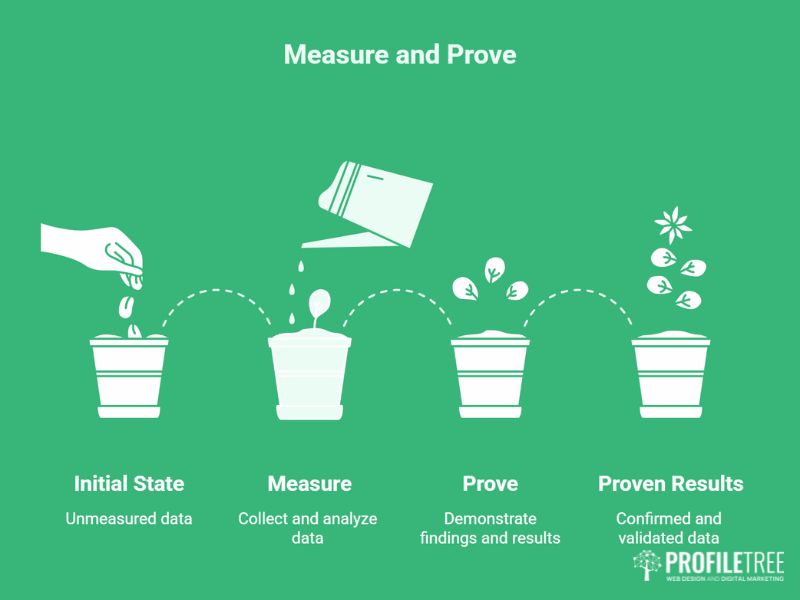
Sustainability in digital marketing only earns trust when it is measured and shown. Without numbers, a green claim is just an opinion, and under the Green Claims Code an unmeasured claim is a liability. This section covers the metrics, tools, and proof points that make an environmental message credible.
Metrics Worth Tracking
Useful indicators include page weight and load time, the carbon estimate per page view, wasted ad spend removed, and engagement with sustainability-focused content. Tracking these over time gives you a defensible record, and tools used in technical SEO already surface most of them. Pick a small set and report them consistently rather than chasing every possible figure.
Tools and Accreditation
Carbon calculators such as the Website Carbon Calculator and the Green Web Foundation directory give a starting measurement for your digital footprint. Recognised accreditations, where genuinely earned, add third-party validation that strengthens a claim. Sustainability in digital marketing is more believable when an independent source confirms it.
Storytelling Through Real Data
Charts, short videos, and clear before-and-after figures communicate progress far better than adjectives. A specific number, properly sourced, carries more weight with both audiences and AI systems than a page of qualitative description. Let the data do the persuading.
Case Studies: Brands Doing the Work
A few well-known brands show what credible sustainability in digital marketing looks like in practice. The examples below are useful because the environmental action and the communication line up, which is the standard the Green Claims Code expects. They also show that storytelling, not slogans, does the heavy lifting.
Patagonia
Patagonia uses its digital channels to advocate for environmental causes and to extend product life through its Worn Wear programme, which encourages repair and reuse over new purchases. The brand’s videos and articles document the work rather than simply asserting it. That consistency between action and message is why its audience trusts the story.
IKEA
IKEA’s furniture buyback and take-back schemes let customers return used items for resale or recycling, and the company promotes these through targeted digital campaigns and email. The communication points to a real operational programme, which keeps the claim grounded. It is a clear example of digital marketing supporting a measurable sustainability initiative.
What SMEs can take from this
The lesson for smaller businesses is that scale is not the point: a genuine, well-documented effort beats a polished but hollow campaign. Start with one real change, measure it, and tell that story honestly. Sustainability in digital marketing rewards proof over presentation.
“The businesses that get this right treat sustainability as an engineering problem first and a marketing message second,” says Ciaran Connolly, founder of ProfileTree. “When you build a faster, leaner website and you can show the numbers behind it, the green claim writes itself. The trouble starts when the message runs ahead of the work.”
Building Your Roadmap
A sensible roadmap for sustainability in digital marketing starts small and proves itself before scaling. Audit your digital carbon footprint, fix the heaviest pages, tighten ad targeting, and set rules for efficient AI use. Each step reduces impact and, in most cases, improves performance at the same time, which makes the business case easy to defend.
Sequence matters. Start with the website, because hosting and page weight affect every visit and the fixes also lift rankings; sound development practice bakes efficiency in from the start. Move next to advertising, where trimming wasted spend cuts cost and carbon together. Then set AI usage rules, since those shape daily workflow. Leave the communication until last, once you have measured results to point to. Sustainability in digital marketing done in this order means the message always trails real, documented work rather than running ahead of it.
Conclusion
Sustainability in digital marketing is now both an environmental and a commercial decision. The work that cuts emissions, leaner pages, smarter advertising, and disciplined AI use, also tends to lift rankings and reduce cost. The rule that ties it together is honesty: measure what you do, document it, and only claim what you can prove. Start with one change you can verify, then build from there.
FAQs
What is sustainability in digital marketing?
It is the practice of reducing the environmental impact of digital activity, such as web hosting, advertising, and content, while communicating that work honestly and with evidence.
Does sustainable web design help SEO?
Yes. Lighter, faster pages improve Core Web Vitals and rankings while using less energy, so the technical work serves both goals.
What is the Green Claims Code?
It is the UK CMA’s set of rules requiring environmental marketing claims to be truthful, clear, and backed by evidence covering the full lifecycle.
Is using AI bad for sustainability?
AI carries a real energy cost, but the responsible approach is efficient use: fewer, better prompts and clear rules rather than avoiding it entirely.
How do I measure my digital carbon footprint?
Tools like the Website Carbon Calculator and the Green Web Foundation directory give a starting estimate you can track and improve over time.