
AI Adoption Challenges for SMEs: What’s Blocking Progress
Table of Contents
Most small business owners who look into AI go through the same experience. They read a headline, get genuinely interested, speak to a few people, and then run into a wall. The technology sounds promising, but the path from curiosity to working implementation is unclear. Costs seem unpredictable. The team has no background in data science. The website was built five years ago, and nobody is sure whether it can support integrations. The AI adoption challenges facing small businesses are consistent across the UK and Ireland, and they are all solvable with the right approach.
Understanding the barriers to AI adoption is where most businesses need to start. This guide honestly addresses each barrier, explains what it actually involves, and sets out a realistic path forward for a small or medium-sized business operating under real budget and time constraints.
The Reality of AI Adoption in the SME Sector
Adoption rates for AI among UK SMEs have risen sharply over the past two years, but progress is uneven. Government data suggests adoption remains low among smaller firms, with uptake concentrated among larger businesses. Smaller businesses consistently cite the same cluster of barriers: cost, skill shortages, and uncertainty about where to start.
This matters because the gap between AI-adopting businesses and those standing still is widening. SMEs that have integrated AI tools into their operations are reporting measurable improvements in areas including customer response times, AI-enhanced marketing output, and operational efficiency. Those that have not are finding it harder to compete on service speed and personalisation, two areas where AI provides a direct commercial advantage.
The challenges in AI adoption for SMEs are real. They are also largely addressable, provided a business approaches the process systematically rather than all at once.
The Main Barriers to AI Adoption for SMEs
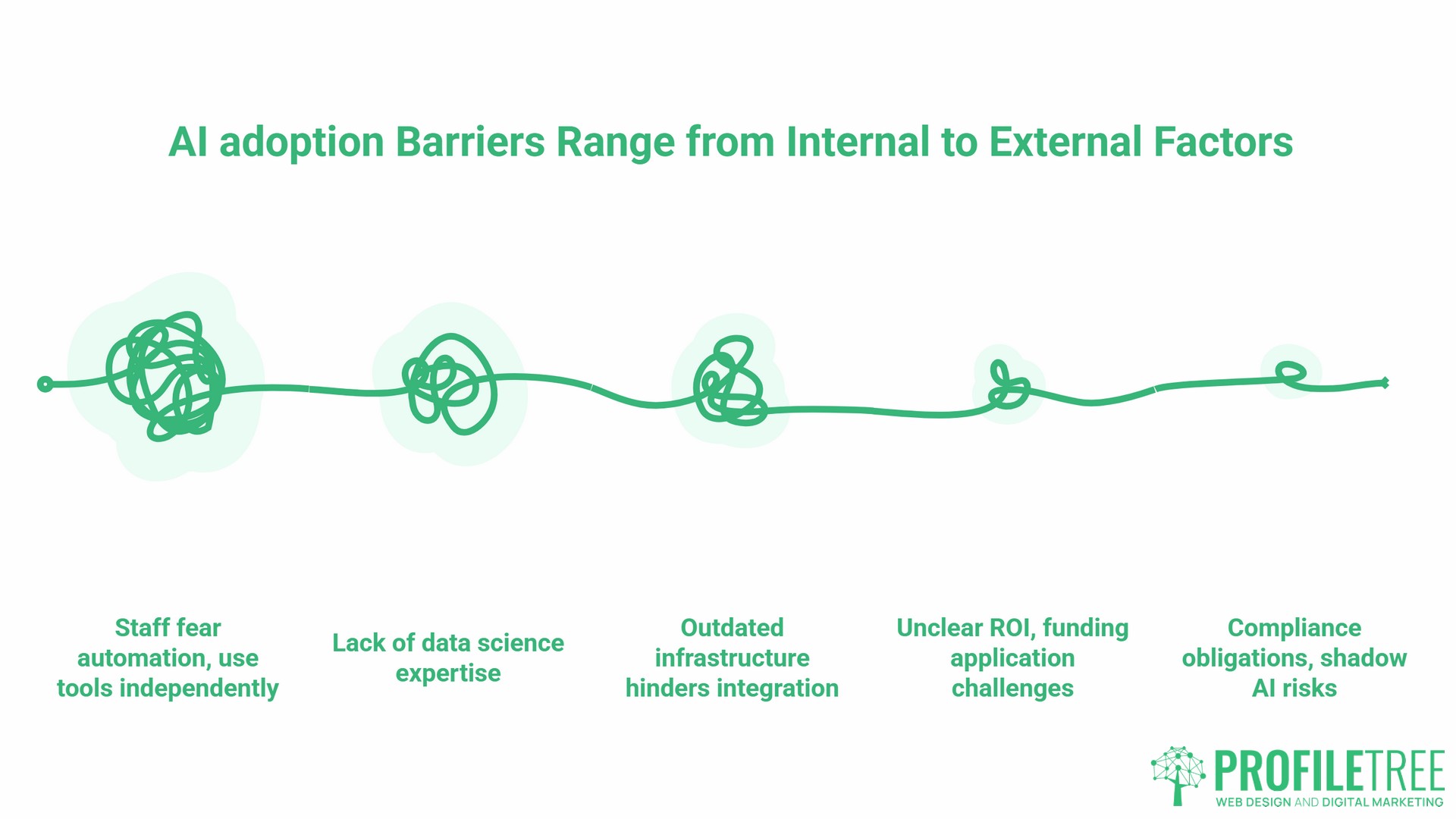
Of the five AI adoption challenges below, the skills gap is the one businesses most consistently underestimate.
The Skills Gap: Beyond the Buzzwords
The most commonly cited barrier to AI adoption is the skills gap. Most SMEs do not have a data scientist on the payroll, and many assume this disqualifies them from using AI in any meaningful way. That assumption is outdated.
The practical skills required to deploy most SME-appropriate AI tools are not data science competencies. They are operational. A business owner or marketing manager needs to understand what AI can and cannot do, which tasks it is well-suited to automate, how to evaluate outputs, and how to manage the risks. These are learnable skills that do not require a technical degree.
ProfileTree’s digital training programmes, delivered through Future Business Academy, are built specifically for non-technical business teams. Modules cover AI tool selection, content workflow automation, prompt engineering for business use, and running an AI readiness audit of your own processes. The goal is to give your team practical capability, not theoretical knowledge.
“AI adoption in small businesses is not primarily a technology problem,” says Ciaran Connolly, founder of ProfileTree. “It’s a confidence and clarity problem. When teams understand what they’re actually being asked to do, most of the resistance disappears quickly.”
Addressing the skills gap through structured training is the highest-return early investment for most SMEs. It removes the internal barrier before any tool is purchased. It is also the challenge most directly within an SME’s control, making it the best place to begin addressing broader AI adoption challenges.
Data Privacy and the UK Regulatory Environment
Data privacy is the second major barrier, and it deserves more serious treatment than most articles give it. Under UK GDPR, any business that processes personal data through an AI system is responsible for that processing, regardless of which third-party tool is used. This creates a compliance obligation that many SME owners are not aware of until they begin implementing.
The key issues are:
- Transparency: If an AI system makes or influences decisions about customers or employees, businesses may be required to explain the basis of those decisions on request.
- Data minimisation: AI tools trained on personal data must only process what is strictly necessary. Feeding a customer database into a generic AI model without understanding how that data is stored or used can create significant liability.
- Data Processing Agreements: Any third-party AI provider processing your data on your behalf must have a Data Processing Agreement (DPA) in place. Many off-the-shelf AI tools do not make this straightforward.
Shadow AI is a specific risk that most guidance overlooks. This refers to employees using free consumer AI tools (such as ChatGPT’s free tier, or AI features built into productivity apps) to process work information without company oversight. This creates data leakage risks that are difficult to audit after the fact. A clear AI usage policy, communicated to staff before any tools are deployed, is a necessary foundation.
ProfileTree’s AI implementation service covers compliance scoping as a standard part of the process, including identifying which tools require DPAs and what data governance steps need to be in place before deployment.
High Initial Costs and the ROI Question
Cost is consistently listed as a barrier, but the framing is often unhelpful. The question most SMEs ask is “how much does AI cost?” The more useful question is “what is the cost of not adopting AI over the next two years?”
AI tools for SME use now range from free or low-cost off-the-shelf applications to bespoke implementations that require significant investment. The difference lies in what you are trying to automate and how tightly it needs to integrate with your existing systems. A content team using AI writing tools to increase output is a very different investment from a manufacturer integrating AI into their production monitoring.
For most SMEs, the practical starting point is not bespoke AI. It is identifying two or three specific tasks that are currently consuming disproportionate staff time and testing whether an off-the-shelf tool can handle them reliably. This scoped, pilot-first approach limits upfront cost and generates evidence of return before a larger commitment is made.
Funding support is available. Innovate UK runs grant programmes for technology adoption in UK businesses, with SME-specific routes. Enterprise Ireland’s Digital Discovery programme supports Irish businesses in assessing and implementing digital and AI tools. Invest NI provides support for Northern Ireland businesses, including digital transformation vouchers. These resources are underused, largely because the process of identifying and applying for them is itself a task that many SMEs do not have the capacity for.
Legacy System Integration
One of the less-discussed challenges in AI adoption for SMEs is legacy infrastructure. AI tools do not exist in isolation. They connect to websites, CRM systems, e-commerce platforms, databases, and communication tools. For many SMEs, the digital infrastructure these tools would need to connect to is not ready for integration.
An outdated website built on an unmanaged platform, without an accessible API or a structured data layer, is a genuine barrier to AI adoption. Before a chatbot can answer customer queries, there needs to be a clear product database it can draw from. Before an AI analytics tool can generate useful reports, there needs to be tracking in place that captures clean, consistent data.
This is why web development is often a prerequisite step rather than a parallel consideration. ProfileTree’s development team works with businesses to assess whether their current digital infrastructure can support the integrations they plan and to lay the groundwork where it cannot. A well-structured website with clean data architecture does not just support AI tools; it makes everything from SEO to CRM integration work more effectively.
Cultural Resistance and Shadow AI
The final barrier is internal, and in many ways, the hardest to resolve. Introducing AI into a business changes how people work, and change is uncomfortable. Resistance most commonly appears in one of two forms: outright reluctance from staff who fear their roles are being automated, or shadow AI use, where individuals adopt tools independently without approval or oversight.
Both problems usually trace back to the same thing: poor communication about what AI is actually being introduced for, and what it means for the people involved. Staff rarely turn to unapproved tools out of defiance. They do it because the sanctioned option is slower, or because nobody told them one existed.
Managing the cultural side of AI adoption requires a deliberate internal strategy. This includes explaining clearly which tasks AI will handle, being transparent about how it affects roles (in most SME contexts, AI augments roles rather than replacing them), and creating a structure for staff to raise concerns or flag problems with outputs. Training helps here, too. Teams that understand how AI tools work are less likely to fear them and more likely to use them effectively.
Overcoming Hurdles: Why a Partner-Led Approach Works
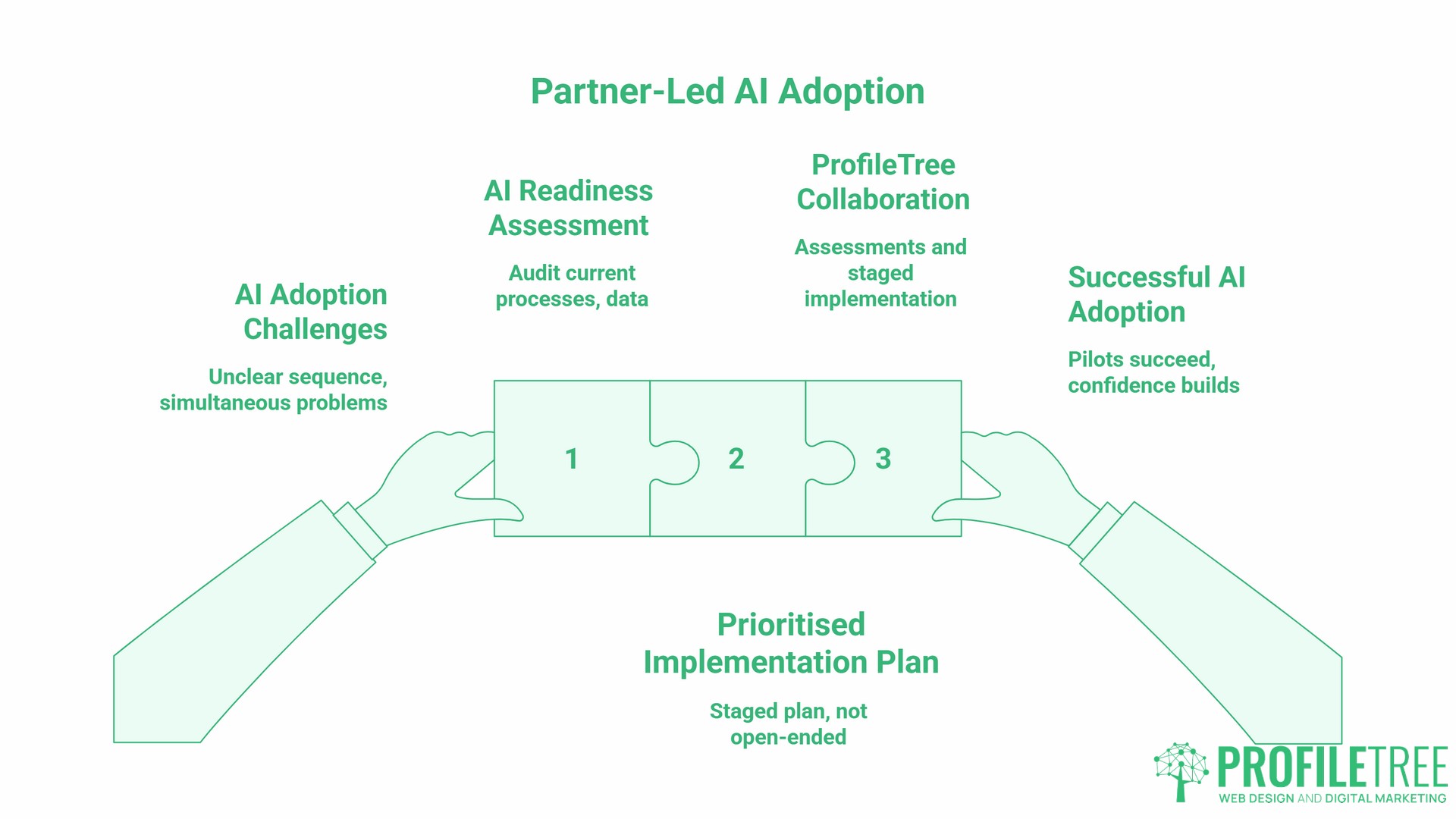
Most SMEs that struggle with AI adoption in small businesses are trying to solve several problems simultaneously without a clear sequence. They are evaluating tools before they have audited their processes. They are worried about cost before they have defined the scope. They are concerned about staff resistance before staff have been given any information.
A partner-led approach resolves this by introducing a clear starting point: the AI readiness assessment. This is a structured audit of what the business currently does, which processes are candidates for AI assistance, what data is available, and the technical and compliance prerequisites. It produces a prioritised plan rather than an open-ended list of possibilities.
ProfileTree works with SMEs across Northern Ireland, Ireland, and the UK to carry out these assessments and translate them into staged implementation plans. The sequencing is what creates the value: doing the groundwork correctly means pilots succeed, and successful pilots build the internal confidence that makes broader adoption possible.
A Step-by-Step AI Implementation Framework for SMEs
The following framework reflects how a structured, low-risk AI adoption process typically works in practice for a small or medium-sized business.
Stage 1, Audit: Map your current processes and identify where staff time is most heavily spent on repetitive, data-driven, or content-related tasks. These are your highest-priority candidates for AI assistance.
Stage 2, Strategy: Define scope clearly. Which two or three tasks will you pilot first? What does success look like, and over what timeframe? What compliance steps are required before any tool handles personal data?
Stage 3, Training: Equip relevant team members with the practical skills needed before deployment. This prevents adoption failure caused by low confidence or misuse.
Stage 4, Deployment: Implement the chosen tools in a controlled, monitored environment. Measure against the metrics defined in Stage 2.
Stage 5, Review and scale: Use the evidence from the pilot to inform the next phase of adoption. What worked? What required more human oversight than expected? What should be approached differently at scale?
The staged model matters because the alternative, attempting to adopt AI across multiple business functions simultaneously without a prior audit, is how most AI adoption projects fail. The technology works. The groundwork underneath it usually has not been done.
Challenge vs. Resolution: A Quick Reference
| Challenge | Risk of Going It Alone | Practical Resolution |
|---|---|---|
| Skills gap | Poor tool selection; low adoption by staff | AI training programme for non-technical teams |
| Data privacy and GDPR | Compliance exposure; customer data risk | Compliance scoping before any tool deployment |
| High initial cost | Overspending on tools before validating ROI | Pilot-first approach; explore Innovate UK and Invest NI funding |
| Legacy web infrastructure | Tools cannot integrate; data is inaccessible | Web development audit and infrastructure groundwork |
| Cultural resistance | Shadow AI use; staff disengagement | Clear internal communication and phased training |
Looking Ahead: AI as a Competitive Advantage
The businesses in the UK and Ireland that are pulling ahead in their sectors are not doing so because they have deployed the most sophisticated AI. They are doing so because they resolved the challenges in AI adoption for SMEs early, built solid foundations, and now operate with tools that compound over time. Content is produced faster. Customer enquiries are handled more consistently. Data-driven decisions are made on better information.
None of that is beyond the reach of a well-run small business. The barriers are real, but they are not permanent. Addressing them in sequence, with the right guidance, is the difference between AI adoption that delivers a return and AI adoption that becomes an expensive lesson.
ProfileTree’s AI implementation and digital training services are built around exactly this kind of structured, practical approach. If you are at the start of this process and unsure where to begin, an understanding of where UK SMEs currently stand with AI adoption is a useful starting point before auditing your own position.
FAQs
What is the first step for an SME wanting to adopt AI?
Start by auditing your current processes before evaluating any tools. The most common reason AI adoption fails in small businesses is that tools are selected before the business has clarity on which tasks it is actually trying to improve. A structured AI readiness assessment, covering your workflows, data, technical infrastructure, and team capability, gives you a prioritised starting point and cuts the risk of wasted investment.
Are there grants available for AI adoption in the UK or Ireland?
Yes, through Innovate UK, Enterprise Ireland’s Digital Discovery programme, and Invest NI. What matters as much as eligibility is timing. Several of these schemes run in competitive rounds with fixed opening and closing dates rather than accepting rolling applications, and eligibility usually depends on company size, sector, and whether you have drawn on the same scheme before. Check the opening dates before you scope a project around the funding, not after.
How long does it typically take to implement an AI solution?
A focused pilot targeting one or two specific tasks can be operational within four to eight weeks for most SMEs, provided the prerequisites are in place. Those prerequisites, clean data, technical integration readiness, team training, and compliance scoping, are usually what determine the timeline more than the tools themselves. A business that has done the groundwork can move quickly. One that has not will need to allow for that preparation phase first.
What is the biggest risk of AI for a small business?
Data leakage through unmanaged shadow AI use is the most underestimated risk. When staff use free consumer AI tools to process business or customer information without company approval or oversight, it creates compliance exposure that is difficult to audit or reverse. The safeguard is a written AI usage policy that names which tools are approved for which categories of data, issued before anyone is asked to use them. This is not about restricting productivity; it is about making sure the tools being used are appropriate for the data being processed.
Do I need an in-house data scientist to use AI?
No. The vast majority of AI tools relevant to SME operations do not require data science expertise to use effectively. What they do require is operational clarity: knowing which task you are automating, evaluating whether outputs are reliable, and knowing when human review is needed. These are skills that can be developed through structured, business-focused AI training in a matter of weeks, not years.
How does AI affect GDPR compliance for UK businesses?
AI tools that process personal data are subject to UK GDPR in the same way as any other processing activity. Businesses must have a lawful basis for the processing, implement appropriate technical and organisational measures, and confirm any third-party provider has a Data Processing Agreement in place. Where AI is used in decision-making that affects individuals, transparency requirements may also apply. UK businesses should treat AI compliance as a standard part of implementation scoping, not an afterthought.