
Niche Blogging: A Complete Guide to Market Authority
Table of Contents
For marketing directors, business owners, and digital strategists, content marketing presents a significant opportunity. Yet many organisations struggle to create blogs that generate genuine business value. The difference between a blog that attracts casual readers and one that converts prospects into clients lies in strategic niche selection and execution.
A well-executed niche blog positions your business as the definitive authority in a specific market segment. This focused approach delivers higher search rankings, stronger audience engagement, and better conversion rates than broad-topic blogs. For businesses across Northern Ireland, Ireland, and the UK, niche blogging offers a cost-effective method to demonstrate expertise while generating qualified leads.
This guide examines the strategic framework behind successful niche blogs, drawing on practical experience from ProfileTree’s work with clients across various sectors, including professional services, technology, and retail. You’ll discover how to identify profitable niches, create content that ranks, and transform blog traffic into business growth.
Understanding Niche Blogging
A niche blog focuses on a specific topic, industry, or audience segment rather than attempting to cover broad categories. This specialisation enables businesses to target decision-makers who seek tailored solutions to specific problems.
The commercial logic is straightforward. When someone searches for “digital marketing,” they receive millions of generic results. When they search for “SEO for Belfast medical practices” or “video marketing for UK SaaS companies,” they’re looking for specific expertise. Niche blogs capture this high-intent traffic.
Modern search behaviour favours specialisation. Google’s algorithms increasingly prioritise content that demonstrates genuine expertise and topical authority. A focused blog that thoroughly covers a specific subject typically outranks broader sites attempting to address multiple topics superficially.
Why Niche Focus Drives Business Results
Attempting to write about everything dilutes your authority and makes it challenging to build a loyal readership. When your content jumps between unrelated topics, visitors struggle to identify what value you offer. Search engines face the same challenge.
Consider two scenarios. The first blog publishes articles ranging from productivity tips to recipe ideas to travel advice. The second exclusively covers digital transformation for UK professional services firms. Which site would you trust when seeking guidance on implementing AI tools in your legal practice?
Niche blogs build competitive advantages through:
- Targeted Audience Development: You attract specific individuals facing particular challenges that your business solves. These visitors convert at higher rates because your content directly addresses their needs.
- Search Engine Authority: Consistent publishing within a single subject area signals topical expertise to search engines. This authority compounds over time, making each new article easier to rank.
- Content Efficiency: Writing within a defined scope becomes faster as you develop deep knowledge. You spot content gaps competitors miss and create more valuable resources with less research time.
- Brand Positioning: A focused blog establishes your business as the specialist choice rather than a generalist option. This perception supports premium pricing and customer retention.
For SMEs and agencies across the UK, niche blogging provides a realistic path to compete with larger organisations. You cannot outspend major competitors on broad keywords, but you can own specific sub-topics through consistent, expert content.
Selecting Your Niche
Choosing the right niche determines whether your blog becomes a business asset or a resource drain. This decision requires balancing your expertise, market demand, and commercial viability. Get this wrong, and you’ll struggle to maintain momentum regardless of content quality.
The strongest niches sit at the intersection of three factors: your knowledge and interest, audience demand, and monetisation potential. Ignore any of these elements and your blog will fail to deliver results.
Follow Expertise, Not Just Passion
Many guides advise following your passion when choosing a blog niche. This advice proves incomplete for businesses. Passion without expertise leads to superficial content that fails to establish authority. Passion without audience demand creates content nobody searches for.
Instead, start with your professional knowledge. What subjects could you discuss in depth without extensive research? Where does your business hold genuine expertise that competitors lack?
A web design agency might consider niches like “WordPress performance optimisation” or “accessibility compliance for UK websites.” A video production company could focus on “corporate video strategy” or “YouTube growth for professional services.” These topics align with existing knowledge whilst addressing specific market needs.
Consider this framework when evaluating potential niches:
Knowledge Depth: Can you create content that goes beyond surface-level advice? Do you have practical experience implementing solutions? Your blog needs to offer insights that readers cannot find in generic articles.
Sustained Interest: Will this topic hold your attention through hundreds of articles? Blogging requires consistency over years, not months. Choose subjects you can write about repeatedly without losing enthusiasm.
Market Demand: Are people actively searching for information on this topic? Use keyword research tools to verify that search volume exists. A fascinating subject with zero searches generates zero traffic.
Commercial Alignment: Does this niche connect to your business offerings? Your blog should attract potential clients, not just casual readers. Every article should address challenges your services solve.
Avoiding Common Niche Selection Mistakes
Several patterns consistently undermine blog success. Recognising these pitfalls prevents wasted effort:
Seasonal or Temporary Topics: Blogs focused on time-limited events typically generate short-term traffic spikes, followed by prolonged periods of low traffic. The 2024 Olympics attracted significant attention during the games, but this audience disappeared immediately afterwards. Choose evergreen subjects that maintain relevance.
Overly Broad Categories: “Marketing” or “business” encompasses too much ground for a single blog to dominate. Narrow your focus to specific segments, such as “email marketing for e-commerce” or “financial management for creative agencies.
Excessive Narrowness: Conversely, some niches prove too specific to sustain a regular content stream. “Left-handed guitar maintenance for jazz musicians in Belfast” lacks sufficient audience size. Balance specificity with viable market size.
Trend Chasing: Building a blog around current trends risks obsolescence when interests shift. Whilst covering trending topics within your niche adds value, building your entire strategy on temporary popularity proves unsustainable.
Finding Your Sub-Niche
Most successful business blogs operate within sub-niches rather than primary categories. This approach carves out defensible market positions against established competitors.
Take legal services as an example. A blog about “law” competes with thousands of established sites. A blog about “construction law for UK developers” targets a specific audience with defined needs. This focus makes creating genuinely helpful content more straightforward whilst attracting precisely the clients you want.
The sub-niche approach works particularly well for professional services and B2B businesses. Your potential clients often have particular requirements. They seek expertise tailored to their specific situation, rather than general advice that may apply to anyone.
Consider these sub-niche opportunities:
- Industry-Specific Applications: “Digital marketing for medical practices” rather than “digital marketing”
- Regional Focus: “SEO for Northern Ireland retailers” rather than “SEO”
- Methodology Specialisation: “Video content strategy for LinkedIn” rather than “video marketing”
- Audience Segmentation: “Web design for professional services” rather than “web design”
ProfileTree’s approach to client content strategy is based on this principle. Rather than creating generic marketing blogs, we develop focused content addressing specific business challenges within defined sectors. This positioning attracts decision-makers seeking specialised expertise rather than general information.
“The businesses that win with content marketing are those brave enough to narrow their focus,” notes Ciaran Connolly, Director of ProfileTree. “You cannot be everything to everyone, but you can become the definitive resource for a specific audience. That’s where commercial value lives.”
Building Your Audience
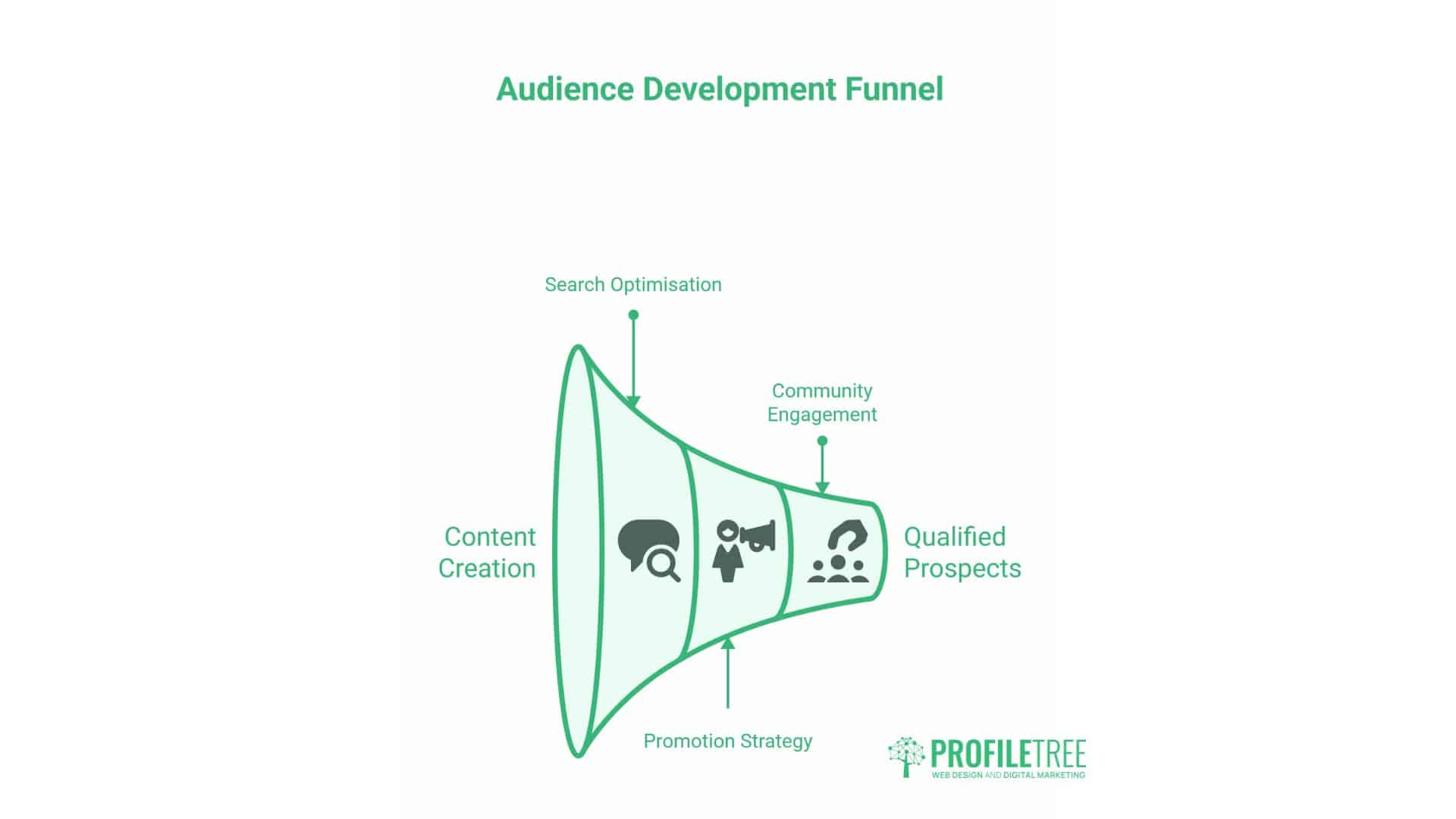
Creating excellent content means nothing if nobody reads it. Audience development requires a systematic approach combining search optimisation, promotion strategy, and community engagement. For businesses, this means thinking beyond traffic numbers to focus on attracting qualified prospects.
Content Creation Fundamentals
High-quality content forms the foundation of audience growth. This means material that genuinely helps readers solve problems or make decisions. Every article should leave visitors more knowledgeable than when they arrived.
Start by understanding what information your target audience actually needs. This extends beyond keyword research to encompass conversations with clients, analysis of frequently asked questions, and identification of knowledge gaps in existing content.
Problem-Solving Focus: Each article should address a specific challenge your audience faces. Avoid writing content that merely exists to rank for keywords. Ask what value each piece provides to someone reading it.
Depth and Thoroughness: Surface-level content rarely builds authority or ranks well. Comprehensive articles that thoroughly examine topics signal expertise to both readers and search engines. This doesn’t mean making every article 3,000 words, but it does mean covering subjects completely.
Practical Application: Business readers want actionable guidance, not theoretical concepts. Include specific steps, frameworks, and examples they can implement. Abstract advice holds less value than concrete direction.
Original Insight: The internet contains endless rewritten versions of the same basic information. Stand out by offering perspectives informed by your experience. Case examples, data from your projects, and lessons from implementation failures prove more valuable than recycled advice.
SEO Optimisation Strategy
Search engine optimisation makes your content discoverable. For niche blogs, this matters more than for broad-topic sites because your entire strategy depends on attracting specific searches.
Keyword Research and Targeting: Identify the precise terms your target audience uses when searching for information. Tools like Google Search Console reveal which queries already bring people to your site. Keyword research platforms show search volume and competition levels.
Focus on terms that indicate buying intent or serious information needs. Someone searching “what is SEO” likely wants a basic education. Someone searching “SEO audit checklist for WordPress sites” has a specific implementation need and potentially a budget to address it.
On-Page Optimisation: Structure content to help both readers and search engines understand your material. This includes:
- Clear headlines that incorporate target keywords naturally
- Descriptive URLs that reflect article topics
- Strategic keyword placement in opening paragraphs and subheadings
- Comprehensive coverage of related concepts and questions
- Internal links connecting related articles to build topical authority
Technical Performance: Page speed, mobile responsiveness, and proper technical implementation affect rankings. Fast-loading pages keep visitors engaged whilst meeting search engine quality signals.
Promotion and Distribution
Creating content represents only half the work. Active promotion expands reach beyond organic search traffic.
Email Marketing: Building an email list provides direct access to potential readers who are genuinely interested in your content. Offer valuable resources in exchange for subscriptions. Regular newsletters keep your audience engaged between site visits whilst driving traffic to new content.
Social Media Strategy: Share articles on platforms where your target audience spends time. For B2B businesses, LinkedIn often delivers better results than Instagram or TikTok. Match your promotion efforts to audience behaviour rather than chasing every platform.
Industry Participation: Engage in relevant online communities, forums, and discussion groups. Answer questions thoughtfully and share helpful resources when appropriate. This positions you as a knowledgeable contributor whilst introducing your content to new audiences.
Collaboration Opportunities: Partner with complementary businesses, industry publications, or established blogs to expand your reach and enhance your brand. Guest posting, podcast interviews, and joint content projects expose your expertise to established audiences.
Community Engagement
Audiences form around conversations, not just content consumption. Encouraging interaction transforms passive readers into active community members.
Respond to every comment on your articles. These conversations often surface additional questions that become future content ideas, while showing readers that you value their engagement.
Create opportunities for readers to contribute. This might include accepting guest posts, conducting interviews with industry practitioners, or featuring client success stories. User-generated content diversifies perspectives whilst reducing your content creation burden.
Consider establishing a newsletter that goes beyond simply announcing articles. Share exclusive insights, answer reader questions, or provide industry analysis not available on the public blog. This provides subscribers with additional value while building stronger connections.
Monetisation Strategies
Converting blog traffic into revenue requires a deliberate and strategic approach. For businesses, the primary monetisation goal typically involves generating qualified leads rather than direct income from the blog itself. However, several monetisation models can complement lead generation whilst building authority.
Lead Generation and Client Acquisition
For professional services firms and agencies, blog traffic should ultimately drive business enquiries. This happens through strategic conversion pathways embedded throughout your content.
Service Alignment: Every article should connect to problems your services solve. Content about website performance issues naturally links to web development offerings. Articles on video strategy relate to video production services. This alignment ensures traffic consists of potential clients rather than casual readers.
Strategic Calls-to-Action: Position relevant offers throughout content. These might include:
- Free consultations or audits related to article topics
- Downloadable resources that demonstrate expertise
- Email courses that nurture prospects over time
- Case studies showing successful client outcomes
Place these offers in a contextually relevant manner rather than a generic one. An article about SEO strategy should offer an SEO audit, not a video production consultation.
Contact Form Optimisation: Make contacting you straightforward. Forms should be visible without being intrusive. Ask for essential information only. Every field you add reduces completion rates.
Advertising Revenue
Display advertising provides passive income from traffic, though it typically generates modest returns unless you achieve substantial visitor numbers. Google AdSense and similar networks place advertisements on your site, paying per impression or click.
For professional service providers, display advertising often conflicts with lead generation goals. Advertisements direct visitors away from your site rather than towards your services. Consider whether advertising revenue justifies this trade-off.
If you pursue advertising, maintain strict quality standards. Excessive or intrusive advertisements harm user experience and damage your brand perception. Many successful business blogs completely avoid display advertising.
Affiliate Marketing
Affiliate marketing involves recommending products or services to your audience in exchange for commission on resulting sales. This works well when recommendations genuinely benefit readers.
Identify tools, software, or services your target audience uses regularly. If you recommend project management software, marketing automation platforms, or professional development courses, affiliate programmes may exist for these products.
Authentic Recommendations: Only promote products you’ve actually used and believe in. Your authority and trust are more valuable than short-term affiliate income. Recommending poor solutions damages credibility permanently.
Disclosure Requirements: UK law requires clear disclosure of affiliate relationships. Include transparent statements when links may generate commission. This honesty builds trust rather than undermining it.
Strategic Integration: Weave affiliate recommendations naturally into helpful content. Product reviews, comparison articles, and “tools we use” posts provide natural contexts for affiliate links.
Digital Products and Services
Creating digital products extends your expertise while generating scalable revenue. Unlike service delivery, digital products can be sold without requiring additional time per transaction.
Educational Content: Online courses teach specific skills related to your niche. A web design agency might create a course on “DIY website maintenance for small businesses.” A marketing agency could develop training on “content strategy fundamentals.”
Templates and Tools: Productise your expertise through reusable resources. Content calendar templates, audit checklists, strategy frameworks, or planning tools provide value while demonstrating your methodology.
Books and Guides: Comprehensive guides on niche topics establish authority while generating income. E-books are relatively inexpensive to produce and distribute, making them accessible starting points for digital product development.
Membership Communities: Providing subscription-based access to exclusive content, resources, or community spaces generates recurring revenue. This approach works well for highly engaged niche audiences who are willing to pay for ongoing value.
Consultation and Training
Your blog demonstrates expertise that positions you for higher-value consulting opportunities. Traffic from potential clients familiar with your thinking leads to better engagement than cold outreach.
Workshops and Training Programmes: Offer in-person or virtual training sessions on topics covered in your blog. Businesses pay substantially for structured learning experiences that deliver tangible skills.
Strategic Consulting: Position yourself for advisory relationships with organisations needing ongoing guidance. Blog content serves as an extended demonstration of your thinking and approach.
Speaking Engagements: Industry events seek knowledgeable speakers. Your blog establishes credentials that lead to speaking opportunities, which generate visibility, authority, and sometimes direct revenue.
ProfileTree’s experience shows that businesses benefit most from hybrid monetisation approaches. Lead generation remains the primary goal, while digital products and training programmes create additional revenue streams that enhance, rather than distract from, core services.
Content Strategy Framework
Consistent execution separates successful blogs from abandoned projects. A systematic approach to content planning, creation, and distribution maintains momentum whilst improving quality over time.
Editorial Planning
Random content creation produces inconsistent results. Strategic planning aligns blog output with business goals whilst maintaining audience engagement.
Content Calendar Development: Plan content at least one month ahead. This allows time for research, creation, and promotion without last-minute scrambling. Your calendar should balance various content types and topics to maintain a diverse range of content.
Topic Clustering: Organise content around core themes rather than isolated articles. If SEO represents one of your service offerings, create multiple articles covering different aspects: technical SEO, local SEO, content optimisation, and link building. This clustering builds topical authority.
Search Data Analysis: Utilise Google Search Console to identify queries that bring visitors to your site. These represent proven audience interests and content opportunities. Articles addressing these searches have already demonstrated demand.
Competitive Gap Analysis: Review what competitors publish. Identify topics they cover superficially or miss entirely. These gaps represent opportunities to create definitive resources that outrank existing content.
Seasonal Planning: Some topics naturally align with specific times. Businesses research marketing strategies in January, review budgets in the fourth quarter, and seek implementation help throughout the year—plan content to match these cycles.
Content Types and Formats
Variety maintains reader interest whilst serving different purposes within your strategy.
- Comprehensive Guides: Long-form articles that thoroughly cover specific topics. These serve as pillar content that ranks for primary keywords whilst providing extensive value.
- How-To Articles: Step-by-step instructions for implementing specific techniques or achieving particular outcomes. These directly help readers whilst demonstrating your expertise.
- Case Studies: Document client successes or project outcomes. These prove your capabilities whilst providing concrete examples of your methods in action.
- Industry Analysis: Examine trends, changes, or developments in your niche. This positions you as someone who understands the broader context, not just tactical execution.
- Problem-Solution Content: Identify common challenges your audience faces and present systematic approaches to address them. This format naturally leads to service offerings.
Production Workflow
Efficient content creation allows consistent output without consuming excessive time or resources.
- Research Phase: Gather information, examples, and data before writing. This includes reviewing existing content on the topic, collecting statistics, and noting key points to cover.
- Drafting: Write complete drafts without stopping to edit. Getting ideas down quickly proves more efficient than perfecting each sentence during the initial writing process.
- Editing and Refinement: Review drafts for clarity, accuracy, and completeness. This includes checking facts, improving explanations, and removing unnecessary content.
- Optimisation: Add SEO elements, including meta descriptions, header tags, internal links, and keyword placement—format content for readability with subheadings, bullet points, and short paragraphs.
- Visual Enhancement: Include relevant images, diagrams, or charts that support understanding. Visual elements break up text whilst illustrating complex concepts.
- Quality Review: Have someone else review content before publishing. Fresh eyes catch errors and identify unclear sections you might miss.
Measuring Performance
Track metrics that indicate progress towards business goals rather than vanity statistics.
- Traffic Growth: Monitor overall blog traffic and individual article performance. Identify the topics that attract the most visitors and generate the most engagement.
- Search Rankings: Track positions for target keywords. Improving rankings indicates growing authority and visibility for essential terms.
- Engagement Metrics: Time on page, pages per session, and bounce rates reveal how well content resonates with visitors. High engagement suggests valuable content, while quick exits indicate mismatched expectations or poor quality.
- Conversion Tracking: Measure how blog traffic converts into leads. This includes form submissions, consultation requests, and email signups. Understanding conversion rates allows optimisation of calls-to-action and content alignment.
- Revenue Attribution: For businesses using multiple monetisation methods, track income sources. This reveals which strategies deliver the best return on content investment.
Continuous Improvement
Successful blogs evolve based on performance data and audience feedback.
- Content Updates: Regularly refresh older articles with new information, updated statistics, and improved explanations. This maintains relevance whilst signalling freshness to search engines.
- Format Testing: Experiment with different content structures, lengths, and approaches. Compare performance to identify what resonates best with your audience.
- Topic Expansion: As you establish authority in core areas, expand into related subjects. This broadens reach whilst maintaining topical relevance.
- Audience Feedback: Pay attention to comments, questions, and direct feedback. These reveal what readers value most and what additional information they need.
Implementation for UK Businesses
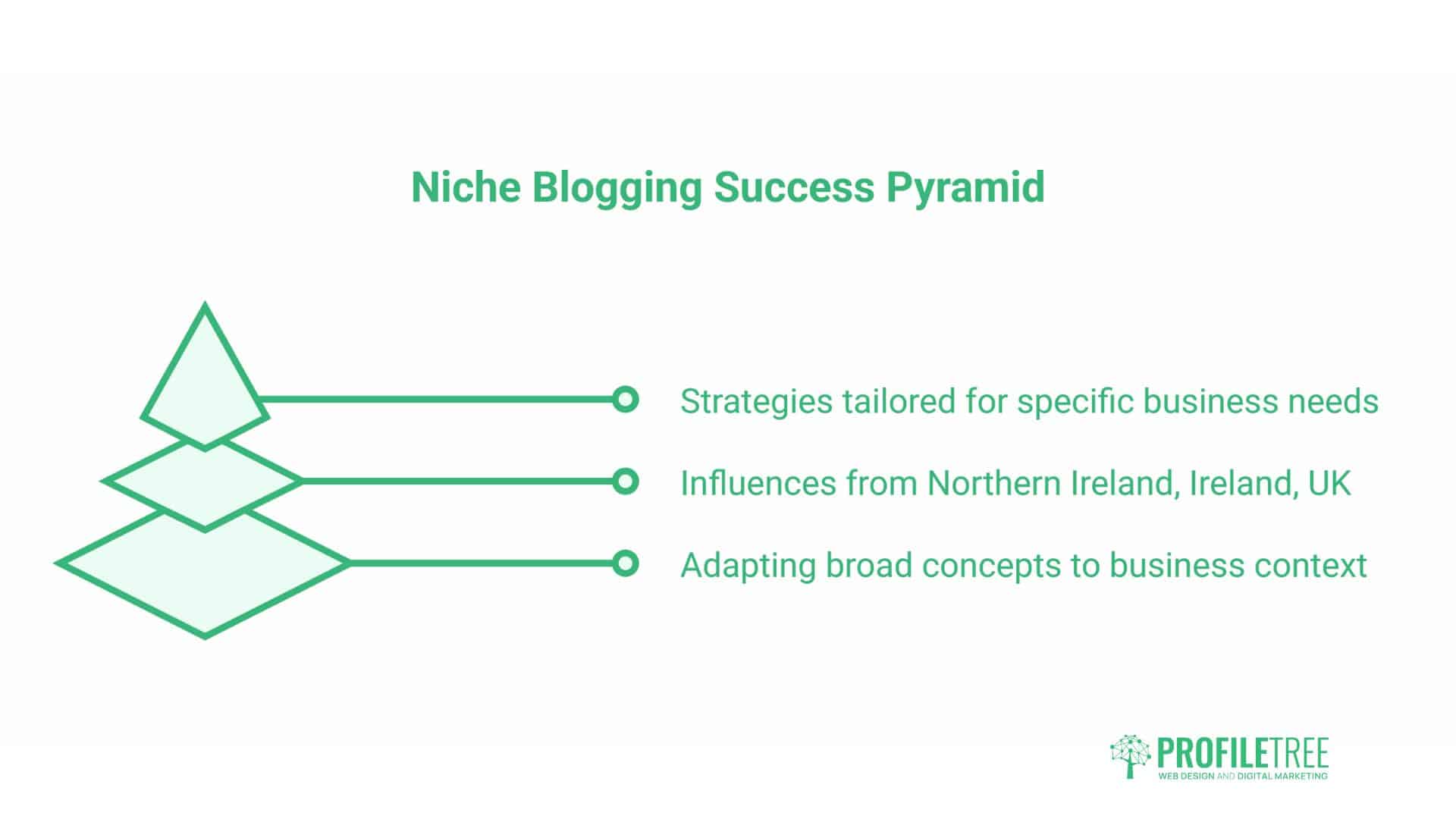
Building a successful niche blog requires adapting general principles to your specific business context. For companies across Northern Ireland, Ireland, and the UK, several factors shape effective implementation.
Regional Market Considerations
UK businesses face distinct challenges and opportunities when building blog audiences.
Local SEO Integration: For businesses serving specific regions, incorporating location-specific content helps attract nearby prospects. This includes addressing local market conditions, regulations, and business practices relevant to your area.
Regulatory Compliance: UK data protection, accessibility requirements, and industry-specific regulations shape both content topics and site implementation. Content addressing compliance demonstrates understanding of client challenges whilst positioning your expertise.
Cultural Context: UK business communication differs from that of the United States or other international norms. Avoid hyperbolic claims, respect reader intelligence, and provide substantive information rather than marketing speak.
Resource Allocation
Most UK SMEs lack dedicated content teams. Successful implementation requires realistic resource planning.
Time Investment: Plan for 5-10 hours per week for content creation, promotion, and blog management. This varies based on article length and production processes, but represents a reasonable starting point.
Skill Requirements: Effective blog management requires a strong writing ability, basic SEO knowledge, and proficiency in technical platform skills. Determine whether you possess these skills internally or need external support.
Budget Considerations: Account for costs, including hosting, tools, images, and potentially content creation assistance. Modest budgets suffice for blog operations, but realistic planning prevents surprises.
Platform Selection
Technical foundation affects both creation efficiency and site performance.
WordPress remains the dominant blogging platform for good reasons. It offers flexibility, extensive plugin options, and strong SEO capabilities. Most businesses benefit from WordPress hosting, paired with the right plugins for SEO, security, and performance.
Shopify, Wix, and Squarespace provide built-in blogging functionality alongside e-commerce features. These work well for retail businesses wanting integrated solutions, though they offer less flexibility than WordPress.
Select platforms based on your technical comfort level, budget, and specific requirements, rather than relying on theoretical optimal solutions.
Getting Started
Begin with manageable steps rather than attempting comprehensive implementation immediately.
- Define Your Niche: Take the time to clarify precisely what topic area you’ll cover and who you aim to serve.
- Develop Initial Content: Create 10-15 foundational articles covering core topics in your niche. This provides substance before promotion begins.
- Establish Publishing Rhythm: Commit to a realistic publishing schedule you can maintain consistently. Weekly posts prove more sustainable than daily attempts, which often quickly falter.
- Implement Basic SEO: Set up Google Search Console and Google Analytics. Install essential WordPress plugins for SEO, security, and performance.
- Begin Promotion: Share content through appropriate channels and start building your email list.
- Monitor and Adjust: Review performance on a monthly basis. Identify what works and refine your approach based on actual results rather than assumptions.
When to Seek Professional Support
Many businesses benefit from professional guidance in implementing content strategies. ProfileTree collaborates with clients across various sectors to develop and execute effective blog strategies that drive business results.
Professional support makes sense when:
- Your internal team lacks specific expertise in SEO, content strategy, or technical implementation
- You need faster results than purely in-house efforts can deliver
- Content quality inconsistency undermines brand perception
- Technical challenges prevent proper site optimisation
- Strategic planning requires an objective external perspective
Quality content marketing requires consistent effort over extended periods. The investment proves worthwhile when blog traffic converts into qualified business enquiries and establishes your position as the authority in your niche.
FAQs
How long does it take to see results from niche blogging?
Expect 6-12 months before significant traffic growth appears. Search engines need time to recognise authority and rank content. The early months focus on creating foundational content and establishing a consistent publishing schedule. Results accelerate as you build more articles and topical authority compounds.
How often should I publish new content?
Consistency matters more than frequency. Weekly publication works well for most businesses. This maintains momentum without overwhelming resources. More frequent posting helps if you can maintain quality, but posting inconsistently undermines results more than posting less frequently but reliably.
How long should blog articles be?
Length should serve content completeness rather than arbitrary word counts. Comprehensive coverage of topics typically requires 1,500 to 2,500 words. Some subjects demand more depth, while others need less. Focus on thoroughly addressing the reader’s questions rather than hitting specific word targets.
What topics should I avoid?
Skip topics unrelated to your business offerings or target audience interests. Avoid controversial political or social issues unless directly relevant to your niche. Steer clear of subjects where you lack genuine expertise. Content that doesn’t serve business goals or audience needs wastes resources.
Taking Action
Building a profitable niche blog requires commitment, consistency, and strategic focus. The businesses that succeed with content marketing treat it as a long-term investment rather than a quick tactic.
Start by clearly defining your niche based on expertise, audience needs, and business alignment. Develop a comprehensive content calendar covering core topics. Establish realistic publishing schedules you can maintain indefinitely.
Focus on creating genuinely helpful content that helps readers solve specific problems. Optimise for search whilst prioritising reader value over algorithm gaming. Promote your content actively, rather than relying solely on organic discovery to build an audience.
Track performance metrics that matter to your business. Monitor traffic growth, conversion rates, and ultimately revenue impact. Adjust strategy based on actual results rather than assumptions.
The niche blogging approach works particularly well for professional services firms, agencies, and specialised product businesses. Your blog becomes an always-available demonstration of expertise that builds trust before prospects ever contact you.
ProfileTree helps businesses across Northern Ireland, Ireland, and the UK develop content strategies that drive measurable results. Our approach combines technical SEO expertise with strategic positioning to establish authority that drives business growth.
Whether you need support developing a strategy, creating content, or optimising technical implementation, we provide the expertise required to make content marketing work for your business. Contact us to explore how strategic niche blogging can help achieve your growth objectives.