
Integrating AI with Existing IT Systems: A Practical Guide
Table of Contents
Most AI system integration projects stall long before they deliver anything measurable. A business buys a tool, hands it to the technical team, and discovers the underlying data infrastructure was never built to support it. The model underperforms, momentum drains away, and leadership quietly writes AI off as overhyped.
The fault rarely lies with the AI. It sits in the gap between modern machine learning and IT environments designed a decade or more before those systems existed. Closing that gap is an engineering and governance exercise, not a procurement one. AI system integration succeeds or fails on that distinction.
This guide covers why integrating AI fails in legacy environments, a seven-stage framework for artificial intelligence systems integration, the architectural patterns that connect old systems to new models, the UK and EU rules that shape what is permitted, and what happens after go-live.
Why AI System Integration Fails in Legacy Environments
Understanding the failure patterns is more useful than studying the success stories. The same problems recur across manufacturing, financial services, and professional practices, and almost all of them trace back to decisions made long before any AI tool was chosen. Three causes account for the bulk of stalled AI systems integration projects.
Data Silos and Architectural Rigidity
Fragmented data is the single most common reason AI projects underdeliver. Customer records sit in one system, transactional data in another, operational logs in a third. Any attempt at AI integration with existing systems trains on partial signals and produces partial answers.
Architectural rigidity compounds it. Older platforms were built around proprietary formats and closed interfaces, so connecting a modern AI layer to a fifteen-year-old on-premise ERP is deliberate engineering work rather than a configuration change.
A large share of UK manufacturing, financial, and public sector organisations still run systems that predate cloud computing. The SME AI implementation case studies published by ProfileTree show what businesses at different stages of readiness actually did about it.
The Latency and Throughput Gap
Software built on large language models has performance expectations that traditional business applications were never designed to meet. A CRM sized for a few hundred transactions an hour will not absorb continuous inference traffic.
Left unaddressed, the result is slow responses, failed API calls, and a user experience poor enough to kill internal confidence in the technology. Extra computing rarely fixes it, because the constraint is usually how data moves between systems.
The practical rule for artificial intelligence integration is to assess capacity before selecting a model. An honest AI readiness assessment answers three questions early: whether the data exists, whether a specific problem is worth solving, and whether the infrastructure can carry the load.
The Human Element Most Projects Underestimate
Technical debt is visible on a diagram. Staff resistance is not, and it usually surfaces only after the rollout has already slipped. People who feel their role is threatened, or who simply do not understand what the system is doing, will find workarounds.
Change management belongs in the project plan as a funded workstream, not an afterthought. Teams need to know what the AI is being asked to do, how to read its outputs, and who owns data quality. Guidance on overcoming AI adoption resistance sets out how to handle that conversation before the brakes go on.
Businesses that build genuine buy-in tend to integrate faster. Practical steps for building acceptance of AI across a workforce matter as much here as the middleware specification.
A Seven-Stage Framework for Artificial Intelligence Systems Integration
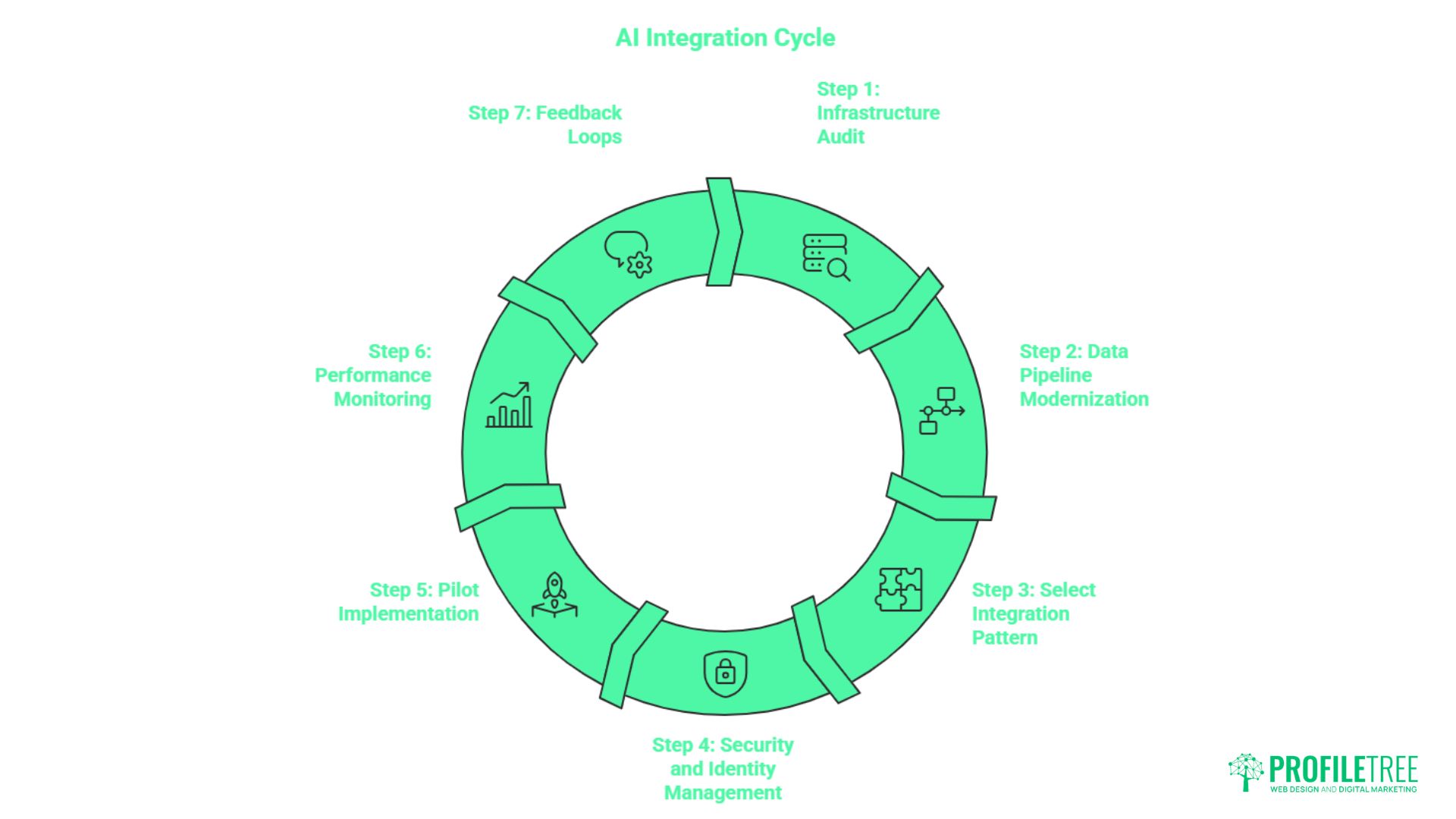
There is no universal template for AI system integration, but there is a reliable order of operations. Each stage creates the conditions for the next, and skipping one is the surest way to build a problem that costs more to unwind later. The four stages below carry the most weight: monitoring, feedback loops, and scaling follow naturally once they are in place.
Stage One: Audit Your Infrastructure and Technical Debt
Map what you have before selecting anything. Every workable integration with existing systems starts from an accurate picture of the current estate. Identify every system holding data relevant to the intended use case, document how those systems connect or fail to connect, and record the technical debt that must be cleared before integration is viable.
The audit should cover database schemas, API availability, data formats, and the volume and velocity of data each system produces. It is also the point to catalogue existing security weaknesses, which become far more consequential once an AI layer sits on top.
An honest reckoning here saves substantial cost later. The most frequent findings, and how businesses work through them, appear in this breakdown of the AI adoption challenges blocking SME progress.
Stage Two: Modernise the Data Pipeline
With the audit complete, the task becomes moving data reliably from source systems to the model. In practice, this often means shifting from traditional Extract, Transform, Load routines to Extract, Load, Transform approaches that cope with larger volumes and messier structures.
Data quality is the priority. Inconsistent formats, missing values, and duplicate records all resurface as faults in AI output, and cleaning them upstream is far cheaper than diagnosing model errors downstream.
Businesses running on older on-premise platforms usually need an intermediate data lake or warehouse. That investment is unglamorous but foundational, as this guide to data readiness for AI explains in detail.
Stage Three: Choose an Integration Pattern
Three patterns dominate artificial intelligence systems integration, and the right one depends on your architecture, your privacy obligations, and the nature of the application.
API-first integration connects the model to existing systems through standardised interfaces. It deploys fastest and stays flexible, at the cost of a dependency on a third-party provider and open questions about where processing happens.
Custom on-premise deployment keeps everything inside your own infrastructure. Regulated sectors and sensitive datasets usually push in this direction, though it demands considerably more internal capability to run.
Hybrid cloud splits the difference: sensitive data stays local while lighter processing moves outward. This is increasingly the default for mid-market UK organisations. Vendor choice shapes all three, and this guide to choosing the right AI partners and vendors covers the questions worth asking before signing. ProfileTree’s AI transformation service works with businesses at exactly this decision point.
Stage Four: Pilot Using the Sidecar Approach
Rather than swapping a core system for an AI-enabled replacement, the sidecar pattern runs the AI layer in parallel. Both take the same inputs, and outputs are compared before the model is trusted to act alone.
Risk drops sharply. If results look wrong during the pilot, the existing system carries on untouched, and the pilot period generates the real performance data needed to tune the model before wider deployment.
“The biggest mistake we see is businesses trying to go from zero to full AI dependency in one step,” says Ciaran Connolly, founder of ProfileTree. “A phased pilot approach gives you evidence, builds internal confidence, and surfaces problems while you still have time to address them without crisis management.”
Structuring that first phase properly matters, and this ten-step SME AI checklist gives a running order for UK and Irish businesses.
Architectural Patterns for Connecting Old Systems to New Models
Architecture decides the long-term maintainability of any AI system integration. Getting it right means understanding both what modern AI infrastructure needs and what the legacy platform can realistically offer. There is no elegant shortcut; the bridge either carries a load or it fails under it.
RESTful APIs as the Standard Bridge
For most organisations, RESTful APIs are the primary mechanism for AI system integration, connecting AI services to existing systems. They are widely supported, well-documented, and flexible enough to handle a broad range of data types.
The complication is that many legacy platforms predate modern API standards. Systems running on AS/400, older SAP versions, or bespoke databases from the early 2000s need a middleware layer to translate between native protocols and the interfaces AI services expect.
That middleware is routinely underestimated during scoping. It requires ongoing maintenance and the same engineering discipline as any other component, which is why ProfileTree’s web development team treats interface work as a build rather than a configuration task.
Event-Driven Architecture for Real-Time Applications
Where the application must react as events happen, such as fraud detection, real-time pricing, or maintenance alerts, a request-response model is often too slow. Event-driven architecture publishes data changes to a message broker, and AI services subscribe to the streams that matter.
Apache Kafka is commonly used for this in larger environments. Data reaches the model as it is generated rather than waiting to be polled, at the price of more architectural complexity and a steeper operational learning curve.
Latency requirements should drive the choice, not general preference. Manufacturing and plant-heavy businesses tend to arrive here first, as this guide to predictive maintenance using AI illustrates.
Vector Databases and Retrieval-Augmented Generation
Relational databases store rows and columns. Language models work with vector embeddings, which are mathematical representations capturing meaning rather than raw values. The two formats do not talk to each other directly.
Vector databases such as Pinecone, Weaviate, and the open-source Chroma let AI systems retrieve semantically similar information quickly. This underpins retrieval-augmented generation, where a model answers using your own documents instead of relying on training data alone.
For document search, knowledge management, or customer query handling, adding a vector layer alongside the existing database is usually the shortest route to capability. Businesses that implement AI chatbots almost always end up building one, which is why ProfileTree’s AI chatbot development starts with the data layer rather than the interface.
| Factor | API-First | Custom On-Premise | Hybrid Cloud |
|---|---|---|---|
| Implementation Speed | Fast (weeks) | Slow (months) | Moderate (6 to 12 weeks) |
| Data Privacy | Depends on provider | Full control | Partial control |
| Ongoing Cost | Usage-based | High (infrastructure plus staff) | Moderate (shared overhead) |
| Maintenance Burden | Low (provider-managed) | High (fully internal) | Shared |
| Best Suited For | Non-sensitive data, fast deployment | Regulated sectors, sensitive data | Most mid-market UK organisations |
Governance and Compliance for UK and Irish Businesses
Compliance is not a final checkbox. It determines which integration patterns are available, what data can train a model, where processing may occur, and how outputs can be used. Governance shapes AI integration with existing systems from the first design meeting. Businesses in Northern Ireland and the Republic face a more layered position than their US counterparts, and the rules are still moving.
UK GDPR and Data Governance in AI Systems
UK GDPR applies to any AI system processing personal data relating to people in the United Kingdom. Training data must be lawfully obtained and documented, individuals have the right to know their data feeds automated decisions, and in defined circumstances they can request human review.
Governance frameworks need to exist before integration starts. That means naming data owners, setting retention and deletion policies, and building audit trails capable of demonstrating compliance with the Information Commissioner’s Office.
The pitfalls are consistent and avoidable. This guide to AI and GDPR compliance for Irish and UK SMEs covers the six most common issues.
The EU AI Act and Its Reach for UK Businesses
The EU AI Act establishes risk-based regulation and applies extra-territorially. Any UK business supplying AI-enabled products or services to customers inside the European Union falls within scope, wherever the processing physically happens.
The Act sorts systems by risk level. High-risk categories, including employment decisions, credit scoring, and critical infrastructure, carry the heaviest obligations: conformity assessments, technical documentation, and human oversight.
Northern Ireland businesses trading into both markets need to establish their classification early, rather than treating it as a future concern. The wider picture of how Irish businesses are implementing AI shows how firms on both sides of the border are responding.
Security Architecture and the Shadow AI Problem
Integrating AI into existing IT workflows opens new attack surfaces. They read from multiple sources, produce outputs that inform decisions, and often call external APIs. Each of those is a weak point if access controls are loose.
Identity and Access Management belongs in the design from the outset. Define who may query the system, what data it can access, and the conditions under which outputs can be acted on. Audit logs should capture every interaction for both security and regulatory purposes.
Shadow AI is the quieter risk: staff wiring unapproved tools into business systems through personal accounts and unmonitored APIs. This reference on protecting user data and secure storage gives a workable control framework, and the government’s AI Regulation White Paper sets out the principles UK sector regulators are applying.
Beyond Deployment: Day 2 Operations, Timelines and Cost
Go-live attracts disproportionate attention while the following years attract too little. AI system integration does not end at deployment. Day 2 operations, meaning the ongoing work of maintaining and improving an integrated system, decide whether the investment pays back. This is also where generic consultancy advice diverges most sharply from what a mid-sized business can actually staff.
Model Drift and Who Owns Monitoring
Models learn from data captured at a point in time. As conditions change, the training data becomes less representative and accuracy degrades. That degradation is model drift, and it affects every deployed system to some degree.
Speed varies by use case. A model trained on purchasing behaviour may drift within two years if spending patterns shift, while one reading sensor data from an unchanged physical process can hold accuracy far longer.
Detection requires continuous comparison of outputs against ground truth, and someone inside the business has to own it. Naming that person during the project, not after, is one of the most effective safeguards available. The same discipline that underpins AI-driven quality assurance applies directly to monitoring the model itself.
Retraining Schedules and Infrastructure Requirements
Once drift is detected or anticipated, the model needs retraining on current data. That means keeping the pipelines built during integration alive, holding training infrastructure available, and retaining the internal capability to validate the results.
Organisations relying wholly on third-party APIs hand retraining to the provider, on a schedule set for the provider’s convenience rather than the business’s. Where accuracy over time is commercially critical, that is a strong argument for hybrid or on-premise deployment.
Retraining is a standing operating cost, not a project line, and it belongs in the business case from the start. Framing it that way is part of treating AI as a business strategy question rather than a technology purchase.
Team Upskilling for Sustained Capability
The role of AI in information systems is only ever as good as the people running it. Technical staff need to monitor performance, read drift signals, and manage retraining. Non-technical staff need to use outputs appropriately, spot anomalies, and escalate through defined channels.
This is not a single session delivered at launch. As new use cases attach to the platform, training has to move with them, which is why ProfileTree delivers structured staff training on AI tools and ongoing AI training for business teams across the UK and Ireland.
Regional context helps explain why this capability is building quickly here. The technology sector has expanded across Belfast, Derry, and Armagh, and the cities across Northern Ireland profiled on Connolly Cove reflect the scale of that growth.
Realistic Timelines and Cost Drivers
Most published guidance avoids this question, so it is worth answering plainly. Artificial intelligence integration timelines are predictable enough to plan around. A contained pilot on a single use case typically runs three months from audit to reviewable output. Extending that to a department takes roughly six. Integration across an organisation, with governance and retraining in place, generally takes between nine and twelve months.
The costs that surprise people are rarely the licences. Data cleaning, middleware maintenance, and internal time consistently exceed the software line, and a system nobody was trained to use produces no return regardless of build quality.
Two references help size the investment properly: this cost-and-ROI analysis for SME AI implementation and a practical look at implementing AI without a large upfront budget.
Where to Start With Your Own Integration
AI system integration rewards planning far more than speed. Audit honestly, build infrastructure you can maintain, treat compliance as a design input rather than a final check, and fund the people who will run the system long after launch. The businesses that get this right start small and prove value before scaling. Speak to the ProfileTree team to review your current infrastructure and agree on a practical first phase.
FAQs
Do I need to replace my legacy systems to use AI?
No. Most integrations use a middleware bridge that translates between older platforms and modern AI interfaces. Replacement is rarely necessary; augmentation is the standard approach.
How long does a typical AI integration take?
Around three months for a single-use-case pilot, six months for a department, and nine to twelve months for organisation-wide integration with governance and retraining in place.
What is the role of APIs in AI integration?
APIs act as the translator between existing data and the AI model. RESTful APIs cover most cases, though older systems usually need a middleware layer to speak to them.
Is my data safe when integrating AI assistants into existing systems?
It depends on the deployment. Private or on-premise instances keep data inside your infrastructure. Public API models process data externally, so check the provider’s retention and training terms before connecting anything sensitive.
What are the hidden costs of AI system integration?
Data cleaning, middleware maintenance, and staff time. These routinely exceed licence fees and are the most commonly underestimated items in the business case.