
The Impact of AI on Customer Relationship Management
Table of Contents
The impact of AI on customer relationship management reaches further than most businesses expect. Sales automation and lead scoring get the most attention, but the deeper commercial value sits elsewhere: in how AI builds and sustains customer loyalty, personalises onboarding, and resolves support issues before they become complaints. For SMEs across the UK and Ireland, understanding where that value actually lies and how to reach it without overcomplicating implementation is what this guide addresses.
What is AI in CRM?
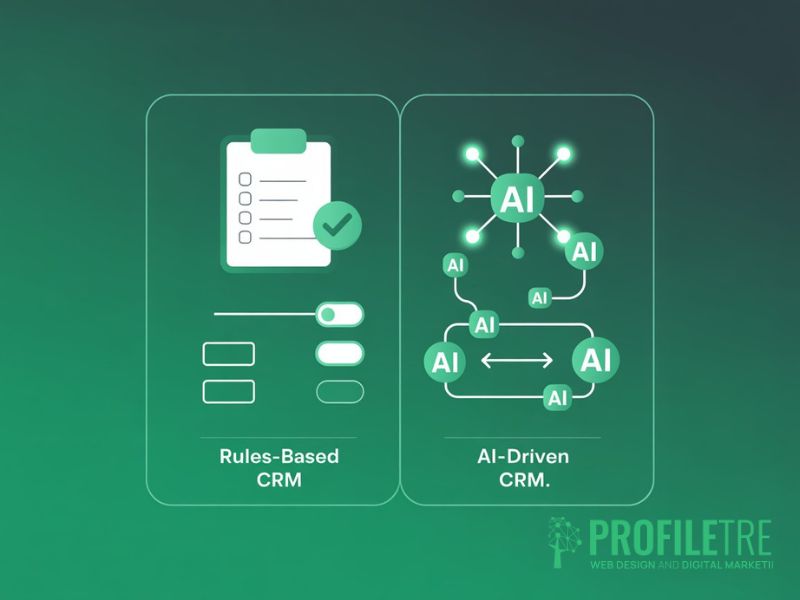
Customer relationship management tools have existed since the 1990s. The core purpose has not changed: store customer data, track interactions, and give teams a single view of the customer. What has changed is the intelligence layer underneath, and that is where AI in customer relationship management makes its mark.
Rules-Based vs AI-Driven CRM
Traditional CRM is rules-based. You define the conditions; the system executes them. Send an email when a contact downloads a resource. Assign a lead when a form is submitted. Useful, but entirely dependent on a human having written the rule in advance.
AI-driven CRM identifies patterns in your data and makes predictions based on what it finds. A rule-based system tells you what happened. An AI system tells you what is likely to happen next, and in some cases takes the next action without waiting for a human.
| Capability | Traditional CRM | AI-Augmented CRM |
|---|---|---|
| Lead scoring | Manual, rule-based | Predictive, learns from conversion history |
| Customer loyalty signals | Not tracked | Flagged from behavioural patterns and purchase history |
| Onboarding personalisation | Same sequence for all | Adapted based on customer profile and behaviour |
| Support escalation | Manual triage | Sentiment-triggered automatic routing |
| Data entry | Manual input | Ambient capture from calls and emails |
The Two Layers of AI in CRM
Most AI-CRM functionality operates at one of two levels. The first is machine learning: algorithms trained on historical data that improve over time. Lead scoring, churn prediction, and loyalty risk flags are all machine learning applications. The second is generative AI: language models that summarise conversations and draft communications based on customer interaction context.
For most SMEs, machine learning is the practical entry point. Generative AI features are newer, more powerful, and depend heavily on the quality of data already in your system.
How AI Builds Customer Loyalty and Retention
Customer loyalty and retention represent the highest-value application of AI in customer relationship management, and the one most guides undercover. The commercial case is straightforward: retaining an existing customer costs less than acquiring a new one, and AI makes retention strategies more effective by shifting them from reactive to predictive.
Predicting Churn Before It Happens
Churn prediction is among the most commercially proven AI applications in CRM. By analysing patterns in customer behaviour (declining purchase frequency, reduced email engagement, longer support response times, changes in product usage), AI models assign a churn risk score to each account. Businesses can then intervene before the customer has decided to leave.
A customer whose order frequency has dropped by 40% over the past 90 days and who has not opened the last three marketing emails looks very different from a customer who bought last week. A rule-based system treats both identically unless a human spots the pattern. An AI-powered CRM automatically flags the first customer for a targeted retention intervention.
For SMEs running lean account management teams, this changes the economics of customer retention. Instead of reviewing the entire customer base manually each month, the team focuses its attention on the accounts the model has identified as at risk. ProfileTree’s work on AI implementation for SMEs consistently finds churn prediction to be among the fastest to deliver measurable ROI, typically within the first quarter of deployment.
AI-Driven Loyalty Programmes
Traditional loyalty programmes offer the same rewards to every customer regardless of their behaviour, preferences, or value to the business. AI changes this by enabling genuinely personalised loyalty strategies at scale.
An AI-powered CRM identifies which customers respond to discount incentives, which prefer early access or exclusive content, and which are motivated by recognition. It serves each customer the loyalty reward most likely to reinforce engagement, rather than applying a blanket offer that works well for some and nothing for others.
This level of personalisation was previously only viable for large enterprises. Mid-market CRM platforms now make it accessible to SMEs, though the prerequisite is clean and complete customer data. Loyalty personalisation based on a patchy purchase history yields poor results regardless of the model’s sophistication. For a deeper look, ProfileTree’s guide to customer loyalty strategic initiatives covers the underlying frameworks.
Customer Lifetime Value Modelling
AI-powered customer lifetime value (CLV) modelling gives businesses a forward-looking view of each customer relationship’s likely revenue contribution, factoring in recency, frequency, purchase diversity, and referral behaviour. The practical value for SMEs is prioritisation: concentrate retention investment on the segments with the highest predicted CLV rather than treating all customers equally when resources are constrained.
AI in Customer Onboarding and Engagement
The impact of AI on customer relationship management is particularly visible in the onboarding phase, where the difference between a customer who becomes a loyal advocate and one who churns within 90 days is often decided. AI makes personalised onboarding achievable at scale for businesses that cannot staff a dedicated onboarding team for every new customer.
Personalised Onboarding Sequences
Generic onboarding sequences treat every new customer identically, regardless of how they engaged before purchase. AI-driven onboarding adapts the sequence based on what the customer actually does: which features they use, which emails they open, and where they slow down or disengage.
A customer who completes setup immediately and uses three features in their first week needs a different experience from one who has not logged in since signing up. An AI-powered CRM identifies the disengaged customer early, triggers a targeted re-engagement sequence, and routes them to a human if automation does not shift their behaviour.
ProfileTree’s dedicated guide to integrating AI in the onboarding process covers platform selection and implementation steps for SMEs working through this for the first time.
Engagement Scoring and Intervention Triggers
Customer engagement scoring applies lead scoring logic to the post-purchase relationship. An AI model tracks meaningful customer interactions, assigns an engagement score, and flags accounts whose scores are declining before they reach a critical threshold.
The triggers are configured to match your business model. For a SaaS product, declining feature usage and skipped renewal reminders are key signals. For a professional services firm, reduced email open rates and slower response times to check-ins indicate disengagement. The AI identifies patterns in your specific data that have historically predicted disengagement and weights them accordingly.
AI and Customer Engagement Strategies
Effective customer engagement strategies depend on reaching customers with the right message at the right moment. AI improves both the targeting and the timing.
On targeting, AI segments customers far more granularly than manual approaches. Rather than grouping by broad demographics or purchase tiers, it identifies microsegments with shared behavioural characteristics. A message tailored to a customer’s actual usage patterns generates higher engagement than a generic quarterly newsletter.
On timing, AI analyses when individual customers typically engage with communications and optimises send times. This consistently improves open rates without changing the content. Combined with personalised content, the compounding effect on engagement is meaningful.
AI-Powered Support: Automation, Sentiment and Escalation
Customer support is where the impact of AI on customer relationship management becomes most visible to customers. Handled well, AI improves response times, resolves routine queries without human involvement, and routes complex issues faster. Handled poorly, it produces the robotic, frustrating interactions that damage the relationship it was meant to strengthen.
Chatbots and AI Assistants
The gap between a basic FAQ chatbot and a well-configured AI assistant is considerable. A basic bot matches keywords to pre-written answers. An AI assistant trained on your product documentation, CRM data, and support ticket history can understand context, handle multi-turn conversations, and resolve a genuine proportion of tier-one queries without escalation.
For SMEs, the business case is strongest where support volume is high, and queries are predictable: e-commerce order tracking, appointment booking, account management queries, and standard troubleshooting. In these contexts, a well-configured AI assistant handles a significant share of inbound contacts at a fraction of the cost of additional headcount. ProfileTree’s guide to implementing AI chatbots for SMEs covers the configuration and integration requirements in detail.
Sentiment Analysis in Customer Interactions
AI-powered sentiment analysis monitors customer communications (support tickets, emails, chat transcripts, and review responses) and identifies emotional tone in real time. A neutral conversation that becomes increasingly frustrated triggers an alert before the customer reaches the boiling point.
The commercial value is in early intervention. A customer who receives proactive outreach acknowledging a frustrating experience is more likely to remain than one who escalates to a formal complaint. Sentiment analysis makes early intervention scalable in a way that manual review never can.
Sentiment analysis also generates aggregate insight. Patterns in negative sentiment across a product feature or service delivery stage give operations teams intelligence that individual ticket reviews would never surface.
Human-in-the-Loop: Getting Escalation Right
The most common failure mode in AI-powered customer support is poor escalation design. When an AI assistant cannot resolve a query, the handoff to a human agent matters enormously. A customer who has already explained their issue to a chatbot does not want to explain it again to a human.
Well-designed escalation passes full conversation context to the agent, provides a summary of the issue and the steps already attempted, and routes to the right person based on the query type. AI handles initial triage; the human handles resolution. This division is good service design, not a limitation.
GDPR and AI CRM: What UK and Irish Businesses Must Know
The impact of AI on customer relationship management does not exist in a regulatory vacuum. The compliance context in the UK and Ireland is more demanding than generic guidance from US-based CRM vendors suggests, and most platform documentation glosses over specifics that matter for businesses operating under UK GDPR and, for those with customers in the Republic of Ireland, the EU GDPR and EU AI Act.
Lawful Basis for AI-Driven Processing
UK GDPR requires a documented lawful basis for processing personal data, including automated AI-CRM processing. For most SME sales and marketing use cases, the relevant basis is legitimate interests or consent. Automated decision-making with significant effects on individuals requires explicit consent or a specific legal basis under Article 22. Most SME CRM use cases do not reach this threshold, but it is worth reviewing if your AI scoring automatically excludes contacts from certain offers.
Data Residency and Third-Party Processors
When you connect a CRM to an AI feature, you are sharing customer data with a sub-processor. Your data processing agreement with the CRM vendor must cover this explicitly. For data transferred outside the UK or EU, the relevant safeguards (adequacy decisions, standard contractual clauses, or binding corporate rules) must be in place.
The ICO has issued fines to UK businesses for inadequate processor agreements, and remediation after a data breach consistently costs more than getting this right upfront. A privacy audit of existing CRM integrations is a sensible first step before adding AI features on top.
The EU AI Act and Customer Data
The EU AI Act classifies most CRM AI tools (lead scoring, recommendation engines, churn prediction) as limited risk, requiring transparency obligations rather than full conformity assessment. For businesses with EU customers, the practical implication is reviewing how AI features are disclosed. Privacy notices written before generative AI was introduced to your CRM may need updating.
Practical Steps for SMEs Adopting AI-Driven CRM
The gap between reading about the impact of AI on customer relationship management and implementing it usefully is wider than most articles acknowledge. The technology is accessible; the preparation is not automatic.
Step 1: Audit Your Data Quality
Before switching on any AI feature, assess your existing CRM data. What percentage of contact records have complete company names, industries, and deal stages? How consistently are call outcomes logged? Incomplete data produces unreliable AI outputs regardless of the platform. ProfileTree’s AI implementation support for SMEs starts with this assessment before any tooling decisions are made.
Step 2: Pick One Use Case First
Generic ambitions do not translate into measurable outcomes. Pick one use case: churn prediction, loyalty personalisation, or onboarding automation. Build it, measure it, then expand. Businesses that try to deploy every AI feature simultaneously typically implement none of them well.
Step 3: Train Your Team
AI-CRM tools shift the work rather than eliminate it. Sales reps review and edit AI-drafted emails rather than writing from scratch. Account managers act on churn alerts rather than manually reviewing the customer base. Both require new skills, not fewer. ProfileTree’s digital marketing and AI training programmes include practical modules on working alongside AI tools in customer-facing roles.
Step 4: Connect Your Website to the CRM Loop
Your website is the first touchpoint in the customer data loop. If lead-capture forms and landing pages are not passing data cleanly into your CRM with correct field mapping and consent capture, no downstream AI sophistication will compensate. ProfileTree’s web design and development services include CRM integration as standard in new builds and upgrades.
Challenges and Limitations of AI in CRM
AI in customer relationship management is not a universal solution. Understanding where it falls short matters as much as knowing what it delivers.
The Cons of AI in CRM
The most common failure mode is deploying AI features on top of poor data. Predictive scoring on incomplete records produces unreliable outputs. Loyalty personalisation based on patchy purchase history results in irrelevant offers. Sentiment analysis calibrated on formal English can misread informal communication styles common in Northern Ireland and Ireland.
Cost is a real constraint at the micro-business scale. Enterprise AI-CRM features from Salesforce and Microsoft Dynamics are not viable for businesses with fewer than 15-20 users. HubSpot and Zoho both offer AI features in free and lower-tier plans, making the entry point accessible, though free-tier AI is limited to basic automation rather than predictive and generative features.
Over-automation is a third risk. Customers notice when interactions feel mechanised. AI should support human relationships, not replace them.
Addressing Bias in AI-CRM
AI systems encode the patterns in historical data, including their biases. If your conversion data is dominated by a narrow customer type or geography, the model deprioritises leads outside that pattern. Regular audits that check which segments are systematically scored low and whether that reflects commercial reality or historical bias are good practice rather than optional.
Conclusion
The impact of AI on customer relationship management is most significant not in the headline features vendors promote, but in the underlying shift from reactive to predictive. Businesses that use AI to anticipate churn, personalise loyalty programmes, and adapt onboarding sequences to individual behaviour are building customer relationships that are demonstrably more durable than those managed through traditional CRM alone.
For SMEs across the UK and Ireland, the path starts with data quality, not platform selection. Get the foundations right, pick one use case, measure it, and build from there. If you would like support, from AI implementation strategy to team training, ProfileTree works with businesses across Northern Ireland, Ireland, and the UK.
FAQs
1. How does AI impact customer relationship management?
AI shifts CRM from a record-keeping tool to a decision-support platform. The impact is most visible in four areas: predicting and preventing customer churn, personalising loyalty and engagement strategies, automating and improving onboarding sequences, and resolving support interactions faster and more accurately. For an SME, the practical result is that the same team can manage a larger customer base more attentively, because AI surfaces the accounts that need attention rather than leaving the team to find them manually.
2. What are the cons of AI in CRM?
The main limitations are data dependency, cost at smaller scales, and over-automation risk. AI features produce poor results on incomplete data, which is the starting position for many SMEs. Enterprise AI-CRM from Salesforce or Dynamics is prohibitive below 15 to 20 users, though HubSpot and Zoho have made entry-level AI accessible. Over-automation, where every customer interaction becomes a templated AI response, damages the relationship quality that CRM is supposed to protect.
3. Is AI in CRM compliant with UK GDPR?
AI-CRM can be compliant with UK GDPR, but compliance is not automatic. You need a documented lawful basis for the automated processing of your AI features, data processing agreements with every vendor whose tools access customer data, and updated privacy notices that accurately describe how AI is used. For most SME sales and marketing use cases, the compliance requirements are manageable, but they require deliberate review rather than assuming the platform vendor has handled it on your behalf.
4. Can AI in CRM replace account managers or sales reps?
No. AI in CRM replaces tasks, not roles. Data entry, email drafting, lead prioritisation, and churn flagging are handled efficiently by AI. Complex negotiations, long-term account relationships, and understanding a customer’s situation are not tasks AI can reliably replicate. What shifts is the ratio of administrative to relationship work: a rep supported by well-configured AI-CRM spends more time on high-value conversations.
5. How does AI improve customer loyalty and retention?
AI improves loyalty and retention by making intervention proactive rather than reactive. Churn prediction models identify at-risk customers before they leave, giving businesses a window to act. Loyalty personalisation engines identify what each customer segment responds to, so reward programmes reinforce the behaviours that matter rather than applying blanket discounts. Customer lifetime value modelling helps businesses prioritise retention investment toward the accounts with the highest long-term value.