
Local SEO Audit: How to Perform & What to Check
Table of Contents
A local SEO audit is a structured review of every signal that determines whether your business appears when someone nearby searches for what you sell. It covers your Google Business Profile, your website’s on-page signals, your citation consistency across directories, your backlink profile, and your technical performance. Done properly, it tells you exactly why you are or are not appearing in local search results — and what to fix first.
For SMEs in Northern Ireland, Ireland, and the UK, local search is where buying decisions get made. Someone in Belfast searching for a plumber, an accountant, or a web designer is not browsing for information. They are choosing. Getting your local SEO right means being present at that moment; getting it wrong means handing that customer to a competitor.
This guide walks through each phase of a local SEO audit in the order that matters, with practical guidance on what to check, what tools to use, and when it makes sense to bring in professional help.
What Is a Local SEO Audit and Why Does It Matter
A local SEO audit differs from a standard technical SEO audit in one important way: it focuses on geographic relevance. Standard SEO asks whether Google can find and rank your content. Local SEO asks whether Google can connect your business to searchers in a specific location.
The two processes overlap — both involve on-page analysis, technical checks, and link review — but local SEO introduces a layer of signals that purely informational content never has to worry about: your GBP listing, NAP consistency across directories, proximity data, and the trust signals that come from local citations and reviews.
For a business serving Belfast, Derry, Dublin, or anywhere else in the UK and Ireland, this distinction is critical. You are not competing to rank nationally for generic terms. You are competing to appear in the local three-pack for specific service queries in a defined area. The audit process reflects that.
“When we audit a new client’s local presence, the most common finding is a disconnect between what their website says about their business and what their Google Business Profile or directory listings say,” says Ciaran Connolly, founder of ProfileTree. “Google needs consistency to trust a business enough to recommend it. Even small discrepancies — a different phone number on Yell versus the website, or an outdated service area on the GBP — can undermine rankings that should be straightforward to hold.”
Phase 1: Google Business Profile Audit
Your Google Business Profile (GBP) is the single most influential factor in local search. It determines whether your business appears in Google Maps results and in the three-pack that sits above organic listings for local queries. Auditing is the logical starting point.
Primary Category and Service Area
Your primary category is the signal Google uses to match your business to relevant searches. It should reflect your core service precisely, not a broad parent category. A web design agency in Belfast should select “web design company,” not “internet marketing service” or “software company.” Secondary categories can capture adjacent services, but the primary category carries the most weight.
Service area settings matter particularly for businesses that travel to clients rather than operate from a fixed shopfront. If you serve Northern Ireland broadly but your GBP lists only Belfast, you are invisible in searches from Derry, Newry, or Antrim unless proximity is very close. Review your service area against where your actual clients are based.
Profile Completeness
Work through every field: business description (750 characters, keyword-relevant, written for a reader not an algorithm), opening hours including special hours for bank holidays, website URL, phone number, and all applicable attributes. The attributes section — which includes options like “online appointments,” “LGBTQ+ friendly,” “women-led” — signals relevance for filtered searches that competitors often ignore.
Photo and video content is underused by most SMEs. Businesses with photos receive significantly more direction requests and website clicks than those without, according to Google’s own published data. Add photos of your premises, team, and work. Update them periodically; stale profiles signal neglect.
Spam and Duplicate Listing Checks
Search for your business name and category in Google Maps. Look for duplicate listings — either old entries from a previous address, or listings created by spam competitors using your category and location. Duplicate GBPs dilute your authority and can cause ranking instability. Report them through the GBP dashboard or the Business Redressal Complaint Form.
Phase 2: UK and Ireland Citation Audit
A citation is any mention of your business name, address, and phone number (NAP) online. Citations help Google verify that your business is real, established, and located where you say it is. Inconsistency across citations — even minor variations like “St” versus “Street” — creates uncertainty that suppresses local rankings.
The UK and Ireland Directory Ecosystem
US-focused SEO guides treat Yelp as the primary citation source. In the UK and Ireland, it carries little weight. The directories that matter here are different.
For UK businesses, the core tier includes Yell.com, Thomson Local, Scoot, 192.com, and Bing Places. Apple Maps (managed through Apple Business Connect) is becoming increasingly important as iPhone users rely on It rather than Google Maps for navigation. For Irish businesses, Golden Pages remains relevant, alongside Yelp Ireland and local chamber directories.
Beyond the general directories, sector-specific listings often carry more authority than general ones. A solicitor’s firm should be on the Law Society of Northern Ireland’s directory. A hospitality business benefits from VisitBelfast or Tourism Ireland listings. A contractor should appear on Checkatrade or Rated People. These sector citations signal topical relevance, not just geographic presence.
| Directory | Relevant For | UK/Ireland |
|---|---|---|
| Yell.com | All sectors | UK |
| Thomson Local | All sectors | UK |
| Scoot | All sectors | UK |
| Apple Business Connect | All sectors | UK & IE |
| Bing Places | All sectors | UK & IE |
| Golden Pages | All sectors | IE |
| Google Business Profile | All sectors | UK & IE |
| Checkatrade | Trades | UK |
| Law Society directory | Legal | NI/IE |
| Tourism Ireland | Hospitality | IE |
NAP Consistency Check
Pull your business name, address, and phone number from five to ten directories and compare them against your website and GBP. Look for: abbreviations (Ltd vs Limited), phone number format differences (028 vs +44 28), address formatting inconsistencies, and old trading names still appearing on legacy listings. Use BrightLocal’s Citation Tracker or Whitespark’s Citation Finder to do this at scale if you have multiple locations.
For businesses in Northern Ireland, the postcode matters. Northern Ireland postcodes follow the BT format, and Google’s proximity algorithm uses postcode clusters to determine relevance. An address listed with an incorrect or incomplete postcode, or one that differs across listings, creates a verification problem that proximity advantage cannot overcome.
Phase 3: On-Page Local SEO Audit
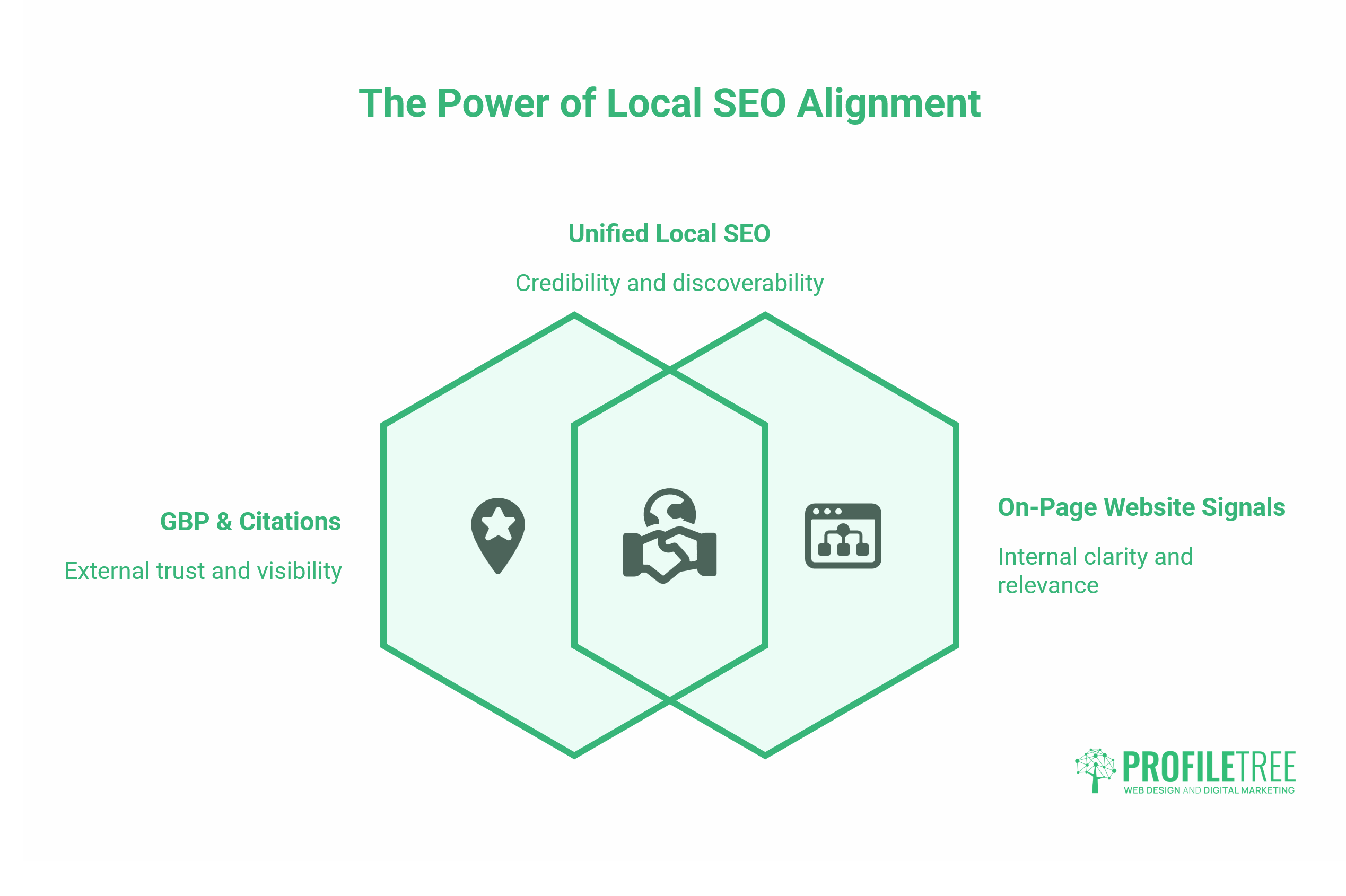
Your GBP and citations build trust externally. Your website’s on-page signals tell Google what you do and where you do it. Both need to align.
Location Pages and Service Pages
If you serve multiple towns or counties, you need location-specific pages — not template pages with swapped city names, but pages with genuine local content: local client context, area-specific service details, relevant local references. Google has become increasingly effective at identifying thin location pages that offer no real value to a local reader.
For a single-location business, your homepage, service pages, and contact page should all carry consistent location signals: the city or town name in your H1 and body copy, your full address in the footer, and a local phone number (not an 0800 or 0845 number, which signals national rather than local presence).
Title Tags, Meta Descriptions, and H1S
Each page targeting local intent should include a location modifier in the title tag. Web Design Belfast” outperforms “Web Design Services” for local searches, even if both pages are technically about the same thing. Keep title tags under 60 characters and front-load the primary keyword.
Run your main pages through a crawler like Screaming Frog to check for duplicate title tags, missing meta descriptions, and pages without H1 tags. These are common audit findings on SME websites, particularly those built on older WordPress themes or by developers who did not prioritise SEO configuration.
LocalBusiness Schema Markup
Schema markup is structured data — code in your website’s header that tells search engines what type of business you are, where you are located, and what you offer. It does not guarantee rankings, but it reduces ambiguity for crawlers and supports the knowledge panel and rich results that increase click-through rates.
For a local business, the minimum viable schema includes: business name, address (PostalAddress with region and postcode), phone number, opening hours, and geo-coordinates. Service businesses should add the areaServed field with the regions they cover.
Use Google’s Rich Results Test to check whether your schema is valid and properly structured. Errors in schema — mismatched data between the markup and what appears on the page — can actively suppress rich result eligibility.
ProfileTree’s web development team builds schema markup into every site we launch, including LocalBusiness, Service, and FAQPage schema where relevant. For businesses whose current sites are missing this layer, it is one of the fastest technical fixes with a direct local SEO payoff.
Phase 4: Review Audit
Reviews directly influence local rankings and conversion rates even more significantly. The audit here has two parts: the data picture and the operational picture.
Review Velocity and Sentiment
Review velocity — the rate at which new reviews arrive — matters as much as total count. A business with 200 reviews accumulated over five years and no new reviews in the past six months looks stale compared to a competitor with 80 reviews and three new ones this month. Google’s local algorithm favours active, current signals.
Check your review profile across platforms: Google, Facebook, and Trustpilot are the most relevant for most UK and Irish SMEs. Note the ratio of positive to negative reviews, whether negative reviews have responses, and whether review content mentions specific services or locations (keyword-rich reviews can reinforce your local relevance signals).
Review Response Strategy
Responding to all reviews — positive and negative — signals engagement to both Google and prospective customers. For negative reviews, a professional, non-defensive response often converts a poor impression into a demonstration of customer care. The absence of any response to negative reviews is a consistent red flag that prospective customers notice.
Phase 5: The AI Search and LLM Audit
This is the section most guides do not cover. AI-powered search — including Google’s AI Overviews, Perplexity, and ChatGPT Search — is now a real source of local discovery, and the signals these systems use are distinct from traditional Google Maps ranking factors.
How AI Search Surfaces Local Businesses
AI search engines draw on structured web data, citation signals, and what might be called “entity completeness” — the degree to which a business is consistently described across multiple sources. When Perplexity or ChatGPT answers “what’s the best web design agency in Belfast,” it is synthesising information from your website, your GBP description, third-party mentions, and review content. If your entity data is inconsistent or incomplete, you get omitted.
The practical audit question is: if you search for your business category and city in an AI tool, does your business appear? If competitors appear and you do not, work through the following:
Check that your business description (on GBP, your website’s About page, and directory listings) contains clear, factual statements connecting your business name, location, and service category. “ProfileTree is a web design and digital marketing agency based in Belfast, Northern Ireland” is the kind of statement AI systems extract and cite. Vague descriptions without this structure are harder for AI to index as entity data.
Check whether your website has been cited by any third-party sites — press coverage, directory listings, chamber of commerce pages, blog mentions. AI systems weigh these co-citations when building their understanding of local business entities.
Auditing for AI Overview: Eligibility
AI Overviews on Google (the AI-generated summaries at the top of search results) are triggered more reliably by pages that use clear answer-first formatting, cover multiple sub-questions within a topic, and include structured data. For a local business, this means your FAQ pages, service description pages, and location pages should be structured so each section begins with a direct answer to a likely question.
ProfileTree’s AI implementation and training specifically address how businesses can position their digital presence for AI discovery — an area where most established businesses are currently underinvested.
Phase 6: Local Backlink Profile Audit
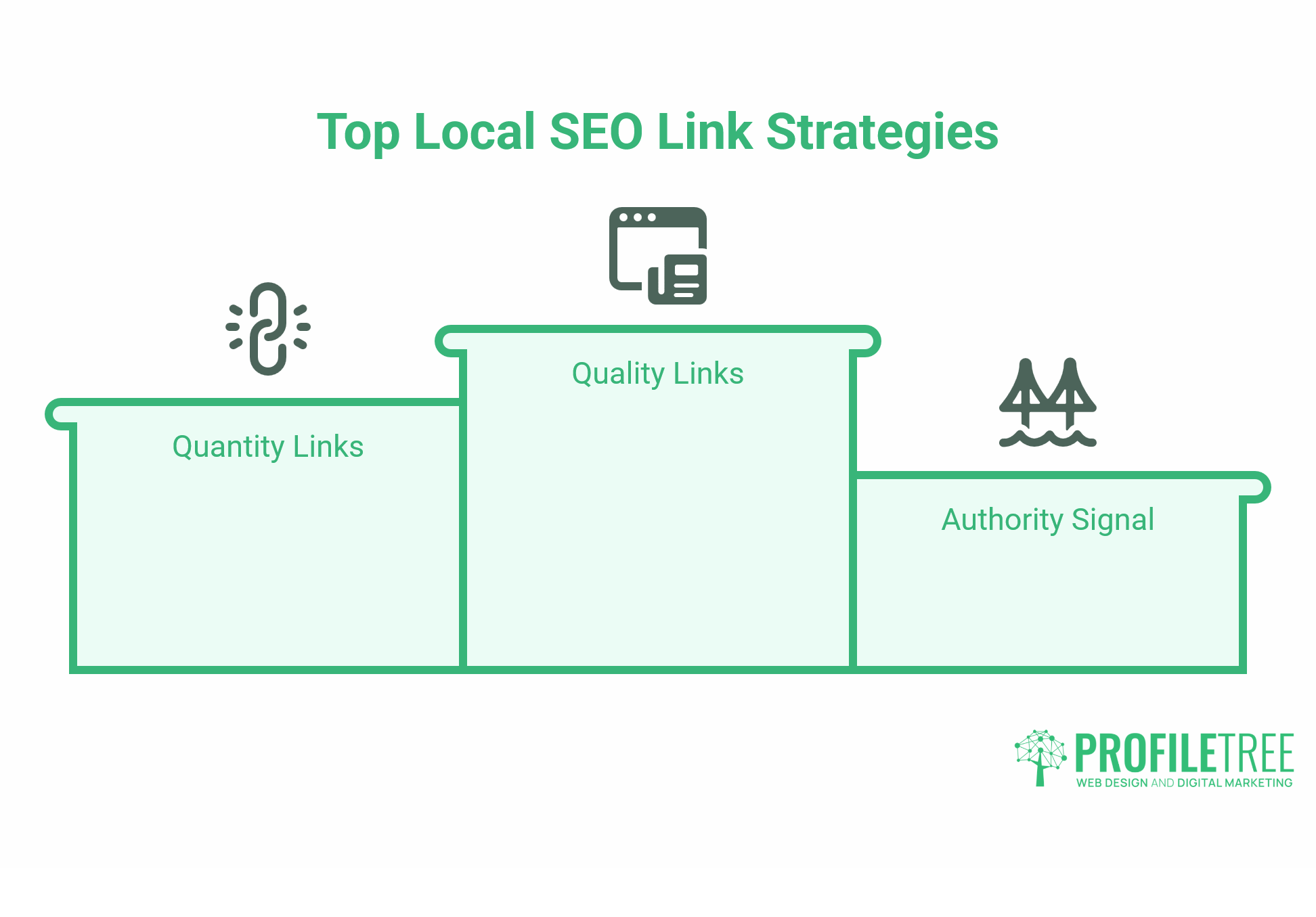
Links remain a significant authority signal, and in local SEO, quality matters more than quantity. A single link from a relevant local publication or industry body is worth more than dozens of links from low-authority directories.
Auditing Your Current Link Profile
Use Google Search Console’s Links report to see which external sites are linking to yours. Look for: local business associations (Chamber of Commerce, NI Chamber, Chambers Ireland), local press (Belfast Telegraph, Irish News, regional news sites), industry bodies (relevant trade associations), and local event or sponsorship pages.
Then look at what is missing. If your main competitor has links from six local press sites and you have none, that gap is addressable through PR and community involvement — sponsoring a local event, contributing commentary to a journalist, or getting involved in a local business network.
Links from irrelevant, low-quality, or spammy sources can actively damage rankings. If Search Console shows links from content farms or link exchanges, flag these for disavowal.
Hyper-Local Link Opportunities
For businesses in Northern Ireland, Ireland, and the UK, hyper-local link sources are often overlooked: local school or charity websites, town twinning pages, council business directories, local sports club sponsor pages, and event listings from local community organisations. These carry domain authority well below the major press outlets, but they provide geographically specific context that national links cannot replicate.
Phase 7: Technical and Website Audit
The final audit phase covers technical signals that affect both local and general search performance.
Website Speed and Core Web Vitals
Page speed directly affects ranking, particularly on mobile. Use Google’s PageSpeed Insights to test your homepage and your most important service or location pages. The Core Web Vitals thresholds — Largest Contentful Paint under 2.5 seconds, Cumulative Layout Shift under 0.1, Interaction to Next Paint under 200ms — are the benchmarks Google uses to assess page experience.
SME websites built on outdated themes or hosting infrastructure frequently fail these tests. Common causes include unoptimised images, excessive plugins, shared hosting with inadequate resource allocation, and unminified CSS and JavaScript. ProfileTree’s web development team regularly inherits sites where speed issues are suppressing rankings that would otherwise be competitive — fixing them is often a faster win than additional content work.
Mobile Optimisation
Local searches are disproportionately mobile. Someone searching for a restaurant, a plumber, or a dentist is usually on their phone. Your site must be fully functional on mobile, with clickable phone numbers, accessible navigation, and no elements that require a desktop screen to interpret. Test your site on a physical device, not just a browser’s responsive preview mode.
Crawlability and Indexation
Verify in Google Search Console that your key pages are indexed. Blocked pages, noindex tags added by mistake, or crawl errors can silently remove pages from local results without any obvious signal. Check the Coverage report in Search Console and address any issues flagged there.
Local SEO Audit Tools
| Tool | Primary Use | Free/Paid |
|---|---|---|
| Google Search Console | Keyword data, coverage, links | Free |
| Google Business Profile dashboard | GBP management and insights | Free |
| Google PageSpeed Insights | Core Web Vitals, speed | Free |
| Google Rich Results Test | Schema validation | Free |
| Screaming Frog SEO Spider | On-page crawl and technical audit | Free (up to 500 URLs) / Paid |
| BrightLocal | Citation tracking, local rank tracking | Paid |
| Whitespark | Citation finder, local SEO tools | Paid |
| Ahrefs / SEMrush | Backlink analysis, competitor research | Paid |
For most SMEs running their first audit, Google Search Console, Google’s own free tools, and a free Screaming Frog crawl cover the essential checks. Paid tools become valuable when you are managing multiple locations, tracking rank changes over time, or doing competitive citation analysis.
How ProfileTree Approaches Local SEO Audits
ProfileTree’s SEO services include full local SEO audits for SMEs across Northern Ireland, Ireland, and the UK. In practice, what we find most consistently is that the businesses struggling with local rankings are not failing on any single factor — they have a cluster of small issues across GBP, citations, on-page signals, and schema that, taken together, push them below the threshold for local three-pack visibility.
The audit process is the diagnostic. The value comes from prioritising the fixes correctly. A business with incomplete GBP and inconsistent NAP data needs to fix those issues before investing in content or link building. A business with solid citations and a well-configured GBP but a slow, poorly structured website needs technical development work. The audit tells you which lever to pull.
Our SEO services for businesses in Northern Ireland and the UK cover both the audit and the implementation — and for SME owners who want to build the capability to manage this in-house, our digital training programmes cover local SEO as part of a broader practical curriculum.
How to Perform a Local SEO Audit: Summary Checklist
Google Business Profile
- Primary category correctly set
- Service area accurately defined
- All fields are complete, including attributes and description
- Photos and videos present and recent
- No duplicate listings
- Reviews were responded to across all platforms
Citations
- NAP consistent across Yell, Thomson Local, Scoot, Apple Maps, Bing Places
- Sector-specific directories covered
- Irish businesses: Golden Pages and relevant Irish directories checked
- No old addresses or trading names on legacy listings
On-Page Signals
- Location modifiers in title tags and H1S
- Dedicated location pages are serving multiple areas
- Full address and local phone number in the footer
- LocalBusiness schema markup validated
Reviews
- Minimum review count is competitive with local three-pack occupants
- Recent review velocity maintained
- Negative reviews with professional responses
AI Search
- Business entity clearly described in GBP and on-page with name, location, and service type
- Third-party citations are present for AI systems to reference
Technical
- Core Web Vitals passing on mobile
- Key pages indexed in Search Console
- No crawl errors on service and location pages
Backlinks
- Local and industry-relevant links present
- No toxic or spammy links identified
Conclusion
A local SEO audit is not a one-off task. The businesses that maintain strong local rankings treat it as a recurring discipline — checking GBP accuracy, monitoring citation consistency, and reviewing technical performance regularly, rather than reacting only when rankings drop.
For SMEs in Northern Ireland, Ireland, and the UK, the framework here gives you a clear order of priority: start with your Google Business Profile and NAP consistency, get your schema in place, and build from there. If you would prefer a professional audit, ProfileTree’s SEO services across Northern Ireland and the UK include a full local audit with a prioritised action plan. If you want to build this capability in-house, our digital training programmes cover local SEO as part of a practical, hands-on curriculum.
FAQs
How do I perform a local SEO audit?
Start with your Google Business Profile, then check NAP consistency across UK directories, review your on-page location signals, validate your schema markup, and assess your local backlink profile. Google’s free tools cover most of the essential checks.
What should be included in a local SEO audit?
Six areas: Google Business Profile, citation and NAP consistency, on-page local signals, review profile and velocity, technical performance, and your local backlink profile. For businesses focused on AI search visibility, add an entity audit as a seventh phase.
How much does a local SEO audit cost in the UK?
A self-conducted audit costs nothing but time — typically 4 to 6 hours per location. A professional audit from a UK or Irish agency typically ranges from £500 to £2,500, depending on scope.
What is the difference between a standard SEO audit and a local SEO audit?
A standard SEO audit focuses on crawlability, site architecture, and keyword targeting. A local SEO audit adds the geographic layer: GBP configuration, NAP consistency, local citation authority, and the review signals Google uses for three-pack rankings.