
B2B Website Design: Strategy, Conversion and UK Compliance
Table of Contents
A B2B website does a fundamentally different job from a B2C one. It has to satisfy procurement managers, technical leads, and financial decision-makers, often simultaneously, while generating qualified leads from buyers who may take months to convert. Getting the design wrong does not just lose a sale; it removes your business from the shortlist entirely.
Most guidance on B2B website design focuses on aesthetics or generic “best practices” drawn from US markets. This guide takes a different approach. It covers the structural, technical, and compliance considerations that matter specifically to UK and Irish businesses: longer procurement cycles, GDPR-compliant lead capture, CRM integration, and the trust signals that conservative B2B buyers actually respond to.
The sections below work through the core differences between B2B and B2C design, the ten pillars of a high-performing B2B site, how to design for UK compliance, the technical engine behind effective lead generation, and how to manage a redesign with multiple stakeholders involved.
Why B2B Website Design Differs from B2C
The distinction between B2B and B2C design goes well beyond tone or content style. The entire decision-making architecture is different, and the website must reflect that. A B2C site is built around impulse and emotion; a B2B site is built around justification and process. Understanding where that divergence matters most is the starting point for any redesign brief.
The Complex Buyer Journey
B2C purchases are typically made by one person in a matter of minutes. B2B purchases involve an average of 6.8 stakeholders according to research from Gartner, and the buying cycle can run from three months to well over a year for high-value contracts. Each of those stakeholders has a different set of questions.
A procurement manager wants pricing transparency and contract terms. An IT lead wants integration specifications and security documentation. A director wants proof of ROI and evidence of credibility. The website has to address all three audiences, without always knowing which one is reading any given page at a given moment.
This is why B2B sites need multi-persona navigation, detailed content across the full buyer journey, and clear routes from awareness-stage blog content through to decision-stage contact forms. A well-structured digital strategy maps those routes before a single page is designed.
Calls to Action: Measured, Not Impulsive
B2C calls to action are designed to reduce friction at the point of purchase. Flash sales, countdown timers, and one-click checkouts all serve that goal. B2B calls to action serve a completely different purpose: they initiate a relationship, not a transaction.
Effective B2B CTAs at the awareness stage might invite visitors to download a technical guide or read a case study. At the consideration stage, they invite a scoping call or a product demonstration. At the decision stage, they facilitate a formal proposal request. A single “Contact Us” button at the bottom of every page treats all three of those different states identically, which is why conversion rates on poorly designed B2B sites tend to be low.
Content Tone and Depth
B2C content uses emotive language to create aspiration and connection. B2B content has to make a rational business case. The tone is direct and factual, the language is commercial, and the depth of information needs to match what a senior buyer would expect before approving significant expenditure.
This affects every element of the page: the homepage hero must state what you do and for whom within five seconds; service pages need to explain process, deliverables, and timelines rather than just benefits; and case studies need measurable outcomes, not vague testimonials. Investing properly in content marketing at this level separates sites that generate genuine leads from those that simply exist.
| Element | B2B Design Requirement | B2C Design Requirement |
|---|---|---|
| Decision-making unit | Multiple stakeholders (6.8 average) | Individual consumer |
| Sales cycle | 3 to 18 months | Minutes to days |
| Primary CTA | Book a consultation / Request a proposal | Buy now / Add to basket |
| Content depth | Technical specifications, ROI data, case studies | Product descriptions, reviews, lifestyle imagery |
| Trust signals | Accreditations, client logos, compliance documentation | Star ratings, social proof, influencer endorsement |
| Navigation priority | Industry or persona-based navigation | Category and product-based navigation |
The Ten Pillars of High-Performance B2B Design
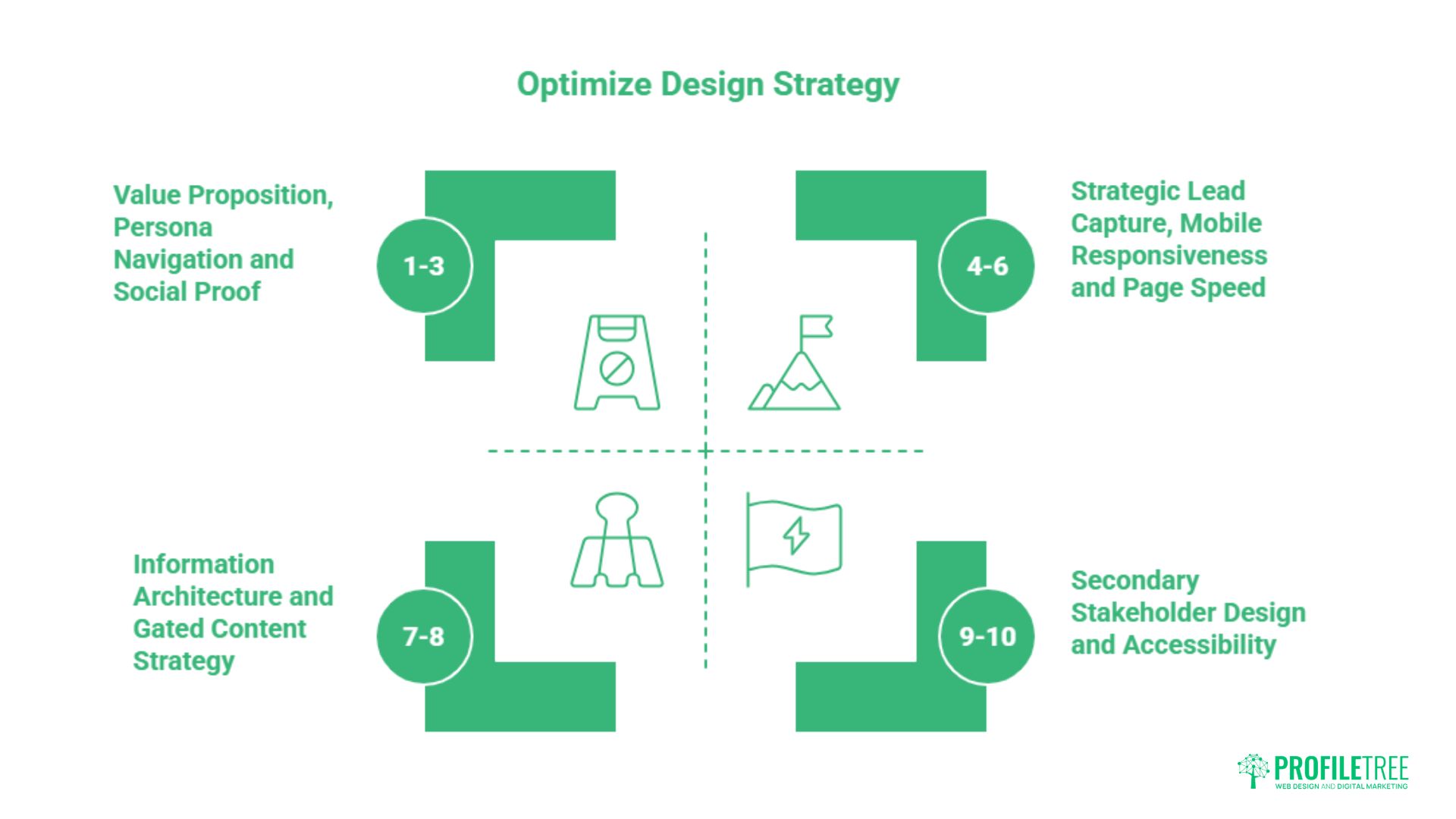
A B2B website that generates consistent leads is built on a set of interconnected principles rather than individual design choices. The ten pillars below represent the structural foundations that differentiate sites which convert from those which simply inform. Each one has direct implications for how pages are built, what content they carry, and how they perform in search.
Pillars One to Three: Value Proposition, Persona Navigation and Social Proof
The first pillar is the value proposition: the single most important element on a B2B homepage. It needs to answer three questions immediately: what does the company do, who does it do it for, and why should a buyer choose it over alternatives. If a visitor cannot answer those questions within five seconds, the site has a conversion problem regardless of how well it looks.
The second pillar is persona-based navigation. A B2B site’s menu should be structured around the buyer’s questions, not the company’s internal departments. Navigation built around audience types (“For Manufacturers,” “For Professional Services,” “For SaaS Companies”) reduces cognitive load and makes visitors feel understood from the first click. Generic service-list navigation, by contrast, forces buyers to work out where they fit.
The third pillar is social proof calibrated for B2B risk levels. Client logos, named case studies with measurable outcomes, accreditation badges, and testimonials from identifiable individuals with job titles all serve different functions. An unnamed quote attributed to “a Belfast-based manufacturer” does very little; a named case study with a company logo and a specific revenue or efficiency outcome does a great deal. Contract values and business risks are high in B2B, and social proof needs to match that weight.
Pillars Four to Six: Strategic Lead Capture, Mobile Responsiveness and Page Speed
The fourth pillar is strategic lead capture. Forms placed only on contact pages miss the majority of visitors who are still in the research phase. Gated content (technical whitepapers, sector benchmarking reports, ROI calculators) captures contact information from buyers who are actively evaluating but not yet ready to request a proposal. The placement and wording of these forms matter as much as their existence.
Long forms with unnecessary fields reduce completion rates sharply. Progressive profiling, where a visitor gives a small amount of information on first contact and more on subsequent interactions, consistently outperforms single long-form approaches for B2B lead quality.
The fifth pillar is mobile responsiveness. B2B buyers use mobile devices for initial research, even for high-value purchases, before moving to a desktop for detailed evaluation. A site that is difficult to use on mobile does not get a second chance at that audience. The sixth pillar is page speed: Google’s Core Web Vitals directly affect search rankings, and a slow-loading site signals poor technical quality to the very buyers you are trying to impress. ProfileTree builds sites to Core Web Vitals benchmarks as a standard requirement within its web development process.
Pillars Seven and Eight: Information Architecture and Gated Content Strategy
The seventh pillar is information architecture: the way content is organised and linked across a site determines whether a visitor can find what they need or gives up and leaves. For B2B, this means mapping every major content type to a stage in the buyer journey and ensuring the navigation system connects them logically.
Awareness-stage content includes sector guides, thought leadership articles, and problem-focused blog posts. Consideration-stage content includes service comparisons, detailed methodology pages, and case studies. Decision-stage content includes pricing frameworks, proposal processes, and client references. A site without clear pathways between these stages leaves buyers stranded at every phase transition.
The eighth pillar is a gated content strategy that ties into the CRM. Downloadable guides, templates, and tools that require a name and email to access build the top of the pipeline database while delivering genuine value to researchers who are not yet ready for a sales conversation. Internal linking between content types, using anchor text that signals what the linked page covers, both improves user experience and strengthens SEO performance.
Pillars Nine and Ten: Secondary Stakeholder Design and Accessibility
The ninth pillar is designing for secondary decision-makers: the Finance Director reviewing contract terms, the IT Manager assessing security specifications, or the Legal team checking compliance documentation. These people rarely fill in contact forms, but they can veto a purchase that a primary contact has already agreed in principle.
Making specific documentation findable without a phone call is the practical application of this pillar. A dedicated “Working With Us” or “Supplier Information” section that consolidates accreditations, compliance documents, and procurement terms reduces friction for buyers working within formal approval processes. Sites built with this in mind reduce the number of deals that stall at the internal sign-off stage.
The tenth pillar is accessibility. WCAG 2.1 AA compliance is increasingly a procurement requirement in its own right for UK public sector and large corporate buyers. Beyond compliance, accessible design produces cleaner code, better semantic structure, and faster pages, all of which benefit search rankings. Working through the design skills required across UX, content strategy, accessibility, and technical architecture gives a useful audit of where a current site falls short of these standards.
Designing for the UK and Irish Market: Trust and Compliance
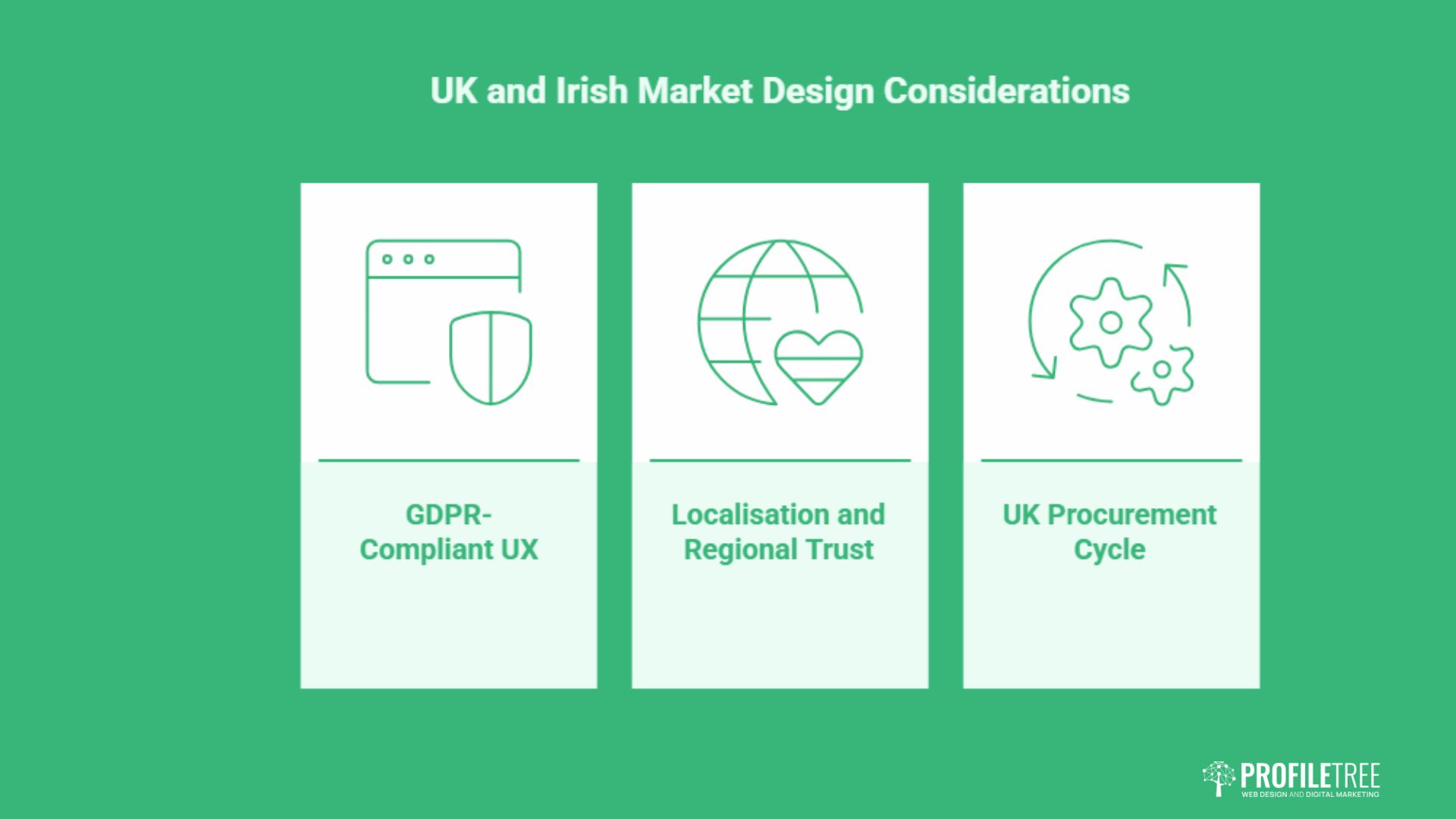
Most B2B web design guidance is written for US markets, where the regulatory environment, procurement norms, and trust signals differ substantially from those in the UK and Ireland. Building a B2B site that performs in Belfast, Dublin, or Glasgow requires a different set of design decisions, particularly around data privacy, legal credibility signals, and the more conservative trust standards of UK and Irish professional buyers.
Northern Ireland’s position, bridging UK and EU commercial relationships, makes this especially relevant. Businesses operating across both jurisdictions need websites that communicate clearly within both regulatory frameworks. For a sense of the range of industries and commercial contexts across the region, Connolly Cove’s guide to Northern Ireland’s cities gives useful context on the economic and business environment.
GDPR-Compliant UX: Beyond the Cookie Banner
GDPR compliance in B2B web design is widely misunderstood as a checkbox exercise: add a cookie banner, link to a privacy policy, and the legal obligation is met. In practice, the design implications of GDPR run much deeper and directly affect lead generation performance.
Lead capture forms must be designed with explicit, granular consent in mind. A single checkbox that bundles marketing consent with service communication consent does not satisfy ICO requirements and creates compliance exposure. Forms need separate, unticked consent options for different communication types, a clear link to the privacy policy at the point of data collection, and a documented record of what was consented to and when.
The design of these forms also affects conversion rates. Poorly worded consent language, typically copied from a legal template without thought for readability, reduces form completion. Clear, plain English explanations of what data is collected and why it is needed consistently outperform legalistic consent wording in A/B tests. ProfileTree’s detailed guide to GDPR-compliant web forms covers the specific design and legal requirements in full.
Localisation and Regional Trust Signals
UK and Irish B2B buyers respond to specific trust signals that US-focused design guides do not address. Company registration numbers, VAT numbers displayed in the footer, and professional body memberships (CIPS, ICB, ICAEW, relevant sector bodies) all contribute to the credibility assessment that procurement processes require. These are not decorative elements; they are often required fields in formal supplier evaluation processes.
Regional credibility matters too. A Belfast-based agency working with Northern Irish manufacturers needs to signal local knowledge and proximity in ways that a remote agency cannot replicate. Named team members with verifiable credentials, specific local client references (with permission), and case studies set in recognisable local contexts all perform better with local buyers than generic agency credentials.
Language and currency localisation: GBP rather than USD, UK English throughout, and references to relevant UK legislation and industry bodies all signal professionalism and attention to detail that conservative B2B buyers notice. Mixing UK and US spellings on a professional services site, for example, is a subtle credibility problem that undermines trust without buyers being fully conscious of why.
The UK Procurement Cycle and Its Design Implications
UK B2B procurement, particularly in the public sector and larger corporate organisations, operates within formal frameworks that most websites are not designed to support. Suppliers may need to provide evidence of ISO certifications, cyber essentials accreditation, public liability insurance levels, or compliance with specific industry regulations before they can even be considered.
A well-designed B2B site for the UK market makes this documentation findable without requiring a phone call. A dedicated “Working With Us” or “Supplier Information” section, linked clearly from the main navigation, that consolidates accreditations, compliance documents, and procurement terms, reduces friction for buyers working within formal approval processes.
This is particularly relevant for professional services firms, technology providers, and manufacturers working with local authorities, NHS trusts, or large corporate procurement teams. The design investment in this section of the site directly affects the number of formal tenders and RFPs a company gets invited to submit.
The Technical Engine: CRM Integration and Performance
A visually well-designed B2B website that is disconnected from the company’s CRM and marketing automation platform is an expensive brochure. The technical architecture of a B2B site (how forms connect to sales pipelines, how page speed is maintained under load, and how the site performs in search) determines whether the design investment translates into revenue. This is the area where most B2B website projects underinvest.
As Ciaran Connolly, founder of ProfileTree, notes: “The B2B sites we see generating consistent pipeline are the ones where the design and the CRM were planned together from the start. Bolting on a HubSpot integration to a site built without it in mind is always a compromise.”
CRM and Marketing Automation Integration
The design implications of CRM integration are more significant than most briefs acknowledge. When a visitor completes a contact form, the data does not simply travel to an email inbox. In a properly configured system, it triggers a sequence of events: the contact is created or updated in the CRM, lead scoring criteria are applied based on which page the form was on, a sales task is created for follow-up, and a nurture email sequence is enrolled based on the content interest that brought the visitor to the site.
For this to work, the forms themselves need to be designed with hidden fields that capture UTM parameters (which marketing campaign drove the visit), page URL (which content the lead consumed), and referral source. These fields are invisible to the visitor but critical for the sales team’s ability to have a relevant first conversation. Sites built without this in mind generate leads with no context, which reduces the quality of every sales interaction.
Salesforce, HubSpot, and Microsoft Dynamics each have specific requirements for front-end integration that affect how forms are built, how tracking scripts are loaded, and how data is structured. A development team that has not worked with these platforms before will typically build forms that work visually but fail to pass the data correctly. This is one of the most common and costly mistakes in B2B web projects.
Core Web Vitals and B2B SEO
Google’s Core Web Vitals (Largest Contentful Paint, Interaction to Next Paint, and Cumulative Layout Shift) are direct ranking factors. For B2B sites, which often carry heavier pages with detailed product specifications, case study PDFs, and embedded video content, maintaining passing Core Web Vitals scores requires deliberate technical decisions at the build stage.
Image optimisation, lazy loading for below-the-fold content, deferring non-critical JavaScript, and using a content delivery network for static assets all contribute to faster load times. A B2B site that scores poorly on Core Web Vitals loses search visibility for the commercial keywords that matter most, compounding the problem of weak organic lead generation.
The relationship between technical performance and search rankings is direct. Understanding the cost of a website that is built to these technical standards helps organisations set realistic budgets for B2B projects rather than discovering the gap between a cheap build and a performant one after launch.
AI-Enhanced Personalisation and UX
AI tools are increasingly available at the CMS level for B2B websites, enabling personalisation that was previously only possible for enterprise-scale platforms. Personalised content blocks that change based on a visitor’s industry, role, or previous behaviour on the site can significantly improve conversion rates for businesses with multiple customer segments.
Chatbots configured for B2B qualification, asking about company size, industry, and specific requirements before routing to a sales team, reduce the volume of low-quality enquiries while improving the experience for serious buyers. The key is ensuring the qualification logic matches the actual sales process rather than creating a generic chat experience that frustrates buyers who know what they want. ProfileTree’s work on AI-enhanced UX covers the practical implementation of these tools in detail.
Managing a B2B Redesign: A Stakeholder Framework
B2B website redesigns fail more often than they should, not because of design or technical shortcomings but because of governance problems. Multiple internal stakeholders with competing priorities, unclear decision-making authority, and a scope that expands without corresponding budget or timeline adjustments are the three most common causes of projects that overrun, underdeliver, or both. A structured stakeholder framework before the build begins prevents most of these problems.
Defining Roles and Decision Rights
A B2B redesign typically involves input from marketing, sales, IT, compliance, and senior leadership, each with legitimate interests in the outcome. Without a defined RACI (Responsible, Accountable, Consulted, Informed) structure, every stakeholder becomes a decision-maker, and projects stall at the point of any disagreement.
The marketing lead should own the content strategy and user journey design. IT or development should own technical specifications and integrations. Senior leadership should approve the budget and strategic direction, but not design details. Sales should provide input on the questions prospects ask and the content gaps that cost them deals, but should not drive design decisions. Compliance and legal should review data collection forms and privacy documentation, not page layouts.
Getting these roles defined in writing before the agency relationship begins means that feedback cycles are structured, revision requests go through the right channel, and the agency is not managing competing instructions from different stakeholders simultaneously. ProfileTree’s digital marketing services work includes project governance support for larger redesign programmes.
Discovery, Build Phases and UAT
A well-run B2B redesign follows a clear phase structure: discovery (audience research, content audit, technical audit, competitor analysis), information architecture and wireframing, visual design, development, content population, quality assurance, and user acceptance testing before launch. For a site of meaningful complexity, this typically takes between three and six months.
User acceptance testing (UAT) is the phase most often compressed when projects run late. It is also the phase where the most consequential problems are found: forms that do not connect to the CRM correctly, tracking scripts that fire on the wrong pages, navigation paths that break on mobile, and content that has not been proofread at the production URL. Compressing UAT to meet a launch deadline that was never realistic in the first place typically results in a site launch that requires immediate fixes.
Post-Launch Measurement and Iteration
A B2B website is not a finished product at launch; it is a starting point. The sites that generate an increasing pipeline over time are those where there is a regular review cycle: monthly analytics review, quarterly content updates based on search performance data, and ongoing A/B testing of key conversion pages.
The metrics that matter for B2B are different from B2C. Total traffic is less important than the quality of traffic from target industries and job titles. Bounce rate matters less than time on site for visitors from high-value company domains. Form completions matter less than the conversion rate of those leads through the full sales pipeline.
Setting up the measurement framework correctly at launch, including GA4 with custom events for key interactions, CRM attribution for closed deals, and heat mapping on priority conversion pages, gives the data needed to make the right improvements over time. ProfileTree’s web design services include this measurement setup as part of the launch process.
Conclusion
B2B website design done well is not about aesthetics: it is about building a sales tool that works for a multi-stakeholder audience, performs in UK search, and converts visitors across a long buying cycle. The sites that consistently generate pipeline are those built on solid information architecture, technically sound CRM integration, GDPR-compliant lead capture, and a clear understanding of what UK and Irish buyers actually need before they sign a contract.
If your current B2B site is not generating the leads your business needs, get in touch with ProfileTree to discuss a redesign that addresses the full picture, not just the visual layer.
FAQs
What is the most important element of a B2B homepage?
The value proposition is the single most critical element. It must answer “what do you do, for whom, and why should I choose you” within five seconds of a visitor landing on the page. Without a clear value proposition above the fold, all other design decisions lose much of their impact. The value proposition should be supported by one primary CTA and at least one trust signal (client logo, accreditation, or proof point) visible before scrolling.
How long does a B2B website redesign take?
For a site of meaningful complexity (multiple service lines, CRM integration, and a considered content strategy), a realistic timeline is three to six months from kickoff to launch. This covers discovery and audit (two to four weeks), information architecture and wireframing (two to three weeks), visual design (two to four weeks), development and content population (six to ten weeks), and user acceptance testing before launch (two to three weeks).
What is the difference between B2B and B2C web design?
The core difference is the decision-making unit. B2C design is built for a single individual making a quick, often emotionally-driven decision. B2B design must address multiple stakeholders with different information needs, operating within a formal approval process that can take months. This affects every design decision: navigation structure, content depth, form design, trust signals, and CTA placement all need to serve a longer, more complex journey than B2C design requires.
How do I make my B2B site GDPR compliant?
GDPR compliance for B2B websites centres on three areas: consent at the point of data collection, transparency about how data is used, and the right for contacts to access, correct, or delete their data. Practically, this means using separate unticked consent checkboxes for different communication types on all lead-capture forms, linking to a plain-English privacy policy at every data-collection point, and ensuring your CRM records what was consented to and when.
Which CMS is best for B2B websites?
WordPress remains the most widely used CMS for B2B sites across the UK and Ireland for good reason: it offers the flexibility for complex information architectures, a mature ecosystem of CRM integration plugins, and strong SEO foundations when built correctly. HubSpot CMS is a strong option for businesses already running their CRM on HubSpot, as the native integration removes significant development complexity.