
Digital Marketing Packages UK: Pricing, Tiers and What to Expect
Table of Contents
Most UK businesses shopping for a digital marketing package encounter the same problem: agency websites list deliverables without explaining outcomes. You see “10 social posts per month” but no indication of what that is supposed to achieve, when results should appear, or how the package fits together as a strategy.
This guide on digital marketing packages covers what a well-structured digital marketing package actually includes, how UK pricing breaks down across growth, professional, and enterprise tiers, and what realistic results look like at months one, three, and six. It also addresses the regional considerations specific to Northern Ireland and cross-border businesses, and the red flags that separate credible agencies from those that will waste your budget.
All prices and figures in this guide are indicative UK examples and correct at the time of writing; use them as a benchmark rather than fixed quotations.
What a Standard Digital Marketing Package Should Include
Before comparing tiers or prices, it helps to understand what a properly assembled package looks like. The components are not arbitrary; each one addresses a different part of the customer journey, from the moment someone first encounters your brand through to the point they convert and return.
Search Engine Optimisation
SEO sits at the foundation of most packages because it drives compounding returns over time. A credible package will include technical auditing, on-page optimisation, keyword research, and some level of off-page activity such as link-building or digital PR. What it should not include are vague promises about “guaranteed rankings,” which are technically impossible and a signal of low standards.
For businesses in Northern Ireland and the Republic of Ireland, local SEO carries extra weight. Appearing in Google’s local pack for searches like “accountant Belfast” or “web design Derry” directly influences phone calls and enquiries. ProfileTree’s SEO services are built around that local intent, connecting technical best practice to the specific search behaviour of UK and Irish audiences.
Content Marketing
Content is the mechanism through which SEO, social media, and email all produce results. Without useful, well-written content, other channel activities lack substance. A package should specify the type of content included (blog posts, landing pages, video scripts), the publishing frequency, and who holds editorial control.
One of the more common gaps in agency packages is the absence of a content strategy. Producing articles without a clear topic cluster plan or audience intent mapping tends to generate traffic that does not convert. ProfileTree’s content marketing services are structured around that planning layer first.
Paid Media Management
Pay-per-click advertising via Google Ads or Meta is the fastest way to generate leads within a new package, often producing results within 48 to 72 hours of a campaign going live. However, there is an important financial distinction that many packages obscure: the management fee paid to the agency and the media spend paid to the platform are separate costs. Clients who do not understand this end up surprised by their total monthly outlay.
A trustworthy package makes both figures explicit. The management fee covers strategy, setup, monitoring, and reporting. The media spend is what actually funds the ads and flows directly to Google or Meta. Conflating them is a red flag.
Social Media and Email
Social media management covers content creation, scheduling, community engagement, and performance reporting across the platforms most relevant to your audience. For most UK SMEs, this means LinkedIn for B2B audiences and Instagram or Facebook for consumer-facing brands. ProfileTree’s social media marketing service is built around a platform-specific strategy rather than a one-size-fits-all content calendar.
Email marketing tends to be underutilised in smaller packages, but it consistently delivers one of the highest returns on investment of any digital channel. A package that includes email should specify list segmentation, automation workflows, and a schedule for campaign reporting. ProfileTree’s email marketing resources provide a useful reference point for what a functional email programme looks like in practice.
The Digital Marketing Package Comparison: Growth, Professional and Enterprise
Most UK agencies structure their packages across three broad tiers. The naming varies (Bronze/Silver/Gold, Starter/Pro/Enterprise), but the underlying logic is consistent: as the monthly investment increases, the scope of activity, the number of channels covered, and the level of strategic input all expand. The table below uses indicative UK pricing to help you benchmark what you should expect at each level.
| Tier | Monthly Investment (exc. VAT) | Core Deliverables | Lead Gen Focus | Ideal Business Size |
|---|---|---|---|---|
| Growth | £500 to £1,500 | SEO basics, 4 to 6 content pieces, social scheduling | Organic search, local visibility | Sole traders, micro-businesses |
| Professional | £1,500 to £3,500 | SMEs with an established trading history | Paid and organic combined | SMEs with established trading history |
| Enterprise | £3,500 to £8,000+ | Multi-channel strategy, CRO, analytics, advanced automation | Full funnel, account-based marketing | Mid-market, multi-location businesses |
Growth Packages for Startups and Small Businesses
At this tier, the primary goal is visibility. For a business that has recently launched or that has little organic presence, the first six months of a growth package are about laying technical foundations: fixing site structure, building initial content, and establishing a presence in local search results. Paid media at this level is typically limited to a modest Google Ads budget targeting a tight geographic area or a single product line.
One of the most common mistakes in the growth tier is expecting lead volume too quickly. Organic results from SEO take four to six months to materialise meaningfully. PPC can generate enquiries faster, but at a lower budget; the targeting options are narrower, and cost-per-click in competitive sectors can limit reach significantly.
Professional Packages for Scaling Businesses
The professional tier is where most established UK SMEs operate. At this level, a package should span at least three active channels simultaneously, with each channel’s activity feeding the others. Blog content, for example, should support organic rankings while also providing material for social media and email newsletters, rather than sitting in isolation.
Ciaran Connolly, founder of ProfileTree, puts it plainly: “The businesses that see the best returns from agency packages are the ones that treat digital marketing as an interconnected system rather than a menu of separate services. When SEO, content, and paid media are pulling in the same direction, the results compound.”
At this tier, reporting should move beyond vanity metrics. Monthly traffic figures are useful context, but the metrics that matter are cost per acquisition, conversion rate by channel, and organic revenue attribution. If your agency cannot provide this level of reporting, that is worth addressing directly.
Enterprise Packages for Mid-Market Businesses
Enterprise packages introduce strategic layers that smaller packages cannot accommodate: conversion rate optimisation, customer journey mapping, marketing automation, and, in some cases, account-based marketing for B2B businesses. The focus shifts from generating awareness to improving what happens after a prospect arrives on your site.
At this investment level, the agency should function as a strategic extension of your marketing team, not simply a supplier executing tasks. That means involvement in product launches, campaign planning, and commercial decisions around budget allocation. ProfileTree’s digital strategy service is designed to provide that kind of embedded partnership rather than a transactional output model.
Realistic ROI: What Happens in Months 1, 3, and 6
One of the most consistent failures in the agency industry is the reluctance to set clear outcome expectations at the outset. Businesses sign contracts without understanding what good performance looks like at each stage, which makes it nearly impossible to evaluate whether a package is working. The timeline below addresses that gap directly.
| Package Tier | Month 1 | Month 3 | Month 6 |
|---|---|---|---|
| Growth | Technical audit, keyword mapping, site fixes, first content pieces published | Organic traffic growth, local ranking improvements, and first organic enquiries | PPC generating qualified leads, SEO showing rank improvements, and email list growing |
| Professional | Full strategy built, PPC live within 72 hours, content calendar approved | Integrated strategy, tracking infrastructure, and automation workflows built | Measurable reduction in cost per acquisition, organic beginning to supplement paid |
| Enterprise | Integrated strategy, tracking infrastructure, automation workflows built | Multi-channel attribution working, CRO tests running, retention campaigns active | Full funnel optimised, ROAS improving, marketing contributing directly to revenue reporting |
Month One: Strategy and Infrastructure
Regardless of tier, month one is not a results month. It is a building month. The agency should be auditing your existing digital presence, agreeing on target keywords and audiences, building or restructuring tracking so that conversions are attributed accurately, and either launching initial campaigns or scheduling the first wave of content.
If an agency promises significant organic ranking improvements in the first 30 days, treat that as a warning sign. Genuine SEO improvements require crawl cycles from Google, which take time regardless of how good the optimisation work is.
Month Three: Early Signals
By month three, there should be measurable signals across every active channel. PPC campaigns should have enough data to begin optimisation: adjusting bids, refining audience targeting, and pausing underperforming ad sets. Organic content should be indexed and beginning to appear in search results, even if rankings are still modest.
This is also the point at which reporting conversations become substantive. If your agency cannot explain what the data shows and what they are doing in response to it, that is a gap in the service that should be addressed before month four. You can benchmark your own results against broader performance patterns using ProfileTree’s overview of maximising digital marketing ROI.
Month Six: Compounding Returns
At the six-month mark, organic and paid activities should be reinforcing each other. Content that has been ranking since month two or three should be generating consistent organic traffic, reducing dependence on paid spend. Email lists built over the preceding months should be producing repeat engagement. Social proof, in the form of reviews, testimonials, or case study content, should be influencing conversion rates on key landing pages.
The businesses that see the weakest returns at this stage are typically the ones that viewed the package as a passive investment. Regular communication with the agency, prompt approval of content drafts, and willingness to provide client-side data (sales figures, product margins, conversion data) all accelerate results significantly.
Regional Considerations for UK and Northern Ireland Businesses
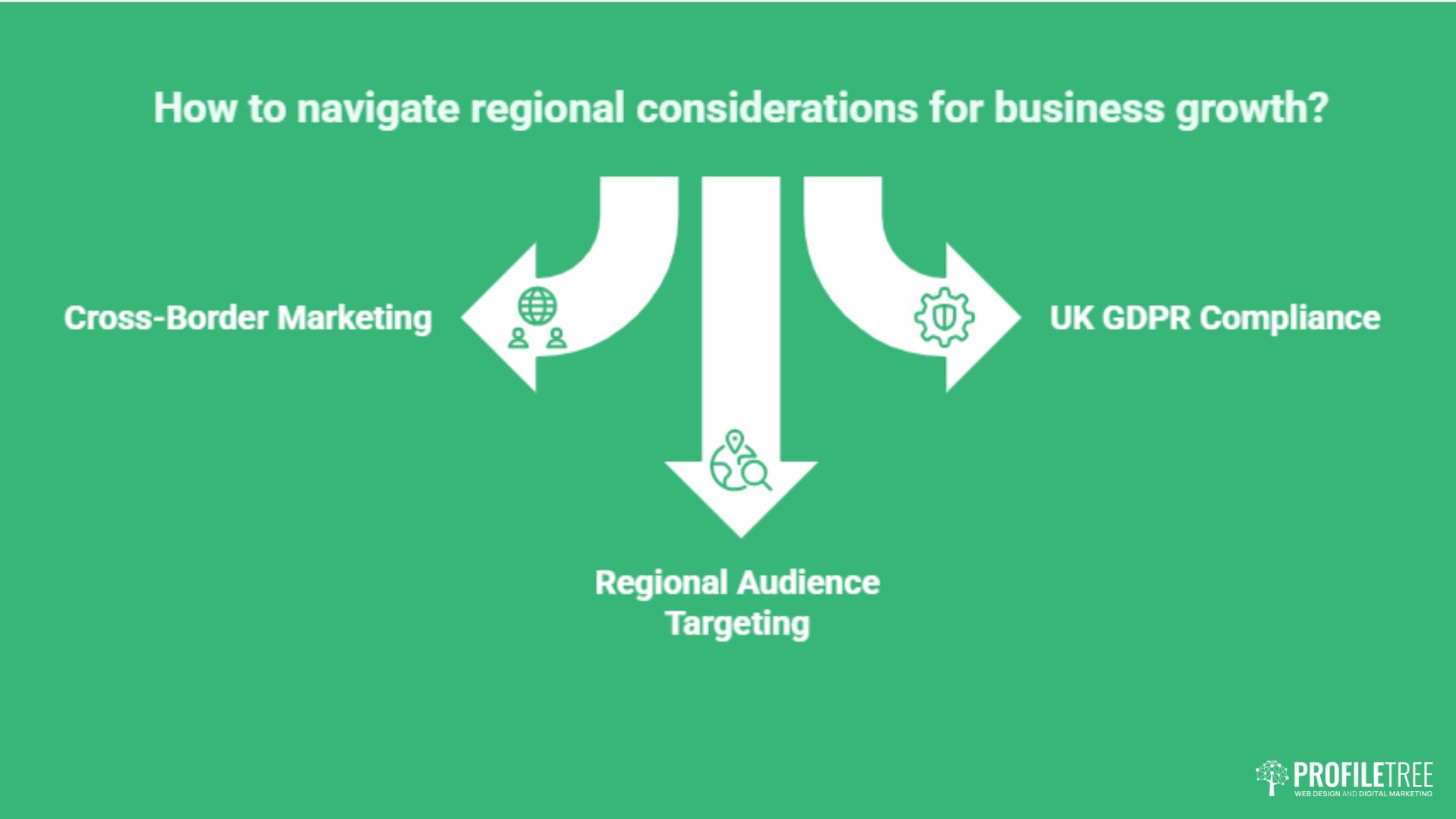
Most digital marketing guides are written for a generic UK or US audience. For businesses operating in Northern Ireland, or those with commercial activity on both sides of the border, there are specific strategic and regulatory considerations that a standard package may not address unless the agency has direct regional experience.
Cross-Border Marketing for Northern Ireland Businesses
Northern Ireland businesses occupy a unique commercial position. They operate within the UK regulatory and tax framework but often have customers, suppliers, and trading relationships across the Republic of Ireland. A digital marketing package for a Northern Ireland SME may need to run simultaneous campaigns targeting audiences in both jurisdictions, using different currencies (GBP and EUR), and sometimes different language registers.
Cities including Belfast, Derry, and Newry serve audiences that include both UK and Irish consumers. Northern Ireland’s major cities each have distinct commercial profiles that affect how local businesses should position their digital presence. A package built without this regional nuance will underperform against locally experienced competition.
UK GDPR and Data Compliance
Any digital marketing package that includes email marketing, retargeting, or audience-based paid media must account for UK GDPR obligations. Since Brexit, UK data protection law has diverged from the EU’s GDPR framework in certain respects, and businesses with customers on both sides of the border need to manage compliance for both regimes.
This is not an area where generic agency templates are sufficient. Email consent mechanisms, cookie consent management, and data retention policies all need to be configured correctly for the specific audience geography. Agencies without direct UK and Irish compliance experience often overlook this, leaving clients exposed to regulatory risk.
Regional Audience Targeting on Paid Platforms
Google Ads and Meta both allow geographic targeting down to the postcode level, but the effectiveness of regional targeting depends heavily on the density of search and social activity in a given area. Northern Ireland has a smaller addressable audience than London or Manchester, which means cost-per-click can be lower in some sectors, but audience reach on Meta is more limited.
A well-structured regional package accounts for this by combining paid activity with strong organic and local SEO work. The aim is to build a search presence that captures demand consistently, rather than relying entirely on paid reach in a market where paid budgets stretch less far. ProfileTree’s strategic digital planning process begins with this kind of audience geography analysis before a package structure is recommended.
Five Red Flags in Agency Packages
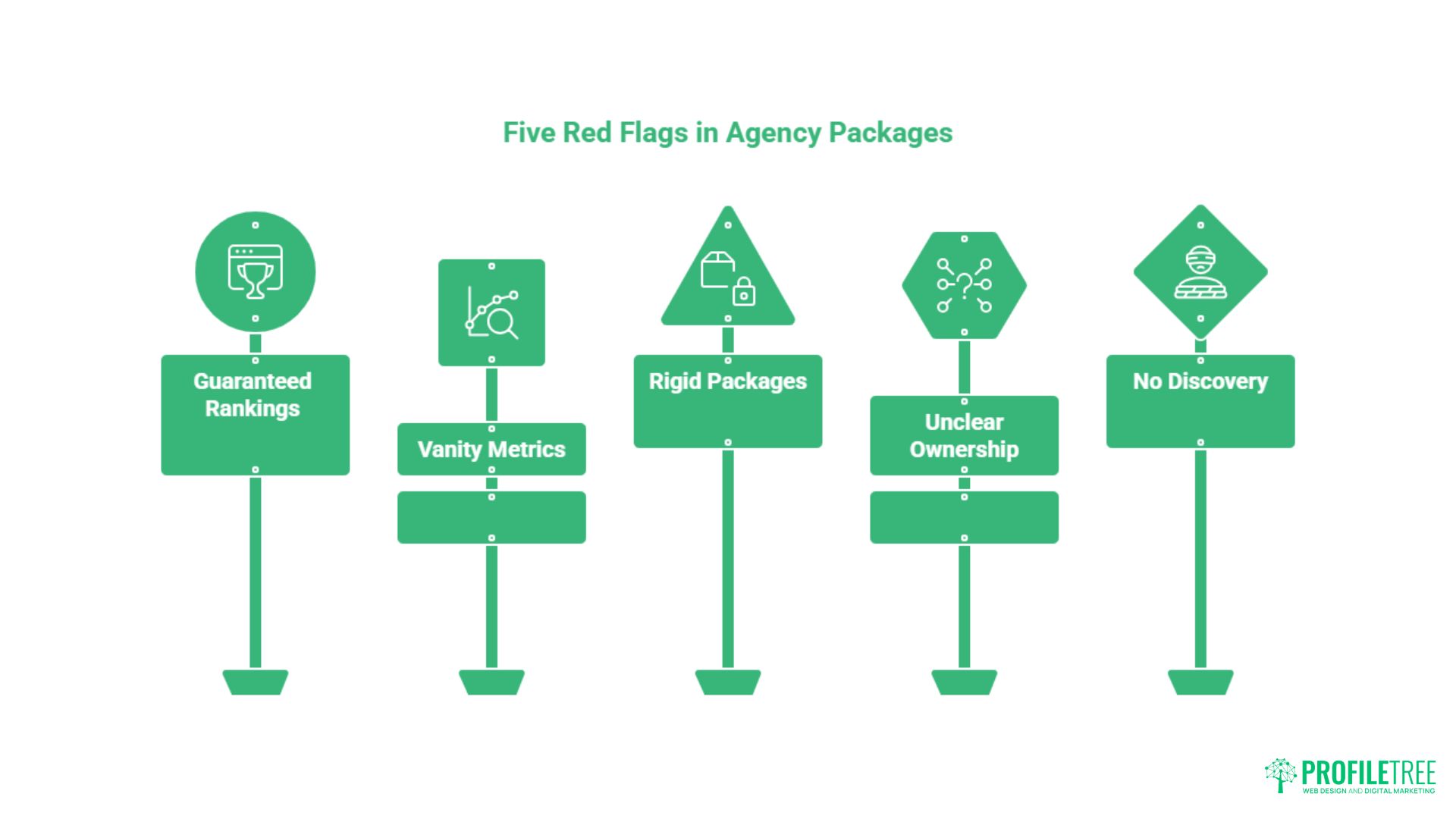
Not all agency packages represent good value. Some are structured to look thorough on paper while delivering limited strategic impact. Knowing what warning signs to look for before signing a contract can save months of wasted investment.
Guaranteed Rankings or Guaranteed Results
No agency can guarantee a specific ranking position on Google. Search rankings are determined by Google’s algorithm, which weighs hundreds of factors, including domain authority, content quality, backlink profile, user behaviour signals, and competitor activity. An agency that guarantees a position in the top three is either misunderstanding how search works or misleading you to win business.
The only things a credible agency can guarantee are its own actions: publishing a certain number of content pieces, running a set volume of A/B tests, and completing a technical audit within a specified timeframe. Outcomes are projections based on strategy and market conditions, not fixed commitments.
Vanity Metrics Without Commercial Context
A monthly report that shows rising page views, growing follower counts, and improving impressions but makes no reference to leads, conversions, or revenue is a vanity metrics report. These numbers may be moving in the right direction, but if they are disconnected from commercial outcomes, they tell you very little about whether your investment is working.
Every metric in a monthly report should trace back to a business objective. If you cannot draw a line between a reported metric and revenue or pipeline, ask the agency to explain the connection. If they cannot, the reporting framework needs to change.
Rigid Packages With No Flexibility
Business needs change. A seasonal retailer may want to redirect SEO budget into PPC for a four-week product launch. A B2B business may need to pause social media management while pivoting its service offering. Packages that cannot accommodate this kind of reallocation lock businesses into activity that is misaligned with their current priorities.
Ask prospective agencies directly: can modules be swapped mid-contract? What is the notice period for changes? What happens to unused deliverables if a channel is paused? The answers reveal how much operational flexibility the agency actually offers.
Unclear Ownership of Assets
When you end an agency relationship, you should retain full ownership of your ad accounts, your website, your content, and your analytics data. Some agencies operate in ways that make this difficult: holding ad accounts in their own name, building sites on proprietary platforms, or retaining content rights. Before signing, confirm in writing that all digital assets belong to your business and will be transferred in full if the relationship ends.
No Discovery Process Before Proposing a Package
An agency that sends a package proposal without first conducting a discovery session, asking about your commercial objectives, auditing your existing digital presence, or understanding your competitive landscape is not building a strategy; it is selling a template. The package structure should follow from a genuine understanding of your business, not precede it.
ProfileTree’s process begins with a strategy conversation before any package is proposed. The digital marketing services framework is shaped around the specific objectives and constraints of each client rather than fixed-price outputs applied uniformly. For businesses exploring how AI-assisted tools are changing how agencies plan and execute campaigns, ProfileTree’s AI-enhanced marketing offering is worth examining alongside traditional package options.
Conclusion
A digital marketing package is only as good as the strategy behind it. Understanding what each tier should deliver, how results materialise over time, and where regional and contractual risks sit gives you the tools to choose well and hold your agency accountable.
If you want a conversation about what a structured package looks like for your specific business, speak to the ProfileTree team about a no-obligation strategy session.
FAQs
Can I switch packages mid-contract?
This depends entirely on the agency’s contract terms. Some agencies allow module swaps or budget reallocations with 30 days’ notice; others lock pricing and deliverables for the full contract term. Always clarify this before signing. If flexibility is important to your business model, make it a contractual condition rather than an informal expectation.
Do packages include the cost of ads?
Typically, no. The package fee covers agency management: strategy, campaign setup, optimisation, and reporting. The actual ad spend, the money that funds your Google or Meta advertisements, is billed separately, either directly by the platform or passed through by the agency.
What is the average contract length for digital marketing in the UK?
Most UK agencies work on three to twelve-month contracts, with six months being a common standard for SME packages. Shorter contracts exist but often come at a premium, and the agency has less incentive to invest in a longer-term strategy if the engagement can end quickly. A twelve-month contract at a lower monthly rate is usually a better value than a rolling monthly arrangement at a higher rate, provided the agency’s quality and fit have been verified through a discovery process first.
How do I know if my package is working?
Focus on metrics that connect to commercial outcomes: cost per acquisition (how much it costs to generate a qualified lead), ROAS (return on ad spend for paid campaigns), and organic revenue attribution (the proportion of sales or enquiries that can be traced to organic search). Traffic volume, follower counts, and impressions are secondary indicators.
Are digital marketing packages suitable for e-commerce businesses?
Yes, but eCommerce packages have specific requirements that general packages may not address. Product feed management for Google Shopping and Meta Catalogue, behavioural retargeting for abandoned baskets, and seasonal campaign planning around peak trading periods all require channel expertise beyond typical SME packages. If you operate an online shop, confirm that the agency has specific eCommerce experience rather than applying a generic package to a context for which it was not designed.