
Free vs Paid Analytics: The SME Guide to ROI, Privacy and Performance
Table of Contents
Most small business owners make the same mistake when they set up website analytics: they install Google Analytics, tick the compliance box, and assume the job is done. The platform is free, after all. What more could you need?
Quite a lot, as it turns out. The real cost of free analytics is not financial: it is the cost of making decisions on incomplete or sampled data. And for growing businesses in the UK and Ireland, there is a second issue that rarely gets discussed: where that data actually goes, and what the ICO has to say about it.
This guide explores the genuine differences between free and paid analytics platforms, the compliance considerations specific to UK and Irish businesses, and the practical question of when upgrading makes sense for an SME.
What Free Analytics Platforms Actually Give You
Free analytics tools have become significantly more capable over the past decade. Google Analytics 4 (GA4) tracks user journeys across devices, measures events rather than just page views, and connects to Google Search Console and Google Ads at no cost. For most SMEs with fewer than 1 million monthly events, it does the job.
The three most widely used free platforms are worth understanding on their own terms before comparing them against paid alternatives.
Google Analytics 4
GA4 is the default starting point for almost every business that wants to measure website performance. It tracks traffic sources, user behaviour, conversion events, and engagement rates. The free tier retains data for up to 14 months by default, which is sufficient for most SME reporting cycles. It requires some technical knowledge to configure correctly: custom events, conversion tracking, and filtering internal traffic all need manual setup, but the foundational data it provides is genuinely useful.
The important caveat is that GA4’s free tier does apply data thresholds. Once a site reaches certain event volumes, GA4 begins using modelled (estimated) data rather than raw data in some reports. Most SMEs will not hit these limits, but businesses running high-traffic e-commerce or media sites may find their conversion reports are less precise than they appear. For businesses serious about maximising return from digital marketing campaigns, this distinction matters.
Matomo (Self-Hosted)
Matomo is the open-source alternative that holds a specific advantage for UK and EU businesses: when self-hosted, all data stays on your own server. Nothing passes through a US-based third party. The ICO and the Irish Data Protection Commission (DPC) have both signalled concern about free analytics tools that process user data on US servers. Matomo sidesteps this entirely. The trade-off is technical: someone needs to install, maintain, and update the server instance. For businesses without an internal IT resource, the managed cloud version is available, but it moves Matomo into the paid tier.
Understanding the data privacy implications of your analytics choice connects directly to how you handle user consent. The guide to protecting user data and secure storage covers the broader obligations UK businesses carry under the UK GDPR.
Hotjar (Free Plan)
Hotjar takes a different approach. Rather than tracking traffic volumes and sources, it records how individual users behave on specific pages: where they click, how far they scroll, and where they hesitate. The free plan limits the number of sessions you can record and the number of heatmaps you can run simultaneously. For businesses trying to diagnose why a specific landing page isn’t converting, even the free tier delivers actionable insights. Pairing Hotjar with GA4 gives a more complete picture than either tool alone.
The Real Difference with Paid Analytics Platforms
Paid analytics platforms do not simply offer more of the same features. They change the nature of the data you receive and the decisions you can make from it.
Data Sampling vs. Raw Data
This is the most significant practical difference, and the one most frequently glossed over in feature comparison tables. When a free analytics platform has more data than it can process in a report, it samples: it analyses a representative portion of your data and extrapolates the rest. GA4 is more resistant to sampling than its predecessor, but sampling can still occur in custom reports and explorations at high traffic volumes.
Paid platforms, including Google Analytics 360 and Piwik PRO’s paid tier, process raw, unsampled data. The difference matters most when you are making budget decisions. If your conversion rate in GA4 shows 2.4% but the underlying data is sampled at 30%, your actual conversion rate could differ by enough to change where you invest next month’s paid media budget. For businesses using analytics to direct significant spend, sampled data introduces compounding risk.
Data Ownership and UK/EU Sovereignty
Free tools, including the standard GA4 implementation, send user data to Google’s servers. Under UK GDPR, you remain the data controller, but Google acts as a data processor, and Google’s servers are predominantly US-based. The UK’s post-Brexit data adequacy arrangements with the US have provided some clarity, but the ICO continues to advise that businesses using US-based analytics tools should conduct a Transfer Impact Assessment and verify their consent mechanisms are correctly configured.
Paid alternatives, particularly Matomo Cloud (EU-hosted option) and Piwik PRO (which offers data processing within the EU and the UK), allow businesses to specify where their data is stored. For businesses in regulated sectors: healthcare, legal, financial services and education, this is not a minor compliance detail. It is a procurement requirement. Configuring your GDPR-compliant data collection forms is one part of the picture; knowing where the collected data actually travels is another.
Support, SLAs and Uptime
Free analytics tools come with community support. When GA4 tracking breaks after a website update (which it does, regularly), you are working through Google’s documentation and community forums. Paid platforms include dedicated support with defined response times. For businesses where the analytics platform feeds directly into weekly reporting for stakeholders or board-level decision making, unresolved tracking issues are not a minor inconvenience. They are a data integrity problem. The guide on why your business needs digital training covers how internal skills gaps often compound these support problems.
Integration Depth
Paid platforms connect to a wider range of data sources and push data into CRM and advertising systems in ways that free tools do not. GA4 integrates natively with Google Ads, but deeper CRM integrations, such as Salesforce, HubSpot, and similar platforms, typically require paid connectors or custom development. For a business running multi-channel campaigns across paid social, email, and organic search, having all performance data in one place improves analysis quality. Businesses exploring AI implementation for SMEs will find that the quality of analytics integration directly affects the range of AI-driven insights available.
The UK and Ireland Context: Compliance as a Business Decision
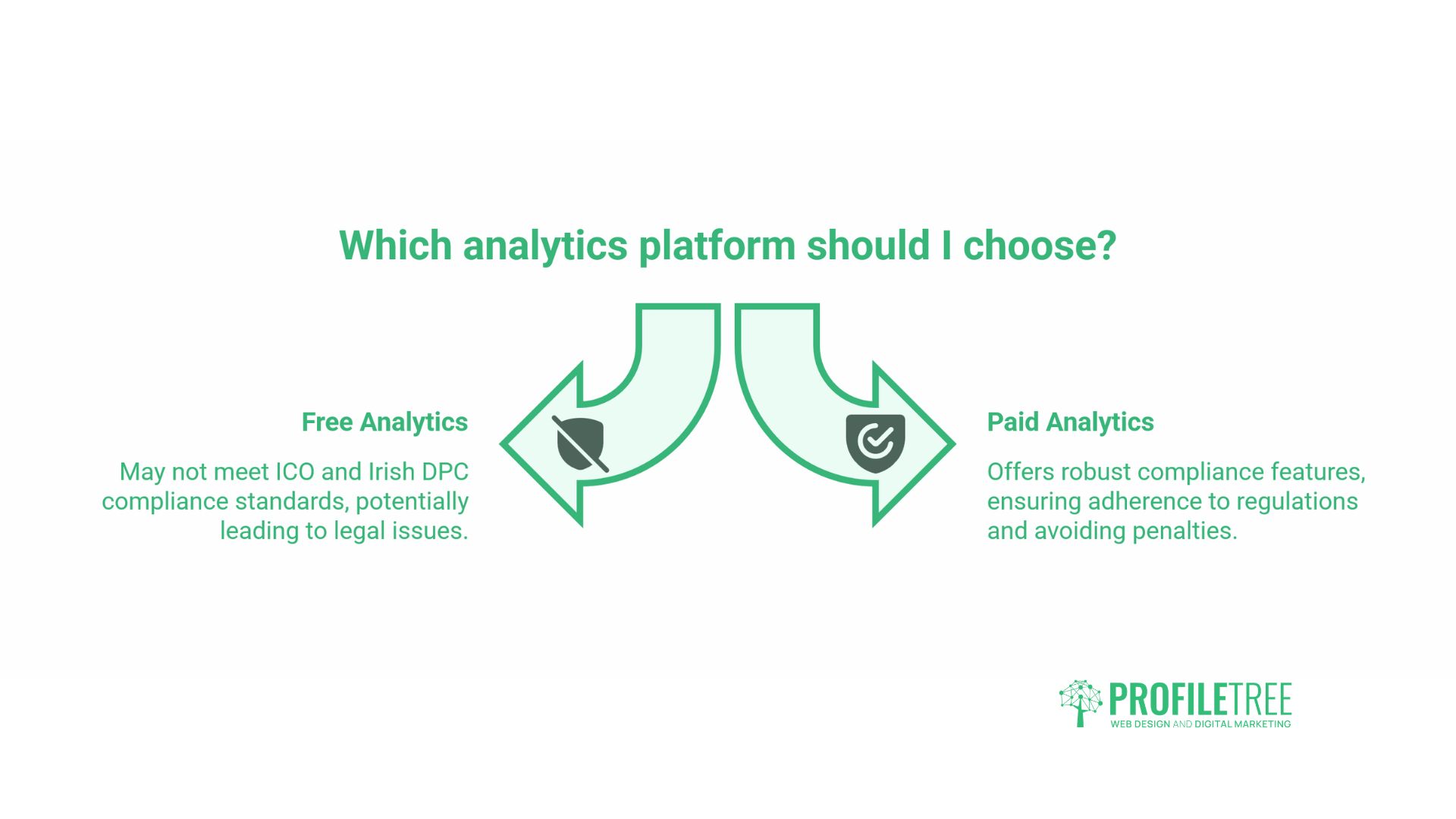
The compliance angle is the most underserved part of the free vs paid analytics debate, particularly in content written for US audiences. The ICO and the Irish DPC have specific expectations that do not apply in the same way to US businesses, and they affect platform choice in practical ways.
The ICO’s Position on Analytics Cookies
Analytics cookies in the UK are not automatically exempt from consent requirements. The ICO’s current guidance makes clear that analytics cookies require user consent unless the data is genuinely anonymised at the point of collection, not simply pseudonymised, which most analytics implementations are. This affects how you configure your consent management platform and, in turn, what percentage of your traffic you actually capture data for. A paid platform that processes truly anonymised data (some implementations of Matomo can do this) may capture more consenting-user data than a GA4 setup that asks for consent on every visit.
The GDPR training topics most relevant for marketing teams cover exactly this distinction: what “anonymised” actually means under UK law, and how to configure your analytics implementation accordingly.
The Irish DPC’s Position
Ireland’s Data Protection Commission has taken a stricter line than many EU regulators on cross-border data transfers involving US tech companies. For businesses operating across both sides of the border, a common situation in Northern Ireland, this creates a genuine compliance complexity. The Windsor Framework clarified some trade aspects of the Northern Ireland situation, but data protection obligations remain subject to both UK GDPR and, for businesses serving customers in the Republic, GDPR as applied by the DPC. Analytics platforms that offer EU-sovereign data hosting simplify this considerably. The article on the impact of Brexit on digital marketing in the UK covers the broader context for businesses navigating this dual regulatory environment.
Calculating the Real Cost: A Total Cost of Ownership Framework
The comparison between free and paid analytics looks straightforward on the surface: one costs nothing, the other costs money. The more useful question is the total cost of ownership for each, including hidden costs that rarely appear on a vendor’s pricing page.
The Hidden Costs of Free
Setting up GA4 correctly takes time. Custom event tracking, funnel configuration, cross-domain tracking, and filtering out bot traffic all require someone with technical knowledge. If that person is a web developer or an external agency, there is a direct cost. Ongoing maintenance, particularly after site redesigns or platform migrations, is the same. Tools like GA4 are not genuinely plug-and-play for any business that wants accurate data rather than default reports.
The second hidden cost is the cost of decisions made on incomplete data. This is harder to quantify, but consider a business spending £5,000 per month on paid advertising. If conversion tracking is misconfigured or data sampling distorts the reported conversion rate by even a small margin, the misallocation of that budget compounds month on month. The analytics platform costs nothing; the misallocated ad spend is significant. Understanding how to maximise ROI from digital marketing campaigns starts with knowing whether your measurement is accurate.
The Real Cost of Paid
Paid analytics platforms range considerably in cost. Piwik PRO’s Growth plan starts at a level accessible to established SMEs; Google Analytics 360 is an enterprise product starting at approximately £40,000 per year and is not relevant for most small businesses. Mid-market options, including Fathom Analytics, Plausible, and the managed Matomo cloud tier, range from £50 to £300 per month, depending on traffic volume and features.
The genuine cost calculation should include: subscription fee, implementation time (often five to fifteen days of technical work for a proper migration from GA4), staff training, and any custom integration work with existing CRM or advertising platforms. Set against the risk exposure from compliance gaps and the quality improvement in decision-making data, many established SMEs find the business case for a mid-market paid platform holds up, particularly if they are already investing seriously in digital marketing strategy and need reliable data to support that investment.
Free vs Paid Analytics: Feature Comparison
| Feature | Free Analytics (GA4) | Mid-Market Paid (e.g. Piwik PRO, Matomo Cloud) | Enterprise Paid (GA360) |
|---|---|---|---|
| Cost | Free | £50–£300/month | From ~£40,000/year |
| Data sampling | Possible at high volumes | Unsampled | Unsampled |
| Data retention | 14 months (default) | Up to indefinite | Up to indefinite |
| Data storage location | Google (US-based servers) | EU/UK hosting available | Configurable |
| UK/EU data sovereignty | Requires TIA; partial | Full compliance options | Partial |
| Support | Community forums | Dedicated support | Dedicated with SLA |
| Custom reporting | Limited | Extensive | Extensive |
| CRM integration depth | Basic (Google products) | Broad | Enterprise-grade |
| Cookieless tracking | Modelled only | Some platforms offer this | Modelled |
| Suitable for | Start-ups, small SMEs | Growing SMEs, regulated sectors | Large enterprise |
When to Upgrade: A Practical Decision Framework
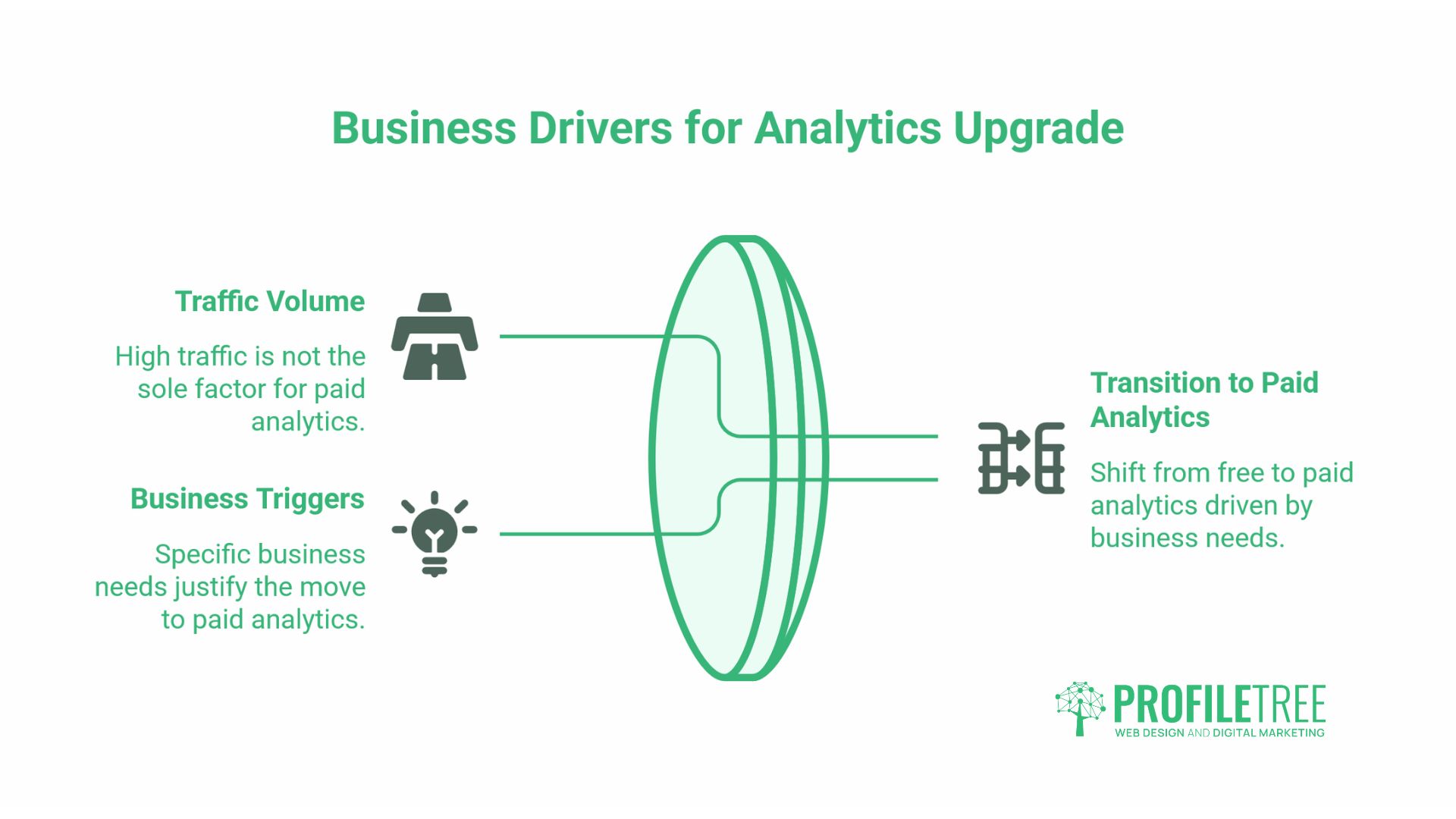
The right time to move from free to paid analytics is not defined solely by traffic volume. These are the business triggers that typically make the case.
Your Analytics Data is Driving Significant Budget Decisions
If you are spending more than £2,000 per month on paid digital advertising, or if your content and SEO investment is substantial enough that you are making quarterly strategy decisions based on analytics data, the quality of that data has direct financial consequences. At this level, the cost of a mid-market paid platform is proportionate to the decisions it informs. Businesses that have followed a proper SEO guide and are investing in organic growth particularly need reliable attribution data to understand what is working.
You Operate in a Regulated Sector
Healthcare, legal, financial services, and education all carry specific obligations around data processing. If your website collects any personal data from users in these sectors (even just email addresses for a newsletter), the analytics platform you use becomes part of your data processing record. A paid platform with documented EU/UK data sovereignty is not optional in these cases; it is a compliance baseline.
You Are Struggling to Answer Basic Business Questions from Your Data
This is the most practical trigger. If your marketing team regularly cannot answer questions like “which channel drove the most revenue last quarter” or “what is our actual cost per acquisition by campaign”, the problem may not be a lack of analytical skills: it may be data quality. Google Analytics for content marketing provides clear guidance on what GA4 can genuinely answer and where its limits are.
Your Team Lacks the Skills to Configure GA4 Correctly
A misconfigured GA4 account is worse than no analytics at all, because it produces numbers that look credible but are not. If your team lacks the technical knowledge to verify that conversion tracking, channel groupings, and event configuration are correct, investing in digital training is often the more cost-effective first step before considering a platform upgrade. Knowing how to read the data you have beats paying for more data you cannot interpret.
You Need Consolidated Reporting Across Multiple Data Sources
Businesses running active campaigns across organic search, paid search, social media, email, and offline channels quickly outgrow what GA4’s default reports can show. Paid platforms typically offer better data connectors and more flexible custom reporting. The overview of business analytics tools covers the wider landscape of platforms that can consolidate multi-source data into a single reporting view.
How Analytics Connects to Your Digital Strategy
Analytics is not a standalone tool. The measurement layer sits beneath every other part of a digital strategy, and its quality determines the quality of every decision made from it.
For businesses investing in SEO, analytics data shows which content is attracting organic traffic, which keywords are converting, and where users are dropping out of the funnel. For businesses running paid social or Google Ads campaigns, analytics attribution determines where to allocate the budget and where to cut it. For businesses building out content marketing programmes, social media analytics tools, and website analytics together tell the story of what audiences engage with and what they ignore.
The practical implication is that the decision between free and paid analytics cannot be made in isolation from your broader digital investment. A business spending £500 per month on digital marketing and reviewing analytics once a quarter has different needs from a business spending £10,000 per month and reviewing performance weekly. Understanding business data and statistics: how to read them, what they actually mean, and where the limits of any dataset lie, is the skill that makes the difference between analytics as a reporting exercise and analytics as a genuine decision-making tool.
ProfileTree works with SMEs across Northern Ireland, Ireland, and the UK on digital training programmes covering analytics configuration, data interpretation, and building a reporting process that actually informs strategy rather than simply producing charts.
Getting Your Analytics Right
The decision between free and paid analytics is not primarily a budget question. It is a question of what your data needs to do for your business.
For most SMEs starting out, GA4 configured correctly is sufficient. The word “correctly” is doing a lot of work in that sentence: a well-configured free platform outperforms a poorly configured paid one every time. The priority before any platform upgrade should be verifying that what you already have is actually measuring what you think it is.
As your business grows and analytics data starts informing larger decisions, the case for a mid-market paid platform builds: cleaner data, clearer compliance, and support when things break. For businesses in regulated sectors, that case arrives sooner regardless of traffic volume.
The businesses that get the most from analytics, free or paid, are not the ones with the most sophisticated platforms. They are the ones who have built the habit of looking at the data, asking the right questions, and adjusting their actions based on what they find.
FAQs
Is Google Analytics 4 genuinely free?
Yes, GA4’s core platform is free. Exporting raw data to BigQuery moves into paid territory once you exceed the free tier limits, but most SMEs will not reach that threshold.
What are the limitations of free analytics tools for UK businesses?
Data sampling at high volumes, 14-month default data retention, US-based data storage requiring a Transfer Impact Assessment under UK GDPR, and community-only support. In regulated sectors, data sovereignty poses the greatest risk.
At what traffic level should I consider paying for analytics?
Traffic volume alone is a poor trigger. The better question is whether analytics data is directing significant financial decisions. If you are spending more than £2,000 per month on paid digital activity, the data quality improvement from a mid-market paid platform is proportionate.
Does free analytics software own your data?
You remain the data controller under UK GDPR. Google’s terms permit it to use aggregated, anonymised analytics data to improve its own products, but it does not sell your specific customer data. Privacy-first paid platforms like self-hosted Matomo commit to no data use for advertising purposes whatsoever.