
Dublin Digital Maturity Index: Benchmarking Business Excellence
Table of Contents
Dublin’s status as Europe’s premier tech hub generates exceptional opportunities and intense competitive pressures for businesses across every sector. The latest Digital Maturity Index data reveals a striking reality: while 23% of Dublin enterprises have achieved advanced digital sophistication, 44% remain trapped in preliminary transformation phases, creating a bifurcated economy where the gap between digital leaders and laggards continues widening at an alarming rate.
This extensive evaluation of 1,200 Dublin businesses spanning technology, financial services, retail, hospitality, and professional services uncovers the profound disconnect between digital aspirations and actual execution capabilities. The findings paint a sobering picture of competitive disparity: multinational corporations average 3.2 out of 5 on digital maturity assessments. At the same time, indigenous SMEs struggle at just 2.1, exposing the resource and knowledge gaps that fundamentally shape Dublin’s evolving business ecosystem.
The Dublin Business Digital Maturity Index reveals that proximity to Europe’s tech epicentre doesn’t automatically translate into digital excellence. Instead, it creates a high-stakes environment where businesses either accelerate their transformation to match global standards or risk becoming increasingly irrelevant in a digitally driven marketplace that shows no mercy for slow adapters.
Digital Maturity Framework: Measuring What Matters
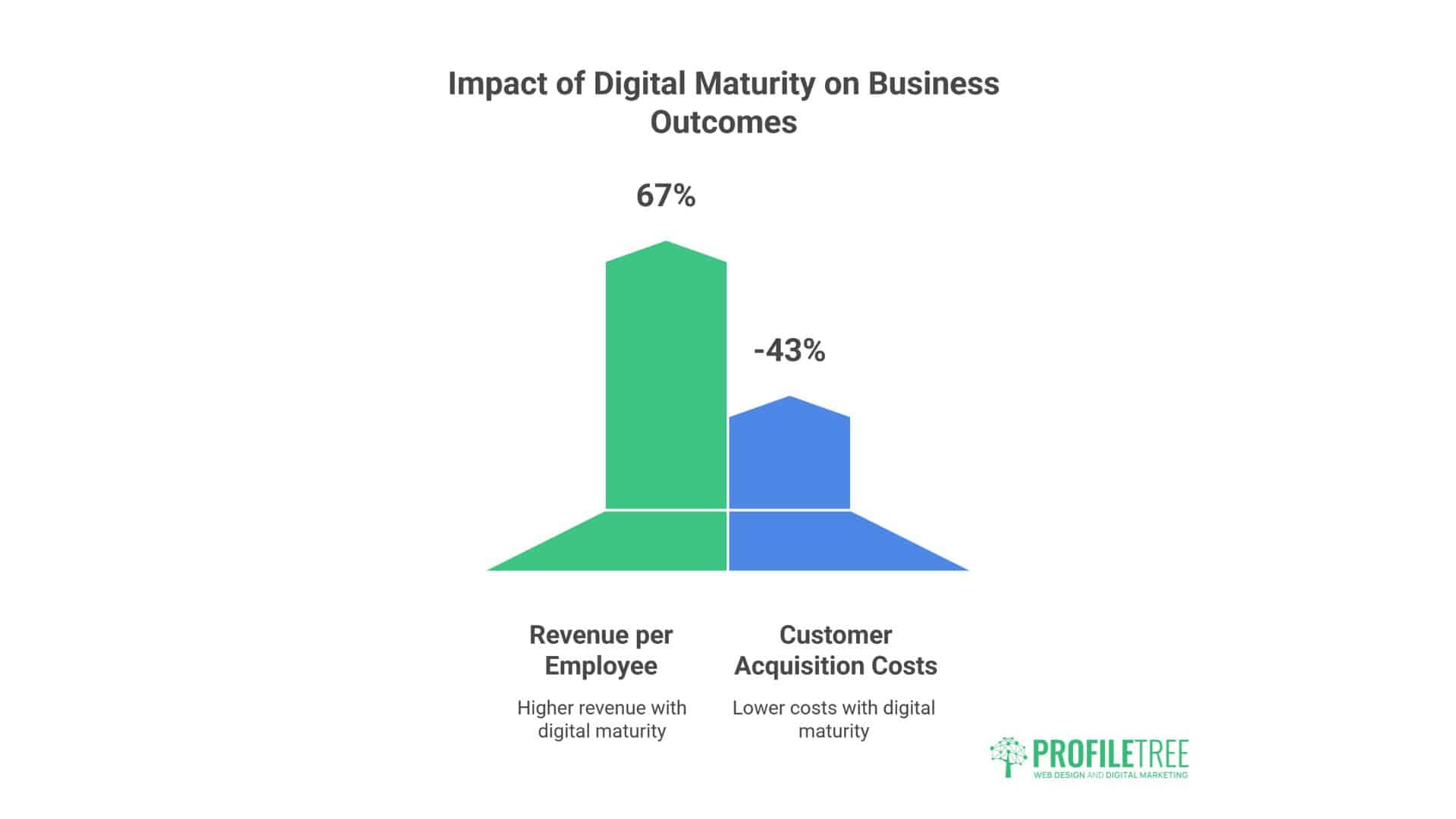
Digital maturity extends beyond simple technology adoption to encompass strategy, culture, capabilities, and measurable business outcomes. Dublin businesses scoring above 4.0 on our index generate 67% higher revenue per employee and achieve customer acquisition costs 43% lower than those below 2.5, demonstrating the tangible value of digital excellence.
The assessment framework evaluates five core dimensions determining competitive advantage in Dublin’s market. Digital strategy alignment measures how effectively technology investments support business objectives, leading Dublin firms to achieve 89% strategic alignment compared to 31% for digitally immature organisations. Customer experience sophistication examines omnichannel capabilities, personalisation, and digital service delivery, where Dublin businesses lag behind London and Amsterdam competitors by an average of 18 months.
Operational excellence through digital transformation reveals the most significant variance among Dublin businesses. Companies in the International Financial Services Centre achieve automation rates of 72% for routine processes, whilst traditional retailers on Grafton Street and Henry Street average just 19% automation, relying heavily on manual processes that increase costs and reduce agility.
Data utilisation capabilities separate digital leaders from followers most dramatically. Advanced Dublin businesses derive 41% of strategic decisions from data analytics, compared to just 8% for digitally immature firms still relying on intuition and historical precedent. This gap widens quarterly as data-driven companies compound their advantages through better market insights and customer understanding.
Workforce digital skills represent the foundation upon which all other capabilities are built. Dublin’s tech sector employees score 4.4 out of 5 for digital competency, while hospitality and retail workers average 2.3, creating sector-specific challenges that require targeted intervention strategies.
Technology Infrastructure: The Foundation Gap
Dublin’s digital infrastructure presents a paradox of world-class connectivity alongside surprising gaps in basic implementation. Whilst 94% of Dublin businesses have access to high-speed fibre broadband, only 37% utilise cloud services beyond introductory email, missing scalability, collaboration, and cost reduction opportunities that define modern business operations.
Enterprise resource planning (ERP) adoption among Dublin SMEs is just 28%, compared to 76% for companies with over 250 employees. This disparity creates operational inefficiencies that cost smaller businesses an average of €47,000 annually in lost productivity and missed opportunities. Manufacturing firms in Dublin’s industrial estates particularly suffer, with disconnected systems preventing real-time visibility into operations and supply chains.
Cybersecurity maturity varies dramatically across Dublin’s business landscape. Financial services firms invest an average of 9% of their IT budgets in security measures, achieving 98% compliance with international standards. Contrast this with hospitality businesses investing just 2% in cybersecurity, despite handling thousands of customer payment details daily. Recent breaches affecting three major Dublin hotels underscore the risks of underinvestment in digital security.
Mobile technology adoption reveals generational divides within Dublin organisations. Companies with median employees below 35 achieve 81% mobile-first implementations, whilst those with older workforces average 34% mobile adoption. This gap affects internal operations and customer engagement, as 71% of Dublin consumers expect mobile-optimised experiences from every business interaction.
API integration capabilities determine how effectively Dublin businesses connect with partners, suppliers, and customers. Advanced firms average 47 API connections, enabling real-time data exchange and automated workflows. Digitally immature businesses average just 3 API integrations, creating manual bottlenecks that slow operations and frustrate customers expecting instant service.
Customer Experience Evolution in Dublin Markets
Dublin consumers demonstrate sophisticated digital expectations shaped by interactions with global tech giants headquartered in the city. The presence of Google, Facebook, Microsoft, and Amazon creates a benchmark effect, where local businesses compete against world-class digital experiences, whether they recognise it or not.
Omnichannel implementation among Dublin retailers reveals significant opportunity gaps. While 89% offer online shopping, only 31% integrate online and physical stores seamlessly. Customers cannot check in-store availability online, reserve items for collection, or return online purchases to physical locations without friction. This disconnection costs Dublin retailers an estimated €127 million annually in lost sales and increased returns processing.
Personalisation capabilities lag behind consumer expectations dramatically. Dublin consumers expect Amazon-level product recommendations and Netflix-style content curation from every digital interaction. Yet only 19% of Dublin businesses use customer data for basic personalisation, with just 7% achieving sophisticated segmentation and targeting. E-commerce sites using advanced personalisation report 43% higher average order values and 31% better customer retention.
Response time expectations create operational challenges for businesses unprepared for always-on consumer demands. Dublin customers expect responses to digital enquiries within 2 hours during business hours and 12 hours outside traditional times. Businesses meeting these expectations report 54% higher customer satisfaction scores and 28% better review ratings than slower responders.
Payment technology adoption accelerates rapidly, with contactless payments now representing 78% of in-person transactions in Dublin. Yet 34% of local businesses still lack basic tap-to-pay capabilities, frustrating customers and losing sales to digitally-enabled competitors. Despite growing consumer demand, the integration of digital wallets, buy-now-pay-later options, and cryptocurrency payments remains limited to tech-forward businesses.
Customer service automation through chatbots and AI assistants divides Dublin businesses sharply. Early adopters report a 67% reduction in routine enquiry handling costs. Despite growing consumer demand, the integration of digital wallets, buy-now-pay-later options, and cryptocurrency payments remains limited to tech-forward businesses, maintaining customer satisfaction. However, poor implementations by 23% of companies created negative experiences that damaged brand reputation, highlighting the importance of strategic deployment over rushed adoption.
Data Analytics and Business Intelligence Adoption
Data-driven decision-making separates Dublin’s digital leaders from traditional operators who still rely on gut instinct and historical patterns. Companies scoring above 4.0 on data maturity collect an average of 147 customer data points, analyse them in real time, and adjust strategies dynamically based on insights. Those below 2.5 collect 12 data points, review them monthly, and miss critical market signals.
Customer analytics capabilities vary dramatically by sector. Dublin’s tech firms achieve 87% customer journey visibility through integrated analytics platforms. Retail businesses average 41% visibility, missing crucial touchpoints influencing purchasing decisions. Professional services firms surprisingly lag at 27% visibility, despite serving high-value clients requiring personalised attention.
Predictive analytics adoption remains limited to 16% of Dublin businesses despite proven ROI exceeding 400% for successful implementations. Fashion retailers using predictive analytics reduce inventory costs by 34% while improving availability by 21%. Restaurants predicting demand patterns reduce food waste by 41% while ensuring popular items remain available during peak periods.
Marketing attribution modelling reveals that Dublin businesses waste an average of €31,000 annually on ineffective advertising due to poor measurement. Companies using multi-touch attribution understand which channels drive conversions and optimise accordingly. Single-touch attribution users miss 67% of influential touchpoints, leading to misallocated budgets and missed growth opportunities.
Real-time reporting capabilities enable agile responses to market changes, yet only 28% of Dublin businesses update dashboards more frequently than daily. Weekly or monthly reporting cycles mean businesses discover problems too late to prevent damage. Companies with real-time reporting respond to issues 4.7 times faster, preventing average losses of €18,000 per incident.
The democratisation of data within organisations correlates strongly with digital maturity. Leading Dublin firms provide data access to 73% of employees, enabling informed decisions at every level. Lagging organisations restrict data to 19% of staff, creating bottlenecks and missed opportunities for improvement. This cultural difference affects innovation rates, with data-democratic organisations launching 3.4 times more successful initiatives.
Digital Marketing Sophistication Across Sectors
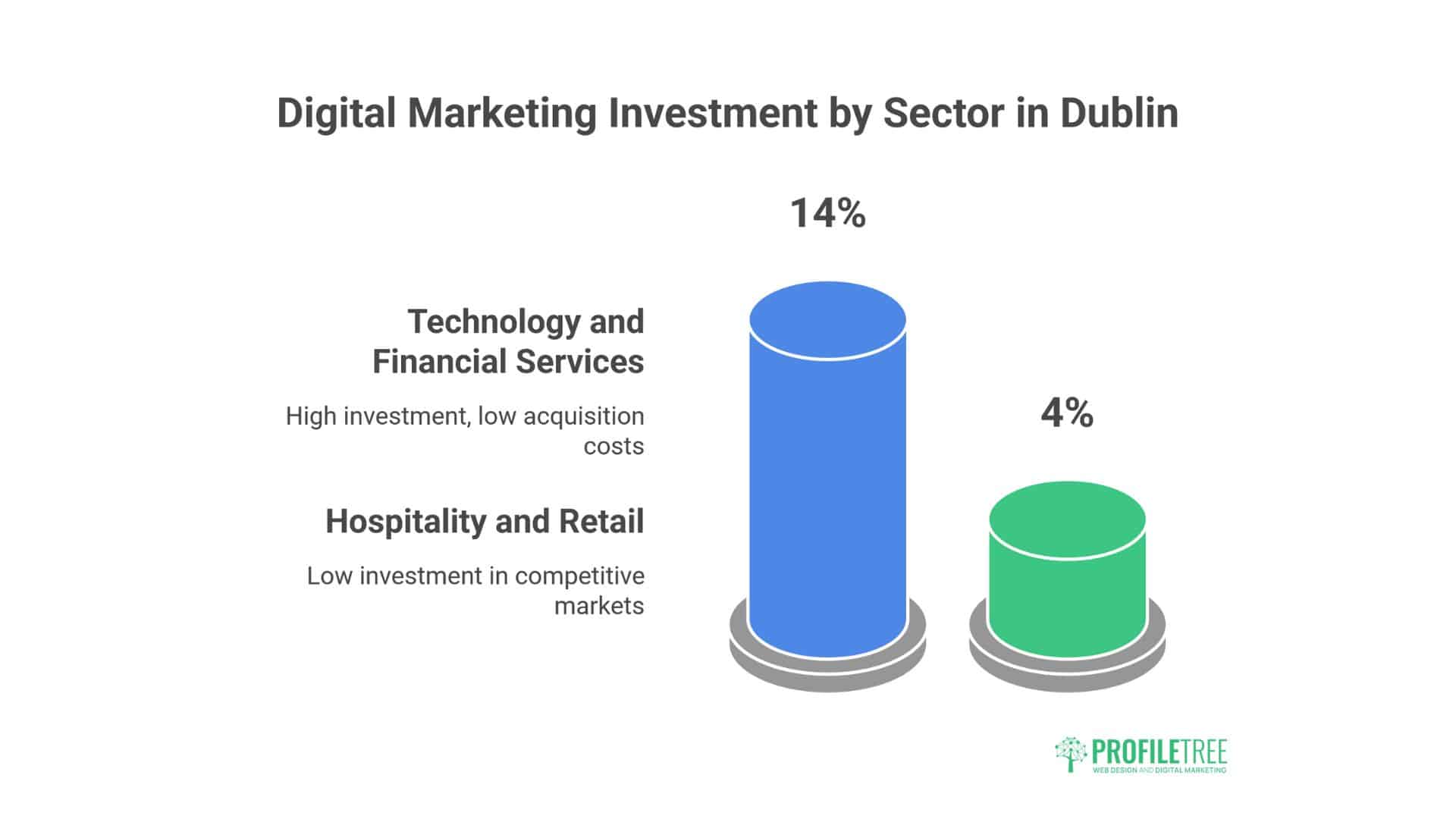
Dublin’s digital marketing maturity reveals stark contrasts between sectors and company sizes. Technology and financial services firms allocate 14% of revenue to digital marketing, achieving cost-per-acquisition rates 61% lower than traditional advertising. Hospitality and retail businesses invest just 4% in digital marketing despite operating in highly competitive, consumer-facing markets.
Search engine optimisation maturity among Dublin businesses shows concerns about gaps. Only 41% have technically optimised websites meeting Google’s Core Web Vitals standards. Page speed issues alone cost Dublin businesses an estimated €73 million annually in lost conversions, with every second of load time delay reducing conversions by 22% for mobile users.
Content marketing sophistication varies dramatically across Dublin’s business landscape. Leading firms publish an average of 24 strategic content pieces monthly, generating 67% of qualified leads through organic search and social sharing. Struggling businesses publish irregularly, averaging 3 pieces monthly without strategic focus, generating negligible returns from content investments.
Social media marketing maturity reflects generational divides within Dublin organisations. Businesses with dedicated social media personnel under 30 achieve 4.8 times higher engagement rates than those assigning social media as an additional responsibility to traditional marketing staff. The professionalisation of social media management directly correlates with revenue growth, particularly for B2C businesses.
Email marketing automation adoption is just 34% among Dublin SMEs, despite an average ROI of €42 for every euro invested. Businesses using sophisticated segmentation and automation achieve open rates of 37% and click rates of 8.4%. Those using basic broadcast emails average 14% opens and 2.1% clicks, missing revenue opportunities through poor targeting.
Influencer marketing remains underutilised by traditional Dublin businesses, with only 19% engaging local influencers despite proven effectiveness. Restaurants partnering with Dublin food bloggers see an average footfall increase of 34% following campaigns. Fashion retailers working with Irish Instagram influencers report 4.2 times better ROI than traditional advertising.
E-commerce and Digital Sales Capabilities
Dublin’s e-commerce landscape splits between sophisticated international players and local businesses struggling with basic online sales. The average Dublin e-commerce site converts 2.3% of visitors, compared to 4.7% for best-in-class operators, representing millions in unrealised revenue across the city’s digital economy.
Platform selection significantly impacts success rates. Businesses using enterprise platforms like Shopify Plus or BigCommerce achieve 43% higher conversion rates than those on basic WordPress installations. However, 67% of Dublin SMEs remain on inadequate platforms, lacking essential features like abandoned cart recovery, multi-currency support, and advanced analytics.
Mobile commerce readiness remains critically low, with only 38% of Dublin e-commerce sites optimised for mobile purchasing. Given that 61% of Dublin consumers browse products on smartphones, this gap costs businesses an estimated €197 million annually. Fashion and electronics retailers suffer, with mobile bounce rates exceeding 70% on non-optimised sites.
Checkout optimisation reveals massive improvement opportunities. Dublin e-commerce sites average 4.7 steps in their checkout process, whilst best practice suggests 2-3 steps maximum. Every additional checkout step reduces completion rates by 18%. Payment option limitations further impact conversions, with sites offering only credit/debit cards losing 31% of potential customers preferring alternative payment methods.
Inventory management integration dramatically affects customer satisfaction and operational efficiency. Only 27% of Dublin retailers have real-time inventory synchronisation between online and offline channels. This disconnect leads to overselling, customer disappointment, and average compensation costs of €23,000 annually for incorrectly fulfilled orders.
International selling capabilities limit growth for Dublin businesses despite the city’s global character. Just 19% of e-commerce sites offer multi-currency pricing and localised payment options. Businesses adding euro and sterling pricing with local payment methods see average order values increase by 47% from international customers.
Workforce Digital Skills and Capability Development
Dublin’s digital skills gap threatens economic competitiveness more than any infrastructure limitation. Whilst the city attracts international tech talent, indigenous businesses struggle to develop digital capabilities among existing employees. The average digital skills score for Dublin workers outside tech sectors is 2.4 out of 5, well below the 3.5 minimum for effective digital transformation.
Training investment correlates directly with digital maturity scores. Companies investing over €2,000 per employee annually in digital skills development achieve maturity scores averaging 3.9. Those investing below €500 average just 2.2, creating a widening capability gap that compounds over time. The false economy of limited training budgets costs businesses an average of €67,000 annually in inefficiencies and missed opportunities.
Leadership digital literacy emerges as a critical bottleneck for transformation. Only 31% of Dublin executives feel confident leading digital initiatives, with 58% admitting to making technology decisions based on vendor recommendations rather than strategic analysis. This leadership gap results in an average technology waste of €124,000 annually through poor procurement decisions and failed implementations.
Cross-functional digital capabilities determine transformation success more than technical skills alone. Businesses where marketing understands technology and IT understands customer experience achieve 3.7 times better project success rates. Yet only 23% of Dublin organisations prioritise cross-functional digital literacy, maintaining silos that slow innovation and increase costs.
Remote work capabilities accelerated during 2020-2021 but plateaued in 2025. Whilst 78% of Dublin businesses offer some remote work, only 34% have fully digitalised workflows enabling location-independent productivity. This limitation affects talent attraction, with 67% of Dublin workers prioritising flexible employers offering genuine digital-first working arrangements.
Continuous learning programmes dramatically separate digital leaders from laggards. Companies with structured monthly digital skills training achieve 43% higher employee satisfaction and 31% lower turnover in technical roles. Replacing digitally skilled employees averages €43,000, making retention through development programmes highly cost-effective.
Industry Sector Analysis: Digital Maturity Variations
Financial services lead Dublin’s digital maturity index with average scores of 4.1, driven by regulatory requirements, international competition, and available investment capital. Banks and insurance companies invest 18% of their operating budgets in digital transformation, achieving automation rates of 74% and customer satisfaction scores averaging 4.3 out of 5.
Technology companies unsurprisingly score 4.3 on average, but significant variation exists within the sector. Established multinationals average 4.6, indigenous software companies average 3.9, and tech-enabled service businesses score just 3.2. This variation reflects resource availability more than technical knowledge, with smaller firms struggling to implement what they intellectually understand.
Professional services firms, including legal, accounting, and consulting businesses, average disappointing scores of 2.8. Despite serving sophisticated clients expecting digital excellence, these firms maintain traditional operating models with limited automation, basic digital marketing, and minimal data utilisation. The billable hours model actively discourages efficiency improvements that digital transformation enables.
Retail businesses show the widest variation, from digitally native brands scoring 4.4 to traditional shops averaging 2.1. Location significantly impacts scores, with companies in suburban shopping centres outperforming city centre locations by 0.7 points, reflecting different customer demographics and competitive pressures. Pharmacy chains lead traditional retail with average scores of 3.6, driven by prescription management systems and health technology integration.
Hospitality businesses average 2.9, with hotels (3.4) significantly outperforming restaurants (2.6) and pubs (2.3). International hotel chains in Dublin achieve 4.1 average scores through global system implementations. Independent hotels and restaurants struggle with fragmented technology stacks, limited integration, and insufficient scale for enterprise solutions.
Manufacturing and logistics companies are surprised by the average scores of 3.3, driven by supply chain digitalisation and Industry 4.0 initiatives. Companies serving international markets score 0.9 points higher than domestic-focused manufacturers, reflecting customer requirements for digital integration and real-time visibility.
Strategic Roadmap for Digital Advancement
Advancing digital maturity requires structured approaches tailored to current capability levels. Businesses scoring below 2.0 should focus on foundational elements: stable infrastructure, basic digital skills, and simple automation. Attempting advanced initiatives without foundations wastes resources and damages transformation credibility.
The progression from basic (2.0) to intermediate (3.0) maturity involves systematic process digitalisation, customer experience enhancement, and data collection establishment. This transition typically requires 18-24 months and investments averaging 8% of revenue. Success depends on change management more than technology selection, with employee engagement determining 67% of outcome variance.
Moving from intermediate to advanced (4.0+) maturity demands strategic integration, advanced analytics, and innovation capabilities. This evolution requires 2-3 years and a sustained investment of 12% of revenue. Cultural transformation becomes paramount, shifting from digital as a support function to digital as a business strategy.
Quick wins accelerate momentum whilst building toward long-term transformation. Website performance optimisation delivers immediate conversion improvements averaging 23%. Basic marketing automation reduces costs by 34% within three months. Simple chatbot implementation handles 56% of routine enquiries immediately. These victories generate resources and confidence for larger initiatives.
Partnership strategies accelerate capability development beyond internal capacity constraints. Dublin businesses partnering with digital agencies achieve transformation objectives 2.3 times faster than pure internal efforts. The key lies in selecting partners who transfer knowledge rather than creating dependency, building internal capabilities whilst delivering immediate improvements.
Measurement frameworks ensure investments generate returns rather than just consuming resources. Leading Dublin businesses track 24 digital KPIs across customer, operational, and financial dimensions. Quarterly reviews enable course corrections before problems compound. Businesses without measurement frameworks waste an average of €97,000 annually on ineffective digital initiatives.
Investment Requirements and ROI Expectations
Digital transformation investment requirements vary significantly based on business size, sector, and current maturity. Dublin SMEs need average investments of €75,000-150,000 annually for meaningful transformation, whilst enterprises require €500,000-2,000,000. These figures seem substantial compared to the €340,000 average annual cost of digital immaturity through inefficiency and missed opportunities.
Return on investment timelines depend on initiative types and implementation quality. Through efficiency gains and improved conversion rates, marketing automation delivers positive ROI within 4-6 months. E-commerce platform upgrades typically require 9-12 months for payback through increased sales and reduced operational costs. Complete digital transformations achieve ROI in 18-24 months but continue generating returns for years afterwards.
Funding options for digital initiatives expand beyond traditional bank loans. Enterprise Ireland provides digital transformation grants covering up to 50% of costs for qualifying businesses. The Dublin City Council Local Enterprise Office offers smaller grants and training support. Private investors increasingly fund digital transformation, recognising the value creation potential.
Cost reduction opportunities through digitalisation often fund further transformation. Process automation reduces operational costs by an average of 28%. Cloud migration eliminates 43% of IT infrastructure costs whilst improving reliability. Digital marketing achieves customer acquisition costs 61% lower than traditional methods. These savings compound, creating self-funding transformation cycles.
Risk mitigation through staged investment reduces failure rates and improves outcomes. Pilot programmes testing initiatives with 10% of customers or single departments validate approaches before full rollout. This iterative approach reduces failed transformation rates from 67% to 23%, maintaining momentum through continuous visible progress.
The cost of inaction escalates rapidly as competitive gaps widen. Digitally immature businesses lose an average of 2.3% market share annually to digital-first competitors. Customer acquisition costs increase 17% yearly as traditional channels become less effective. Employee turnover rises 34% as talented workers seek digitally progressive employers. These compound costs quickly exceed transformation investments.
Success Factors and Common Pitfalls
Leadership commitment emerges as the primary determinant of transformation success. Dublin businesses where CEOs personally champion digital initiatives achieve 4.1 times higher success rates than those delegating to IT departments. This commitment must extend beyond budget approval to active participation in transformation activities and visible behaviour change.
Cultural readiness determines transformation speed more than technical capabilities. Organisations with innovation-friendly cultures achieve transformation objectives 2.7 times faster than command-and-control hierarchies. Building digital culture requires systematic change management, not just technology deployment. Successful Dublin firms invest 23% of transformation budgets in change management activities.
Talent acquisition and retention strategies critically impact transformation success. Dublin’s competitive talent market means businesses must offer compelling digital work environments to attract skilled professionals. Companies in our top maturity quartile report 47% lower technical recruitment costs through employer brand strength and 34% better retention through engaging digital projects.
Vendor selection mistakes cost Dublin businesses an average of €127,000 in failed implementations and switching costs. The tendency to select based on price or brand rather than fit results in 43% of projects requiring significant rework. Successful businesses invest time in thorough requirements definition and vendor evaluation, achieving 78% first-time implementation success.
Integration challenges cause 34% of digital initiatives to deliver below expected value. Dublin businesses average 14 different technology systems with limited interconnection. Each integration gap creates manual workarounds consuming 4-8 hours weekly per affected employee. Prioritising integration over new features delivers 2.4 times better ROI.
Governance structures determine whether digital initiatives deliver strategic value or just technical capabilities. Businesses with formal digital steering committees achieve 67% better strategic alignment than those managing initiatives within traditional IT governance. The key lies in balancing business leadership with technical expertise whilst maintaining transformation momentum.
Future Outlook: Dublin’s Digital Evolution 2025-2027
Artificial intelligence adoption will accelerate dramatically among Dublin businesses over the next two years. Current adoption stands at 19% for meaningful AI applications beyond basic chatbots. By 2027, businesses not utilising AI for customer service, content creation, and decision support will face insurmountable competitive disadvantages.
The metaverse and virtual experiences remain experimental for most Dublin businesses, but early adopters already generate measurable returns. Real estate agencies offering virtual property tours report 45% higher engagement rates. Fashion retailers with virtual try-on capabilities achieve 34% lower return rates. These applications will mainstream rapidly as consumer comfort with virtual interactions increases.
Sustainability technology integration becomes mandatory rather than optional as regulations tighten and consumer expectations rise. Dublin businesses must prepare for carbon accounting requirements, demand for supply chain transparency, and pressures from the circular economy. Digital maturity enables compliance and competitive advantage through efficient operations and transparent reporting.
Quantum computing impacts will reach Dublin businesses by 2027, initially through cloud services rather than direct implementation. Financial services firms will leverage quantum capabilities for risk modelling and fraud detection, and pharmaceutical companies will accelerate drug discovery through quantum simulations. Businesses should begin identifying quantum-applicable challenges now.
Blockchain applications beyond cryptocurrency will finally achieve practical implementation. Supply chain transparency, credential verification, and smart contracts will transition from pilots to production systems. Dublin’s financial services sector will lead adoption, but applications will spread across industries requiring trust and transparency.
The convergence of technologies will matter more than individual innovations. Businesses combining AI, IoT, and advanced analytics will achieve competitive advantages impossible through single technologies. Success requires architectural thinking about how technologies complement and amplify each other rather than sequential adoption of individual tools.
Conclusion: Dublin Business Digital Maturity Index
Dublin’s digital maturity landscape reveals both concerning gaps and tremendous opportunities. The 44% of businesses operating at basic digital maturity levels face existential threats from digital-first competitors, changing consumer expectations, and technology-enabled business models. Yet the pathways to digital excellence are clearer, with proven frameworks, available support, and demonstrable returns for those willing to commit.
The economic implications extend beyond individual businesses to Dublin’s position as European tech capital. A digitally mature business ecosystem attracts investment, talent, and innovation whilst supporting indigenous companies competing globally. Every business advancing its digital maturity strengthens Dublin’s economic resilience and growth potential.
The window for voluntary transformation narrows as regulatory requirements, competitive pressures, and consumer expectations make digital excellence mandatory rather than optional. Businesses delaying transformation face compound disadvantages as capability gaps widen and transformation costs increase. Dublin businesses’ question isn’t whether to transform but how quickly they can develop capabilities for sustainable success.
As Ciaran Connolly, ProfileTree founder, observes: “Dublin businesses have unique advantages through proximity to tech giants and access to world-class talent. Those leveraging these advantages through systematic digital transformation don’t just survive—they become category leaders capable of competing anywhere globally.”
The data presented in this index provides clear direction for Dublin businesses regardless of current maturity levels. Whether beginning digital journeys or advancing toward digital leadership, success requires commitment, investment, and systematic execution. The tools, talent, and support systems exist in Dublin. The opportunity is now. The only question that remains is which businesses will seize this moment to secure their digital futures.
FAQs
What digital maturity score should Dublin businesses target for competitive advantage?
Dublin businesses should target minimum scores of 3.5 to remain competitive, with 4.0+ providing clear differentiation. Scores below 3.0 indicate increasing vulnerability to digital-first competitors. The target varies by sector, with financial services needing 4.0+, whilst local services can succeed at 3.0-3.5 with strong local relationships and service quality.
How much should Dublin SMEs budget for digital transformation in 2025?
Dublin SMEs should allocate 8-12% of annual revenue to digital transformation initiatives, equating to roughly €75,000-150,000 for typical businesses. This investment covers technology, training, marketing, and external expertise. Companies investing below 5% of revenue typically achieve only cosmetic improvements without meaningful transformation.
Which digital initiatives deliver the fastest ROI for Dublin businesses?
Website optimisation typically delivers 20-30% conversion improvements within 6-8 weeks. Marketing automation achieves positive ROI within 4-6 months through efficiency gains. Basic process automation pays back within 6-9 months. Customer service chatbots immediately reduce support costs by 40% while maintaining satisfaction.
Should Dublin businesses build internal digital capabilities or outsource?
Hybrid approaches work best for most Dublin businesses. Build internal capabilities for core competitive advantages and ongoing operations—partner with specialists for technical implementation, strategic planning, and capability acceleration. Pure outsourcing creates dependency, while pure internal development moves too slowly for competitive markets.
What mistakes do Dublin businesses most commonly make in digital transformation?
Common costly mistakes include starting with technology rather than strategy, underestimating change management requirements, selecting vendors based on price rather than fit, attempting everything simultaneously rather than prioritising, and treating digital transformation as an IT project rather than a business transformation.