
How to Do a Website Analysis: Tools, Techniques, and a UK Framework
Table of Contents
If your website generates impressions in search results but converts almost no one into a visitor or customer, the problem is rarely the product. It’s usually the site itself. A proper analysis of a website tells you exactly where the gaps are: slow load times, weak content, poor mobile experience, or a technical fault that stops search engines from understanding what you offer.
This guide walks through a practical, structured approach to website analysis. It covers the five areas that matter most, the tools available at different budgets, and a prioritisation framework designed for businesses that need to act on findings rather than just collect data. Where relevant, it includes UK-specific considerations around compliance that most US-based guides skip entirely.
“Most businesses come to us having done some form of analysis of a website, but they’ve focused on one area and missed the others,” says Ciaran Connolly, founder of ProfileTree. “A site might be technically sound but failing on content. Or the content is strong but the page is slow. The analysis only becomes useful when you look at everything together.”
What is an Analysis of a Website?
An analysis of a website is the process of evaluating a site across multiple dimensions to identify what is working, what is failing, and what to fix first. It goes beyond checking a few metrics in Google Analytics. A thorough analysis looks at how search engines crawl and index the site, how users behave once they arrive, whether the content serves the intent behind each search query, how quickly pages load, and whether the site meets legal requirements.
The term is sometimes used interchangeably with website audit, though there is a meaningful distinction. An audit is a health check: it identifies problems. An analysis is strategic: it puts those problems in context, evaluates their business impact, and produces a prioritised action plan. For most SMEs, the goal is not a perfect technical score. It’s a site that attracts the right visitors and converts them.
The Five Pillars of Website Analysis
Effective website analysis covers five distinct areas. Each contributes something different, and weaknesses in one area can mask strengths in another.
1. Technical Performance and Core Web Vitals
Technical performance determines whether search engines can access, crawl, and render your pages correctly. It also affects how quickly pages load for real users, which is now a direct Google ranking signal through Core Web Vitals.
The three Core Web Vitals metrics are Largest Contentful Paint (LCP), which measures loading speed; Interaction to Next Paint (INP), which measures responsiveness; and Cumulative Layout Shift (CLS), which measures visual stability. Google’s recommended thresholds are LCP under 2.5 seconds, INP under 200 milliseconds, and CLS under 0.1.
Technical issues worth checking include broken internal links, redirect chains, duplicate content caused by parameter URLs, missing or duplicate title tags and meta descriptions, pages blocked from indexing via robots.txt or noindex tags, and crawl errors flagged in Google Search Console. A site that has multiple redirect hops before reaching key pages, or that inadvertently blocks product pages from crawling, will underperform regardless of how strong the content is.
For businesses considering a full site rebuild or redesign, understanding these technical signals before you start informs the brief. ProfileTree’s web development services include a technical audit as part of the discovery phase, which prevents problems from being built in from the start.
2. SEO and Keyword Visibility
The SEO pillar examines how visible the site is in search results, which pages rank for which queries, and whether the current content is aligned with what people are actually searching for.
Start in Google Search Console. The Performance report shows which queries generate impressions, which pages receive clicks, and where average positions sit. Pages with hundreds or thousands of impressions but near-zero click-through rates often have a mismatch between the search intent behind those queries and what the page delivers. This is a content and positioning problem, not a technical one.
Keyword analysis goes deeper. Tools such as Semrush or Ahrefs show the full keyword universe: terms the site ranks for, terms competitors rank for that you don’t, and the search volume behind each. This identifies genuine gaps in content coverage, not just optimisation opportunities on existing pages.
On-page factors to check include whether the primary keyword appears in the H1, the first 100 words, and naturally throughout the body copy; whether title tags and meta descriptions are within character limits and accurately describe the page; whether internal links point to the pages that matter most; and whether any pages are cannibalising each other by targeting the same query.
A well-structured search engine optimisation strategy is built on this type of data. Without it, optimisation effort is guesswork.
3. User Experience and Behavioural Data
Traffic data tells you who arrived. Behavioural data tells you what they did. These are different problems that require different tools.
Google Analytics 4 provides session data: pages visited, time on site, bounce rates, and conversion paths. But aggregate data has limits. A high bounce rate on a blog post might mean the content was poor, or it might mean the user read the whole article and left satisfied. Context matters.
Heatmap tools such as Hotjar or Microsoft Clarity show where users click, how far they scroll, and where they abandon pages. Session recordings reveal specific journeys: a user who clicks a call-to-action button three times without it working, or who repeatedly scrolls back to a section they can’t find again. This kind of data is far more actionable than bounce rate percentages.
Key UX questions during an analysis: Is the navigation logical from a user’s perspective, not just from the business’s? Is the primary call to action visible without scrolling on mobile? Do forms have too many fields? Are pages readable on screens smaller than 375px? Is the checkout or enquiry process more than three steps?
Mobile performance deserves particular attention. Google uses mobile-first indexing, which means its assessment of your site is based on the mobile version. If the mobile experience is meaningfully worse than desktop, that gap will show in rankings.
ProfileTree’s website design service focuses on conversion-oriented layouts informed by behavioural data, not just visual preferences.
4. Content Quality and Gap Analysis
Content is where many technically sound sites underperform. A page might load quickly, render correctly on mobile, and have a well-structured URL, and still rank on page seven because the content doesn’t fully answer the query behind it.
Content quality analysis looks at whether each page has sufficient depth and specificity to compete for its target query; whether the structure (headings, paragraphs, tables) makes the information easy to scan; whether the content is genuinely informative or just restates what every other page on the topic already says; and whether it demonstrates first-hand knowledge rather than generic advice.
Information gain is a useful concept here. If a page says the same things as the top five results for a query, it adds nothing new for users or search engines. The strongest content covers the topic more thoroughly, from a more specific angle, or with evidence not found elsewhere. For UK businesses, this often means adding regional context, local compliance considerations, or examples from real client work.
Content gap analysis identifies topics your target audience searches for that you haven’t covered. These might be subtopics adjacent to your core service, common objections or questions that arise in sales conversations, or comparison searches where someone is deciding between two approaches.
ProfileTree’s content marketing service builds content strategies around this type of gap analysis, prioritising pages that have commercial value and a realistic chance of ranking.
5. UK Compliance and Accessibility
This pillar receives the least coverage in most website analysis guides, most of which are written for a US audience. For UK and Irish businesses, compliance is not optional and should form part of any serious website review.
- UK-GDPR and cookie consent: Under UK-GDPR, websites must obtain explicit, informed consent before placing non-essential cookies. Consent must be freely given, which means pre-ticked boxes are unlawful, “accept all” and “reject all” options must be equally prominent, and consent cannot be bundled with other agreements. Audit your cookie banner against these requirements. Check that your privacy policy accurately describes what data you collect, how you use it, who you share it with, and how users can exercise their rights.
- WCAG 2.2 accessibility: The Web Content Accessibility Guidelines set out how websites should be made accessible to users with disabilities. For public sector organisations, compliance with WCAG 2.1 AA is a legal requirement under the Public Sector Bodies Accessibility Regulations. For private sector businesses, the Equality Act 2010 creates a duty to make reasonable adjustments, which courts have found can include digital accessibility. Common failures include missing alt text on images, poor colour contrast between text and background, form fields without labels, and keyboard navigation that breaks on interactive elements.
Running an accessibility audit using tools such as Axe or WAVE identifies the most common issues quickly. Manual testing with a keyboard and a screen reader reveals more. These fixes protect against legal risk and improve the experience for a wider range of users.
Step-by-Step: Conducting Your Analysis
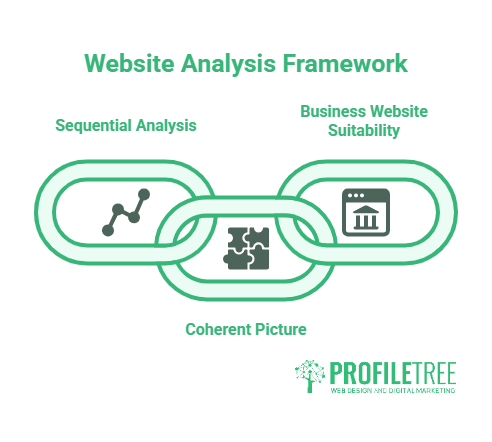
Running an analysis of a website in sequence helps you build a coherent picture rather than a disconnected list of issues. These six steps work for most business websites, from a small brochure site to a multi-service platform.
Step 1: Set a Baseline
Before making changes, establish what you’re working with. Pull three months of data from Google Search Console (pages and queries views), export your current Core Web Vitals from the CrUX report, and note your current organic traffic level in GA4. This baseline makes it possible to measure whether changes are working.
Step 2: Run the Technical Audit
Use Screaming Frog (free up to 500 URLs) or Semrush’s Site Audit to crawl the site. The report will flag broken links, redirect chains, missing meta tags, duplicate content, and pages blocked from indexing. Work through these systematically, starting with anything that affects crawlability.
Run Google PageSpeed Insights on your five most important pages: homepage, main service page, most-trafficked blog post, contact page, and any page that drives enquiries. Note the Core Web Vitals scores and the specific recommendations for each.
Step 3: Analyse Your Search Visibility
In Google Search Console, filter the Performance report to the last three months. Sort by impressions to find pages with high visibility and low CTR. These are your highest-priority optimisation targets. The content or metadata on those pages does not match the expectation created by the search query.
For keyword gap analysis, use Semrush or Ubersuggest. Enter your domain, then check the “keyword gap” or “missing keywords” report against one or two direct competitors. The queries they rank for that you don’t represent potential content opportunities.
Step 4: Review User Behaviour
Install Hotjar or Microsoft Clarity if not already in place. Review heatmaps and scroll maps on your top five pages. Watch five to ten session recordings for each page. Make a note of where users stop scrolling, what they click on, and where they appear confused or frustrated.
Cross-reference this with your GA4 conversion data. Which pages have high traffic but low conversions? Which have low traffic but high conversion rates? The latter are pages worth promoting more aggressively because the conversion mechanism is already working.
Step 5: Audit Your Content
Go through your top 20 pages by organic traffic. For each, ask: Does this page fully answer the query that drives traffic to it? Is the content more complete and specific than the competing pages currently ranking above it? Is there a logical next step for the user after reading it?
Flag thin pages (under 800 words for informational content), pages with duplicate or missing metadata, and pages that target queries already covered by another page on the site.
Step 6: Check UK Compliance
Run your site through your cookie consent platform’s audit tool if available. If not, manually visit the site in a private browser and note whether the cookie banner appears, whether it includes equal options, and whether declining cookies still loads the page correctly. Check your privacy policy against the UK-GDPR requirements for transparency.
Run an automated accessibility check using Axe or WAVE. Note any critical failures (missing alt text, form fields without labels, empty heading tags) and flag these for immediate attention.
[YOUTUBE EMBED: Digital training: https://youtu.be/SKoIm0T8OMQ | “Digital Skills Training with ProfileTree”]
If this level of analysis is beyond current internal capacity, ProfileTree’s digital strategy service includes a structured discovery and audit process as the foundation for any engagement.
Free vs Paid Tools: What You Actually Need
| Tool | Primary Use | Cost | Best For |
|---|---|---|---|
| Google Search Console | SEO visibility, indexation, Core Web Vitals | Free | All sites |
| Google Analytics 4 | Traffic, behaviour, conversions | Free | All sites |
| PageSpeed Insights | Technical performance | Free | All sites |
| Microsoft Clarity | Heatmaps, session recordings | Free | SMEs |
| Screaming Frog | Technical crawl audit | Free up to 500 URLs; £199/yr | SMEs and agencies |
| Semrush | Full SEO + keyword gap analysis | From £99/month | Agencies, competitive sectors |
| Ubersuggest | SEO overview, keyword research | Free limited; from £29/month | Small businesses |
| Hotjar | Advanced behavioural analysis | Free limited; from £32/month | Conversion optimisation |
| Axe / WAVE | Accessibility audit | Free browser extensions | All UK businesses |
For a zero-budget analysis, the combination of Google Search Console, Google Analytics 4, PageSpeed Insights, Microsoft Clarity, and the free tier of Screaming Frog covers technical performance, SEO visibility, and user behaviour. The gap in this budget is competitive keyword data and full-site crawl capability beyond 500 URLs.
Ubersuggest’s free tier provides enough competitive insight for small businesses with straightforward websites. For businesses in competitive markets or managing sites with hundreds of pages, Semrush or Ahrefs provides the depth needed for a meaningful gap analysis.
The Prioritisation Matrix: Turning Data Into Action
The most common failure in website analysis isn’t the analysis itself; it’s what happens next. Businesses end up with a list of 60 issues and no framework for deciding which to fix first.
A simple prioritisation matrix separates findings into four quadrants based on two factors: business impact and ease of fix.
| Easy to Fix | Hard to Fix | |
|---|---|---|
| High Impact | Fix immediately | Plan and resource |
| Low Impact | Fix when convenient | Consider deferring |
Apply this to your findings:
- Fix immediately (high impact, easy): Missing meta descriptions on key service pages, broken internal links to high-value pages, cookie consent banner that doesn’t meet UK-GDPR requirements, images without alt text on prominent pages.
- Plan and resource (high impact, hard): Site rebuild to address Core Web Vitals failures caused by the current theme or hosting, creation of content to cover high-volume keyword gaps, and structural changes to improve mobile navigation.
- Fix when convenient (low impact, easy): Minor formatting inconsistencies, outdated footer links, blog posts with thin content on low-traffic queries.
- Defer (low impact, hard): Advanced schema markup for low-traffic pages, aesthetic redesign of sections with acceptable conversion rates, migration to a new CMS platform without a clear performance rationale.
The prioritisation step is what separates analysis from action. A detailed technical report that sits in a folder delivers no value. A short list of ten ranked fixes, with owners and deadlines, changes things.
For businesses that want support moving from analysis to implementation, ProfileTree’s website hosting and management service includes ongoing performance monitoring and structured fix cycles.
Social and Content Signals Worth Including
Website analysis increasingly needs to account for off-site signals. How well your social channels reinforce the brand and drive relevant traffic affects overall digital performance. ProfileTree’s social media marketing service approaches this as part of an integrated digital presence rather than a separate channel.
For businesses exploring AI-driven content tools as part of their analysis and content workflow, ProfileTree’s AI training service covers practical applications for SMEs, including how to use AI responsibly in content creation and SEO processes.
Conclusion
An analysis of a website is worth doing properly once rather than superficially several times. The five-pillar framework for analysis of a website (technical performance, SEO visibility, user behaviour, content quality, and UK compliance) gives a complete picture of where a site stands and what’s holding it back.
The prioritisation matrix turns that picture into a manageable action list. Not every issue requires urgent attention. The ones that do are usually a small subset of the total findings, and acting on those first produces the most measurable improvement.
If you’d like to discuss a structured website analysis for your business, get in touch with the ProfileTree team.
Frequently Asked Questions
What is the difference between a website audit and a website analysis?
A website audit is a health check: it identifies technical problems such as broken links, slow load times, or indexation errors. A website analysis is broader and more strategic. It covers SEO visibility, user behaviour, content gaps, and compliance alongside the technical layer, and produces a prioritised action plan rather than just a list of errors.
How do I analyse a website for free?
The combination of Google Search Console, Google Analytics 4, PageSpeed Insights, Microsoft Clarity, and the free tier of Screaming Frog (up to 500 URLs) covers the core pillars of analysis at no cost. Add the free browser extensions Axe or WAVE for accessibility checks. This toolkit is sufficient for most small business websites.
How often should a website analysis be done?
A full analysis covering all five pillars is realistic once per quarter. Monthly reviews should track Core Web Vitals, GSC performance data, and conversion rates. Any significant site change (a redesign, a CMS migration, a major content push) warrants an ad hoc analysis before and after.
What should a website analysis report include for stakeholders?
An executive summary with the three to five most significant findings. Current performance benchmarks (organic traffic, conversion rate, Core Web Vitals scores). A prioritised list of recommended fixes with estimated business impact. Compliance status for UK-GDPR and accessibility. A timeline for implementation.
Are UK websites legally required to be accessible?
Public sector websites and mobile apps must meet WCAG 2.1 AA standards under the Public Sector Bodies Accessibility Regulations 2018. Private sector businesses face obligations under the Equality Act 2010, which requires reasonable adjustments for disabled users. Courts have found that digital accessibility falls within this duty. A WCAG-compliant site also performs better in search, as many accessibility best practices overlap with SEO best practices.