
Sustainable Digital Marketing: An SME Efficiency Guide
Table of Contents
Sustainable digital marketing is less about brand messaging and more about how a business chooses to run its online activity. For SMEs across Northern Ireland, Ireland, and the UK, the most practical version of this conversation is not about carbon offsetting or green logos; it is about cutting wasted spend, building a leaner website, and producing content that actually earns its place.
Done properly, a sustainable digital marketing strategy reduces overheads, improves conversion rates, and positions a brand to meet the growing expectations of customers, procurement partners, and grant bodies who are increasingly asking questions about responsible business practices.
This guide sets out what sustainable digital marketing means in real operational terms, what UK regulations require, and how to apply an efficiency-first approach to web design, SEO, and content.
What Sustainable Digital Marketing Actually Means
The phrase is used loosely. At its most useful, sustainable digital marketing describes two related things.
The first is environmental: the internet consumes significant energy. Data centres, video streaming, ad delivery networks, and bloated websites all draw power. The Shift Project, a French climate think tank, estimated that digital technology accounted for around 3.5% of global greenhouse gas emissions as of 2019, with energy consumption growing at roughly 9% a year.
The second is strategic: a marketing approach built on volume, vanity metrics, and short-term tactics is not sustainable in a business sense. Campaigns that generate traffic without conversions, content that is never read, and ad spend chasing the wrong audience all represent wasted resources.
The overlap between these two concerns is where sustainable digital marketing delivers the most value for SMEs. A fast, efficient website uses less energy and converts better. Targeted SEO attracts fewer but more relevant visitors, reducing server requests without sacrificing results. A disciplined content strategy that refreshes existing assets rather than constantly creating new ones reduces production costs and server load simultaneously.
“The businesses that benefit most from sustainable digital practices are usually the ones who treat efficiency as a design principle from the start, not an afterthought,” says Ciaran Connolly, founder of ProfileTree.
The Environmental Cost of Digital Waste
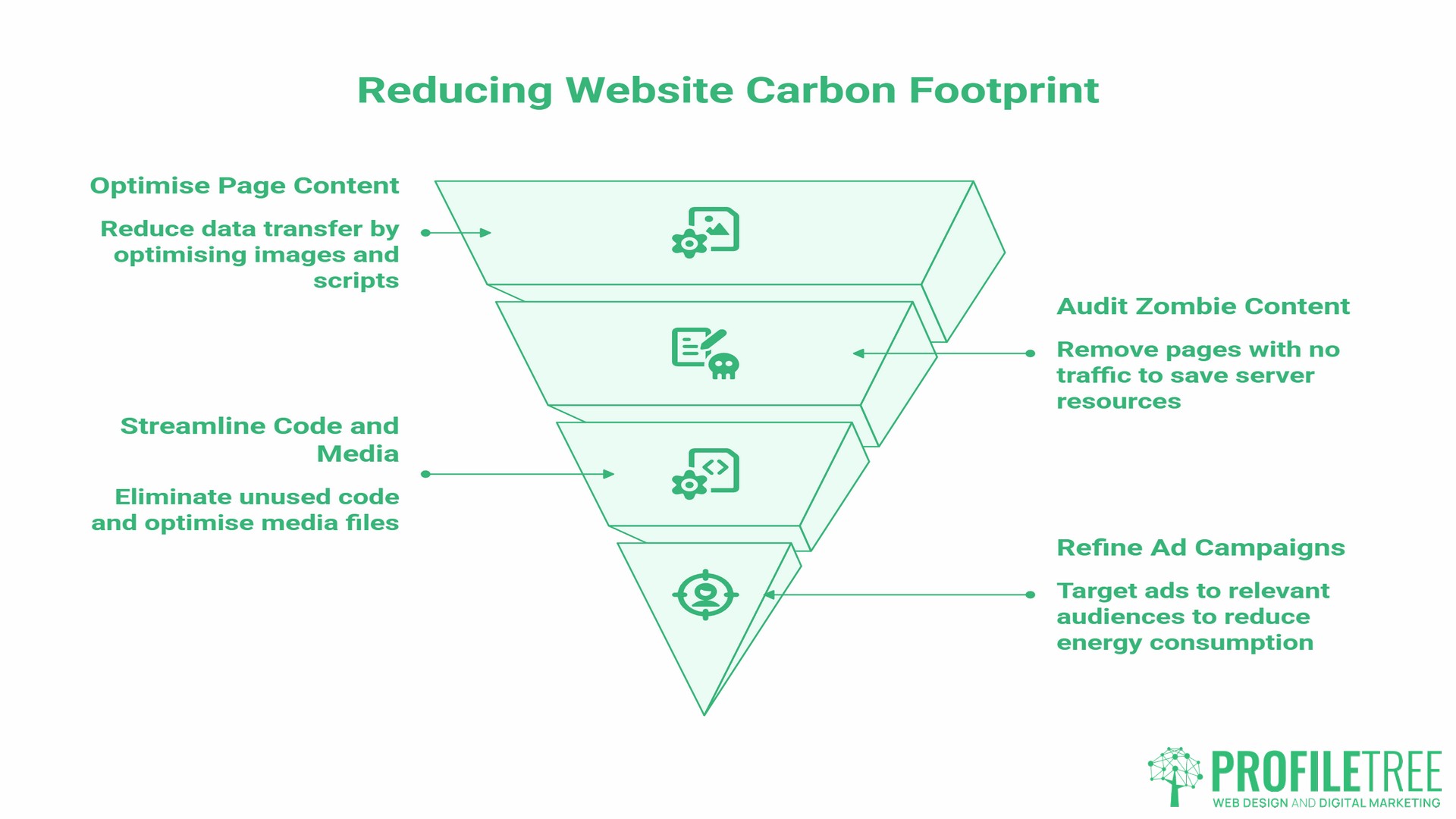
Every page on a website has a carbon footprint. A page heavy with uncompressed images, unused scripts, and third-party trackers draws more data through the network on every visit than a lean, well-built page does. Multiply that difference by thousands of monthly visits, and the energy gap becomes material.
Website Carbon (websitecarbon.com) offers a free calculator that estimates the CO₂ emitted per page view based on data transfer volume and the energy source of the hosting provider. Google Lighthouse, accessible through Chrome DevTools, measures page performance and identifies the specific assets inflating load times. Both tools provide SMEs with a starting point for understanding the environmental costs of their current website.
Beyond individual pages, digital waste accumulates in a few common places.
- Zombie content: Pages that receive no traffic and serve no search intent consume server resources and dilute a site’s overall authority. An annual content audit that identifies and consolidates or removes these pages is both an SEO best practice and a waste-reduction measure. ProfileTree’s SEO checker tool can surface pages that are underperforming and costing more than they contribute.
- Bloated code and unoptimised media: Themes with unused functionality, plugins that load scripts on every page regardless of relevance, and images exported at print resolution rather than screen resolution all add weight without adding value. Web development decisions made at build time have a lasting impact on a site’s energy footprint.
- Unfocused ad campaigns: Paid campaigns with broad match targeting generate impressions and clicks from audiences who will never convert. Each ad delivery consumes energy and costs money. Tightening targeting to intent-based audiences reduces both.
The Three Pillars of a Sustainable Digital Strategy
High-Performance Web Design
A fast website is a greener website. The design and build decisions that reduce page weight, compress images, use efficient code, minimise third-party scripts, and provide a reliable hosting environment also improve load times, which in turn improve user experience and search rankings.
For SMEs, this translates to a few practical priorities. When choosing a hosting provider, look for one that publishes a verified commitment to renewable energy for its data centres; the Green Web Foundation maintains a publicly searchable database of verified green hosts at thegreenwebfoundation.org. Image formats also matter: according to Google’s own compression research, WebP lossy images are 25–34% smaller than comparable JPEGs at equivalent quality. Every image converted reduces bandwidth on every page load.
Intuitive navigation reduces the number of pages a visitor loads before finding what they need. That is good UX design, and it reduces unnecessary server requests. A well-structured site where the most important information is reachable in two clicks serves the user, the search engine, and the environment.
ProfileTree’s web design and development work is built around performance as a foundation, not a finishing step. The connection between a well-built site and lower operational energy consumption is direct.
Targeted SEO Over Volume Traffic
One of the clearest efficiency arguments in sustainable digital marketing involves how SEO is approached. A strategy that chases high search volumes regardless of relevance generates traffic that bounces without converting. Each visit consumes server energy, loads assets, and produces no commercial return.
Intent-based SEO targets the specific queries that signal genuine interest in a business’s offerings. A roofing company in Belfast that ranks well for “roof repair Belfast emergency” attracts fewer visitors than one ranking for “roofing,” but those visitors are far more likely to become customers. Fewer irrelevant sessions mean a lower digital footprint and a higher return on the investment made in producing and hosting the content.
Maximising ROI in digital marketing campaigns requires exactly this kind of targeting discipline. When the SEO strategy is built around commercial intent rather than traffic volume, the sustainability and the business case align naturally.
Local SEO is particularly well-suited to this approach. Businesses serving a defined geography, which describes the majority of SMEs in Northern Ireland and Ireland, benefit from ranking for location-specific queries rather than competing nationally for terms they cannot realistically win. The traffic is smaller in volume and significantly higher in quality.
The Circular Content Model
The dominant approach to content marketing in many businesses treats content as disposable: publish, move on, repeat. This model is expensive to produce, results in a site full of thin or dated content, and yields inconsistent search performance.
A circular content model starts with fewer, stronger pieces of content and extends their value through structured refreshes and repurposing. A comprehensive guide on a topic can be updated rather than replaced with current information. Key sections can be adapted for social media, email newsletters, or short-form video. The original research or framework at the core of the piece retains its value because it is maintained rather than abandoned.
This approach costs less to run, produces fewer new server-hosted assets, and typically performs better in search because Google rewards content that demonstrates sustained relevance over time rather than a single spike of freshness at publication.
A social media content strategy built on this model produces results that compound rather than reset with each new publishing cycle.
Implementing Digital Sobriety in SME Campaigns
Digital sobriety is a term introduced by the Shift Project to describe reducing unnecessary data consumption and server requests across digital activity. In practical terms, for SMEs, it shows up in a few specific areas.
- Email marketing list hygiene: An email sent to 10,000 subscribers, of whom a large proportion have not opened a message in the past 12 months, costs more in server energy and delivery fees than one sent to a smaller, engaged list. Regular list cleaning, suppressing contacts who have not engaged over a defined period, reduces the footprint of every send and typically improves deliverability rates at the same time.
- PPC frequency management: Showing an ad to the same user many times before they convert is more wasteful than a campaign built around frequency caps and negative keyword lists that prevent serving ads to audiences who have already signalled disinterest. Reducing ad frequency fatigue is both a budget-efficiency measure and a way to reduce unnecessary data consumption.
- Video optimisation: Video is the highest-bandwidth content format in digital marketing. Embedding video from a hosted platform such as YouTube rather than self-hosting reduces the load placed on a site’s own server. Choosing appropriate resolution settings for the likely viewing context, rather than defaulting to the highest available, reduces data transfer per view.
The video below from ProfileTree provides a broader view of building a digital marketing approach that delivers results without unnecessary resource expenditure.
UK Regulations: Avoiding the Greenwashing Trap
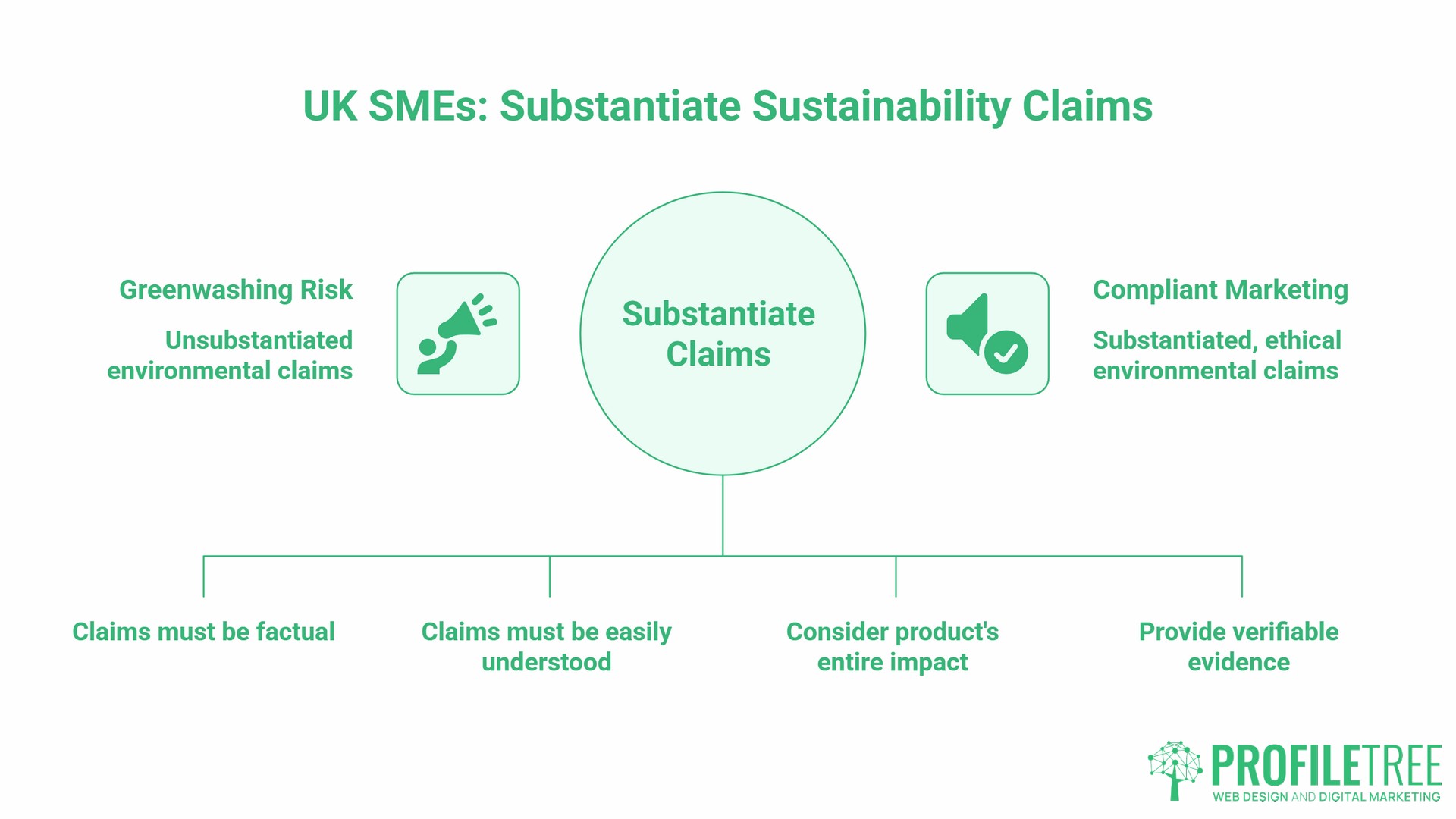
Sustainable digital marketing in the UK operates within a legal framework that many SMEs are not yet aware of. The Competition and Markets Authority published its Green Claims Code in September 2021, setting out requirements for businesses making environmental claims in marketing communications, including digital advertising and website copy.
The code sets out six key principles: claims must be truthful and accurate; claims must be clear and unambiguous; claims must not omit or hide material information; claims must only make fair comparisons; claims must consider the full life cycle of the product or service; and claims must be substantiated.
For SMEs, the practical risk is in overstatement. Describing a product as “carbon neutral” without a certified methodology, or calling a service “sustainable” without evidence of what that means operationally, puts a business at risk of regulatory action. Since April 2025, the Digital Markets, Competition and Consumers Act 2024 has given the CMA direct powers to determine breaches of consumer law and impose fines of up to £300,000 or up to 10% of global annual turnover for serious violations. The code applies to all marketing channels, including social media posts, landing page copy, and email campaigns.
The EU Corporate Sustainability Reporting Directive introduces additional requirements for larger businesses operating in or trading with the EU, including those in Ireland. While most SMEs fall below the current thresholds, the direction of travel in regulation is clearly toward greater scrutiny of environmental claims across all business sizes.
Understanding the ethics and legalities of digital marketing is increasingly relevant for any SME publishing content that touches on environmental or social responsibility.
The practical implication for content and campaign teams is simple: only make claims you can evidence. If a business cannot point to a specific, verifiable action that supports a sustainability claim, that claim should not appear in marketing copy.
Measuring Sustainable Digital Marketing: Useful KPIs
Traditional digital marketing KPIs measure volume: sessions, impressions, and click-through rate. A sustainable digital marketing framework adds an efficiency dimension to each of these.
| Metric | Traditional focus | Sustainability lens |
|---|---|---|
| Traffic | Total sessions | Qualified sessions (low bounce rate) |
| Content | Pages published | Pages actively driving traffic or conversions |
| List size | Engaged subscribers; open and click rates | |
| Paid media | Impressions delivered | Cost per conversion; impression share on intent queries |
| Website | Page views per visit | Core Web Vitals scores; page weight in KB |
Carbon per conversion is an emerging metric used by some agencies and in-house teams to quantify the environmental cost of acquiring an online customer. It combines estimated page carbon data (available from tools such as Website Carbon) with conversion volume to produce a figure that can be tracked over time. It is not yet a standard reporting metric for most SMEs, but it provides a useful frame for prioritisation: reduce the footprint of the pages that receive the most traffic first.
Digital training for business teams at ProfileTree covers practical approaches to reading and acting on performance data, including building reporting frameworks that reflect both commercial and efficiency goals.
The SME Sustainable Marketing Checklist
A practical starting point for SMEs reviewing their current digital marketing against an efficiency framework:
- Run your homepage through Website Carbon and Google Lighthouse. Note the page weight and the largest contributing assets.
- Audit your content. Identify pages that have received no organic traffic in the past twelve months and decide whether to consolidate, update, or remove them.
- Review your hosting provider. Check whether they are listed as a verified green host in the Green Web Foundation database.
- Check your email list. Suppress or remove contacts who have not engaged in the past six months.
- Review your PPC campaigns. Add negative keywords, apply frequency caps, and check that targeting is aligned with purchase intent rather than broad interest.
- Audit your environmental claims. Every sustainability-related statement in your marketing copy must be accurate, specific, and substantiable under the CMA Green Claims Code.
- Move images to WebP format. According to Google’s compression research, WebP files are 25–34% smaller than JPEG at equivalent visual quality, reducing bandwidth on every page load.
- Review your content production pace. Identify three to five existing pieces that could be refreshed and expanded rather than replaced by new content this quarter.
- Tighten your keyword targeting. Identify the highest-converting search terms on your site and confirm your SEO strategy is actively reinforcing rankings for those terms specifically.
- Set an efficiency baseline. Record current Core Web Vitals scores, page carbon estimates, and email engagement rates so that improvements can be measured.
Frequently Asked Questions
What is sustainable digital marketing?
Sustainable digital marketing is the practice of running online marketing activities in ways that reduce environmental impact, avoid resource waste, and remain viable in the long term. In practical terms for SMEs, it means building efficient websites, targeting the right audience rather than the largest one, and producing content that retains value over time rather than being discarded after a single publishing cycle.
How do I calculate my website’s carbon footprint?
The most accessible starting point is Website Carbon (websitecarbon.com), which estimates the CO₂ emitted per page view based on data transfer size and the energy source of the hosting provider. Google Lighthouse, available in Chrome DevTools, measures page performance and identifies the assets contributing most to page weight. Together, they give a reasonable picture of where the largest reductions are available.
What is the UK Green Claims Code, and does it apply to my digital marketing?
Yes. The Green Claims Code, published by the Competition and Markets Authority and in effect since September 2021, applies to all marketing communications, including website copy, social media posts, and email campaigns. It requires that any environmental claim be accurate, substantiated, clear in scope, and not misleading by omission. Since April 2025, the CMA has had direct enforcement powers under the Digital Markets, Competition and Consumers Act 2024, including the ability to impose fines of up to 10% of global annual turnover for serious violations.
Can a more sustainable digital marketing approach reduce costs?
Yes, in several areas. A faster, lighter website typically costs less to host at scale and converts better, reducing the cost per acquisition. Email list cleaning reduces delivery costs and often improves deliverability. Targeted PPC wastes less spend on non-converting impressions. A circular content model reduces the production cost of maintaining search rankings over time. The business case and the environmental case point in the same direction.
What is digital sobriety?
Digital sobriety is a term developed by the Shift Project to describe reducing unnecessary data consumption and processing across digital activity. It covers decisions such as list cleaning in email marketing, frequency capping in paid media, image compression, and removing redundant content from a website. The aim is to do more with less data, reducing both costs and energy use.
Does green hosting improve SEO rankings?
Not directly. Google has not confirmed green hosting as a ranking factor. The performance benefits associated with well-maintained, modern data centres, including faster response times and higher uptime, do contribute to Core Web Vitals scores, which are a confirmed ranking input. The SEO benefit comes from the performance, not the hosting provider’s energy credentials.