
B2B Content Marketing Statistics: What the 2026 Data Actually Shows
Table of Contents
B2B content marketing statistics tell a more complicated story in 2026 than most round-up articles admit. Adoption is near-universal, budgets are rising, and AI has removed most of the production barriers that once slowed teams down. What the data also shows, though, is that the gap between organisations producing content and those actually converting it into the pipeline has widened. For UK SMEs, that gap is where the real strategic question sits.
This article draws on current research from the Content Marketing Institute, HubSpot, DemandSage, and SeoProfy to map where UK B2B content marketing stands, where the measurable opportunities are, and what the numbers say about format, distribution, and measurement priorities in 2026. ProfileTree works with businesses across Northern Ireland, Ireland, and the UK on exactly these challenges, and the patterns we see on client projects broadly mirror what the data shows.
What Makes B2B Content Marketing Work in 2026
The fundamentals of B2B content marketing have undergone significant shifts. Where volume once mattered, strategic authority now wins. UK businesses face a specific challenge: buyers complete extensive research independently before engaging with sales teams, making your content the primary sales tool during the critical consideration phase.
Modern B2B content marketing encompasses more than just blog posts and social updates. It encompasses strategic audience intelligence, expert-led creation, multi-channel distribution and measurable business outcomes. For UK SMEs working with agencies like ProfileTree, this means content must serve both ranking objectives and revenue generation simultaneously.
The distinction between successful and struggling content strategies often comes down to three factors: understanding the complexity of UK B2B buyer journeys, addressing the distribution gap that leaves quality content unseen, and integrating genuine subject matter expertise to combat AI-generated mediocrity.
The UK B2B Buyer Journey Has Transformed
B2B buyers now complete approximately 70% of their research before contacting sales representatives. This self-education phase requires content that addresses complex, technical, and commercial questions typically reserved for boardroom discussions. Surface-level SEO topics no longer satisfy the information requirements of senior decision-makers.
UK professional audiences respond differently to content than their international counterparts. Evidence-based authority, understated expertise, and clear regulatory context (UK GDPR, FCA compliance, sector-specific requirements) resonate more effectively than hyperbolic claims or disruption narratives. Content services that ignore these nuances create barriers between brands and prospects.
Risk mitigation plays a significant role in the UK B2B purchasing process. Content focusing solely on benefits appears superficial to experienced buyers. Strategic content must address “the cost of inaction,” providing internal champions with data and business cases required to secure budget approval from CFOs and boards.
Key B2B Content Marketing Statistics for 2026
Data from recent industry research reveals how UK B2B marketers are allocating resources and measuring success across content initiatives.
Strategy & Adoption Statistics:
- 91% of B2B marketers now use content marketing as part of their overall strategy, according to 2026 data from SeoProfy and DemandSage
- Only 40% of B2B marketers maintain a documented content marketing strategy, according to current CMI research.
- 61% of B2B marketers are increasing their overall marketing spend in 2026, according to the Content Marketing Institute. The top investment priorities are AI-powered marketing tools (45%), events and experiential marketing (33%), and owned media including content, websites, and email (32%).
- B2B marketers allocate between 22% and 29% of their marketing budget to content activities, depending on company size and sector, according to combined CMI and HubSpot 2026 data. Larger mid-market businesses typically sit toward the higher end of that range, investing between £5,000 and £10,000 per month in content production and distribution.
Content Effectiveness & Challenges:
- 60% of marketers identify engaging content as their primary challenge
- 72% of B2B marketers cite measuring content marketing ROI as their biggest challenge
- 61% of B2B marketers report content marketing as their most effective lead generation strategy
- 76% report that content marketing helps them reach and engage target audiences more effectively
Content Formats & Channels:
- 82% of B2B marketers use video as part of their content strategy
- 95% of B2B marketers use LinkedIn to distribute content
- 93% of B2B marketers use social media platforms for content distribution
- 80% of B2B marketers use email as part of their content marketing strategy
- 40% of B2B marketers identify email as the most critical channel for content distribution
These statistics highlight a fundamental tension: widespread adoption and planned investment increases alongside persistent challenges with engagement, measurement, and ROI demonstration. This gap represents an opportunity for businesses willing to adopt more sophisticated approaches.
Emerging Content Marketing Trends Shaping UK B2B Strategy
Several trends are reshaping how UK B2B organisations approach content creation and distribution. Understanding these shifts enables businesses to allocate resources effectively and maintain a competitive edge.
Video Content Dominance
Video remains the most engaging format for B2B content. Beyond top-of-funnel awareness content, UK businesses are using video for product demonstrations, client testimonials, technical explainers, and thought leadership pieces. For companies working with agencies like ProfileTree on video production, the focus has shifted from pure creativity to strategic video content that advances prospects through consideration stages.
Video is now the second most-used content format among B2B marketers, behind only in-person events, according to LinkedIn’s 2026 B2B marketing data. 72% of B2B marketers consider video marketing essential, and 59% cite it as a top-performing channel for reaching decision-makers.
Personalisation Becomes Non-Negotiable
80% of B2B marketers prioritise creating personalised content for their target audiences. This extends beyond inserting company names into email templates. True personalisation means creating content that addresses specific industry challenges, company size considerations, regional regulatory requirements, and stage-specific buyer journey needs.
UK businesses benefit from understanding that personalisation in B2B contexts often means creating industry-specific content variations rather than individual-level customisation. A manufacturing sector whitepaper addresses different pain points than a professional services case study, even when both discuss similar solutions.
Interactive Content Drives Higher Engagement
Interactive content, including quizzes, calculators, assessments, and tools, generates higher engagement and conversion rates than static content. These formats provide immediate value to users while capturing behavioural data that informs follow-up strategies.
For UK SMEs, interactive content doesn’t need to require extensive development resources. Simple assessment tools that help prospects evaluate their current state against best practices can be highly effective lead generation mechanisms whilst providing genuine utility.
Voice Search Optimisation
With increased adoption of voice assistants across professional environments, optimising content for natural language queries becomes more important. This affects keyword strategy, content structure, and the way technical topics are explained. Voice search optimisation aligns well with the UK preference for clear, direct communication over marketing hyperbole.
Sustainability and Social Responsibility Messaging
UK B2B buyers are increasingly evaluating suppliers based on their environmental sustainability and social responsibility credentials. Content addressing these topics demonstrates value alignment and can influence purchasing decisions, particularly within public sector procurement and amongst larger corporate buyers with formal ESG requirements.
“The businesses seeing real growth from content marketing are those treating it as a strategic revenue driver rather than a marketing checkbox,” notes Ciaran Connolly, Director at ProfileTree. “We work with clients to build content that directly supports their sales conversations and demonstrates measurable pipeline contribution.”
AI and Machine Learning Integration
83% of B2B marketers use SEO tactics in their content marketing strategy, and many are incorporating AI tools for data analysis, content personalisation, and process automation. However, the most successful strategies use AI to augment human expertise rather than replace it. Subject matter expert insights remain the differentiating factor that AI cannot replicate.
B2B vs B2C Content Marketing: What Changes and Why It Matters
Understanding the distinctions between B2B and B2C content marketing prevents resource misallocation and strategic missteps. These differences affect everything from content creation to distribution channel selection.
Audience Size and Specificity
B2B content targets smaller, more defined audiences of business decision-makers and influencers. This allows for greater specificity and depth but demands more precise targeting. Unlike B2C content designed for broad appeal, B2B content must speak directly to technical requirements, commercial considerations, and organisational dynamics.
Content Type and Purpose
B2B content tends to focus on informational and educational formats, emphasising problem-solving and demonstrating value. Whitepapers, case studies, technical guides, and industry reports perform well in B2B contexts. B2C content often prioritises entertainment and emotional engagement to drive immediate consumer action.
UK businesses benefit from understanding that B2B content serves as evidence and ammunition for internal advocates. Your content must equip the middle manager to convince their director, who then needs to persuade the board. This multi-stakeholder reality shapes content requirements.
Sales Cycle Length and Complexity
B2B sales cycles typically extend over months rather than days, requiring content that addresses the various stages of the extended buyer’s journey. B2C sales cycles are often shorter and more impulsive, driving different content priorities and formats. Your content strategy must provide relevant information at the consideration, evaluation, and decision stages, not just awareness.
Relationship Building vs Transaction Focus
B2B content marketing creates and nurtures long-term client relationships through thought leadership, case studies, and industry insights. This relationship-building approach contrasts with B2C strategies that focus on brand awareness, loyalty, and social media interaction. For UK professional services and technology companies, this relationship dimension is particularly important given the high value and duration of typical client engagements.
Measurement and Metrics
B2B content marketing prioritises metrics such as lead generation, conversion rates, pipeline contribution, and customer lifetime value. B2C content may focus more on social engagement, website traffic, and brand sentiment. This measurement difference affects how content success is defined and reported internally.
The Role of Subject Matter Expertise in B2B Content Creation
Generic content created without industry expertise fails to resonate with experienced B2B buyers. The proliferation of AI-generated content has made genuine subject matter expertise more valuable, not less. UK businesses working with agencies should prioritise those conducting subject matter expert interviews, sales call audits, and deep industry research over those simply producing SEO-optimised text.
High-performance B2B content is built on the extraction of internal expert knowledge. This includes interviewing technical specialists, reviewing sales conversations, analysing customer support queries, and synthesising product development insights. This approach creates content with a human fingerprint that competitors cannot easily replicate.
For ProfileTree clients, this means combining web design and development expertise with strategic content that demonstrates technical understanding. When discussing AI implementation or digital training, content must reflect practical experience rather than generic observations.
The Distribution Gap: Why Good UK B2B Content Still Falls Flat
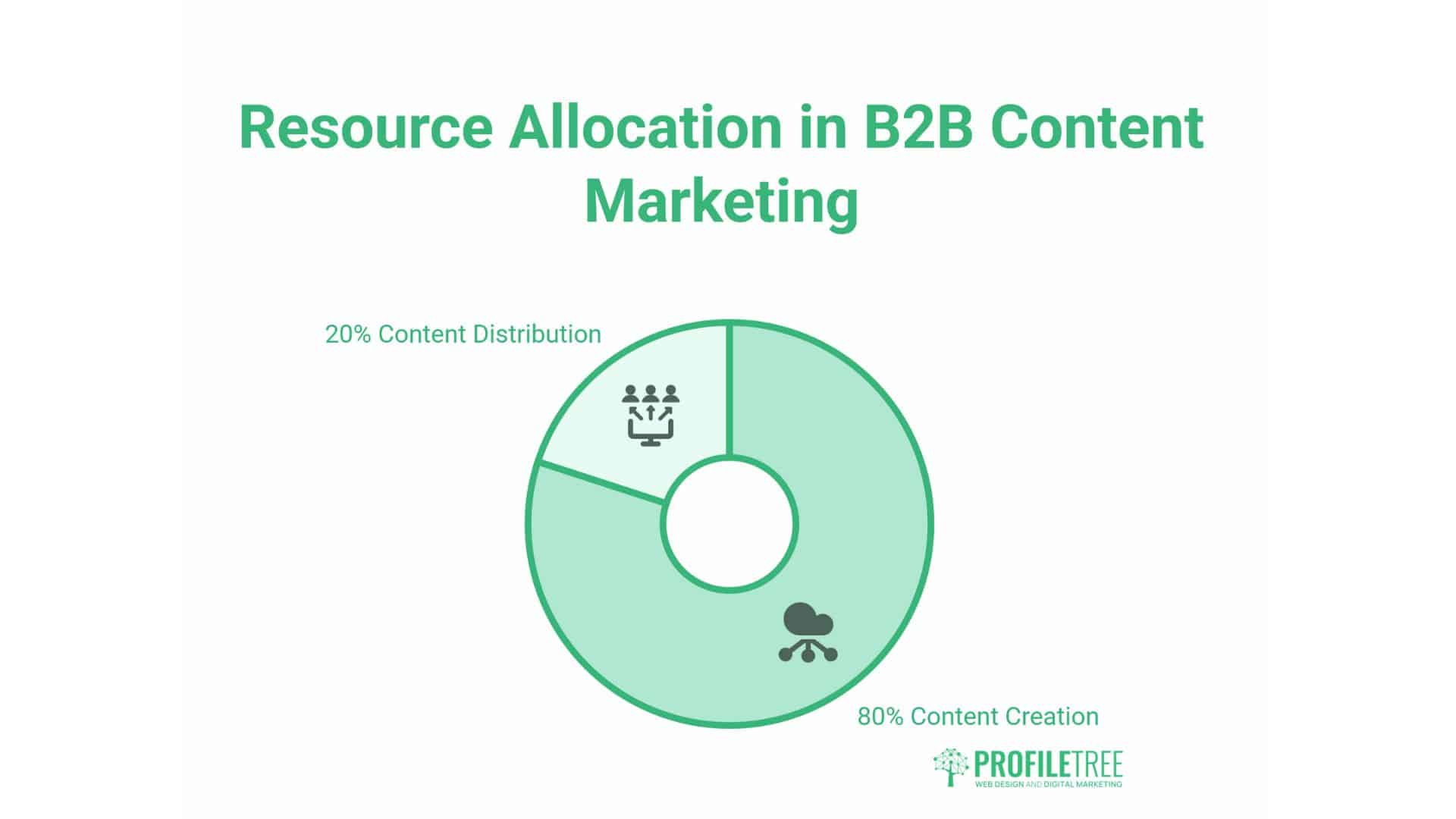
Creating excellent content represents only half the challenge. The “distribution gap”, the failure to effectively promote and distribute content to target audiences, undermines many UK B2B content strategies. Research consistently shows that businesses spend 80% of resources on creation and just 20% on distribution, when the reverse allocation often produces better results.
Social Amplification and Employee Advocacy
LinkedIn remains the leading platform for B2B lead generation, with 89% of B2B marketers using it for that purpose and 62% reporting it produces leads effectively, according to Sprout Social. Active use of LinkedIn as a distribution channel grew 11% year-on-year, reaching 42% of all marketers in 2026 (HubSpot).
Employee advocacy multiplies content reach without proportional cost increases. When team members share company content through personal LinkedIn profiles, it reaches new networks while carrying implicit endorsement. UK businesses should develop clear guidelines and toolkits, making employee content sharing straightforward and comfortable.
Content for Sales Enablement
Content marketing shouldn’t exist separately from sales activities. The most effective strategies create content specifically designed to support sales conversations and overcome common objections. This includes battle cards, competitor comparisons, ROI calculators, case studies addressing specific objections, and technical documentation that answers frequent prospect questions.
For UK SMEs, integrating content marketing with sales enablement means regular collaboration between marketing and sales teams. Sales representatives should influence content priorities based on prospect conversations, whilst marketing should track which content pieces contribute to deal progression and closure.
Email Marketing as a Distribution Channel
Despite the proliferation of new channels, email remains a highly effective means of distributing B2B content. 80% of B2B marketers use email as part of content strategies, with 40% identifying it as their most critical distribution channel. Email allows for segmentation, personalisation, and nurture sequences that guide prospects through extended buying cycles.
Effective email content marketing for UK B2B contexts involves sending valuable insights rather than promotional messages, segmenting lists by industry and role, incorporating video and interactive elements where appropriate, and maintaining a consistent cadence without overwhelming recipients.
Measuring B2B Content Marketing: Moving Past Vanity Metrics
The persistent challenge of measuring content marketing ROI, cited by 72% of B2B marketers, stems from focusing on the wrong metrics rather than the difficulty of measurement. Traffic and social shares represent engagement but don’t necessarily indicate business impact. Revenue-first attribution frameworks connect content consumption to commercial outcomes.
From MQLs to Pipeline Contribution
Marketing Qualified Leads (MQLs) provide a starting point for measurement but fall short of demonstrating true value. More sophisticated measurement tracks the role of content in pipeline creation, deal velocity, and revenue generation. This requires integration between content platforms and CRM systems, allowing visibility into which content pieces influence deal progression.
Key Performance Indicators for B2B Content:
| Metric Category | Specific KPIs | Business Relevance |
|---|---|---|
| Engagement | Time on page, scroll depth, content completion rate | Indicates content relevance and quality |
| Lead Generation | Content downloads, contact form submissions, newsletter signups | Measures top-of-funnel effectiveness |
| Pipeline Contribution | Closed revenue is influenced by content, customer acquisition cost, customer lifetime value | Demonstrates sales impact |
| Revenue Impact | Closed revenue is influenced by content, customer acquisition cost, and customer lifetime value | Proves ultimate business value |
| Content-influenced opportunities, deal velocity, and content engagement by opportunity stage | Cost per lead, cost per pipeline dollar, content ROI | Informs resource allocation decisions |
UK businesses should implement multi-touch attribution models, recognising that B2B buyers interact with multiple content pieces before making a purchase. First-touch attribution (crediting the initial content interaction) and last-touch attribution (crediting the final interaction) both provide incomplete pictures of the customer’s journey. Multi-touch models distribute credit across the buyer journey more accurately.
The Role of SEO in B2B Content Performance
83% of B2B marketers incorporate SEO tactics into content marketing strategies, making search visibility a critical performance factor. For UK businesses, effective SEO means understanding both broad industry terms and specific long-tail queries that high-intent buyers use during research phases.
Local SEO considerations become important for UK businesses serving specific regions. Content optimised for “SEO services Northern Ireland” or “digital marketing training Belfast” captures geographically specific demand while building regional authority. ProfileTree’s approach combines national visibility for broader terms with strong local positioning for regionally-focused services.
Technical SEO foundations, including site speed, mobile responsiveness, structured data, and proper internal linking, determine whether quality content achieves its ranking potential. Many UK SMEs focus exclusively on content creation while neglecting these technical factors, which limits their performance despite high-quality content.
Current SEO Trends Affecting UK B2B Strategies:
- Core Web Vitals: Google’s emphasis on loading speed, interactivity, and visual stability means content must exist within technically sound environments
- E-E-A-T (Experience, Expertise, Authoritativeness, Trustworthiness): Content demonstrating genuine expertise and experience ranks more effectively than generic information
- Mobile-First Indexing: Content must perform excellently on mobile devices, which now dominate B2B research activities
- Voice Search Optimisation: Natural language queries require different keyword targeting and content structuring approaches
- Local Search Emphasis: For regionally-focused services, local SEO factors significantly impact visibility
Video Marketing in UK B2B: From Nice-to-Have to Non-Negotiable
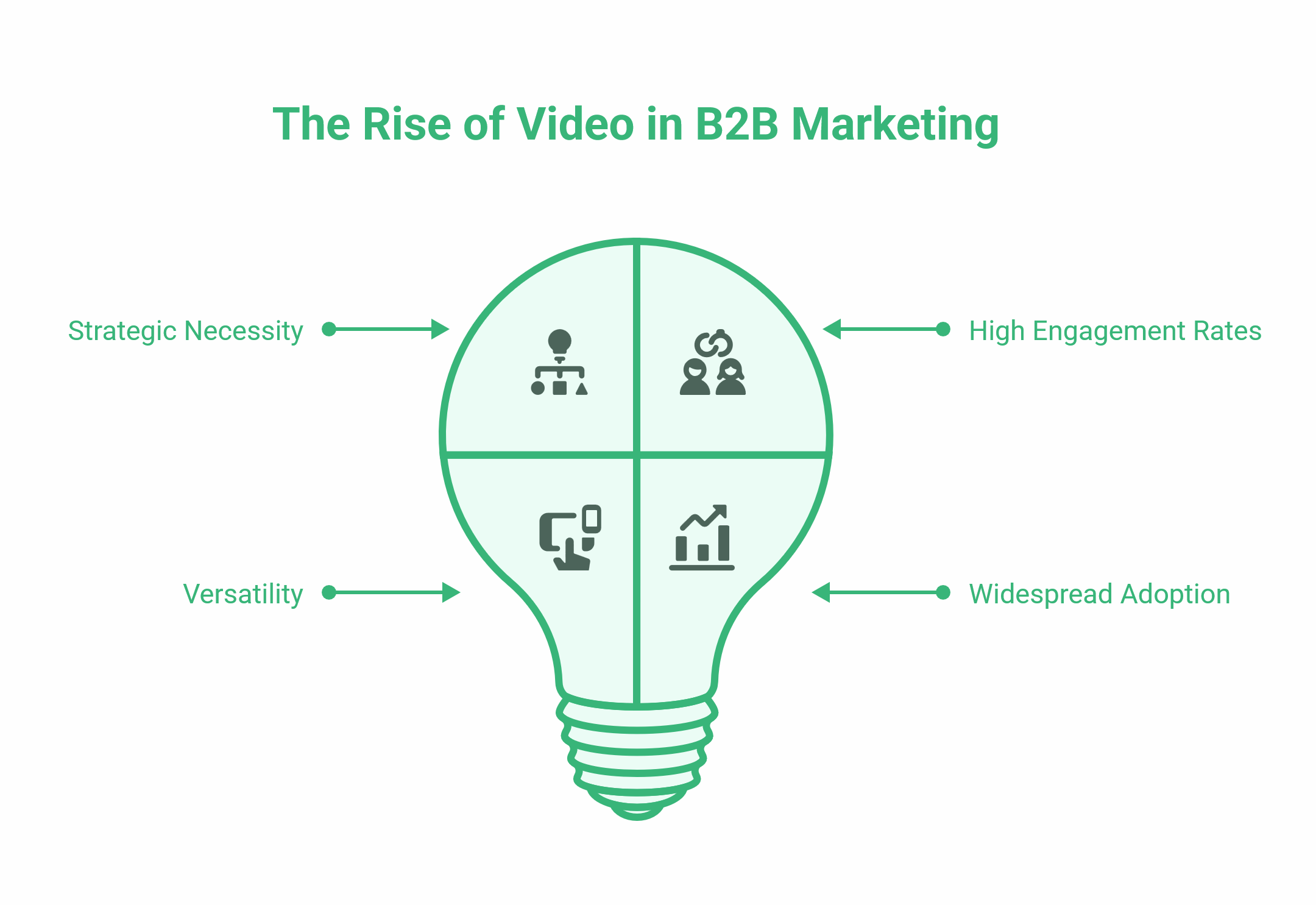
Video content has evolved from a “nice to have” element to a strategic necessity across B2B marketing. 82% of B2B marketers now incorporate video into their content strategies, driven by its superior engagement rates and versatility across various stages of the buyer journey.
Video Content Types for B2B Applications
Different video formats serve distinct purposes within comprehensive content strategies. UK businesses should deploy video strategically, rather than uniformly, matching the format to the objective.
- Thought Leadership Videos position executives and experts as industry authorities through commentary on trends, challenges, and opportunities. These work particularly well on LinkedIn for building personal and corporate brand authority. ProfileTree’s experience with video production emphasises authentic delivery over high production polish; executive credibility matters more than cinematographic perfection in B2B contexts.
- Product Demonstrations and Tutorials address the “how it works” questions that arise during the consideration stages. Technical products and complex services particularly benefit from video explanations that written content cannot match. Screen recordings with voiceover commentary provide a cost-effective format for demonstrating software and digital services.
- Client Testimonials and Case Studies delivered through video carry greater authenticity and emotional impact than written equivalents. Hearing satisfied clients describe experiences in their own words builds trust more effectively than corporate messaging. UK businesses should prioritise capturing these testimonials systematically as projects are completed successfully.
- Webinar Content and Educational Series serve multiple functions: lead generation through registration requirements, authority building through educational value delivery, and relationship nurturing through ongoing series. Webinars also generate repurposable content, including blog posts, social media clips, and email marketing material.
Video Distribution and Performance Optimisation
Creating video content represents just the starting point. Distribution strategy determines actual business impact. LinkedIn, YouTube, and website embedding each serve different purposes within comprehensive strategies.
LinkedIn native video posts typically achieve higher organic reach than link posts, making the platform effective for thought leadership and awareness content. YouTube serves as both a distribution channel and search engine, with B2B buyers often searching for solution comparisons and how-to content directly on the platform. Website embedding increases time on site and engagement metrics whilst keeping visitors within your digital ecosystem.
Video SEO considerations include descriptive filenames, transcripts for accessibility and search indexing, compelling thumbnails that drive click-through, and strategic keyword inclusion in titles and descriptions. For UK businesses, adding captions enhances accessibility while allowing for viewing in sound-sensitive professional environments.
How AI Is Changing B2B Content Marketing in the UK
Artificial intelligence has transformed content marketing capabilities whilst simultaneously raising the bar for what constitutes valuable content. UK businesses must navigate between AI efficiency gains and the authenticity requirements of B2B audiences.
AI Applications in Content Marketing
AI tools now support content ideation, keyword research, data analysis, personalisation, distribution timing optimisation, and performance tracking. These applications enhance efficiency and scalability without compromising strategic thinking or subject matter expertise.
- Content Creation Assistance: AI writing tools help overcome writer’s block and accelerate draft creation. However, treating AI output as final content produces generic results that fail to differentiate. The most effective approach utilises AI for identifying structural starting points and synthesising research, then combines human expertise, industry insights, and strategic positioning.
- Data Analysis and Insights: AI excels at analysing large datasets to identify patterns, trends, and opportunities. For content marketing, this means identifying which topics resonate with specific audience segments, determining optimal posting times, and recognising content gaps competitors haven’t addressed.
- Personalisation at Scale: AI enables content customisation based on user behaviour, company characteristics, and engagement history. This powers dynamic website content, personalised email sequences, and targeted content recommendations that previously required unsustainable manual effort.
- Performance Optimisation: Machine learning algorithms identify which content attributes correlate with success, informing future creation and distribution decisions. This includes optimal content length, heading structures, media inclusion, and call-to-action placement.
The Human Expertise Imperative
As AI-generated content proliferates, genuine expertise becomes increasingly valuable rather than less so. B2B buyers can recognise generic, AI-produced content and dismiss it accordingly. The competitive advantage lies in content that demonstrates real experience, nuanced understanding, and original thinking.
For UK businesses, this means investing in the involvement of subject matter experts, conducting original research and surveys, taking a stance on industry controversies, and sharing specific examples and case studies. ProfileTree’s approach to AI training and implementation emphasises using AI as an efficiency tool whilst maintaining the human expertise that builds client trust and authority.
Content marketing in the age of AI requires combining technological efficiency with human judgment, industry knowledge, and strategic thinking. Businesses that master this balance will outperform those relying exclusively on either AI or traditional approaches.
How to Choose a UK B2B Content Marketing Agency
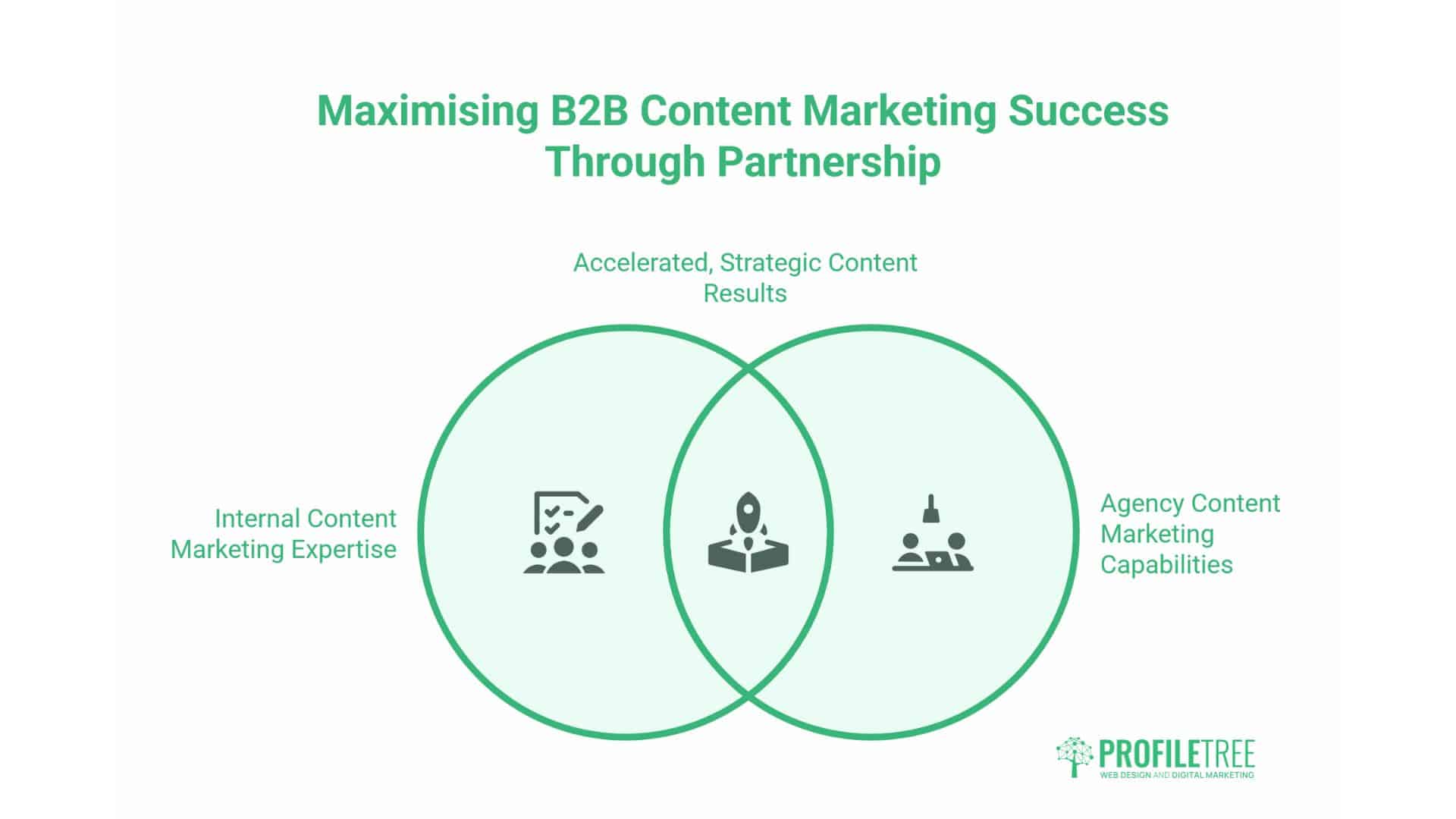
For businesses lacking internal content marketing expertise or capacity, partnering with an agency can accelerate results. However, selecting the right partner requires evaluating capabilities beyond surface-level promises.
Five Questions to Ask Potential Content Marketing Partners:
- How do you extract and incorporate subject matter expertise into content creation? Agencies should describe processes for interviewing their technical experts, reviewing sales conversations, and synthesising internal knowledge, rather than simply researching topics online.
- What’s your approach to content distribution, not just creation? Look for specific distribution strategies, channel expertise, and measurement frameworks rather than vague promises about “promoting your content.”
- Can you demonstrate measurable business impact from previous client work? Request case studies showing pipeline contribution, lead generation improvements, or revenue impact rather than just traffic increases or rankings achieved.
- How do you integrate content marketing with our sales process? Effective agencies understand sales enablement and can explain how content will support your specific sales conversations and overcome typical objections.
- What’s your approach to measurement and ongoing optimisation? Agencies should articulate clear KPIs, reporting cadence, and optimisation processes rather than treating content as “set and forget.”
For UK SMEs, working with agencies like ProfileTree that combine content expertise with technical capabilities, such as web design, SEO, video production, and AI implementation, provides integrated solutions rather than disconnected service components. This integration improves efficiency and ensures consistent messaging across digital touchpoints.
Building a Revenue-First B2B Content Strategy for 2026
Moving beyond generic content approaches requires adopting a revenue-first philosophy that connects every content initiative to business outcomes. This strategic framework guides decisions about topic selection, format choices, distribution priorities, and measurement approaches.
Strategy Development Process
- Audience Intelligence: Start with a deep understanding of your target buyers, their challenges, decision-making processes, and information needs at each stage. This goes beyond demographic profiling to psychographic and behavioural insights. Conduct customer interviews, analyse sales call recordings, and review lost deal post-mortems to understand real buyer thinking.
- Content Audit and Gap Analysis: Evaluate existing content against buyer journey stages and competitor offerings to identify gaps and opportunities for improvement. Identify gaps where prospects need information you haven’t provided, opportunities where competitors have overlooked important topics, and underperforming content that requires optimisation or retirement.
- Strategic Prioritisation: Not all content opportunities merit equal investment. Prioritise based on commercial potential (topics relevant to high-value offerings), competitive advantage (topics where you possess unique expertise), and search opportunity (terms with meaningful volume and achievable rankings). UK businesses should factor regional considerations into prioritisation.
- Creation Excellence: Develop content that demonstrably surpasses competitor alternatives in depth, specificity, and utility. This means longer-form comprehensive guides rather than surface-level blog posts, original research rather than recycled statistics, and specific implementation guidance rather than general principles.
- Distribution Intensity: Allocate significant resources to content promotion across owned, earned, and paid channels. This includes social media amplification, email nurture sequences, sales enablement integration, industry publication outreach, and strategic paid promotion.
- Measurement and Optimisation: Implement tracking to connect content consumption to pipeline and revenue outcomes. Establish regular review cadences to examine performance data, user feedback, and competitive shifts. Use insights to refine strategy continuously rather than treating content marketing as a fixed programme.
FAQs
What percentage of B2B marketers use content marketing?
94% of B2B marketers use content marketing as part of their overall strategy, demonstrating near-universal adoption. However, effectiveness varies significantly based on strategic sophistication and execution quality.
What is the biggest challenge in B2B content marketing?
72% of B2B marketers identify measuring content marketing ROI as their biggest challenge, followed by 60% citing engaging content creation as a primary difficulty. These challenges reflect the complexity of B2B attribution and the rising expectations of the audience.
How much should UK businesses allocate to content marketing?
B2B marketers allocate an average of 28% of their marketing budget to content marketing activities, with 75% planning to increase spending in the coming year. Appropriate allocation depends on the industry, competitive intensity, and the existing marketing mix.
What content formats are most effective for B2B marketing?
Video (used by 82% of B2B marketers), email marketing (80%), social media content (93%), and SEO-optimised written content (83%) all demonstrate strong effectiveness. The optimal mix depends on target audience preferences and buying cycle characteristics.
Conclusion: The Future of B2B Content Marketing
The B2B content marketing statistics from 2026 point in one clear direction: production is no longer the constraint. With AI lowering the cost of content creation and 91% of B2B marketers already active in the space, the organisations pulling ahead are those solving the harder problems, distribution, measurement, and genuine information gain.
For UK businesses, three things stand out from the data. First, a documented strategy still separates top performers from the rest; the gap between marketers who measure ROI and those who do not is not a technology problem, it is a planning one. Second, owned channels, particularly email, SEO, and a well-maintained website, continue to deliver the strongest ROI despite the noise around newer platforms. Third, the rise of AI in search means content now needs to serve two audiences simultaneously: the human buyer conducting independent research and the AI system deciding what to cite.