
AR VR Web Design: Practical Business Applications
Table of Contents
The integration of augmented reality (AR) and virtual reality (VR) into web design represents a significant shift in how businesses engage with their customers online. For SMEs across Northern Ireland, Ireland, and the UK, these immersive technologies are no longer confined to gaming or entertainment—they’re becoming practical tools for showcasing products, delivering training, and creating memorable brand experiences that convert visitors into customers.
This article examines the real-world applications of AR VR web design, focusing on implementations that deliver measurable business value rather than technological novelty for its own sake. We’ll explore how businesses can integrate these technologies into their websites to create competitive advantages and improve customer engagement.
Understanding AR and VR in the Web Context

Before implementing AR VR web design, businesses must understand the fundamental differences between these technologies and how they function within web browsers. This knowledge shapes decisions about which technology suits specific business objectives and customer needs.
AR VR web design requires understanding how these technologies function differently within browser environments. Augmented reality overlays digital information onto the real world through a device’s camera, allowing users to visualise products in their own environment before making a purchase.
Virtual reality creates fully immersive digital environments that users can explore, typically through headsets but increasingly through web browsers using WebXR technology. The distinction matters for web implementation because AR experiences often work directly through mobile browsers without requiring app downloads, making them accessible to a broader audience.
For businesses considering these technologies, the key question isn’t whether AR or VR is more advanced—it’s which creates the most value for your specific customers and business model. WebVR and WebXR standards now enable browser-based virtual experiences that work on standard devices, albeit with reduced immersion compared to headset experiences.
Practical AR Applications for Business Websites
Augmented reality applications offer immediate practical value for businesses across multiple sectors. These implementations focus on solving specific customer problems rather than showcasing technology for its own sake.
Product Visualisation and Placement
AR VR web design enables customers to visualise products in their real-world environments before purchasing. Furniture retailers, home improvement companies, and interior design firms have pioneered AR product visualisation, allowing customers to point their smartphone at a space in their home and see exactly how a sofa, paint colour, or lighting fixture would look.
This application extends beyond home goods into automotive, fashion, and industrial sectors. Automotive dealerships use AR to let potential buyers configure vehicle colours and options in their driveway, whilst fashion retailers enable virtual try-ons for glasses, watches, and jewellery.
The technical implementation typically involves 3D product models, spatial recognition algorithms, and lighting adjustment systems that make virtual objects appear realistic in real environments. Modern JavaScript frameworks and WebGL make these experiences deliverable through standard mobile browsers without requiring native apps.
Interactive Product Demonstrations
Complex products that require explanation benefit significantly from AR demonstrations within AR VR web design frameworks. Rather than watching a two-dimensional video or reading specifications, customers can interact with a three-dimensional model, rotating it, viewing internal components, and understanding functionality through animated sequences.
B2B companies selling technical equipment find this particularly valuable for communication. An engineering firm can demonstrate how a water filtration system works by letting prospects explore an AR model that shows water flow, filtration stages, and maintenance points.
This level of interaction communicates technical information more effectively than traditional web content. Manufacturing companies use AR to allow engineers to visualise industrial equipment in their facilities to assess spatial requirements before purchase.
Virtual Showrooms and Property Tours
Estate agents and property developers have adopted AR VR web design for virtual property viewings. Users can walk through rooms, examine finishes, and understand spatial relationships without physical visits, saving time for both buyers and agents.
Retailers with limited physical presence use AR to create virtual showrooms where customers browse complete product ranges. This proves particularly valuable for businesses in Northern Ireland and Ireland serving customers across dispersed geographic areas, reducing the need for extensive physical retail infrastructure.
VR Applications That Drive Business Results
Virtual reality delivers measurable business outcomes when applied to specific use cases that benefit from immersive environments. The following applications demonstrate how VR creates value beyond novelty.
Immersive Brand Experiences
Virtual reality enables businesses to create memorable brand experiences through AR VR web design that differentiates them from competitors. Tourism operators use VR to preview destinations, hotels offer virtual tours of facilities, and event venues let potential clients experience spaces configured for different event types.
These experiences work through WebXR-enabled browsers, making them accessible without requiring users to own VR headsets. The experiences remain effective on desktop computers and tablets, where users navigate virtual spaces using mouse or touch controls.
Training and Education Delivery
Companies with complex products or services use VR for customer education within their AR VR web design strategy. Software firms create virtual environments where users learn applications through interactive scenarios rather than documentation, improving comprehension and retention.
Professional services firms demonstrate processes and methodologies through immersive walkthroughs. Virtual environments enable hands-on practice in safe settings where mistakes carry no real-world consequences—manufacturing training, equipment operation, and safety procedures all translate effectively to VR implementations.
Virtual Consultation Spaces
Professional services firms, from architects to consultants, create VR meeting spaces through AR VR web design, where they collaborate with clients on projects. These virtual environments display plans, models, and documents in three-dimensional space, making complex information easier to understand and discuss.
For businesses working with international clients or serving large geographic territories across the UK and Ireland, these virtual meeting spaces reduce travel costs and enable more frequent client interactions. The technology proves particularly valuable for design review processes that traditionally required physical presence.
Technical Implementation Considerations

Successful AR VR web design requires careful attention to technical details that affect user experience and performance. These considerations determine whether implementations deliver value or frustrate users.
WebXR and Browser Support
WebXR represents the current standard for delivering AR VR web design experiences through web browsers. Major browsers, including Chrome, Firefox, and Edge, support WebXR, making these experiences accessible to most users without additional software.
The standard enables developers to create experiences that adapt to available hardware, from basic smartphone screens to full VR headsets. This adaptability means businesses can invest in developing one experience that reaches customers across different devices and contexts.
Performance and Optimisation
AR VR web design experiences demand significant processing power, making optimisation critical. Web implementations must balance visual quality with performance to prevent slow loading times and choppy frame rates that frustrate users.
Optimisation techniques include progressive loading (showing basic models quickly and adding detail as resources load), level-of-detail systems (showing simpler models when objects are distant), and efficient 3D model construction. File sizes matter significantly—a poorly optimised 3D model can consume tens of megabytes, creating unacceptable loading times on mobile connections.
Businesses working with web development partners should specify performance requirements explicitly. Frame rates below 30 frames per second create uncomfortable experiences that users abandon quickly.
Mobile-First Considerations
Most AR experiences occur on smartphones, making mobile optimisation critical for AR VR web design. Touch interfaces require different interaction patterns than mouse-based desktop systems, affecting how users manipulate and explore 3D content.
Screen sizes affect information density and user interface design decisions. Battery consumption becomes a concern for extended experiences, requiring careful management of processing demands.
Successful implementations test extensively on actual mobile devices rather than desktop emulators. Network conditions vary dramatically—an experience that loads quickly on office Wi-Fi may become unusable on a 4G connection in a rural area.
Business Case Development
Building a solid business case for AR VR web design investment requires systematic analysis of costs, benefits, and expected returns. This section provides frameworks for evaluating whether these technologies suit your business context.
Identifying Suitable Applications
Not every business benefits from AR VR web design implementation. The technology makes sense when visual understanding drives purchase decisions, where products with size, spatial, or appearance considerations benefit from visualisation tools.
Complex information that requires demonstration becomes clearer through interactive 3D experiences. Technical products or services that are difficult to explain through text and images translate well to AR VR web design applications.
Remote engagement creates value for businesses serving geographically dispersed customers or operating in markets where physical showrooms are impractical. In competitive markets, innovative experiences that competitors lack create memorable impressions that influence buying decisions.
Cost-Benefit Analysis
AR VR web design implementations require investment in 3D modelling, development, and ongoing maintenance. Businesses should compare these costs against alternatives and expected returns to determine viability.
A furniture retailer might spend £15,000-£30,000 developing an AR visualisation tool. This compares favourably to the cost of returned items from customers who ordered products without seeing them in context—if the tool reduces return rates by even a few percentage points, it pays for itself quickly.
Professional services firms investing in virtual meeting spaces can calculate savings from reduced travel costs. If senior staff travel less frequently for client meetings, the time savings alone may justify the investment before considering environmental benefits or improved client service.
Implementation Timeline
Realistic timelines for AR VR web design implementation typically span 3-6 months for initial versions, depending on complexity. This includes requirements definition, 3D asset creation, development, testing, and refinement based on user feedback.
Businesses should plan for iterative development rather than attempting to create perfect experiences immediately. Launch with core functionality serving the most important use cases, then expand based on user behaviour and feedback gathered through analytics.
Integration with Existing Digital Strategy
AR VR web design should complement rather than replace existing digital marketing efforts. Strategic integration amplifies effectiveness across all channels and creates synergies that multiply returns.
Connection to Content Marketing
AR VR web design experiences generate content opportunities beyond the experiences themselves. Behind-the-scenes content showing how experiences were created, case studies demonstrating business impact, and tutorial content helping users get the most from the technology all support broader content marketing objectives.
These experiences also provide data about user interests and behaviour patterns. Tracking which products users view in AR, which virtual spaces they spend time exploring, and where they encounter difficulties informs both the AR VR web design development and wider digital strategy.
Search Engine Optimisation Implications
AR VR web design content presents unique SEO considerations that affect organic visibility. Search engines cannot directly index 3D experiences, making supporting content crucial for discovery.
Detailed product descriptions, use case explanations, and technical specifications help search engines understand what the experience contains. Structured data markup helps search engines categorise AR and VR content appropriately, with Schema.org providing 3D model markup that enables rich results in search.
Page loading speed affects search rankings, making optimisation of 3D assets and code important not just for user experience but for organic search performance. Large, unoptimised files that slow page loading hurt search visibility.
Social Media Amplification
AR experiences particularly lend themselves to social media marketing within an AR VR web design strategy. Users naturally share images and videos of AR-placed products in their environments, creating organic promotional content that extends reach.
VR experiences require a more deliberate social media strategy, as users cannot easily capture and share immersive experiences. Shareable highlights, preview videos, and behind-the-scenes content extend VR experiences into social channels.
User Experience Best Practices
User experience determines whether AR VR web design implementations succeed or fail. Following established best practices prevents common pitfalls that reduce engagement and conversion rates.
Clear Instructions and Onboarding
Many users encounter AR VR web design for the first time on your website, requiring clear guidance. Concise instructions prevent frustration and abandonment—visual guides showing how to activate cameras, move devices, and interact with virtual objects reduce barriers to engagement.
Progressive disclosure works well for introducing AR VR web design features effectively. Show essential information first, then provide advanced features once users understand basics—a furniture retailer might start with simple product placement, then introduce rotation and colour-change features after users successfully place their first item.
Fallback Options
Not all users can access AR VR web design features due to device limitations. Older devices, restrictive browser settings, or user preferences may prevent immersive experiences, requiring alternative content delivery.
Providing traditional images, videos, and product specifications through your website design maintains engagement for these users. The fallback content should never feel like a punishment for not having the right technology—design it to be useful in its own right.
Accessibility Considerations
AR VR web design presents accessibility challenges that require attention. Users with visual impairments may not benefit from visual experiences, motion sensitivity affects some users during VR experiences, and alternative content formats demonstrate commitment to inclusive design.
Text descriptions of 3D content, audio narration of visual elements, and keyboard navigation for users who cannot use motion controls extend experiences to broader audiences. Clear warnings about motion effects protect users with sensitivity conditions.
Case Study Examples from Similar Markets
Real-world implementations demonstrate how businesses across the UK and Ireland successfully deploy AR VR web design. These examples provide benchmarks for expected outcomes and investment returns.
A Northern Ireland kitchen supplier implemented AR visualisation, allowing customers to see cabinets and worktops in their homes through AR VR web design. The feature reduced consultation visits by 40% as customers arrived at showrooms with clear preferences established through AR exploration.
More importantly, it reduced decision time after consultation by 25%, as customers had already visualised options at home. The implementation cost £22,000 but generated savings through reduced staff time and increased conversion rates.
A UK-based professional training provider created VR simulations for equipment operation training using AR VR web design principles. Businesses purchasing their training programmes reported a 30% reduction in on-site training time, as participants arrived with a basic understanding developed through VR practice.
The provider now markets VR access as a premium training feature commanding 15% higher prices. An Irish estate agency implemented VR property tours during pandemic restrictions on physical viewings—they maintained deal flow when competitors struggled, and post-pandemic analysis showed properties with VR tours sold 20% faster than those with only traditional photographs and videos.
Working with Development Partners
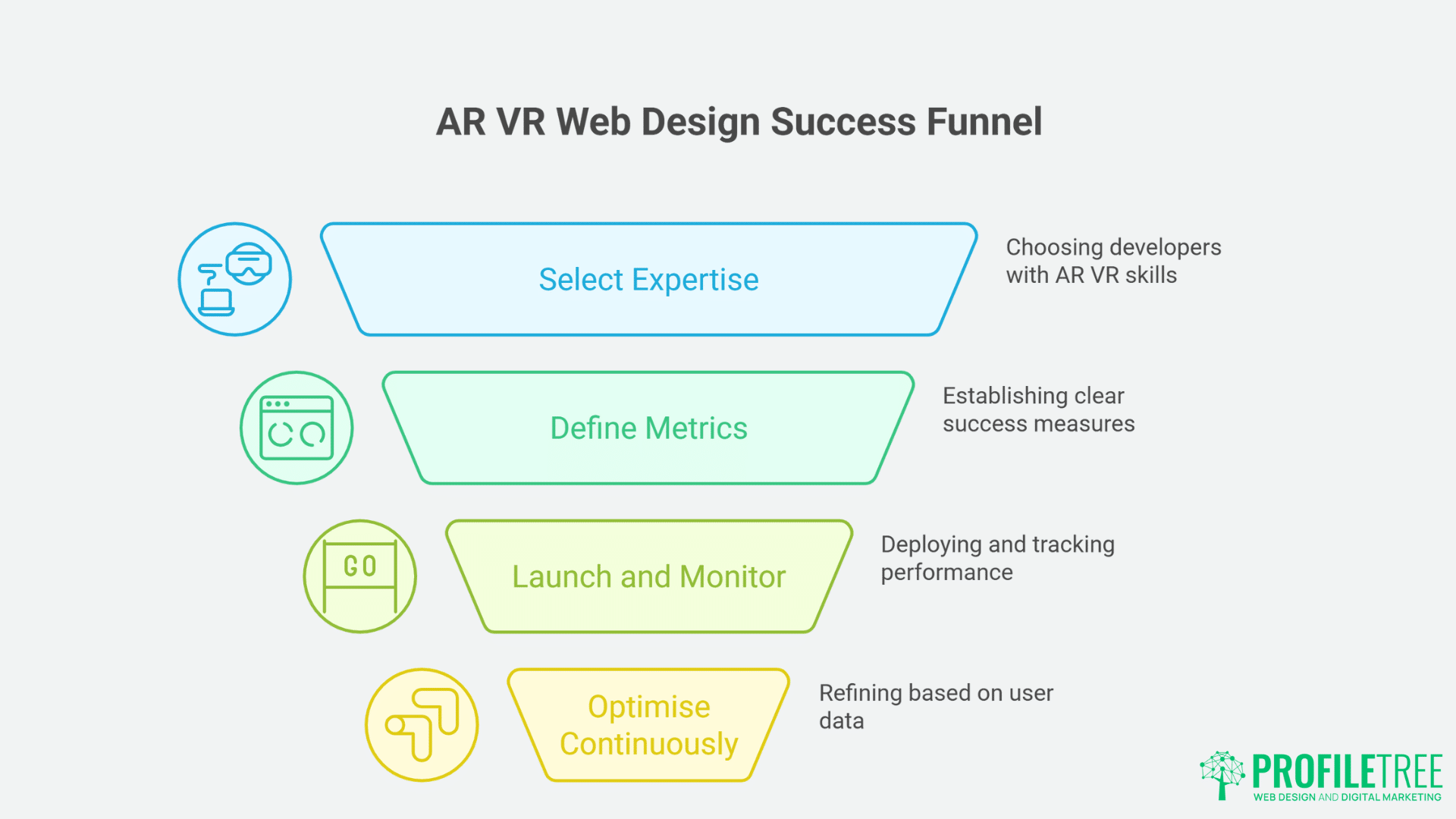
Selecting the right development partner significantly impacts AR VR web design project success. Understanding what to look for and how to structure the relationship sets projects up for positive outcomes.
Selecting Appropriate Expertise
AR VR web design requires specialised skills beyond traditional web development. Developers need experience with 3D modelling software, WebXR frameworks, and performance optimisation for immersive experiences to deliver effective solutions.
When evaluating website development partners, ask for examples of previous AR and VR work. Test the experiences on multiple devices to assess performance and usability, and discuss their approach to mobile optimisation and progressive enhancement.
Defining Success Metrics
Establish clear metrics for measuring AR VR web design effectiveness before development begins. Relevant metrics provide an objective assessment of whether the investment delivers expected returns.
- Engagement rates measure the percentage of visitors who activate AR and VR features and the time spent in experiences.
- Conversion impact compares conversion rates between users who engaged with immersive features and those who didn’t.
- Return rates for e-commerce assess whether AR visualisation reduces product returns. Lead quality for B2B evaluates whether VR demonstrations generate more qualified sales leads.
- Support reduction measures: whether interactive demonstrations reduce customer support enquiries.
Ongoing Optimisation
Initial launches of AR VR web design rarely achieve optimal performance immediately. Plan for ongoing refinement based on user behaviour data, feedback, and technical monitoring to improve effectiveness over time.
A/B testing different interaction patterns, content arrangements, and visual treatments identifies what works best for your specific audience. “Businesses often approach AR and VR as one-time projects, but the real value emerges through continuous refinement based on how customers actually use these features,” notes Ciaran Connolly, Director at ProfileTree. “The first version establishes the foundation; subsequent iterations based on real user data create the competitive advantage.”
AI Integration Opportunities
Combining artificial intelligence with AR VR web design creates more personalised and effective experiences. AI technologies solve specific problems that pure AR and VR implementations cannot address alone.
Personalised Experiences
AI implementation can enhance AR VR web design through personalisation. Machine learning algorithms analyse user behaviour to suggest products likely to interest specific customers, customise virtual environment layouts based on preferences, and adjust experience complexity based on user skill level.
An estate agency might use AI to analyse which property features specific users spend most time examining in VR tours, then prioritise similar properties in future recommendations. A furniture retailer could learn which styles individual users prefer through AR placement behaviour, then customise virtual showroom layouts accordingly.
Automated 3D Asset Creation
Creating 3D models for AR VR web design traditionally required significant manual work from specialist modellers. AI tools now generate 3D models from photographs, reducing production time and cost for businesses implementing these technologies.
Quality remains below that of manually created models for hero products, but automated generation works well for supporting items and environmental elements. Businesses can photograph inventory and generate AR-ready models more quickly than traditional processes allowed, making AR visualisation practical for larger product catalogues.
Intelligent Assistance
AI chatbots integrated within AR VR web design experiences answer questions, provide guidance, and offer recommendations without requiring users to leave immersive environments. A virtual showroom might include an AI assistant that answers product questions, compares items, and provides purchase advice while users explore.
This combination of immersive experience and intelligent assistance creates sophisticated customer service that operates 24/7 without staffing requirements for routine enquiries. The integration represents the next evolution of AR VR web design capabilities.
Training and Change Management
Technology implementation succeeds or fails based on how well organisations prepare their teams and customers. Change management processes determine whether AR VR web design investments deliver expected returns.
Staff Training Requirements
Implementing AR VR web design affects multiple business areas that require preparation. Sales teams need an understanding of when and how to direct customers to immersive experiences for maximum impact.
Customer service staff require knowledge of troubleshooting common technical issues that users encounter. Marketing teams must learn to promote new features effectively through appropriate channels. Digital training programmes addressing these needs accelerate adoption and prevent situations where businesses invest in technology that their teams underutilise.
Customer Education
Users need guidance on accessing and using AR VR web design features effectively. Contextual prompts appearing when AR or VR would help specific user tasks improve discovery rates.
Short tutorial videos demonstrating feature activation and basic interaction reduce learning curves. Progressive disclosure introduces advanced features after users master the basics, preventing overwhelming initial experiences. Prominent help access within experiences supports users who encounter difficulties.
Internal Process Adaptation
AR VR web design implementation may require process changes across departments. Customer service workflows need updates to handle enquiries about immersive features, including technical troubleshooting and usage guidance.
Sales processes should incorporate demonstrations of AR and VR capabilities during prospect conversations. Marketing campaigns require adaptation to promote new functionality effectively across digital channels and highlight competitive advantages.
Future Developments and Planning
The AR VR web design landscape continues evolving rapidly through technological advancement and increased adoption. Understanding future directions helps businesses make investment decisions that remain relevant long-term.
Emerging Standards
WebXR continues evolving, with new capabilities added regularly to AR VR web design standards. Staying informed about standard development helps businesses plan future enhancements and maintain competitive advantages.
Upcoming features include improved hand tracking, spatial audio enhancements, and better integration with device sensors. Working with development partners who actively follow standards evolution positions businesses to adopt new capabilities as they become available.
Hardware Adoption Trends
VR headset adoption grows steadily, particularly in business contexts where AR VR web design serves professional purposes. As more users access capable hardware, experiences can become more sophisticated without excluding significant audience segments.
AR continues primarily occurring on smartphones, with glasses-based AR still in early adoption stages. Planning should focus on smartphone-optimised experiences for the foreseeable future, with awareness of potential glasses-based AR emergence in specific use cases.
Market Maturity
AR VR web design is moving from experimental novelty to expected functionality in certain sectors. Furniture, fashion, and real estate industries increasingly view AR as standard e-commerce features rather than optional extras.
Businesses in these sectors risk competitive disadvantage by not implementing these capabilities. Other sectors remain in earlier adoption stages, where implementation creates differentiation rather than matching competitor features—understanding where your industry sits on the adoption curve informs timing decisions.
Getting Started with Implementation
A structured approach to AR VR web design implementation reduces risk and enables businesses to learn from each phase. This phased methodology proves effective across different industries and business sizes.
For businesses in Northern Ireland, Ireland, and the UK considering AR VR web design integration, a phased approach reduces risk and enables learning.
- Phase One: Research and Planning involves identifying specific use cases where AR or VR adds clear value, studying competitor implementations, and defining success metrics and budget parameters.
- Phase Two: Prototype Development creates a limited-scope implementation focused on one use case, tests with real customers, gathers feedback, and measures against defined success metrics. Phase Three: Refinement and Expansion improves initial implementation based on feedback and data, adds use cases that proved valuable during research, and integrates with broader digital strategy.
- Phase Four: Optimisation and Scale expands to the full product range or all relevant use cases, implements advanced features based on user behaviour patterns, and develops supporting content and marketing programmes. This approach enables businesses to prove value before significant investment occurs.
Measuring Return on Investment
Quantifying AR VR web design ROI requires tracking multiple metrics across customer journey stages. Comprehensive measurement provides a clear understanding of business impact and informs optimisation decisions.
- Engagement metrics include activation rates (percentage of visitors who use AR or VR features), session duration within immersive experiences, and interaction depth (which features users actually utilise).
- Conversion metrics compare conversion rates between users who engaged with AR VR web design features and those who didn’t, average order values for each group, and time-to-purchase differences. Retention metrics measure product return rates, customer satisfaction scores, and repeat purchase rates.
- Operational metrics track support ticket reduction related to product questions, sales cycle length for B2B implementations, and staff time savings from reduced consultations or site visits. Comprehensive measurement across these dimensions provides a complete understanding of business impact.
How ProfileTree Can Support Your AR VR Web Design Projects
ProfileTree brings technical expertise and strategic thinking to AR VR web design implementations for businesses across Northern Ireland, Ireland, and the UK. Based at the McSweeney Centre in Belfast, our team has delivered immersive web experiences that drive measurable business results for SMEs across multiple sectors.
Our website design and website development services include AR and VR implementation using WebXR standards, creating browser-based experiences that work across devices without requiring app downloads. We focus on practical applications that solve real customer problems—product visualisation, virtual showrooms, interactive demonstrations, and immersive training environments.
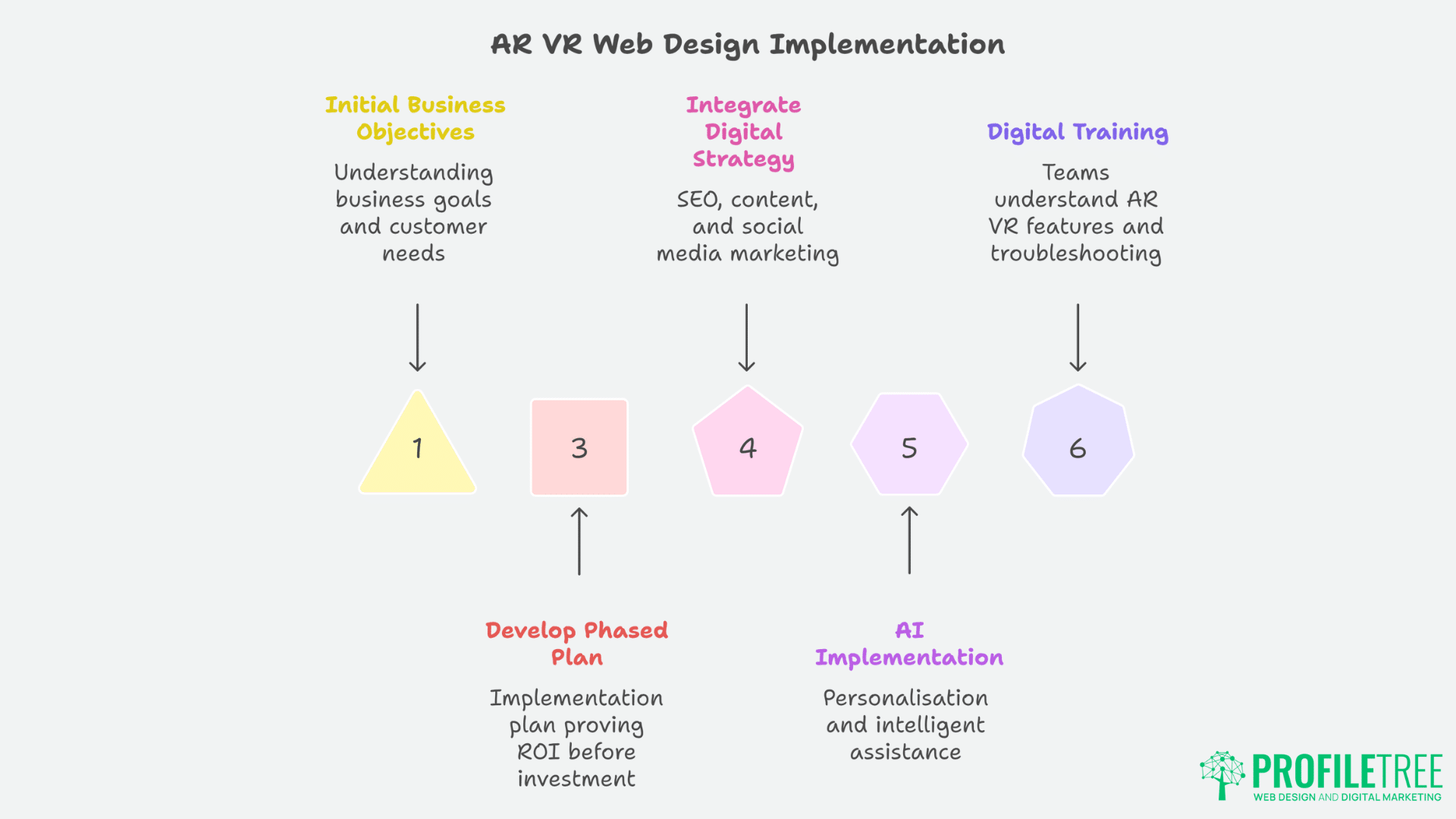
We integrate AR VR web design with a comprehensive digital strategy that includes SEO optimisation for immersive content, content marketing that promotes new capabilities, and social media marketing campaigns that amplify reach. Our AI implementation services add personalisation and intelligent assistance to immersive experiences, creating sophisticated customer interactions that convert visitors into customers.
For businesses new to these technologies, our digital training programmes help teams understand when and how to direct customers to AR and VR features, troubleshoot common issues, and integrate immersive experiences into existing sales and marketing processes. We also provide AI training that demonstrates how artificial intelligence enhances AR VR web design through personalisation and automated content generation.
Our approach begins with understanding your specific business objectives and customer needs. We identify use cases where AR or VR creates genuine value, develop phased implementation plans that prove ROI before major investment, and provide ongoing optimisation based on user behaviour data. This methodology has helped businesses across retail, professional services, manufacturing, and property sectors create competitive advantages through innovative web experiences.
If you’re considering AR VR web design for your business, contact ProfileTree at the McSweeney Centre, Belfast, to discuss how immersive technologies can support your growth objectives. We’ll assess your specific situation, recommend appropriate applications, and develop implementation plans that deliver measurable returns on investment.
Conclusion
AR VR web design delivers practical business value when implemented thoughtfully for specific use cases. Rather than pursuing technological novelty, successful implementations focus on solving real customer problems—helping them visualise products in context, understand complex offerings, or access services remotely.
For SMEs across the UK and Ireland, these technologies level the playing fields previously tilted towards larger competitors with extensive physical infrastructure. A small retailer can offer virtual showrooms rivalling major chains through effective AR VR web design, and a regional professional services firm can deliver immersive demonstrations matching multinational competitors.
The key lies in matching technology to genuine business needs, implementing with attention to user experience and performance, and integrating with broader website design and digital marketing strategies. Businesses taking this approach find AR VR web design becomes a valuable tool for customer engagement and conversion rather than an expensive novelty that users ignore.
As these technologies mature and user familiarity grows, the question for many businesses shifts from “Should we implement AR or VR?” to “How do we implement AR VR web design most effectively for our specific customers and business model?” Companies addressing that question strategically position themselves for continued growth in increasingly digital markets, creating competitive advantages that drive measurable business results.