
SEO for Print and Design Services: Get Found by the Right Customers
Table of Contents
Print businesses used to win work through a shopfront, a van sign, and word of mouth. That still matters, but the first move most buyers make now is a search. A marketing manager needs exhibition banners for next month’s trade show. A startup founder wants a logo designed and printed before launch. Both of them open Google before they call anyone.
SEO for print and design services is how you get in front of those searches. It is not a generic SEO exercise dressed up for a different industry. Print buyers search in specific ways, local intent plays a bigger role than in most sectors, and the technical setup of many print websites actively works against ranking. Get this right, and you capture demand that competitors are leaving on the table. Most local print businesses still have not invested properly in search visibility, which leaves genuine room for the ones who do.
How Print and Design Customers Search Today
Search behaviour in this industry splits into a handful of clear patterns, and each one needs a different response on your website.
Urgent need searches. Someone has run out of business cards before a conference or needs pull-up banners for an exhibition next week. These searchers use phrases like “same day printing” or “printers near me”, and they will book with whoever answers fastest with a clear, local option.
Project-based searches. A rebrand, a product launch, or an event prompts someone to search for combined design and print, such as “logo design and print” or “event programme printing”. They are weighing creative ability against turnaround and price at the same time.
Ongoing relationship searches. Some businesses are actively looking to replace an underperforming printer. A search such as “printing services Belfast” or “commercial printers Belfast” often signals someone shopping for a long-term partner rather than a one-off job. This is a query worth watching closely; it shows genuine local commercial intent, and a well-built local page can convert it into a call.
Product-specific searches. Roller banners, vinyl stickers, wedding invitations. People often know exactly what they need and search for the product by name.
Understanding which of these searches your business should be chasing shapes almost every decision that follows, from the pages you build to the content you write.
Why SEO for Printing Companies Works Differently
Anyone researching how to run SEO for printing companies quickly runs into two problems that generic SEO advice does not cover.
The first is technical. Many print websites are built on web-to-print platforms with interactive product configurators and pricing tools. These often rely heavily on JavaScript to render pricing, materials, and finishing options, leaving search engines with very little static, crawlable content to index. If your core product pages are essentially empty shells until a script loads, you are fighting an uphill battle regardless of how good your content strategy is. The practical fix is to ensure every product page includes solid, static text describing the product, its options, and its uses, positioned alongside the interactive configurator rather than replacing it.
The second is commercial. Print keywords split sharply between high-volume, low-margin terms and lower-volume, high-value ones. “Business cards” attract enormous search volume and enormous competition from budget online printers. “Bespoke exhibition graphics” or “large format signage installation” attracts far less traffic but far better margins and far less competition. A strategy built entirely around volume keywords tends to win the wrong customers; a strategy that also targets the specific, high-value terms wins the profitable ones. ProfileTree’s SEO services are built around this kind of prioritisation rather than chasing raw traffic numbers.
The Local SEO Foundation: Winning “Printing Services Belfast” Searches
For most print businesses, local search is where the real opportunity sits. When someone searches “printing services Belfast” or “printers near me”, they are usually indicating a preference for a local supplier they can visit, call, or collect from at short notice.
Google Business Profile is the foundation here. A complete, accurate profile determines whether you appear in the map results that often sit above the standard organic listings.
The elements that matter most for a print business:
- Accurate core details. Address, phone number, website, and opening hours are kept up to date.
- A full set of categories. Printer, Print Shop, Graphic Designer, Sign Shop, Screen Printer; select every category that genuinely applies so you surface for a wider range of relevant searches.
- A full services list. Business cards, brochures, banners, signage, design services, large format; anything Google can use to match you to a search.
- Photos that show capability. Your shop, your equipment, your team, and finished work. A profile showing an impressive large-format printer signals capacity in a way text alone cannot.
- Regular posts. Completed projects, new capabilities, or seasonal offers keep the profile active.
Local citations matter alongside this. Consistent listings across directories such as Yell and Scoot, plus any print-industry-specific directories, reinforce the same address and contact details Google sees on your Business Profile; a rundown of free business listing sites is a reasonable place to start building these out. Inconsistent details across listings are one of the most common reasons a print business underperforms locally despite decent website content.
Reviews carry particular weight for a “printing services Belfast” style search, since buyers researching a new supplier will check them before picking up the phone. Encouraging reviews after successful, time-pressured jobs builds a track record that a competitor with no reviews simply cannot match.
Keyword Strategy: Beyond “Printing Services”
Ranking for “printing services” alone is close to impossible for most independent print businesses; the term is dominated by national online printers with enormous budgets. The more realistic and more valuable approach is building out from that core term into the long tail.
Product-led keywords. Paper weights (GSM), finishes such as spot UV or lamination, and UK-specific sizing (A-series) all appear in real searches from buyers who already know roughly what they want. A dedicated page for business cards that covers stock options, finishes, and turnaround will outperform a single generic “printing” page every time. Working through a proper keyword research process before building these pages helps you spot the specific phrases worth targeting rather than guessing.
Intent-based keywords for designers. Searches like “brand identity design” or “rebranding services” sit alongside pure print searches and open up an entirely separate customer base for businesses that offer both design and production.
The sustainability angle. Searches for “eco-friendly printing UK” and “recycled paper stock” are growing, and this is an area where competitor content is thin. A print business with genuine environmental credentials (FSC certification, for example) has a clear opening to build authority here before larger players catch up.
The table below is a useful way to prioritise where to spend content and optimisation effort first.
| Keyword type | Example | Volume | Margin | Priority |
|---|---|---|---|---|
| Generic product | Business cards | High | Low | Support pages only |
| Local + product | Business card printing Belfast | Medium | Medium | High |
| Niche B2B | Exhibition graphics, large format signage | Low | High | High |
| Sustainability | Eco-friendly printing UK | Low, growing | Medium-high | Emerging opportunity |
A clear digital marketing strategy should underpin these decisions rather than treating each page as an isolated task; prioritising the wrong keywords wastes budget that could go toward the terms that actually convert. If you have not mapped this out formally, a guide to developing an SEO strategy is a useful starting point before committing to a full content plan.
Building a Website That Wins Print and Design Business
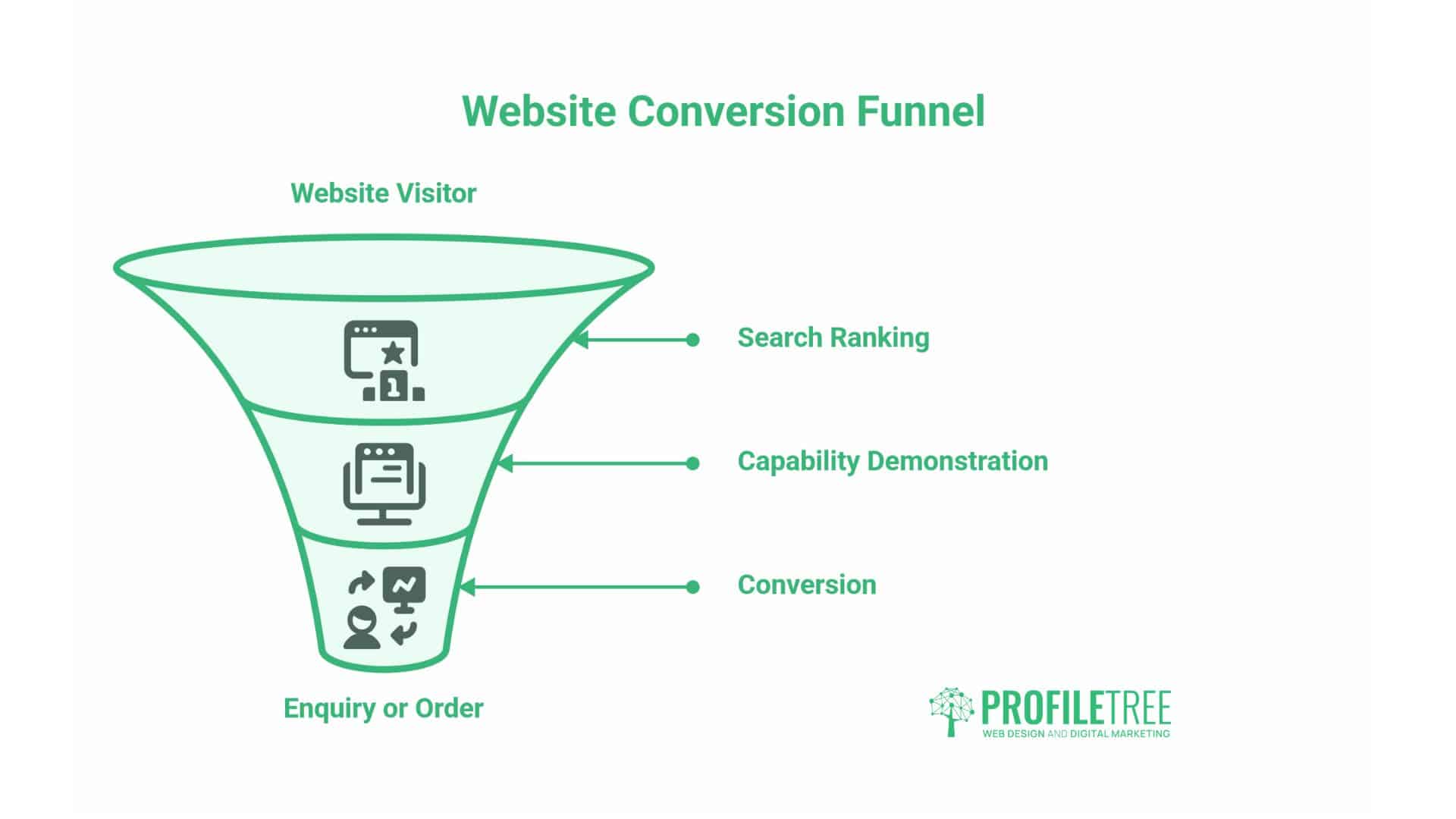
Your website has to do three jobs at once: rank in search results, demonstrate real capability, and convert a visitor into an enquiry or an order. Getting the underlying web design right affects all three, since a slow or confusing site undermines even the best content sitting on it.
Structure around how people search. If people search “business card printing Belfast”, you need a page specifically about business cards that mentions Belfast, not a single “our products” page trying to cover everything at once. Sensible page groupings include:
- Product categories: business cards, brochures, banners, signage, packaging, promotional items
- Services: design, print management, large format, finishing
- Industries served, where relevant: estate agents, hospitality, events, construction
- Location pages, where genuine local search demand justifies them
Give each page real substance. A business card page should cover paper stock options, finishing choices, standard and custom sizes, turnaround times, minimum quantities, and whether design support is included. This content helps the page rank, answers questions a buyer would otherwise have to phone in to ask, and demonstrates expertise.
Invest in the portfolio. A gallery of past work matters more for print and design than for almost any other service business, because the work itself is the proof. Organise it logically by product type or industry, and add context to each piece; “48-page perfect-bound brochure with spot UV finishing for a hospitality client” tells a far better story than an unlabelled photo. For design-led businesses in particular, the portfolio often does more selling than the copy around it.
Make the path to ordering obvious. Whether you run online ordering, a quote-based process, or both, the next step should never be ambiguous. Straightforward, standardised products such as business cards or flyers suit online ordering well; more complex or bespoke work usually converts better through a quote-and-consultation process.
Video content strengthens all of this. A short walkthrough showing how a product page or configurator works, or a behind-the-scenes look at production, builds trust in a way static photos cannot. Video production support from a specialist team can turn a single studio visit into content that serves multiple product pages.
Content Marketing That Positions You as the Print Expert
Beyond core service pages, ongoing content marketing brings in customers earlier in their research, before they have chosen a supplier.
Educational content answers the practical questions buyers already have: guidance on paper weights, an explanation of finish options, or a walkthrough of setting up artwork bleed correctly. Someone searching “how to prepare artwork for print” is planning a project right now, and a genuinely useful guide positions you as the printer who understands what they need before they have even asked.
Industry-specific content speaks directly to a sector rather than print buyers in general: menu design and printing for restaurants, exhibition stand advice for event organisers, signage requirements for construction sites. This kind of segmentation is a stronger information-gain signal than a generic guide covering the same ground as every competitor.
Project stories and case studies show completed work in context rather than as an isolated portfolio image; a short write-up of how a client used print materials for a launch or event gives readers ideas they can apply to their own work while demonstrating what you can deliver.
As Ciaran Connolly, founder of ProfileTree, puts it: “The print businesses that grow fastest online are rarely the cheapest. They are the ones whose website actually answers the questions a buyer has before they pick up the phone.”
Content built this way also supports a broader organic social media presence, since finished work and short how-to clips both translate well to LinkedIn, Instagram, and TikTok, extending the reach of content you have already produced for the website.
Trust, Credibility, and Competing With Online Print Companies
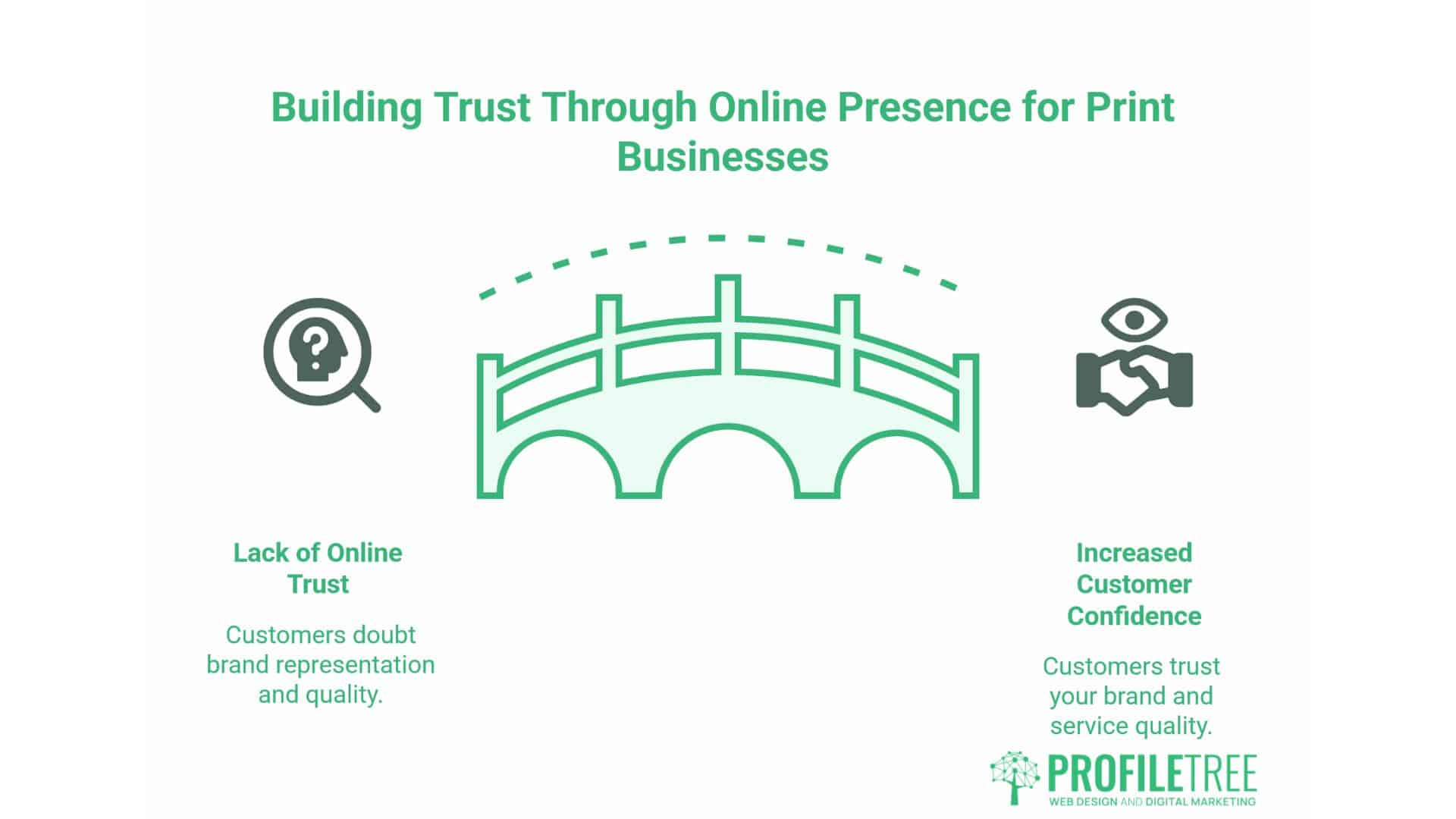
Print involves a level of trust that many services do not: a customer relies on you to represent their brand accurately, meet a deadline, and deliver consistent quality throughout a run. Your online presence needs to build that confidence before a phone call ever happens.
Reviews and testimonials carry particular weight where reliability under time pressure is part of the pitch. A quote from a marketing manager praising a fast turnaround on a tight exhibition deadline does more than any amount of copy about “quality and service”.
Evidence of capability matters too: photos of equipment, information about the team’s experience, quality-control processes, and any relevant environmental credentials, such as FSC or ISO 14001 certification.
Trade credentials, including membership of bodies such as the British Printing Industries Federation, add a layer of third-party validation that a website alone cannot provide.
On the question of competing with large online print companies, the honest answer is that you rarely beat them on price alone. You compete on what an algorithm-driven ordering system cannot offer: a conversation about requirements, the ability to accommodate a last-minute change, local collection instead of waiting for delivery, and a relationship that develops over repeated projects. Positioning your website around this, rather than trying to out-discount a national platform, tends to attract exactly the kind of customer who becomes a repeat client.
Tailoring Your Approach by Print Business Type
Not every print business should follow the same playbook, since the buyers and the searches differ significantly by specialism.
Commercial printers serving B2B clients should focus on business-to-business positioning, the range of offset and digital capabilities available, volume capacity, and any genuine industry expertise built up over time.
Quick print and copy shops benefit most from messaging that emphasises speed and convenience, strong local visibility, and clear communication that walk-ins are welcome, alongside the full range of services on offer.
Large format and signage businesses should lead with a visual portfolio of installations, dedicated pages for specific products such as vehicle wraps or exhibition stands, and clear information on materials and durability for outdoor use.
Combined design and print businesses should give the design portfolio real prominence, show the process from concept through to finished production, and use case studies that demonstrate a complete project rather than isolated design or print work in isolation.
Measuring What Actually Matters
Search visibility only means something if it converts into business, so the metrics worth tracking connect directly to outcomes rather than vanity numbers.
Track rankings for the specific “[service] [location]” terms that matter to your business, monitor whether organic traffic is growing and which pages are driving it, and, most importantly, track enquiries, quote requests, and orders rather than traffic alone. A smaller amount of highly relevant traffic that converts into profitable, repeat business beats a larger amount of traffic from budget-focused searchers every time.
If you are unsure where your current site stands against these measures, a free website audit is a reasonable starting point before committing budget to a full strategy. It is also worth deciding early whether paid search sits alongside your organic work; a comparison of paid advertising versus organic SEO sets out the trade-offs before you commit budget either way.
Getting Started: SEO for Print and Design Services
Getting found locally for print and design work is not complicated, but it does require consistent effort rather than a single push. Claim and complete your Google Business Profile first; build proper pages for your main products; get a portfolio in front of people; ask satisfied customers for reviews; and publish something genuinely useful once a month.
Print is not disappearing. Buyers are just finding their printers differently, whether that search is “printing services Belfast” or a specific product name. The businesses that show up where those buyers are now looking are the ones picking up the work.
FAQs
How do we compete on price with online printers?
In most cases, you do not compete directly on price; you compete on service, speed, and relationship. Where price comparison is unavoidable, make pricing visible on comparable products, since many buyers assume local is more expensive without actually checking.
Should we offer online ordering?
For straightforward, standardised products such as business cards or flyers, online ordering removes friction and can capture self-service buyers. Complex or bespoke work usually suits a quote-based process better. Many print businesses run both side by side.
How important is design capability for SEO?
Design capability opens up an additional set of searches beyond pure printing terms. “Brochure design” and “brand identity” searches are distinct from “brochure printing” searches, so a website that showcases design capability and a strong portfolio captures both.
Should we target national or local searches?
For most print businesses, local focus is the stronger play. National terms put you up against every online printer in the country, while local terms have far more manageable competition and buyers who genuinely prefer a nearby supplier.