
Web Design Process: A Business Owner’s Guide for UK and Irish SMEs
Table of Contents
Most SMEs think about the web design process the wrong way. They ask: “How long will it take?” and “What will it look like?” The more useful questions are: “Will this site actually convert visitors into enquiries?” and “Will it rank in Google for the terms my customers use?” A well-run web design process answers both before a single page is designed.
This guide walks you through every stage of the web design process from the business owner’s perspective: what happens at each phase, what you should receive, and where the decisions that matter most are made. ProfileTree, a Belfast-based web design and digital marketing agency, has completed over 1,000 web projects for businesses across Northern Ireland, Ireland, and the UK since 2011. The patterns below reflect what actually separates sites that perform from sites that disappoint.
Phase 1: Discovery, Strategy and Market Context
Discovery is the most important phase of the web design process. If you get this wrong, no amount of good design or clever code will fix it later.
The goal of discovery is to define what the website needs to achieve commercially, who it is for, and what it is up against. This is not a creative conversation; it is a strategic one. At ProfileTree, we use discovery sessions to align the project with actual business KPIs rather than personal visual preferences.
“We see it regularly; a business invests in a beautiful site that nobody can find. That happens when SEO is treated as an afterthought rather than a foundation,” says Ciaran Connolly, founder of ProfileTree. “Discovery is where we prevent that.”
What happens in discovery:
During a discovery session, your agency should be asking about revenue goals, current traffic sources, your best-performing services, and who your customers actually are. Expect questions about your sales process, your competitors, and whether you need your site to rank locally, nationally, or across both the UK and Irish markets.
For businesses operating across Northern Ireland and the Republic of Ireland, the discovery phase should address dual-market considerations directly. Domain strategy (.ie vs .co.uk vs .com), separate location pages, and differing legal requirements are decisions best made before the sitemap is drawn. A business based in Belfast serving customers in Dublin needs a different site architecture from one focused purely on Northern Ireland.
What you should receive from Phase 1:
- A documented brief covering goals, audience personas, and success metrics
- A competitor audit covering at least three to five direct competitors
- A keyword research summary identifying the terms your customers use
- Confirmation of the primary domain strategy and any secondary location targets
- A project timeline with clear milestones and approval points
The website design process for most SME projects spans 8 to 12 weeks from the signed brief to launch. Discovery typically takes one to two weeks and should not be rushed. Time spent here is recovered many times over in reduced revisions and stronger post-launch performance.
Phase 2: Planning, Architecture and User Experience
Once the strategy is agreed upon, the web design process moves into planning. This is where the site’s structure is mapped out before any visual work begins.
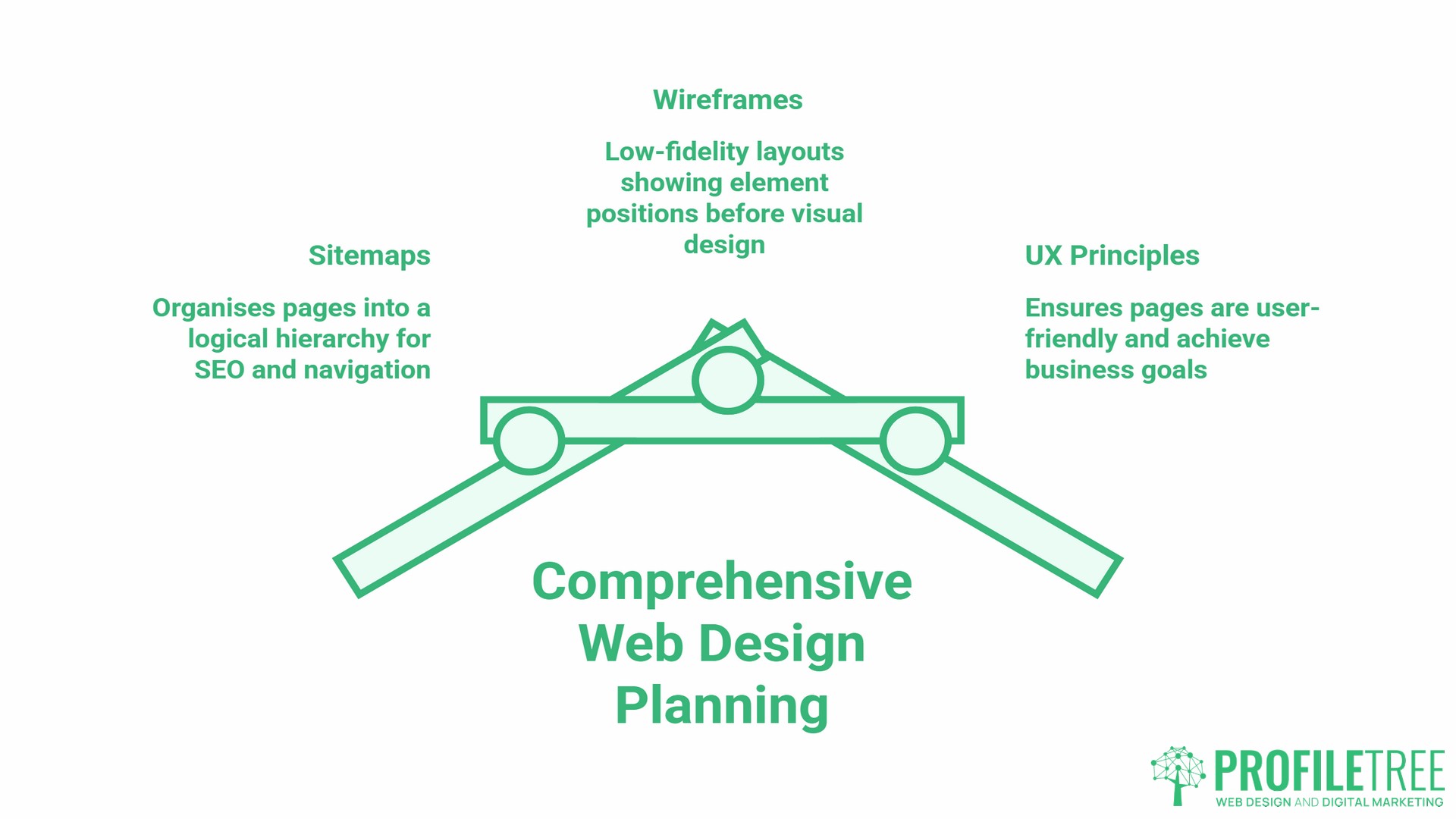
Sitemaps
A sitemap is a document that lists every page on the site, organised into a logical hierarchy. It shows how the homepage connects to service pages, how service pages relate to blog content, and where conversion pages sit. For SEO purposes, the sitemap also determines internal linking architecture and the distribution of authority across the site.
A common mistake at this stage is building the sitemap around what the business wants to say rather than what customers search for. If your customers search for “web design Belfast” and “WordPress development Northern Ireland” as distinct queries, those need to be separate pages with separate content. Combining them into a single generic “services” page dilutes SEO value and makes neither page competitive.
Wireframes
Wireframes are low-fidelity page layouts that show the positions of key elements: navigation, headline, calls to action, content blocks, images, and footer. They contain no colour, no final typography, and no imagery. The purpose is to agree on page structure and user journey before the visual layer is added.
Getting wireframes approved early prevents the most common and costly form of scope creep: a client who changes the layout after the design has been applied. Wireframes are the checkpoint for layout; design is the checkpoint for visual style.
UX principles at this stage
The step-by-step web design process from wireframe to prototype should answer three questions for each page:
- What is the one action we want the visitor to take on this page?
- Is that action visible without scrolling on a mobile screen?
- Does the content above the fold give a clear reason to stay?
For most SME sites, the answer to the first question is “contact us” or “request a quote.” If the contact mechanism is buried, the website design process has failed the business, regardless of how well the rest of it is executed.
Phase 3: Visual Design and Brand Integration
Visual design in the web design process is where most clients focus most of their attention, and where agencies spend proportionally less time than clients expect. That imbalance is normal; strong discovery and planning make the design phase faster and more predictable.
What Visual Design Covers
Colour palette, typography, imagery style, iconography, and the overall visual language of the site. For businesses without a developed brand, this phase also covers brand decisions that will then carry through to all marketing materials. For businesses with existing brand guidelines, the designer’s job is faithful implementation rather than creation.
Typography choices affect readability on mobile, loading speed (custom fonts add weight), and brand perception. A service business communicating expertise and trust should read differently from a consumer retail brand communicating energy and accessibility. These are not arbitrary aesthetic choices; they affect conversion.
Conversion Rate Optimisation Built into Design
The website design process should treat design and CRO as the same discipline. Button colour, heading hierarchy, whitespace, and the visual weight given to calls to action all influence whether a visitor enquires or leaves. An experienced web design agency applies these principles during the design phase, not as a later optimisation exercise.
Layouts and Responsiveness
Every page layout in the ProfileTree web design process begins with the mobile view. Mobile-first design is not a trend; it is a technical requirement. Since July 2024, Google has used the mobile version of every website as the primary version for crawling and indexing. A design that looks excellent on desktop but compromises heavily on mobile will underperform in search results.
Phase 4: Content Strategy and AI-Assisted Workflows
Content is where the web design process most commonly stalls, and where the gap between a functional site and a high-performing site is widest.
The most frequent project delay in our experience is not design revisions; it is clients arriving at the development phase without the content their pages need. Discovery conversations about content should happen in Phase 1. By Phase 4, the content plan should be agreed upon, and writing should be underway.
Why Content Must Precede Development
Developers build pages around content, not around placeholder text. When real content arrives late, developers must rework layouts, resize image containers, and adjust typographic spacing. That rework costs time and money. More importantly, content written after the page is built tends to fit the layout rather than serve the reader, which weakens both SEO performance and conversion.
At ProfileTree, the content strategy phase of the web design process covers:
- A page-by-page content plan with word counts, headings, and key messages
- Keyword mapping confirms which search terms each page targets
- Internal linking architecture connecting service pages, location pages, and supporting blog content
- An agreed source for each page: client-written, agency-written, or collaborative
AI-Assisted Content Workflows in 2026
Generative AI tools now form part of the professional web design process in a specific, bounded way. At ProfileTree, AI assists with first-draft structure, heading hierarchies, and FAQ generation. It does not replace human expertise, local knowledge, or factual verification.
The risk in AI-assisted content is homogenisation. AI tools generate plausible, generic text. The pages that rank are the ones that add something a reader cannot find elsewhere: a specific insight, a local example, a genuine professional judgement. Content that reads like every other page on the topic will not outperform pages that have been on the first page for years.
For SMEs in Northern Ireland and Ireland, local specificity is a genuine competitive advantage. References to local market conditions, regulatory context, or regional audience behaviour are not included in generic AI output. That specificity is what our content team builds in.
Phase 5: Technical Development and CMS Selection
Technical development is where designs and content come together to create a working website. The web design process at this stage involves choices that affect the site’s long-term performance, maintainability, and your ability to manage it without agency involvement.
Choosing the Right CMS
The most common decision in the technical phase is platform selection. For the majority of SME websites in the UK and Ireland, the choice narrows to three options:
| Platform | Best suited for | Main limitation |
|---|---|---|
| WordPress | Service businesses, content-heavy sites, SEO-focused projects | Requires maintenance and security updates |
| Shopify | E-commerce businesses with product catalogues | Limited flexibility for non-retail use cases |
| Custom build | Complex functionality, integrations, bespoke requirements | Higher upfront cost, longer development time |
WordPress powers around 42% of all websites globally, according to W3Techs data, and remains the most SEO-flexible platform for SME service businesses. For businesses that need strong content marketing capabilities and control over technical SEO, it is usually the right choice.
What Technical Development Covers
The correct web design process for development includes building the HTML and CSS structure from the approved designs, implementing JavaScript for interactive elements, configuring the CMS for the client’s team to manage, integrating third-party tools (CRMs, booking systems, analytics), optimising images for web delivery, and setting up the site structure for search engine indexing.
Performance is a ranking factor. Pages that load slowly on mobile devices rank lower than fast pages on equivalent content. Core Web Vitals, the set of performance metrics Google uses to assess page experience, should be built into the development process, not tested and fixed after launch.
Web Development Services at ProfileTree
Our web development team builds on WordPress as the primary platform for service and content businesses. We handle everything from CMS configuration through to performance optimisation, hosting setup, and post-launch technical maintenance. For businesses with specific integration requirements, our development team also works on custom builds.
Phase 6: Testing, Quality Assurance and Legal Compliance
Testing is the phase of the web design process that business owners most often underestimate in scope. A thorough QA process before launch prevents failures that are far more expensive to fix once the site is live.
What QA Covers
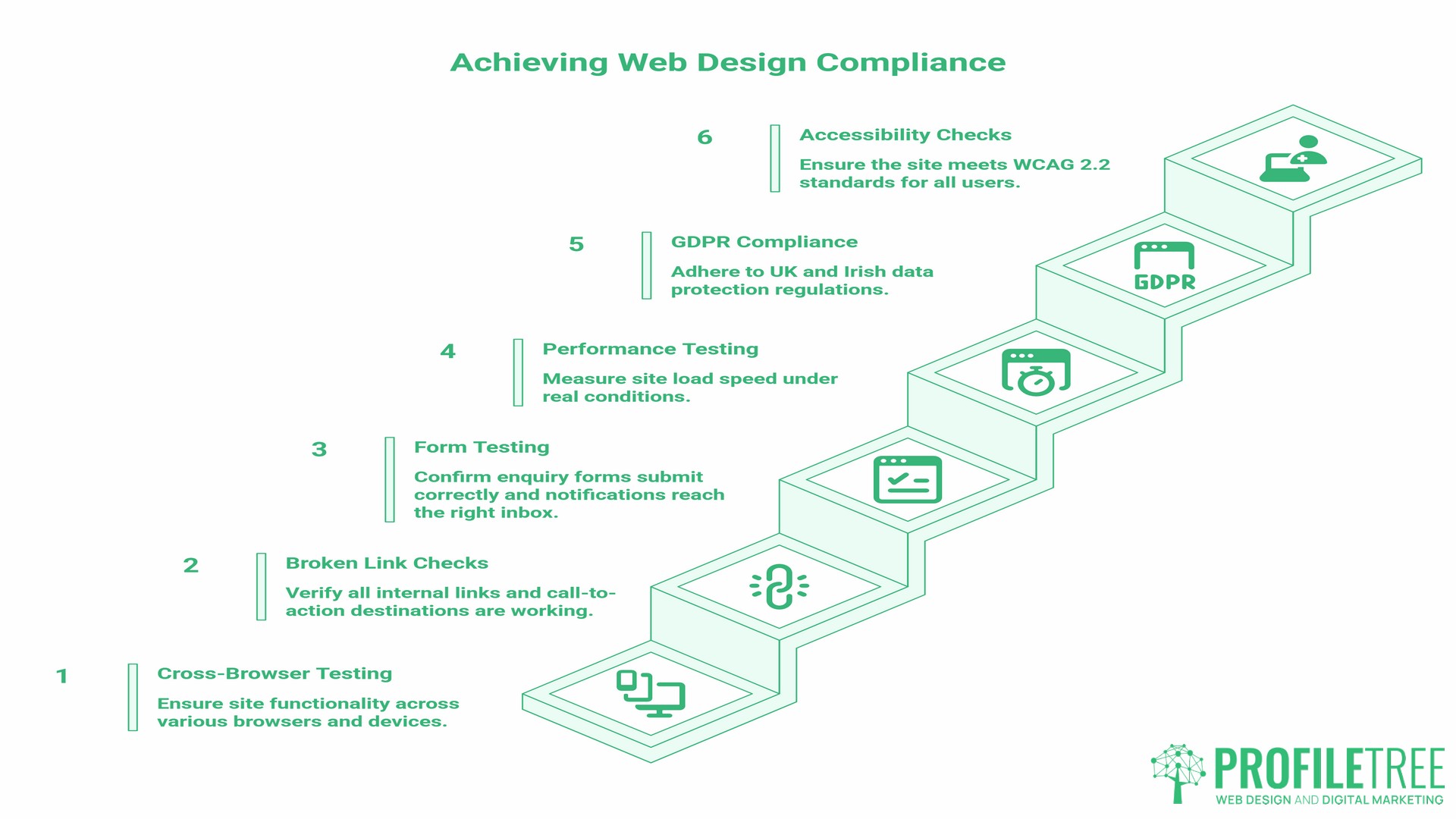
Cross-browser and cross-device testing confirms that the site renders and functions correctly across Chrome, Safari, Firefox, and Edge on desktop, tablet, and mobile devices. Broken link checks confirm every internal link and every call-to-action destination is working. Form testing confirms that enquiry forms submit correctly and notifications reach the right inbox. Performance testing measures load speed under real conditions.
GDPR and UK Data Regulation Compliance
For businesses operating in the UK and the Republic of Ireland, legal compliance is a mandatory component of the web design process, not an optional add-on. The key requirements at launch are:
- A cookie consent mechanism that meets UK ICO and Irish DPC standards
- A privacy policy that accurately describes how visitor data is collected, stored, and used
- If the site collects personal data through forms, a lawful basis for processing is documented in the privacy policy
- For e-commerce sites, compliance with Consumer Rights regulations in both jurisdictions
The UK and the Republic of Ireland have separate regulatory frameworks following Brexit. A business operating across both markets should have its legal compliance reviewed against both the UK GDPR (governed by the ICO) and the Irish GDPR framework (governed by the Data Protection Commission). This is especially relevant for businesses targeting Dublin audiences while operating from Belfast.
Accessibility: WCAG 2.2
Web accessibility is both a legal requirement and a practical quality standard. The Web Content Accessibility Guidelines (WCAG) 2.2 set the benchmark for accessible design. In the UK, public sector websites are legally required to meet WCAG 2.1 AA as a minimum. For private sector businesses, accessibility affects both legal risk and the size of the audience you can serve.
Accessibility checks in our QA process cover colour contrast ratios, keyboard navigation, screen reader compatibility, alt text on images, and form label associations.
Phase 7: Launch and the First 90 Days
The web design process does not end at launch. It enters a new phase.
The Launch Process
Going live involves migrating the site to the live server, configuring DNS settings, activating the SSL certificate, submitting the sitemap to Google Search Console and Bing Webmaster Tools, and verifying that tracking and analytics are recording correctly. For sites replacing an existing domain, a redirect plan must be in place before the old site is taken down to preserve any existing search equity.
The First 90 Days
Search engines do not immediately rank a new or newly revised website. The indexing and ranking process takes time. During the first 90 days post-launch, the most valuable work is:
- Monitoring Search Console for crawl errors and indexing confirmation
- Reviewing analytics data for visitor behaviour patterns, including where users drop off
- Publishing the first round of supporting blog content to build topical authority around service pages
- Requesting and publishing client reviews on Google Business Profile
- Building initial backlinks through press mentions, directory listings, and industry publications
ProfileTree provides ongoing website maintenance and SEO support post-launch through a structured monthly service. For businesses that want to continue growing traffic after the initial launch, this ongoing work is what separates sites that plateau from sites that compound in visibility over time.
Post-Launch Content Marketing
A website without a content marketing programme is a static asset. Search engines favour sites that update regularly with useful, authoritative content. A quarterly content calendar aligned to the keyword gaps identified in discovery and the questions your sales team hears most often is the most direct route to sustained organic growth.
ProfileTree’s content marketing service manages this for clients who want consistent output without adding to their internal workload.
Frequently Asked Questions
How long does the web design process take?
For most SME projects, eight to twelve weeks from signed brief to launch. Simple brochure sites with five to eight pages and client-supplied content can come in at six to eight weeks. E-commerce builds with product imports, payment integration, and catalogue management typically take 12 to 16 weeks. The most common cause of delay is late content delivery from the client side. Having your content ready, or agreeing on a content creation service at the outset, is the single most reliable way to keep a project on schedule.
What is the most important stage in the web design process?
Discovery. The decisions made in Phase 1 about goals, audience, keyword targets, site architecture, and market positioning are the foundation on which everything else builds. A visually strong site built on a weak strategic foundation will not perform in search and will not convert visitors into enquiries. Reworking the foundation after launch is substantially more expensive than getting it right before design begins.
What deliverables should I expect from a web design agency?
At each phase of the web design process, you should receive tangible outputs you can review and approve. Discovery produces a brief and keyword summary. Planning produces a sitemap and wireframes. Design produces mockups for key pages. Development produces a staging site for review. Launch produces a live, indexed, analytics-connected website. Post-launch produces regular performance reports. If an agency cannot describe clear deliverables at each stage, that is a risk.
How much input will I have during the process?
Structured approval points at the end of each phase give you control without requiring day-to-day involvement. The most important input moments are the discovery sign-off (you approve the strategy before design begins), the design sign-off (you approve the visual direction before development begins), and the pre-launch review (you approve the live site before it goes public). Feedback outside these windows increases cost and extends timelines; agencies build in fixed revision rounds for a reason.
Is the web design process different for e-commerce?
Yes, significantly. E-commerce projects require additional phases covering product catalogue structure, payment gateway integration and testing, inventory management setup, shipping configuration, and for UK and Irish businesses, VAT display requirements and Consumer Rights compliance. The testing phase for e-commerce is also substantially more involved, covering checkout flows, payment failures, order confirmation emails, and stock management edge cases. Budget and timeline expectations for e-commerce should reflect this additional scope.
Will my site be mobile-friendly?
Mobile-first design is the standard for every project we build. Google indexes the mobile version of your site first, so a site that performs poorly on mobile performs poorly in search, regardless of how it looks on desktop. Every design, layout, and template is tested on mobile before being presented for approval.
What happens after the website is launched?
The site enters a maintenance and growth phase. For most businesses, this involves monthly security updates, plugin updates, performance monitoring, and content additions. For businesses investing in organic search growth, an ongoing SEO programme builds on the foundations laid during the design process. The web design process creates the platform; SEO, content marketing, and digital marketing strategy determine how far it travels.