
AI Tools for Small Business Marketing: 2026 Complete Guide
Table of Contents
The AI marketing revolution has demolished the technological advantages that large corporations once monopolised, transforming sophisticated marketing capabilities from million-pound enterprise investments into accessible tools for monthly subscription costs. Small businesses aren’t merely competing—they’re systematically outmanoeuvring corporate giants through strategic AI adoption and nimble implementation approaches that large organisations struggle to match.
The transformation is remarkable: A Belfast bakery now orchestrates marketing campaigns that previously demanded entire agency teams and substantial budgets. A Manchester fitness studio produces broadcast-quality video content using AI tools costing less than traditional software licenses. A Dublin consultancy generates SEO-optimised content at velocities that surpass established media organisations with vastly larger resources.
These success stories represent the vanguard of a fundamental shift where AI Tools for Small Business Marketing level the competitive playing fields across every industry. ProfileTree has rigorously evaluated over 300 AI marketing solutions, systematically documenting real-world performance metrics, identifying hidden cost structures, and measuring authentic business value delivery.
This comprehensive guide eliminates marketing hype to reveal which AI tools generate measurable results for small businesses, identify solutions that waste precious resources, and provide strategic frameworks for building AI marketing ecosystems that exponentially multiply capabilities without proportionally increasing operational costs.
Content Creation AI: Beyond Basic Writing
Content creation AI has evolved beyond basic text generation to encompass sophisticated multimedia production, brand voice adaptation, and strategic content planning that rivals professional creative agencies. Advanced AI tools now handle video scripting, image creation, podcast production, and social media campaigns while maintaining consistent brand messaging and simultaneously optimising content for specific audiences and platforms.
Advanced Writing Platforms
Jasper AI has evolved from a simple blog generator to a comprehensive content ecosystem. The platform now includes brand voice training, SEO optimisation, and collaborative workflows, transforming content production. Small businesses report 10x content output increases while maintaining quality. One Trustpilot reviewer notes, “Jasper doesn’t just write—it understands our brand better than some human writers we’ve hired.
Pricing starts at £39 monthly, but the value emerges at the £99 Creator tier, offering unlimited brand voices and advanced templates. The platform integrates with Surfer SEO, Grammarly, and major CMSs, creating seamless content workflows.
Copy.ai takes a different approach, focusing on short-form content and sales copy. Its workflow automation features let you create entire campaign sequences from single prompts. The standout feature is its multilingual capabilities, which support 95+ languages without quality degradation. G2 reviewers consistently praise its “uncanny ability to capture conversational tone while maintaining persuasive power.”
Unlike tools limited to training data, Writesonic differentiates through real-time data integration; Writesonic searches current information, incorporating the latest statistics and trends. This proves invaluable for news-sensitive industries. The Photosonic image generation adds visual content capabilities without additional subscriptions.
The Rising Star: Claude for Business While ChatGPT dominates mindshare, Anthropic’s Claude quietly delivers superior long-form content. Its 100,000 token context window means it can ingest entire websites, maintaining consistency across extensive content projects. Small businesses using Claude report “more nuanced, thoughtful content that actually sounds human.”
Our content marketing services leverage these advanced AI tools while adding strategic human oversight that ensures genuine value. The Three Content Pillars video demonstrates how AI amplifies rather than replaces content strategy.
Specialised Content Tools
Copysmith targets e-commerce specifically, generating product descriptions, category pages, and ad copy optimised for conversion. Its bulk generation features create thousands of unique descriptions from spreadsheet uploads. One Shopify store owner reports: “Six months of product description work completed in an afternoon.”
Hypotenuse AI excels at technical and detailed content. Where other tools struggle with specifications and accuracy, Hypotenuse maintains precision while adding marketing appeal. Manufacturing and B2B companies find particular value here.
Pepper Content combines AI generation with human editing networks. This hybrid approach delivers AI speed with human polish. The platform’s content brief generator helps non-marketers articulate requirements effectively.
The Unexpected Gem: Lex Originally designed for authors, has found surprising adoption among marketers needing thoughtful, narrative content. Its minimalist interface eliminates distractions while its AI assists rather than dominates the writing process.
Visual Content Revolution
AI-powered visual content creation has democratised professional design capabilities, enabling small businesses to produce studio-quality graphics, videos, and animations without expensive software or specialised creative teams. This visual revolution encompasses everything from automated logo design and social media graphics to product photography enhancement and video editing, delivering professional aesthetics that previously required substantial creative budgets and technical expertise.
Image Generation Platforms
Midjourney remains the quality leader for artistic and conceptual images. Version 6 delivers photorealistic results that challenge stock photography. Small businesses create unique brand imagery for a fraction of photography costs. A Reddit user’s review captures the consensus: “Midjourney turned our startup into a visual brand that looks like we have a massive creative budget.”
The learning curve proves steeper than competitors’, but ProfileTree’s prompt library helps businesses generate consistent, on-brand imagery. Discord-based interface feels archaic, but results justify the friction.
DALL-E 3 through ChatGPT Plus offers unmatched ease of use. Natural language prompts generate surprisingly accurate images. The seamless integration with ChatGPT enables complete campaign creation—copy and visuals—in a single interface. Capterra reviewers highlight “the ability to iterate through conversational refinement rather than prompt engineering.”
Stable Diffusion via platforms like Leonardo.ai democratises professional image generation. Free tiers provide genuine value while paid plans unlock commercial usage rights. The controlnet features enable precise composition control that designers appreciate.
Adobe Firefly integrates directly into Creative Cloud, making it indispensable for existing Adobe users. The commercial safety features and integration with Photoshop’s generative fill create professional workflows. One designer notes: “Firefly doesn’t replace creativity—it removes technical barriers to creative expression.
The Budget Champion: Bing Image Creator Microsoft’s free DALL-E 3 integration delivers premium quality without cost. Daily limits restrict volume, but quality matches paid alternatives. Perfect for bootstrapped startups needing occasional hero images.
Video Creation AI
Synthesia transforms text into professional presenter videos without cameras or actors. Over 140 AI avatars speak 120+ languages, creating training videos, product demonstrations, and marketing content. TrustRadius reviews consistently mention “eliminating the biggest barrier to video marketing—getting in front of the camera.”
Pricing starts at £22 monthly, but small businesses typically need the £56 Creator plan for commercial usage and custom branding.
Runway ML pushes creative boundaries with AI-powered video editing. It can remove backgrounds, animate images, and generate new footage from text prompts. Film-makers praise its “ability to achieve effects previously requiring expensive post-production teams.”
Pictory specialises in transforming long-form content into short social videos. Upload blog posts or transcripts; receive edited videos with captions, music, and visuals. G2 reviewers highlight “turning our blog archive into months of social content in hours.”
HeyGen creates ultra-realistic avatar videos with perfect lip-sync in 40+ languages. The voice cloning feature lets you create videos in your voice without recording. Small businesses use it for personalised outreach, achieving “response rates 3x higher than traditional email.”
The Newcomer: Pika Labs This free tool generates short video clips from text prompts. While limited to 3-second clips currently, the quality rivals high-end production. Early adopters create stunning social media content and website backgrounds.
Our video marketing services combine these AI tools with strategic storytelling. The Video Revolution guide shows how small businesses compete with corporate video budgets.
Design and Graphics Tools
Canva Magic Studio transformed Canva from a template platform to an AI powerhouse. Magic Design generates complete campaigns from simple prompts. Magic Eraser, Background Remover, and Magic Edit provide Photoshop-like capabilities without complexity. One small business owner enthuses: “Our Instagram went from amateur to agency-quality overnight.”
Designs.ai offers a comprehensive design suite, including Logomaker, Videomaker, and Mockup Generator. The AI understands design principles and creates balanced compositions that work across media. This is particularly valuable for businesses without design expertise.
Looka (formerly Logojoy) generates professional logos and complete brand identities. In addition to logo generation, it creates business cards, social templates, and brand guidelines. Entrepreneurs appreciate “getting professional branding for less than one hour of designer time.”
The Underdog: Recraft AI This vector image generator creates scalable illustrations perfect for web and print. Its ability to maintain a consistent style across image sets makes it invaluable for cohesive brand imagery.
SEO and Research Intelligence
AI-powered SEO tools provide small businesses with enterprise-level keyword research, competitor analysis, and content optimisation capabilities that automatically identify search opportunities and generate data-driven strategies for improved rankings. These intelligent research platforms go beyond basic keyword suggestions to analyse search intent, predict trending topics, and recommend content gaps that small businesses can exploit to compete effectively against larger competitors with dedicated SEO teams.
SEO Optimisation Platforms
Surfer SEO analyses top-ranking content to reverse-engineer success patterns. Its Content Editor provides real-time optimisation scores while writing. The SERP Analyser reveals exactly why competitors rank. Software Advice reviewers report “moving from page 3 to page 1 within weeks of implementing Surfer’s recommendations.”
Integration with Jasper and WordPress streamlines content optimisation. The £89 monthly Essential plan covers most small business needs.
Clearscope takes a semantic approach, ensuring content comprehensively covers topics. Rather than keyword stuffing, it identifies related concepts that Google expects. Content teams praise its “ability to transform thin content into authoritative resources.”
MarketMuse uses AI to identify content gaps and opportunities. Its competitive content analysis reveals exactly where you can outperform competitors. One agency reports: “MarketMuse identified opportunities that tripled our client’s organic traffic in six months.”
Frase combines research, writing, and optimisation in one platform. Its answer engine extracts key information from top results, accelerating research. The content brief feature helps freelancers understand requirements without extensive briefing.
The Game-Changer: Alli AI This autonomous SEO platform directly changes your website. It identifies issues, suggests fixes, and implements approved changes automatically. Small businesses without technical expertise find it “like having an SEO expert on staff.
Our SEO services combine these AI tools with strategic expertise. The Website Audit guide demonstrates comprehensive optimisation approaches.
Research and Intelligence Tools
Perplexity AI revolutionises market research with real-time web access and source citations. Unlike ChatGPT, it provides current information with verifiable sources. Researchers call it “Google meets ChatGPT with academic rigour.”
AlsoAsked maps question relationships from People Also Ask boxes. This reveals customer journey questions, content opportunities, and user intent patterns. Content strategists report “discovering content angles we never would have considered.”
AnswerThePublic visualises search questions around topics. The AI-powered clustering identifies themes and priorities. One marketer notes: “It’s like reading your customers’ minds before they even contact you.”
ChatGPT Code Interpreter (now Advanced Data Analysis) transforms data analysis. Upload spreadsheets, receive insights, visualisations, and recommendations. Small businesses gain “enterprise-level analytics without enterprise-level analysts.”
The Hidden Treasure: Consensus This academic search engine uses AI to extract findings from peer-reviewed papers. Businesses needing credible statistics and research find it invaluable for authoritative content.
Social Media and Community Management
AI social media management tools automate content scheduling, audience engagement, and community building while maintaining an authentic brand voice and responding intelligently to customer interactions across multiple platforms simultaneously. These sophisticated systems analyse optimal posting times, generate platform-specific content variations, and provide real-time sentiment monitoring, enabling small businesses to maintain a professional social media presence without dedicated community management staff.
Social Media Automation
Buffer AI Assistant generates months of social content from single prompts. Its scheduling intelligence identifies optimal posting times per platform. The engagement analytics reveal what resonates. ProductHunt reviews highlight “turning social media from daily grind to weekly planning session.”
Lately uses AI to atomise long-form content into social posts. Upload videos, podcasts, or blogs; receive dozens of platform-optimised social updates. The AI learns your voice, maintaining consistency across all content.
Ocoya combines content creation, scheduling, and analytics with AI throughout. Its integration with Canva, stock libraries, and major platforms creates a comprehensive social workflow. Small teams appreciate “managing 10 social accounts with the effort of managing one.”
Predis.ai generates complete social campaigns from brief descriptions. It creates copy, designs graphics, selects hashtags, and schedules posts. One startup founder reports: “Our social presence looks like we have a dedicated team, but it’s just me spending 30 minutes weekly.”
The Efficiency Master: Taplio Specifically for LinkedIn, Taplio uses AI to write posts, schedule content, and identify engagement opportunities. B2B companies report “10x increase in LinkedIn engagement within first month.”
Community and Engagement Tools
ManyChat evolved from a simple chatbot to an AI-powered conversation platform. Its GPT integration enables natural conversations that actually resolve issues. E-commerce stores report a “50% reduction in support tickets while improving satisfaction scores.”
Tidio combines live chat, chatbots, and email in an AI-powered platform. The Lyro AI assistant handles complex queries without scripting. Small businesses praise “providing 24/7 support that actually helps customers.”
Chatfuel specialises in WhatsApp and Instagram automation. Its AI understands context and maintains conversations across sessions. International businesses value “engaging customers in their preferred messaging apps.”
The Surprise Hit: Character.AI While designed for entertainment, creative marketers use Character.AI to create brand personalities that engage audiences. One fashion brand’s AI stylist character generates “more engagement than our human influencers.”
Our social media services leverage these tools strategically. Our TikTok Mastery guide shows how AI amplifies creative content.
Email Marketing Intelligence
AI email marketing platforms leverage machine learning to optimise send times, personalise content at scale, and predict customer behaviour patterns that dramatically improve open rates, click-through rates, and conversion performance. These intelligent systems automatically segment audiences, generate subject lines, create dynamic content variations, and conduct A/B testing continuously, enabling small businesses to achieve email marketing sophistication that rivals enterprise-level campaigns without manual optimisation expertise.
AI-Powered Email Platforms
Phrasee uses AI to optimise subject lines, email copy, and CTAs. Its language model, trained on billions of marketing messages, understands what drives opens and clicks. Enterprise clients report “30% improvement in email performance within the first quarter.”
Seventh Sense optimises send times for each subscriber using AI. Rather than batch sending, emails arrive when recipients are most likely to engage. Marketers report “doubling open rates just by changing when we send.”
Persado generates emotionally resonant email copy using AI understanding of language psychology. The platform tests thousands of variations identifying highest performers. One retailer notes: “Persado consistently beats our best human copywriters.”
The Accessible Alternative: Beehiiv This newsletter platform includes AI writing assistant, subject line optimisation, and content recommendations. Creators appreciate “publishing professional newsletters without marketing expertise.”
Email Optimisation Tools
Litmus uses AI to predict email performance across devices and clients. Its accessibility features ensure ADA compliance automatically. Email marketers call it “insurance against embarrassing email fails.”
Automizy combines an AI subject line tester, an email sequence builder, and a performance predictor. Small businesses value “achieving enterprise email sophistication at SME prices.”
Analytics and Intelligence Platforms
AI analytics platforms transform raw business data into actionable insights, automatically identifying trends, predicting customer behaviour, and recommending strategic adjustments that would typically require dedicated data science teams to uncover. These intelligent systems integrate multiple data sources—from website traffic and social media engagement to sales patterns and customer feedback—providing small businesses with comprehensive business intelligence that enables data-driven decision-making previously exclusive to large enterprises.
Predictive Analytics Tools
Breadcrumbs uses AI to score leads and predict conversion probability. It analyses historical data, identifying patterns humans miss. Sales teams report “focusing on leads that actually close instead of chasing everyone.”
Madgicx optimises Facebook and Google ads using AI. It identifies winning audiences, creates ad variations, and automatically scales winners. Advertisers praise “achieving ROAS we couldn’t reach with manual management.”
The Data Democratiser: Obviously AI this no-code platform enables predictive analytics without data science expertise. Users upload data, ask questions, and receive predictions and recommendations. Small businesses gain “Fortune 500 analytics capabilities without Fortune 500 budgets.”
Competitive Intelligence
Crayon tracks competitor changes across websites, social media, and reviews. AI identifies significant changes requiring attention. Strategists value “never being surprised by competitor moves.”
Kompyte provides real-time competitive intelligence with AI analysis. It identifies threats, opportunities, and strategic insights. One startup credits Kompyte with “identifying a market gap that became our biggest product.”
Customer Experience and Personalisation
AI customer experience platforms enable small businesses to deliver personalised interactions across every touchpoint, from intelligent chatbots that handle complex inquiries to recommendation engines that suggest relevant products based on customer behaviour patterns. These sophisticated personalisation systems analyse customer data in real-time to create tailored experiences, automated follow-ups, and predictive service offerings that build stronger relationships while reducing manual customer service workload and improving satisfaction scores.
Personalisation Engines
Dynamic Yield personalises websites, apps, and emails using AI. It tests variations, identifies segments, and automatically optimises experiences. E-commerce sites report “20% conversion improvement through personalisation.”
Mutiny enables website personalisation without developers. Its AI identifies visitor segments and personalises content accordingly. B2B companies praise “speaking directly to each visitor’s needs.”
The Conversion Optimiser: Unbounce Smart Traffic feature uses AI to route visitors to landing page variants that are most likely to convert them. Marketers report “30% conversion improvements without changing anything.”
Voice and Conversation AI
Descript transcribes, edits, and generates voice content using AI. Its Overdub feature creates ultra-realistic voice clones. Podcasters call it “editing audio like editing a Google Doc.”
Murf.ai generates professional voiceovers in 120+ voices across 20+ languages. The emotion and emphasis controls create natural-sounding narration. Video creators value “professional voiceovers without recording studios.”
The Accessibility Champion: ElevenLabs This voice AI creates incredibly realistic speech from text. Small businesses use it for audiobooks, video narration, and accessibility features. One publisher notes: “We made our entire content library accessible for a fraction of traditional costs.”
Emerging and Experimental Tools
Emerging AI marketing tools push beyond established categories to explore cutting-edge applications like voice commerce optimisation, augmented reality content creation, and predictive trend analysis that give early adopters significant competitive advantages. These experimental platforms—from AI-powered influencer matching and automated video testimonial generation to sentiment-driven pricing optimisation—represent the frontier of marketing innovation where small businesses can gain first-mover advantages before these capabilities become mainstream and commoditised.
Next-Generation Platforms
AutoGPT represents autonomous AI agents completing complex tasks independently. While experimental, early adopters use it for market research, content planning, and competitive analysis. Tech-savvy marketers call it “a glimpse of marketing’s autonomous future.”
AgentGPT enables browser-based autonomous agents without coding. Small businesses experiment with automated research, content creation, and data analysis. One user reports: “It’s like having an intern who never sleeps and never complains.”
Dust creates custom AI assistants trained on your business data. These assistants answer questions, generate content, and provide insights based on your context. Companies appreciate “AI that actually understands our business.”
The Wild Card: Gamma This AI creates complete presentations from simple prompts. It designs slides, writes content, and ensures visual consistency. Consultants report “creating pitch decks in minutes that used to take days.”
Industry-Specific Solutions
Pencil specialises in ad creative for e-commerce. It generates product ads, analyses performance, and iterates automatically. Online stores report “finding winning ad creative 10x faster than traditional testing.”
Brandmark creates complete brand identities using AI. Beyond logos, it generates colour palettes, font pairings, and usage guidelines. Startups value “professional branding before we can afford agencies.”
The Niche Master: Podcastle This AI platform handles complete podcast production. It transcribes, edits, enhances audio, and even generates synthetic voices. Podcasters praise “broadcast quality from bedroom recordings.”
Building Your AI Marketing Stack
Building an effective AI marketing stack requires strategic tool selection that creates synergies between platforms while avoiding redundant functionality and integration complications that can overwhelm small business operations. Successful AI stack development prioritises core business needs, ensures seamless data flow between tools, and maintains scalability that allows gradual capability expansion without disrupting established workflows or exceeding operational capacity to manage multiple AI systems effectively.
Essential Foundation (£100-200/month)
Start with core tools providing immediate impact:
- Content Creation: ChatGPT Plus or Claude Pro (£20)
- Design: Canva Pro (£11)
- Social Media: Buffer or Later (£15-25)
- Email: Beehiiv or ConvertKit (£25-50)
- SEO: Ubersuggest or SE Ranking (£30-50)
This foundation covers 80% of small business marketing needs while leaving room for growth.
Growth Stack (£300-500/month)
Expand capabilities as business scales:
- Add Jasper for advanced content
- Include Surfer SEO for optimisation
- Integrate Synthesia for video
- Deploy ManyChat for automation
- Implement Clearscope for content intelligence
Advanced Stack (£500-1000/month)
Comprehensive capabilities rivalling agencies:
- Premium tiers of foundation tools
- Specialised platforms for your industry
- Advanced analytics and personalisation
- Multiple AI assistants for different functions
- Testing and optimisation platforms
Our digital strategy services help design optimal AI stacks. We ensure tools integrate effectively while avoiding redundancy and waste.
Implementation Best Practices
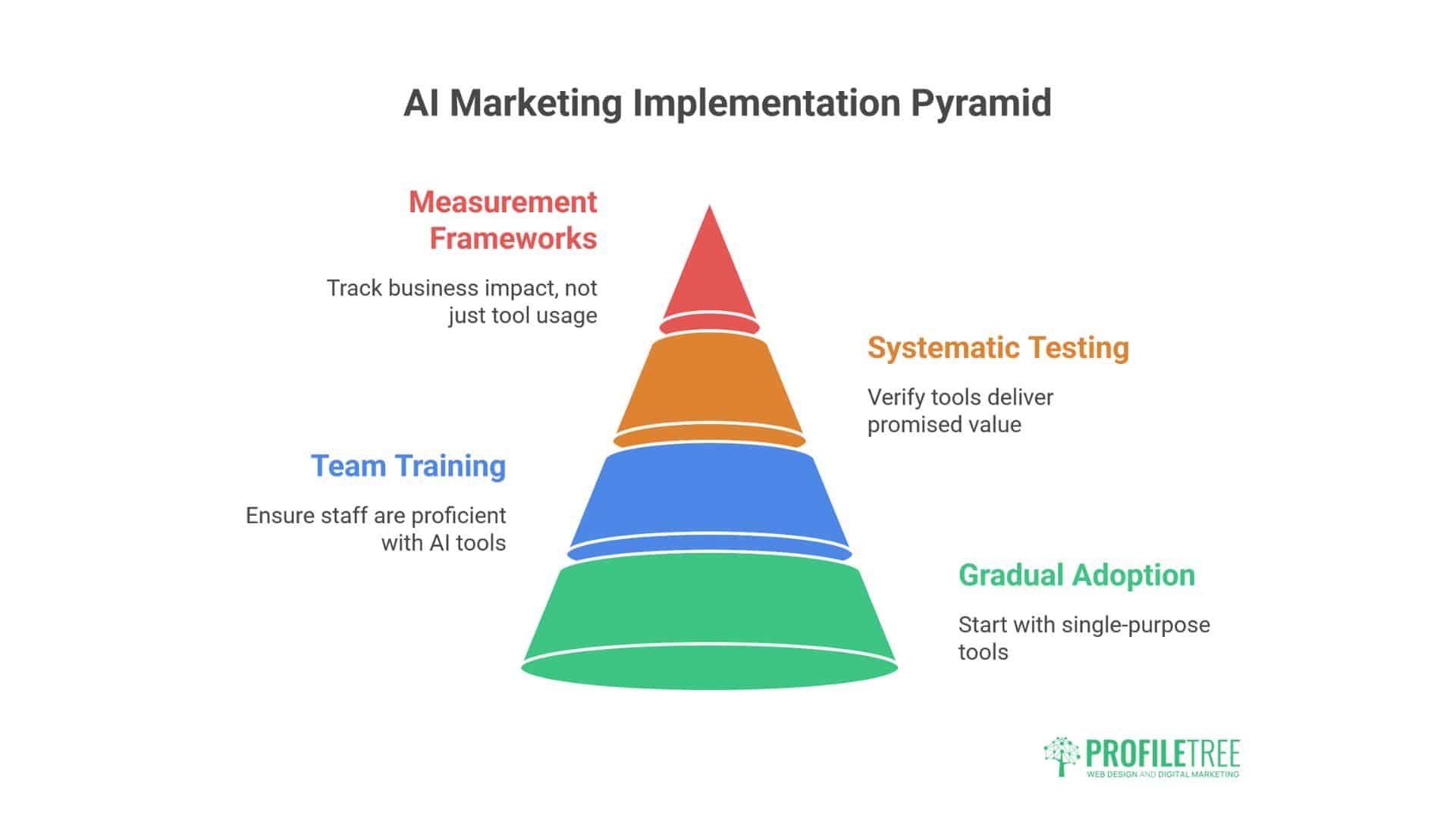
Successful AI marketing implementation follows proven best practices that prioritise gradual adoption, team training, and systematic testing to ensure tools deliver promised value without overwhelming existing operations or creating workflow disruptions. These implementation strategies focus on starting with single-purpose tools that address specific pain points before expanding to comprehensive AI ecosystems, while establishing measurement frameworks that track actual business impact rather than just tool usage metrics.
Tool Selection Framework
Start with Problems, Not Tools: Identify specific challenges before selecting solutions. The shiniest tool isn’t always the right tool. Document workflows that need improvement, then find AI solutions that address those particular needs.
Trial Everything: Most platforms offer free trials or freemium tiers. Test extensively before committing. What works for others might not work for your specific situation.
Integration Priorities: Choose tools that connect with existing systems. Isolated tools create data silos and workflow friction. Zapier integration often indicates good connectivity.
Scalability Considerations: Select tools that grow with your business. Switching platforms disrupts operations and causes the loss of historical data. It’s better to start with tools offering clear upgrade paths.
Security and Compliance
Data Protection: Understand where your data goes. EU businesses need GDPR compliance, healthcare companies require HIPAA compliance, and financial services need additional safeguards.
Intellectual Property: Clarify ownership of AI-generated content. Some platforms claim rights to outputs. Others restrict commercial usage. Read the terms carefully.
Brand Safety: Implement approval workflows for AI-generated content—automated publishing without review risks brand damage. Human oversight remains essential.
Team Adoption Strategies
Champion Programme: Identify enthusiasts who explore tools and train others. Organic adoption beats forced implementation. Champions become internal consultants supporting broader adoption.
Gradual Rollout: Implement one tool at a time. Master each before adding complexity. Overwhelming teams with multiple tools simultaneously ensures failure.
Success Metrics: Define clear success criteria for each tool. Track adoption rates, efficiency gains, and quality improvements. Data-driven decisions about keeping or replacing tools.
Our AI training services ensure successful adoption. The Future-Proof Your Business guide provides a comprehensive implementation framework.
Cost-Benefit Analysis
AI marketing tools require careful cost-benefit analysis that considers not just subscription fees but implementation time, training requirements, integration costs, and potential productivity gains to determine true return on investment. Practical analysis compares AI tool costs against traditional alternatives—such as hiring specialists or outsourcing tasks—while factoring in scalability benefits, time savings, and competitive advantages that may justify higher upfront investments for long-term business growth and operational efficiency.
Real ROI Calculations
Content Creation ROI: Jasper at £99 monthly generates content worth £3,000-5,000 from freelancers. Even accounting for editing time, ROI exceeds 1000%.
Design Tool Value: Canva Pro at £11 monthly replaces occasional design needs costing £500-1000 monthly. Annual savings: £6,000-10,000.
Video Production Savings: Synthesia, at £56 monthly, creates videos costing £2,000-5,000 through traditional production. One video monthly justifies an annual subscription.
Time Recovery: The Average small business saves 20 hours weekly through AI tools. At £50 hourly value, that’s £4,000 monthly in recovered productivity.
Hidden Costs to Consider
Learning Curve: Initial productivity decreases while learning the tools. Budget 20-40 hours for mastery per platform. Consider this investment, not a cost.
Integration Effort: Connecting tools requires setup time, and sometimes, technical assistance is needed. Budget £500-2000 for proper integration.
Quality Control: AI-generated content needs review and editing. Budget 20-30% of time saved for quality assurance.
Tool Sprawl: Multiple subscriptions add up quickly. Regular audits prevent paying for unused tools. Consolidate where possible.
Future Trends and Preparations
AI marketing evolution accelerates rapidly with emerging capabilities like autonomous campaign management, predictive customer lifecycle modelling, and cross-platform intelligence integration that will reshape competitive landscapes within the next two years. Preparing for these trends requires building flexible AI infrastructures, developing internal expertise that transcends specific tools, and maintaining strategic agility that enables small businesses to adopt breakthrough technologies before competitors, while avoiding premature investment in unproven solutions.
2025-2026 Developments
Autonomous Marketing Agents: AI will manage entire campaigns independently, from ideation through execution and optimisation. Early versions are already emerging.
Hyper-Personalisation: Every customer interaction is uniquely tailored. AI understands individual preferences, behaviours, and contexts. Privacy-preserving techniques enable this without creepiness.
Predictive Content: AI anticipates content needs before trends emerge, creating content for searches that have yet to happen. This offers first-mover advantages for early adopters.
Voice-First Marketing: Optimising for voice search and audio content. AI is enabling every business to have podcasts, audiobooks, and voice apps.
Preparing Your Business
Build AI Literacy: Invest in team education now. AI fluency becomes a competitive necessity. Those who understand AI capabilities gain advantages.
Develop Prompt Libraries: Document successful prompts and workflows. Institutional knowledge in AI usage provides a competitive moat.
Create Feedback Loops: Systematically improve AI outputs through consistent feedback. Your AI tools should get better over time, not stagnate.
Maintain Human Touch: AI amplifies but doesn’t replace human creativity and empathy. Businesses balancing AI efficiency with human connection win in the long term.
Ciaran Connolly, ProfileTree founder, observes: “The democratisation of AI marketing tools represents the greatest levelling of the playing field we’ve ever seen. Small businesses with smart tool selection and implementation now compete with—and often outperform—enterprises with massive budgets. The key isn’t using every AI tool; selecting the right combination multiplies your unique strengths. We’re seeing clients achieve results in weeks that previously took years to accomplish.”
Success Stories from Real Small Businesses
Real small business success stories demonstrate how strategic AI implementation transforms marketing performance, from a Cornwall bakery increasing online orders by 340% through personalised email campaigns to a Birmingham consultancy reducing content creation time by 75% while improving engagement rates. These documented case studies reveal specific tools, implementation approaches, and measurable outcomes that prove AI marketing capabilities deliver genuine business value rather than just technological novelty, providing actionable blueprints for similar small businesses seeking competitive advantages.
The Local Bakery Revolution
Sarah’s Sourdough in Belfast implemented AI tools with remarkable results:
- Canva AI for daily social posts: 300% follower growth
- ChatGPT for email newsletters: 45% open rate improvement
- Tidio for customer service: 60% reduction in phone calls
- Total monthly cost: £75
- Monthly revenue increase: £3,500
“AI didn’t replace our personal touch—it gave us time to focus on it,” Sarah explains.
The Consultant’s Transformation
Manchester consulting firm (5 employees) deployed a comprehensive AI stack:
- Jasper for thought leadership content
- Synthesia for training videos
- Clearscope for SEO optimisation
- Perplexity for research
- Results: 200% lead increase, 50% higher project values
The E-commerce Explosion
Dublin fashion retailer leveraged AI for dramatic growth:
- Pencil for ad creative: 40% ROAS improvement
- Phrasee for email: 35% revenue increase
- Dynamic Yield for personalisation: 25% conversion boost
- ROI: 15x return on AI investment within 6 months
Common Pitfalls and How to Avoid Them
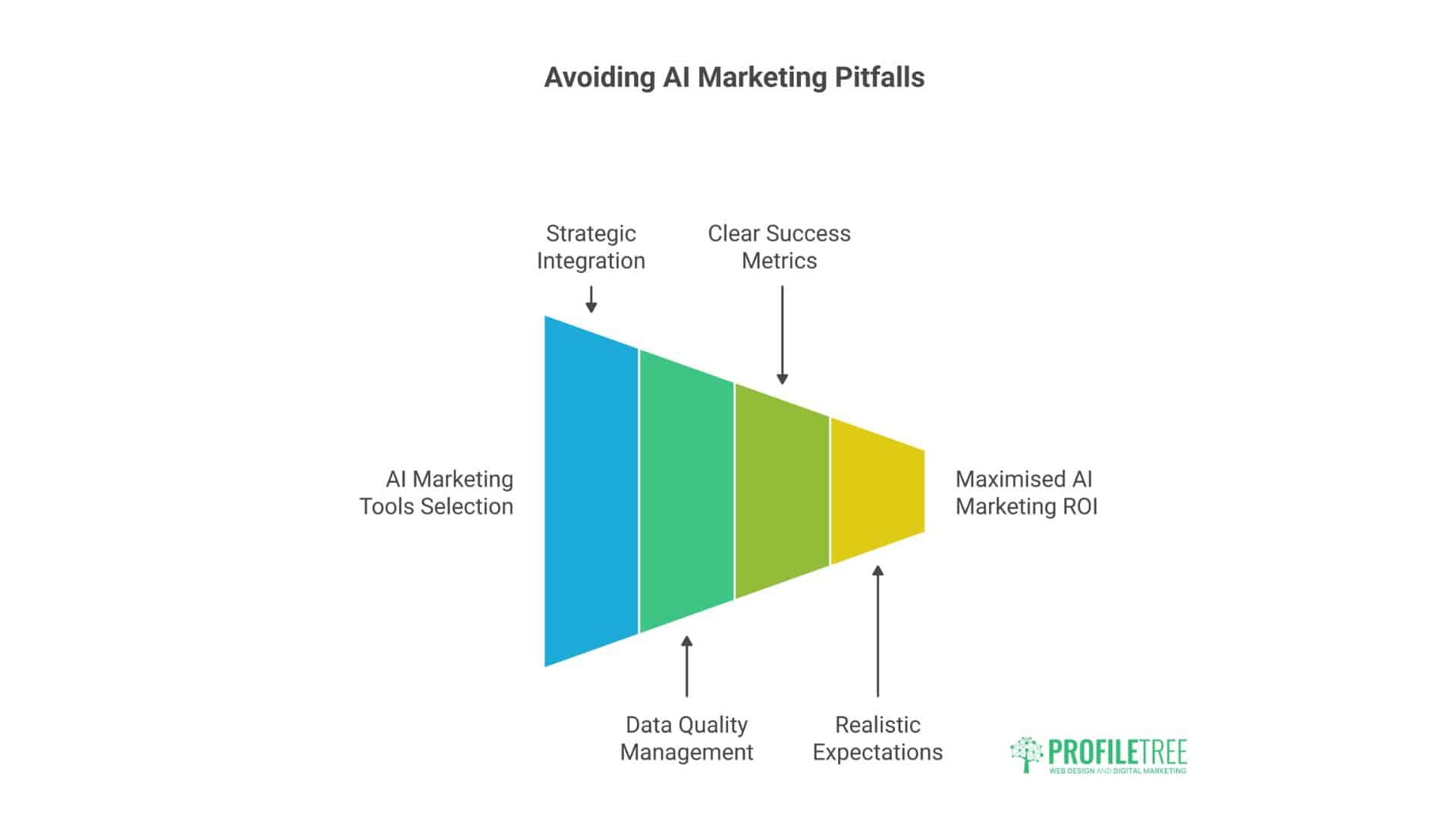
Small businesses frequently fall into predictable AI marketing traps, from selecting overly complex tools that exceed their operational capacity to expecting immediate results without proper setup, training, or strategic integration with existing processes. Understanding these common pitfalls—such as tool proliferation without purpose, neglecting data quality requirements, or implementing AI without clear success metrics—enables businesses to avoid costly mistakes while developing realistic expectations and sustainable implementation approaches that maximise AI marketing investment returns.
Over-Automation Syndrome
Automating everything removes the human connection that customers value. Solution: Use AI for efficiency, humans for empathy. Automate repetitive tasks, not relationship building.
Tool Redundancy
Multiple tools with overlapping features waste money—solution: Map capabilities before purchasing. One comprehensive platform often beats various specialised tools.
Quality Degradation
Unreviewed AI content damages brand credibility. Solution: Implement approval workflows. AI generates; humans verify and enhance.
Integration Paralysis
Too many tools create complexity paralysis. The solution: Master one tool before adding another. Integration quality beats tool quantity.
Taking Action: Your 30-Day AI Implementation Plan
A structured 30-day AI implementation plan provides the roadmap small businesses need to move from AI curiosity to operational AI advantage through systematic tool adoption, team training, and performance measurement that builds confidence and expertise progressively. This action-oriented timeline breaks down AI integration into weekly milestones that ensure sustainable adoption while minimising disruption to existing operations and maximising early wins, demonstrating value to stakeholders and team members.
Week 1: Assessment and Selection
- Audit current marketing workflows
- Identify the biggest time drains
- Research relevant AI tools
- Start free trials of 2-3 tools
Week 2: Foundation Implementation
- Set up chosen tools
- Import necessary data
- Create initial templates
- Generate first content
Week 3: Refinement and Expansion
- Optimise workflows based on experience
- Add complementary tools
- Develop prompt libraries
- Train team members
Week 4: Optimisation and Scaling
- Analyse performance metrics
- Eliminate underperforming tools
- Document best practices
- Plan expansion strategy
Ongoing: Evolution
- Monthly tool audits
- Quarterly strategy reviews
- Continuous team training
- Regular innovation experiments
Conclusion: AI Tools for Small Business Marketing
The AI marketing revolution isn’t coming—it’s here. Small businesses leveraging these tools effectively don’t just compete with larger competitors; they outmanoeuvre them through agility and innovation. The question isn’t whether to adopt AI marketing tools, but how quickly you can implement them effectively.
Without AI assistance, productivity, missed opportunities, and a competitive disadvantage are lost daily. While you evaluate options, competitors extend their leads. The tools exist, the knowledge is available, and the results are proven. Only action remains.
ProfileTree stands ready to accelerate your AI marketing transformation. Our comprehensive services spanning which include AI training, digital strategy, content marketing, SEO, social media, and video production ensure you maximise AI tools’ potential while avoiding common pitfalls.
Start small, but start now. Choose one tool, master it, measure results, then expand. Perfect implementation matters less than rapid iteration. The businesses winning with AI aren’t those with perfect strategies—they’re those taking action today.
Your competitors are already exploring these capabilities. Your customers expect AI-enhanced experiences. Your team wants AI augmentation. The only question is whether you’ll lead this transformation or follow others who do.
Contact ProfileTree today to design your optimal AI marketing stack. Through intelligent AI deployment, we can multiply your marketing capabilities, transform your efficiency, and secure your competitive future. The future belongs to businesses that embrace AI augmentation—ensure yours is among them.
FAQs
Which AI tool should small businesses start with?
Begin with ChatGPT Plus or Claude Pro for versatility, then add Canva Pro for design. These two tools cover 60% of marketing needs for under £35 monthly. Expand based on specific needs and success with initial tools.
How much should small businesses budget for AI marketing tools?
Start with £100-200 monthly, scaling to £300-500 as you grow. Most businesses find optimal value around £400 monthly. This investment typically returns 5-10x through efficiency gains and improved results.
Can AI tools really replace marketing agencies?
AI tools augment rather than replace agencies. They handle execution while agencies provide strategy. Many businesses find AI tools plus occasional strategic consulting more effective than full agency relationships.
What’s the learning curve for AI marketing tools?
Basic proficiency takes 10-20 hours per tool, and mastery requires 40-60 hours. Invest this time—the productivity gains compound indefinitely. Consider it professional development rather than overhead.
How do we maintain quality with AI-generated content?
Implement a three-layer approach: AI generates, human edits, final review before publication. Train AI on your best content. Maintain brand guidelines. Never publish without human oversight.
Which tools are essential versus nice-to-have?
Essential: Content creation, basic design, social scheduling. Nice-to-have: Advanced analytics, video generation, personalisation. Build a foundation before adding sophistication.