
How to Get Video Production Signed Off by Your Finance Director
Table of Contents
Video production budgets stall at one point more than any other: the moment a marketing manager has to defend the spend to a finance director who wants numbers, not enthusiasm. The pitch deck looks good, the agency quote is reasonable, and then the question lands. What return does this actually deliver, and how will we measure it? If you cannot answer that in the language a CFO uses, the budget gets deferred.
This guide sets out how to build that answer. It covers the metrics finance teams accept, the attribution models that connect video to revenue, and the way to present a video production case to a board so it reads as a considered investment rather than a marketing want.
ProfileTree, a Belfast-based web design and digital marketing agency, works with SME marketing teams across Northern Ireland, Ireland, and the UK who face exactly this hurdle. The pattern is consistent: the creative case is easy, the financial case is where approval is won or lost.
Why finance teams resist video budgets
Finance directors are not against video. They are against spend they cannot model. A video production quote of several thousand pounds sits in the same approval queue as equipment, software, and headcount, and it competes on the same terms. The problem is that marketing often presents video as a creative project with a vague upside, while finance assesses it as a capital outlay with an expected return.
The fix is to reframe the request before it reaches the approval stage. Treat the video as an asset with a measurable working life, a defined set of outputs, and a tracking plan attached from day one. A single production day can yield a homepage hero video, shorter social clips, and sales-enablement content, so the cost is spread across several uses rather than charged against one. That framing alone moves the conversation from “should we spend this” to “what return are we modelling”.
If you want the production side mapped out before you cost it, the video production process guide sets out what each phase involves, which helps when finance asks what they are paying for. For the wider return picture, the video marketing ROI covers the performance side in more detail.
The three metrics finance directors accept
A board responds to metrics it already uses elsewhere. Build the video case on three: customer acquisition cost, sales cycle length, and customer lifetime value. These are the numbers a finance team tracks for every channel, so presenting video in the same terms removes the need to explain a new framework.
Customer acquisition cost
Acquisition cost is total marketing spend divided by qualified leads generated. To make the video case, you need a baseline figure for your current channels before the video goes live, then the same measurement after. The argument is not that video is cheaper in the abstract. It is that you will measure cost-per-lead before and after, and report the difference. Finance teams accept a measured comparison far more readily than a projected percentage.
Sales cycle length
Video can shorten the path from first contact to closed deal by answering common objections before a sales conversation starts. A product demonstration video, for example, removes a round of back-and-forth that a salesperson would otherwise handle. Measure average time from first contact to close for the period before video, then compare. A shorter cycle frees sales capacity, which is a cost saving a finance director can see directly.
Customer lifetime value
Customers who understand a product before they buy tend to use it more fully and stay longer. If you can segment customers by whether they engaged with video content, you can compare lifetime value across the two groups over time. This is a longer-horizon metric, so present it as a tracked indicator rather than an immediate return, and be honest that it takes several quarters to read.
Build the ROI case with attribution
The weak point in most video budget requests is attribution. Finance will ask how you know a sale came from video, and “engagement was high” is not an answer they can put in a model. Set up attribution before the video launches, not after.
Use UTM parameters on every video link and platform referral data to capture which prospects first arrived through video. Most considered purchases involve several touchpoints, so a multi-touch model that records video at the awareness, consideration, and decision stages gives a fairer picture than crediting a single click. Where your CRM supports it, a time-decay model weights touchpoints nearer the purchase more heavily, which reflects how buying decisions actually form.
The point of this work is not perfect precision. It is to show finance that video sits inside the same measurement discipline as every other channel, with a defined tracking method agreed in advance.
Present the case to the board
Boards approve what they can compare. Frame your request around evidence types that financial stakeholders recognise.
Build a short performance dashboard rather than a written report. Include total video views and completion rates, video-influenced pipeline value, cost-per-lead against other channels, and any change in sales cycle length. A visual dashboard communicates faster than prose and signals that the spend is already being managed like an investment.
Use benchmark comparisons to give context. A statement such as “video-sourced leads cost less per lead than our paid search leads, on current data” lands because it sets one known channel against another. Avoid invented percentages; use your own figures or clearly attributed industry data.
When you request the initial budget, give conservative projections, then report actual performance against them. Coming in ahead of a cautious forecast builds the confidence that opens up a larger video budget later. Over-promising at the outset does the opposite.
Video for investor relations and fundraising
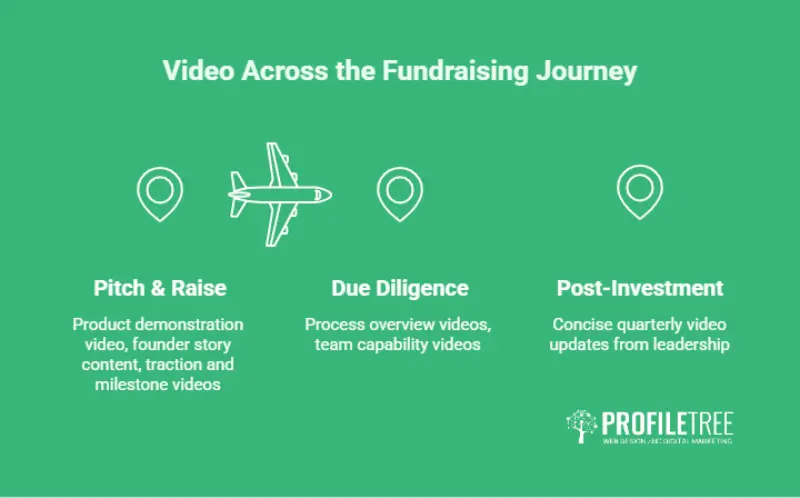
The finance case for video extends beyond marketing. Founders raising capital use video to convey business models and traction more efficiently than slides allow.
Short product demonstration videos of around sixty to ninety seconds show functionality that static slides only describe, which matters most for software and technical products. Founder story content builds the personal credibility investors weigh alongside the numbers, provided it stays natural rather than rehearsed. Traction videos, such as a time-lapse of a facility expansion or a compilation of customer feedback, give visual evidence of execution.
Video also speeds up due diligence. Process overview videos show how a company delivers without exposing proprietary detail, answering common diligence questions before they are asked. Team capability videos let investors assess the people behind the business. After investment, concise quarterly video updates from leadership tend to be watched in full where long written reports are skimmed.
Keeping video consistent across locations
Businesses operating across several sites face a related finance question: how to control quality and brand without paying for separate productions everywhere. The answer is a centralised standard with local execution.
Document the visual identity once: colour palette, typography, logo usage, and templates for lower thirds, title cards, and end screens that local teams reuse. Provide an approved messaging library so regional offices add local examples without drifting from the core narrative. Set minimum technical standards for resolution, aspect ratio, audio, and lighting, so no location’s output undermines the brand.
A hybrid model works well for cost control. Local teams capture footage following a standard shooting guide, while a central team handles editing, colour grading, and finishing. A digital asset management system with an approval workflow keeps content on-brand without creating a bottleneck. This spreads production cost across locations while holding quality at one standard, which is the efficiency argument a finance director wants to hear.
ProfileTree’s approach to the financial case
ProfileTree begins video work with the business objective, not the equipment list. The first questions are what outcome you need, which audiences you must reach, and how the video fits existing marketing. Those answers shape every creative decision, which is also what makes the spend defensible to finance: each output maps to a stated goal.
The team’s Belfast studio serves clients across Northern Ireland, Ireland, and the UK, and the production runs from planning through filming to post-production and platform-specific delivery. Building the tracking plan into the project from the start is what lets clients report return rather than guess at it.
“The mistake we see is businesses commissioning video because a competitor has it, with no measurement plan attached,” says Ciaran Connolly, founder of ProfileTree. “Start with the outcome you need and decide how you will measure it before you film. When the tracking is in place from day one, the finance conversation becomes straightforward, because you are reporting numbers rather than asking for faith.”
A practical next step
If you are preparing a video production request for sign-off, start with the three metrics your finance team already uses, agree the attribution method before anything is filmed, and present the case as a dashboard rather than a pitch. That sequence turns a creative ask into an investment proposal. ProfileTree’s video marketing services include the measurement framework alongside the production, so the financial case is built in from the start.
Frequently asked questions
How do I justify video production cost to a finance director?
Present it as an asset with measurable outputs and a tracking plan, not a creative project. Build the case on cost-per-lead, sales cycle length, and customer lifetime value, measured before and after launch.
What metrics prove video ROI to a board?
Customer acquisition cost, sales cycle velocity, and customer lifetime value, supported by attribution data linking video views to pipeline. Present these in a dashboard against your other channels.
How do I attribute revenue to video content?
Use UTM parameters and platform referral data, then apply a multi-touch or time-decay model in your CRM. Set this up before the video launches so the data is captured from the start.
How long before video production shows a return?
Conversion effects can appear within the first couple of months on key pages, while sales cycle and lifetime value changes take longer to read. Treat the longer-horizon metrics as tracked indicators over several quarters.
How can a smaller business control video costs across multiple locations?
Use a centralised brand and quality standard with local filming and central post-production. A shared template system and approval workflow hold quality at one standard while spreading cost across sites.