
Video Case Studies: The UK & Ireland SME Commissioning Guide
Table of Contents
Most businesses already know that social proof sells. The question is whether a written testimonial on a service page is doing enough work for them. For many SMEs across the UK and Ireland, the answer is no, and that is where video case studies close the gap.
Video case studies are not promotional brand films. They are structured pieces of content that follow a real client through a recognisable problem, show how it was solved, and present the outcome in a format that a prospective buyer can immediately relate to. Done well, they are among the most commercially effective assets a business can commission.
This guide is written for marketing managers and business owners who are evaluating whether to commission professional video case studies and what to expect from the process if they do. It covers what separates a strong production from a weak one, how the commissioning journey works, how to handle consent under UK and Irish data protection rules, and how to get the most from the finished asset once it is in place.
Beyond the Testimonial: Why Video Case Studies Build B2B Trust
A written quote from a satisfied client has value. A two-minute video of that same client, in their own words, explaining exactly what changed for their business after working with you is a different thing entirely.
The difference comes down to what the viewer experiences. Text requires the reader to imagine credibility. Video demonstrates it. The viewer can hear the tone of voice, see the client’s environment, and form a judgment about whether the story feels authentic. That authenticity is what closes the gap between interest and enquiry for most B2B buyers.
Video case studies also work across multiple stages of the buying journey. On a service page, they give a hesitant prospect the reassurance they need to take the next step. In a sales email, a short clip used ahead of a proposal call can shift the conversation before it starts. On LinkedIn, a 60-second cut from a longer case study creates organic reach that written content rarely achieves.
For businesses operating in Northern Ireland, Ireland, and across the UK, there is a regional dimension worth noting. Buyers in these markets respond well to local voices. A case study featuring a business owner from Belfast, Cork, or Manchester speaking naturally, rather than reading from a script, carries more weight than a polished but impersonal production filmed somewhere generic.
“The most effective video case studies we produce are the ones where the client’s customer does the selling for us,” says Ciaran Connolly, founder of ProfileTree. “When a viewer hears someone from their own industry describe a problem they recognise, the credibility is immediate in a way that no amount of copywriting can replicate.”
Commissioning vs. DIY: What the Production Decision Actually Costs
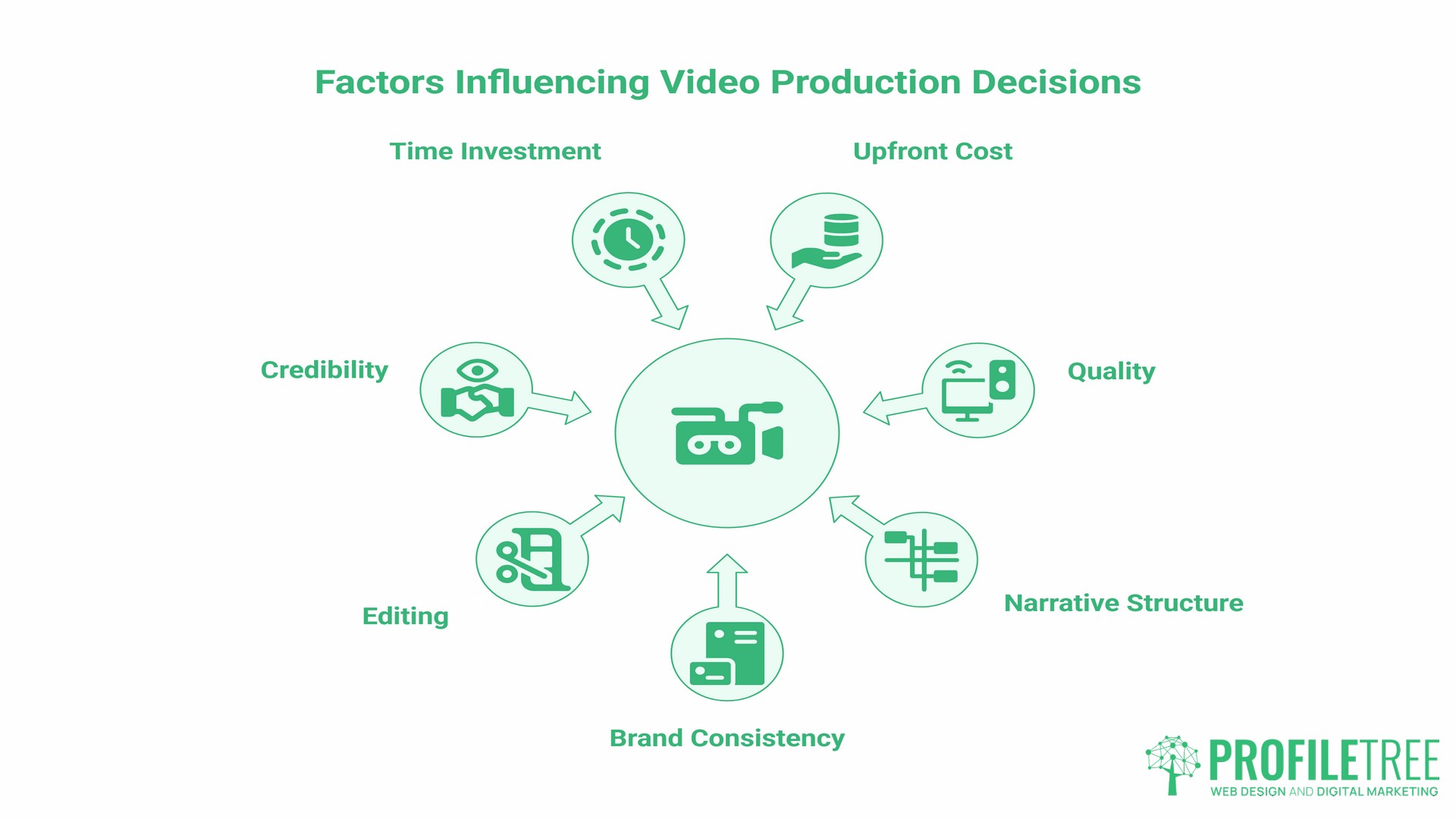
The smartphone in your pocket can record 4K video. That fact leads many SMEs to consider producing their own video case studies in-house. Whether that is the right decision depends on what the asset needs to do.
The table below honestly compares the two approaches.
| Factor | DIY / Smartphone | Professional Production |
|---|---|---|
| Upfront cost | Low (equipment you own) | £2,750 to £5,000+ |
| Lighting and audio quality | Variable; difficult to control in real offices | Controlled; professional grade |
| Narrative structure | Often flat; relies on what the interviewee says | Shaped by pre-production planning and interview direction |
| Brand consistency | Inconsistent unless the team has design skills | Consistent; aligned with brand guidelines |
| Editing and post-production | Time-intensive for non-specialists | Handled by the production team |
| Perceived credibility | Works for social media and internal use | Appropriate for service pages, pitch decks, sales calls |
| Time investment from your team | High (planning, filming, editing) | Lower; primarily brief and review stages |
Cost figures for professional case study video production in the UK are drawn from industry pricing data published by UK production companies in 2024 and 2025. The average cost for a case study video sits around £3,850, with the range reflecting variation in crew size, number of locations, and whether motion graphics and social media cuts are included.
The case for professional production strengthens when the video needs to do serious commercial work: on a high-traffic service page, in a proposal to a major client, or as part of a tender submission. The case for DIY is stronger when the goal is social media volume, speed, or a budget that genuinely cannot stretch further.
For most SMEs weighing up the decision, the honest question is not “can we film it ourselves?” but “what is the cost of a low-quality asset on the page where buyers make their decision?”
The Professional Production Framework: What to Expect
Commissioning a video case study from a production agency is a defined process. Understanding each phase helps clients know what they need to contribute and what they can expect in return.
Phase 1: Strategic Planning and the Client Brief
The process starts with a briefing conversation, not a camera. A good production team will want to understand what the finished video needs to achieve before anything else is decided: which service it supports, where it will be placed, who the target audience is, and what action a viewer should take after watching.
From the client’s side, this phase requires you to identify a suitable case study subject: a real client who achieved a meaningful outcome and is willing to speak on camera. The production team will advise on what makes a strong case study subject, but the relationship and the permission are yours to secure.
This phase also sets the narrative direction. The strongest video case studies follow a clear arc: a specific problem, a defined solution, and a measurable result. Vague accounts of a “great experience working together” do not perform well on camera. Specific outcomes, a percentage increase in enquiries, a cost that was reduced, and a process that was simplified give viewers something to hold onto.
Phase 2: Pre-Production and Narrative Planning
Before the shoot day, the production team develops the interview question framework. This is not a script for the client to read. It is a structured set of questions designed to draw out the narrative naturally, in the subject’s own words.
A typical framework for a B2B video case study might include:
- What was the specific challenge or problem you were facing before the project?
- What made you choose this particular solution or partner?
- What did the process look like from your perspective?
- What changed after the project was complete?
- What would you say to another business facing the same situation?
The pre-production phase also covers logistics: location, B-roll requirements (footage of the client’s premises, team, or product in use), any graphics or text overlays needed in editing, and technical specifications for where the video will be published.
Phase 3: The Shoot Day
A standard shoot day for a single video case study runs between two and four hours on location. For clients across Belfast, Dublin, or regional UK locations, the production team handles all equipment, lighting rigs, professional audio, and camera setup.
The most important variable on the day of the shoot is not the equipment. It is the comfort of the interviewee. Experienced directors know that a relaxed, natural interview produces footage that viewers trust, while a stiff or over-prepared interviewee reads as scripted and loses credibility. The pre-production question framework matters precisely because it gives subjects time to think through their answers before the camera is rolling.
B-roll footage (shots of the business, its team, its product, or its environment) is filmed separately and used in editing to add visual variety to the video. A case study consisting only of a static talking head will lose viewers regardless of how good the content is. B-roll keeps the viewer’s attention and provides context that the interview alone cannot.
For businesses that cannot accommodate an on-site crew, high-quality remote recording is a practical alternative. Platforms designed for remote video capture can produce strong results when the subject has good lighting and a neutral background. The trade-off is the loss of environmental B-roll, which limits the editing options.
Phase 4: Post-Production and Review
Editing transforms raw footage into a structured, on-brand asset. This includes selecting the best interview segments, cutting to B-roll, adding any motion graphics or text overlays, incorporating music, and colour grading the final output.
Review cycles are built into a professional production timeline. Clients typically receive a first cut for feedback, followed by a round of revisions before final delivery. The finished asset is usually delivered in multiple formats: a full-length version for the website and a shorter 60-second cut for social media.
Captions are not optional. A significant proportion of video content in the UK is watched without sound: on mobile, in shared spaces, or by users who have not enabled audio. Captions increase reach, improve accessibility in line with UK accessibility guidelines, and give search engines crawlable text from the video’s content.
ProfileTree’s video marketing services cover the full production cycle for SMEs across Northern Ireland, Ireland, and the UK, from initial brief through to final delivery and distribution support.
Navigating the Legalities: GDPR and Consent for UK and Irish Businesses
This is the section that US-centric guides on video case studies consistently overlook, and it matters significantly for businesses operating under UK GDPR or the Irish Data Protection Acts.
Under UK GDPR, video footage of an identifiable individual is personal data. Publishing that footage online constitutes processing of personal data, which means the obligations of UK GDPR apply. The lawful basis most commonly used for commercial case study videos is explicit consent, obtained before filming begins.
Practical steps for UK and Irish businesses:
- Issue a consent form to every individual who will appear on camera before the shoot date. The form should specify the purpose for which the footage will be used (website, social media, paid advertising, trade press), the channels on which it will be published, and the duration.
- Confirm the intended usage in writing. This becomes the boundary for how the footage can legally be used.
- Keep signed consent records on file for the full duration the video is in use. Under UK GDPR, you must be able to demonstrate that valid consent was obtained.
- If a participant later withdraws consent, you are obliged to remove the video from any publicly accessible channel. Plan for this possibility before commissioning, particularly for content featuring employees of client businesses rather than business owners.
The ICO’s guidance on consent confirms that valid consent must be freely given, specific, informed, and unambiguous. It must be confirmed by a clear affirmative action, not inferred from participation alone. Production agencies working regularly in the UK market should have standard consent documentation in place. If yours does not, ask before the shoot date.
For businesses operating in Ireland, the Irish Data Protection Acts 2018 implement the requirements of GDPR. The principles are substantively the same as those of the UK GDPR in this context, though the supervisory authority is the Data Protection Commission (DPC) rather than the ICO.
Distribution: Maximising the Asset’s Commercial Return
A video case study that sits in a private folder is not doing any commercial work. Distribution planning should start during the briefing phase, not after delivery.
Landing Page and SEO Integration
The primary home for video case studies is the service page that supports them. Embedding the video directly on the page increases the time visitors spend on the page, which is a positive engagement signal for search engines. Video schema markup, structured data added to the page’s code, helps search engines understand the video’s content and can trigger a rich snippet in search results showing a video thumbnail alongside the organic listing.
For the video itself on YouTube, optimisation matters. YouTube is widely recognised as the second-largest search engine in the world, after Google. A keyword-informed title, a description that summarises the client’s challenge and outcome in plain language, chapter markers for longer videos, and relevant tags all contribute to discoverability and can drive organic traffic to the page where the video is embedded.
ProfileTree’s guide to short-form video content covers how to repurpose longer case study footage into social cuts that extend the asset’s reach without additional filming costs.
Social Media Clipping
The full-length video rarely performs best on social media. A 60-second cut that opens with the client’s problem and closes with the result, with captions, is built for LinkedIn and Instagram. A 15-second cut highlighting a single strong quote works well for X and Facebook stories.
Plan these cuts at the brief stage so the shoot captures enough material to support them. Trying to create a compelling 60-second social cut from footage shot with only the full-length version in mind often produces something that feels truncated rather than purposeful.
LinkedIn is worth particular attention for B2B video case studies. Native video on LinkedIn receives higher organic reach than external links, and case study content, a real client talking about real results, consistently outperforms brand content and thought leadership posts in B2B feeds.
Use in the Sales Pipeline
Video case studies have a specific value at the proposal stage of a sales process. A link to a relevant case study in a follow-up email after a first meeting, or embedded in a proposal document, gives the prospect something concrete to consider before making a decision. This works well when the case study subject is in a similar industry or faced a similar problem to the prospect.
Common Mistakes When Commissioning Video Case Studies
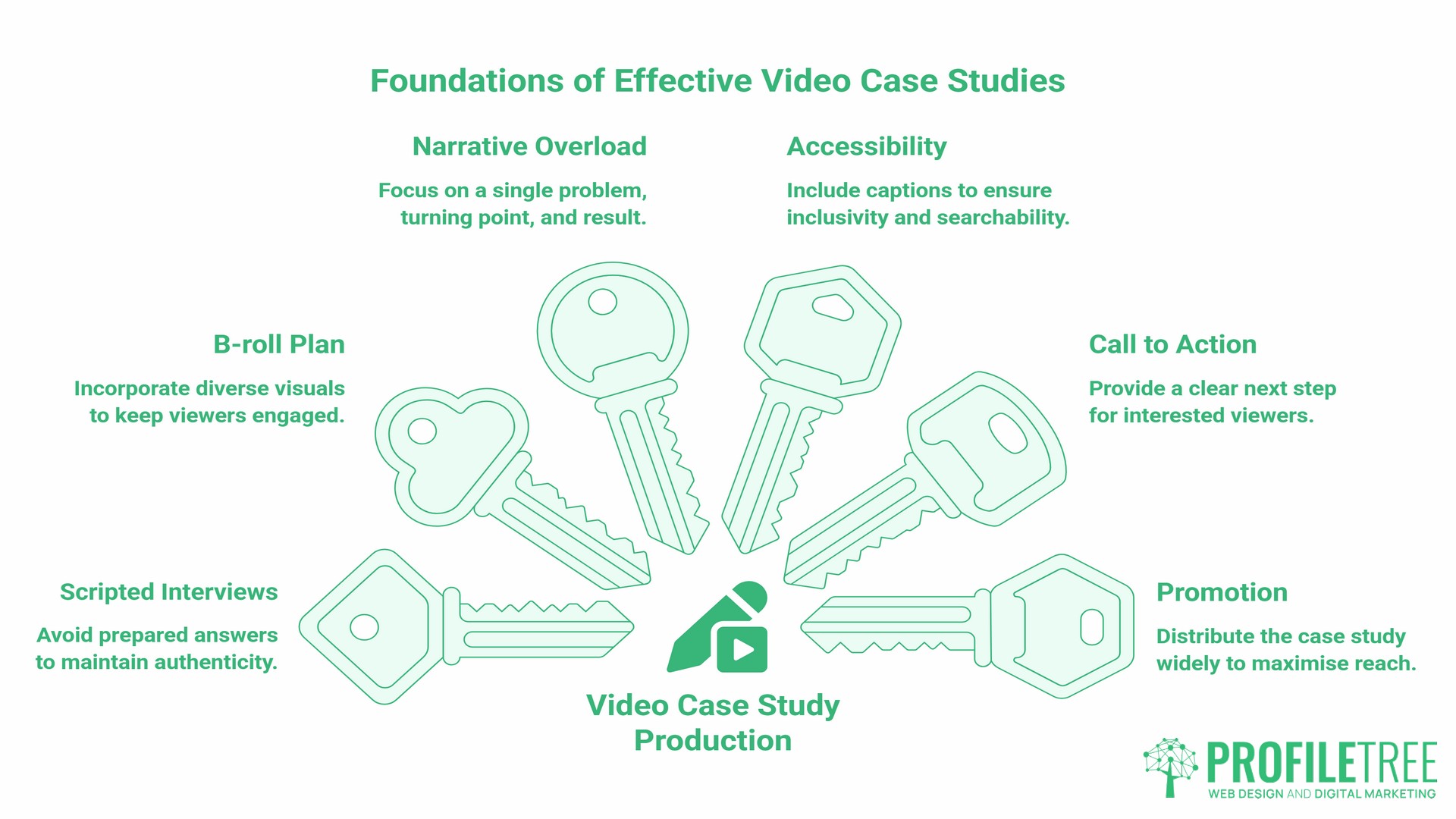
The most consistent errors in video case study production have nothing to do with camera quality. They are strategic and structural.
- The scripted interview. Asking your client to read prepared answers or coaching them too heavily before the shoot removes the authenticity that makes video case study content credible. Viewers can tell. Brief your subject on the topic areas beforehand, but let them find their own words on the day.
- No B-roll plan. A video consisting entirely of a static talking head will lose viewers within 30 seconds, regardless of how good the content is. B-roll, the office, the product, the team, the environment, keep attention across the full running time. Plan it in pre-production, not on the day.
- Overloading the narrative. A two-minute video cannot tell the full story of a complex project. Choose one problem, one turning point, and one measurable result. Leave everything else out. The most effective video case studies are simple.
- Ignoring accessibility. Captions are not a nice-to-have. They are required for viewers watching without sound, meet UK accessibility expectations, and provide search engines with text to index. Build them into every deliverable as standard.
- Forgetting the call to action. The video ends; then what? Whether the CTA appears as an end card within the video, a text overlay in the final seconds, or in the page content surrounding the embed, a viewer who found the case study compelling needs a clear next step.
- Failing to promote the finished asset. Poor distribution is the most common waste in video production. A case study that lives only on one page of a website reaches a fraction of the audience it could reach with a structured distribution plan across email, social, and the sales pipeline. ProfileTree’s animated video production and broader content services are built around ensuring every asset works as hard as possible once it exists.
Choosing a Video Production Partner in Northern Ireland and Beyond
For SMEs across Northern Ireland, Ireland, and the UK, commissioning video case studies from a local production partner has practical advantages beyond logistics. Regional producers understand local business culture, can work flexibly around your team’s schedule, and bring experience of what resonates with the audiences you are selling to.
When evaluating a production partner, look beyond the showreel. Ask to see completed case study work specifically, not brand films or explainer videos. Ask how they handle the briefing process, how many revision cycles are included, and what deliverables are covered in the fee. A production partner who cannot clearly explain their process before the contract is signed will not improve once it is.
ProfileTree has worked with businesses across Belfast, Northern Ireland, Ireland, and the wider UK to produce video case studies that support service pages, sales processes, and content marketing strategies. If you are planning a production and want to understand what the process looks like in practice, get in touch with our team.
FAQs
How long does a professional video case study take to produce?
From initial briefing to final delivery, expect four to six weeks for a standard single-subject production. This covers pre-production planning, the shoot day, editing, and review cycles. Rush timelines are possible, but they compress the pre-production phase, which is where most of the narrative quality is established.
What is the ideal length for a B2B video case study?
For embedding on a service or landing page, the practical range is 90 seconds to three minutes. Shorter than 90 seconds rarely gives enough time to establish the client’s problem and make the result feel meaningful. Longer than three minutes requires exceptionally strong content to retain viewers. For social media cuts, the target is 45 to 90 seconds.
Do I need a script?
No, and in most cases, a script will make your video less effective. Scripted interviews read as promotional and reduce viewers’ trust in what they hear. What you do need is a structured question framework developed in pre-production, which gives your case study subject clarity on the topic areas without locking them into specific phrasing.
How do I get my client to agree to take part?
Frame participation as a co-marketing opportunity. The finished video will feature their business, be shared across professional channels, and give them content they can use in their own marketing. Most B2B clients respond positively when the ask is positioned as a genuine benefit to them, not just a favour to you.
How much does professional video case study production cost in the UK?
Based on UK production company pricing data from 2024 and 2025, a case study video in the UK averages around £3,850. The range runs from approximately £2,750 for a straightforward single-location production through to £5,000 or more where multiple locations, motion graphics, or a suite of social media cuts are included. Costs vary depending on geography, crew size, and the production company’s day rate.
Can video case studies be filmed remotely?
Yes. Remote recording platforms designed for professional video capture can produce strong results when the subject has good lighting and a clean background. The trade-off is the absence of environmental B-roll, which limits editing options and reduces the visual variety of the finished piece. For subjects who are geographically distant, remote recording is a practical alternative to on-site production.
What happens under GDPR if a client later withdraws consent?
If an individual withdraws their consent, you are obliged to remove the video from any publicly accessible channel. The ICO’s guidance on consent confirms that individuals have the right to withdraw at any time, and that withdrawal must be acted on promptly. This is why written consent documentation should specify usage channels and duration upfront; it clarifies the boundaries and reduces the likelihood of a later dispute.