
Data Science for Small Business UK: A Practical Guide for SMEs
Most small business owners in the UK already use data science. They just don’t call it that. Every time you check which products sell best in which month, review your website’s traffic sources, or look at which email subject lines get opened, you’re applying the core logic of data science: collecting information, identifying patterns, and making better decisions because of it.
The problem isn’t access to data. Businesses today generate more of it than ever, from website visits and social media engagement to customer purchase history and email open rates. The problem is knowing what to do with it and having the tools or support to act on what the data is telling you.
This guide explains what data science actually means for a small or medium-sized business in Northern Ireland or the UK, which applications are realistic right now without a data science team, and how to build a data-led approach that improves your marketing, your website, and your business decisions over time.
Table of Contents
What Data Science Actually Means for a Small Business
Data science is often described in academic terms: a multidisciplinary field combining statistics, computer science, and machine learning. That framing is accurate, but it’s not particularly useful for a business owner trying to decide whether to invest in it.
For an SME, data science is more usefully defined as the practice of using data to make better business decisions than you would make on instinct alone. It sits on a spectrum. At one end, basic data analytics means looking at what has already happened: your sales figures last quarter, your website bounce rate, and your most-viewed pages.
At the other end, predictive data science uses historical patterns to forecast what is likely to happen next, which customers are at risk of churning, which products will sell well in the next six weeks, or which website visitors are most likely to convert.
Most UK SMEs are currently operating at the basic analytics end of that spectrum, often using tools they already have access to but haven’t fully explored. The realistic opportunity for most businesses isn’t to hire a data science team; it’s to use existing tools more deliberately and to bring in external expertise when a specific problem justifies it.
Data Analytics vs Data Science: Why the Distinction Matters
Data analytics looks backward. It tells you what happened and helps you understand why. A Google Analytics report showing that your blog post drove 400 sessions last month but converted nobody is data analytics.
Data science looks forward. It uses patterns in historical data to make predictions. A model that identifies which of your website visitors match the profile of your best customers and flags them for a targeted follow-up is data science.
For most SMEs, the immediate value is in getting better at analytics first. Once you understand what your data is telling you about past behaviour, you’re in a much stronger position to use more advanced tools to predict and influence future behaviour.
Is Data Science Too Expensive for Small Companies?
This is one of the most common questions from UK business owners, and the short answer is: not at the level most SMEs actually need.
The expensive version of data science involves hiring a data scientist (typically £50,000 to £80,000 per year in the UK), building custom models, and maintaining complex infrastructure. That’s genuinely out of reach for most SMEs, and for most, it’s also unnecessary.
The accessible version involves using tools that have data science built in: Google Analytics 4, which uses machine learning to fill gaps in your data; Meta Ads, which uses predictive algorithms to find audiences similar to your existing customers; and email platforms like Mailchimp or Klaviyo, which use behavioural data to suggest the best send times and subject lines.
Beyond that, working with a digital agency or a fractional data consultant for a defined project, such as a customer segmentation analysis or a website conversion audit, is a far more realistic model for SMEs than employing a full-time specialist.
Five Ways UK SMEs Are Using Data Science Today
Data science sounds like something that belongs in a tech company with a dedicated analytics team. In practice, the five applications below are already in use by small and medium-sized businesses across the UK, often with tools they already pay for and data they’re already collecting.
Improving Digital Marketing Performance
The most immediate application of data science for most UK SMEs is in digital marketing. Every campaign you run generates data: which audience segments responded, which ad creatives performed, which landing pages converted, which keywords brought buyers rather than browsers.
Without a structured approach to that data, most businesses make the same campaign mistakes repeatedly because they’re not connecting performance patterns to decisions. With even basic data analysis, you can identify which channels are actually driving revenue rather than just traffic, and allocate budget accordingly.
ProfileTree works with SMEs across Northern Ireland and the UK to build digital marketing strategies grounded in performance data. Rather than recommending channels based on general best practice, the approach is to audit what the business’s existing data shows about where its customers actually come from, then build on that foundation. More detail on how this works in practice is covered in our digital marketing strategy guide.
Understanding Website Behaviour
Your website generates data every day: which pages people visit, how long they stay, where they drop off, and which paths lead to enquiries or purchases. Most businesses look at headline traffic figures but rarely dig deeper into what that behaviour is actually telling them.
Data-informed web design uses behavioural data to make decisions about page layout, content placement, calls to action, and user flow. Heatmapping tools show where visitors click and how far they scroll. Session recording tools show where people get confused or give up. Google Analytics 4 uses machine learning to identify which user segments are most likely to convert, and flags behavioural anomalies you might otherwise miss.
When ProfileTree builds or rebuilds a website, the structure isn’t based solely on aesthetic preferences. It’s informed by what the data shows about how the target audience actually navigates and makes decisions online. Our work on web design is shaped by exactly this kind of behavioural insight.
Predicting Customer Behaviour and Reducing Churn
For businesses with a customer base and purchase history, even simple data analysis can identify who is likely to buy again, who hasn’t purchased in a while and might be at risk of leaving, and which customers have the highest lifetime value.
A local retailer with 12 months of transaction data can identify, without any specialist software, that customers who make a second purchase within 30 days of their first purchase are significantly more likely to become regulars. That insight alone is enough to design a targeted post-purchase follow-up campaign for new customers in that window.
More advanced applications use machine learning to score every customer in your database based on their probability of churning, enabling targeted rather than blanket retention campaigns. Tools like HubSpot and Klaviyo have this functionality built in at price points accessible to growing SMEs.
Optimising Content and SEO Performance
Content marketing and SEO generate significant data, but much of it goes unread. Search Console shows which queries bring your pages into view, how often searchers click through, and where your content is gaining or losing ground. Combined with on-page engagement data from Analytics, this gives a clear picture of which content is actually earning its place and which is underperforming despite ranking.
Data science applied to content means using that performance information systematically: identifying which topics are driving qualified traffic, which pages are ranking but failing to convert, and where there are genuine search queries your audience is making that your current content doesn’t address.
ProfileTree’s approach to content marketing is built on this kind of performance data. We track which content is generating commercial outcomes, not just traffic, and use that to shape what we create next. For a deeper look at how data informs content decisions, see our article on the importance of data in AI implementation.
AI-Powered Business Tools
A growing number of business tools now have AI and data science built in, meaning SMEs are increasingly benefiting from these capabilities without realising it. Google Ads uses machine learning to optimise bidding in real time. GA4 uses predictive modelling to estimate future revenue from current user cohorts. Canva’s AI features use pattern recognition to suggest design elements that align with your brand. Shopify’s analytics uses purchase history to surface demand forecasting insights.
The question for most SMEs isn’t whether to adopt data science; it’s whether they’re getting value from the data science already embedded in the tools they’re using. In most cases, the answer is that they’re using 20% of what’s available to them. Our guide on Canva AI features is a useful starting point for understanding how AI is already built into tools many businesses use daily.
The UK and Northern Ireland Data Landscape
Any business collecting and using customer data in the UK is subject to UK GDPR and the Data Protection Act 2018. These aren’t just legal formalities: they govern how you collect data, how long you store it, and how you use it for marketing or analysis purposes.
For SMEs starting to build more data-driven processes, the key principles to understand are lawful basis for processing (you need a valid legal reason to use someone’s data), data minimisation (collect only what you actually need), and purpose limitation (don’t use data collected for one purpose for a different one without consent).
Practically, this means making sure your website’s privacy policy accurately reflects how you use data, that your email marketing lists are built on genuine opt-in consent, and that any analytics tools you use are configured in line with your cookie consent setup. The Information Commissioner’s Office (ICO) publishes guidance specifically for small businesses, and it’s worth reviewing before building out any more advanced data collection.
Funding and Support for UK SMEs
Several UK and Northern Ireland funding programmes support businesses looking to invest in digital capabilities, which include data tools and skills development.
Invest NI offers Innovation Vouchers for Northern Ireland businesses looking to access expertise from local universities, including data science and AI consultancy from institutions such as Queen’s University Belfast and Ulster University. The Help to Grow: Digital scheme, run by the UK Government, has offered subsidised access to approved digital tools for eligible SMEs, including productivity and analytics software.
For businesses looking to upskill existing staff rather than hire externally, the Apprenticeship Levy in Northern Ireland and equivalent schemes across the UK can fund digital skills training, including data literacy programmes. ProfileTree’s digital training services cover practical data and AI skills for business teams, designed for people without a technical background.
Essential Data Tools for SMEs on a Realistic Budget
The right tool depends on what problem you’re trying to solve. This table covers the most practical options for UK SMEs at different stages.
| Tool | Primary Use | Skill Level | Approximate UK Cost |
|---|---|---|---|
| Google Analytics 4 | Website behaviour, traffic source analysis | Beginner to intermediate | Free |
| Google Search Console | Organic search performance, keyword visibility | Beginner | Free |
| Google Looker Studio | Data visualisation, dashboard reporting | Intermediate | Free |
| Microsoft Power BI | Business reporting, data visualisation | Intermediate | From £7.50/user/month |
| HubSpot (Starter) | CRM, email analytics, customer behaviour | Beginner | From £15/month |
| Klaviyo | E-commerce email, customer segmentation | Intermediate | Free up to 250 contacts |
| Hotjar | Heatmapping, session recording | Beginner | Free tier available |
| Semrush | SEO data, keyword research, competitor analysis | Intermediate | From £99/month |
For most SMEs starting out, Google Analytics 4, Search Console, and Looker Studio together give a solid data foundation at no cost. The challenge is less about the tools and more about having the time, knowledge, and process to use them consistently.
Hiring vs Upskilling: The Fractional Data Science Model
The most common question businesses ask after deciding they want to do more with their data is: do we need to hire someone?
For most UK SMEs, a full-time data scientist isn’t the right answer. The role commands a salary that is difficult to justify unless data analysis is genuinely core to the business’s daily operations, and the talent pool for experienced data scientists is competitive.
The more practical options are:
- Upskilling existing team members. Most businesses already have someone who is comfortable with spreadsheets and numbers. Investing in focused data literacy training, covering tools like GA4, Power BI, or basic Python for data manipulation, can significantly improve what that person can do with the data the business already generates.
- Working with a digital agency on defined projects. For specific needs, such as a customer segmentation exercise, a website conversion rate analysis, or setting up a reporting dashboard, engaging an agency on a project basis gives you access to expertise without the overhead of a permanent hire.
- Using AI-powered tools that do the heavy lifting. Many of the tools listed above make data science accessible without requiring technical expertise. GA4’s predictive metrics, HubSpot’s AI-powered email optimisation, and Shopify’s built-in analytics surface insights that would previously have required a specialist to generate.
As Ciaran Connolly, founder of ProfileTree, puts it: “The gap for most NI businesses isn’t a lack of data. They have plenty of it. The gap is in knowing what questions to ask of that data, and having the confidence to act on what it tells them. That’s a skills and mindset issue as much as a technology one.”
Our guide to SMEs successfully implementing AI solutions covers the practical steps businesses across Northern Ireland and the UK have taken to build more data-driven operations without the cost of enterprise-level investment.
A 4-Step Roadmap to Data Readiness
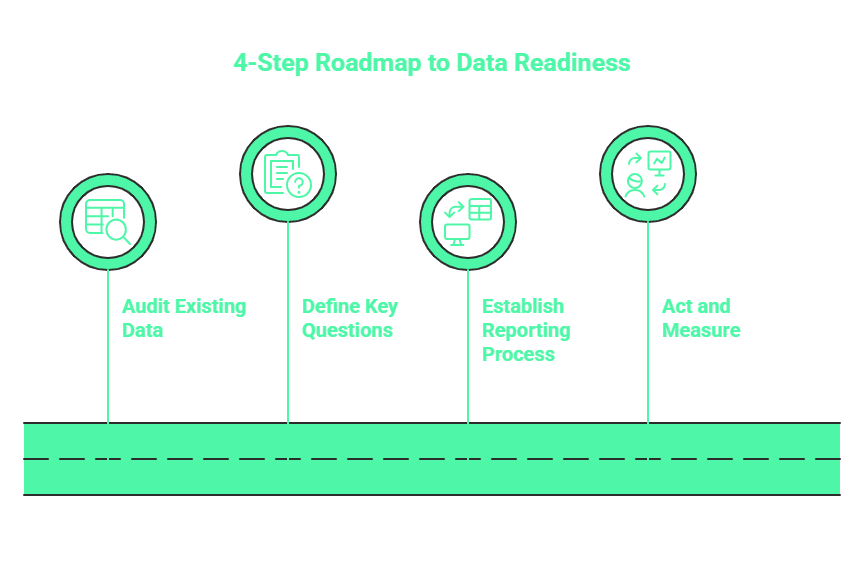
Getting from “we have data but don’t really use it” to “data informs our decisions” doesn’t require a transformation programme. For most SMEs, it requires four concrete steps taken in the right order.
Step 1: Audit what you already have. Before investing in new tools, map what data you’re already collecting. Website analytics, email campaign reports, CRM records, sales transaction data, and social media insights are all sources most businesses already have access to. The question is whether anyone is reading them regularly and connecting them to decisions.
Step 2: Define the questions that matter. Data analysis is most useful when it’s directed at specific business questions. Which marketing channel is actually driving enquiries? Which products have the highest margin and the highest repeat purchase rate? Which pages on the website have the highest drop-off rate? Starting with concrete questions keeps the analysis focused.
Step 3: Set up a simple reporting process. A monthly data review doesn’t need to be sophisticated. A shared Looker Studio or Power BI dashboard pulling together website traffic, lead sources, email performance, and sales figures gives the leadership team a consistent view of performance. The value is in the consistency: reviewing the same metrics monthly builds pattern recognition over time.
Step 4: Act on what you find, then measure the result. The purpose of data analysis is to make better decisions. For each insight that emerges from your data review, identify one concrete action, implement it, and then check whether the data changes in the way you expected. This iterative loop is the foundation of a genuinely data-led approach.
For help with the AI implementation side of this process, our article on the cost-benefit analysis of AI implementation for SMEs provides a practical framework for evaluating where investment is justified.
Conclusion
Data science for small businesses in the UK isn’t a single tool, a hire, or a project. It’s a way of working: using the information your business generates to make better decisions than you would make on instinct alone. Most SMEs already have more data than they’re using. The priority is building the habits, skills, and processes to act on it.
ProfileTree works with businesses across Northern Ireland, Ireland, and the UK to build data-informed digital marketing, website, and AI strategies. If you want to understand where your business sits on the data maturity scale and what a realistic next step looks like, get in touch with our team.
FAQs
What is the difference between data analytics and data science for business?
Data analytics looks at historical data to understand what happened and why. Data science goes further, using statistical models and machine learning to predict future behaviour. For most SMEs, the practical starting point is analytics: getting consistent, reliable insight from the data you already have before investing in more advanced predictive tools.
How much does data science cost for a small business in the UK?
It depends entirely on what you’re trying to do. Using built-in analytics tools like Google Analytics 4 and Search Console costs nothing. A mid-range analytics and CRM stack (Power BI, HubSpot, Hotjar) might cost £100-£300 per month.
Do I need a dedicated data scientist on my team?
For most SMEs, no. The more realistic options are upskilling an existing team member with strong numerical ability, using AI-powered business tools that surface insights without requiring specialist expertise, and bringing in agency or consultancy support for specific projects.
Is my business too small for data science?
If your business has customers and generates any kind of sales, marketing, or website data, you’re not too small. The tools and approaches that are genuinely useful at the SME scale are now accessible without enterprise budgets or specialist staff. The right question isn’t whether you’re big enough for data science; it’s which applications are most likely to generate a return for your specific business right now.
How does UK GDPR affect my data science activities?
Any use of customer data for analysis, segmentation, or marketing in the UK is governed by UK GDPR and the Data Protection Act 2018. You need a lawful basis for processing personal data (consent or legitimate interest for marketing purposes), you should only collect data you have a genuine use for, and you must be transparent with customers about how their data is used.