Why Rebrand? 5 Right (and Wrong) Reasons For a Fresh Start
Table of Contents
Why rebrand? It’s a question every growing business eventually confronts. Your company has evolved, your market has shifted, or your competitors have modernised—and suddenly the brand identity that served you well for years feels misaligned with where you’re heading.
The temptation to rebrand can be compelling. A fresh visual identity promises renewed energy, more precise positioning, and an opportunity to rectify past mistakes. Yet rebranding remains one of the riskiest moves a business can make. Done strategically, it can transform your market presence and unlock significant revenue growth. Done poorly, it alienates loyal customers, destroys hard-won search rankings, and wastes substantial resources.
The distinction between rebranding success and failure lies entirely in your motivation. Strong reasons for rebranding stem from genuine business evolution—service expansion that outgrows your original name, market repositioning that necessitates a new visual language, or mergers that require a unified identity. Poor reasons often originate from aesthetic preferences, impatience with gradual growth, or boardroom impulses that are disconnected from customer reality.
So why rebrand? The answer depends on whether you’re solving a real business problem or simply seeking change for its own sake. A logo that “feels dated” isn’t a business problem. Losing premium clients because your brand suggests you’re a budget provider—that’s a business problem. A website that doesn’t excite you personally isn’t a business problem; it’s a personal preference. A website that fails accessibility standards and ranks poorly in search results—that’s a business problem worth addressing.
This guide examines both sides of the rebranding decision, helping UK business owners, marketing directors, and decision-makers distinguish between strategic necessities and costly mistakes. We’ll explore five legitimate reasons that justify rebranding investment, and five common pitfalls that disrupt without corresponding benefit.
When Rebranding Makes Sense
Strategic rebranding addresses fundamental business changes rather than superficial preferences. The following scenarios represent legitimate reasons to reconsider your brand identity.
Clarifying Your Business Offer
Companies often outgrow their original names as their services expand and evolve. A brand that accurately describes your initial product can become a limitation as you diversify.
Consider Northern Ireland company Traction Finance. Their previous identity, Lease Options, described a single funding product. As the business expanded into contract hire, personal contract purchase, and used vehicle sales, the name no longer captured their full service range. Additionally, changes in how people fund vehicles threatened to make the brand feel outdated.
The rebrand to Traction Finance solved both problems. The new name encompassed their broader financial services whilst remaining relevant regardless of funding trends. Combined with an updated visual identity and website, the rebrand presented a clear and comprehensive picture of the company’s capabilities.
This principle applies across sectors. If your business name or visual identity references a specific product you’ve moved beyond, or describes only one aspect of what you now offer, rebranding deserves serious consideration. Your brand should communicate your current value proposition, not your historical starting point.
ProfileTree’s Approach to Brand Clarity
At ProfileTree, we’ve guided numerous businesses in Northern Ireland and the UK through this type of strategic evolution. When assessing whether a name change is justified, we examine whether your current brand creates customer confusion or limits your ability to present new services credibly.
Sometimes a complete rebrand isn’t necessary; a brand refresh with updated messaging and visual refinement can bridge the gap. Other times, particularly when entering new markets or moving significantly upmarket, a complete rebrand becomes the more straightforward path forward.
Modernisation and Market Relevance
Some companies build their reputation on heritage and established trust. However, an image that once conveyed reliability can begin to signal stagnation if it remains unchanged for too long.
Financial services provider Mastercard exemplified strategic modernisation when it refined its iconic logo. The change wasn’t arbitrary—it reflected the evolution of payment methods. As digital transactions replaced physical cards and mobile payments became standard, Mastercard needed to demonstrate that it was keeping pace with these fundamental shifts in its industry.
In the UK market, Marks and Spencer provides another instructive example. During the early 2000s, the retailer had developed a reputation as a destination primarily for older consumers. Through considered rebranding efforts spanning visual identity, product ranges, and marketing approach, M&S transformed into a modern brand appealing to multiple generations. The company adapted their brand without abandoning its heritage.
Modernisation becomes necessary when your visual identity or brand perception no longer aligns with your actual capabilities. This is particularly true for technology companies, where an outdated appearance can suggest obsolete solutions. If competitors are winning business partly because they appear more current, modernisation warrants serious attention.
Digital-First Modernisation
ProfileTree specialises in digital-first rebranding for UK businesses. We recognise that modern brands must function seamlessly across websites, social media, video content, and mobile devices. A logo that works perfectly in print materials might scale poorly on mobile screens or fail to meet accessibility standards. Our web design and development services integrate brand modernisation with technical requirements, creating identities that work across all digital touchpoints whilst maintaining visual impact.
Mergers, Acquisitions and Business Unification
When companies merge, or one business acquires another, rebranding addresses a fundamental question: how do we present this new entity to the market?
Continental Airlines and United Airlines faced this challenge in the United States. Rather than forcing one legacy brand to disappear entirely, they created a unified identity that combined elements from both. The new United Airlines logo incorporates design aspects from both predecessors, helping customers understand the transition while maintaining continuity.
Mergers create particular brand challenges. Customers from both legacy companies may feel strong loyalty to their familiar brands. Employees may identify more with one heritage than the other. A carefully considered rebrand can unite these groups under a forward-looking identity rather than leaving one side feeling absorbed or diminished.
However, not every acquisition requires complete rebranding. Volkswagen Group demonstrates an alternative approach. After acquiring Audi, Skoda, and Seat, Volkswagen has maintained the distinct identities of each brand. This strategy enabled them to target different market segments with each brand, rather than consolidating them under one umbrella.
The decision between unified rebranding and maintaining separate brands depends on your market strategy. If the acquired businesses serve different customer segments or operate in distinct categories, separate brands may be more effective in serving their needs. If you’re combining forces to compete more effectively in one market, unified branding often makes more sense.
For strategic guidance on this decision, assess customer overlap, brand equity in each legacy identity, and your forward market positioning to know whether unification, separate brands, or a hybrid approach best serves your objectives.
Building Trust Through Heritage
When market conditions create uncertainty or scepticism, established brands can lean into their history to rebuild trust.
Audi took this approach with their Audi Sport sub-brand. As environmental concerns intensified around engine emissions, Audi chose to remind automotive enthusiasts of their racing heritage and the legendary Quattro era. This heritage-focused branding created an emotional anchor with loyal followers, while the leading brand gradually shifted towards electric and hybrid technologies.
This strategy is effective when your history includes genuine achievements that current customers value. Simply being old isn’t sufficient—your heritage needs to represent something meaningful. Financial institutions might reference their stability during economic crises. Manufacturing companies might highlight generations of craftsmanship. Technology companies with long track records might emphasise sustained innovation.
Heritage-focused rebranding requires authenticity. Customers quickly detect attempts to fabricate or exaggerate historical credentials. The approach works best when your actual history provides legitimate differentiation in your current market.
“Businesses often underestimate the value of their own story,” notes Ciaran Connolly, Director of ProfileTree. “When we work with established Northern Ireland companies, we frequently discover compelling heritage elements they’ve taken for granted. Properly communicated, these become powerful differentiators, particularly when competing against newer entrants with no track record.”
Growth and Business Evolution
Sometimes companies simply outgrow their original brand identity. This happened to ProfileTree itself.
As a rapidly expanding web design, SEO, content marketing, and digital training company based in Belfast, Northern Ireland, ProfileTree has undergone significant evolution since its inception. The business expanded into larger premises, developed new service offerings including AI training and implementation, and began serving clients across broader geographic markets.
A comprehensive rebrand proved to be the most effective way to communicate these changes. The new brand identity, website, and messaging presented ProfileTree as the complete package that potential clients needed to understand—a full-service digital agency capable of handling complex, multifaceted projects, rather than a specialist in one narrow area.
Growth-driven rebranding typically occurs when the gap between your actual capabilities and your perceived positioning becomes too wide. Marketing campaigns alone cannot always bridge this gap. Visual identity, messaging, and brand positioning must evolve to match your expanded scope.
This scenario particularly affects businesses that have successfully moved upmarket. A brand identity that worked when serving small local clients may lack the gravitas needed when pitching to larger organisations or competing in premium market segments. Your pricing, team size, and client roster might have elevated, but if your brand hasn’t evolved accordingly, you’ll struggle to compete at your new level.
Recognising Growth Triggers
Watch for these signals that growth has outpaced your brand:
- Prospects express surprise when they discover your full range of services
- You lose opportunities to competitors who “look more established” despite having less capability
- Your brand identity references your original niche but you’ve diversified significantly
- Employee recruitment becomes harder because your brand doesn’t reflect your actual culture or opportunities
- Your website and marketing materials require lengthy explanations to correct misconceptions
For UK businesses experiencing rapid growth, ProfileTree offers brand strategy development that aligns visual identity with business reality. Our approach combines web development, content marketing, and SEO services to create cohesive brand experiences across all customer touchpoints.
Common Rebranding Mistakes
Understanding what not to do proves as valuable as knowing when to rebrand. These scenarios represent weak justifications that often lead to problematic outcomes.
Logo Changes Without a Strategic Foundation
A new logo isn’t a brand strategy. Your brand encompasses your entire visual identity—colours, typography, imagery style, tone of voice, and much more. Having an appealing logo concept doesn’t justify disrupting an established brand.
Gap learned this lesson expensively. Several years ago, they launched a redesigned logo without apparent strategic reasoning. The new design appeared disconnected from Gap’s identity and market positioning. Rather than emerging from a comprehensive rebrand addressing genuine business needs, the logo seemed to be a top-down decision focused purely on aesthetics.
Customer backlash was immediate and severe. Gap abandoned the new logo within days, reverting to its established identity. The episode damaged the brand’s credibility and wasted a significant amount of resources.
The core problem: rebranding must address business challenges, not simply refresh visuals. Before considering a rebrand, ask whether you need a comprehensive brand evolution or just targeted improvements to specific elements, such as your logo, website design, or photography style.
If only certain elements feel outdated, address those specifically rather than overhauling everything. A website redesign using your existing brand colours and logo might solve the problem without the cost and risk of complete rebranding. ProfileTree’s web design and WordPress development services often help businesses refresh their digital presence while maintaining brand continuity.
Careless Business Separation
Businesses sometimes decide to separate a division or service line into a distinct brand. This can work well—but only when the new brand receives proper investment and positioning.
Netflix provides a cautionary example. When they wanted to distance their streaming service from their original DVD rental business, they renamed the rental division “Qwikster.” However, customers who had built trust with the Netflix brand felt confused and abandoned by this abrupt separation. The Qwikster brand failed to carry the same credibility, and the initiative was quickly scrapped.
The lesson: customers who feel important to your business today won’t appreciate being shuffled into a lesser-sounding spin-off. If you’re separating services, the new brand requires sufficient strength and positioning to stand independently.
Compare this to how Dodge handled their RAM trucks spinoff in the United States. RAM became a distinct brand with its own identity, marketing, and dealer presence. Rather than feeling like a castoff, RAM was positioned as a focused, premium truck brand. The separation succeeded because both brands maintained strength.
For UK businesses considering service separation, the question becomes: will the new brand be as strong as the original? If a service segment faces decline, separating it into a weaker brand just makes the decline more visible. If the segment has genuine growth potential, invest properly in establishing the new brand rather than treating it as a cost-cutting exercise.
ProfileTree has worked with Northern Ireland businesses navigating service diversification. Sometimes, the answer lies in better website architecture and content strategy rather than separate brands. Creating distinct service sections with dedicated landing pages, case studies, and resources can achieve clarity without the overhead of multiple brand identities.
Design by Committee
The 2012 London Olympics logo generated intense debate when it was revealed. Opinions varied widely, but many found it muddled and unclear compared to the timeless elegance of the Olympic rings themselves.
The probable culprit: too many stakeholders influencing the design process. When numerous people contribute opinions, provide feedback, and request changes, the result often becomes compromised—trying to satisfy everyone whilst ultimately satisfying no one.
This phenomenon, sometimes referred to as “a camel is just a horse designed by committee,” plagues many rebranding projects. Each stakeholder pushes for their preferred direction, and the final output becomes a patchwork of conflicting ideas rather than a cohesive vision.
A logo and brand identity aren’t art created for aesthetic appreciation. They’re communication tools designed to convey specific messages quickly and effectively. The primary question isn’t “do I personally like this?” but rather “does this communicate what we need to communicate to our target audience?”
Strong brands typically emerge from a clear strategic vision executed by skilled professionals, with stakeholder feedback gathered systematically rather than incorporated haphazardly. The brand strategy development process involves stakeholder input during the research and strategy phases, while maintaining design integrity during execution. Options should be based on strategic requirements rather than personal preferences, and then feedback should be specifically on whether the designs meet the stated objectives.
The principle extends beyond visuals to verbal identity. Website copy, marketing messages, and content strategy should follow a unified voice and purpose. When too many internal voices dilute the message, customers receive mixed signals that undermine rather than strengthen brand position.
Premature Celebrity Endorsement
Celebrity associations can significantly expand market reach. Nike and Pepsi have built major campaigns around athlete and musician partnerships. However, tying your fundamental brand identity too closely to any individual creates vulnerability.
When a celebrity endorses your product in advertising, you control the context and can end the relationship if needed. When a celebrity becomes an integral part of your brand identity, you’ve surrendered control over an essential aspect of your business.
Consider Michelob beer’s 1980s advertising featuring Eric Clapton. At the time, this seemed like an excellent partnership with a respected musician. Clapton’s subsequent public discussions about alcoholism created an association the brand hadn’t anticipated and couldn’t have wanted.
The core problem isn’t predicting specific controversies—it’s that celebrities operate independently of your brand’s interests. Their public statements, behaviour, and relevance can change rapidly. A celebrity who resonates powerfully with audiences today might be forgotten or controversial within a few years.
This doesn’t mean avoiding influencer partnerships or celebrity endorsements entirely. These tactics serve valuable marketing purposes. The key is separating your foundational brand identity from any individual personality. Your brand should stand independently, with celebrity relationships as temporary marketing amplifiers rather than structural elements.
For UK businesses, particularly SMEs, the temptation often comes from local celebrities or influencers offering partnership opportunities. These can be effective marketing tactics, but shouldn’t drive fundamental rebranding decisions. Your brand identity should reflect your business’s intrinsic value proposition, not borrowed credibility from external personalities.
ProfileTree’s video production and content marketing services often incorporate influencer partnerships as part of broader campaigns. We position these as tactical elements within a strategic framework rather than building brands around temporary associations.
Executive Preference Without Business Justification
Perhaps the weakest reason to rebrand: someone senior had an idea they find exciting.
A managing director’s brilliant logo concept doesn’t constitute a branding strategy. An executive who found a colour scheme they personally prefer doesn’t justify overhauling established visual identity. Personal aesthetic preferences aren’t a business strategy.
This scenario plays out repeatedly across businesses of all sizes. Someone in leadership sees a competitor’s rebrand or attends a conference where they encounter an appealing design approach. They return energised about implementing something similar, regardless of whether it addresses any actual business need.
Strong brands require professional expertise. Graphic designers, brand strategists, and content specialists develop these skills through training and experience. Just as you wouldn’t let non-technical leadership design your website’s backend architecture, brand identity requires professional execution.
Moreover, effective rebranding emerges from research and strategy, not inspiration. What problems are you solving? What perceptions are you changing? What market positions are you claiming? These questions must drive rebranding decisions.
When leadership preferences do play a role, they should inform the creative brief rather than dictate the solution. “I prefer minimalist design” becomes input for the design team to consider alongside market research, competitor analysis, and customer feedback. It doesn’t become “use this specific design I sketched.”
For Northern Ireland and UK SMEs, where business owners often maintain direct involvement in all aspects of the business, this distinction becomes particularly important. Your instincts about your business have value, but they should guide professional execution rather than replace it.
At ProfileTree, we frequently work with owner-managers who have intense visions for their businesses. Our role involves translating those visions into professional execution whilst ensuring decisions serve business objectives rather than personal preferences. We challenge ideas constructively, present evidence-based recommendations, and ultimately deliver solutions that work in the market rather than just in the boardroom.
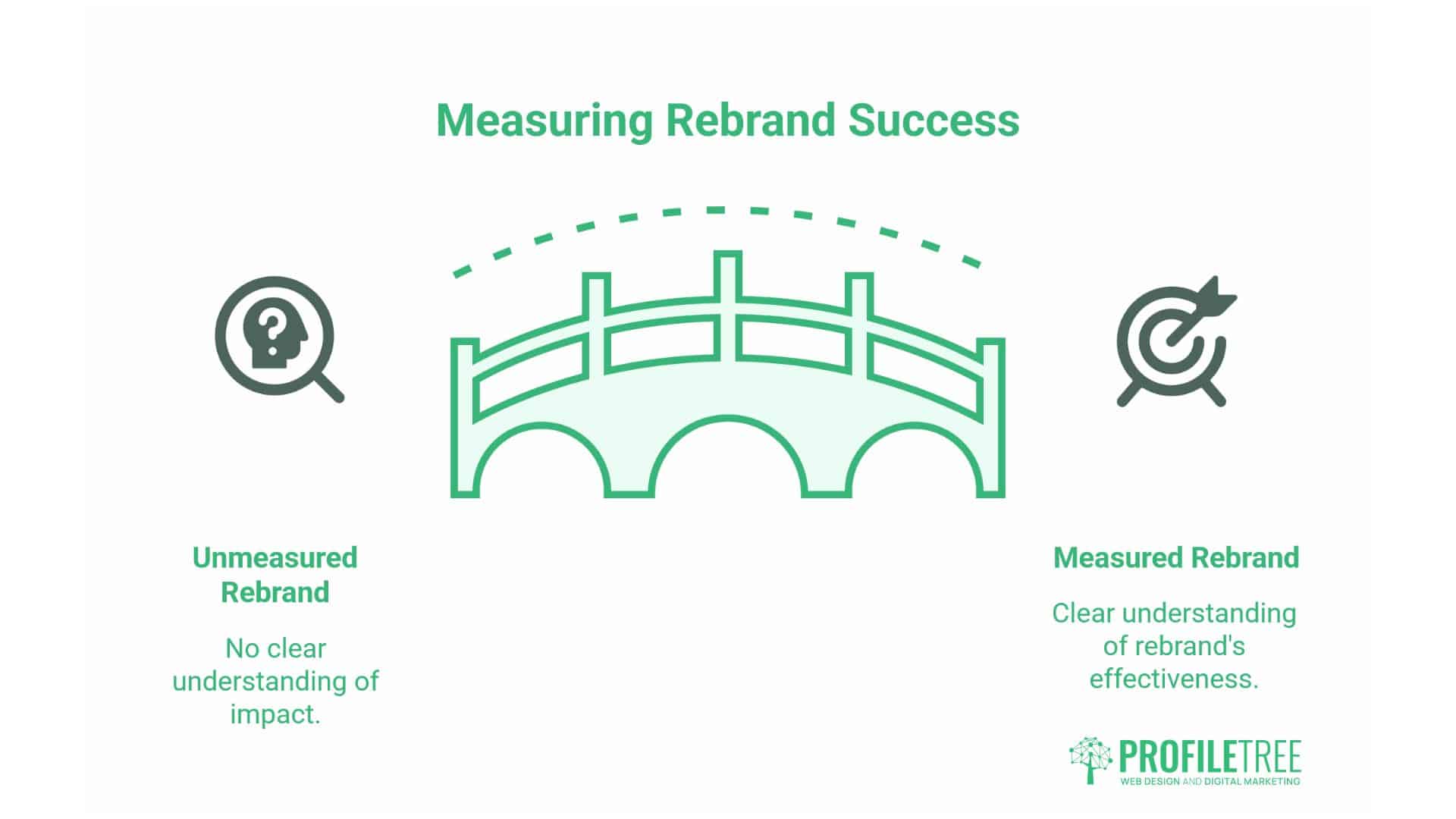
Measuring Rebrand Success

Rebranding represents a significant investment in time, resources, and risk. Measuring its impact helps justify the expense and guides future brand decisions.
Brand Perception Metrics
Research demonstrates measurable improvements from strategic rebranding. Companies that rebrand successfully experience an average 43% increase in brand awareness and 38% growth in brand recognition, according to Brand24 research. Lucidpress studies found that 72% of consumers view rebranded companies as more innovative.
These perceptions translate into customer behaviour. Research from the Crowdspring Blog indicates 65% of consumers show increased willingness to try products or services from rebranded companies. Forbes research suggests rebranding can improve customer satisfaction by 27% and loyalty by 30%.
For B2B companies, brand perception has a significant impact on lead quality and the length of the sales cycle. When prospects perceive your brand as more established, innovative, or capable, they enter sales conversations with greater confidence. This reduces the convincing required during the sales process.
Measuring perception changes requires baseline measurement before rebranding and systematic tracking afterwards. Methods include:
- Customer surveys that ask about brand attributes (e.g., professional, innovative, trustworthy)
- Focus groups exploring unprompted associations with your brand
- Social listening tracking sentiment in online conversations
- Website analytics examining visitor behaviour patterns
- Sales team feedback on prospect reactions and objections
Financial Performance Indicators
Brand value ultimately manifests in business results. Interbrand research shows companies with strong brands outperform the market by 84%. Successful rebrands can increase revenue by an average of 23%, according to studies by Lucidpress.
Customer lifetime value often improves following rebrands. Harvard Business Review research indicates a 17% increase in customer lifetime value from strategic rebranding. This reflects both improved customer retention and increased spending from existing customers.
Premium pricing becomes more viable with stronger brand perception. McKinsey research suggests strong brands can command an 11% premium, directly improving profit margins. When customers perceive greater value in your brand, they are more willing to accept higher prices.
Long-term stock performance also correlates with brand investment. Interbrand found that companies consistently investing in branding enjoy a 20% stock price increase over extended periods.
For privately held businesses, these metrics translate into:
- Revenue growth rates before and after rebranding
- Average transaction values and repeat purchase rates
- Customer acquisition costs and conversion rates
- Employee retention and recruitment success rates
- Market share changes within specific segments
ProfileTree clients have demonstrated these patterns. Following strategic rebranding supported by comprehensive digital implementation, including web design, SEO, and content marketing, businesses typically see an improvement in inquiry quality, even when total inquiry volumes remain steady initially. Prospects arrive better informed and more interested in premium services rather than commodity offerings.
Digital Performance Metrics
For businesses with a significant online presence, digital metrics provide concrete data on the impact of rebranding.
Search engine rankings can suffer during rebrands if migration isn’t handled carefully (more on this shortly). Still, strategic digital rebrands often improve organic visibility by better aligning content with search intent. Track:
- Organic traffic volumes across key pages
- Keyword rankings for priority terms
- Click-through rates from search results
- Domain authority and backlink profiles
Website engagement metrics reveal whether the new brand better connects with visitors:
- Bounce rates and time on site
- Pages per session
- Goal completions and conversion rates
- Form submissions and inquiry quality
Social media provides immediate feedback on brand reception:
- Follower growth rates across platforms
- Engagement rates (likes, comments, shares)
- Mention volumes and sentiment
- Profile visit rates and website clicks
Email marketing metrics often improve when brand changes include refreshed templates and messaging:
- Open rates and click rates
- Unsubscribe rates
- Forward rates and social shares
At ProfileTree, we implement comprehensive tracking before, during, and after rebrands. Our SEO services include careful migration planning to preserve search rankings, whilst our web development approach integrates analytics to capture detailed performance data. This evidence-based approach helps clients understand the ROI of rebranding and identify which elements deliver the strongest results.
Setting Realistic Expectations
Not all rebranding benefits appear immediately. Brand perception changes gradually as awareness spreads through your target market. Revenue impacts may lag by several months as sales cycles are completed.
Set measurement timelines appropriate to your business:
- Immediate (0-3 months): Website metrics, social engagement, internal employee sentiment
- Near-term (3-6 months): Lead generation quality, initial sales results, search rankings
- Medium-term (6-12 months): Revenue trends, customer retention patterns, market share
- Long-term (12+ months): Brand equity, competitive positioning, premium pricing capability
The most important question isn’t “did we see an immediate spike?” but rather “are we trending positively across relevant metrics?” Sustainable brand building requires patience and consistent execution.
Strategic Implementation Process

Successful rebranding follows a structured process that manages risk whilst maximising positive impact.
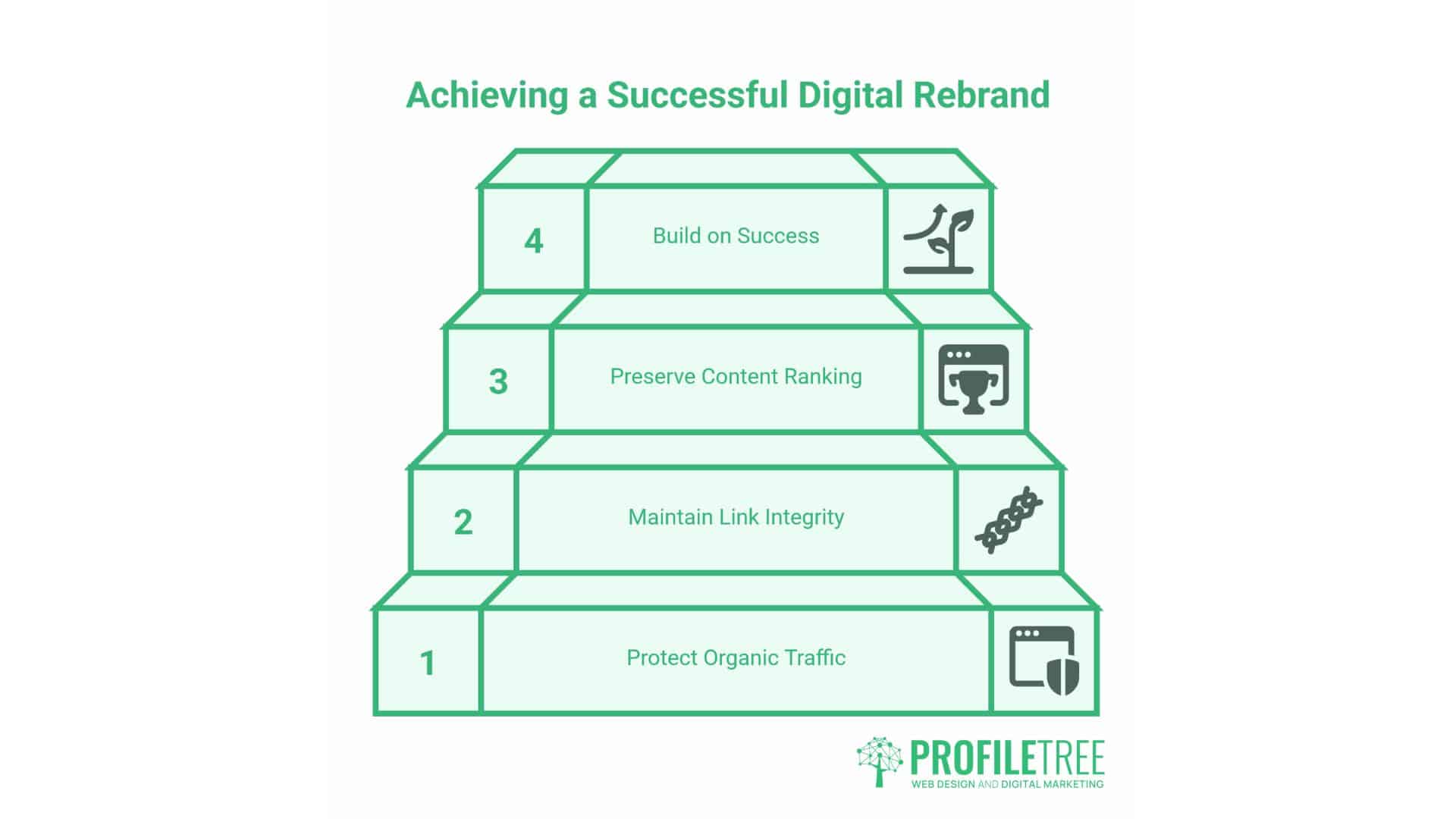
The SEO-Safe Rebrand Approach
For businesses that rely on organic search traffic, SEO considerations must inform technical implementation. Companies can lose 60% of organic traffic following poorly executed rebrands when agencies prioritise aesthetics over search continuity.
Domain and URL Strategy
If your rebrand includes a domain change, meticulous planning prevents traffic loss:
- Implement 301 redirects from every old URL to its equivalent new URL. This passes approximately 90% of link equity to the new location.
- Update internal linking across all pages to reference new URLs directly rather than relying solely on redirects.
- Notify search engines through Google Search Console and Bing Webmaster Tools about the domain change.
- Maintain old domain ownership for at least 12 months to catch any missed redirects and preserve backlinks.
- nk
- Monitor crawl errors closely during the first month post-migration, fixing any broken links or redirect loops immediately.
Even when keeping the same domain, changes to the URL structure require careful handling. If page URLs must change, apply the same redirect principles. However, the safest approach is to maintain the URL structure whenever possible—rebrand the content while keeping the same addresses.
Content Migration Considerations
Rebranding often involves rewriting website copy to align with the new messaging. This creates SEO risk if not handled carefully:
- Preserve keyword usage that drives current rankings. You can refresh the writing style whilst maintaining key terms and phrases that rank well.
- Keep page titles and headers aligned with established search intent. Clever, creative headlines might delight readers, but they can also confuse search algorithms.
- Maintain content depth. If your current pages rank partly because they’re comprehensive, the new versions must be equally thorough.
- Republish systematically rather than all at once. This allows you to monitor the impact and roll back changes if specific pages lose rankings.
ProfileTree’s approach to SEO-safe rebranding involves detailed keyword mapping prior to content changes, phased rollouts with ongoing monitoring between phases, and contingency plans in place in case rankings decline. Our content marketing and SEO specialists work together to create fresh, on-brand content that enhances search engine performance.
Technical Website Considerations
Beyond URLs and content, technical factors affect rebranding success:
- Page speed often changes with new designs. Heavy imagery or complex animations can slow load times, potentially harming rankings. Optimise all assets.
- Mobile responsiveness becomes more critical with each Google algorithm update. Thoroughly test the new design across various devices and platforms.
- Accessibility standards (WCAG compliance) affect both user experience and search rankings. Build accessibility into design from the start.
- Schema markup helps search engines understand your content. Please update it to reflect new brand information.
ProfileTree’s WordPress development services prioritise these technical elements. We build websites that look outstanding whilst loading quickly, functioning seamlessly across devices, and meeting accessibility requirements.
Internal Stakeholder Management
Rebranding affects your entire organisation, not just marketing. Internal communication and change management determine whether staff embrace or resist the new brand.
Pre-Launch Internal Communications
Before public launch, bring staff along the journey:
- Explain the reasoning behind the rebrand clearly. When employees understand why change is necessary, they become advocates rather than resistors.
- Show the development process through internal updates. This builds anticipation and allows for input where appropriate.
- Provide training on new brand guidelines, messaging, and visual applications. Staff need to represent the brand confidently.
- Address concerns directly. Employees might worry about customer reactions, implementation workload, or what the change means for them personally.
- Create celebration moments around the launch. Rebranding should feel positive and energising.
Post-Launch Support
After public launch, internal support remains crucial:
- Supply all employees with updated business cards, email signatures, and presentation templates
- Create a brand guidelines document accessible to all staff
- Designate brand champions in each department who can answer questions
- Monitor internal adoption and address misuse quickly but constructively
- Celebrate early wins and positive customer reactions
ProfileTree’s digital training services often include brand implementation sessions for client teams. We help staff understand not only what has changed, but also why it matters and how to apply it consistently.
Customer Communication Strategy
How you introduce the rebrand to existing customers affects their reception and loyalty.
Timing and Messaging
Announce the rebrand with clear, confident messaging that:
- Explains why you’re evolving (but doesn’t dwell on problems with the old brand)
- Emphasises continuity in service quality and relationships
- Highlights the benefits customers will experience
- Sets clear expectations about what changes and what stays the same
For B2B businesses, consider personalised communication to key accounts before the public launch. These relationships warrant individual attention to address concerns and reinforce commitment.
For consumer-facing businesses, coordinate announcements across all touchpoints—website, email, social media, and physical locations—to create a cohesive brand awareness.
Managing the Transition Period
Even well-communicated rebrands create temporary confusion. Plan for:
- Customer service staff trained to answer rebrand questions
- Updated FAQ content addressing common concerns
- Flexibility during the transition (accepting old gift cards, honouring previous promotional materials, etc.)
- Extra attention to customer feedback and complaints during the first months
Maintaining Momentum
Don’t let the rebrand conversation end with the launch. Continue reinforcing the new brand through:
- Content that demonstrates your evolved capabilities
- Case studies showing results under the new positioning
- Consistent application across all materials and channels
- Regular reinforcement of key messages and brand attributes
ProfileTree’s content marketing and video production services help clients maintain momentum during their rebranding efforts. Creating high-quality content that embodies the new brand—from blog articles to YouTube videos—reinforces the identity whilst demonstrating capability.
Phased vs. Big Bang Approaches
Two primary implementation strategies exist:
Big Bang Launch: Everything changes simultaneously on one date. This creates maximum impact and avoids confusion from mixed branding. However, it concentrates risk and requires extensive preparation.
Phased Rollout: Elements change gradually—perhaps digital first, then physical materials; or one product line at a time. This spreads cost and risk but can create prolonged periods of mixed branding.
The right approach depends on:
- Competitive factors (sometimes speed matters more than perfection)
- Business complexity (multiple locations, product lines, or markets favour phasing)
- Budget constraints (phasing spreads costs over time)
- Customer base size and sophistication (smaller, professional customers tolerate phasing better than large consumer bases)
FAQs
How long does a complete rebrand take?
Comprehensive rebranding typically requires 3-6 months for most businesses. This includes research and strategy (4-6 weeks), design and development (8-12 weeks), and implementation (4-8 weeks). Smaller organisations might complete it in 2-3 months, whilst complex enterprises may need 9-12 months.
What’s the difference between a rebrand and a refresh?
A refresh updates visual elements while maintaining core brand identity—modernising your logo, updating colours, or refining messaging. A complete rebrand changes the fundamental identity itself, often including name changes, a completely new visual system, or a repositioned market approach.
How much does rebranding cost?
Small businesses typically spend £5,000 to £15,000 on professional rebranding. Medium-sized companies invest £15,000 to £50,000, including web design and marketing materials. Large organisations or complex rebrands can incur costs of £ 100,000 or more, including market research and international rollouts.
Will rebranding harm our SEO?
Properly executed rebrands protect search rankings by maintaining a consistent URL structure, implementing perfect 301 redirects, preserving ranking content, and ensuring close monitoring. Poor rebranding can result in a 50-70% decline in traffic. Working with SEO-aware specialists prevents these problems.
Taking Action: Why Rebrand?
Rebranding succeeds when driven by a clear business strategy rather than aesthetic preference or executive impulse. The strongest reasons—clarifying expanded services, modernising outdated perceptions, unifying merged entities, leveraging heritage strategically, and matching brands to business growth—all address genuine business challenges.
The weakest reasons—logo preferences, careless separations, design by committee, celebrity dependence, and executive whims—create risk without corresponding business benefit.
For Northern Ireland and UK businesses considering rebranding, start with an honest assessment: Does your current brand limit your business growth? Does it misrepresent your capabilities? Does it position you incorrectly in your market? If you cannot identify specific business problems your rebrand will solve, you probably need a refresh rather than a rebrand.
When rebranding becomes necessary, approach it systematically. Develop a strategy before design. Plan the technical implementation carefully, particularly in relation to SEO and digital properties. Communicate internally and externally to build support rather than resistance—measure results to understand what works and what needs adjustment.
ProfileTree has guided dozens of businesses in Northern Ireland and the UK through strategic rebranding. Our integrated approach combines brand strategy with web design, SEO, content marketing, and digital training to create cohesive brand experiences that drive business results. We start with your business objectives rather than our creative preferences, building brands that work in competitive markets rather than just looking attractive in portfolios.
Whether you need comprehensive rebranding, a focused refresh, or simply guidance on whether change is warranted, speaking with specialists helps clarify your options. Book a consultation with ProfileTree to discuss your specific situation and explore whether rebranding serves your business objectives.
The investment in strategic rebranding—done for the right reasons, at the right time, with professional execution—transforms businesses. Done poorly or for weak reasons, it wastes resources and disrupts without a corresponding benefit. The difference lies in your approach, your reasoning, and your commitment to execution excellence.