
How to Copyright Your Digital Assets: A Guide for UK SMEs
Table of Contents
Your website code, your video library, your blog archive and your brand graphics are not just marketing tools. They are assets that sit on your balance sheet, whether you have formally valued them or not. Knowing how to copyright these digital assets, and just as importantly, knowing what protection you already have without doing anything, is one of the more overlooked parts of running a digital business.
The good news for UK business owners is that copyright protection is automatic. The harder part is everything that follows: who actually owns the work when a freelancer or agency creates it, how to prove you made something first, what counts as copyright infringement if someone copies it, and what happens when content created with AI tools enters the picture. This guide covers how to copyright digital assets in practical terms, with a focus on the situations that actually trip up small and medium businesses across Northern Ireland, Ireland and the UK.
Why Digital Assets Are Worth Protecting
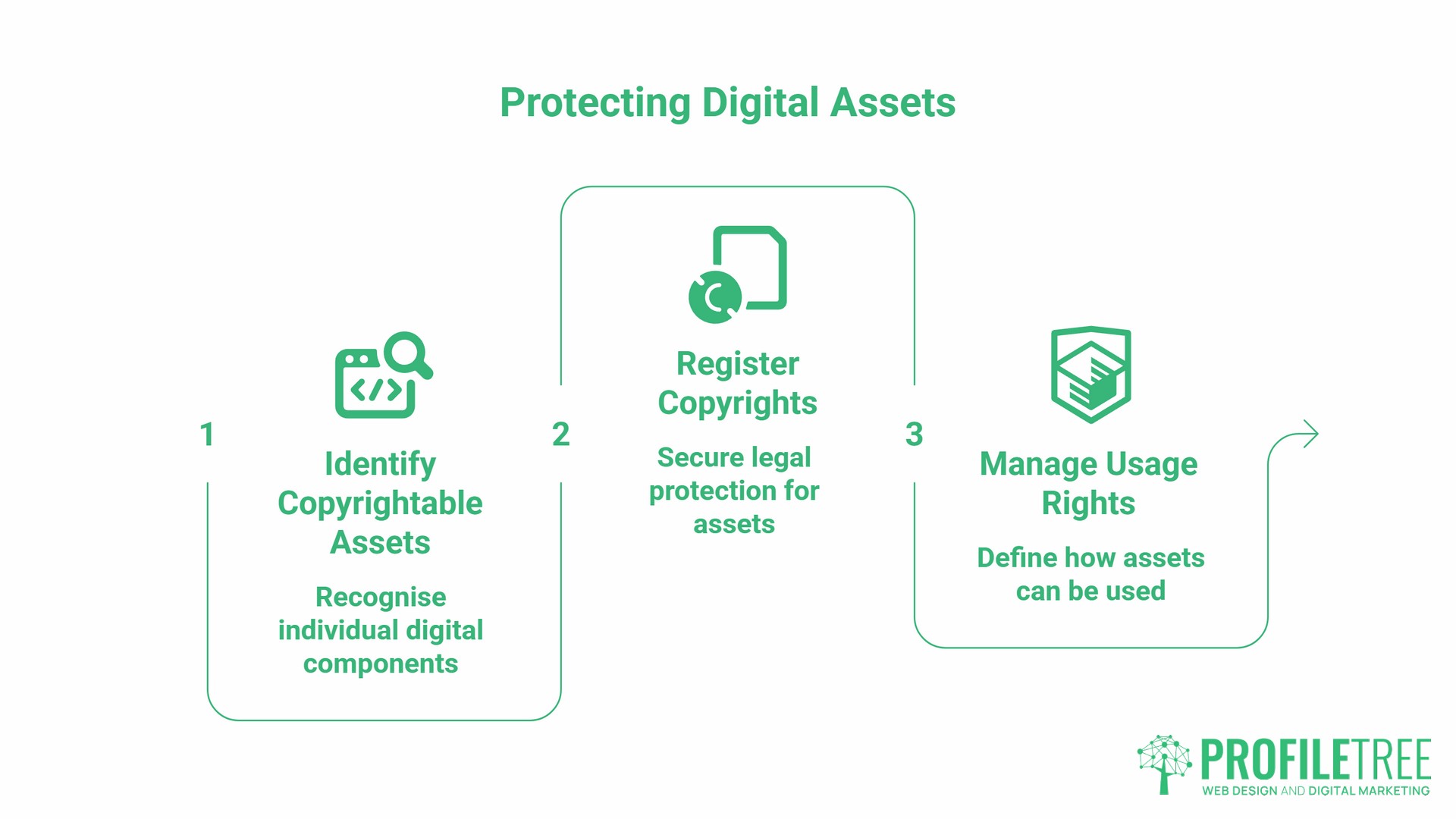
A website redesign, a year of blog content, or a library of training videos represents real investment, in time, in agency fees, or in staff hours. If that work can be copied freely by a competitor, the investment loses much of its value. Copyright infringement of that kind is more common online than most business owners realise, and understanding how to copyright your output properly is part of protecting what you have already paid to create.
This matters more for digital businesses than it once did. A website’s design and code, its written content, its video assets and its custom graphics are all separately copyrightable digital assets. Treating them as a single undifferentiated “the website” leads to gaps, particularly when different people or different suppliers were involved in creating different parts of it. A business that has never thought about how to copyright these pieces individually often discovers the gap only when something goes wrong, a developer disappears, a freelancer disputes usage rights, or a competitor’s site looks suspiciously familiar.
Does Copyright Exist Automatically in the UK?
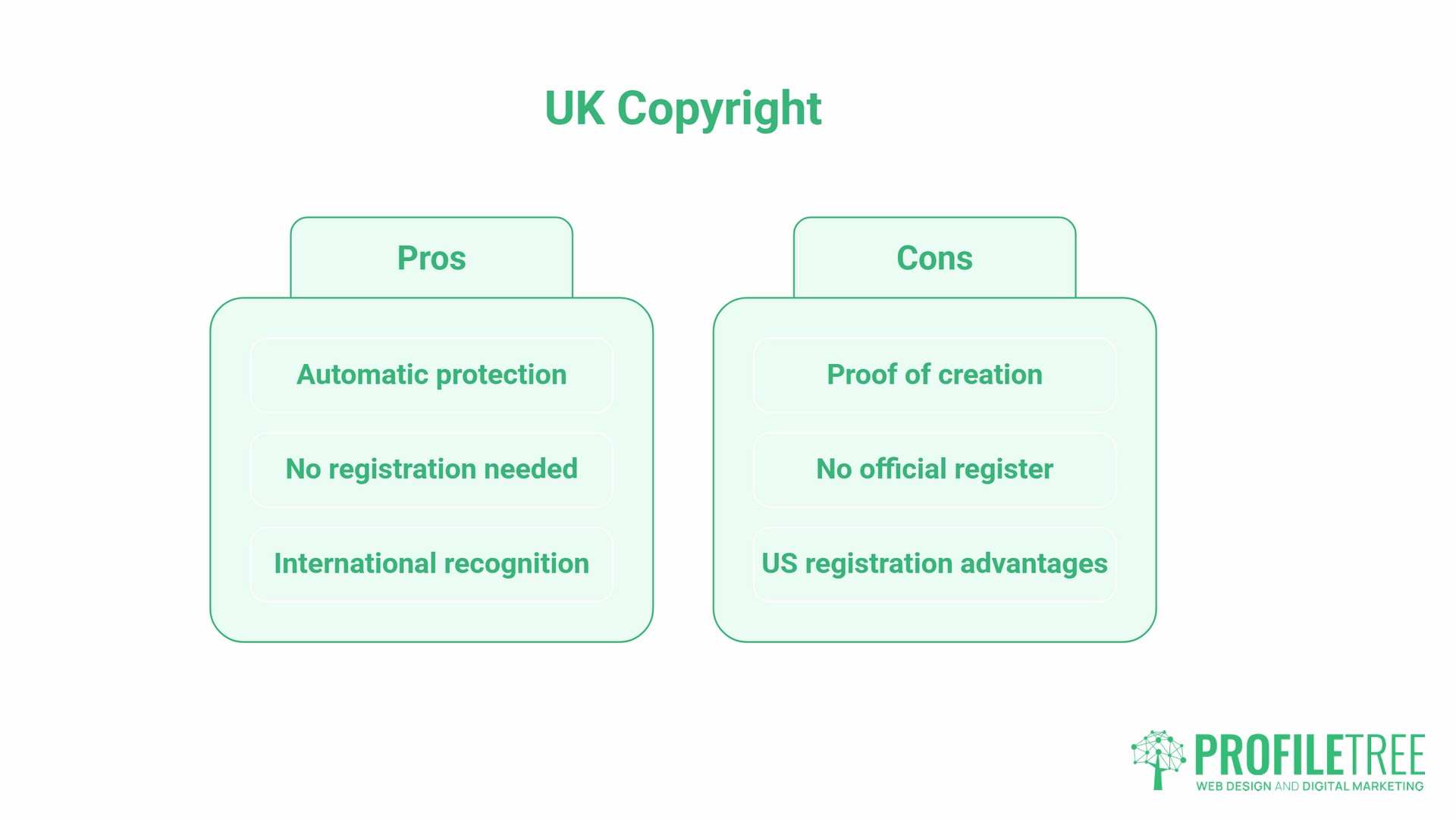
Yes. Under UK copyright law, specifically the Copyright, Designs and Patents Act 1988, copyright protection applies the moment an original work is fixed in a tangible form, whether that is written, recorded, coded or designed. There is no application process and no fee.
This surprises people accustomed to hearing about copyright registration in the United States, where the US Copyright Office maintains a formal register. The UK has no equivalent government register. If you are searching for how to copyright something officially in the UK, the honest answer is that there is no official registration step to complete. What you can do instead is strengthen your ability to prove when you created something, which matters far more than any certificate if a dispute over copyright infringement arises later.
Practical ways to establish proof of creation include keeping dated drafts and version history, retaining original project files with creation metadata, using time-stamped cloud storage, and keeping email or project management records showing when work was commissioned and delivered. Private registration services exist and will provide a certificate for a fee, typically between £20 and £50 per work, but this is supplementary evidence rather than a legal requirement, since UK copyright already exists from the moment of creation.
The Berne Convention extends this automatic protection across more than 180 member countries, including the EU, the US, and most of the markets a growing UK business is likely to trade in. A UK business does not need separate registration in each country to hold copyright there. Formal US registration is different again: it is genuinely optional, but it does carry specific litigation advantages if you ever need to take action over copyright infringement in an American court.
A US online application costs $45 for a single work by one author that is not made for hire, or $65 for a standard claim, according to current US Copyright Office fees. Registering before any infringement happens also opens the door to statutory damages of between $750 and $30,000 per work, rising to $150,000 for wilful infringement, rather than having to prove actual financial loss, which can be difficult and expensive in practice.
How to Copyright Your Work When Someone Else Creates It: The Ownership Trap
This is where most of the genuine business risk lies, and it is the part of learning how to copyright digital assets that most often catches SME owners out.
UK copyright law sets a default position: copyright belongs to the person who creates the work, not the person who pays for it. There are two important exceptions and one important trap.
- Employees who create work as part of their normal job automatically transfer copyright to their employer. If a member of your in-house team builds a feature, writes a blog post, or edits a video as part of their role, your business owns it.
- Freelancers and agencies are different. A freelance developer, designer, copywriter or videographer retains copyright in what they produce by default, even after you have paid the invoice in full. Many business owners assume payment equals ownership. It does not, unless a contract says so explicitly. Without that clause, technically the freelancer could licence the same work to someone else, or object to you modifying it, and any modification you made without their agreement could itself constitute copyright infringement against the creator who still holds the rights.
Who Owns the Website Code?
If your business commissioned a website from a freelance developer or an agency without a written agreement covering intellectual property, the developer may technically still own the code, the custom functionality, and the specific implementation, even though you paid for it and use it daily. This becomes a real problem if you later want to move to a new developer, redesign the site, or sell the business, since the buyer will want a clean title to every asset involved, and an unresolved ownership question can hold up a sale or valuation.
The fix is straightforward: any web design and development contract should clearly state that copyright in custom-built deliverables transfers to the client upon final payment, while the agency retains rights to its own reusable frameworks, code libraries, and pre-existing tools used to deliver the project. This is standard practice for properly structured agency agreements, and it is worth checking your own contracts against it if you commissioned your site some years ago under a less detailed agreement.
Who Owns the Video Footage?
The same principle applies to video production. If you commission a promotional video, a training series, or social content from a freelance videographer, check whether the agreement covers only the final edited file or the raw footage, project files, and any unused takes as well. A business that only has rights to the final export cannot re-edit, repurpose, or update that video later without going back to the original creator, which can be costly or simply impossible if that person is no longer contactable.
“Detailed documentation of your creative process is worth far more than people expect,” says Ciaran Connolly, founder of ProfileTree. “Thorough project records, covering who created what and when, protect both the business commissioning the work and the team delivering it, and they make ownership disputes far less likely to happen in the first place.”
Six Practical Steps to Protect Digital Assets Without a Lawyer
You do not need legal representation to take sensible, low-cost steps that strengthen your position. This is the practical side of how to copyright and protect what your business has already created, and it is also the groundwork that makes any future copyright infringement claim far easier to prove.
- Keep dated records of creation. Version history in your CMS, design files with timestamps, and commit history in code repositories all serve as evidence of when work existed and who produced it. This is the single most useful habit for proving ownership later, since courts and counterparties both respond well to a clear, dated paper trail.
- Use the © symbol and a clear copyright notice. This is not required for protection to exist, but it puts third parties on notice and removes any claim of innocent infringement. A simple footer line with the year and the business name takes minutes to add.
- Apply metadata to images and video. Embedding creator and ownership details directly into a file’s metadata survives some forms of copying and strengthens reverse image search results when checking for unauthorised use.
- Protect against hotlinking and scraping. Basic technical SEO and server configuration can prevent other sites from directly embedding your images or pulling your content via automated scraping, reducing casual unauthorised reuse before it becomes a deliberate copyright infringement issue.
- Put ownership in writing before work begins. A short clause in any contract with a freelancer, contractor or agency, confirming what transfers and what does not, prevents the vast majority of disputes that arise after the fact. This single step resolves more potential ownership problems than anything else on this list.
- Run a periodic digital asset audit. Once or twice a year, list out what your business owns, who created it, where the source files sit, and whether the ownership contract for each piece is on file. Gaps tend to surface fastest when reviewed systematically rather than discovered one at a time.
These steps sit alongside, rather than replace, the broader content marketing and brand protection work many SMEs already do. A business publishing consistent, well-documented original content, supported by genuine version history and a clear contracting process, is in a far stronger position than one relying on the © symbol alone to protect its digital assets.
Copyright Infringement: What Counts and What to Do
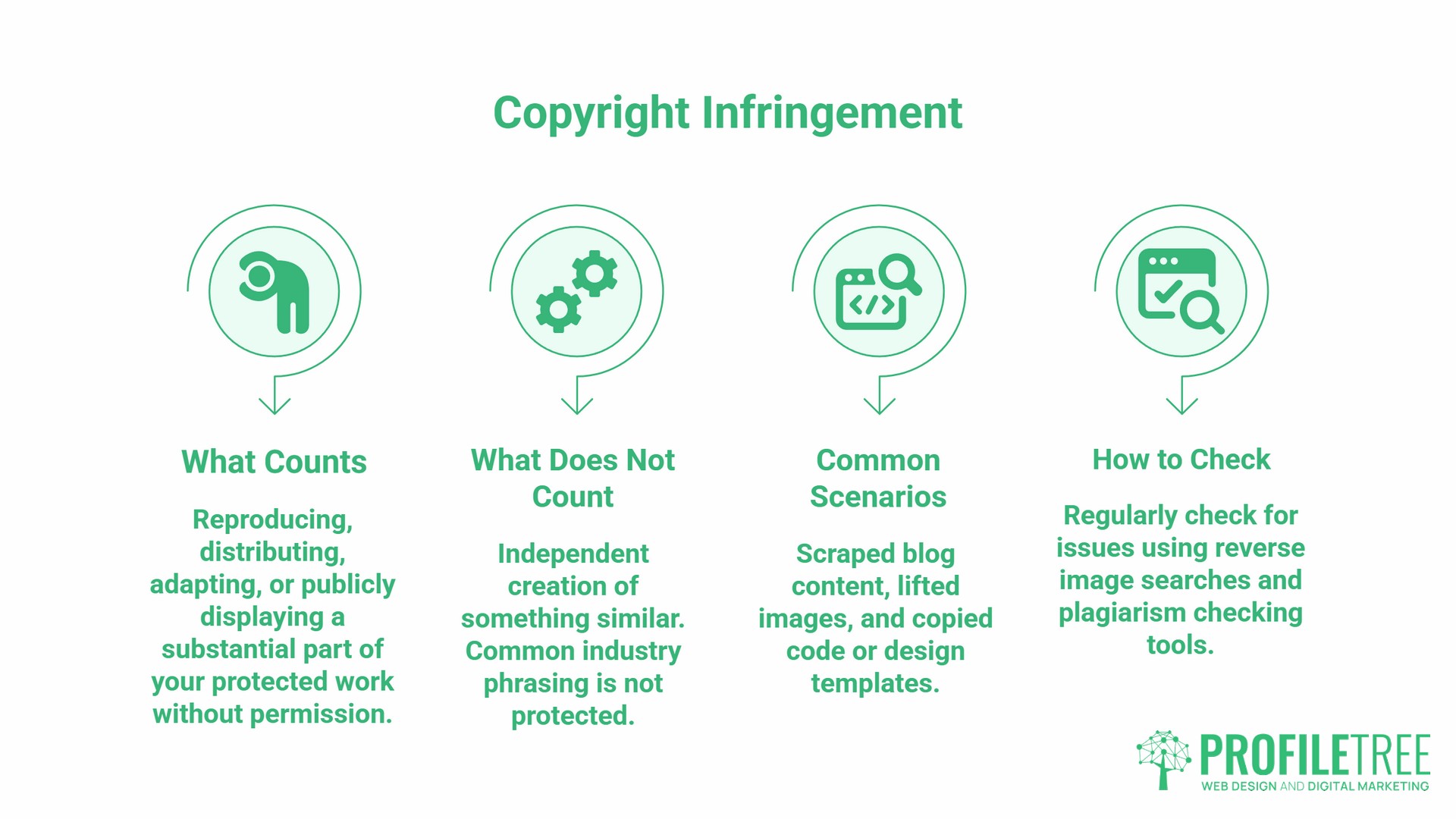
Copyright infringement happens when someone reproduces, distributes, adapts, or publicly displays a substantial part of your protected work without permission. It does not need to be an exact copy. Lifting the structure, the wording, or the distinctive design elements of your work, even with minor changes, can still amount to copyright infringement if what was taken forms a substantial and recognisable part of the original.
What does not count as infringement is the independent creation of something similar. If a competitor happens to write a blog post covering the same topic, using common industry phrasing, that is not copyright infringement unless they have actually copied your specific wording or structure. Ideas, facts, and general approaches are not protected; their specific expression is.
For UK businesses, the most common scenarios involve scraped blog content republished elsewhere, images lifted from a website without permission, and code or design templates copied wholesale by competitors or former clients. Regularly checking for these issues, through reverse image searches, plagiarism checking tools for written content, and periodic manual searches for distinctive phrases from your own site, is a sensible part of protecting your digital assets on an ongoing basis rather than something to deal with only after a problem is reported to you.
Copyright and AI-Generated Content: Who Owns the Output?
This is a genuinely unsettled area of UK law, and it is becoming a real source of anxiety for SMEs using AI tools in their content marketing and design work.
The current UK copyright law was not written with generative AI in mind. Purely AI-generated output, with no meaningful human creative input, sits in a grey area regarding copyright protection in most jurisdictions, including the UK. Where a person provides substantial creative direction, edits the output significantly, or combines AI-generated elements with original human work, the resulting piece is more likely to qualify for copyright as a work of human authorship.
The closest the UK courts have come to addressing AI and copyright directly is Getty Images v Stability AI, decided by the High Court in November 2025. Getty had argued that Stability AI’s image-generating model infringed its copyright by being trained on Getty’s photographs. The court rejected Getty’s copyright claims, partly because Getty could not show the training had taken place in the UK, and partly because the judge found the AI model itself did not store or reproduce the original images it had learned from.
The case upheld a narrower finding of trade mark infringement regarding watermarks appearing in some AI-generated outputs. The judgment leaves the core question of whether using copyrighted material to train an AI model is itself infringement undecided in UK law, which means this area is likely to keep shifting as further cases and any government reform proceed.
For SMEs adopting AI tools as part of their content marketing or design process, the practical takeaway is to document the human input rather than wait for the law to settle. Keep records of prompts, edits, and the creative decisions made on top of any AI-generated draft. This is also relevant when bringing AI tools into a business more broadly, since clarity over what a team produces, edits, and owns becomes part of good practice as AI implementation expands across marketing, content and design functions.
Copyright vs Trademark vs Patent: What Protects What
| Asset | Protection Type | What It Covers |
|---|---|---|
| Website code | Copyright | The specific code as written, not the underlying idea or function |
| Blog content and copy | Copyright | The specific wording and structure of the text |
| Video and animation | Copyright | The finished footage, edit, and original creative elements |
| Logo and brand name | Trademark | The brand identifier itself, including how it is used commercially |
| A novel technical process | Patent | The functional invention, not its expression |
Understanding which protection applies to which asset prevents businesses from assuming a trademark application covers their website content, or that copyrighting a blog post protects their brand name. Each form of UK copyright, trademark and patent protection has its own rules, and a single digital project, a new website, for example, can involve all three at once: copyright in the code and content, trademark in the brand name and logo, and occasionally patent protection if a genuinely novel technical process sits behind it.
Enforcing Your Rights: From Takedown Notices to UK Small Claims
If you discover your content, images or video has been copied without permission, the proportionate first step is usually a direct request for removal rather than legal action. A clear, factual email or message identifying the original work, where it was published, and a deadline for removal resolves the majority of copyright infringement cases, particularly where the copying appears unintentional.
Where informal contact fails, a formal cease and desist letter, ideally drafted with input from an intellectual property solicitor for anything beyond a minor case, sets out your ownership, the infringement, and a clear deadline for compliance. For content hosted on third-party platforms, most platforms operate their own takedown procedures, similar to the DMCA process used in the US, which can resolve removal faster than direct contact with the infringer.
If a dispute does need to go to court, UK businesses have a more proportionate route than the High Court for most digital copyright infringement cases. Under UK copyright law, the Intellectual Property Enterprise Court operates a Small Claims Track for claims of £10,000 or less, with simplified, informal procedures designed for businesses and individuals without large legal budgets.
Hearings are short, parties are frequently unrepresented, and the losing side rarely has to cover the winner’s legal costs, which removes much of the financial risk that puts SMEs off pursuing a legitimate claim. For higher-value or more complex disputes, the IPEC also runs a multi-track route, though costs and complexity rise accordingly, and full High Court litigation remains an option for the most significant cases.
Litigation is rarely proportionate for minor infringements, regardless of which route is available. The cost and time involved in pursuing any claim through the courts should be weighed against the actual commercial harm caused before deciding to escalate.
Making Copyright Part of Your Content Strategy
Copyright protection in the UK exists automatically, but the practical work of protecting your digital assets, documenting creation, contracting properly with freelancers and agencies, watching for copyright infringement, and understanding where AI-assisted work sits is something a business has to actively manage. Treating digital assets the same way you treat any other valuable business property, with clear records and clear ownership terms, is what actually protects the investment behind your website, your content and your video library.
If you do not own it outright, you cannot fully control it, license it, or include it in your business’s value when the time comes to sell or expand. Getting the contracts and records right at the point of creation, rather than learning how to copyright something properly only after a dispute, is considerably cheaper than resolving an ownership disagreement afterwards.
Frequently Asked Questions
How do I register copyright in the UK?
You do not need to. UK copyright protection is automatic from the moment a work is created and fixed in tangible form. There is no official UK government register, unlike the US Copyright Office. Private registration services exist and provide supplementary evidence of creation date for a fee, but they are not a legal requirement.
Does copyright protect my website’s look and feel?
Copyright protects the specific code, written content, and original graphics on your website. It does not protect a general layout style or “feel” that other businesses might independently arrive at. Distinctive visual branding elements, such as a logo, are better protected through trademark registration.
Does UK copyright protect me in the US?
Largely yes, through the Berne Convention, which provides automatic protection across more than 180 member countries, including the US. Formal registration with the US Copyright Office is not required for protection to exist there, but it does provide additional legal advantages, including eligibility for statutory damages, if you ever need to enforce your rights in American courts.
What is the © symbol for if registration is not required?
The © symbol, alongside the year and the owner’s name, acts as a notice to others that the work is protected and that you are asserting ownership. It removes any claim that an infringer was unaware that the work was protected, and it is good practice, even though there is no legal requirement attached to it in the UK.
Can I copyright a domain name?
No. A domain name itself is not eligible for copyright protection. Depending on the circumstances, it may be protected as a trademark or through contractual and registration rules specific to domain registries.
Who owns my social media posts?
You generally retain copyright in original content you post to social platforms, but most platforms require you to grant them a broad licence to host, display, and distribute that content as part of their terms of service. Read the specific platform’s terms, since the scope of that licence varies between platforms.
What counts as copyright infringement if someone copies my work?
Reproducing, distributing, adapting, or publicly displaying a substantial part of your protected work without permission counts as copyright infringement, even if the copy is not identical. Independently creating something similar, without copying your specific expression, does not.
How much does copyright registration cost?
Nothing, since UK protection is automatic and free. Private UK registration services that provide supplementary proof-of-creation certificates typically charge between £20 and £50 per work. US Copyright Office online registration costs $45 for a single work by an author not made for hire, or $65 for a standard claim; paper applications cost more.
Do I need to register my copyright?
No. Protection exists automatically in the UK from the point of creation. Registration with a private service can strengthen your evidence of ownership and creation date in a dispute, but it is optional, not required.