
AI for Content Marketing Strategy: A Guide for UK & Irish SMEs
Table of Contents
Most SME owners now know that AI can write a blog post. Far fewer know how to use it in a way that actually ranks, sounds like their business, and holds up to scrutiny if a customer or a regulator ever asks how it was made. That gap, between using AI and using it well, is where AI for content marketing strategy either pays off or quietly wastes a founder’s evening.
This guide sets out a practical approach to AI for content marketing strategy for businesses across Northern Ireland, Ireland, and the wider UK. It covers the prompts worth using, the framework for combining AI with human judgement, the risks worth managing before anything goes live, and the point at which it makes more sense to hand the work to a content marketing agency than to keep doing it yourself.
Beyond the Hype: Why Smart Prompting Is the New SEO Standard
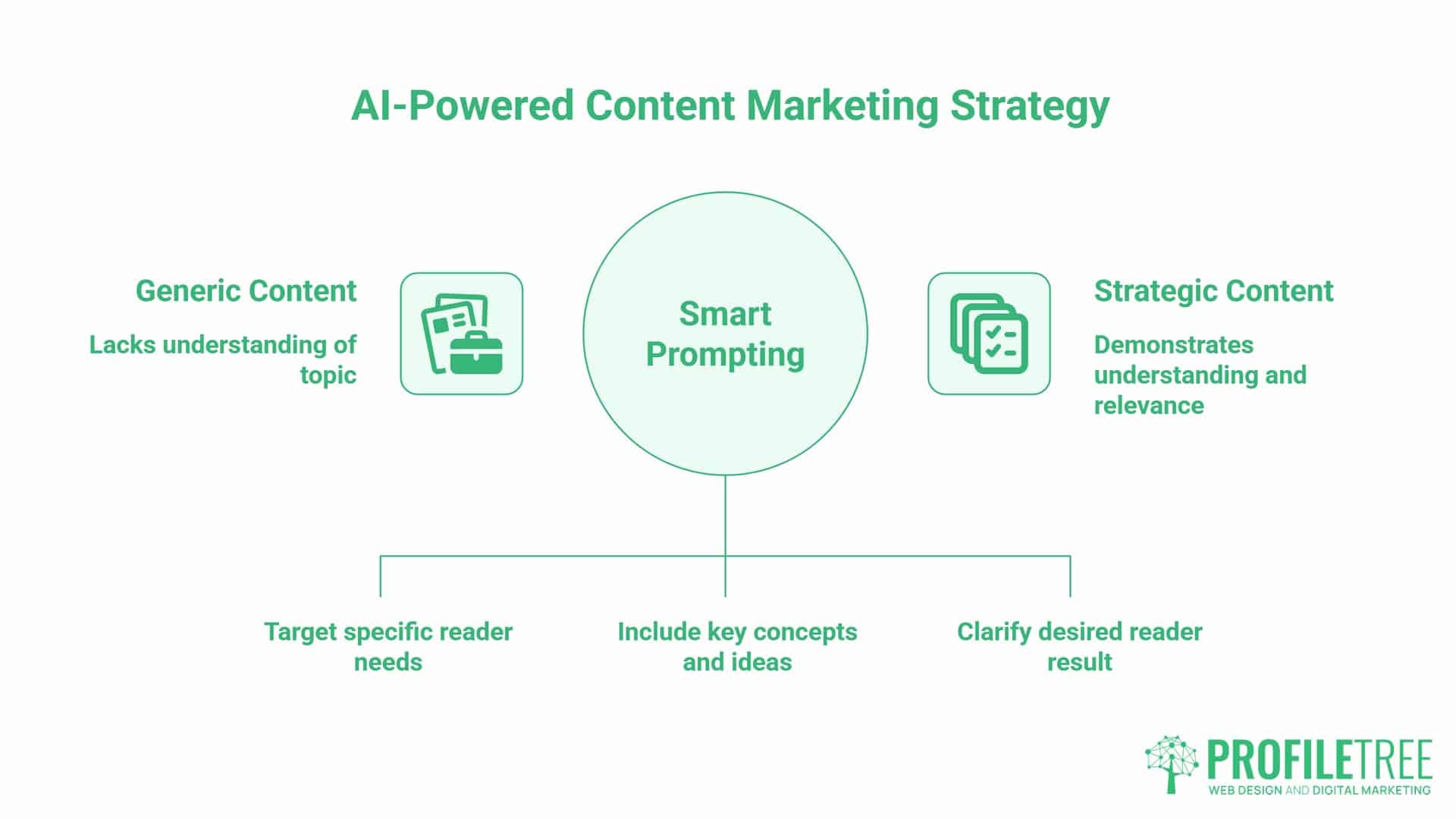
Search has moved on from matching keyword strings. Google, and the AI systems now sitting alongside it (AI Overviews, Perplexity, ChatGPT), read for entities, relationships between ideas, and whether a page actually answers the question asked. A prompt that says “write about SEO” produces generic filler. A prompt that specifies the audience, the entities to cover, and the outcome the reader needs produces something closer to what ranks.
This is the real shift behind AI for content marketing strategy. It isn’t about generating more content; it’s about generating content that demonstrates it understands the topic and the reader, not just the keyword. A business using AI for content marketing strategy well will produce fewer, better pieces rather than a higher volume of average ones, because the prompting itself now does the strategic thinking that used to happen separately.
The ProfileTree Hybrid Framework: Balancing AI and Human Expertise
The businesses getting the most out of AI for content marketing strategy aren’t the ones using it to skip the work. They’re the ones using it to skip the blank page, then applying judgement AI simply doesn’t have.
A workable framework looks like this:
- Prompting. AI drafts using a structured brief that specifies the topic, the audience, the entities to cover, and any constraints on length or format.
- AI Draft. A first-pass draft that covers the ground reasonably well but reads generically, without local detail or brand personality.
- Human Fact-Check. A person verifies every claim, statistic, and quote before anything is published, and removes anything that can’t be traced to a real source.
- Local and SEO Optimisation. Someone with genuine market knowledge adjusts the spelling, references, and search intent specifically for UK or Irish readers, then checks the piece against a real keyword strategy and an internal linking plan.
Each step exists for a reason. Skipping the prompting step and asking AI to “just write something” produces content with no strategic direction, so it tends to rank for nothing in particular. Skipping the fact-check step is how invented statistics and misattributed quotes end up published under a business’s name. Skipping the localisation step is how a UK-facing article ends up using American spelling and unfamiliar terminology, which readers notice even when they can’t quite say why the content feels off.
As Ciaran Connolly, ProfileTree’s founder, puts it: “The best content meets readers where they are whilst gently expanding their knowledge. AI can produce a draft in seconds, but it can’t tell you what your Belfast customers actually worry about, or what tone builds trust with them. That still has to come from a person.” That distinction between what AI can generate and what a person needs to verify and localise is the basis for a workable AI for content marketing strategy.
This is also where a genuine content marketing partner earns their place: not replacing the AI step, but owning the fact-checking and localisation steps that determine whether the output is publishable or just plausible-sounding. ProfileTree’s content marketing services are built around exactly this division of labour, with AI handling the first draft and a person handling everything that requires judgement.
Raw AI Output vs Optimised Output
| Metric | Raw AI Output | Optimised Output |
|---|---|---|
| Tone of voice | Generic, US-influenced | Matches brand voice, UK/Irish register |
| Local relevance | Vague or absent | Names real regions, funding schemes, sectors |
| Factual accuracy | Unverified, occasional hallucination | Checked against sources before publishing |
| Internal linking | None | Linked to relevant service pages and guides |
| Search intent match | Answers the prompt | Answers what the searcher actually needs |
Essential AI Prompts to Power Your Content and Local SEO Strategy
A useful way to structure any prompt is the CREATE framework: Context, Role, Evidence, Action, Tone, Evaluation. Tell the AI who it’s writing for, what role to adopt, what evidence to draw on, exactly what to produce, in what tone, and how you’ll judge whether it worked. Vague prompts produce vague content. Specific prompts, built around this structure, produce something you can actually use straight away.
Most SME owners don’t have time to build a library of 100 prompts, and they don’t need to. A handful of well-built prompts, used consistently, cover most of what a busy founder needs from AI for content marketing strategy.
- Content gap analysis. “Review these three competitor articles on [topic]. List the questions they don’t answer, and the local UK or Irish context they’ve missed. Suggest five angles that would give a reader more value.” This does in minutes what would otherwise take an afternoon of manual reading, and it’s often the single highest-value prompt in an AI for content marketing strategy workflow because it points directly at what to write next.
- Search intent mapping. “For the keyword ‘[keyword]’, identify whether the searcher wants information, a comparison, or a decision-ready guide. Suggest the content format that matches.” This prevents writing a 3,000-word guide when the reader wanted a quick answer, or a short answer when the topic genuinely needed depth.
- Local entity extraction. “Suggest genuine local landmarks, regions, or business terms relevant to a [industry] audience in Belfast, Dublin, or the wider UK, without forcing them in artificially.” This supports an AI content strategy that reads as genuinely local rather than templated, which matters more for search visibility than most owners realise.
- Structure and outline generation. “Create a logical section-by-section outline for an article on [topic], written for [audience], covering [list of entities/subtopics], in a UK/Irish context.” This gives the AI draft a shape before any writing happens, which is usually faster than editing a disorganised draft afterwards.
- Performance-based rewriting. “This page has [X] impressions but a low click-through rate. Suggest three alternative headlines and a revised opening paragraph that better matches what someone searching for [keyword] is actually looking for.” This turns Search Console data into a concrete editing task rather than a vague sense that a page “isn’t working.”
Used together, these five prompts form a compact, repeatable process. That’s a more realistic version of AI for content marketing for a time-poor founder than a hundred-prompt library that never gets opened after the first week.
Prompting for the UK and Irish Market
Most AI prompt libraries are written with a US audience baked in, and it shows. AI defaults to American spelling, American idioms, and American reference points unless told otherwise. A prompt for a UK or Irish audience needs to say so explicitly, and needs to specify the vocabulary that matters: “estate agent” rather than “realtor,” “optimisation” rather than “optimization,” VAT rather than sales tax, and pounds sterling or euro, depending on which market the piece is aimed at.
This localisation step is small to execute but easy to skip, and it’s usually the difference between content that reads as written for the reader and content that reads as generated for anyone. A business running AI for content marketing across both the UK and Irish markets should also be explicit about which market a given piece targets, since a single article trying to serve both often ends up serving neither particularly well.
Prompting for AI Overviews and Generative Engine Optimisation
Search results now increasingly show an AI-generated summary above the traditional list of links, drawing from a small number of sources it considers clear and trustworthy. Getting cited in that summary, sometimes called Generative Engine Optimisation or GEO, depends less on traditional keyword placement and more on whether a page answers a specific question in a self-contained, clearly structured way.
A useful prompt here: “Write a 40 to 60 word answer to the question ‘[question]’ that could stand alone as a direct answer, followed by a more detailed explanation.” Structuring key sections this way, one clear answer followed by supporting detail, gives AI systems something citable, and gives human readers a fast answer if they’re scanning rather than reading in full. This is an increasingly important part of any AI for content marketing strategy that wants to be found not just in traditional search results, but inside the AI summaries now sitting above them.
Managing the Risks: Fact-Checking and UK Advertising Standards
AI-generated content carries two risks that matter more in the UK and Ireland than they might elsewhere: factual errors, where AI models occasionally invent statistics, sources, or quotes with total confidence, and disclosure expectations under the Advertising Standards Authority’s guidance on AI-generated content and imagery.
Neither risk is a reason to avoid AI for content marketing strategy. Both are reasons to build a verification step into the workflow rather than treating the first draft as the finished article. Hallucinated statistics are a genuine and common problem: AI models will confidently state a percentage, a study, or a named source that doesn’t exist, phrased with exactly the same level of conviction as a fact that does. The only reliable defence is treating every specific number or attributed claim as unverified until someone checks it against a real source.
The ASA’s position on AI-generated content is still developing, but the underlying principle is a familiar one: advertising and marketing content must not mislead, regardless of how it was produced. For most SME content, this means being straightforward about the role AI played in production, rather than presenting AI-assisted drafting as entirely human-written when a customer or regulator might reasonably expect otherwise.
A simple pre-publish check covers most of what matters before anything using AI for content marketing strategy goes live:
- Has every statistic been traced back to a real, checkable source
- Has every quote been verified as something the named person actually said
- Does the spelling and terminology match the target market, UK or Irish, rather than US
- Would the claims made stand up if a customer or regulator asked where they came from
- Is it clear, where relevant, that AI-supported drafting and a person reviewed the final content
- Have any local statistics or regional claims been checked rather than assumed
Treating this as a standard part of the process, rather than an afterthought, is what separates content marketing that holds up under scrutiny from content that quietly damages credibility the first time someone checks a fact.
Implementation: When to Prompt Yourself vs When to Hire an Agency
For a single blog post a month, prompting AI yourself with a clear framework is entirely workable. The maths changes once a business needs a genuine content programme: multiple articles a month, consistent brand voice across all of them, ongoing keyword research, technical SEO checks, and a fact-checking process that doesn’t fall to whoever has ten spare minutes between other jobs.
That’s usually the point where SME owners in Northern Ireland and Ireland look at a proper content marketing service rather than continuing to manage AI for content marketing strategy entirely in-house. It’s also worth separating out the parts of the process that are a one-off skill to learn versus an ongoing service to buy:
- If the gap is knowing how to prompt properly, AI training or broader digital training closes that gap directly, and the skill stays in-house afterwards rather than depending on an external supplier indefinitely.
- If the gap is capacity rather than knowledge, an ongoing content marketing service covers the writing, fact-checking, and optimisation load, so AI for content marketing strategy becomes something delivered rather than something squeezed in between other work.
- If the content strategy depends on video, whether that’s repurposing a blog into a script or building original video for YouTube, video production sits alongside the written content rather than replacing it, since video and text content increasingly reinforce each other in search results.
- If local search visibility is the underlying goal, the content work should sit inside a wider local SEO strategy, not run separately from it, since content that isn’t built around real keyword research and local intent tends to underperform regardless of how well it’s written.
There’s no single correct answer here. A sole trader publishing one article a month may never need more than a good prompt and thirty minutes of fact-checking. A business trying to build sustained organic visibility across multiple service lines usually reaches a point where doing so properly, at the required volume, is no longer a sensible use of a founder’s time.
AI for content marketing strategy works when it’s treated as an efficiency tool within the strategy, not a replacement for it. The businesses seeing genuine results are prompting with structure, fact-checking before publishing, properly localising for a UK or Irish audience, and recognising when the work has outgrown what one person can manage alongside everything else involved in running a business. Get those pieces right, and AI for content marketing strategy becomes a real advantage rather than another source of generic content nobody reads.
FAQs
Does AI content rank on Google?
Yes. Google has been clear that AI-assisted content can rank as well as any other content, provided it demonstrates real experience, expertise, authority, and trustworthiness (E-E-A-T) and genuinely helps the reader. What doesn’t rank is unedited, unchecked AI output published at volume with no human input.
What’s the best AI tool for UK content marketing?
ChatGPT, Gemini, and Claude all handle British English reasonably well when explicitly instructed to use it, though all three default to American spelling and phrasing unless otherwise instructed. None of them reliably know current UK-specific detail, such as funding schemes, regional business terms, or recent local statistics, without being given that information directly in the prompt. For a business running AI for content marketing strategy across multiple markets, the choice of tool tends to matter less than the quality of the prompt and the subsequent fact-checking. Testing the same brief across two tools and comparing which handles British spelling and tone more consistently is often more useful than picking one tool on reputation alone.
How do I make AI sound like my brand?
Give it a brand persona prompt: specific examples of your existing tone, the phrases you use and avoid, and the audience you’re writing for. Feed it real examples of your past content rather than a vague adjective list, since AI matches patterns in the material it’s given far more reliably than it interprets abstract instructions like “sound more professional.”
Is AI-generated content copyright-protected in the UK?
This sits in a genuine grey area. UK copyright law was written around human authorship, and purely AI-generated text without meaningful human input may not qualify for the same protection as fully human-written work. Content that a person substantially edits, restructures, and adds original judgement to is on firmer ground, which is another practical reason to treat AI drafts as a starting point rather than a finished product, and another reason the human fact-check and localisation steps matter beyond simply catching errors.
How do I avoid AI hallucinations in my blog posts?
Verify every specific claim, statistic, and quote against a real source before publishing. Never take an AI-generated fact at face value, particularly numbers, dates, and attributed statements. This human-in-the-loop check is not optional if the content is going out under your business’s name, and it’s the single most important habit in any AI for content marketing strategy process.