
Video Email Marketing Statistics: Rates, ROI and AI
Table of Contents
Video email marketing statistics tell a clear story: adding video to your email campaigns lifts open rates, drives more clicks, and keeps subscribers engaged for longer. The data has been consistent across multiple years of industry research, and the direction of travel in 2026 is toward more personalised, AI-assisted video content that raises the bar further.
For marketers building a case internally, or for business owners weighing up the production cost against likely return, the numbers matter. But so does the context behind them. An open rate uplift of 19% means something different for a B2B firm on Microsoft 365, where Outlook blocks HTML5 video by default, than it does for a D2C brand reaching a predominantly mobile audience on Apple Mail.
This guide covers the benchmarks that hold up under scrutiny — on open rates, click-through rates, conversions, and unsubscribe behaviour — alongside the technical and regional factors that determine whether those figures apply to your campaigns.
The Core Metrics: Open Rates, CTR, and Conversions
Video has a measurable effect at every stage of the email funnel, but the size of that effect depends heavily on how it is integrated. These are the figures that matter.
Open rates
Subject line phrasing is the first lever. Including the word “video” in the subject line increases open rates by 6-19% compared to equivalent text-only subject lines, according to Campaign Monitor data. Adding a video thumbnail as a preview image — a tactic supported by some email clients — can push that figure higher still, with some sources citing gains of up to 40% in controlled tests.
Overall, video emails consistently report open rates that are 19% higher than text-only benchmarks. That gap has remained broadly stable across the last two years of published data.
Click-through rates
CTR is where video’s impact becomes most commercially significant. Studies consistently report average CTR increases of around 65% for video emails over static campaigns. Some Forrester research cited by multiple sources puts the ceiling higher, with embedded or linked video landing pages producing CTR uplifts of up to 300% in specific test conditions — though that upper figure reflects optimised campaigns rather than typical performance.
Videos embedded directly in the email body tend to outperform linked landing pages on raw click-through metrics, though the gap narrows when the thumbnail design is strong.
Conversions and unsubscribes
Video emails can improve conversion rates significantly in well-structured campaigns. Reports of 300% increases in lead generation and sales attach to specific optimised setups, not averages. A more conservative and broadly supported figure is a consistent uplift over text-only campaigns across industries.
On the retention side: video in emails reduces unsubscribe rates by up to 26% in studies measuring engaged audiences. The mechanism is straightforward — viewers who find content useful are less likely to opt out.
Comprehension and retention
Viewers retain approximately 95% of a message delivered via video, compared to around 10% from text. For complex products, service-based businesses, or anything requiring explanation, that gap has real implications for how much of your message actually lands.
The Rise of AI-Personalised Video
Generic video is now table stakes in competitive email programmes. The 2025–2026 shift that most statistics roundups have been slow to cover is the move toward AI-generated personalised video, where the recipient’s name, company, or specific context is injected into the video at scale.
Early data from platforms using this approach shows higher engagement than generic video content. B2B campaigns using personalised video thumbnails — where the recipient’s name appears on the thumbnail image even when the video itself is not truly personalised — report open rate improvements of 35% or more in some published case studies. Fully personalised video, where the content itself is tailored, produces stronger conversion performance still, though the cost-per-lead calculation is more complex.
For UK SMEs, the practical entry point is personalised thumbnails and name-injected subject lines rather than full AI video production, which carries a higher setup cost. The underlying principle — that relevance drives response — holds regardless of the format.
“Video no longer competes just with other videos. It competes with every other type of content in the inbox,” says Ciaran Connolly, founder of Belfast digital agency ProfileTree. “For businesses we work with across Northern Ireland and Ireland, the question isn’t whether to use video in email — it’s whether the video is relevant enough to earn the click.”
ProfileTree’s video marketing services help businesses plan content that works across channels, including email sequences where video plays a defined role in moving prospects through the funnel.
Video Email Performance by Industry
Aggregate benchmarks obscure real variation across sectors. B2B and B2C email audiences respond differently, and industry context matters.
B2B performance
B2B video email typically performs best when video is used for demos, case study walkthroughs, and onboarding sequences. Decision-makers in professional services respond to proof-based video content that reduces perceived risk. CTR uplifts in B2B contexts tend to track below the headline 65% figure in poorly targeted campaigns but above it when the video directly addresses a buying-stage question.
B2C performance
E-commerce and retail campaigns benefit from product demo videos and personalised “you viewed this” video content. Emotional storytelling, behind-the-scenes content, and time-limited offer videos perform consistently in B2C, with open rates particularly sensitive to thumbnail quality and subject line urgency.
High-performing video types across both
- Product demonstrations (73% of viewers report using video to learn about a product before purchasing)
- Customer testimonials
- Explainer and tutorial content
- Personalised greetings linked to purchase history or browsing behaviour
- Short-form content under two minutes
The rise of short-form video as a consumer expectation has pushed email video formats in the same direction. Anything over 90 seconds results in a meaningful drop-off across most audience segments.
The Technical Reality: Deliverability and Client Support
This is the section most video email statistics articles skip. The data on CTR uplifts is only meaningful if the video actually reaches the inbox and renders correctly.
Email client support
HTML5 embedded video does not play in Outlook, which is the dominant email client across UK corporate environments, given the prevalence of Microsoft 365. It also renders inconsistently in some versions of Gmail on Android. Apple Mail and iOS Mail support HTML5 video playback.
| Email Client | HTML5 Video | Autoplay | GIF Fallback |
|---|---|---|---|
| Apple Mail (iOS/Mac) | Yes | Yes (muted) | Yes |
| Gmail (desktop browser) | No | No | Yes |
| Gmail (Android) | Partial | No | Yes |
| Outlook (all versions) | No | No | Yes |
| Samsung Mail | Partial | No | Yes |
What this means in practice
For UK B2B audiences who are heavily reliant on Outlook, a fallback strategy is not optional — it is the primary strategy. The most reliable approach is a static thumbnail image linked to a video landing page, styled to look like a video player. This method achieves near-universal deliverability and retains most of the CTR benefit because the visual cue (the play button) still triggers click intent.
GIF previews are a middle option: they show movement in clients that support them and fall back to a static image where they do not. They increase file size, which can affect load times on mobile devices.
Spam and deliverability
The video itself does not trigger spam filters. Deliverability issues are caused by embedding large files or using video hosting domains with a poor reputation. Using established platforms (Vimeo, Wistia, YouTube) for hosting and linking out rather than embedding raw video files is the recommended approach for consistent deliverability.
For a broader view of how email content strategy affects performance across sectors, the email statistics by industry data is a useful context.
Regional Spotlight: UK and Ireland Video Marketing Trends
Most published video email statistics come from US-based platforms surveying US-predominant user bases. A few patterns are relevant when applying this data to UK and Irish campaigns.
GDPR and tracking
Video tracking in email typically uses a tracking pixel embedded in or near the video thumbnail. Under GDPR and the UK PECR regulations, tracking pixels require either consent or a legitimate interests basis that is clearly documented. For Irish businesses, the DPC’s interpretation of PECR-equivalent rules under the ePrivacy Regulations has been consistently strict.
In practical terms, this means that “play rate” data — which relies on tracking when a recipient clicks through to the video — is generally compliant. Tracking that fires automatically on email open is a higher-risk approach under UK/Irish data protection law and should be reviewed with a compliance perspective before implementation.
Mobile usage patterns
UK mobile email open rates have consistently tracked above 60% in industry surveys over the last three years. This reinforces the case for short video content (under 60 seconds), fast-loading thumbnails, and fallback images that display clearly on small screens.
Microsoft 365 prevalence
As noted in the deliverability section, UK business email is disproportionately Outlook-based compared to the US, where Gmail holds a larger share. Any UK-focused B2B video email campaign should be tested in Outlook before launch. The fallback experience in Outlook is what most recipients will see.
The broader email marketing compliance landscape for finance and regulated industries covers some of the tracking consent questions in more detail.
Optimising Video Length and Placement for ROI
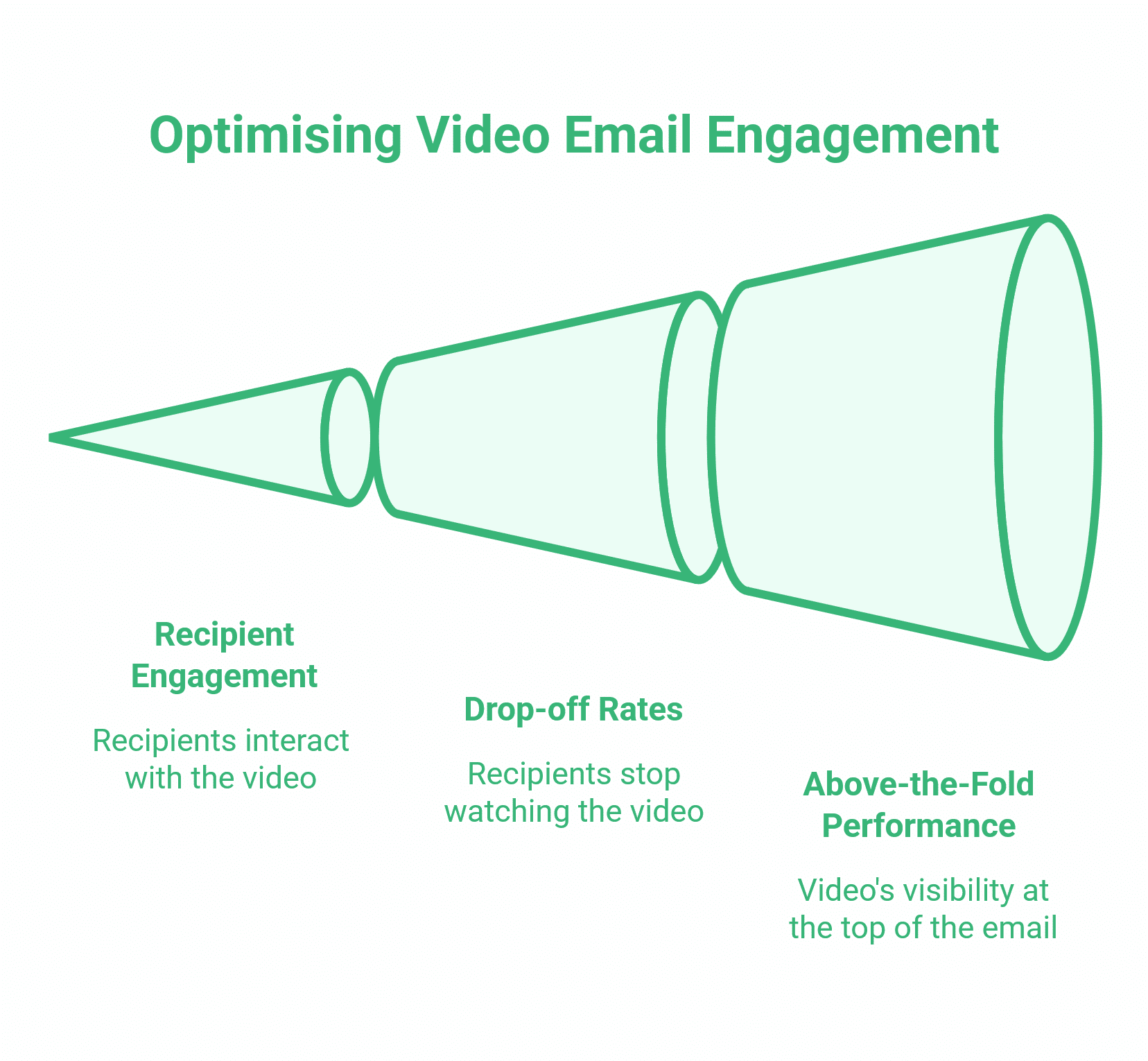
Getting video length and placement right has a direct impact on whether recipients click through or scroll past. The data on drop-off rates and above-the-fold performance points to a few consistent principles worth building into any video email campaign.
Length
Audience attention in email contexts is shorter than on social or dedicated video platforms. The most commonly cited sweet spot for video linked from email is 30 to 45 seconds for awareness and engagement goals, and up to two minutes for tutorial or demo content where the viewer has actively chosen to engage.
Drop-off data from video hosting platforms shows a consistent pattern:
- 0 to 30 seconds: high retention (70–80% of viewers)
- 30 to 60 seconds: moderate drop (retention falls to 50–60%)
- 60 to 90 seconds: significant drop (40–50%)
- Beyond 90 seconds: less than 40% of viewers typically reach the end for non-opted content
For email, where the viewer has not specifically sought out video, erring toward the shorter end of these ranges reduces drop-off risk.
Placement and thumbnail design
Placing the video (or its thumbnail) above the fold — visible without scrolling — consistently outperforms below-the-fold placement on CTR. The visual cue of a play button draws the eye and communicates format before the reader processes the subject matter.
Thumbnail quality matters more than most marketers account for. A clear, high-contrast image with a visible play button and minimal text performs better than a complex frame from the video itself. On mobile, the thumbnail may render at a small size — test at 375px width before sending.
Calls to action
Include a CTA both within the video and in the email body immediately below the thumbnail. The two should not be identical in phrasing — the email CTA can be more specific than the video’s closing message.
What These Statistics Mean for SMEs
The aggregate data makes a case for video in email. The more useful question for a business considering the investment is where video fits in their specific funnel and what production and tracking setup they can actually sustain.
For most SMEs, the practical entry points are:
- A short product or service explainer video used in a welcome email sequence
- A testimonial video embedded in a proposal follow-up sequence
- A personalised thumbnail (name in the image) in outbound B2B prospecting
Each of these can be produced at reasonable cost, tracked through standard ESP click-through data, and tested against a text-only control in an A/B split.
ProfileTree’s video production work includes planning for multi-channel use, so videos produced for one purpose — a website testimonial or a social clip — can be adapted for email without additional production spend.
For those building out a broader email marketing strategy, video sits most naturally in nurture and re-engagement sequences where the recipient has already shown interest and the video adds something a text email cannot.
Common Video Email Mistakes
Even well-resourced campaigns make avoidable errors that undercut the performance gains video is supposed to deliver. These are the most frequent ones worth checking before you send.
Embedding large video files directly Attaching or embedding raw video files inflates email size, triggers spam filters, and breaks rendering across most clients. Host the video externally and link to it via a thumbnail.
Ignoring the Outlook problem Sending an HTML5 video email to a UK B2B list without a fallback means most recipients see a broken layout. Always build and test the static thumbnail version first, then treat HTML5 playback as a bonus where it works.
Using the wrong thumbnail A blurry or cluttered thumbnail kills click intent before the subject line has a chance to do its job. Use a clean, high-contrast image with a clear play button that renders legibly at mobile screen sizes.
Skipping the CTA in the email body The video should not carry the entire conversion burden. Include a text CTA below the thumbnail so recipients who do not click play still have a clear next step.
Sending without A/B testing Video emails involve more production effort than text campaigns, which makes testing feel like an added overhead. Running even a simple subject line or thumbnail A/B split before a full send protects that investment and builds useful data for future campaigns.
Conclusion: Video Email Marketing Statistics
The data supporting video email marketing has strengthened over the last two years, not weakened. Open rate and CTR uplifts are consistent across sources, even as the format evolves. The 2026 story is not simply “video works” — it is that generic video is becoming standard, and personalisation and technical execution are where the performance gaps now sit.
For UK and Irish marketers, the Outlook compatibility question and GDPR-compliant tracking approach are practical details that US-focused statistics reports overlook. Getting those details right is what separates campaigns that hit the benchmarks from those that fall short. If you are ready to build video into your email and content strategy, speak to ProfileTree’s team about how video production and digital marketing planning can work together.
FAQs
Does video play directly in the inbox?
In most email clients, it does not. Apple Mail supports HTML5 video playback, but Outlook — widely used across UK businesses — does not. The most reliable approach is a clickable thumbnail linked to a hosted video page, which works across all clients and retains most of the click intent.
What is the ideal video length for email?
For most email contexts, 30 to 45 seconds is the sweet spot for awareness and engagement goals. Tutorial or demo content can stretch to two minutes when the viewer has actively chosen to watch. Beyond 90 seconds, drop-off rates increase significantly.
Will adding video trigger spam filters?
The video itself does not trigger spam filters. Problems arise from embedding large files directly or linking to video hosting with a poor domain reputation. Using established platforms such as Vimeo, Wistia, or YouTube to host content avoids the most common deliverability pitfalls.
Is video email marketing GDPR compliant?
It can be, with the right setup. Tracking through click-based data — where the recipient clicks a thumbnail to a landing page — is generally compliant. Auto-firing tracking pixels on email open carry higher risk under UK PECR and Irish ePrivacy rules.