
Clubhouse for Networking: A B2B Guide for UK Professionals
Table of Contents
Most of the advice on Clubhouse for Networking was written in 2021, when the app was invite-only, wildly hyped, and treated as the next big thing in social. Almost none of it holds up. The invites are gone; anyone can join, and the breathless predictions about audio replacing every other channel quietly didn’t come true. What’s left is more useful than the hype suggested: a steady, low-cost way to be heard by the right professional community, sitting alongside LinkedIn Audio and X Spaces as one option among several.
So the question for a professional services firm in the UK or Ireland isn’t whether to rush in before the moment passes. It’s a flatter, more practical one. Does live audio earn an hour of your week, and if it does, how do you turn that hour into a connection that actually leads somewhere?
This guide answers that directly. It covers when audio networking is worth your time, how to set up a profile that works while you listen, a non-pushy way to introduce yourself, how the main platforms compare for British and Irish professionals, how to repurpose and measure what you do, and the follow-up process that converts a voice in a room into a real conversation about work.
When live audio networking is actually worth it
Start with the honest answer: audio networking suits some businesses far better than others. If your work depends on trust, reputation, and being known as a credible voice (consultancy, professional services, coaching, agencies, B2B software), live audio gives you something a written post cannot. People hear how you think in real time. If your business is transactional or local footfall, the hours rarely pay off, and your effort is better spent on local SEO and a strong social media plan.
The mistake most people make is treating Clubhouse as a broadcast channel. It isn’t. It rewards consistent presence in a small number of relevant rooms, not a scattergun appearance across dozens. Think of it the way you’d think about a recurring industry meetup: you go often, people start to recognise your name, and connections form because you keep turning up, not because you pitched.
For a fuller picture of where audio fits among the available channels, our overview of business networking sites sets live audio in context against the platforms most UK firms already use.
Setting up a profile that works while you listen
On audio platforms, your bio does the selling, because most of the time you’re listening rather than speaking. Treat the first line as a headline, not a job title. “Helping NI manufacturers cut energy costs” tells a room far more than “Operations Director.”
A few practical points:
- Front-load the first sentence. It’s what shows in previews and what people read before deciding to follow you.
- Link the platforms that matter. On Clubhouse, that usually means Instagram and a professional profile; make sure your LinkedIn presence is up to date, because that’s where the real follow-up happens.
- Keep it specific to a region and a problem. “Belfast-based” and “Dublin tech” are more relevant than vague national claims.
This is the same discipline that underpins any personal branding work: clarity about who you help and what changes for them. A bio that reads like a billboard gets scrolled past. One that reads like a useful introduction gets the follow.
If you find writing a tight, benefit-led bio difficult, that’s not unusual; it’s the hardest 30 words most people will write all month. The same skills sit behind a good brand strategy, where the whole point is to say less but say the right thing.
A non-pushy framework for introducing yourself
Most networking advice assumes you want to grab the microphone immediately. In British and Irish professional culture, that often backfires. A more reserved, listen-first approach tends to land better, and it suits introverts who’d rather build authority quietly.
Here’s a practical sequence:
- Listen first. Spend your first few sessions in a room without speaking. Learn who the regulars are, how the moderators run things, and what kind of contribution gets a warm response.
- Raise your hand with a reason. Don’t come up to introduce yourself; come up to add something. A short, specific point that helps the speaker is worth more than any pitch.
- Keep the self-introduction to one sentence. “I’m Aoife. I run an accountancy practice in Galway, and I’ve seen this exact issue with three clients this quarter.” That’s context plus credibility in a breath, no sales angle.
- Let the bio do the conversion. If your contribution was useful, people will check your profile. That’s where the link and the clear positioning earn the follow.
The thread running through all of this is the same one that drives social media, that builds community: you give before you ask. Audio just makes the giving more personal, because it’s your actual voice.
As Ciaran Connolly, founder of ProfileTree, puts it:
“Live audio strips away the polish. On LinkedIn you can edit your way to sounding clever; in a room you either know your subject or you don’t, and people can tell within a minute. For the firms we work with, that’s an opportunity, not a risk. If you genuinely know your field, an hour of unscripted conversation will do more for your reputation than a month of scheduled posts.”
Clubhouse vs LinkedIn Audio vs X Spaces for UK professionals
No single platform wins outright. The right one depends on where your audience already spends time and what you’re trying to achieve.
| Factor | Clubhouse | LinkedIn Audio | X Spaces |
|---|---|---|---|
| Primary audience | Topic-led communities, international | B2B professionals, decision-makers | Mixed, news and tech-led |
| Discovery | Hashtag and follower-based | Tied to your existing network and feed | Hashtag and follower based |
| Best for | Niche communities and recurring rooms | Reaching colleagues and prospects directly | Reactive, event-driven conversation |
| UK/Ireland density | Lower, concentrated in specific clubs | Highest for B2B | Moderate |
| Follow-up path | Bio link, then off-platform | Native, connection is one click away | Profile and DMs |
For most UK and Irish B2B firms, LinkedIn Audio offers the shortest path from conversation to connection because the network is already there. Clubhouse earns its place when you’ve found a genuinely active niche community that LinkedIn doesn’t replicate. X Spaces tends to suit reactive, news-led participation more than steady relationship building. Choosing well is a strategic decision, and it’s the kind of platform-fit judgement that sits at the heart of social media marketing in Northern Ireland.
Timing: working the GMT/BST cycle
US-centric guides quote Pacific Time, which is little help if your prospects are in London or Dublin. Treat audio networking like any other UK business activity: early morning before the day starts, lunch, and early evening tend to draw the most engaged professional audiences. Sector matters too. Property and finance rooms often fill earlier in the day; creative and tech conversations run later. There’s no fixed timetable, so spend a week noting when the rooms you care about are busiest, then commit to those slots.
Privacy and GDPR in audio rooms
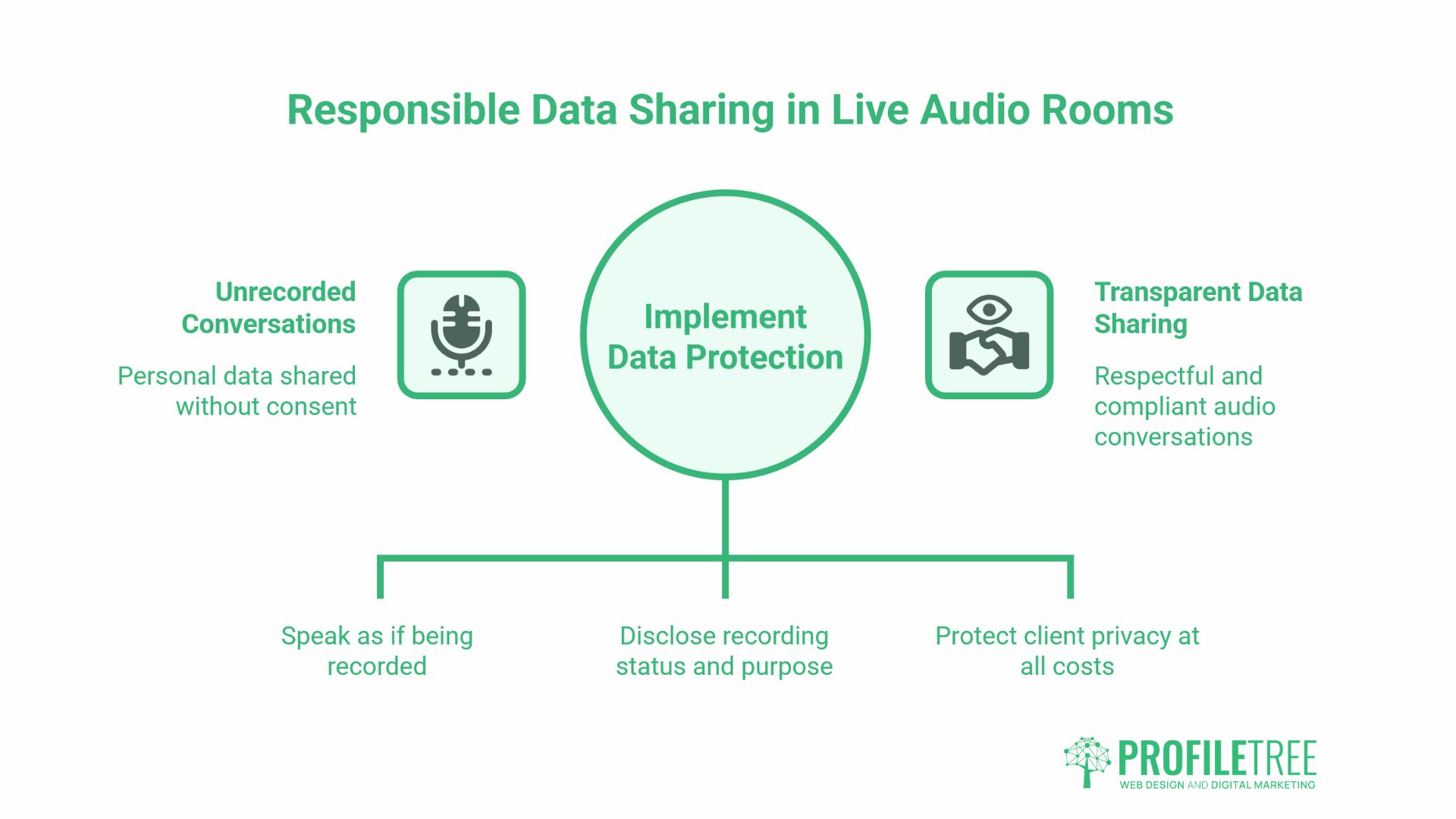
This is the gap most existing guides ignore, and it matters for UK and EU professionals. Live rooms can be recorded, and conversations may include casual sharing of personal data. Before you speak, assume you may be recorded. If you’re hosting, tell participants whether the room is being recorded and why. Don’t share client details, even anonymised ones, in a way that could identify someone. The principles are the same as any responsible approach to digital marketing: be transparent, collect only what you need, and respect that a casual setting doesn’t suspend data protection obligations.
Turning a room into a connection
The single biggest weakness in most people’s audio networking is the follow-up, or rather, the lack of one. A useful three-step bridge:
- Same day, find them on LinkedIn. Reference the specific room and point you discussed, not a generic “great to connect.”
- Within 48 hours, send something useful. A relevant article, a quick answer to a question they raised, anything that continues the value rather than pivoting to a pitch.
- Only then, if it fits, suggest a call. By this point, you’ve demonstrated rather than claimed expertise.
This is content repurposing in miniature. A single strong contribution in a room can become a LinkedIn post, a short follow-up note, and material for a longer piece. Firms that do this consistently are running, in effect, a small content marketing engine off their live conversations. If you want that done properly and at scale, it’s worth understanding how a structured content and SEO approach turns one-off appearances into compounding visibility.
Audio also feeds naturally into video. A recurring audio room can become a podcast, and a podcast clip can become a short-form video for LinkedIn and YouTube. That progression, from voice to repurposed video, is exactly the kind of work covered in our video marketing service.
Building the skills in-house
Plenty of business owners know they should be doing this and freeze at the thought of speaking live. That’s a confidence and process gap, not a talent one, and it’s learnable. Structured digital training covers exactly this: how to present, how to run a room, and how to fold live audio into a wider plan rather than treating it as a one-off experiment. For teams, building capability internally tends to pay off faster than outsourcing every task.
Repurposing one room into a month of content
The hour you spend in a live room is raw material, not a one-off event. A single strong conversation can feed a week or more of output: a LinkedIn post built around the point that landed best, a short clip if the room was recorded with consent, a few sentences for a newsletter, and notes towards a longer article. Treat every appearance as a small production line rather than a disposable chat.
The practical method is to capture as you go. Jot the two or three moments where you said something worth keeping, or where someone asked a question you answered well. Those become your content prompts later that day, while the wording is still fresh. This is the same logic behind a podcast for business growth: the live recording is the asset, and everything else is derived from it. Firms that work this way stop treating social as a daily scramble and start running it like a content marketing engine, where one effort produces several outputs across channels.
Audio sits at the start of that chain because it’s the cheapest format to produce: no script, no editing, just a conversation. The output then climbs in production value as it moves to written posts and short-form video, each version reaching a slightly different slice of your audience.
Measuring whether audio networking pays back
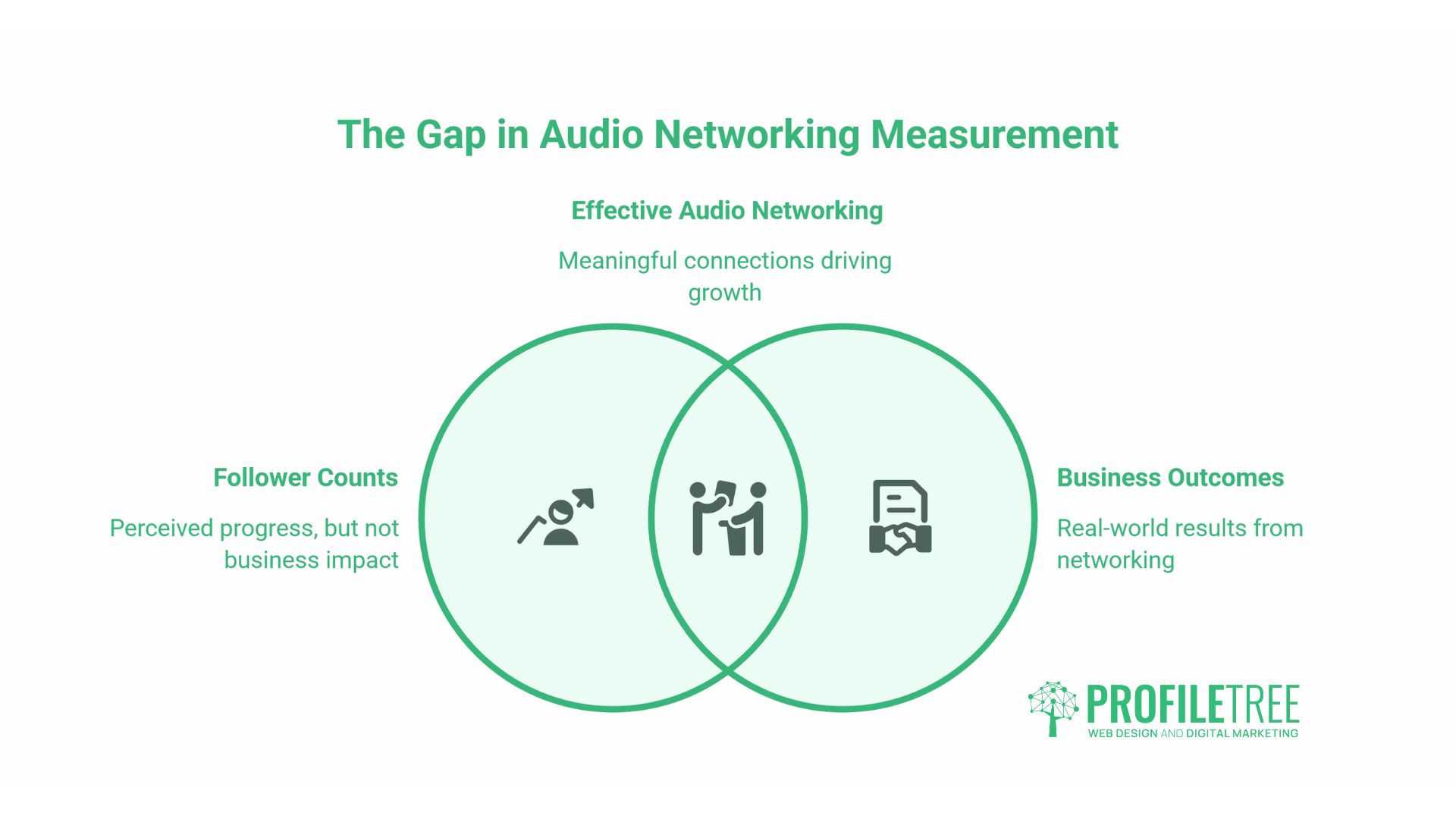
Most people abandon audio networking because they can’t tell if it’s working, and the platforms give you almost nothing useful to go on. Follower counts are the wrong measure. They feel like progress and tell you very little about whether the time is generating business.
Track the things that actually matter to a pipeline. How many relevant LinkedIn connections came from rooms this month? How many of those turned into a real conversation? How many enquiries can you trace back, even loosely, to an audio appearance? You won’t get clean attribution, and that’s fine; a rough, honest tally beats a vanity metric every time. The same discipline applies across digital marketing ROI, where the useful question is always whether an activity moves prospects closer to buying, not whether it produced impressions.
Set a simple review point. After six to eight weeks of consistent presence, review what the time has produced and decide whether to keep going, change rooms, or stop. If you’ve made even a handful of genuine connections that wouldn’t have happened otherwise, audio is earning its slot. If you’ve collected followers and nothing else, the hours are better spent on a channel where you can measure the impact more directly. The point isn’t to be precise; it’s to be honest enough that you’re not pouring time into a habit that quietly returns nothing.
Hosting your own room: from guest to authority
Joining rooms builds connections; hosting them builds standing. Once you’ve spent a few weeks listening and contributing, running your own room is the step that turns you from a familiar voice into the person people associate with a topic. It’s also less daunting than it looks, because as the host, you set the agenda, control the pace, and decide who speaks.
Keep the format tight. A clear title that names the problem (“Cash flow fixes for NI tradespeople”), a regular slot so people can plan around it, and a co-host or two to keep the conversation moving all matter more than a big audience on day one. Small and consistent beats large and one-off. The same thinking applies to any event marketing: a recurring, well-run gathering compounds, while a single splashy launch fades within a week.
Hosting also gives you the strongest material to repurpose. A room you control can be recorded with proper notice, which means it can become a podcast episode, clips, and written posts without the awkwardness of capturing someone else’s session. And because you’ve set the topic, every appearance reinforces the same area of expertise rather than scattering your reputation across whatever room you happened to drop into.
There’s a practical conversion point too. People who attend your room and want more will look for the next destination, so make sure that destination exists. A clear service or about page that loads fast and explains what you do is the difference between a warm lead and a dead end; if yours doesn’t pull its weight, that’s a website development job worth doing before you start hosting, not after. The conversation creates the interest; your site has to catch it.
Conclusion: Clubhouse for Networking
Clubhouse and live audio aren’t the revolution they were sold as, and they’re better for it. As a steady, low-cost way to demonstrate expertise to the right professional community, audio networking works, provided you treat it as a process: listen first, contribute usefully, let a sharp profile convert attention, and follow up where the real relationships form. For UK and Irish firms whose reputation is their pipeline, an hour a week in the right room, handled well, can do more than most paid campaigns. The platforms will keep shifting. The habit of showing up and being useful won’t go out of date.
FAQs
Is Clubhouse still relevant for networking?
Yes, but more narrowly than at launch. The hype has faded, and it’s no longer invite-only, but it still works for niche professional communities that meet in recurring rooms. For broad B2B reach in the UK and Ireland, LinkedIn Audio is usually the shorter path. Test it against your audience rather than assuming you need it.
How do I find UK-specific networking rooms?
Search the “Houses” and topic features using terms tied to your sector and region, then note which rooms stay active during UK and Irish business hours. Following a few well-run rooms, surface-related ones over time. Regularity matters more than the number you join.
How do I introduce myself without being pushy?
Lead with a useful contribution, not a pitch. Add a specific, relevant point, then keep any self-introduction to one sentence covering who you help and a concrete example. If you were genuinely useful, people would check your profile, where a clear bio does the rest.
Do I need a professional microphone to speak?
No. A decent wired headset is fine to start and usually clearer than a laptop mic. A quiet room and a stable connection matter more. Upgrade only once you’re hosting regularly and audio quality has become part of your impression.