
Small Business Revenue Statistics: Hard Facts for UK Business Growth
Table of Contents
Small enterprises across the UK face unique challenges and opportunities when it comes to revenue generation and growth. The financial health of these businesses not only affects individual business owners but also plays a crucial role in local economic stability and employment. Understanding current revenue statistics provides business owners with the knowledge needed to make strategic decisions that support sustainable development and profitability.
The past several years have brought unprecedented challenges to small businesses, from Brexit adjustments to pandemic disruptions and now inflationary pressures. Despite these obstacles, UK small businesses have demonstrated remarkable resilience, with many finding innovative ways to adapt their revenue models. Digital transformation has emerged as a critical factor separating thriving businesses from those merely surviving, creating new revenue streams and efficiencies that were previously inaccessible to smaller enterprises. These evolving revenue patterns offer valuable lessons for businesses looking to strengthen their financial foundation in uncertain times.
The Current Small Business Revenue Landscape in the UK
Small and medium-sized enterprises (SMEs) form the foundation of the UK economy, representing over 99% of all businesses. Recent data from the Department for Business and Trade reveals that the UK’s 5.5 million small businesses contribute approximately £1.9 trillion to the economy annually, highlighting their crucial economic role.
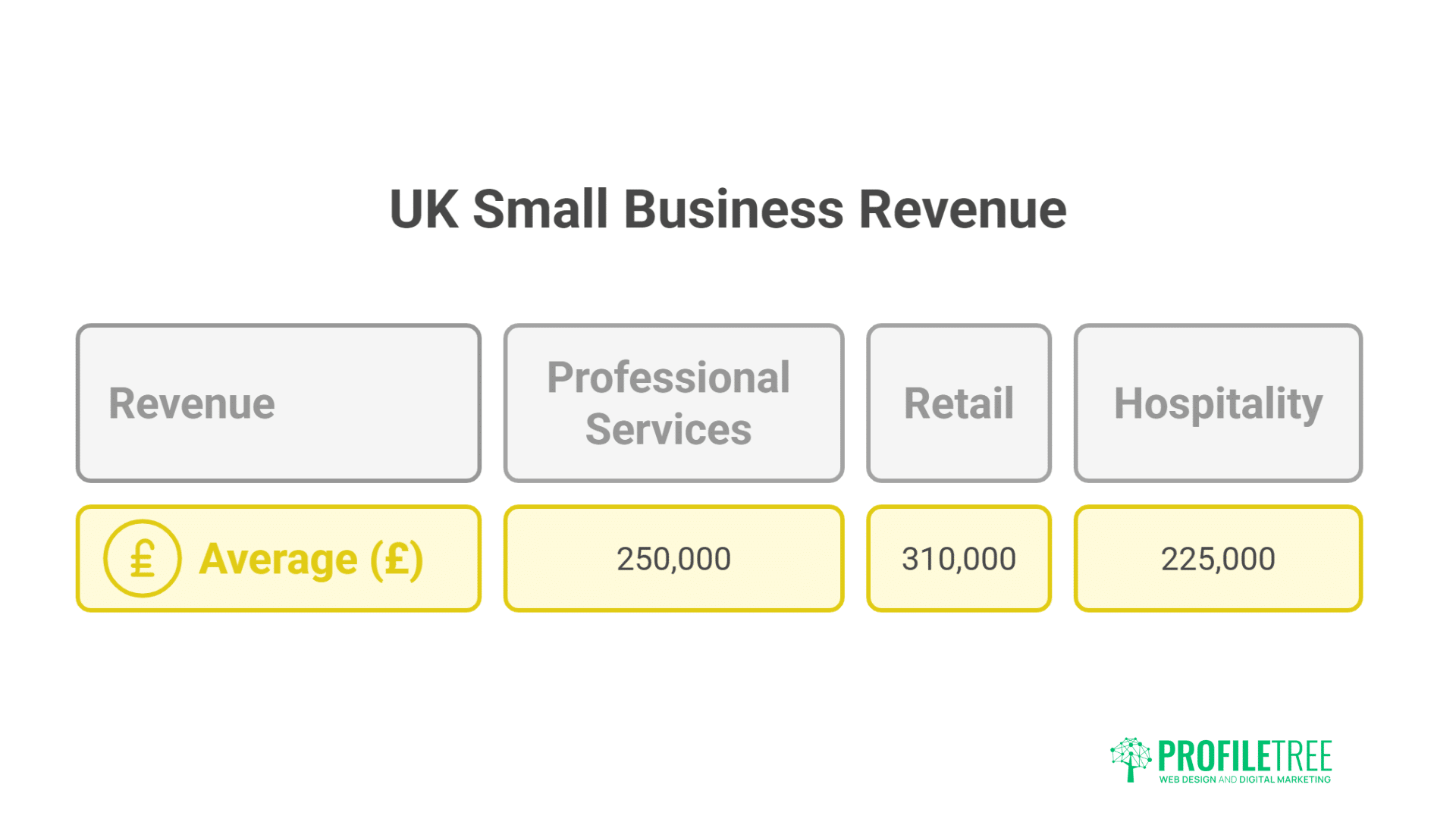
The average small business in the UK generates approximately £275,000 in annual revenue, though this figure varies significantly across industries, locations, and business maturity levels. Professional services firms typically report average revenues of £250,000, retail businesses around £310,000, and hospitality ventures approximately £225,000 annually.
“Understanding your revenue patterns is fundamental to business growth. The most successful small businesses we work with recognise that revenue growth isn’t simply about increasing sales volumes—it’s about building scalable digital systems that efficiently connect with their ideal customers,” says Ciaran Connolly, Director of ProfileTree.
Key Revenue Metrics and Benchmarks for UK Small Businesses
Understanding how your business performs against industry standards provides valuable context for strategic planning. These key revenue metrics offer a benchmark to assess your current position and identify growth opportunities within the UK small business ecosystem.
Revenue Growth Rates
Small businesses in the UK experienced average revenue growth of 4.3% in the past year, though this varies substantially by sector:
- Technology and digital services: 14.3% growth
- Healthcare and wellness: 9.6% growth
- Professional services: 6.8% growth
- Retail: 3.7% growth
- Hospitality: 5.2% growth (recovering from pandemic impact)
These figures highlight the uneven nature of growth across different sectors, with digitally-focused industries consistently outperforming traditional sectors.
Profit Margins
While revenue figures provide important context, profit margins reveal a more complete picture of business health:
- Average gross profit margin for UK small businesses: 49.6%
- Average net profit margin: 7.2%
- Highest margins: Software and digital services (15.3% net)
- Lowest margins: Retail (4.1% net) and food service (3.7% net)
Businesses with stronger digital presence consistently report profit margins 2-3 percentage points higher than industry averages.
Revenue Distribution by Business Size
Business size significantly impacts revenue patterns:
- Micro-businesses (1-9 employees): Average annual revenue of £87,000-£275,000
- Small businesses (10-49 employees): Average annual revenue of £300,000-£1.5 million
- Medium businesses (50-249 employees): Average annual revenue of £1.5 million-£10 million
The Digital Impact on Small Business Revenue
The digital revolution has fundamentally transformed how small businesses generate and maximise revenue in the UK market. From enhanced customer acquisition to streamlined operations, digital adoption has become the defining factor separating high-growth businesses from their competitors.
Digital Presence and Revenue Correlation
The data shows a clear correlation between digital investment and revenue performance. Small businesses with comprehensive digital strategies generate 40% more revenue than those with minimal digital footprints.
- Businesses with optimised websites see 18% higher conversion rates
- Companies actively using social media marketing report 23% higher customer retention
- Small businesses utilising local SEO strategies experience a 35% increase in foot traffic
- Businesses using data analytics for decision-making report 21% higher profitability
E-commerce Revenue Trends
E-commerce has transformed revenue possibilities for small businesses:
- UK SMEs with e-commerce capabilities saw revenue growth of 18.2% compared to 3.5% for those without
- Small businesses implementing omnichannel retail strategies (combining physical and online sales channels) report 28% higher customer lifetime value
- Mobile commerce now accounts for 61% of online sales for small retailers
- Click-and-collect options increase average order value by 23% for local businesses
Regional Revenue Variations Across the UK
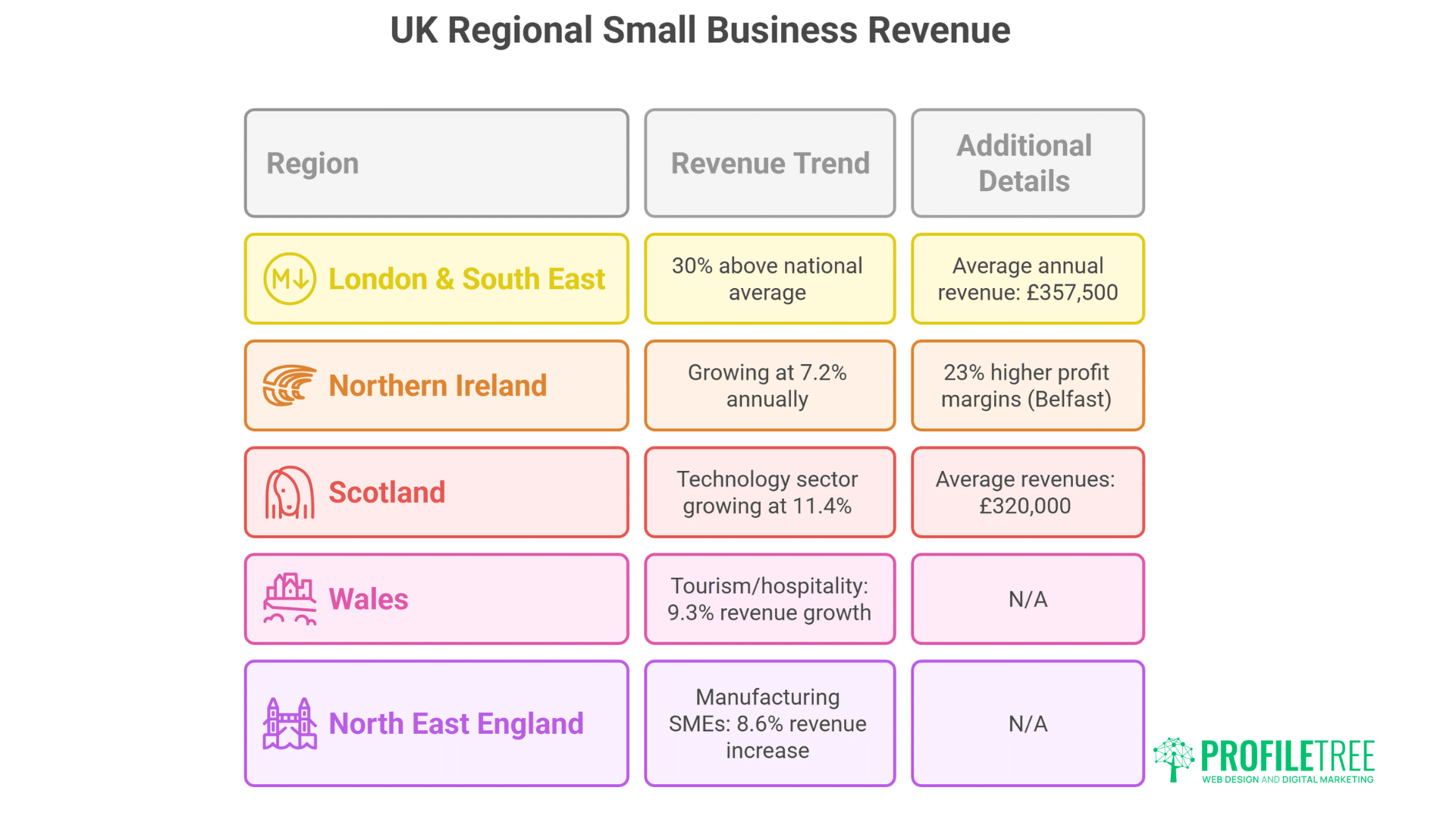
Small business revenue shows notable regional differences that reflect local economic conditions and industry concentrations:
- London and South East: Average annual revenue 30% above the national average at approximately £357,500
- Northern Ireland: Growing at 7.2% annually, outpacing several other UK regions
- Scotland: Technology sector growing at 11.4% with average revenues of £320,000
- Wales: Tourism and hospitality businesses seeing 9.3% revenue growth
- North East England: Manufacturing SMEs reporting 8.6% revenue increases
Small businesses in Northern Ireland benefit from lower operational costs compared to London, with Belfast-based businesses reporting 23% higher profit margins despite lower gross revenue figures. This competitive advantage makes Northern Ireland an increasingly attractive location for start-ups and scale-ups.
Industry-Specific Revenue Insights
Different business sectors experience unique revenue patterns and growth opportunities shaped by market demands and technological disruption. Examining industry-specific revenue data reveals valuable insights that can inform more targeted strategies for businesses operating in these specialised markets.
Digital and Technology Services
Digital service providers continue to lead revenue growth across the small business sector:
- Average annual growth rate: 14.3%
- Average time to break even: 18 months (faster than most other sectors)
- Recurring revenue models: 68% of digital service businesses now utilise subscription-based models
- Client retention: 76% for businesses offering ongoing digital services
Retail and E-commerce
The retail sector continues to undergo significant transformation:
- Physical retailers integrating e-commerce experience 27% higher revenue than store-only operations
- Hybrid retail models (click-and-collect, local delivery) show 32% higher customer lifetime value
- Small retailers investing in inventory management technology report 17% higher gross margins
- Local retailers using targeted digital marketing reach 42% more first-time customers
Professional Services
Professional service firms show a strong correlation between digital adoption and revenue performance:
- Firms leveraging digital marketing report 21% higher client acquisition rates
- Digital client onboarding processes reduce acquisition costs by 32%
- Average project values are 34% higher for firms with strong digital portfolios
- Client retention increases by 25% when using client portals and digital communication tools
Customer Acquisition Costs and Lifetime Value
Understanding the relationship between acquisition costs and customer value is essential for sustainable growth:
Customer Acquisition Costs (CAC)
- Average CAC has risen by 15% in the past two years across all sectors
- Retail CAC: £25-£30 per customer
- B2B services CAC: £75-£300 per new client
- Businesses using targeted digital marketing reduce acquisition costs by up to 25%
- Social media advertising CAC: £18-£22 (42% lower than traditional advertising)
Customer Lifetime Value (CLV)
The focus on customer retention and maximising value has intensified:
- Average CLV for UK small businesses: £1,450
- Businesses with loyalty programmes report 27% higher CLV
- Email marketing campaigns increase CLV by 23% when properly segmented
- Personalised customer experiences lead to 38% higher repeat purchase rates
The CLV: CAC ratio has become a critical metric, with top-performing small businesses maintaining ratios of 3:1 or higher.
How Digital Marketing Transforms Small Business Revenue
Digital marketing has moved beyond being merely a promotional channel to become a primary revenue driver for forward-thinking small businesses. The following case examples demonstrate how strategic digital initiatives directly translate into measurable revenue growth across various business models and sectors.
At ProfileTree, we’ve helped hundreds of businesses across Northern Ireland and the UK implement these transformative digital strategies. “We consistently see that businesses willing to embrace comprehensive digital approaches achieve revenue growth that outpaces their market average by 23-35%,” notes Ciaran Connolly. “The key is developing an integrated digital strategy that aligns with specific business goals rather than pursuing disconnected tactical activities.”
Case Example: Local Retailer Growth
A Belfast retailer implemented targeted local SEO and content marketing strategies, resulting in:
- 43% increase in website traffic within 4 months
- 27% growth in new customer acquisition
- 35% higher average transaction value
- Overall revenue growth of 31% year-on-year
ProfileTree’s web development and SEO services were instrumental in this transformation, creating a mobile-responsive website with localised content that connected with the retailer’s target customer base.
Subscription Model Adoption
Small businesses adopting subscription-based revenue models through digital platforms experience:
- 24% more predictable revenue forecasting
- 38% higher customer lifetime value
- 45% reduction in customer churn
- 19% lower customer acquisition costs over time
Omnichannel Integration
Businesses implementing seamless omnichannel experiences report:
- 13% higher average transaction value
- 23% increase in repeat purchase rate
- 34% higher customer satisfaction scores
- 27% improvement in inventory turnover
Common Revenue Challenges and Digital Solutions
Small businesses frequently encounter revenue obstacles that can limit growth potential and threaten sustainability. By identifying these common challenges and implementing targeted digital solutions, businesses can overcome traditional barriers and establish more resilient revenue streams in an increasingly competitive marketplace.
Seasonal Revenue Fluctuations
Nearly 40% of UK small businesses report significant seasonal revenue variations. Digital marketing helps smooth these fluctuations through:
- Year-round lead generation campaigns that build pipeline during off-seasons
- Content marketing strategies that address seasonal challenges and opportunities
- Email nurturing campaigns that maintain customer relationships regardless of the buying cycle
- Diversified product/service offerings that appeal to different seasonal needs
Cash Flow Management
Poor cash flow management causes 82% of small business failures. Digital systems help by:
- Automating invoice processing and payment reminders (reducing days sales outstanding by 23%)
- Providing real-time financial visibility through integrated accounting systems
- Enabling subscription-based revenue models that create predictable monthly income
- Streamlining payment processes to reduce friction (businesses offering 4+ payment methods see 12% higher conversion rates)
Market Penetration Barriers
Small businesses often struggle to compete with larger enterprises for market share. Digital strategies help level the playing field:
- Niche content marketing establishes authority in specific market segments
- Targeted local SEO helps small businesses dominate geographic territories
- Social media allows direct customer engagement regardless of business size
- Online reviews and testimonials build trust (92% of consumers read online reviews before making purchase decisions)
How Digital Marketing Transforms Small Business Revenue
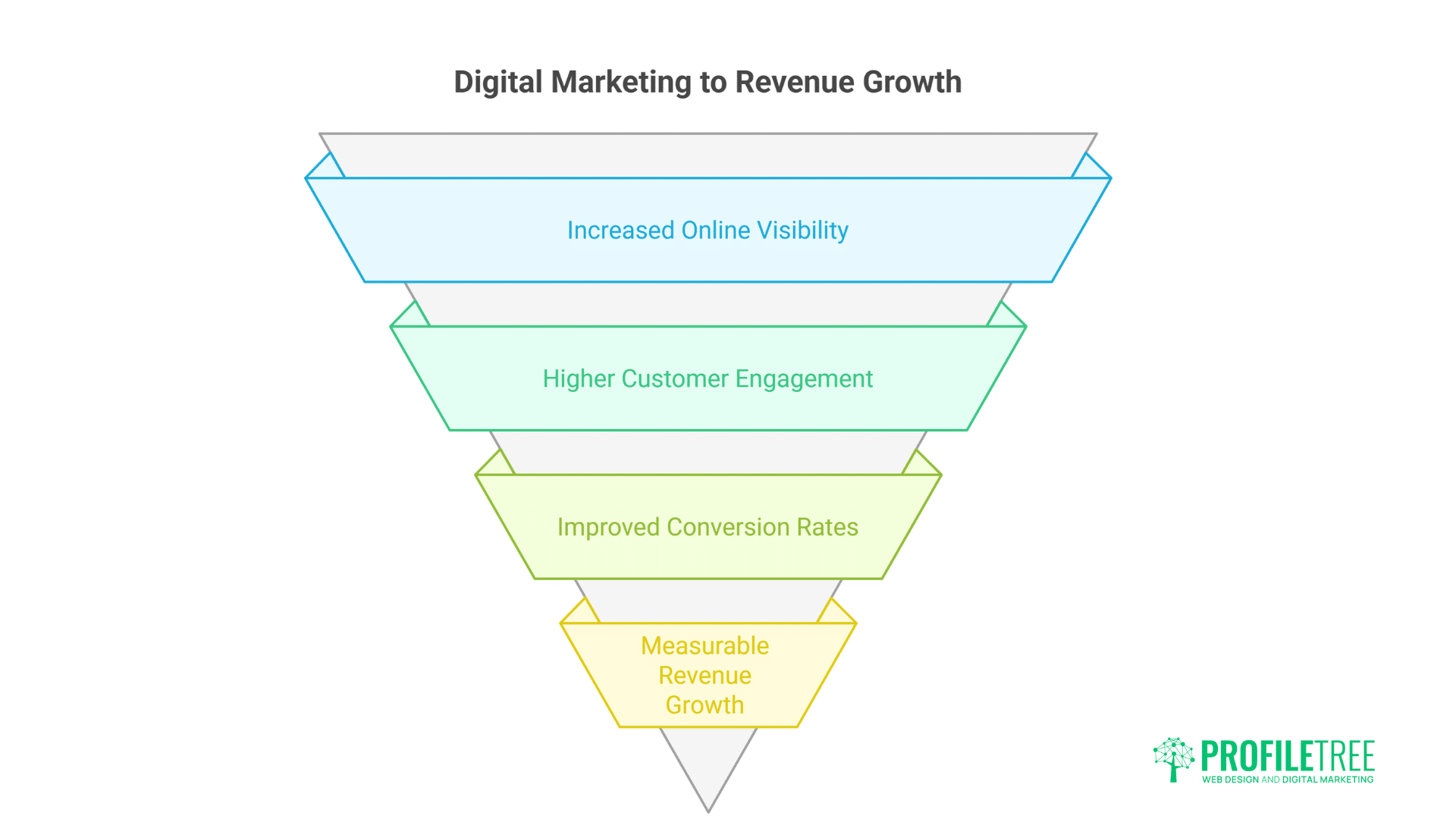
Digital marketing has moved beyond being merely a promotional channel to become a primary revenue driver for forward-thinking small businesses. The following case examples demonstrate how strategic digital initiatives directly translate into measurable revenue growth across various business models and sectors.
Case Example: Local Retailer Growth
A Belfast retailer implemented targeted local SEO and content marketing strategies, resulting in:
- 43% increase in website traffic within 4 months
- 27% growth in new customer acquisition
- 35% higher average transaction value
- Overall revenue growth of 31% year-on-year
Subscription Model Adoption
Small businesses adopting subscription-based revenue models through digital platforms experience:
- 24% more predictable revenue forecasting
- 38% higher customer lifetime value
- 45% reduction in customer churn
- 19% lower customer acquisition costs over time
Omnichannel Integration
Businesses implementing seamless omnichannel experiences report:
- 13% higher average transaction value
- 23% increase in repeat purchase rate
- 34% higher customer satisfaction scores
- 27% improvement in inventory turnover
Future Revenue Trends for UK Small Businesses
Several emerging trends will shape small business revenue in the coming years:
AI and Automation
- AI-powered customer experience tools projected to increase sales by 15-20%
- Automated marketing workflows reduce marketing costs by 12.2% while increasing effectiveness
- Predictive analytics improves inventory management, reducing stockouts by 28%
- Chatbots and virtual assistants handle 40% of customer queries, improving response times and satisfaction
Voice and Visual Search
- Voice search optimisation expected to influence 30% of web sales by 2026
- Visual search capabilities increase conversion rates by 30% for product-based businesses
- Location-based voice queries are growing at 136% annually for local businesses
- Voice commerce expected to reach £3.5 billion in the UK by 2027
Payment Innovation
- Digital payment diversification leading to 12% higher conversion rates
- Buy-now-pay-later options increase average order value by 45%
- Contactless and mobile payments now account for 67% of in-store transactions
- Cryptocurrency payment adoption is growing at 22% annually among tech-savvy small businesses
Personalisation at Scale
- Personalisation technologies driving 18% increase in customer spending
- AI-driven product recommendations account for 35% of e-commerce revenue
- Customised email marketing improves click-through rates by 14%
- Personalised loyalty programmes increase repeat purchases by 25%
How ProfileTree Helps Small Businesses Boost Revenue
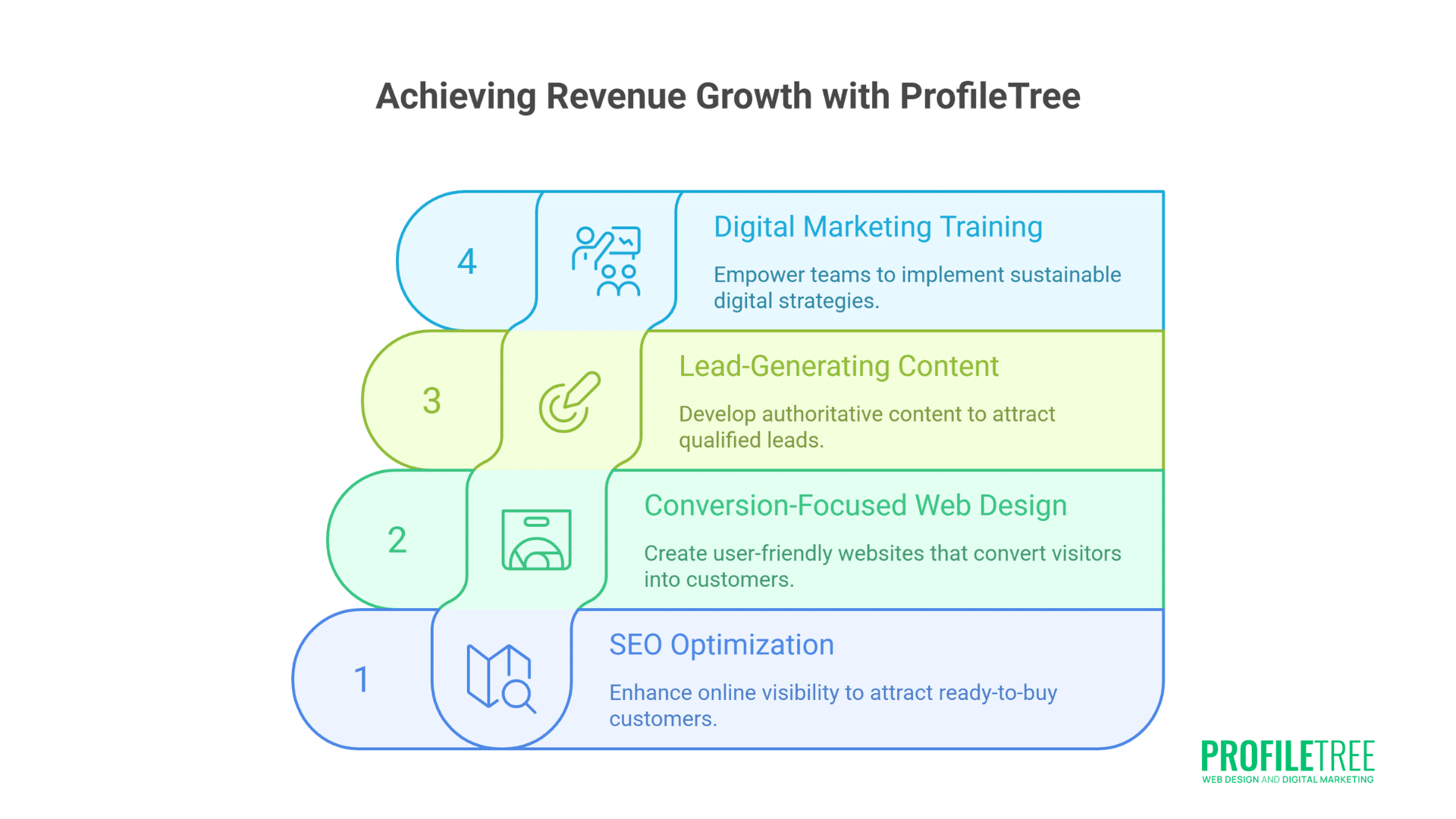
At ProfileTree, we specialise in transforming small business revenue through strategic digital marketing solutions tailored to your specific business goals:
SEO and Local SEO
Our SEO specialists develop strategies that put your business in front of ready-to-buy customers. By optimising your digital presence for local search, we help businesses across Northern Ireland, Ireland, and the UK capture high-intent traffic that converts to revenue.
Web Design Focused on Conversion
Our web design approach goes beyond aesthetics. We build websites specifically engineered to convert visitors into paying customers by creating user journeys that guide prospects through your sales funnel.
Content Marketing That Generates Leads
Our content specialists develop authoritative, engaging content that establishes your business as a trusted industry voice while attracting qualified leads through organic search.
Digital Marketing Training
We provide hands-on training that empowers your team to implement revenue-generating digital strategies independently, creating sustainable growth capabilities within your organisation.
Take Action for Revenue Growth
The statistics paint a clear picture: small businesses that embrace strategic digital marketing consistently outperform those relying solely on traditional approaches. With the right digital partner, your business can exceed industry revenue averages and build sustainable growth.
Ready to transform your business revenue through proven digital strategies? Contact ProfileTree today for a personalised digital growth assessment and discover how our tailored digital marketing solutions can help your business thrive in today’s competitive marketplace.