
Serverless Architecture: Affordable Edge for UK SME Web Development
Table of Contents
Small and Medium-sized Enterprises across the UK face mounting pressure to establish a strong digital presence without breaking the bank. Traditional web development approaches often trap businesses into expensive hosting contracts, ongoing maintenance costs, and the constant fear of traffic spikes crushing their servers. Modern serverless architecture offers a revolutionary solution that aligns perfectly with SME budgets and growth patterns.
For UK businesses seeking cost-effective web solutions, serverless architecture eliminates upfront infrastructure investments and transforms fixed hosting costs into variable expenses that scale with actual usage. This paradigm shift has helped Northern Ireland businesses reduce their web hosting expenses by up to 70% compared to traditional server-based approaches.
ProfileTree has witnessed how businesses across Belfast and beyond transform their digital operations through strategic technology choices. Our 15 years of developing high-performance websites and managing WordPress hosting solutions provide insight into web infrastructure decisions that impact business success. The key lies in understanding how to leverage these modern technologies without getting lost in technical complexity.
Ready to explore if serverless architecture could transform your web development costs? Let’s get started.
Why Serverless Matters for UK SME Web Budgets

UK small businesses struggle with predicting and managing web infrastructure costs. Traditional hosting requires upfront commitments to server capacity that may never be fully utilised, yet businesses must pay regardless of actual usage.
Eliminating Upfront Infrastructure Costs
Serverless architecture operates on a functions-as-a-service model where cloud providers manage all underlying infrastructure, delivering immediate financial benefits:
- Capital Expenditure Reduction: No server purchases, hosting deposits, or long-term contracts required. Businesses can launch web applications with minimal initial investment.
- Operational Efficiency: Development teams focus on creating features rather than managing servers. A typical UK SME can redirect 15-20 hours per week from infrastructure management to revenue-generating activities.
- Predictable Scaling: Automatic resource allocation prevents over-provisioning whilst maintaining performance during traffic spikes.
Consider a Belfast-based e-commerce startup that traditionally would allocate £800-£1,200 monthly for dedicated hosting. With serverless architecture, the same business pays approximately £50-£150 during normal periods, scaling to £300-£400 only during peak seasonal demand.
Pay-Per-Execution Cost Structure
The pay-per-use billing model represents a fundamental shift from fixed to variable costs, directly benefiting businesses with fluctuating demand patterns.
- Usage-Based Billing: Pay only when functions execute, eliminating idle server costs during low-traffic periods. This proves especially valuable for businesses with distinct peak and off-peak patterns.
- Granular Cost Control: Monitor expenses at the function level, identifying optimisation opportunities within specific application components. This granular visibility enables precise budget management, crucial for SME success.
- Automatic Scaling: Cloud providers handle traffic variations without manual intervention or capacity planning, addressing the operational challenges facing smaller technical teams.
This model particularly benefits businesses with variable traffic patterns. A Leicester digital marketing agency reported 60% cost savings by migrating client websites to serverless infrastructure, paying minimal amounts during off-peak hours while maintaining full performance during campaign launches.
Understanding these concepts helps business leaders make informed technology decisions, whether optimising existing WordPress solutions or working with appropriate technology partners for more complex implementations.
Accelerated Development Cycles
Serverless architecture streamlines development processes by removing infrastructure complexity from the development workflow.
- Rapid Deployment: Functions deploy in seconds rather than hours required for traditional server setup, enabling faster response to market opportunities.
- Simplified Testing: Isolated functions enable focused testing without full infrastructure provisioning, reducing development overhead for smaller teams.
- Version Management: Easy rollbacks and A/B testing without server downtime, which is crucial for maintaining service continuity during updates.
“Modern hosting architectures represent more than cost optimisation—they enable business agility and competitive positioning that traditional approaches simply cannot match,” notes Ciaran Connolly, Director of ProfileTree. “Our experience helping Belfast and UK businesses optimise their digital presence shows that understanding these principles, even without immediate implementation, creates better decision-making around hosting, development, and digital strategy.”
Understanding Modern Web Architecture
While ProfileTree specialises in WordPress hosting and web development services, understanding emerging technologies like serverless architecture helps business leaders make informed digital strategy decisions.
How Traditional Hosting Compares to Serverless Solutions
Our managed WordPress hosting packages demonstrate proven reliability standards that any web infrastructure should meet. Our £35/month hosting solutions provide daily secure backups, security monitoring, and 24/7 uptime monitoring—benchmarks for evaluating whether alternative approaches offer genuine advantages.
WordPress Hosting Strengths: Traditional managed hosting provides predictable costs, familiar management interfaces, and established security protocols. For many UK businesses, optimised WordPress hosting delivers the required performance and reliability without additional complexity.
When Serverless Might Apply: Businesses with highly variable traffic patterns, specific scalability requirements, or development teams comfortable with cloud-native approaches might find serverless architecture beneficial.
Making Informed Decisions: Understanding both approaches helps business leaders have productive discussions with technology consultants and make decisions aligned with their specific requirements and capabilities.
Need reliable WordPress hosting that performs? Contact our Belfast team to learn how our proven hosting solutions support UK businesses with consistent performance.
Real UK Savings: Serverless Case Studies
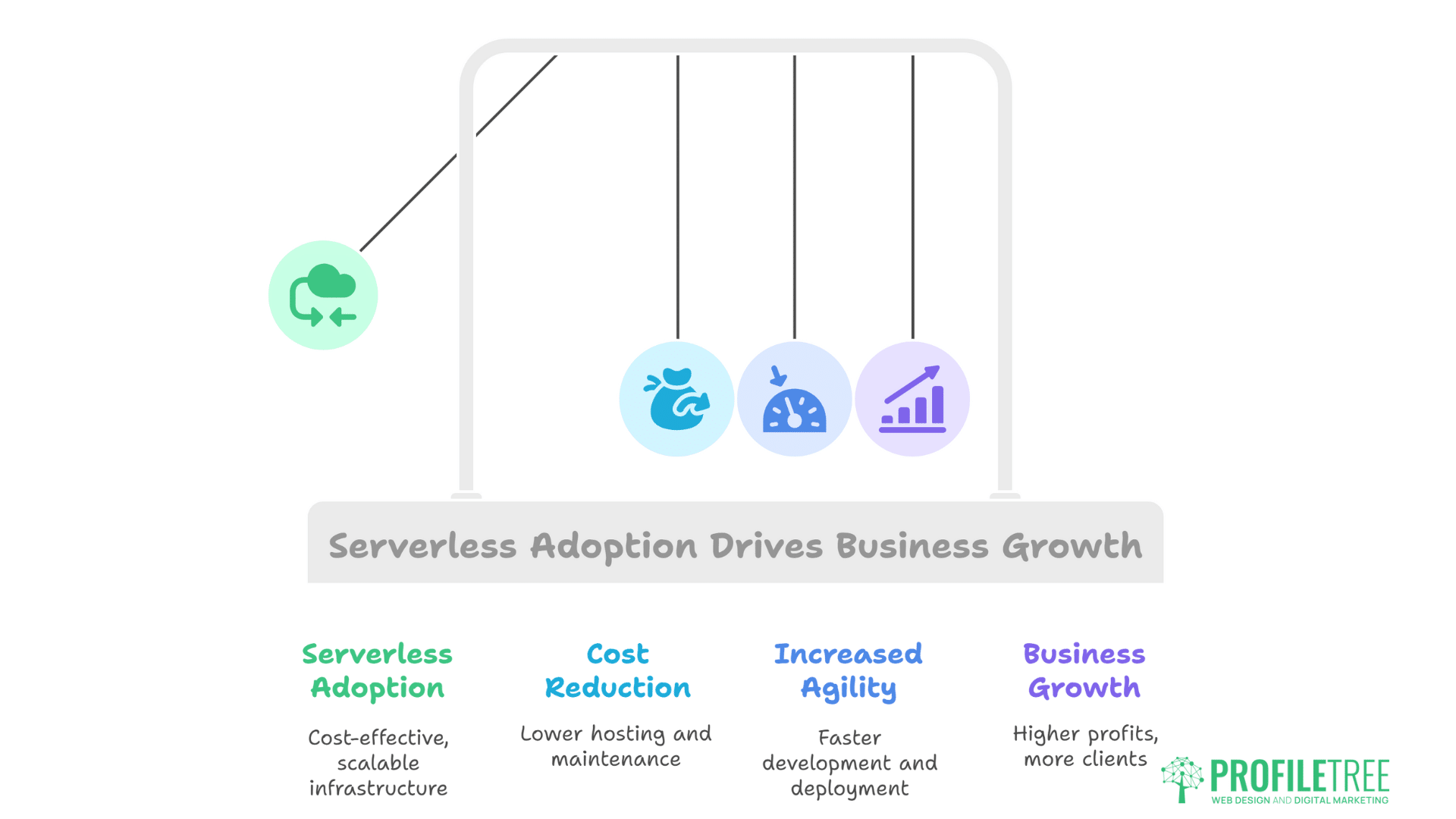
Understanding theoretical benefits differs significantly from witnessing real-world implementation results. UK businesses across various sectors have documented substantial cost reductions through strategic serverless adoption, with particularly compelling results emerging from Northern Ireland’s diverse business ecosystem.
E-commerce Platform: Seasonal Scaling Success
A Belfast-based fashion retailer, specialising in traditional Irish textiles for both local and international markets, faced the classic e-commerce challenge: massive traffic spikes during sales events and seasonal peaks, followed by extended quiet periods. Their traditional hosting solution required maintaining expensive server capacity year-round to handle peak loads, particularly challenging given the seasonal nature of Northern Ireland’s tourism industry.
- Previous Infrastructure Costs: £1,500 monthly for dedicated servers capable of handling peak tourist season traffic, resulting in significant over-provisioning for eight months annually when tourism drops significantly.
- Serverless Transformation: Migration to AWS Lambda and API Gateway reduced baseline costs to £80-£120 monthly, scaling to £400-£600 only during peak events such as St. Patrick’s Day promotions and summer tourism peaks.
- Annual Savings: £12,000+ reduction in hosting costs whilst improving site performance during high-traffic periods, crucial for competing with larger retailers during peak seasons.
The business reinvested these savings into digital marketing campaigns targeting diaspora communities and international tourists, directly contributing to 35% revenue growth over the following year.
SaaS Startup: Agile Development Advantage
A Derry-based software startup developing customer relationship management tools specifically for Northern Ireland’s manufacturing sector needed infrastructure that could support rapid feature iteration without prohibitive costs. The company’s focus on local manufacturing challenges required frequent updates and customisations.
- Development Velocity: Serverless functions enabled daily deployments without infrastructure concerns, accelerating feature delivery from monthly to weekly releases.
- Cost Efficiency: Initial monthly infrastructure costs of £300-£500 dropped to £45-£90 during early development phases, scaling proportionally with customer adoption.
- Market Responsiveness: Ability to test new features with minimal cost exposure enabled rapid market validation and pivoting.
This approach allowed the startup to extend their runway by eight months whilst developing a more competitive product offering.
Digital Agency: Client Project Efficiency
A Lisburn-based digital agency specialising in websites for Northern Ireland’s hospitality and tourism sectors needed cost-effective hosting solutions that wouldn’t erode project margins whilst maintaining the performance standards expected by tourism businesses competing for international visitors.
- Project Economics: Traditional hosting added £100-£200 monthly per client project, significantly impacting profitability for smaller hospitality businesses.
- Serverless Implementation: Migration to serverless architecture reduced per-project hosting costs to £15-£40 monthly whilst improving site performance during peak tourism periods when international visitors research Northern Ireland destinations.
- Business Impact: 70% reduction in hosting costs enabled more competitive pricing and higher profit margins, resulting in a 40% increase in project acquisition from local tourism businesses.
The agency now offers performance-optimised web solutions that appeal directly to cost-conscious hospitality SMEs whilst maintaining the professional quality standards expected by international tourists researching Northern Ireland destinations.
Choosing the Right Tools for Your UK SME
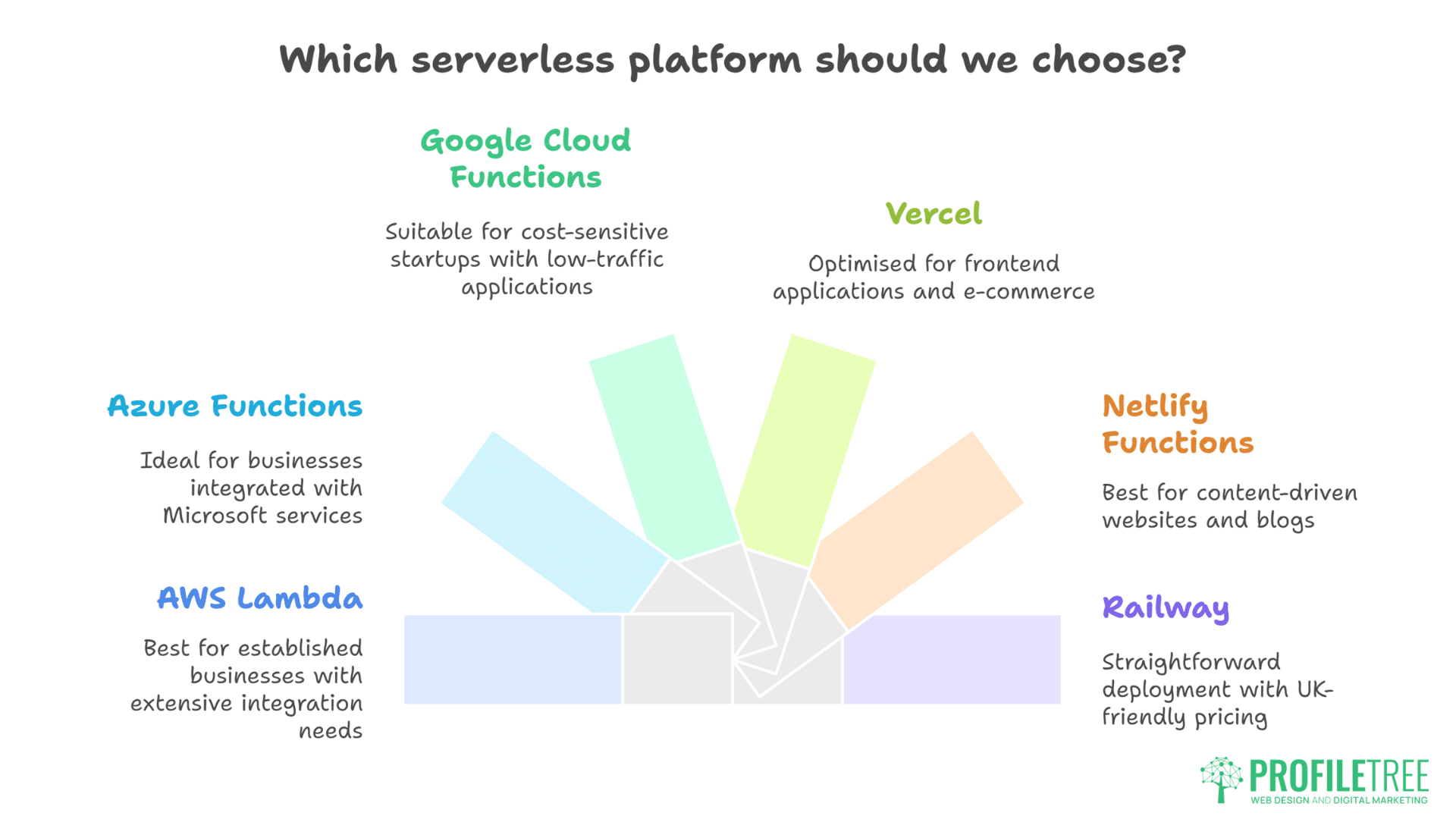
Selecting appropriate serverless platforms requires balancing cost considerations with technical requirements and regional compliance needs specific to UK businesses.
Major Cloud Providers Comparison
| Provider | Free Tier | UK Data Centres | SME-Friendly Pricing | Best For |
|---|---|---|---|---|
| AWS Lambda | 1M requests/month | London, Multiple | Pay-per-100ms | Established businesses |
| Azure Functions | 1M requests/month | London, Cardiff | Pay-per-execution | Microsoft ecosystem |
| Google Cloud | 2M requests/month | London | Pay-per-invocation | Cost-sensitive startups |
AWS Lambda:
- Mature ecosystem with extensive integration options.
- Higher learning curve but comprehensive documentation.
- Pricing starts at $0.0000006 per request ($0.60 per 1 million requests) with additional charges for execution time.
Azure Functions:
- Seamless integration with Microsoft services commonly used by UK businesses.
- Competitive pricing with consumption-based billing starting at £0.000016 per execution.
Google Cloud Functions:
- Generous free tier makes it attractive for startups and low-traffic applications.
- Simple pricing model with transparent cost calculation, appealing to SMEs managing tight budgets.
Each platform offers UK data residency options. The choice often depends on existing technology partnerships and specific compliance requirements.
Open-Source and Alternative Solutions
Budget-conscious UK SMEs can explore additional options that provide serverless benefits without major cloud provider complexity:
- Vercel: Optimised for frontend applications with a generous free tier. Particularly suitable for marketing websites and e-commerce frontends.
- Netlify Functions: Integrated with static site hosting, ideal for content-driven websites and blogs.
- Railway: UK-friendly pricing with straightforward deployment.
These platforms often provide simpler onboarding processes and more predictable pricing structures, making them suitable for businesses new to serverless architecture. For businesses seeking guidance on website development, these alternatives offer fun websites and cool websites functionality without the complexity of major cloud platforms.
Data Residency and UK Compliance
UK businesses must consider specific data protection requirements when selecting serverless platforms:
- GDPR Compliance: All major providers offer UK data centre options with GDPR-compliant data processing agreements.
- Data Sovereignty: Choose providers with a commitment to UK data residency for sensitive business data.
- Financial Services: Additional compliance considerations for businesses handling payment information.
ProfileTree recommends conducting a compliance assessment before platform selection, particularly for businesses in regulated sectors or those handling personal data.
Migration Roadmap for UK SMEs
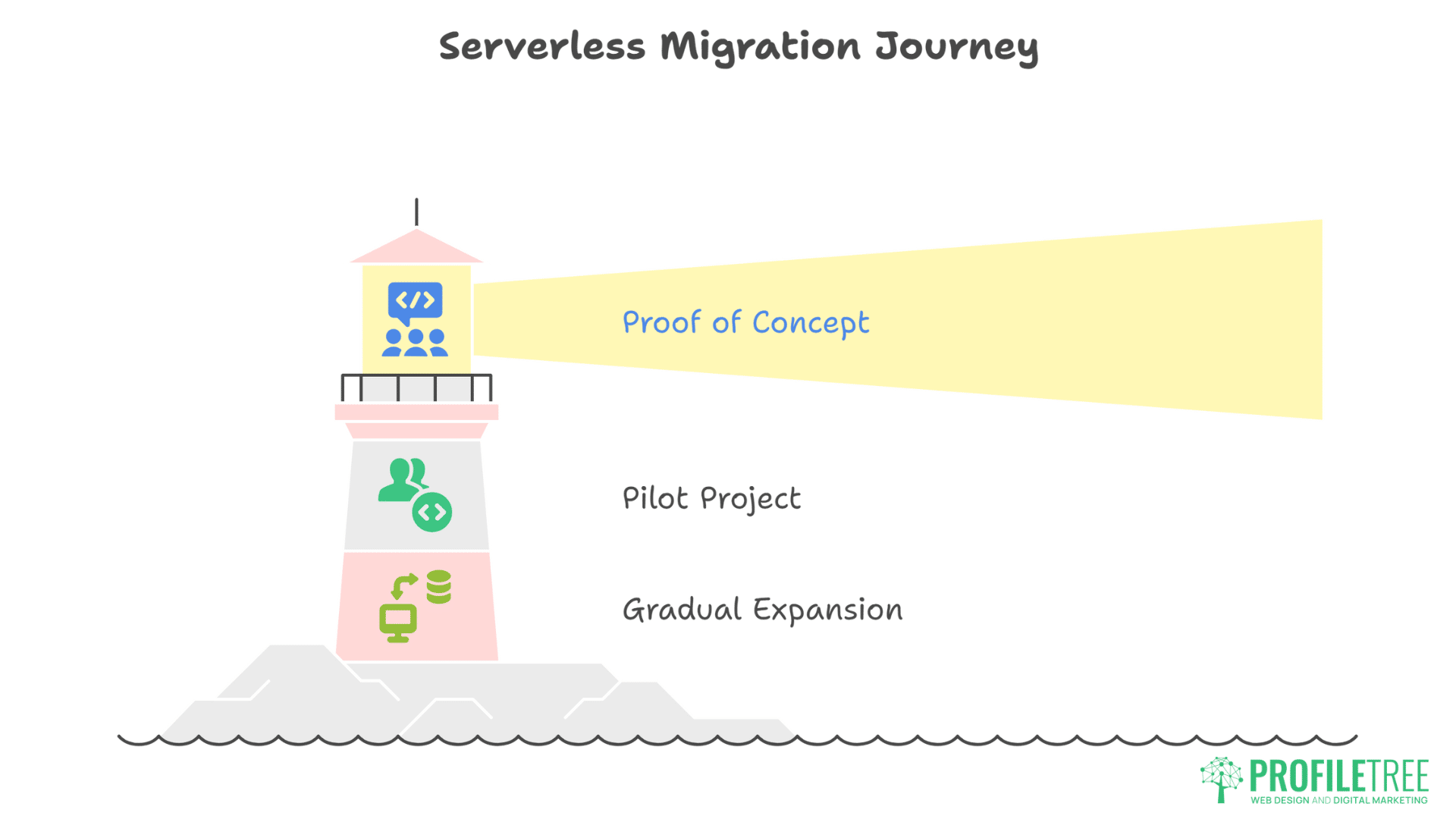
Successful serverless adoption requires a structured approach that minimises risk whilst maximising benefits. UK businesses benefit from a phased implementation that proves value before full commitment.
Identifying Migration Candidates
Not all application components benefit equally from serverless architecture. Focus initial efforts on high-impact, low-risk opportunities:
- API Endpoints: Customer data retrieval, product catalogues, and contact forms adapt well to serverless functions.
- Background Processing: Email sending, image resizing, and data synchronisation tasks perform excellently as serverless functions.
- Static Content: Marketing websites, landing pages, and documentation sites combine serverless functions with static hosting for optimal cost-performance balance.
- Avoid Initially: Complex applications with long-running processes, legacy databases requiring persistent connections, or applications with strict latency requirements.
Step-by-Step Implementation Strategy
Phase 1: Proof of Concept (Weeks 1-2)
- Select a single, non-critical function for serverless migration
- Implement basic monitoring and cost tracking
- Document performance and cost metrics
Phase 2: Pilot Project (Weeks 3-6)
- Migrate complete but contained functionality
- Establish development and deployment workflows
- Train team members on serverless development practices
Phase 3: Gradual Expansion (Months 2-6)
- Migrate additional functions based on pilot success
- Optimise costs through function-level analysis
- Develop internal expertise and best practices
This phased approach allows UK businesses to build confidence and expertise whilst minimising disruption to existing operations.
Addressing Common UK Business Concerns
- Vendor Lock-in: Use infrastructure-as-code tools and avoid provider-specific features during initial implementation to maintain flexibility.
- Data Security: Implement proper authentication, encryption, and access controls from the beginning rather than retrofitting security measures.
- Skills Gap: Invest in team training or partner with agencies experienced in serverless development for UK businesses.
Many UK SMEs partner with local digital agencies during initial serverless adoption to accelerate implementation whilst building internal capabilities.
Beyond Cost Benefits: Productivity and Scalability
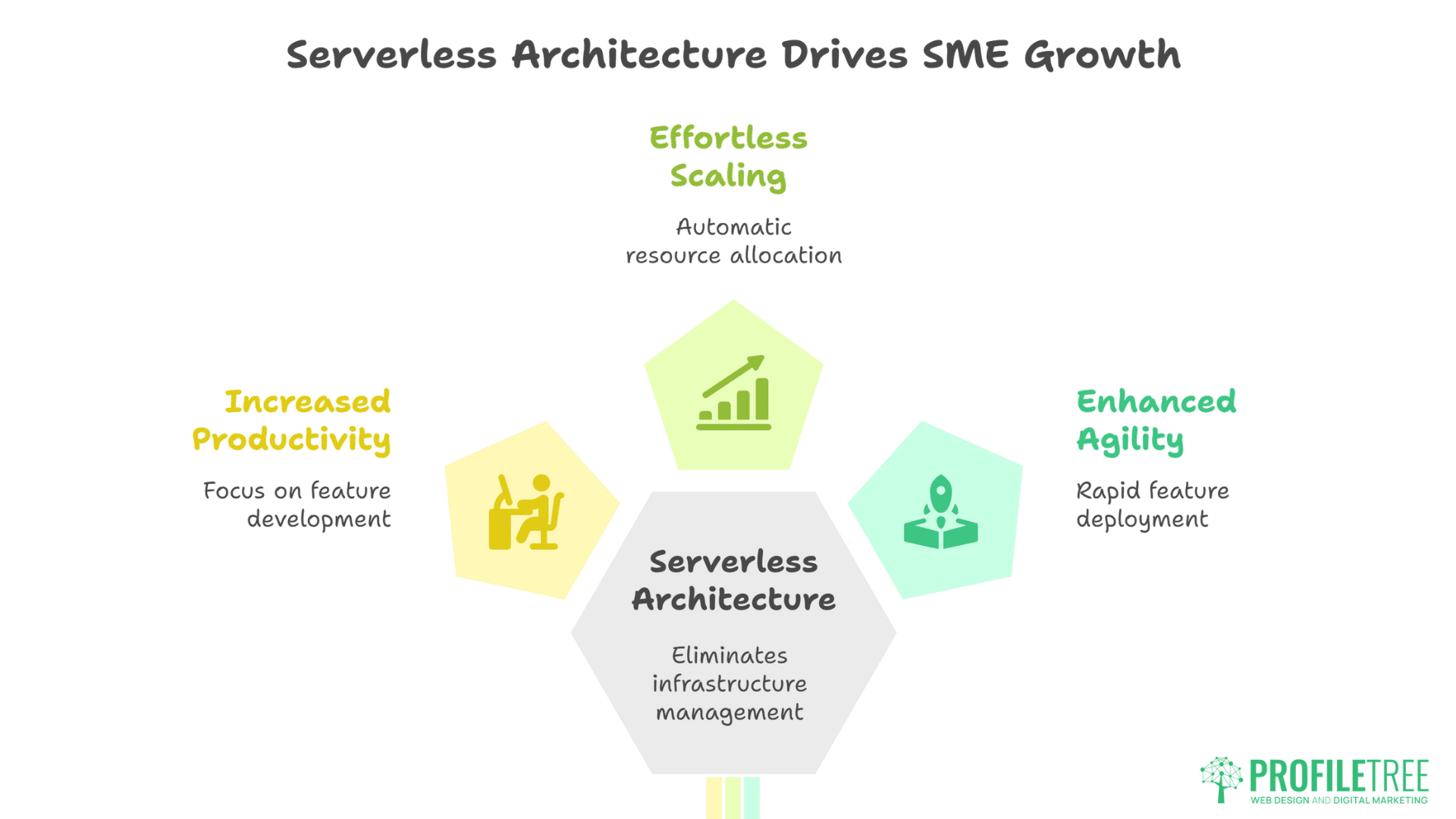
Whilst cost reduction drives initial interest in serverless architecture, UK SMEs discover additional operational benefits that support long-term business growth.
Empowering Small Development Teams
Limited technical resources represent a common challenge for UK small businesses. Serverless architecture amplifies team productivity by eliminating infrastructure management overhead:
- Reduced Operational Burden: Developers focus on feature development rather than server maintenance, monitoring, and security updates.
- Simplified Deployment: Automated scaling and load balancing reduce deployment complexity.
- Enhanced Reliability: Cloud provider infrastructure management typically exceeds what small teams can achieve independently, providing enterprise-grade reliability without enterprise costs.
A Liverpool-based fintech startup reported a 40% increase in feature delivery velocity after migrating to serverless architecture.
Effortless Scaling for Growth
Business growth often strains existing infrastructure, forcing expensive upgrades or service disruptions that can damage customer relationships. Serverless architecture provides seamless scaling that grows with business success:
- Automatic Capacity Management: Traffic increases trigger automatic resource allocation without manual intervention or advance planning.
- Performance Consistency: Maintained response times during traffic spikes prevent customer dissatisfaction.
- Cost Proportionality: Infrastructure expenses increase proportionally with business success rather than requiring large upfront investments.
The UK businesses report particular satisfaction with serverless architecture during unexpected viral marketing campaigns or seasonal demand spikes that would previously overwhelm traditional hosting solutions, such as during major sporting events or cultural celebrations that attract international attention.
Enhanced Development Agility
Modern business environments require rapid response to market opportunities. Serverless architecture supports agile development practices essential for competitive success:
- Rapid Prototyping: New features and experiments deploy quickly without infrastructure provisioning delays, enabling faster response to changing market conditions.
- A/B Testing: Easy function versioning enables sophisticated testing strategies without complex server configurations.
- Global Distribution: Content delivery network integration provides worldwide performance optimisation.
Practical Implementation for UK Web Development
Understanding serverless benefits differs from successful implementation. UK businesses benefit from practical guidance that addresses real-world challenges and opportunities.
WordPress and Serverless Integration
Many UK SMEs use WordPress for content management, and serverless architecture can enhance rather than replace existing WordPress investments:
- Headless WordPress: Use WordPress as a content management system whilst delivering content through serverless functions for improved performance and cost efficiency.
- Plugin Optimisation: Replace resource-intensive plugins with serverless functions for contact forms, search functionality, and data processing.
- Performance Enhancement: Combine WordPress hosting with serverless CDN and image optimisation for dramatic speed improvements.
This approach allows businesses to maintain familiar WordPress workflows while gaining serverless benefits for specific functionality.
Understanding WordPress workflows helps businesses evaluate whether serverless architecture offers genuine advantages for their specific needs. Looking to optimise your WordPress performance? ProfileTree’s web design and development team specialises in WordPress hosting solutions and performance optimisation.
Video Production and Content Delivery
UK businesses increasingly rely on video content for marketing and customer engagement. Serverless architecture provides cost-effective solutions for video-heavy applications:
- Automated Processing: Serverless functions handle video transcoding, thumbnail generation, and format optimisation without dedicated media servers.
- Efficient Distribution: Global content delivery networks integrated with serverless functions provide fast video delivery worldwide.
- Dynamic Optimisation: Automatic video quality adjustment based on user connection and device capabilities improves user experience whilst reducing bandwidth costs.
ProfileTree has provided hosting and digital strategy guidance for UK businesses, helping them make informed technology decisions. Transform your video marketing strategy with expert guidance? Our video production and YouTube strategy services help you create powerful, cost-effective content campaigns.
SEO and Performance Optimisation
Search engine optimisation benefits significantly from serverless architecture implementation:
- Improved Core Web Vitals: Faster response times and reduced server response delays positively impact Google search rankings.
- Global Performance: Content delivery network (CDN) integration improves website speed for international audiences.
- Reliability Benefits: Higher uptime and better performance during traffic spikes support SEO rankings and user experience.
UK businesses report measurable SEO improvements within 3 to 6 months of serverless migration, with particular benefits for mobile search performance.
Advanced Considerations for Growing Businesses
As UK SMEs mature and expand their digital operations, serverless architecture provides a foundation for sophisticated capabilities that support continued growth.
AI Integration and Automation
Serverless architecture provides an ideal platform for AI implementation that many UK SMEs find prohibitively expensive with traditional infrastructure:
- Machine Learning Models: Deploy AI-powered features like chatbots, recommendation engines, and automated content analysis without expensive GPU servers.
- Data Processing: Handle customer data analysis, business intelligence, and automated reporting through scalable serverless functions.
- Integration Flexibility: Connect AI services with existing business systems through lightweight serverless interfaces.
This approach enables UK SMEs to compete with larger organisations by accessing advanced capabilities without enterprise-level infrastructure investments.
Ready to explore AI capabilities for your business? Our comprehensive AI training programmes help UK business leaders understand practical AI applications whilst developing strategic implementation approaches.
Strategic Planning and Future Readiness
Successful technology adoption requires strategic planning that aligns technology choices with business objectives and growth plans.
- Assessment Phase: Evaluate current infrastructure costs, performance bottlenecks, and scalability requirements. This includes understanding which programming language is used in website development to plan appropriate technology strategies.
- Priority Setting: Identify high-impact opportunities for serverless implementation based on cost savings potential and technical feasibility.
- Implementation Planning: Develop realistic timelines and resource allocation for technology projects.
This structured approach prevents costly mistakes while ensuring maximum benefit. Planning for digital transformation? Our digital strategy and training consultancy helps UK businesses understand emerging technologies and develop strategic approaches aligned with business growth objectives.
Conclusion: Your Path to Affordable Web Development Success
Serverless architecture represents more than a technical upgrade; it provides a strategic advantage that enables UK SMEs to compete effectively in digital markets without the need for enterprise-level infrastructure budgets. The combination of reduced costs, improved performance, and enhanced scalability creates a compelling value proposition for businesses serious about digital growth.
Success requires thoughtful planning, phased implementation, and commitment to developing internal capabilities or strategic partnerships with experienced agencies. UK businesses that embrace serverless architecture position themselves for sustained competitive advantage while maintaining cost efficiency essential for long-term success.
The question facing UK SMEs is not whether serverless architecture will transform web development, but how quickly businesses can adapt to capture available advantages. Those who act decisively will establish significant competitive advantages while their competitors struggle with traditional infrastructure limitations.
Consider conducting a serverless readiness assessment for your business to identify immediate opportunities and develop an implementation roadmap that aligns with your growth objectives. The transformation to cost-effective, scalable web development begins with understanding how serverless architecture applies to your specific business requirements.
Frequently Asked Questions
How much can UK SMEs realistically save with serverless architecture?
Cost savings typically range from 40-70% compared to traditional hosting, with actual savings dependent on traffic patterns and current infrastructure costs. Businesses with variable traffic see the highest savings.
What programming languages work best for serverless development?
Most serverless platforms support JavaScript/Node.js, Python, Java, and C#. JavaScript and Python offer the best combination of performance and development speed for UK SMEs. Understanding how to check the programming language of a website helps determine the complexity of serverless migration projects.
How do I ensure data compliance when using serverless platforms?
Choose cloud providers with UK data centres and GDPR compliance certifications. Implement proper data encryption and access controls from the beginning rather than retrofitting security measures. Professional guidance on legal and ethical issues in digital marketing can help navigate compliance requirements.
Can existing WordPress websites benefit from serverless architecture?
Yes, through headless WordPress implementation, serverless plugin replacement, and CDN integration. This approach maintains WordPress familiarity while gaining performance and cost benefits. Many programming languages used in the most popular websites can be adapted for serverless implementation.
What happens if my serverless provider experiences downtime?
Major cloud providers offer 99.9%+ uptime guarantees with automatic failover capabilities. Multi-region deployment strategies can further reduce downtime risk for critical applications.
How do I monitor and optimise serverless costs?
Use built-in cloud provider monitoring tools to track function-level costs and performance. Implement automated alerts for unusual spending patterns and regular cost optimisation reviews.