
Content Delivery Networks: The Definitive Guide for UK Businesses
Table of Contents
A content delivery network is no longer a luxury reserved for global enterprises. For any UK or Irish business that relies on a website to attract customers, generate leads, or sell products, CDN implementation has become a foundational element of modern web infrastructure as essential as hosting itself.
This guide explains how content delivery networks work, why they matter for performance and security, and how to choose and configure one for your business with a specific focus on the realities of operating in the UK and Ireland.
What Is a Content Delivery Network and How Does It Work?

Understanding what a CDN does and why it matters is the first step towards making an informed decision for your website.
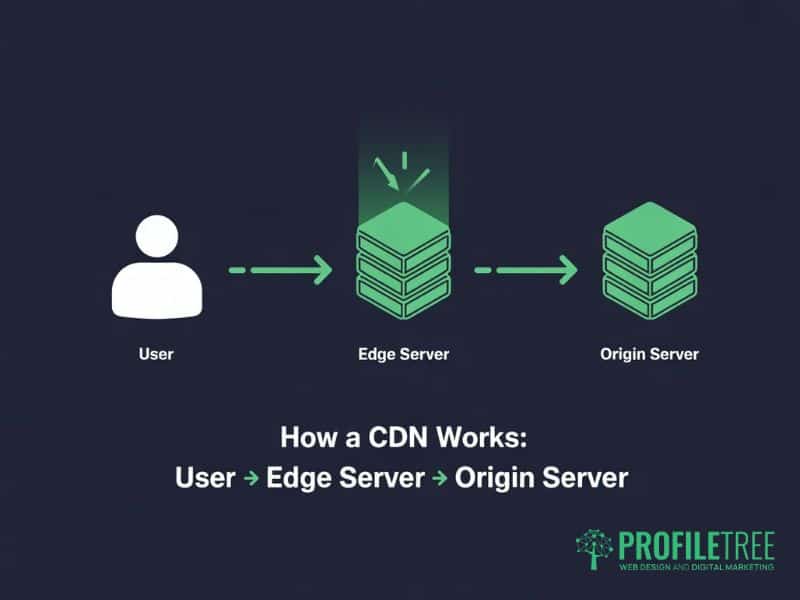
A content delivery network is a globally distributed system of servers designed to deliver web content to users from the location closest to them. Rather than every visitor to your site fetching files from a single origin server in one data centre, a CDN caches and serves that content from an edge server near the user, dramatically reducing the distance data must travel.
Origin Servers, Points of Presence, and Edge Servers
Three components sit at the heart of every content delivery network:
The origin server is your primary web server, the master copy of your website. Without a CDN, every visitor request goes directly to this server regardless of their location. A user in Dublin loading a site hosted in Manchester still completes the same round trip as a user in Sydney.
Points of Presence (PoPs) are physical data centre locations distributed across the CDN provider’s network. Major providers operate hundreds of PoPs worldwide. For UK and Irish businesses, the most relevant PoPs are typically located in London, Manchester, Dublin, Amsterdam, and Frankfurt.
Edge servers in each PoP store cached copies of your content. When a user requests a page, the CDN’s DNS resolves to the nearest edge server, which delivers the cached content almost instantly without the request ever reaching your origin server.
The Caching Process: How Data Travels
When a new visitor lands on your site via a CDN, the request travels to the nearest edge server. If the content is already cached there, it is delivered immediately. If not a “cache miss”, the edge server fetches the content from the origin server, delivers it to the user, and stores a copy for subsequent requests.
Cache behaviour is controlled by Time-to-Live (TTL) settings. Static assets such as images, CSS files, and JavaScript are typically cached for days or weeks. Dynamic content personalised pages, live feeds, or checkout data uses shorter TTLs or bypasses the cache entirely, depending on configuration.
Why Your Website Needs a CDN
The business case for CDN integration extends well beyond raw speed. A properly implemented CDN affects revenue, security, and your ability to compete online.
Reducing Latency and Improving Load Times
Page speed is directly tied to commercial outcomes. Research consistently shows that a one-second delay in load time can reduce conversion rates significantly, and this effect compounds for mobile users, who now account for the majority of web traffic in the UK and Ireland.
A CDN reduces latency by eliminating the round-trip distance between the user and the server. For a business targeting customers across the UK, Northern Ireland, and the Republic of Ireland, having edge servers in both London and Dublin means your content loads quickly regardless of which side of the border a user is on.
CDN implementation also benefits Core Web Vitals, Google’s performance metrics that directly influence search rankings. Improvements in Largest Contentful Paint (LCP) and First Input Delay (FID) are among the most measurable outcomes of a properly configured CDN.
Security: DDoS Protection and WAF Integration
Modern CDNs provide a critical layer of cybersecurity. In 2025, a CDN is not simply an optional performance upgrade; it is one of the most practical tools available for protecting a business website from attack.
Distributed Denial of Service (DDoS) attacks work by flooding a server with traffic until it becomes inaccessible. A CDN absorbs this traffic across its distributed network of servers, preventing any single point from being overwhelmed. For an SME without a dedicated infrastructure team, this kind of protection, which would otherwise require significant investment, is included as standard with most CDN providers.
Many CDN providers also offer Web Application Firewall (WAF) integration, filtering malicious requests before they reach your origin server. When combined with SSL/TLS encryption, which all reputable CDNs support, this creates a robust security architecture suited to businesses handling user data or processing transactions online.
Our website security and performance optimisation services can help you identify the right CDN configuration for your risk profile and technical setup.
Bandwidth Savings and Cost Efficiency
Because a CDN serves the majority of requests from cached edge servers rather than your origin, the load on your primary hosting infrastructure drops considerably. This can reduce bandwidth costs, delay the need to upgrade hosting plans, and protect against unexpected bills during traffic spikes.
For small and medium-sized businesses in Northern Ireland and Ireland competing in markets previously dominated by larger corporations, CDN deployment offers a level of performance and resilience that was historically out of reach.
The UK and Ireland Perspective: Why Geography Still Matters
Most CDN guides treat Europe as a single, uniform region. For UK and Irish businesses, the geographic reality is more nuanced and understanding it can make a meaningful difference to performance.
Local Latency: The London–Manchester–Dublin Triangle
The UK’s internet infrastructure is heavily centralised around London, which hosts LINX (the London Internet Exchange), one of the largest internet peering exchanges in the world. For businesses in Belfast, Edinburgh, or Cork, this creates a latency penalty even before any international distance is factored in.
A well-configured CDN with PoPs in both London and Dublin addresses this directly. Irish traffic resolves to the Dublin edge server; traffic from Northern Ireland, depending on provider and routing, may resolve to either. The practical result is that users across the island of Ireland and across Great Britain receive content from a server within milliseconds of their location, rather than from a distant origin.
For businesses running e-commerce websites or media-heavy platforms where every millisecond counts, this geographic specificity is worth discussing with your CDN provider during configuration.
Compliance: UK GDPR and Data Residency at the Edge
Since Brexit, UK businesses must comply with UK GDPR, a near-mirror of EU GDPR but administered separately by the Information Commissioner’s Office. For businesses operating across both jurisdictions, compliance requires careful consideration of where data is processed and stored.
CDNs introduce a compliance complexity that many US-authored guides simply overlook. When a CDN edge server in Frankfurt or Amsterdam handles a request from an Irish user, personal data, including IP addresses and session data, is technically processed in an EU jurisdiction. When a CDN routes a UK user’s request to a server in the US, different adequacy provisions apply.
For IT decision-makers and compliance leads, the key questions to ask any CDN provider are: which data residency options are available, can you restrict processing to UK or EEA servers, and what data processing agreements (DPAs) are in place?
Providers such as Cloudflare and Akamai offer data localisation options at higher tiers. For businesses handling sensitive personal data, such as healthcare, financial services, and legal, these controls are not optional; they are a compliance requirement.
CDN vs Related Technologies
CDNs are often confused with other infrastructure tools. Understanding the distinctions helps you make more informed decisions about your overall web stack.
CDN vs Web Hosting: What Is the Difference?
Your web host stores the master, authoritative version of your website on an origin server. When someone visits your site, their browser fetches files from that server. Hosting determines what your website contains; a CDN determines how efficiently it is delivered.
Think of hosting as a warehouse and a CDN as a distribution network. The warehouse holds the stock; the distribution network ensures it reaches customers quickly, regardless of location. You need both a CDN and quality hosting at the origin; without it, you’ll still be limited by the performance and reliability of that underlying infrastructure.
CDN vs VPN: Clearing the Confusion
A Virtual Private Network (VPN) encrypts a user’s internet connection and masks their IP address, protecting their identity and privacy while browsing. It is a tool for individual users, not for website owners.
A CDN is deployed by the website owner to improve performance and security for all visitors. It has no bearing on a user’s privacy or location as perceived by other services. The two technologies serve entirely different purposes and are not interchangeable.
Choosing and Implementing a CDN
With a clear understanding of what a CDN does and why it matters, the practical question becomes how to select and deploy one effectively.
Key Features to Look For
Not all CDN providers are built for the same audience. Enterprise platforms such as Akamai are designed for organisations with large infrastructure teams and the budget to match. For most UK and Irish SMEs, mid-market and plugin-based options offer a better balance of capability and accessibility.
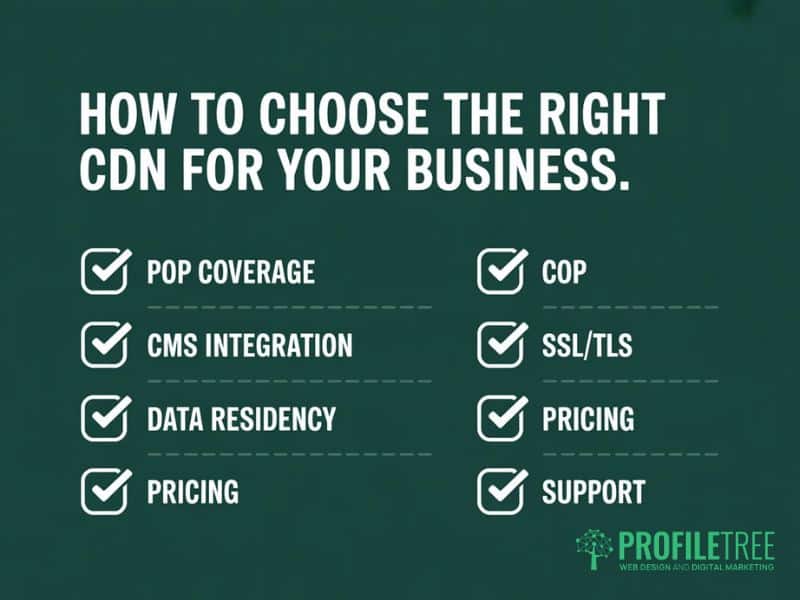
When evaluating CDN providers, prioritise the following:
PoP coverage in the UK and Ireland. Confirm that the provider has edge servers in London and Dublin at a minimum. Many providers list hundreds of global PoPs but have sparse coverage in the regions that matter most to your users.
Ease of integration with your CMS. For WordPress-based websites, which account for a substantial share of the UK SME market, CDN providers with native plugin support (such as Cloudflare’s WordPress plugin or WP Rocket’s CDN integration) significantly simplify deployment.
SSL/TLS included as standard. Any reputable CDN provider should offer HTTPS delivery without additional cost. Avoid providers that treat this as an add-on.
Data residency controls. As discussed above, this is a compliance consideration for any business handling personal data under UK GDPR.
Transparent pricing. Bandwidth-based pricing models can produce unexpected costs during traffic spikes. Look for providers that offer predictable flat-rate plans for SME-scale traffic volumes.
Implementation Checklist: From DNS to Deployment
CDN implementation typically follows a structured sequence regardless of provider:
- Audit your current performance. Use tools such as Google PageSpeed Insights or GTmetrix to establish a baseline. Identify which assets (images, scripts, stylesheets) are the largest contributors to load time.
- Select a CDN provider based on the criteria above, your budget, and your compliance requirements.
- Update your DNS settings. Changing your domain’s CNAME record to point to the CDN is the core technical step. Your registrar or hosting provider can assist if needed.
- Configure cache rules. Define TTL values for different content types. Static assets can be cached aggressively; dynamic pages require shorter TTLs or cache exclusions.
- Enable SSL/TLS. Ensure HTTPS is active across all CDN-delivered URLs. Check that mixed-content warnings are resolved.
- Test before going live. Use your CDN provider’s staging tools to verify that cached content is being served correctly from edge locations.
- Monitor performance post-deployment. Review speed metrics and CDN analytics in the first week to identify any configuration issues.
For businesses whose websites are managed by an agency, CDN management can often be handled as part of a broader website management and hosting package, removing the need for in-house technical expertise.
Sustainability and the Green CDN
One angle that rarely appears in content delivery network guides but is increasingly relevant for UK businesses is the environmental impact of content delivery infrastructure.
The internet accounts for a significant share of global energy consumption, and content delivery is a major contributor. Every time a web page loads, data travels through servers, switches, and cables, all of which consume electricity.
A CDN reduces the total energy consumed per page load in two ways. First, by caching content at edge servers, it eliminates redundant round-trip to distant origin servers. A request resolved locally consumes far less energy than one that travels transatlantically. Second, by reducing bandwidth consumption at the origin, CDNs lower the load on data centres, many of which still rely on carbon-intensive energy sources.
For UK businesses operating under ESG commitments or working towards Net Zero targets, choosing a CDN provider with a credible sustainability programme is a meaningful consideration. Several major providers, including Cloudflare and Fastly, publish information about their renewable energy usage and carbon offset commitments. This is worth verifying independently against current disclosures before including it in your own sustainability reporting.
CDN Performance Monitoring
Deploying a content delivery network is not a set-and-forget task. Ongoing monitoring ensures the configuration remains effective as your site evolves and your traffic patterns change.
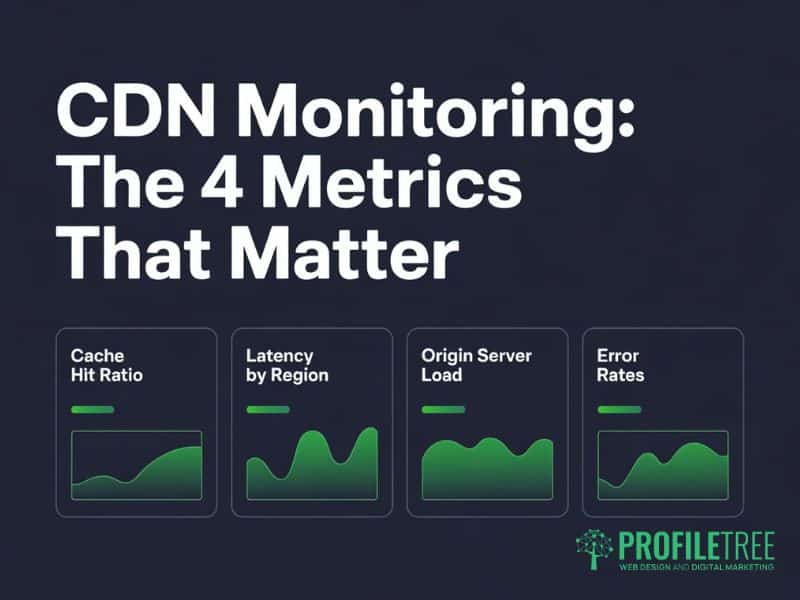
The key metrics to track are:
Cache hit ratio. This measures the percentage of requests served from cache rather than your origin server. A healthy CDN configuration typically achieves a cache hit ratio above 80–90% for static assets. A low ratio suggests that cache rules are too restrictive or that TTL values need adjustment.
Latency by region. Most CDN providers offer dashboards showing response times from different geographic locations. For UK and Irish businesses, latency to users in London, Dublin, Belfast, and Edinburgh should be consistently low.
Origin server load. Monitor your hosting infrastructure’s CPU and bandwidth usage after CDN deployment. A significant reduction confirms that the CDN is absorbing traffic as intended.
Error rates. Track 4xx and 5xx errors to identify any configuration issues introduced by CDN deployment, particularly around cache rules for authenticated or dynamic pages.
Regular performance reviews, monthly at a minimum, allow you to fine-tune your content delivery network implementation in line with changes to your website’s content, structure, and traffic profile.
FAQs
1. Do I need a CDN if all my customers are in the UK?
Yes. Even for businesses with an entirely UK-based audience, CDN implementation delivers meaningful benefits. A CDN provides redundancy if your origin server experiences an outage; cached content can continue to be served from edge locations. It also provides protection against DDoS attacks, improves load times for users in different regions of the UK, and helps your site handle traffic spikes without degrading performance.
2. What is the difference between a CDN and web hosting?
Web hosting stores the master copy of your website on an origin server. A CDN distributes cached copies of your content to edge servers worldwide, serving users from the closest available location. You need both: hosting provides the foundation; a CDN optimises delivery. Many hosting providers now offer bundled CDN options, though standalone CDN services typically offer more configuration flexibility.
3. Does a CDN improve SEO?
Yes, indirectly but meaningfully. CDN deployment improves page load times and Core Web Vitals scores, both of which are factors in Google’s ranking algorithm. Faster sites tend to have lower bounce rates, higher engagement metrics, and better crawlability. For competitive keywords, the performance advantage provided by a CDN can contribute to ranking improvements over time.
4. How much does a CDN cost for a UK small business?
Costs vary significantly by provider and usage. Entry-level options such as Cloudflare’s free tier or Jetpack for WordPress are available at no cost and provide meaningful performance and security improvements for low-traffic sites. Mid-market plans typically range from £15 to £80 per month. Enterprise-grade managed CDN services are priced at several hundred pounds per month upwards. For most SMEs, a mid-market plan provides the best balance of features and value.
5. Can a CDN help with GDPR compliance?
Yes, if configured correctly. Choosing a CDN provider with data residency options allows you to restrict where user data is processed and stored, keeping it within the UK or EEA as required by UK GDPR or EU GDPR, respectively. Ensure that a Data Processing Agreement (DPA) is in place with your CDN provider, as they will be processing personal data (including IP addresses) on your behalf. Review your provider’s data localisation documentation carefully, as default configurations may not align with your compliance obligations.