
Content Marketing Strategies That Work for UK and Irish SMEs
Table of Contents
ProfileTree is a Belfast-based web design and digital marketing agency that has worked with SMEs across Northern Ireland, Ireland, and the UK for over a decade. One pattern shows up repeatedly in those client relationships: businesses that invest in content marketing without a clear strategy get little back for their effort.
This guide covers the content marketing strategies with the strongest evidence base for smaller businesses: what works, what wastes budget, and how to build an approach that generates real commercial results without a large in-house team.
What Is a Content Marketing Strategy?
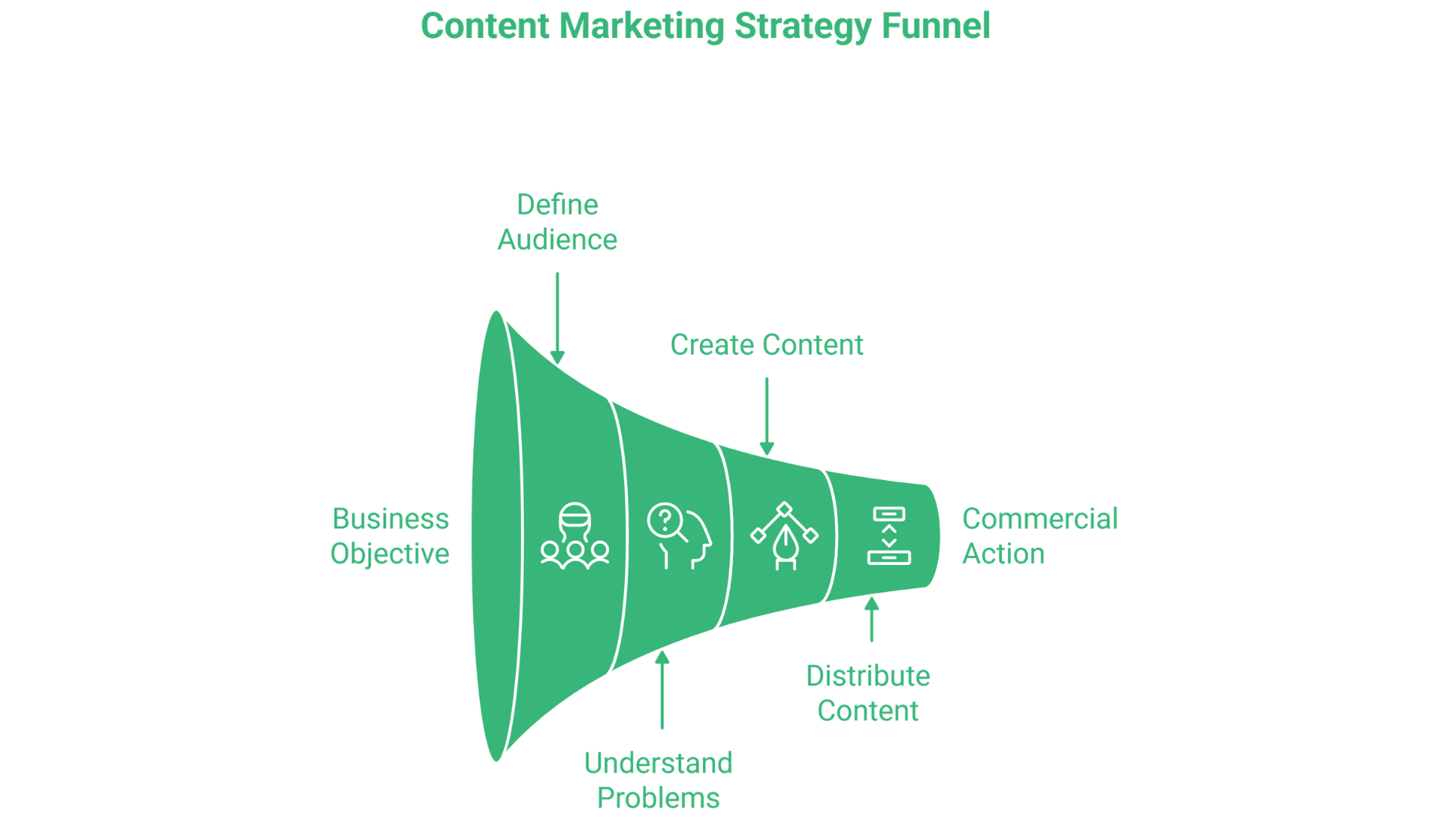
A content marketing strategy is a plan for creating, publishing, and distributing content that attracts a defined audience and moves them towards a commercial action — whether that is making an enquiry, booking a call, or buying a product. It is the “why, who, and what” behind every piece of content you produce.
The distinction matters. Content marketing itself is the execution: the blogs, videos, emails, and social posts. The strategy is what ties those outputs to a business objective. Without it, content activity tends to be inconsistent, unmeasured, and disconnected from the services or products you actually sell.
For SMEs, a useful content marketing strategy does not need to be complicated. It needs to answer four questions clearly: who are you trying to reach, what problems do they have, what content will help them, and how will that content find its way in front of them.
The 4 Pillars of a Content Marketing Strategy
Before looking at specific tactics, it helps to understand the structure that sits underneath every effective content marketing approach. These four pillars apply whether you are a sole trader in Belfast or a 50-person business serving clients across the UK.
Strategy is the foundation: your goals, your audience, and the commercial outcomes you are targeting. Without this, content production becomes an activity for its own sake.
Creation covers what you actually produce and the quality standard you hold it to. One well-researched, genuinely useful article outperforms ten thin posts almost every time. The same principle applies to video, email, and every other format.
Distribution is where most SMEs fall short. Publishing content on your website and waiting for organic traffic is a slow game. Distribution means actively getting content in front of people through email, social channels, paid promotion, and partnerships.
Measurement closes the loop. If you are not tracking which content drives enquiries, you have no basis for deciding what to produce next. The metrics that matter for SMEs are organic traffic, time on page, lead conversions, and cost-per-acquisition — not vanity figures like total social impressions.
Strategy 1: SEO-Driven Blog Content
Search-optimised content is the most reliable long-term content marketing strategy for SMEs. Done well, it brings qualified traffic to your website from people already searching for what you offer, without paying for each click.
The mechanics are straightforward. You identify the questions and topics your target customers are searching for, write content that answers those questions better than existing results, and build a body of work that signals topical authority to search engines.
How to Find the Right Topics
Start with the problems your customers bring to you at the start of a sales conversation. Those questions are almost always searched online by people at the same stage of the buying process.
Google’s People Also Ask boxes and search autocomplete are free starting points for topic research. For a more structured approach, tools like Ubersuggest, Ahrefs, or Google’s own Keyword Planner help identify search volumes and competition levels.
For UK and Irish SMEs, the best opportunities often sit in long-tail keywords with clear commercial intent. These phrases attract fewer visitors than broad terms, but those visitors are usually much further along in their decision-making.
How to Structure Content That Ranks
Search engines favour content that answers a question completely and organises information clearly. In practice, this means starting with the most important point rather than building up to it, using headings that reflect the terms people actually search, and covering the sub-questions that naturally follow the main topic.
Keyword density should feel natural rather than mechanical. For a target phrase like “content marketing strategies”, that means using it in the title, the opening paragraph, and a few natural points throughout, not shoehorning it into every sentence.
Internal links matter too. Articles that connect logically to service pages and related content on your site help search engines understand the structure of your website and pass authority between pages.
Writing for AI Overviews and Answer Engines
Search behaviour has shifted noticeably over the past two years. Google’s AI Overviews now appear above standard organic results for a growing proportion of informational queries, and tools like ChatGPT and Perplexity are increasingly used as first-stop research tools by business buyers.
The practical implication for SMEs is that content structured to answer a specific question clearly and completely — with the answer in the first sentence or two of a section, followed by supporting detail — is more likely to be cited in AI-generated responses than content that buries its point. This is sometimes called Answer Engine Optimisation (AEO), though the underlying principle is simply writing for the reader first and making each section self-contained.
For SMEs, this means prioritising content that directly addresses the questions your customers ask at each stage of the buying process. A page that clearly answers “how much does this cost?” in its opening sentences, then expands with context and examples, serves both the human reader and the AI systems extracting answers from your page.
How to Measure Results
Organic traffic growth is the headline metric, tracked through Google Search Console or Google Analytics. More useful for commercial purposes is tracking which articles lead to contact form submissions or service page visits. If your SEO content generates traffic but no enquiries, the audience it is attracting is probably not your buyer.
Strategy 2: Video Content
Video is the most-consumed content format online, and it performs across multiple channels in ways that written content cannot replicate. For SMEs, it is also more achievable than it looks.
YouTube functions as a search engine in its own right, with users actively searching for tutorials, product demonstrations, and business advice. Short-form video on platforms like LinkedIn, Instagram, and TikTok reaches audiences who may never find you through Google. And video content tends to hold people’s attention for longer than text, which matters for SEO signals like time on page.
Using YouTube as a Search Channel
The same keyword logic that applies to blog content applies to YouTube. A video titled “how to choose a web designer in Belfast” or “what does a content marketing agency actually do” has a realistic chance of appearing in search results for those phrases — both on YouTube and on Google, which regularly surfaces video results for how-to and explainer queries.
ProfileTree’s own experience building video content for clients confirms that short, specific videos focused on a single question or topic consistently outperform longer, general overview videos on search visibility.
Short-Form Video for Social Reach
For social media, short-form video (clips of 30 to 90 seconds) typically generates more organic reach than static posts or text. The barrier to entry is low: a phone camera, decent natural light, and a clear point to make are enough to start.
The most effective approach for SMEs is repurposing. A single well-produced piece of content, a product demonstration, a client story, or an answer to a common question can be cut into a YouTube video, a LinkedIn post, an Instagram reel, and a clip for your website. One recording session generates multiple pieces of content across multiple channels.
Strategy 3: Case Studies and Social Proof Content
For service businesses in particular, case studies are one of the highest-converting forms of content marketing. They do something that thought leadership and educational content cannot: they show a prospective client exactly what working with you looks like and what they can expect in return.
A good case study is not a testimonial. It describes the client’s situation before working with you, the specific work you did, and the measurable outcome. “We redesigned their website and they were pleased” is not a case study; “A Belfast-based solicitor’s firm saw a 47% increase in contact form submissions in the six months following a website rebuild and SEO audit” is.
Why Social Proof Outperforms Thought Leadership for SMEs
Thought leadership content (opinion pieces, trend analysis, industry commentary) has value for building brand awareness and demonstrating expertise. But for SMEs selling services to other businesses, prospective clients are less interested in your views on the future of digital marketing than in evidence that you have solved the problem they are currently facing.
Case studies, verified reviews, and testimonials with specific outcomes address the single biggest concern in a B2B buying process: the risk of choosing the wrong supplier. Content that reduces the perceived risk converts better than content that expands your audience’s knowledge.
The practical implication is that most SMEs should prioritise building a library of specific, outcome-focused case studies over producing general industry commentary. Three strong case studies on your website will do more commercial work than thirty thought leadership blog posts.
Strategy 4: Email Marketing as a Distribution Channel
Email is consistently underused by SMEs as part of a content marketing strategy. Most small businesses that create blog content, videos, or case studies publish them to their website and wait. Email turns that passive publishing into active distribution.
A subscriber who receives a useful, relevant email from you once or twice a month is far more likely to remember you at the point of purchase than someone who reads one of your articles once and moves on. Email keeps your business visible with people who have already indicated interest by subscribing.
Building a List That Has Commercial Value
The quality of an email list matters more than its size. A list of 500 subscribers who are genuinely interested in your services and fit your target audience is worth considerably more than 5,000 people who signed up for a generic offer and rarely open your emails.
For UK businesses, GDPR compliance is not optional. You need explicit consent from subscribers, a clear way for them to unsubscribe, and transparency about how you use their data. Building a compliant list from scratch takes longer, but it produces better commercial outcomes.
What to Send
The simplest and most effective approach for most SMEs is a monthly or fortnightly email that shares recent content from your website, a piece of useful advice, and a soft call to action pointing towards a relevant service page or case study. It does not need to be elaborate.
Ciaran Connolly, founder of ProfileTree, puts it plainly: “The single biggest mistake SMEs make with content marketing is creating without distributing. Businesses spend time producing content that almost nobody ever sees, because they have no system for getting it in front of people. Email is the simplest and most controllable distribution channel most businesses are not using properly.”
Strategy 5: Local Content Authority
For service businesses operating in specific regions (Northern Ireland, the Republic of Ireland, a particular city or county), locally focused content is one of the highest-return investments in the content marketing toolkit. It targets an audience with clear geographic intent, which means less competition and more qualified traffic.
Location-specific content builds trust with local audiences in a way that generic content cannot. For example, an article about “choosing a content marketing agency in Belfast” or “digital marketing strategies for businesses in Northern Ireland” tells a local reader that you understand their market, not just the topic in general.
What Local Content Looks Like in Practice
Local content is not simply inserting a place name into a generic article. It means writing content that is genuinely relevant to the local context: the types of businesses that operate there, the local economic conditions, relevant local regulations or funding, and examples that resonate with a Northern Irish or Irish audience.
ProfileTree’s content marketing services include location-specific content development as a standard part of the strategy for clients serving defined geographic areas, precisely because the combination of relevance and lower competition produces reliable, measurable results.
What Does Not Work in Content Marketing Strategies
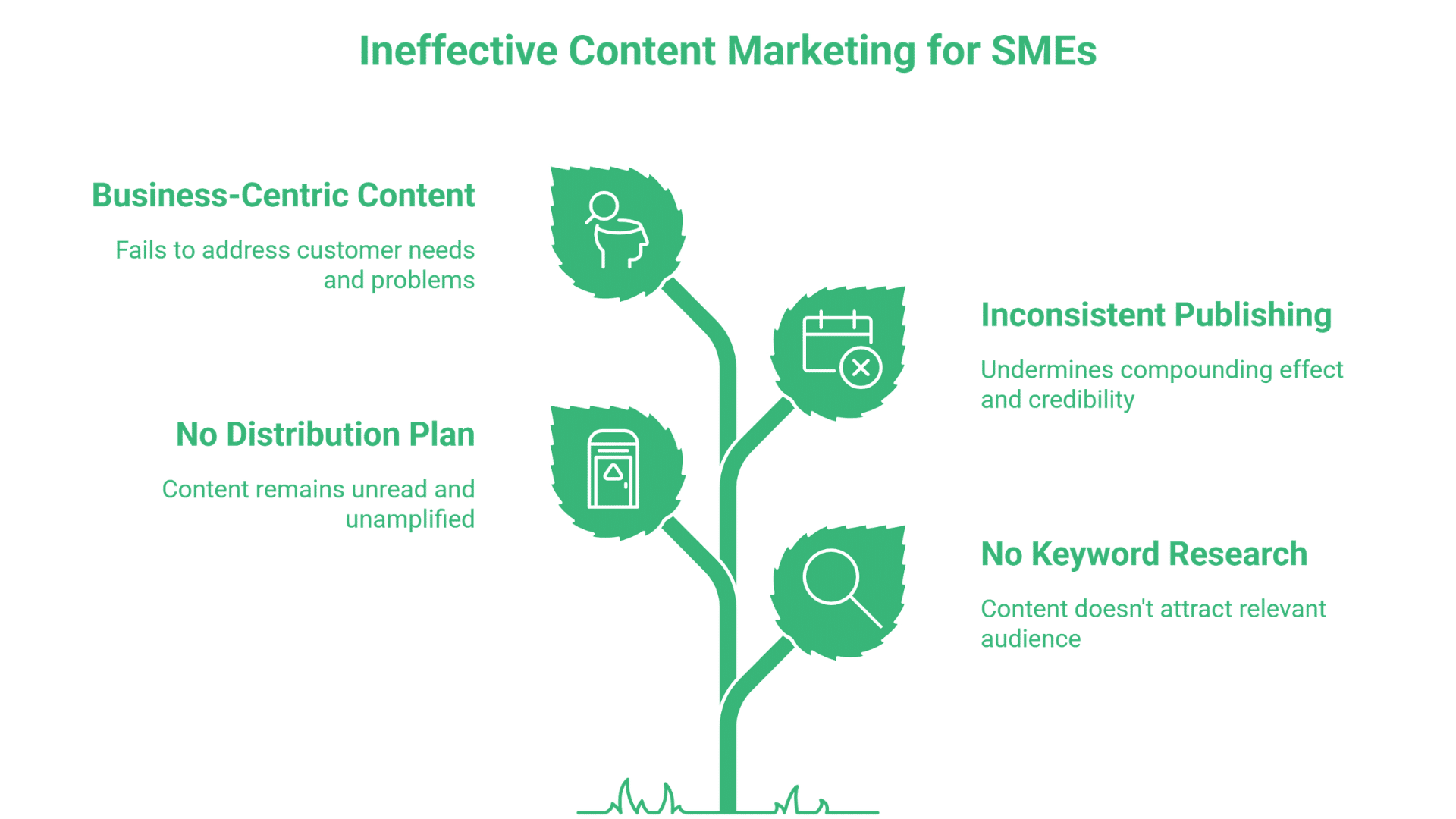
Understanding which content marketing tactics consistently fail for SMEs is as useful as knowing which ones succeed.
Content created without keyword research rarely ranks for anything valuable. Writing about topics that interest you rather than topics your customers are searching for is a common trap. The result is content that generates traffic from people who will never buy from you, or no traffic at all.
Publishing without a distribution plan means most content goes unread. Organic search takes time to build. Without email, social media, or paid amplification, a new piece of content may receive fewer than ten visits in its first month. That is not a return worth the investment.
Inconsistent publishing undermines the compounding effect that makes content marketing valuable. A blog with three articles from six months ago and nothing since sends a negative signal to both search engines and potential clients. A realistic publishing schedule you can sustain delivers better results than an ambitious one you abandon.
Finally, content that talks about your business rather than your customer’s problem rarely performs. People search for answers to their questions, not for descriptions of your services. Content that leads with the reader’s situation and works towards a solution will always outperform content that leads with what you sell.
Measuring Content Marketing ROI
Connecting content marketing activity to commercial outcomes requires tracking the right metrics at each stage of the funnel.
At the top, organic traffic growth and search visibility show whether your content is reaching people. Google Search Console provides both without any cost.
In the middle, engagement signals (time on page, scroll depth, and return visits) indicate whether your content is useful enough to hold attention. A high bounce rate on an article that ranks well usually means the content is not delivering on what the search query promised.
At the bottom, conversion tracking links content activity to enquiries and sales. Setting up goals in Google Analytics that fire when a contact form is submitted, a phone number is clicked, or a key page is visited gives you the data to calculate a genuine cost-per-acquisition for your content marketing investment.
For most SMEs, monthly reporting on these three levels is sufficient. The goal is not to optimise every metric in isolation but to understand which content is driving business and produce more of it.
Putting Your Content Marketing Strategy Into Practice
Content marketing works for SMEs when it is built around a clear plan rather than sporadic output. The businesses that see consistent results are not necessarily producing the most content; they are producing the right content for the right audience, distributing it deliberately, and measuring what leads to enquiries rather than just traffic.
The five strategies covered here are not a checklist to work through all at once. Start with one or two that align with how your customers currently find you, build the habit of consistency, and expand from there.
If you would like support developing a content marketing strategy tailored to your business, ProfileTree’s content marketing services cover everything from keyword research and content planning through to production and performance tracking. Get in touch to discuss what a realistic strategy looks like for your sector and audience.
FAQs
What is the most effective content marketing strategy for small businesses?
SEO-driven blog content combined with email distribution consistently produces the strongest return for small businesses. Blog content builds long-term organic visibility, while email ensures that content reaches an existing audience of potential customers. The combination addresses both discoverability and retention — two of the most common weaknesses in small business marketing.
How long does content marketing take to show results?
Organic content marketing typically takes three to six months before meaningful traffic results appear, and six to twelve months to build significant commercial impact. Paid amplification or a strong existing email list can accelerate results. It is worth setting realistic expectations: content marketing is a long-term investment that compounds over time rather than delivering immediate returns.
How much should a UK SME spend on content marketing?
There is no universal figure, but a practical starting point for most SMEs is between £500 and £2,000 per month for outsourced content marketing, depending on volume and complexity. In-house content production reduces cost but requires staff time. The most important factor is consistency: a modest, sustained budget produces better results over time than periodic large investments.
What content marketing metrics actually matter?
For SMEs, the metrics that matter most are organic traffic to target pages, conversion rate from content visitors to enquiries, and cost per lead attributable to content activity. Social shares and total impressions are less useful unless they translate into traffic or awareness that you can link to business outcomes.
Can I do content marketing without a blog?
A blog is not essential, but some form of owned content that you control and can optimise for search is. Video content hosted on YouTube, detailed service pages, and case studies can each function as the anchor for a content marketing strategy. The key is having content that can be found through search, shared through email and social, and pointed to in sales conversations.
What is the difference between content marketing and SEO?
Content marketing is the strategy of creating and distributing valuable content to attract and engage an audience. SEO (search engine optimisation) is a set of technical and editorial practices that improve how that content performs in search engines. In practice, the two are closely intertwined: good content marketing requires SEO thinking to ensure content is discoverable, and good SEO requires content marketing to ensure there is something worth finding.