
PPC Automation Guide: Mastering Google Performance Max for SMEs
Table of Contents
PPC automation has fundamentally transformed how businesses approach paid advertising, with Performance Max campaigns representing the most significant shift in paid search strategy for a decade. For business owners managing marketing budgets, understanding how to work with, rather than againstGoogle’s AI-driven campaign types has become essential for competitive advantage.
Performance Max (PMax) campaigns use machine learning to automatically optimise bids, placements, and creative combinations across Google’s entire advertising inventory. Unlike traditional campaign types where you control keywords, placements, and ad variations, PPC automation hands much of this control to Google’s algorithms. This creates both opportunities and challenges for UK businesses trying to generate profitable returns from paid advertising.
The transition to PPC automation isn’t optional. Google has systematically deprecated manual controls across its advertising platform, making Performance Max the default option for businesses wanting comprehensive reach. For SMEs in Belfast, Northern Ireland, and across the UK, this means adapting strategy to succeed within an automated framework rather than attempting to maintain outdated manual approaches.
This guide explains how PPC automation through Performance Max campaigns actually works, provides practical implementation steps, and offers strategic insights developed from managing campaigns for businesses across multiple sectors. Whether you’re new to automated PPC or transitioning from traditional Search campaigns, you’ll learn how to build campaigns that generate genuine business results.
What Is Google Performance Max?
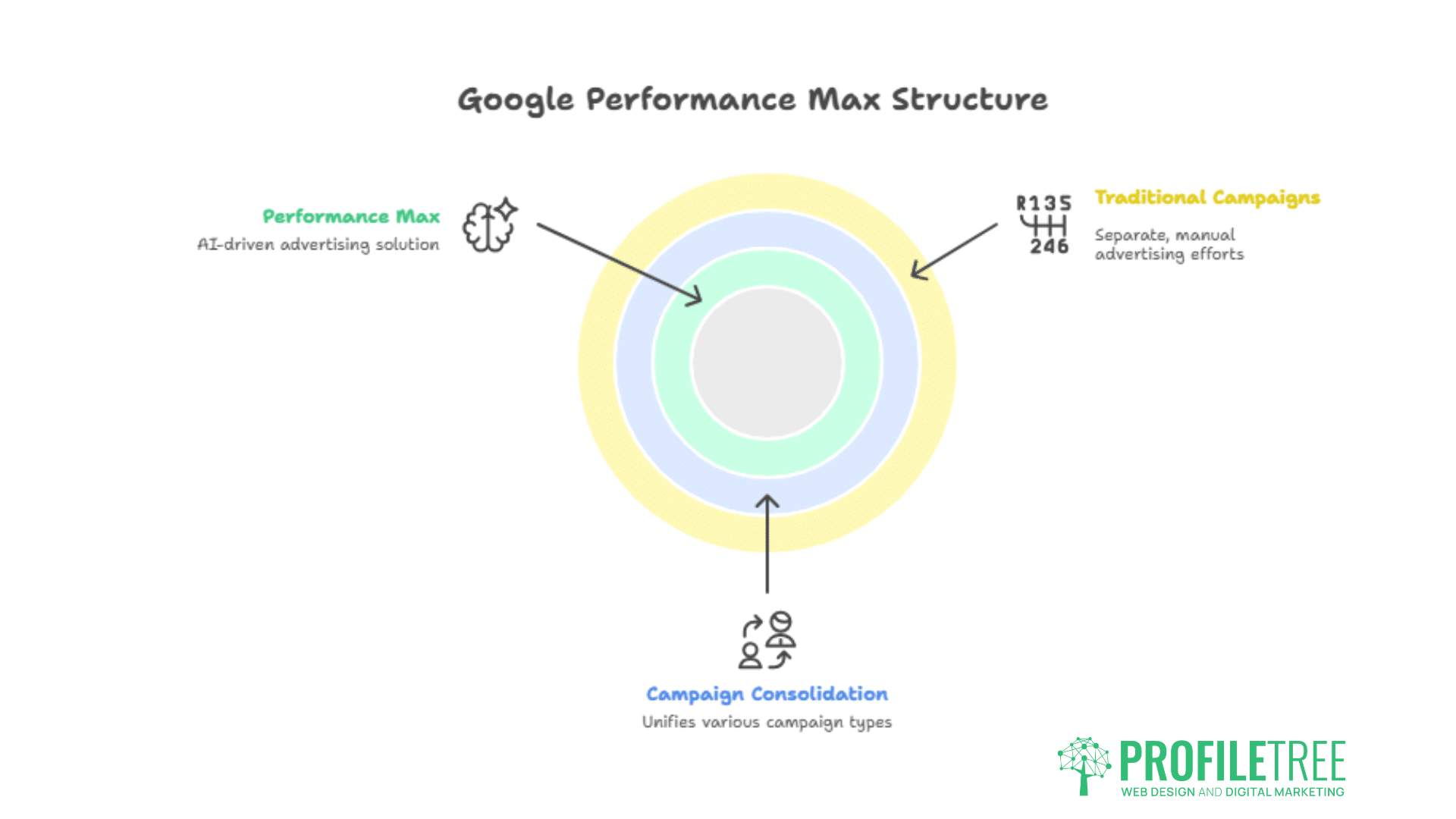
Performance Max fundamentally changes how businesses approach paid advertising by consolidating multiple campaign types into a single, AI-driven format. Understanding what PMax actually is and how it differs from traditional campaigns provides the foundation for successful implementation.
Understanding Performance Max Campaign Structure
Performance Max launched in late 2021 as Google’s answer to simplified campaign management. Rather than creating separate campaigns for Search, Display, YouTube, Shopping, and other placements, PMax consolidates everything into a single campaign type that automatically distributes budget across all Google properties.
The fundamental building block is the asset group—a collection of headlines, descriptions, images, videos, and logos that Google’s algorithms combine dynamically based on where the ad appears and who sees it. You provide the raw materials; Google’s machine learning determines which combinations to show, when to show them, and how much to bid.
This differs fundamentally from traditional campaign types, where you create specific ads for specific placements. With PMax, you’re creating a pool of assets rather than finished advertisements. Google assembles these assets into responsive ads optimised for each placement opportunity, whether that’s a Search result, YouTube video, Gmail inbox, or Discovery feed.
The machine learning system analyses conversion data to understand which asset combinations drive results, then automatically shifts budget toward high-performing placements and audiences. This happens continuously and automatically, without manual intervention required.
Why Google Built Performance Max
Google’s shift toward automation reflects genuine efficiency gains from AI optimisation. Human campaign managers cannot analyse billions of auction signals in real-time or test thousands of creative combinations simultaneously. Machine learning excels at pattern recognition across massive datasets—exactly what’s needed for modern advertising optimisation.
The business case for automation is straightforward: Google’s algorithms can process more variables, test faster, and optimise across more dimensions than manual management allows. Early adopter data showed businesses achieving 12-18% conversion increases when migrating from traditional Shopping campaigns to Performance Max, primarily through improved cross-channel budget allocation.
Google’s strategic motivation is equally clear. Simplified campaign types lower barriers to entry for new advertisers whilst reducing the technical expertise required to run profitable campaigns. This expands Google’s advertiser base and increases overall platform revenue, even as it reduces granular control for sophisticated advertisers.
For UK SMEs, this automation democratises access to sophisticated optimisation previously available only to large advertisers with dedicated PPC specialists. A Belfast retailer can now access the same algorithmic bidding and creative testing that multinational brands use, levelling the competitive playing field.
Core Components of Performance Max Campaigns
Every Performance Max campaign consists of three essential components that work together to drive automated optimisation. Understanding how asset groups, audience signals, and conversion goals interact helps you configure campaigns for maximum effectiveness.
Asset Groups Explained
Asset groups function as containers for related marketing materials. Each asset group should represent a distinct product line, service category, or audience segment—similar conceptually to ad groups in traditional Search campaigns but with broader application.
A typical asset group contains multiple variations of each required component: 3-5 images in different aspect ratios, 1-5 videos if available, up to 15 headlines, up to 5 descriptions, plus business name and logo. Google combines these dynamically, testing which combinations perform best for different users and placements.
The key difference from traditional ad groups lies in how assets are used. Traditional text ads combine headlines and descriptions in predictable structures. Asset groups allow Google to select any combination, display them in different formats depending on placement, and continuously optimise based on performance data.
Best practice involves creating multiple asset groups per campaign when you have distinct offerings. An e-commerce business might separate asset groups by product category; a service business might split by service type. This provides Google’s algorithms with clearer signals about which assets relate to which conversion goals.
Audience Signals vs Targeting
Performance Max uses audience signals rather than traditional targeting—a subtle but significant distinction. Traditional targeting restricts ad delivery to specific audiences. Signals guide machine learning about where to start, but the algorithm can expand beyond these boundaries when it identifies profitable conversion opportunities.
You provide signals through customer match lists (email addresses of existing customers), website visitors, demographic interests, or custom intent audiences. Google’s algorithms use these as starting points, then automatically expand to similar users likely to convert based on pattern recognition across the broader ecosystem.
This approach requires a mindset shift. You’re not limiting delivery; you’re educating the algorithm. Strong signals accelerate the learning phase by pointing machine learning toward proven converters, but the system will explore beyond these boundaries when data suggests value.
First-party data provides the strongest signals. Uploading customer lists helps Google identify characteristics of your actual buyers, then find similar users across its network. Website visitor lists work similarly, though with less conversion certainty. Demographic and interest signals offer weaker guidance but remain useful when first-party data is limited.
Conversion Goals and Bidding Strategies
Performance Max optimises toward specific conversion goals you define. Primary conversions might include purchases, form submissions, or phone calls—actions representing genuine business value. Secondary conversions could include newsletter signups or product page views—lower-value actions that still indicate interest.
Available bidding strategies include Maximise Conversions (get as many conversions as possible within budget), Target CPA (aim for specific cost per acquisition), and Target ROAS (achieve specific return on ad spend). Each strategy shapes how aggressively the algorithm bids and which auction opportunities it pursues.
Automated bidding learns from historical conversion data. The system analyses which user signals, times, devices, and contexts produce conversions, then adjusts bids in real-time based on the probability of conversion for each auction. This happens millions of times daily, continuously refining predictions as new data arrives.
Expect 2-6 weeks for meaningful learning. The algorithm needs sufficient conversion volume to identify reliable patterns—Google recommends at least 30 conversions per month for effective optimisation. Businesses with lower conversion volume should consider using higher-funnel actions as conversion goals to provide adequate learning data.
Setting Up Your First Performance Max Campaign
Proper campaign setup determines whether your Performance Max campaign succeeds or struggles. Following systematic preparation and configuration steps prevents common mistakes that undermine performance before the algorithm even begins learning.
Pre-Launch Requirements
Successful Performance Max campaigns require proper conversion tracking before launch. Google’s algorithms optimise toward conversions, so accurate tracking is non-negotiable. Verify that Google Ads conversion tracking or Google Analytics 4 conversion events are firing correctly for all desired actions.
Enhanced conversions implementation strengthens data accuracy by sending hashed customer information (email addresses) alongside conversion events. This allows Google to attribute conversions more reliably, particularly for users who convert on different devices or after extended consideration periods. UK businesses must handle this data according to GDPR requirements, but proper implementation significantly improves campaign performance.
Budget recommendations vary by industry and conversion value, but £1,000-£1,500 per month represents a reasonable minimum for most SMEs. Lower budgets constrain the algorithm’s ability to gather learning data quickly, extending the learning phase and delaying meaningful results. Higher budgets accelerate learning and provide more opportunities for optimisation.
Account history matters. New Google Ads accounts with limited historical data face longer learning periods. If possible, run conversion-tracking campaigns for several weeks before launching Performance Max to establish baseline data that the algorithm can reference.
Campaign Configuration Step-by-Step
Campaign creation begins with goal selection. Choose the objective that matches your business priority: sales, leads, website traffic, or store visits. This choice influences which optimisation options Google presents and how the algorithm prioritises different conversion types.
Budget allocation requires strategic thinking. Performance Max can consume daily budgets rapidly during learning phases as the algorithm tests various placements and audiences. Set daily budgets you’re comfortable spending consistently—Google may exceed daily limits by up to 100% on high-opportunity days, though monthly totals will average to your daily amount multiplied by 30.4 days.
Location targeting should reflect where you actually do business. Belfast businesses serving only Northern Ireland should restrict geographically rather than accepting UK-wide defaults. Conversely, e-commerce businesses shipping nationally should enable broader targeting. Language settings typically default to English but can include multiple languages if your business serves multilingual audiences.
Final URL expansion allows Google to send traffic to pages beyond those explicitly specified if the algorithm determines that different pages better match user intent. This setting divides opinion—it can improve relevance but reduces control. Conservative approaches disable this initially, enabling it only after reviewing Search terms insights to verify appropriate traffic quality.
Building Effective Asset Groups
Asset group creation requires more preparation than traditional ad creation. You’ll need multiple versions of each asset type to give Google’s algorithms sufficient variation for testing and optimisation.
Image requirements include landscape (1.91:1 ratio, minimum 600×314 pixels), square (1:1 ratio, minimum 300×300 pixels), and portrait (4:5 ratio, minimum 480×600 pixels) formats. Google automatically crops and displays these across different placements—landscape for Display ads, square for Discovery, portrait for Gmail. Provide at least one of each, ideally 3-5 variations showing different product angles, use cases, or customer benefits.
Video assets significantly strengthen Performance Max campaigns. YouTube integration means video ads can appear before, during, or alongside YouTube content, in Discovery feeds, and across Display placements. Videos should be 10-30 seconds for optimal performance, though longer content works for consideration-focused campaigns. Businesses without video assets should consider working with video marketing specialists to develop this crucial content type—campaigns with video assets consistently outperform those without.
Headlines follow responsive search ad conventions, but with a broader application. Write 15 distinct headlines between 30-90 characters, each capable of standing alone or combining with others. Include primary keywords naturally, highlight different benefits or features, and vary messaging to appeal to different motivations. Avoid repetition—Google needs genuine variation for effective testing.
Descriptions allow 60-90 characters each (up to 5 descriptions per asset group). These should expand on headline messages, incorporate secondary keywords, and include clear calls-to-action. Think of descriptions as supporting detail rather than complete sales messages—they’ll often appear truncated depending on placement.
Business name and logo requirements are straightforward but important for brand consistency. Upload logos in both square and landscape formats, minimum 128×128 pixels for square, 512×128 pixels for landscape. These appear across most placements, building visual recognition even when users don’t immediately convert.
Implementing Audience Signals
Audience signal implementation begins with first-party data if available. Customer match lists uploaded from your email marketing platform or CRM provide the strongest signals. Google analyses characteristics of these known customers to identify similar users across its network. Format requirements are specific—CSV files with properly hashed email addresses adhering to Google’s data policies.
Website visitor lists created through Google Ads remarketing tags offer another strong signal source. Users who’ve visited specific pages—particularly product pages or service descriptions—demonstrate interest that correlates with conversion probability. Create segments for different engagement levels: all visitors, engaged visitors (multiple pages or extended time on site), and cart abandoners for e-commerce.
Interest and demographic signals provide directional guidance when first-party data is limited. Select interests related to your products or services, but avoid over-restriction—remember these are signals, not hard targeting. Demographic signals (age ranges, parental status, household income) can be relevant for specific offerings but should be used thoughtfully to avoid unnecessarily limiting reach.
Competitor audiences represent an advanced signal strategy. If competitor research has identified specific businesses your customers also engage with, adding these as affinity audiences can help Google find users in-market for your category. This works particularly well in professional services where decision-makers research multiple providers.
PPC Automation: How Performance Max Actually Works

Understanding the mechanics behind Performance Max automation helps you work effectively within the system rather than fighting against it. The algorithm’s learning process, bidding logic, and creative optimisation follow predictable patterns you can influence through strategic inputs.
The Machine Learning Process
Performance Max campaigns enter a learning phase immediately upon launch, typically lasting 2-6 weeks, depending on conversion volume. During this period, the algorithm actively tests different asset combinations, audience segments, and placement types to identify patterns that predict conversions.
Initial learning focuses on signal validation. Google’s algorithms check whether the audience signals you provided actually correlate with conversions, adjusting delivery based on early results. This explains why early performance often appears volatile—the system is exploring possibilities rather than exploiting known patterns.
Data collection during learning occurs across multiple dimensions simultaneously. The algorithm tracks which headlines perform best with which descriptions, which images drive engagement on different placements, which audiences convert at the lowest cost, which times of day show the strongest performance, and hundreds of other variables. This multidimensional analysis identifies interaction effects that manual testing would never discover.
Performance prediction models develop as conversion data accumulates. The system builds statistical models predicting conversion probability for different users based on their characteristics, behaviour patterns, and context. These models continuously refine as new data arrives, theoretically improving performance over time even without manual intervention.
Automated Bidding in Action
Automated bidding operates at the auction level, making unique bid decisions for each individual ad opportunity. When a user searches or browses content where your ad might appear, Google’s algorithms calculate conversion probability in milliseconds, then bid accordingly based on your target CPA or ROAS.
Real-time auction participation means bids fluctuate constantly based on context. The same user might receive different bids at different times of day, on different devices, or after different browsing behaviour. This granular optimisation exceeds human capability—no manual bidder can adjust hundreds of thousands of bids daily based on contextual conversion probability.
Cross-channel budget allocation represents one of PMax’s key advantages over separate campaign types. The algorithm automatically shifts budget toward whichever channel (Search, Display, YouTube, Discovery) is performing best at any given moment. A campaign might spend 60% on Search during weekday mornings when commercial intent peaks, then shift toward Display during evenings when brand consideration dominates.
Device, time, and location optimisation happen automatically without bid adjustments. The algorithm learns that mobile users convert differently from desktop users, that Tuesday afternoons perform better than Saturday mornings, and that certain postcodes generate higher-value customers. It adjusts bids accordingly, allocating budget toward proven high-performance contexts.
User intent signal processing goes beyond simple keyword matching. Google analyses search history, browsing behaviour, previous interactions with your business, and hundreds of other signals to assess purchase readiness. Users showing strong intent signals receive higher bids; casual browsers receive lower bids or no impression at all.
Dynamic Creative Optimisation
Dynamic creative optimisation determines which specific assets appear for each user. The algorithm selects from your asset pool based on predicted performance for that particular person, placement, and context. This means different users see different combinations of your headlines, images, and descriptions—each theoretically optimised for maximum conversion probability.
Personalisation based on user context extends beyond simple demographic matching. Google’s algorithms consider device type, previous interactions with your business, search history indicating intent level, and even the specific content where your ad appears. A user researching solutions on a desktop might see detailed product information, whilst a mobile user showing purchase intent sees simplified pricing and strong calls-to-action.
Testing methodology differs fundamentally from traditional A/B testing. Rather than splitting traffic evenly between two variants and measuring results, PMax uses multi-armed bandit algorithms that automatically shift traffic toward better-performing combinations whilst continuing to explore alternatives. This approach finds optimal combinations faster than sequential A/B testing whilst avoiding the risk of prematurely committing to suboptimal variants.
Asset performance reporting remains deliberately limited. Google provides ratings (Low, Good, Best) for individual assets but doesn’t reveal exactly which combinations appear most frequently or drive most conversions. This opacity frustrates advertisers accustomed to granular data but reflects Google’s broader automation philosophy—focus on overall results rather than micromanaging individual elements.
Performance Max Strategy for UK Businesses
UK businesses face specific market conditions, competitive dynamics, and customer expectations that shape how Performance Max campaigns should be configured and optimised. Tailoring your approach to British commercial realities improves results significantly.
Local Business Applications
Local businesses—retailers, restaurants, professional services operating from physical locations—can configure Performance Max for store visit conversions. This requires Google Business Profile integration and location assets, allowing the algorithm to optimise for driving foot traffic rather than just online conversions.
Store visit tracking uses aggregated and anonymised location data from Android devices with location history enabled. When users who saw your ads later visit your business location, Google attributes these as conversions. This tracking isn’t perfect—it requires sufficient visit volume for statistical modelling and doesn’t capture iOS users who’ve disabled location sharing—but provides directional insight into offline impact.
Belfast and Northern Ireland businesses should use location targeting carefully. Targeting “Belfast” as a city captures users physically present or regularly located there, plus users showing interest in Belfast-related content. For businesses serving broader Northern Ireland, regional targeting covers commuter towns and surrounding areas where customers actually live.
Multi-location businesses require a strategic asset group structure. Creating separate asset groups per location allows location-specific messaging and offers, though this demands sufficient budget per location for adequate learning. Alternatively, single asset groups with dynamic location insertion in ad copy can serve multiple locations efficiently when offerings are consistent across sites.
E-commerce Implementation
E-commerce businesses benefit significantly from Performance Max through shopping feed integration. Product feeds containing titles, descriptions, prices, images, and availability sync directly into campaigns, allowing Google to create dynamic product ads across all placements.
Shopping campaign migration to PMax has become increasingly necessary as Google deprecates traditional Shopping campaign features. The migration process involves maintaining existing product feeds whilst building asset groups that supplement product data with brand messaging, value propositions, and promotional content.
Dynamic remarketing through PMax automatically shows users the specific products they viewed on your website, combined with your custom messaging from asset groups. This personalisation increases relevance without requiring manual audience segmentation or custom ad creation—the algorithm handles everything based on browsing behaviour.
Seasonal campaign adjustments require proactive planning. Performance Max needs time to learn, so launching campaign changes for Christmas shopping, January sales, or other seasonal peaks should begin 4-6 weeks before the actual selling period. Update asset groups with seasonal imagery and messaging, adjust budgets to accommodate increased auction competition, and prepare for algorithm re-learning as conversion patterns shift.
Lead Generation Campaigns
Lead generation campaigns optimise toward form submissions, phone calls, or other inquiry actions rather than immediate purchases. This approach suits professional services, B2B businesses, and high-consideration consumer purchases where extended sales cycles are normal.
Form fill optimisation requires conversion tracking on thank-you pages or through Google Ads conversion tracking tags firing on successful submissions. Use Target CPA bidding focused on cost-per-lead, setting targets based on historical lead acquisition costs or working backwards from customer lifetime value and close rates.
Phone call tracking integration allows Performance Max to optimise for calls generated through call extensions, click-to-call ads, or website phone numbers using Google forwarding numbers. This particularly benefits businesses where phone consultations represent primary conversion paths—legal services, medical practices, and home services contractors.
Integration with CRM systems enables offline conversion imports, connecting leads to eventual sales. When leads convert to customers weeks or months after initial contact, importing this data trains the algorithm to recognise characteristics of leads that actually close. This significantly improves lead quality over time compared to optimising purely for lead volume. Setting up proper digital strategy infrastructure to track this complete customer journey provides crucial data for algorithm optimisation.
Lead quality versus quantity balance requires strategic goal setting. Optimising purely for lead volume often generates low-quality inquiries that waste sales team time. Setting higher Target CPAs or incorporating lead quality scores as conversion values helps the algorithm prioritise qualified prospects over casual inquiries.
Budget Allocation Across Campaign Types
Performance Max works best as part of a broader paid strategy rather than as your sole campaign type. Many businesses maintain traditional Search campaigns for branded terms and high-priority non-branded keywords alongside PMax for broader reach and automation benefits.
The split approach provides control where it matters most. Branded Search campaigns with manual controls protect against competitors bidding on your brand terms and maintain consistent messaging for users specifically seeking your business. PMax handles discovery and broader consideration-stage traffic where automation advantages outweigh control benefits.
Testing budget recommendations suggest allocating 60-70% of paid budget to Performance Max when first implementing, maintaining 30-40% in traditional campaigns for comparison and backup. Monitor performance for 60-90 days before making dramatic allocation shifts—early volatility doesn’t always predict long-term results.
Scaling successful campaigns requires gradual budget increases. The algorithm adapts to budget changes over several days, so dramatic increases (doubling the budget overnight) force re-learning that temporarily decreases efficiency. Increase budgets 20-30% weekly when scaling, allowing the algorithm to adjust smoothly whilst maintaining performance.
Monitoring and Optimising Performance Max Campaigns
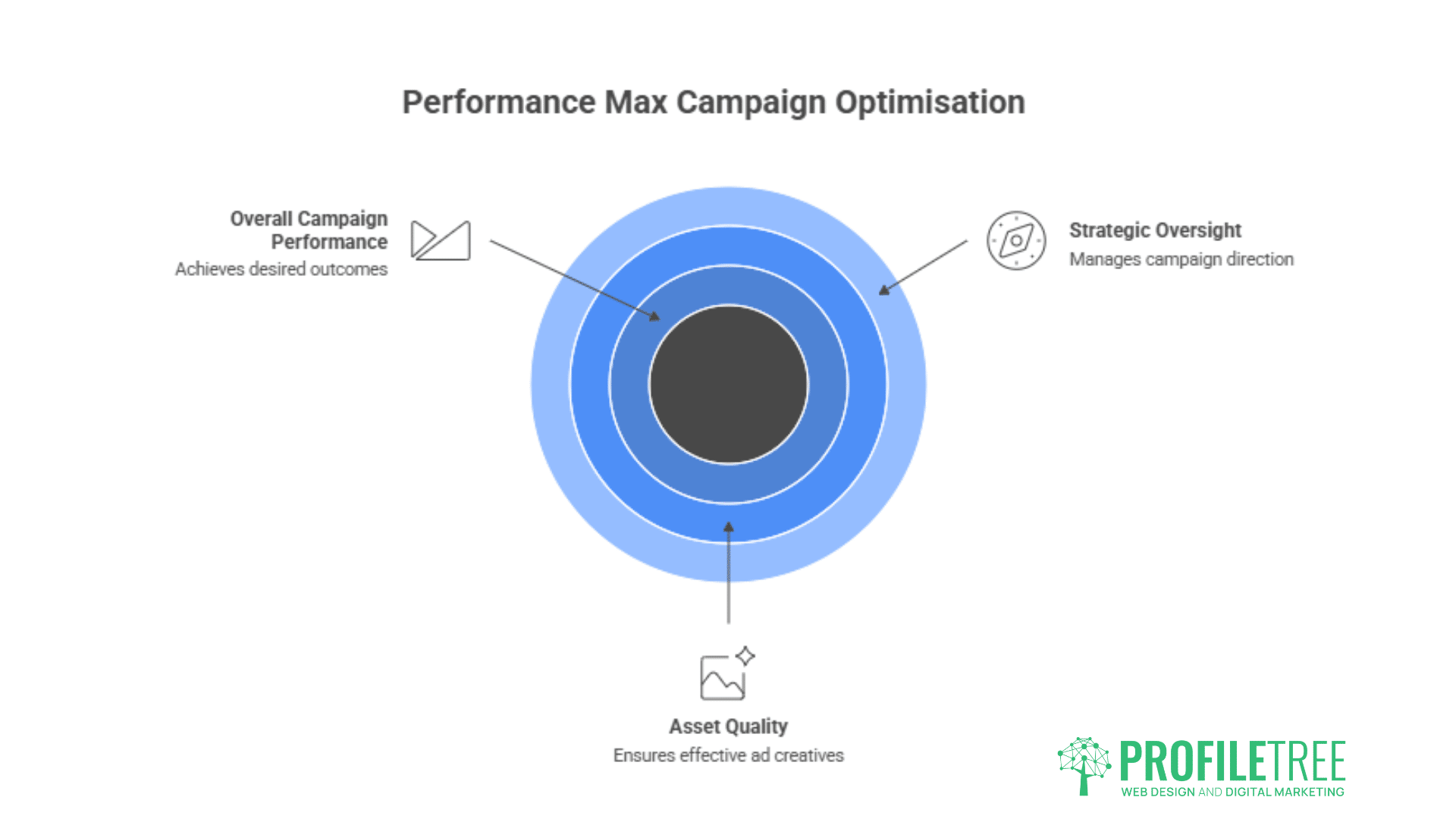
Performance Max provides less reporting transparency than traditional campaigns, requiring different approaches to monitoring and optimisation. Focus shifts from granular control of individual elements to strategic oversight of overall performance and asset quality.
Key Performance Metrics
Performance Max reporting provides less granular data than traditional campaign types, requiring focus on overall results rather than individual keywords or placements. Primary metrics include total conversions, cost per conversion, conversion value, and return on ad spend—the outcomes that actually matter for business success.
Conversion value tracking becomes particularly important for businesses with varying transaction values. Rather than treating all conversions equally, assigning values allows the algorithm to prioritise high-value customers. E-commerce businesses should pass actual transaction values; lead generation businesses might assign estimated values based on historical close rates and average deal sizes.
ROAS (Return on Ad Spend) calculation divides conversion value by cost. A ROAS of 4:1 means you generate £4 in revenue for every £1 spent on advertising. Target ROAS bidding aims for specific ratios, though achieving targets requires sufficient historical data for accurate prediction.
Asset group performance comparison reveals which themes or offerings generate strongest results. If you’ve structured asset groups by product category or service type, comparing conversion rates and costs across groups identifies top performers worthy of increased budget allocation or separate campaign focus.
Search terms insights remain available but deliberately limited. Google shows a sample of search queries that triggered ads, but doesn’t provide comprehensive lists as traditional Search campaigns do. This limited visibility prevents over-optimisation but allows identifying completely irrelevant traffic that might warrant negative keywords.
The Insights Tab Deep Dive
The Insights tab within Performance Max campaigns provides the richest available data for optimisation decisions. This section reveals which audience segments, demographics, and asset combinations perform best within the constraints of Google’s limited reporting.
Auction insights analysis shows how your campaigns compete against other advertisers. Overlap rate indicates how often competitors appear in the same auctions, outranking share shows how often they rank above you, and top-of-page rate reveals how frequently you achieve premium positions. Significant changes in these metrics suggest competitive landscape shifts requiring budget or strategy adjustments.
Asset performance ratings (Low, Good, Best) provide directional guidance on which creative elements perform strongly. Assets consistently rated “Best” are working well and should remain; “Low” rated assets should be replaced with new variations. However, ratings reflect relative performance within your asset group rather than absolute quality, so all assets might rate “Good” if they’re similarly effective.
Audience segment reporting reveals which of your provided signals actually correlate with conversions. Customer match lists showing high conversion rates validate that your existing customer base provides strong learning signals. Demographic or interest segments performing poorly suggest those signals aren’t actually predictive for your business.
The combinations report appears only for campaigns with sufficient data volume (Google doesn’t specify exact thresholds). When available, this report shows which headline and description combinations appear most frequently and drive the most conversions. This rare granular insight helps identify winning messages worthy of expansion into other marketing channels.
When and How to Make Changes
Respecting the learning phase means avoiding changes during initial optimisation periods. Each significant modification—budget changes over 20%, new asset additions, audience signal adjustments—can trigger partial or complete re-learning. Campaigns that constantly change never fully optimise because they’re always learning rather than exploiting proven patterns.
Asset rotation and updates should happen gradually. Rather than replacing all headlines simultaneously, swap one or two whilst maintaining proven performers. This approach provides continuity for the algorithm whilst testing new creative directions. Seasonal updates can be more aggressive since conversion patterns are shifting anyway.
Budget adjustments impact performance predictably. Increases generally maintain or improve efficiency as the algorithm accesses more auction opportunities. Decreasing the force the algorithm to become more selective, sometimes improving efficiency but often reducing volume. Make budget changes no more than weekly to allow stabilisation between adjustments.
Audience signal refinement happens after reviewing segment performance data. If customer match lists show strong performance, consider expanding with lookalike audiences. If specific demographic signals underperform, remove them to allow broader exploration. However, avoid removing all signals—even underperforming signals provide some directional guidance during learning.
Common Optimisation Mistakes
Over-editing during learning phases represents the most frequent mistake. Advertisers accustomed to daily campaign management see early volatility and make constant adjustments, preventing the algorithm from completing learning. Resist intervention urges for at least 2-3 weeks unless performance is catastrophically poor (zero conversions with adequate spend).
Insufficient asset variety limits the algorithm’s testing capability. Providing three headlines that say essentially the same thing or using one image in three sizes gives Google nothing meaningful to test. Create genuinely distinct assets covering different benefits, addressing different objections, and appealing to different customer motivations.
Poor-quality creative assets undermine even the best automation. Blurry images, generic stock photos with no brand connection, or headline copy that’s simply keyword stuffing will perform poorly regardless of algorithmic sophistication. Investment in professional creative—whether through internal teams or agencies specialising in content marketing—pays dividends in automated campaigns where creative quality directly impacts algorithmic performance.
Ignoring conversion value optimisation leaves significant performance on the table. If you’re treating all conversions equally when they actually vary in value, you’re training the algorithm to optimise for the wrong objective. Implement proper value tracking, even if it requires estimating lead values or using historical average order values.
Performance Max vs Traditional Campaign Types
Understanding how Performance Max compares to traditional campaign structures helps you decide when to use each type and how to combine them effectively for comprehensive paid advertising coverage.
PMax vs Standard Search Campaigns
Control trade-offs represent the fundamental difference. Search campaigns allow keyword-level bidding, ad scheduling, device bid adjustments, and complete control over ad copy shown for specific queries. Performance Max surrenders these controls to algorithmic optimisation across all placements.
Search term visibility differences frustrate advertisers transitioning from Search campaigns. Traditional campaigns show every query that triggered ads, allowing detailed negative keyword refinement. Performance Max shows only sample queries, preventing granular control whilst supposedly avoiding over-optimisation that constrains algorithmic learning.
Search campaigns still make sense for specific use cases. Branded terms warrant dedicated Search campaigns to maintain control over brand messaging and prevent competitor poaching. High-value commercial terms where you have strong quality scores and want to maintain prominent positions benefit from a dedicated Search focus. Emergency services or time-sensitive offers need Search-specific copy that PMax’s broad coverage might dilute.
Complementary strategy approaches work best for most businesses. Run dedicated Search campaigns for branded terms and top-priority commercial keywords whilst using Performance Max for broader discovery, competitive conquesting, and automated optimisation across remaining opportunities. This hybrid approach captures control benefits where they matter, whilst using automation for scale.
PMax vs Shopping Campaigns
Product feed utilisation comparison reveals that both campaign types use the same underlying product data from Merchant Centre feeds. The key difference lies in where and how products appear. Shopping campaigns show primarily in Shopping tabs and text search results; Performance Max shows products across Display, YouTube, Discovery, Gmail, and Search.
Bidding strategy differences reflect campaign scope. Shopping campaigns traditionally allow product group-level bidding with manual or automated strategies. Performance Max uses only automated bidding across the entire product catalogue, determining which products to promote based on conversion data and profit margins when values are provided.
Reporting granularity strongly favours Shopping campaigns. You can see performance by specific products, brands, categories, and custom labels. Performance Max provides only asset group-level reporting, making it difficult to identify which products drive results. This lack of visibility frustrates businesses wanting to optimise inventory strategy based on advertising performance.
Migration considerations for e-commerce businesses should balance reach versus control. Performance Max generally generates more conversions by accessing additional placements, particularly YouTube and Discovery, where visual product ads perform well. However, losing product-level insights creates challenges for inventory planning and pricing decisions. Many businesses run both campaign types simultaneously, using Shopping campaigns for reporting insights and Performance Max for incremental reach.
PMax vs Display and Video Campaigns
Creative control comparison shows that traditional Display campaigns allow placement targeting, specific ad format creation, and detailed reporting on where ads appeared. Performance Max Display inventory uses your assets to create responsive ads shown on Google’s algorithmic placement selections without revealing specific sites.
Audience targeting precision differs fundamentally. Display campaigns offer detailed audience targeting with exact inclusion and exclusion controls. Performance Max uses audience signals that guide rather than restrict delivery. This difference matters most for niche B2B businesses where precise targeting avoids wasting budget on irrelevant audiences.
Brand awareness versus conversion focus distinguishes appropriate use cases. Display campaigns often target upper-funnel brand awareness with different creatives and objectives. Performance Max inherently optimises for conversion actions, making it less suitable for pure awareness goals where conversions don’t happen immediately.
Use case scenarios help clarify which campaign type fits specific objectives. Choose traditional Display or Video campaigns when running brand awareness initiatives, launching new products where conversion data doesn’t exist yet, or targeting very specific placements or publishers. Choose Performance Max when optimising for conversions, willing to trade control for reach and efficiency, and able to provide diverse creative assets.
Troubleshooting Performance Max Campaigns
Even well-configured campaigns encounter performance issues. Systematic diagnosis and correction keep campaigns profitable when problems emerge.
Low Performance Diagnosis
Identifying the learning phase versus genuine issues requires patience. Performance fluctuates significantly during the first 2-6 weeks as the algorithm tests different approaches. Conversion rates might vary 50-100% day-to-day during learning. Only after 4-6 weeks should you diagnose persistent underperformance as requiring intervention.
Asset disapprovals and quality problems prevent ads from showing effectively. Check the Assets page for disapproval notices indicating policy violations. Common issues include misleading claims, prohibited content, or trademark violations. Low-quality assets (poor resolution images, thin content) receive limited delivery even without explicit disapproval.
Conversion tracking verification should happen immediately when performance seems problematic. Use Google Tag Assistant or Google Ads preview mode to verify conversion tags fire correctly. Misattributed conversions, duplicate conversion counting, or completely broken tracking explain many “low performance” complaints that actually reflect measurement problems rather than genuine campaign issues.
Budget constraints and bid strategy issues often manifest as low impression share or limited delivery. If daily budgets are exhausted before the end of the day, the algorithm can’t access all available opportunities. If Target CPA settings are significantly below achievable levels based on historical data, the algorithm can’t find sufficient conversions at that cost, leading to under-delivery.
Budget Pacing Problems
Rapid budget depletion typically stems from overly aggressive bidding or underestimated conversion volume. If budgets consistently exhaust in early hours, either increase daily budgets to match actual opportunity or implement Target CPA/ROAS constraints to limit cost per conversion. Remember that Performance Max will sometimes deliberately spend 100% of the daily budget by mid-day if algorithmic predictions suggest strong evening performance justifies the approach.
Underspending campaign fixes require an investigation into delivery-limiting factors. Check Search impression share metrics and lost impression share reasons. “Budget” lost impression share means you need higher budgets; “Rank” lost impression share means you need higher bids or better quality scores through improved assets and relevance. If neither factor shows lost impression share, you might simply be exhausting available relevant auction volume.
Seasonal fluctuation management requires proactive budget adjustments aligned with demand patterns. Retail businesses should increase budgets 4-6 weeks before Christmas shopping peaks, allowing algorithm adjustment before competition intensifies. Service businesses might decrease budgets during slow seasons rather than maintaining consistent spending that generates poor returns during off-peak periods.
Daily budget optimisation balances consistent delivery with peak opportunity capitalisation. If performance clearly peaks during specific hours or days, consider allowing budget flexibility through shared budgets across multiple campaigns or accepting uneven daily pacing. However, extreme volatility, where some days receive zero spend, undermines learning continuity.
Asset Performance Issues
Low asset ratings resolution begins with identifying which specific assets underperform. Replace “Low” rated headlines, images, or descriptions with fresh variations, testing different approaches. However, don’t abandon core messages just because ratings are low—sometimes lower ratings reflect specificity to niche audiences that convert at high rates despite limited overall volume.
Creative refresh requirements vary by industry and campaign maturity. E-commerce campaigns showing the same products for months benefit from fresh lifestyle imagery showing different use cases. Service businesses might refresh seasonal messaging or update offers. Generally, plan major creative updates quarterly, with minor asset additions monthly to provide continuous learning opportunities.
Video asset production needs don’t require professional studio budgets. Smartphone-shot authentic footage often outperforms polished corporate videos, particularly for local businesses where authenticity matters more than production value. Focus on clear messaging, good lighting, and watchable content rather than perfection. Businesses lacking internal video capability should explore video marketing services that specialise in efficient, results-focused production.
Landing page experience improvements influence Performance Max performance through quality score-style mechanisms that Google doesn’t fully disclose. Slow-loading pages, poor mobile experiences, or misleading content relative to ad messaging reduce delivery and increase costs. Investing in proper website development that prioritises user experience and conversion optimisation provides benefits across all campaigns, including Performance Max.
Performance Max and Broader Digital Strategy
Performance Max doesn’t exist in isolation—it works best when integrated with organic search, attribution systems, and broader AI marketing initiatives that share data and amplify results across channels.
Integration with Organic Search
PPC and SEO synergy exists through shared keyword insights and consistent messaging. Performance Max Search terms reports, though limited, reveal which queries generate paid clicks. These queries inform SEO strategy by identifying high-commercial-intent terms worth targeting organically. Conversely, strong organic rankings for certain terms might suggest pausing paid efforts there to allocate budget toward terms where organic visibility is weaker.
Keyword insights for content strategy flow from paid campaign data. Queries generating conversions in Performance Max represent proven commercial intent—create organic content targeting these terms. Queries generating clicks but no conversions suggest informational intent appropriate for educational blog content that nurtures audiences toward eventual purchase.
Landing page optimisation for both channels requires balancing paid and organic best practices. Pages receiving PPC traffic need clear conversion paths and minimal distractions to justify advertising costs. Pages targeting organic traffic need comprehensive content satisfying informational queries. Often this suggests different pages for paid and organic—product pages for PPC, educational content for SEO.
Unified messaging across paid and organic channels strengthens brand consistency and recognition. Users researching your category might encounter both organic content and paid ads. Consistent value propositions, visual branding, and messaging tone across touchpoints build trust and recognition that improve conversion rates across both channels.
Cross-Channel Attribution
Understanding assisted conversions reveals Performance Max’s role in customer journeys that don’t end with immediate conversions. Google Analytics 4’s attribution reports show how often PMax impressions or clicks occur before conversions attributed to other channels. This assisted conversion value should factor into campaign performance evaluation.
Multi-touch attribution challenges arise because Performance Max operates across so many placements simultaneously. A user might see Display impressions, click a YouTube ad, then later convert via organic search. Determining which touchpoint deserves credit requires sophisticated attribution modelling beyond last-click methodology.
Google Analytics 4 integration provides deeper insights into user behaviour after ad clicks. Whilst Performance Max reporting shows conversions, GA4 reveals what users do on-site—pages visited, time spent, bounce rates. This behavioural data helps optimise landing pages and identify where users disengage before converting.
ROI calculation methodology should account for full customer lifetime value rather than just initial conversion value. Performance Max might acquire customers at slightly higher initial cost than other channels, but if those customers have higher retention rates or larger lifetime values, the channel performs better than simple ROAS suggests. Importing customer value data weeks or months after initial conversion trains the algorithm to optimise for long-term value rather than just immediate return.
AI and Automation in Digital Marketing
Performance Max represents part of broader AI implementation trends transforming digital marketing. Machine learning optimisation extends beyond PPC into email marketing automation, content personalisation, predictive analytics, and customer service chatbots. Businesses treating PMax in isolation miss opportunities for cohesive AI-powered marketing ecosystems.
Marketing automation ecosystem integration connects paid advertising with other automated systems. Customer data platforms centralise information from PMax conversions, email engagement, website behaviour, and offline purchases. This unified view enables sophisticated cross-channel orchestration where Performance Max acquisition feeds into automated email nurture sequences and personalised website experiences.
Future of paid advertising clearly trends toward increased automation with decreased manual control. Google has systematically deprecated manual bidding options, removed granular targeting controls, and consolidated campaign types. This trajectory continues—expect further automation, broader algorithm control, and emphasis on creative quality and conversion tracking over technical campaign management.
Preparing for continued automation evolution requires businesses to develop capabilities in areas machines can’t yet handle. Creative strategy, brand positioning, offer development, and customer insight remain human domains. Meanwhile, technical campaign management skills decline in importance. Invest in creative talent, conversion rate optimisation, and strategic thinking rather than tactical bid management. Businesses needing support transitioning to AI-powered marketing should consider digital training that focuses on working effectively within automated frameworks.
Performance Max ROI Expectations
Setting realistic expectations for Performance Max ROI prevents premature campaign abandonment whilst guiding appropriate budget allocation and timeframe planning.
Realistic Performance Benchmarks
Industry-specific ROAS expectations vary dramatically based on margins, customer lifetime value, and competitive intensity. E-commerce businesses commonly target 4:1 to 6:1 ROAS—£4-£6 in revenue for every £1 spent. Professional services with higher lifetime values might consider 2:1 successful, given that one converted lead could generate £10,000+ in revenue.
UK market considerations include higher CPCs in competitive sectors like finance, insurance, and legal services. Belfast and Northern Ireland businesses sometimes benefit from lower competition and costs compared to London and Southeast England, allowing for more efficient performance. However, smaller audience pools in Northern Ireland can limit scale potential.
SME versus enterprise performance differences often reflect sophistication in conversion tracking, creative quality, and budget scale. Enterprises with dedicated teams, professional creative assets, and comprehensive attribution typically achieve better ROAS than SMEs running campaigns themselves with limited resources. However, automation theoretically narrows this gap by democratising sophisticated optimisation.
Timeframe for positive ROI typically extends 60-90 days from launch. Initial learning phases often show negative or break-even returns as the algorithm explores options and accumulates data. Profitable performance usually emerges in weeks 6-8, then continues improving for several months as the algorithm refines. Businesses expecting immediate profitability from week one will be disappointed.
Cost Considerations
Minimum viable budget recommendations centre around £1,000-£1,500 per month for most SME campaigns. This provides sufficient spend for the algorithm to gather meaningful learning data within reasonable timeframes. Lower budgets extend learning phases to 2-3 months and may never achieve optimal performance due to limited data volume.
Management time investment decreases compared to manual campaigns but doesn’t disappear entirely. Expect 2-4 hours weekly for campaign monitoring, asset updates, and performance analysis. This reduced time commitment represents a key automation benefit—you’re paying Google’s algorithms to handle the minute-to-minute optimisation that previously required constant attention.
Creative production costs vary dramatically based on approach. DIY smartphone photography and self-written copy cost only time. Professional photography, copywriting, and particularly video production represent meaningful investments—£500-£2,000 for initial asset creation, then £200-£500 quarterly for refreshes. However, creative quality directly impacts campaign performance, making this investment typically worthwhile.
When to consider agency support depends on budget scale, internal capabilities, and opportunity cost. Businesses spending over £3,000 monthly on Performance Max often benefit from professional management that improves ROAS by 20-40% whilst freeing internal time for other priorities. Smaller budgets might not justify agency fees, making DIY approaches with occasional consultation more appropriate.
Calculating True Campaign Value
Beyond last-click attribution requires understanding that Performance Max often assists conversions credited to other channels. A customer’s journey might include PMax impression, organic search click, email click, and then direct conversion. Last-click attribution credits the direct visit, but removing PMax from the mix might eliminate the original awareness that started the journey.
Customer lifetime value integration transforms ROI analysis. Initial conversion might show 3:1 ROAS, but if those customers make repeat purchases over 12 months, true ROAS might be 8:1 or higher. Building customer value tracking into your attribution model reveals long-term campaign value that short-term ROAS calculations miss.
Assisted conversion value appears in attribution reports, showing how often PMax touchpoints occur in multi-step conversion paths. If Performance Max shows 100 last-click conversions plus 200 assisted conversions, the total value contribution is significantly higher than the last-click data alone suggests. Factor-assisted value when evaluating campaign performance.
Brand lift measurement assesses whether paid advertising increases branded search volume and direct traffic—signs of growing brand awareness. Compare branded search trends in Google Search Console before and after launching Performance Max. Increasing branded searches suggest your paid campaigns build awareness, driving longer-term organic growth beyond immediate conversions.
The Future of PPC Automation
Understanding where paid advertising automation is heading helps businesses prepare capabilities and strategies that remain relevant as platforms continue evolving toward increased AI control.
Google’s Automation Roadmap
Continued expansion of automated campaign types follows clear patterns visible in Google’s product releases. Performance Max launched in 2021, expanded to cover Shopping campaigns by 2023, and continues absorbing features from traditional campaign types. Expect further consolidation into fewer, more automated campaign options.
Deprecation of manual controls accelerates as automation proves effective. Google removed broad match modifier keywords, eliminated expanded text ads in favour of responsive search ads, and continuously reduces targeting granularity. This trend continues—manual bid adjustments, device targeting, and ad scheduling controls may eventually disappear from even traditional Search campaigns.
Enhanced AI capabilities emerging from Google’s broader DeepMind integration will improve prediction accuracy and creative optimisation. Future Performance Max versions might generate ad copy variations autonomously, create video content from product images, or predict conversion probability weeks in advance based on early engagement signals.
Privacy-first advertising adaptations respond to cookie deprecation and privacy regulations. Performance Max already relies less on third-party cookies than traditional Display campaigns, using Google’s first-party data and contextual signals instead. This positions it well for privacy-restricted futures where audience targeting becomes increasingly difficult across the open web.
Preparing Your Business
Skills needed for automated campaign management shift from technical tactics toward strategic thinking and creative excellence. Future-focused marketers should develop capabilities in conversion rate optimisation, customer insight research, creative briefing and evaluation, and landing page experience rather than bid management or keyword research.
Digital training opportunities help teams adapt to automation-first environments. Rather than courses on manual bidding strategies, focus on understanding algorithmic decision-making, providing effective signals to machine learning systems, and interpreting limited reporting data. ProfileTree’s digital training services specifically address these emerging skill requirements for SME marketing teams.
Building internal capabilities versus outsourcing depends on business scale and priorities. Companies spending £5,000+ monthly on paid advertising often benefit from dedicated internal resources focused on strategy, creative, and optimisation. Smaller budgets might better suit agency partnerships that provide expertise without full-time employment costs.
Staying current with platform changes requires active engagement with official Google resources, industry publications, and testing new features as they are released. Google’s advertising platform evolves continuously—features available now might be deprecated next year, whilst new opportunities emerge regularly. Build learning time into your workflow rather than assuming current knowledge remains sufficient.
Emerging Alternatives
Microsoft Performance Max equivalent (Performance Max for Microsoft Advertising) launched in late 2024, bringing similar automation to Bing, LinkedIn, and Microsoft’s advertising network. Though smaller audience scale than Google, Microsoft’s integration with LinkedIn creates unique B2B opportunities and typically shows lower competition and costs.
Social platform automation tools increasingly incorporate AI-driven optimisation similar to Performance Max. Meta’s Advantage+ Shopping campaigns automate creative testing and audience targeting for Facebook and Instagram. TikTok’s Smart Performance campaigns operate similarly. Multi-platform strategies require understanding different platforms’ automation approaches rather than assuming Google’s model applies universally.
Cross-platform campaign management tools from third-party vendors attempt to unify reporting and optimisation across Google, Microsoft, Meta, and other platforms. These tools face challenges accessing data as platforms restrict API access, but they provide efficiency benefits for businesses advertising across multiple channels.
Diversification strategies protect against over-reliance on any single platform. Businesses running only Google Performance Max face risk if algorithm changes negatively impact performance or if Google increases costs. Maintaining presence across Google, Microsoft, and social platforms provides stability and negotiating power while accessing different audience pools.
Conclusion
Performance Max campaigns represent an irreversible shift in paid advertising toward AI-driven automation. Google’s platform evolution makes this campaign type increasingly central to search marketing strategy, deprecating traditional approaches in favour of machine learning optimisation across all placements simultaneously.
The balance between automation and strategic human input defines success in this environment. Algorithms handle minute-to-minute bidding decisions and asset combination testing that exceed human capability. Humans provide creative strategy, conversion goal definition, and business context that algorithms cannot generate. Businesses succeeding with Performance Max embrace this division of labour rather than fighting automation.
UK SMEs should approach Performance Max with realistic expectations and commitment to proper implementation. This means investing in quality creative assets, implementing comprehensive conversion tracking, providing sufficient budget for algorithm learning, and maintaining patience through initial learning phases. Shortcuts in any of these areas consistently produce disappointing results.
The opportunity for businesses in Belfast, Northern Ireland, and across the UK lies in reaching customers across Google’s entire ecosystem through a single, streamlined campaign type. This comprehensive reach, combined with sophisticated algorithmic optimisation, democratises capabilities that previously required large budgets and specialist expertise. However, success demands understanding how automation actually works and aligning your approach accordingly.
Start with one well-configured campaign rather than attempting complex multi-campaign strategies immediately. Build confidence and understanding through hands-on experience, then expand as performance justifies additional investment. Performance Max rewards thoughtful implementation more than aggressive scaling—quality assets and proper tracking matter more than budget size.
About ProfileTree’s Digital Marketing Services
Implementing and managing Performance Max campaigns requires both technical expertise and strategic insight. At ProfileTree, our Belfast-based digital strategy team has successfully launched and optimised PPC automation campaigns for businesses across Northern Ireland, Ireland, and the wider UK market.
Our approach combines data-driven campaign setup with high-quality creative asset production. We work with businesses to develop comprehensive asset libraries, from professional video marketing content to compelling copy developed by our content marketing specialists. This integration means your Performance Max campaigns have the quality assets needed to perform whilst maintaining brand consistency across all placements.
We handle the technical complexity of conversion tracking implementation, audience signal configuration, and ongoing optimisation so you can focus on running your business. Our team monitors campaign performance daily, identifies opportunities for improvement, and makes strategic adjustments that respect algorithm learning cycles whilst maximising returns. For businesses wanting to understand these systems rather than simply outsourcing them, our digital training services empower your team with knowledge of PPC automation fundamentals and best practices.
Beyond Performance Max, we provide comprehensive search engine optimisation services that complement paid advertising with organic visibility. The keyword insights from PPC campaigns inform SEO content strategy, whilst strong organic rankings reduce dependence on paid traffic for already-proven commercial terms. This integrated approach maximises overall search visibility whilst optimising budget efficiency.
Whether you’re launching your first Performance Max campaign or looking to improve existing automation efforts, ProfileTree provides the expertise needed to generate genuine returns from your PPC investment. Our work spans e-commerce, lead generation, and local business campaigns, with particular strength in understanding Northern Ireland and UK market nuances that impact campaign performance.
Contact ProfileTree at our Belfast office to discuss how Performance Max automation can drive measurable growth for your business. Visit our services page to learn more about our comprehensive digital marketing solutions, including website design, AI implementation, and social media marketing that work together to build a complete digital presence.