
Personal Development in Your Workplace: A Complete UK Strategy
Table of Contents
Are you maximising your team’s potential, or leaving untapped talent on the table? Personal development in your workplace represents one of the most significant investments you can make in your business’s future.
For UK organisations navigating an increasingly competitive marketplace, the ability to grow, adapt, and improve continuously separates thriving companies from those merely surviving. Whether you’re a business owner in Belfast, a marketing manager in Manchester, or a team leader anywhere across the UK, understanding how to implement effective personal development strategies can transform both individual performance and overall business outcomes.
This comprehensive guide explores the practical application of personal development principles within professional settings, with particular focus on digital training workshops and modern learning approaches. We’ll examine proven frameworks, implementation strategies, and measurement techniques that deliver tangible results for organisations of all sizes.
What is Personal Development in the Workplace?
Personal development in the workplace encompasses the continuous process of acquiring new skills, expanding knowledge, and enhancing capabilities that benefit both your current role and future career prospects. It represents a commitment to professional growth and self-improvement within your professional environment.
For UK businesses, workplace personal development extends beyond traditional training programmes. It includes learning new technical skills, working towards promotions, taking on fresh responsibilities, or transitioning into entirely new roles. The challenge lies in aligning individual professional goals with business objectives—creating a mutually beneficial relationship where employee growth drives organisational success.
At ProfileTree, we work with businesses across Northern Ireland, Ireland, and the UK to develop digital strategies that include comprehensive training and development programmes. Our experience shows that organisations prioritising personal development see measurable improvements in employee retention, productivity, and overall business performance.
The scope of workplace personal development includes:
- Technical Skills Enhancement: Learning industry-specific software, mastering new technologies, or gaining certifications relevant to your field. This might include digital marketing qualifications, web development skills, or AI implementation capabilities.
- Leadership Capabilities: Developing management skills, decision-making abilities, and team coordination techniques. These competencies become increasingly valuable as professionals progress through their careers.
- Communication Proficiency: Improving presentation skills, written communication, and interpersonal effectiveness. Strong communication underpins success in virtually every professional role.
- Digital Literacy: Understanding emerging technologies, social media platforms, content management systems, and data analytics tools. Digital competence has become fundamental to most modern roles.
“Personal development shouldn’t be viewed as an optional extra—it’s a strategic investment in your workforce that delivers tangible returns through improved performance, innovation, and employee satisfaction,” notes Ciaran Connolly, Director of ProfileTree.
Why Personal Development at Work Matters for UK Businesses
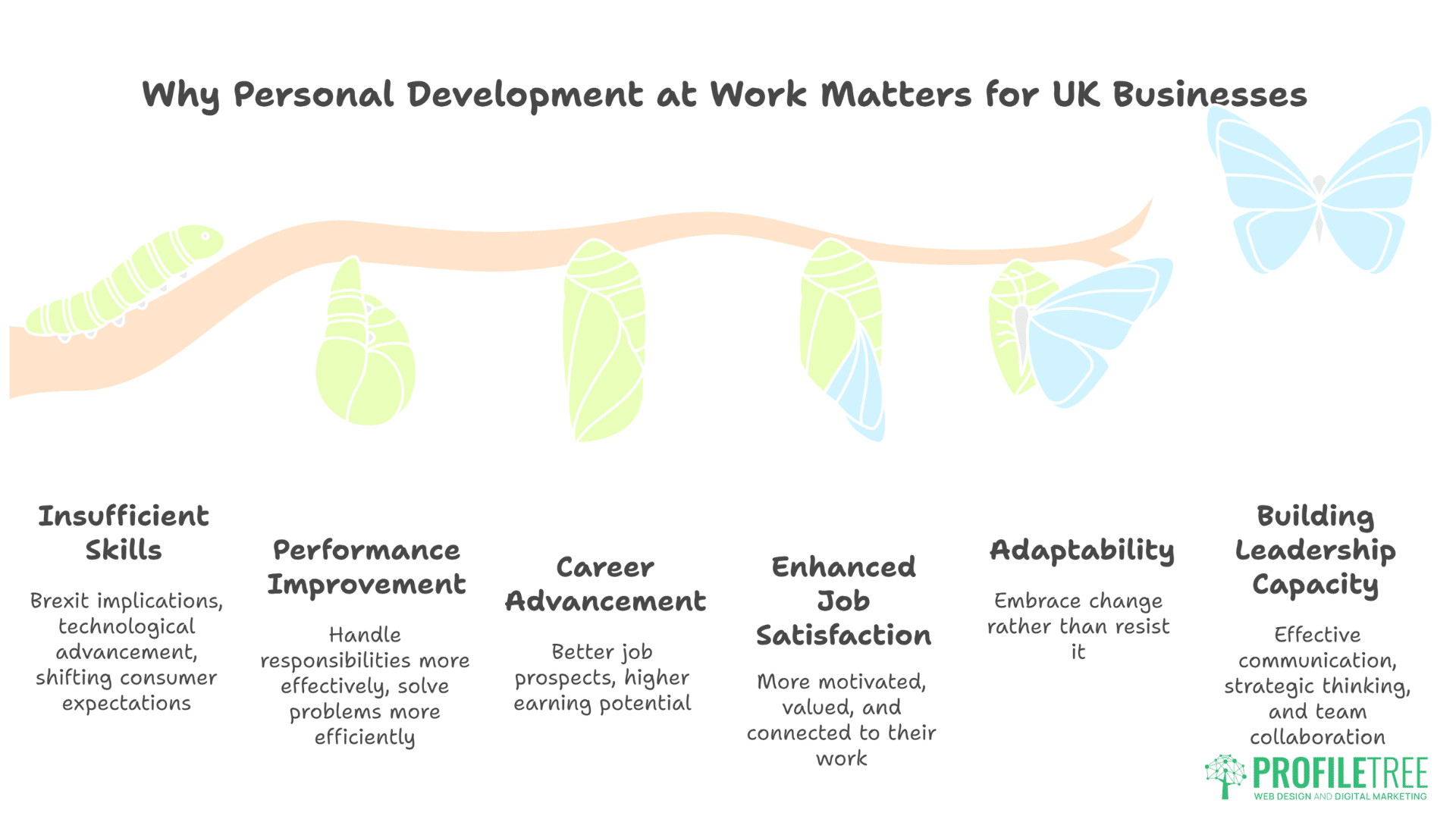
The UK business landscape demands continuous adaptation. Brexit implications, technological advancement, remote working normalisation, and shifting consumer expectations mean that what worked five years ago may prove insufficient now. Personal development provides the agility organisations need to remain competitive.
Performance Improvement and Productivity
Employees who actively develop their skills deliver better results. When team members expand their knowledge and capabilities, they handle responsibilities more effectively, solve problems more efficiently, and contribute greater value to organisational objectives. This performance improvement directly impacts the bottom line.
Research from the Chartered Institute of Personnel and Development (CIPD) consistently demonstrates the correlation between learning opportunities and job satisfaction. Businesses investing in employee development report higher productivity levels, improved quality of work, and enhanced customer satisfaction scores.
Career Advancement Opportunities
Personal development opens doors. Organisations notice and reward employees who demonstrate commitment to growth and learning. When promotion opportunities arise, candidates with proven development track records stand out. They’ve shown initiative, acquired relevant skills, and demonstrated the capacity for increased responsibility.
For individuals, this translates into better job prospects, higher earning potential, and increased career satisfaction. For organisations, it means developing internal talent pipelines—reducing recruitment costs and retention challenges.
Enhanced Job Satisfaction and Engagement
Learning new skills and overcoming challenges creates genuine job satisfaction. Employees engaged in continuous learning feel more motivated, valued, and connected to their work. This engagement reduces turnover, improves workplace culture, and creates positive momentum throughout organisations.
UK businesses face significant skills shortages across multiple sectors. Developing existing talent through structured personal development programmes addresses these gaps more effectively than solely relying on external recruitment.
Adaptability in a Changing Market
Change remains constant in modern business. New technologies emerge, market conditions shift, and customer expectations evolve. Personal development builds adaptability—enabling professionals to embrace change rather than resist it.
At ProfileTree, we’ve observed this firsthand, supporting businesses through digital transformation. Companies that prioritise employee development navigate technological changes more smoothly, adopt new tools more quickly, and maintain competitiveness more effectively.
Building Leadership Capacity
Leadership skills don’t appear spontaneously—they require deliberate development. Personal development programmes that include leadership training, management workshops, and mentoring opportunities build the leadership capacity organisations need for sustainable growth.
These skills prove valuable regardless of whether individuals pursue formal management roles. Leadership qualities like effective communication, strategic thinking, and team collaboration benefit everyone.
Setting Personal Development Goals for Your Workplace
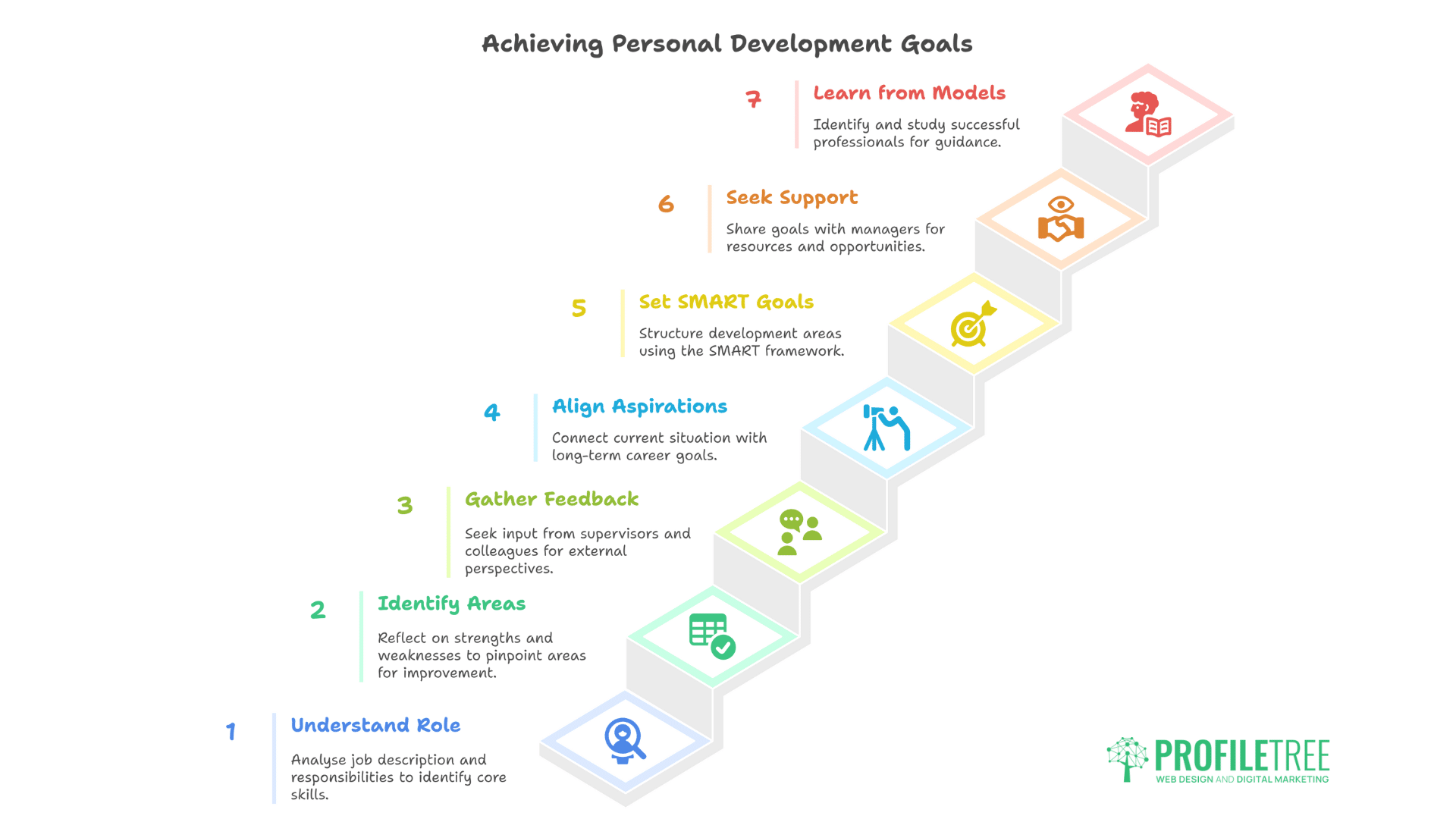
Effective personal development begins with clear, well-defined goals. Without specific objectives, development efforts lack direction and measurable outcomes. The process of setting workplace development goals requires honest self-assessment, strategic thinking, and alignment with both personal aspirations and organisational needs.
Understanding Your Current Role
Start by thoroughly examining your job description and responsibilities. Identify the core skills required for your position, the key deliverables expected from you, and the performance standards against which you’re measured. Consider how you would train someone new to your role; this exercise reveals essential competencies and potential areas for development.
Understanding your current role provides the foundation for identifying growth opportunities. It highlights skills you’ve mastered, areas requiring improvement, and capabilities you might develop to add greater value.
Identifying Improvement Areas
Reflect honestly on your professional performance. Consider your strengths—skills that come naturally and areas where you excel. Then examine your weaknesses—aspects of your role that challenge you or tasks you find difficult to complete effectively.
This self-assessment should include:
- Technical Competencies: Specific software, tools, or methodologies relevant to your industry. For instance, a marketing professional might need to develop SEO skills, whilst a project manager might require proficiency in specific project management software.
- Soft Skills: Communication abilities, leadership qualities, emotional intelligence, and interpersonal effectiveness. These transferable skills prove valuable across roles and industries.
- Industry Knowledge: Understanding of sector-specific trends, regulations, best practices, and emerging developments. Staying current with industry evolution maintains professional relevance.
Gathering Feedback from Multiple Sources
Seek input from supervisors, managers, colleagues, and team members. External perspectives reveal blind spots—areas you might not recognise as development opportunities. This feedback provides valuable insights into how others perceive your performance and where you can focus your improvement efforts.
Request specific, actionable feedback rather than general comments. Ask questions like “Which skills would make me more effective in this role?” or “What areas should I prioritise for development?” This directed approach yields more useful information.
Aligning with Career Aspirations
Consider your long-term career goals. Where do you want to be in three years? Five years? Ten years? What skills, qualifications, or experience will you need to achieve those positions? Personal development goals should connect your current situation to your desired future.
This alignment provides motivation during challenging learning periods and keeps personal development efforts focused on meaningful outcomes.
SMART Goals Framework
Once you’ve identified development areas, structure them using the SMART framework. This proven methodology creates goals that are:
- Specific: Clear and well-defined rather than vague or general. Instead of “improve marketing skills,” aim for “complete Google Analytics certification and implement data-driven content strategy.”
- Measurable: Quantifiable with tangible evidence of accomplishment. How will you know when you’ve achieved the goal? What metrics indicate success?
- Achievable: Realistic and attainable given your resources, time, and circumstances. Challenging goals motivate, but impossibly difficult objectives discourage.
- Relevant: Aligned with your broader objectives and organisational needs. The goal should meaningfully contribute to your role effectiveness or career progression.
- Time-bound: Attached to specific deadlines or timeframes. “Within six months” or “by the end of Q2” creates urgency and commitment.
For example, rather than setting a vague goal like “get better at social media,” a SMART goal might state: “Complete a professional social media marketing certification and increase company Instagram engagement by 30% within four months.”
Seeking Management Support
Share your personal development goals with your line manager or supervisor. Their support proves crucial for successful implementation. Managers can provide resources, create learning opportunities, assign relevant projects, and offer feedback on your progress.
This conversation also helps align your personal development with business objectives. Your manager might identify skills particularly valuable to the organisation or suggest development areas you hadn’t considered. This alignment increases the likelihood of receiving company support—whether financial backing for courses, time allocation for learning, or opportunities to apply new skills.
Learning from Role Models
Identify professionals you admire—either within your organisation or your broader industry. What qualities make them effective? What skills have they developed? What career paths have they followed?
These role models provide both inspiration and practical guidance. If they’re accessible, consider requesting informational interviews or mentoring relationships. If they’re public figures, study their work, read their content, or listen to their podcasts. Understanding their personal development journey can inform your own.
For UK professionals, numerous business podcasts, LinkedIn thought leaders, and industry conferences provide access to role models across sectors.
Creating Your Personal Development Plan
A personal development plan helps transform goals into actionable steps. It provides the structure, accountability, and measurement necessary for meaningful progress. Without a documented plan, development intentions often fade amidst daily work pressures.
Personal development planning should follow a systematic approach. Moving from abstract aspirations to concrete action requires careful consideration of what you want to achieve, why it matters, how you’ll get there, and how you’ll measure success along the way.
Essential Components of an Effective Plan
- Personal Details and Context: Document basic information, including your name, position, department, and planning date. This context helps when reviewing plans over time or sharing them with managers.
- Skills Self-Assessment: List your current skills and those requiring development. Be honest in this assessment—accurate self-awareness forms the foundation for effective development planning.
- Career Objectives: Define short-term (one year), mid-term (three to five years), and long-term (ten years) career goals. These objectives provide direction and purpose for your personal development efforts.
- SMART Development Goals: List three to five specific personal development goals using the SMART framework. Fewer, focused goals typically prove more effective than numerous scattered objectives.
- Detailed Action Plans: For each goal, specify:
- Specific actions you’ll take to achieve it
- Resources or support you’ll require
- Timeline for completion
- Measures of success
- Potential obstacles and solutions
- Learning Opportunities: Identify books, courses, seminars, workshops, or digital training programs that support your goals. Be specific about which resources you’ll use and when.
- Review Schedule: Establish regular review dates—typically monthly or quarterly. Consistent review maintains momentum and allows for plan adjustments based on progress or changing circumstances.
Practical Development Plan Example
To illustrate how this works in practice, consider this example for a marketing professional looking to transition into a digital strategy role:
Personal Details
- Name: Sarah Thompson
- Position: Marketing Executive
- Department: Marketing
- Date: January 2025
Skills Self-Assessment
- Current Strengths:Content creation, social media management, email marketing
- Skills to Develop: Data analytics, SEO strategy, digital advertising, AI tools for marketing
Career Objectives
- Short-term: Become proficient in Google Analytics and SEO best practices within 12 months
- Mid-term: Secure a Digital Marketing Manager position within 3 years
- Long-term: Head of Digital Strategy role within 10 years
SMART Development Goals
- Goal 1: SEO Proficiency: Complete Google Analytics certification and SEO fundamentals course, then increase organic website traffic by 40% within six months.
- Goal 2: Data-Driven Decision Making: Master data visualisation tools (Tableau or PowerBI) and implement a monthly data-driven reporting process within four months.
- Goal 3: AI Implementation: Complete AI for Marketing certification and successfully implement two AI-powered marketing tools within the next quarter.
Action Plan for Goal 1 (SEO Proficiency)
- Specific Actions:
- Enrol in a comprehensive SEO course
- Dedicate 5 hours weekly to learning
- Audit the current website SEO
- Implement on-page optimisation
- Create a content strategy based on keyword research
- Required Resources:
- £500 course budget
- Google Analytics access
- SEO tools subscription (Ahrefs or SEMrush)
- 5 hours weekly learning time
- Timeline:
- Complete certification by the end of March
- Implement strategies April-June
- Measure results by July
- Success Measures:
- Course completion certificate
- 40% organic traffic increase
- Improved keyword rankings for 10 target terms
- Potential Obstacles:
- Limited time
- Technical complexity
- Budget constraints
- Solutions:
- Block dedicated learning time in the calendar
- Start with fundamentals before advanced concepts
- Request company funding through a professional development budget
This example demonstrates how abstract development intentions become concrete, actionable plans. The specificity creates clarity about what needs to happen and when.
Digital Training Workshops for Professional Development
Digital training workshops have transformed workplace learning. These online programmes offer flexibility, accessibility, and cost-effectiveness that traditional classroom training often cannot match. For UK businesses, digital workshops provide particular advantages:
- Accessibility Across Locations: Teams spread across different regions can access identical training. A Belfast-based business can provide the same personal development opportunities to remote workers in Manchester or London.
- Flexible Scheduling: Employees can often complete digital training during times that suit their schedules, reducing disruption to daily operations.
- Cost Effectiveness: Digital workshops typically cost less than equivalent in-person training when considering travel, accommodation, and time away from work.
- Measurable Progress: Digital platforms provide detailed analytics on completion rates, assessment scores, and time invested—enabling organisations to measure training effectiveness accurately.
Implementation and Accountability
Creating a development plan represents just the beginning. Successful personal development requires consistent implementation and regular accountability checks.
- Schedule Learning Time: Block specific times in your calendar for development activities. Treat these appointments as seriously as client meetings or project deadlines. Without protected time, development often gets postponed indefinitely.
- Track Your Progress: Maintain a personal development journal or digital log to document what you’ve learned, the skills you’ve practised, and your progress toward goals. This record motivates during challenging periods and provides concrete evidence of growth over time.
- Seek Regular Feedback: Schedule quarterly check-ins with your manager to discuss progress, challenges, and any necessary plan adjustments. These conversations maintain alignment between your personal development and organisational needs.
- Celebrate Milestones: Acknowledge achievements along your personal development journey. Completed a certification? Mastered a new skill? Successfully applied learning to a work project? Recognise these wins. Celebration reinforces positive behaviour and maintains motivation.
- Adjust as Needed: Personal development plans should remain flexible. If circumstances change—new responsibilities, shifting priorities, unexpected opportunities—adjust your plan accordingly. Regular reviews facilitate these adaptations.
Essential Skills for Personal Development in Your Workplace
Certain core competencies consistently prove valuable across industries, roles, and career stages. Technical skills vary by profession, but these fundamental capabilities support success in virtually any workplace context.
Time Management and Productivity

Time represents your most finite resource. Effective time management enables you to accomplish more, reduce stress, and maintain a better work-life balance. Poor time management creates constant pressure, missed deadlines, and substandard work quality.
Deadlines feature prominently in professional life. Successfully managing your time requires conscious attention to priorities, effective planning, and disciplined execution. When you master time management, formerly strenuous responsibilities become manageable sequences of tasks.
Prioritisation Techniques
Not all tasks carry equal importance—distinguish between urgent and important work. Focus on high-impact activities that advance key objectives. Many professionals waste hours on low-value tasks whilst crucial work remains incomplete.
The Eisenhower Matrix provides a useful framework: categorise tasks as urgent/important, important/not urgent, urgent/not important, or neither urgent nor important. Focus primarily on important tasks, whether urgent or not.
Planning and Organisation
Start each week by reviewing upcoming commitments and priorities. Plan your days the evening before or first thing each morning. This planning creates clarity about what needs to be accomplished and when.
Use digital tools to support the organisation. Project management platforms like Trello or Asana help track tasks and deadlines. Calendar blocking ensures important work receives dedicated time. Task management apps like Todoist help capture and organise all commitments.
Eliminating Time-Wasters
Identify activities that consume time without adding value. Social media browsing, excessive email checking, unproductive meetings, and task-switching all drain productivity. Track how you spend your time for one week—the results often prove eye-opening.
Restrict time-wasting activities to designated breaks. Turn off non-essential notifications. Use website blockers during focused work periods. Schedule email checking rather than responding to every message immediately.
Digital Tools for Time Management
Several applications support better time management:
- Todoist: Comprehensive task management across all devices, with priority levels, due dates, and project organisation.
- RescueTime: Automatic time tracking showing exactly how you spend computer time, revealing productivity patterns and time-wasters.
- Forest: A Gamified focus tool that grows virtual trees during concentration periods, dies if you exit the app. Particularly effective for those easily distracted by devices.
- Google Calendar: Robust scheduling and time-blocking capabilities with reminder functionality and team integration.
- Asana: Project and task management with team collaboration features, deadline tracking, and progress visualisation.
These tools are only effective when used consistently. Select one or two that suit your working style rather than attempting to use numerous applications simultaneously.
Communication and Interpersonal Skills

Effective communication underpins virtually all workplace success. Whether explaining ideas to colleagues, presenting to clients, writing reports, or providing feedback, the quality of your communication directly impacts your professional effectiveness.
Personal development in communication extends beyond speaking clearly or writing well. It encompasses understanding your audience, adapting your message appropriately, listening actively, and building genuine connections with colleagues.
Professional Communication Styles
Different situations demand different communication approaches. Presenting to senior executives requires a different language and structure than chatting with teammates. Client emails should maintain professionalism whilst internal messages might adopt more casual tones.
Develop versatility in your communication. Read widely to see various writing styles. Observe effective communicators in your organisation. Practice adapting your approach based on audience and context.
Active Listening
Communication flows both ways. Active listening—fully concentrating on what others say rather than just waiting to speak—builds stronger working relationships and prevents misunderstandings.
Practice active listening by maintaining eye contact, asking clarifying questions, summarising what you’ve heard, and avoiding interruptions. This focus demonstrates respect and ensures you’ve understood accurately.
Digital Communication Competency
Modern workplaces rely heavily on digital communication—emails, video calls, instant messaging, and collaboration platforms. Each medium requires specific competencies.
Email should be clear, concise, and professional. Video calls demand a different presence than in-person meetings. Instant messaging suits quick questions but not complex discussions. Understanding these nuances improves communication effectiveness.
Building Workplace Relationships
Strong professional relationships make work more enjoyable and effective. Healthy relations with colleagues facilitate collaboration, knowledge sharing, and mutual support.
Develop workplace relationships through:
- Approachable demeanour and welcoming body language
- Genuine interest in colleagues as individuals
- Willingness to help others when possible
- Participation in team activities and social events
- Respectful communication even during disagreements
- Recognition of others’ contributions and achievements
These relationship-building efforts create positive team dynamics that benefit everyone involved.
Data-Driven Decision Making
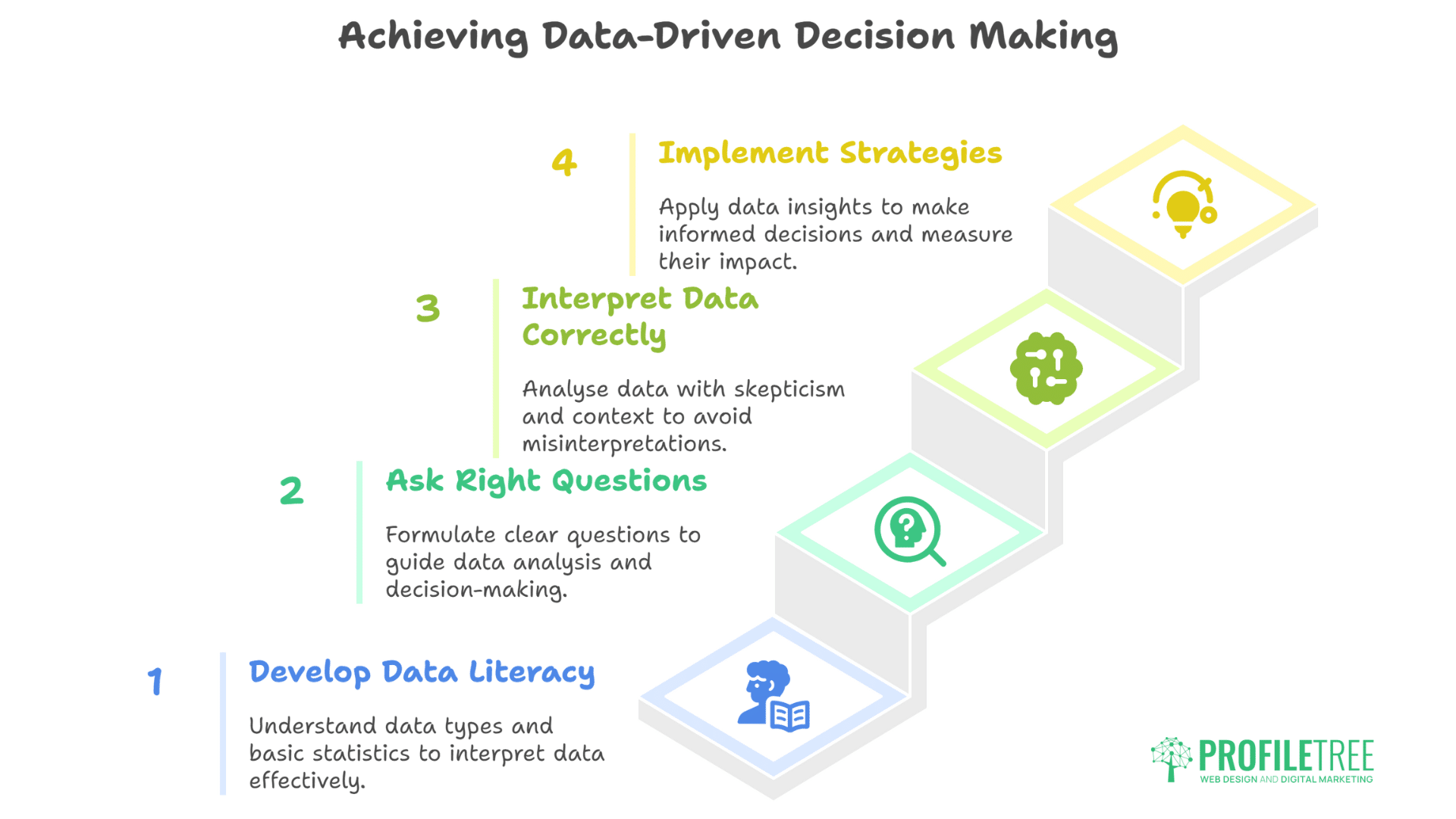
Data increasingly informs business decisions across all sectors. The ability to gather relevant data, analyse it effectively, and draw actionable conclusions has become a valuable professional skill.
Data-driven decision making doesn’t require advanced statistical knowledge. It does require basic data literacy, critical thinking, and a willingness to let evidence guide choices rather than relying solely on intuition or assumptions.
Developing Data Literacy
Start with fundamentals: understand different data types, recognise data quality issues, and interpret basic statistics. Learn to create informative charts and graphs that communicate insights clearly.
Numerous free resources teach data basics. Google Analytics Academy provides excellent training in digital marketing data analysis. Microsoft offers tutorials for Excel. LinkedIn Learning gives data analysis courses for learners of all skill levels.
Asking the Right Questions
Effective data analysis begins with clear questions. What specifically do you need to know? What decision will this information inform? What metrics actually matter for your objectives?
Vague questions produce vague answers. “How’s our marketing performing?” generates less useful insights than “Which marketing channels deliver the highest-quality leads at the lowest cost per acquisition?”
Interpreting Data Correctly
Data requires careful interpretation. Correlation doesn’t imply causation. Short-term trends don’t necessarily indicate long-term patterns. Context matters enormously.
Develop healthy scepticism about data. Question assumptions, look for alternative explanations, and understand limitations of your datasets before drawing conclusions.
Implementing Data-Informed Strategies
Data proves valuable only when it influences decisions and actions. After analysis, determine what changes or initiatives your findings suggest. Implement these changes, then measure results to assess effectiveness.
This cycle of analysis, action, and measurement creates continuous improvement—the foundation of data-driven organisational culture.
At ProfileTree, we help businesses implement data-driven approaches across their digital strategies. Our web design focuses on conversion tracking and analytics integration from the outset, whilst our AI training programmes include practical modules on using data for business improvement.
Emotional Intelligence in Professional Settings

Emotional intelligence—the capacity to understand and manage both your emotions and others’—significantly impacts workplace success. High emotional intelligence correlates with better leadership, stronger teamwork, and improved conflict resolution.
Emotional intelligence encompasses several interconnected capabilities:
Self-Awareness
Understand your emotional triggers, recognise how feelings influence behaviour, and acknowledge your strengths and limitations. Self-aware professionals make better decisions because they recognise when emotions might cloud judgment.
Develop self-awareness through reflection. After facing challenging situations, reflect on what you felt, why you reacted as you did, and how you might respond differently next time. Journaling supports this reflective practice.
Self-Regulation
Manage emotional responses rather than react impulsively. Self-regulation doesn’t mean suppressing emotions—it means expressing them appropriately and constructively.
Practice pausing before responding in emotionally charged situations. This brief delay allows rational thinking to engage alongside emotional reaction, typically producing more effective responses.
Empathy
Understand others’ perspectives, feelings, and motivations. Empathy enables better communication, stronger relationships, and more effective collaboration.
Cultivate empathy by genuinely listening to colleagues, considering situations from their viewpoints, and acknowledging their feelings as valid even when you disagree with their conclusions.
Social Skills
Manage relationships effectively, including communication, conflict resolution, influence, and teamwork. Strong social skills make you a more effective colleague and leader.
These capabilities develop through conscious practice and feedback. Notice patterns in your interactions. Which situations challenge you? Which relationships prove difficult? These pain points indicate development opportunities.
Observing Emotional Patterns
Track your emotional responses over several weeks. What situations trigger stress, anger, or frustration? What inspires or energises you? Understanding these patterns enables better self-management.
Similarly, observe colleagues’ emotional patterns. What motivates different team members? How do they respond to pressure? This awareness improves your ability to work effectively with diverse personalities.
Continuous Learning Mindset

Personal development never truly completes—it represents an ongoing journey rather than a destination. Cultivating a continuous learning mindset provides adaptability, relevance, and engagement throughout your career.
This mindset involves:
- Curiosity and Openness: Approaching new situations with genuine interest rather than resistance. Viewing challenges as learning opportunities rather than threats.
- Comfort with Discomfort: Accepting that growth requires moving beyond your comfort zone. Initial incompetence with new skills can be uncomfortable but represents a necessary stage of personal development.
- Learning from Failure: Treating mistakes as educational experiences rather than disasters. Analysing what went wrong, extracting lessons, and applying those insights moving forward.
- Seeking Diverse Experiences: Pursuing varied learning opportunities—different projects, cross-functional collaborations, industry events, or stretch assignments. Diverse experiences build adaptable skillsets.
- Staying Current: Remaining aware of industry trends, emerging technologies, and evolving best practices. Regular reading, professional development courses, and industry networking keep you informed.
Personal Development Resources and Support
Numerous resources support your personal development journey. These tools, programmes, and materials provide knowledge, structure, and guidance as you work towards your development goals.
Books for Professional Growth
Reading remains one of the most cost-effective methods for personal and professional development. These widely acclaimed books provide valuable insights for workplace personal development:
- “Atomic Habits” by James Clear – Practical strategies for forming beneficial habits and breaking counterproductive ones. Particularly valuable for implementing sustained behavioural changes.
- “The 7 Habits of Highly Effective People” by Stephen R. Covey – Timeless principles for personal and professional effectiveness. Despite being published decades ago, these concepts remain highly relevant.
- “Mindset: The New Psychology of Success” by Carol S. Dweck – Explores how beliefs about abilities impact success. Particularly insightful regarding growth mindset versus fixed mindset.
- “Emotional Intelligence” by Daniel Goleman – Comprehensive exploration of emotional intelligence and its impact on professional success.
- “Think and Grow Rich” by Napoleon Hill – Classic examination of success psychology and the role of mindset in achievement.
Reading proves most valuable when combined with application. After finishing a business book, identify three specific concepts to implement in your work. This application transforms theoretical knowledge into practical capability.
Professional Training and Workshops
Structured training programmes provide expert instruction, practical exercises, and often professional certifications. Options include:
- Corporate Training Programmes: Many organisations offer internal training covering company-specific systems, industry knowledge, or professional skills. Take full advantage of these opportunities—they typically cost you nothing whilst providing valuable development.
- Industry Conferences and Seminars: These events combine learning sessions with networking opportunities. UK professionals have access to numerous industry-specific conferences throughout the year.
- Professional Certifications: Recognised qualifications demonstrate competence and commitment to professional development. Google Analytics certification, project management qualifications (PRINCE2, Agile), or industry-specific credentials all add value to your professional profile.
- Digital Skills Training: As businesses across the UK undertake digital transformation, digital skills become increasingly valuable. Training in areas like SEO, web development, content creation, social media marketing, or AI implementation opens numerous opportunities.
ProfileTree’s Digital Training Programmes
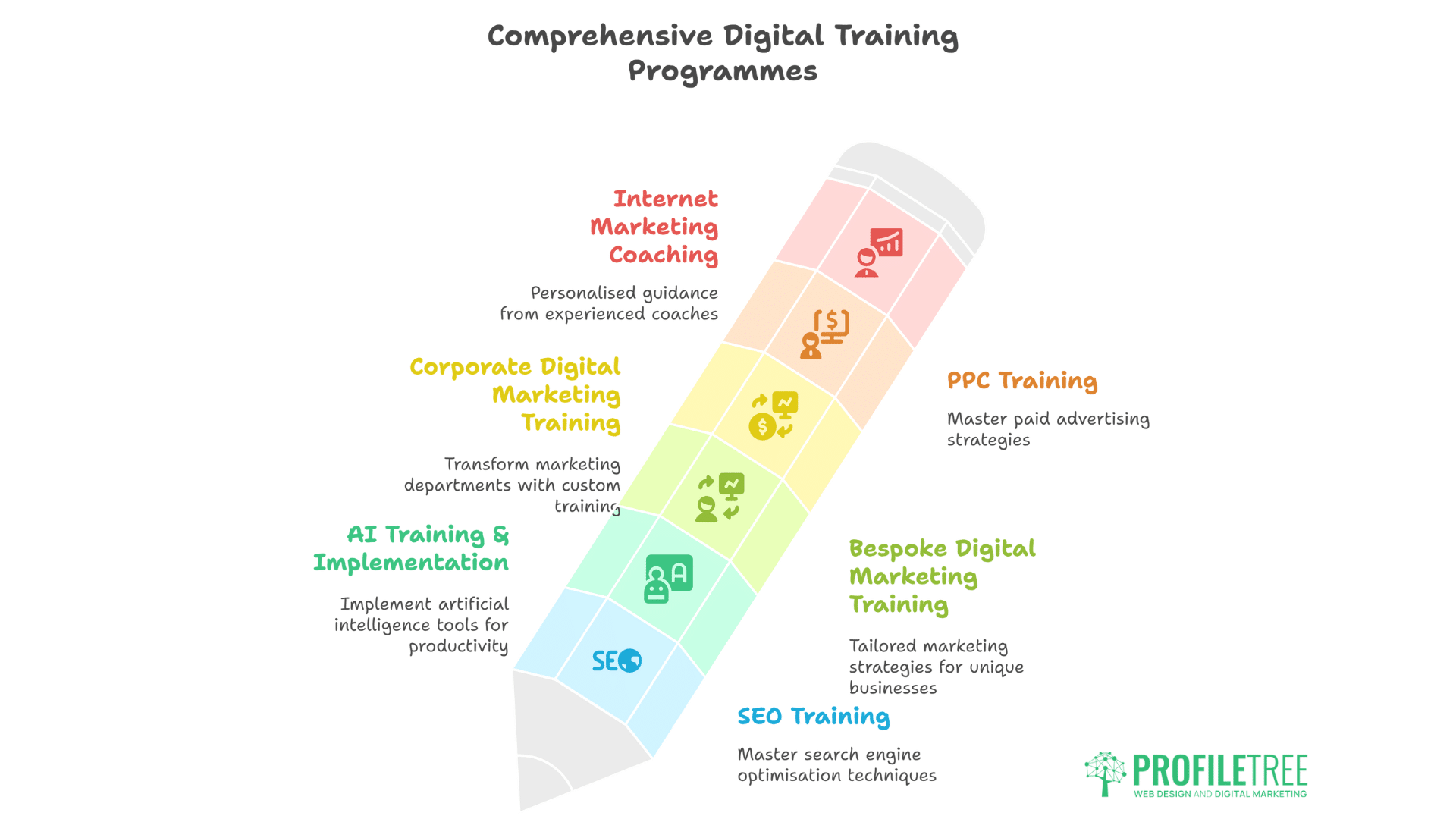
ProfileTree provides digital training programmes for businesses across Northern Ireland and beyond, covering web design principles, AI implementation for business, content marketing strategies, and SEO fundamentals. These programmes combine theoretical knowledge with practical application specific to UK business contexts.
Our digital training programmes include:
- SEO Training: Master search engine optimisation through comprehensive SEO courses, designed for businesses and marketing teams who want to control their own search visibility. From SEO fundamentals to technical SEO and local SEO training, our programmes cover everything needed to achieve first-page rankings.
- AI Training & Implementation: Learn how to implement AI tools that transform productivity and results. Our AI training modules cover Claude and ChatGPT for business, AI content creation, and custom AI solutions tailored to your specific industry.
- Bespoke Digital Marketing Training – Every business is unique. Our custom digital marketing training programmes are tailored specifically for your industry, team, and objectives, from bespoke digital PR training to complete digital transformation.
- Corporate Digital Marketing Training – Transform entire marketing departments with our corporate training programmes. We provide custom SEO training for corporate marketing teams, digital marketing training for corporates across all departments, and ongoing support from dedicated SEO trainers.
- PPC Training Belfast & Digital Advertising – Master paid advertising with our comprehensive programmes covering Google Ads, Facebook & Instagram advertising, LinkedIn advertising for B2B, and remarketing strategies.
- Internet Marketing Coaching Programmes – Receive personalised one-on-one guidance from experienced digital marketing coaches with weekly sessions, strategy development, and ongoing support between sessions.
Our training approach focuses on immediate applicability—participants leave with skills they can implement immediately rather than just concepts to consider. With our founder Ciaran Connolly speaking at international conferences on AI implementation and digital transformation, our programmes benefit from cutting-edge strategies and global perspectives.
Mentoring and Coaching
Guidance from experienced professionals accelerates personal development. Mentors provide insights from their experience, help navigate career challenges, and offer perspectives you might not consider independently.
Finding a Mentor
Look within your organisation first. Identify successful professionals whose career paths or working styles you admire. Many senior professionals willingly mentor junior colleagues when asked directly.
Alternatively, professional organisations, industry groups, or formal mentoring programmes can connect you with mentors outside your organisation. These relationships offer different perspectives and potentially broader industry insights.
Being an Effective Mentee
Mentoring relationships work best when mentees come prepared with specific questions, respect mentors’ time constraints, and actively apply advice received. Document insights from mentoring conversations and report back on how you’ve implemented suggestions.
Online Learning Platforms
Digital learning platforms provide enormous course libraries covering virtually every professional skill imaginable:
- LinkedIn Learning – Thousands of courses taught by industry professionals, covering business, technology, and creative skills.
- Coursera– University-level courses and professional certificates from leading institutions worldwide.
- Udemy– Marketplace of courses across all topics, often available at accessible prices.
- FutureLearn– UK-based platform offering courses from universities and cultural institutions.
These platforms typically allow you to learn at your own pace, making them ideal for busy professionals. Many offer certificates upon completion—valuable additions to your professional profile.
Professional Networking
Professional relationships provide learning opportunities, career advancement prospects, and support during challenges. Building a strong professional network should feature in your personal development plan.
- LinkedIn Engagement: LinkedIn serves as the primary professional networking platform in the UK. Maintain an updated profile, share relevant content, engage with others’ posts, and connect with professionals in your industry.
- Industry Events: Attend conferences, seminars, workshops, and networking events relevant to your sector. These gatherings provide both learning and relationship-building opportunities.
- Professional Associations: Many industries have professional bodies offering training, publications, events, and networking opportunities. Membership demonstrates professional commitment and provides valuable resources.
Measuring Personal Development Success

Personal development efforts deserve measurement. Without assessment, you cannot determine whether development activities actually improve your capabilities or advance your career. Effective measurement combines subjective self-assessment with objective performance indicators.
Tracking Progress Against Goals
Review your personal development plan quarterly. For each goal, assess your progress honestly:
- What specific actions have you completed?
- What learning has occurred?
- How have you applied new knowledge or skills?
- What challenges have you encountered?
- What adjustments might improve progress?
This regular review maintains momentum and enables plan adjustments based on experience. Goals that seemed appropriate initially might require modification as circumstances change or as you learn more about what personal development you actually need.
Performance Improvement Indicators
Look for concrete evidence that development efforts are improving your work performance:
- Increased Responsibility: Are you being assigned more complex projects or additional responsibilities? This often indicates management confidence in your developing capabilities.
- Improved Output Quality: Has the quality of your work improved? Are you producing better reports, more effective presentations, or superior results from your core responsibilities?
- Enhanced Efficiency: Can you complete tasks more quickly whilst maintaining quality? Improved efficiency typically indicates increased competence.
- Positive Feedback: Have colleagues, clients, or managers commented positively on improvements they’ve observed? External validation provides a valuable perspective on your personal development.
- Problem-Solving Ability: Do you handle challenges more effectively than previously? Greater problem-solving capability demonstrates genuine skill development.
Career Progression Markers
Personal development should eventually translate into career advancement:
- Promotion or Role Expansion: Have you received a promotion, significant pay increase, or expanded role? These represent clear career progression indicators.
- Increased Influence: Are your opinions sought more frequently? Do colleagues request your input or advice? Growing influence indicates developing expertise and respect.
- External Opportunities: Have you received approaches from recruiters or other organisations? External interest suggests your developing skills have market value.
- Professional Recognition: Have you received industry awards, speaking invitations, or publication opportunities? Professional recognition validates developing expertise.
Skill Acquisition Verification
Demonstrate skill development through:
- Certifications Achieved: Professional qualifications provide objective validation of knowledge and capabilities.
- Projects Completed: Successfully implementing new skills in actual work projects proves practical competence beyond theoretical knowledge.
- Portfolio Development: For many roles, building a portfolio of work samples demonstrates developing capabilities visually and tangibly.
- Peer Teaching: When you can effectively teach skills to others, you’ve achieved genuine mastery. Training colleagues validates your expertise.
Personal Development Challenges and Solutions
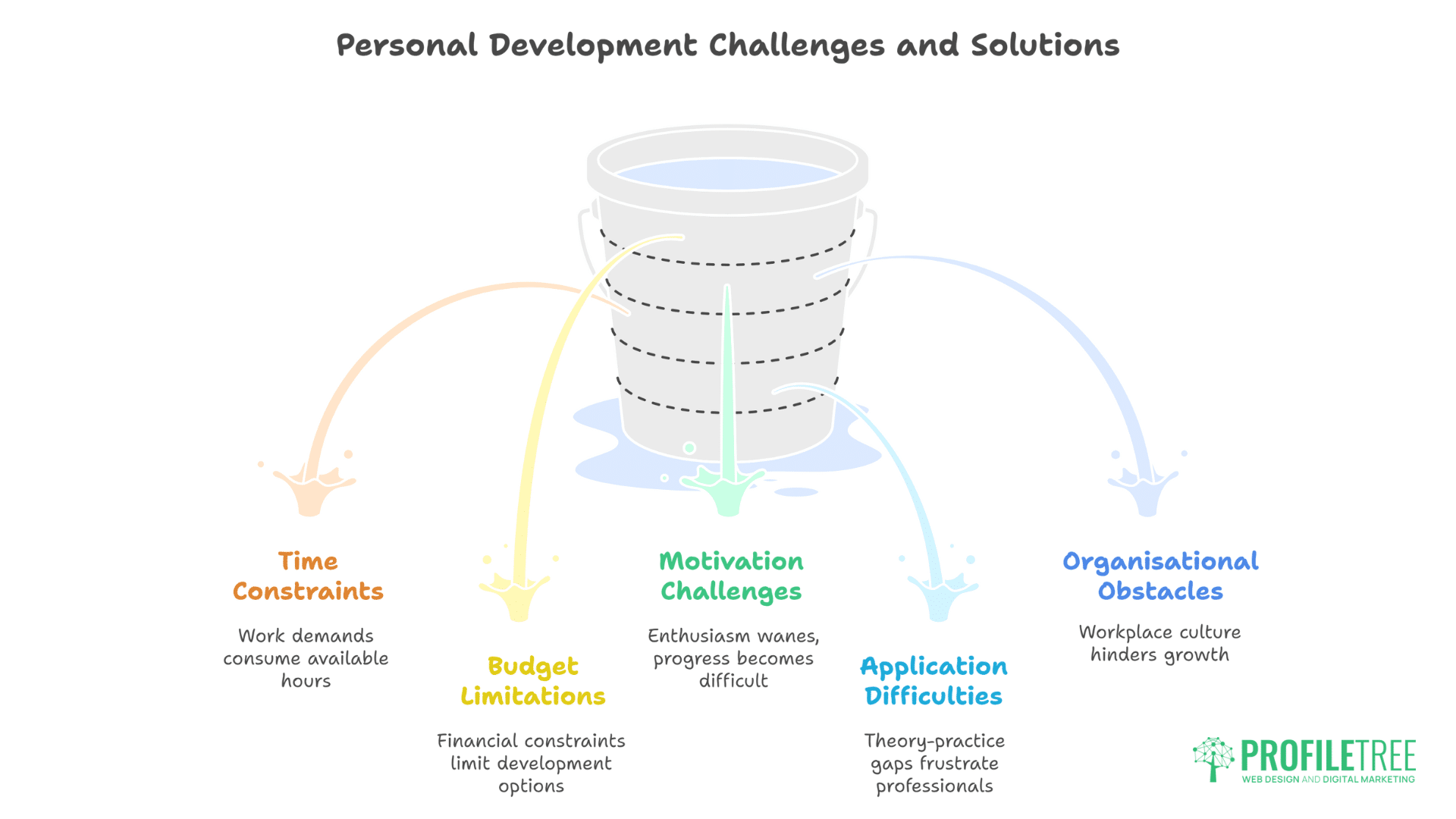
Personal development rarely proceeds smoothly. Common obstacles derail development plans or slow progress. Anticipating these challenges and having solutions ready improves your likelihood of sustained development success.
Time Constraints
Busy professionals often struggle to find time for personal development activities. Daily work demands consume available hours, leaving development perpetually postponed.
Solutions:
- Protected Time Blocks: Schedule development activities in your calendar exactly as you would important meetings. Treat this time as non-negotiable. Even 30 minutes daily or two hours weekly enables significant progress over time.
- Microlearning: Break learning into small, manageable chunks. Rather than seeking hour-long study sessions, use 10-15-minute periods. Listen to podcasts during commutes. Read industry articles during lunch. Microlearning accumulates surprisingly quickly.
- Integration with Work: Seek opportunities to develop skills through actual work projects. Volunteer for assignments requiring capabilities you want to develop. This approach provides learning whilst fulfilling work responsibilities.
Budget Limitations
Professional development sometimes requires financial investment—courses, certifications, books, or conference attendance. Budget constraints can limit options.
Solutions:
- Free Resources: An Enormous amount of high-quality learning materials is available online for free. YouTube tutorials, business blogs, free online courses, and open-access academic journals provide vast knowledge at no cost.
- Employer Funding: Many organisations provide professional development budgets. Present a clear case for how your development benefits the company. Link requested funding to business objectives. When employers understand the return on investment, they often provide support.
- Incremental Investment: Rather than expensive comprehensive programmes, start with affordable options. Many valuable courses cost under £50. Books provide exceptional value. Build learning gradually rather than seeking immediate comprehensive coverage.
Motivation Challenges
Initial enthusiasm often wanes. Personal development becomes just another item on an overwhelming to-do list. Maintaining motivation over months or years requires deliberate effort.
Solutions:
- Clear Purpose: Regularly remind yourself why you’re pursuing development. How will these new capabilities improve your work? How will they advance your career? A clear purpose sustains motivation during difficult periods.
- Visible Progress: Track development visibly. Maintain a learning journal. Create a skill checklist showing progress. Celebrate completed courses or achieved milestones. Visible progress reinforces commitment.
- Accountability Partners: Share development goals with colleagues or friends who can provide encouragement and accountability. Regular check-ins with accountability partners maintain momentum.
- Varied Learning Methods: Monotony kills motivation. Vary your learning approaches—books, videos, hands-on practice, discussions, workshops. Variety maintains engagement.
Application Difficulties
Learning new concepts proves easier than successfully applying them to real work situations. Theory-practice gaps frustrate many professionals.
Solutions:
- Immediate Application: Implement new learning quickly, even in small ways. After learning a new technique, use it that week. Immediate application reinforces learning and builds confidence.
- Practice Environments: Create safe spaces for practising new skills before high-stakes application. Volunteer for low-risk projects. Practice presentations with colleagues before important client meetings. Rehearsal builds competence.
- Incremental Implementation: Don’t attempt wholesale change immediately. Introduce new approaches gradually. Implement one new technique at a time, master it, then add another. Incremental change proves more sustainable.
Organisational Obstacles
Sometimes, workplace culture or organisational constraints hinder personal development. Unsupportive managers, rigid processes, or limited opportunities can impede growth.
Solutions:
- Demonstrate Value: Show tangible benefits from personal development activities. When new skills improve work outcomes, resistance typically diminishes. Results convince sceptics more effectively than arguments.
- Self-Directed Development: When organisational support is lacking, pursue development independently. Many valuable capabilities can be developed outside work hours using free or low-cost resources.
- Seek Alternative Opportunities: If your current organisation genuinely blocks development, consider whether you’re in the right environment for your career growth. Sometimes moving to a more development-friendly organisation proves necessary.
The Future of Workplace Personal Development
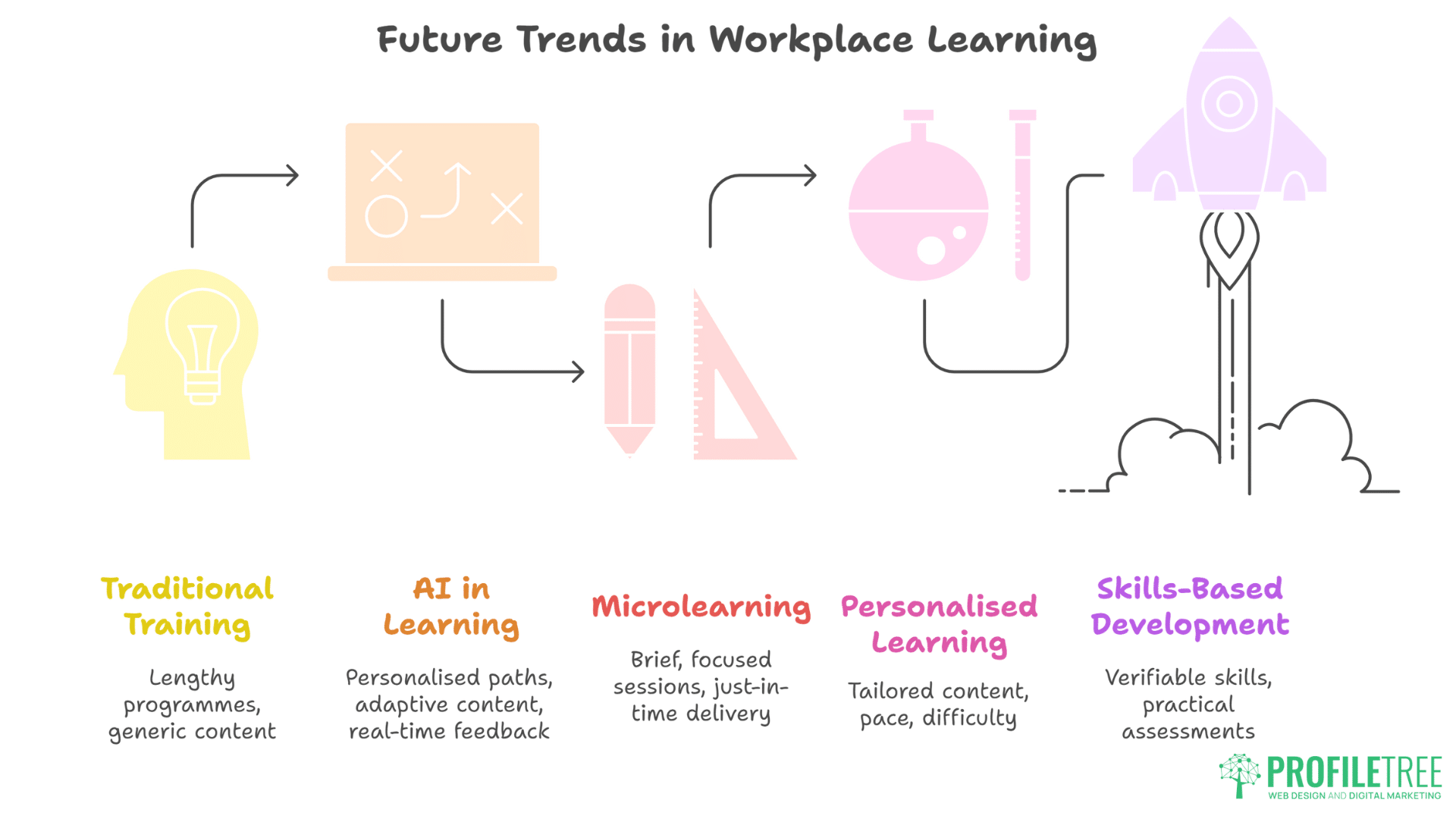
Personal development approaches continue evolving. Understanding emerging trends helps you prepare for future learning paradigms and stay ahead in your professional development journey.
Artificial Intelligence in Learning
AI increasingly influences workplace learning. Intelligent systems can assess skills, recommend personalised learning paths, provide adaptive content, and offer real-time feedback. These technologies make learning more efficient and targeted.
At ProfileTree, we specialise in AI implementation for businesses across Northern Ireland and the UK. With over 750,000 learners on our YouTube channels and thousands trained in-person, we’re not just trainers—we’re practitioners who’ve built successful digital businesses.
Our comprehensive AI training programmes help organisations adopt AI tools appropriately, including AI-enhanced learning systems. We focus on practical implementation rather than theoretical possibilities—showing businesses exactly how AI can improve their operations. Our training delivers 40% productivity gains within six months for most organisations.
AI-powered learning platforms can:
- Assess current skill levels accurately
- Identify specific knowledge gaps
- Recommend precise learning resources
- Adapt content difficulty based on performance
- Provide instant feedback on exercises
- Predict future skill requirements based on career goals
These capabilities personalise learning in ways previously impossible at scale. However, technology supplements rather than replaces human elements like mentoring, coaching, and collaborative learning.
Microlearning and Just-in-Time Training
Attention spans shorten. Work intensifies. These realities favour brief, focused learning sessions over lengthy training programmes. Microlearning—delivering content in small, specific chunks—aligns with modern working patterns.
Just-in-time training provides exactly the information needed precisely when needed. Rather than comprehensive upfront training covering everything someone might eventually need, just-in-time approaches deliver specific knowledge at the point of application.
This approach proves remarkably effective for technical skills and procedural knowledge. When facing an unfamiliar task, brief targeted training enables immediate application rather than requiring extensive advance preparation.
Personalised Learning Pathways
One-size-fits-all training gives way to personalised learning journeys. Modern learning platforms can tailor content, pace, and difficulty to individual needs, prior knowledge, and learning styles.
Personalisation improves both efficiency and effectiveness. Learners skip content they’ve already mastered, focus more time on challenging concepts, and follow paths aligned with their specific roles and goals.
Creating personalised learning requires a sophisticated assessment of current capabilities and a clear definition of target competencies. The gap between these points determines the specific learning journey most appropriate for each individual.
Skills-Based Hiring and Development
Many organisations shift towards skills-based approaches rather than traditional credential-focused hiring. This trend emphasises demonstrated capabilities over formal qualifications.
For professionals, this shift means personal development should focus on building verifiable skills with concrete evidence of competence. Portfolios, project examples, certifications with practical assessments, and measurable achievements become more valuable than simply listing courses completed.
This evolution democratises opportunity—capable individuals without traditional qualifications can demonstrate their competencies directly. It also emphasises continuous skill development over static credentialing.
Remote and Hybrid Learning
Remote working normalisation extends to professional development. Digital learning platforms, virtual workshops, and remote mentoring enable personal development regardless of location.
For UK businesses, this geographical independence provides advantages. Belfast-based companies can access training providers anywhere. Remote workers receive development opportunities equal to office-based staff. Global expertise becomes accessible through virtual delivery.
However, effective remote learning requires different approaches than in-person training. Engagement strategies, interaction methods, and assessment techniques must adapt to virtual environments. The most effective digital learning combines self-paced content with live interactive sessions for discussion, practice, and community building.
Personal Development at Work: Commit to Continuous Growth
Personal development isn’t a project with a clear endpoint—it’s an ongoing professional commitment. Technology evolves. Industries change. Best practices develop. Markets shift. Continuous learning maintains relevance and competitiveness throughout your career.
Cultivate genuine curiosity about your field. Read industry publications. Attend professional events. Participate in online communities. Stay aware of emerging trends and evolving practices.
This mindset transforms work from mere employment into a continuing education opportunity. Every project becomes a learning experience. Every challenge offers development potential. Every interaction provides insights.
Personal development in your workplace ultimately determines both your career trajectory and your daily job satisfaction. Professionals who commit to continuous growth navigate change more successfully, access better opportunities, and find greater fulfilment in their work.
The question isn’t whether to invest in personal development—it’s whether you’ll approach it systematically or haphazardly. Structured, intentional development yields far better results than relying on accidental growth. To take your personal development to the next level, consider enrolling in corporate behavioral training courses or team workshops focused on emotional intelligence, communication, collaboration and conflict resolution.
Your professional development journey begins with a single decision: committing to growth. Everything else—plans, resources, strategies, support—flows from that fundamental commitment.
FAQs about Personal Development in Your Workplace
What are good personal development goals for the workplace?
Effective workplace development goals include mastering specific technical skills relevant to your role, developing leadership or management capabilities, improving communication effectiveness, gaining industry certifications, enhancing data analysis skills, learning new software or technologies, building emotional intelligence, or improving time management and productivity.
How can I find time for personal development when working full-time?
Find personal development time by scheduling protected blocks in your calendar, even just 30 minutes daily. Use microlearning approaches with brief, focused sessions. Integrate learning with work through relevant projects. Listen to educational podcasts during commutes. Read industry content during breaks.
What digital training workshops are most valuable for professional development?
Valuable digital training workshops include SEO and digital marketing fundamentals, data analytics and visualisation, AI implementation for business applications, project management methodologies, leadership and communication skills, web development basics, social media strategy, and content creation.
How do I measure personal development success?
Measure personal development through progress against specific goals, improved work performance indicators, positive feedback from colleagues and managers, increased responsibilities, career advancement, certifications achieved, successful project applications of new skills, and enhanced efficiency.
How is AI changing workplace personal development?
AI enables personalised learning paths, adaptive content difficulty, instant feedback, accurate skill assessments, and just-in-time training delivery. AI-powered platforms can identify knowledge gaps precisely and recommend specific resources.
What’s the difference between personal development and professional development?
Personal development encompasses all aspects of self-improvement, including emotional intelligence, relationships, well-being, and life skills. Professional development specifically focuses on capabilities, knowledge, and skills relevant to career advancement and workplace effectiveness.
Ready to transform your team’s capabilities?Book a free training consultation to discuss your specific development needs and discover how our programmes can drive measurable business growth. Contact our Belfast team today at 028 9568 0364 or hello@profiletree.com.