
Machine Learning Explained: From Basic Concepts to Business Impact
Table of Contents
Every day, your smartphone predicts the next word you’ll type. Banks detect fraudulent transactions in milliseconds. Your email filters spam before you see it. Self-driving cars navigate complex traffic. Virtual assistants understand your voice commands. Behind these everyday experiences lies machine learning—technology that’s no longer the exclusive domain of tech giants.
A Belfast retailer recently cut customer churn by 28% using predictive analytics. A Dublin logistics company reduced delivery costs by 23% through route optimisation. An Edinburgh consultancy automated 60% of its client reporting. These aren’t Fortune 500 companies with unlimited budgets—they’re SMEs applying machine learning strategically to solve specific business problems.
If you’re a business owner, marketing manager, or decision-maker exploring how intelligent technologies can drive growth, this guide breaks down machine learning in practical terms. You’ll discover what machine learning is, how it works, and—most importantly—how your organisation can benefit from these transformative capabilities.
Whether you’re curious about AI training opportunities or evaluating digital transformation strategies, understanding machine learning explained through real-world applications helps you make informed decisions that deliver measurable returns.
What is Machine Learning? Core Concepts for Business Leaders
Machine learning explained simply: it’s a method of teaching computers to learn from data without being explicitly programmed for every task. Think of it like teaching a child: instead of giving them a strict set of rules for every situation, you provide examples, and they learn to recognise patterns and make decisions on their own. Similarly, machine learning systems analyse patterns in information and make decisions based on what they’ve learned.
Traditional programming requires developers to write specific instructions for every scenario. For example, if you want software to identify spam emails, you’d create rules like “if the message contains ‘free money’ and ‘urgent action,’ flag it as spam.” This approach struggles with the countless variations that spam takes.
Machine learning takes a different path. You provide a model with thousands of emails—some spam, some legitimate—and it learns to distinguish between them by identifying patterns humans might miss. The system improves its accuracy as it processes more examples, adapting to new spam techniques without manual rule updates.
Consider how this applies to business operations. A traditional customer service system follows decision trees: if the customer asks X, provide answer Y. A machine learning system analyses thousands of customer interactions, learns which responses resolve issues effectively, and suggests personalised solutions based on context, previous interactions, and successful outcomes with similar queries.
This learning capability extends across business functions:
- Customer Analysis: Instead of grouping customers by the demographic categories you define, machine learning can identify natural segments based on behaviour patterns, purchase timing, and engagement preferences you hadn’t considered.
- Inventory Forecasting: Rather than relying on seasonal averages, ML systems analyse weather patterns, local events, economic indicators, and historical data to predict demand with greater precision.
- Content Performance: Machine learning can analyse which blog posts, videos, or social media content drives conversions, identifying subtle factors like tone, length, or timing that influence audience engagement.
For businesses in Belfast and across the UK, this technology represents an opportunity to compete more effectively by making smarter, data-informed decisions at scale.
Types of Machine Learning Explained: Different Approaches
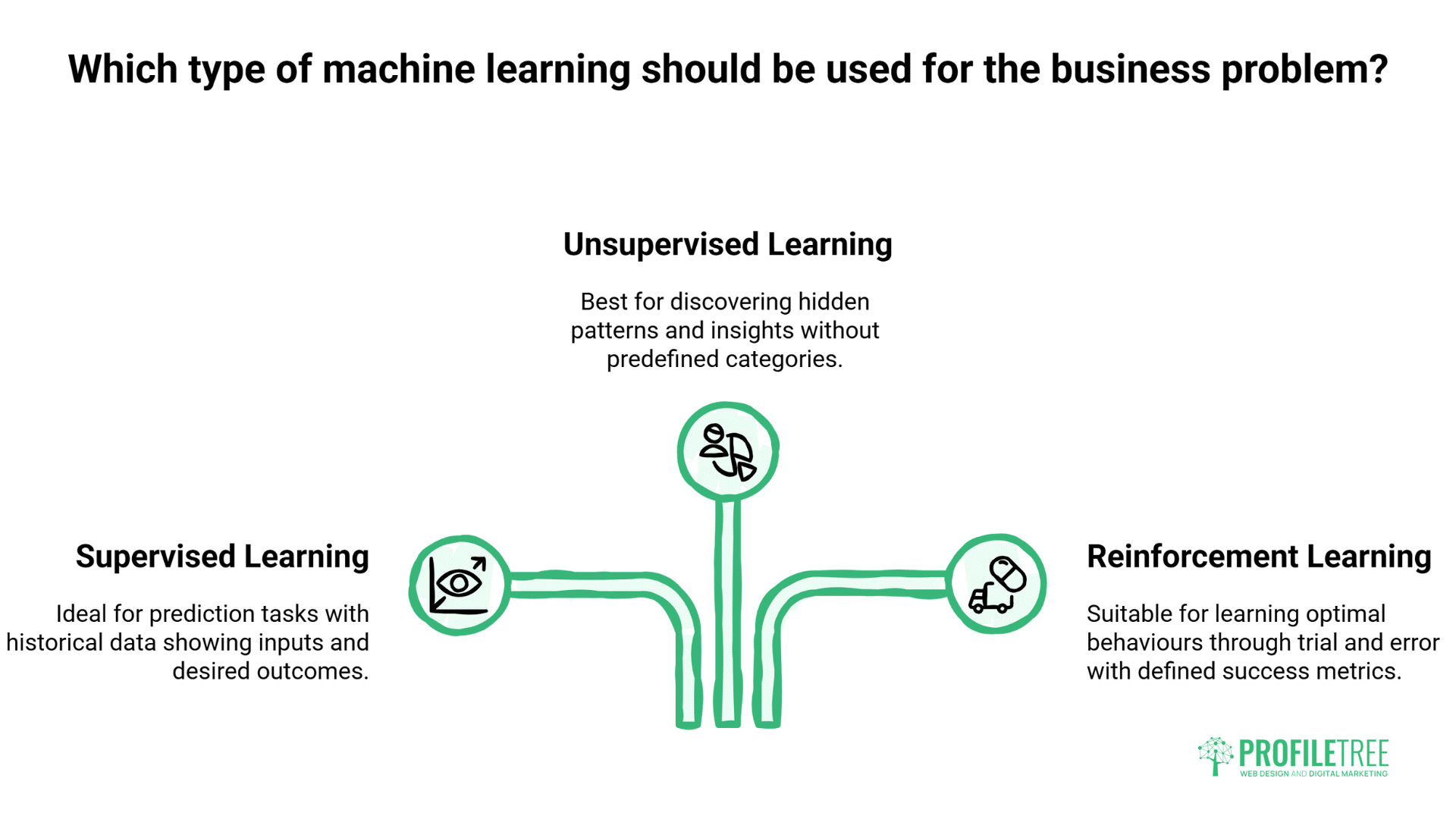
To use machine learning effectively, you need to understand the three primary types, each solving different business problems.
Supervised Learning: Learning from Labelled Examples
Supervised learning is the most widely used approach in business applications. The system learns from a dataset where inputs are matched with correct outputs. It then applies this knowledge to new situations.
How It Works in Practice:
A retail business wants to predict customer churn. You provide the system with historical data showing customer behaviour (purchase frequency, support tickets, engagement patterns) alongside outcomes (whether they stayed or left). The model learns which factors indicate churn risk and flags at-risk customers before they leave.
Business Applications:
- Lead Scoring: Predicting which prospects are most likely to convert based on their behaviour, demographics, and engagement patterns
- Price Optimisation: Forecasting optimal pricing based on demand, competition, and customer willingness to pay
- Quality Control: Identifying defective products in manufacturing by learning from images of good and faulty items
- Email Classification: Automatically categorising customer emails by urgency, topic, or department
Supervised learning excels when you have historical data showing both inputs and desired outcomes. This makes it ideal for prediction tasks where past patterns inform future decisions.
Unsupervised Learning: Discovering Hidden Patterns
Unsupervised learning works with unlabelled data, finding structures and relationships without predefined categories. This approach uncovers insights you might not know to look for.
How It Works in Practice:
An online retailer has customer transaction data but no predetermined groupings. An unsupervised learning algorithm analyses purchase patterns, browsing behaviour, and timing to identify natural customer segments. It might discover groups like “weekday morning browsers who buy within 24 hours” or “weekend researchers who compare extensively before purchasing”—segments defined by behaviour rather than demographics.
Business Applications:
- Customer Segmentation: Identifying natural groupings for targeted marketing without assuming categories upfront
- Anomaly Detection: Spotting unusual patterns in financial transactions, system logs, or user behaviour that might indicate fraud or technical issues
- Market Basket Analysis: Discovering which products customers frequently purchase together, informing cross-selling strategies
- Content Organisation: Grouping documents, images, or products by similarity to improve search and recommendations
This approach is particularly valuable when entering new markets or launching new products, where historical patterns are lacking to guide decisions.
Reinforcement Learning: Learning Through Trial and Error
Reinforcement learning involves an agent learning optimal behaviours by performing actions and receiving feedback. The system tries different approaches, receives rewards for successful actions, and learns which strategies work best.
How It Works in Practice:
A logistics company wants to optimise delivery routes. The system starts with basic knowledge about roads and delivery points. It tries different route combinations, receives “rewards” for faster deliveries and fuel efficiency, and receives “penalties” for delays or exceeded budgets. Over time, it learns sophisticated strategies that account for traffic patterns, weather conditions, and vehicle capacity.
Business Applications:
- Dynamic Pricing: Learning optimal pricing strategies that respond to demand, competition, and inventory levels in real-time
- Resource Allocation: Optimising staff schedules, warehouse operations, or manufacturing processes through continuous improvement
- Advertising Optimisation: Learning which ad placements, bidding strategies, and creative combinations generate the best return
- Chatbot Development: Creating customer service bots that improve responses based on which answers successfully resolve issues
Reinforcement learning suits scenarios where you can define success metrics but don’t have a dataset of “correct” actions to learn from.
Key Machine Learning Algorithms: From Theory to Application
Understanding core ML concepts means getting familiar with the algorithms that power machine learning systems. Here’s how the most common algorithms work and when to apply them.
Linear Regression: Predicting Continuous Values
Linear regression finds relationships between variables to predict numerical outcomes. It’s one of the simplest algorithms, but it remains widely used for business forecasting.
Business Use Case:
A manufacturing company wants to predict maintenance costs based on machine age, usage hours, and production volume. Linear regression analyses historical data to create a formula that estimates costs for any combination of these factors, helping with budget planning and identifying machines that need replacement.
When to Use It:
- Forecasting sales, revenue, or costs
- Predicting customer lifetime value
- Estimating project timelines or resource needs
- Any scenario where you’re predicting a number based on other numbers
Limitations:
Linear regression assumes relationships between variables follow straight lines. Real-world business data often has more complex patterns, requiring more sophisticated approaches.
Logistic Regression: Classification and Decision Making
Despite its name, logistic regression solves classification problems—deciding which category a given item belongs to. It predicts the probability of an outcome occurring.
Business Use Case:
An e-commerce business wants to predict whether visitors will complete a purchase. Logistic regression analyses factors like time on site, pages viewed, previous purchases, and cart value to calculate the probability of conversion. Visitors with high conversion probability might receive special offers, while those with low probability might get targeted re-engagement campaigns.
When to Use It:
- Customer churn prediction (will they leave or stay?)
- Credit risk assessment (will they repay or default?)
- Click-through rate prediction (will they click this ad?)
- Any yes/no or category decision based on multiple factors
Decision Trees: Visual Decision-Making Models
Decision trees create flowchart-like structures representing decisions and their possible consequences. Each branch represents a choice, and each leaf represents an outcome.
Business Use Case:
A customer service team wants to route support tickets efficiently. A decision tree learns from past tickets: “If the issue type is ‘billing’ and customer value is ‘high,’ route to senior support. If issue type is ‘technical’ and product is ‘mobile app,’ route to technical team.” The tree grows more sophisticated as it learns from thousands of tickets, creating optimal routing logic.
When to Use It:
- Situations requiring explainable decisions (you can show exactly why the system made a choice)
- Problems with clear if-then logic
- Scenarios where different factors have varying importance
- Applications requiring quick predictions without extensive computation
Advantages for Business:
Decision trees are interpretable—you can trace the exact path of how a decision was made. This transparency is crucial for regulatory compliance, customer communication, or internal audits.
Random Forests: Collective Decision Making
Random forests combine multiple decision trees, with each tree making a prediction and the final decision based on a majority vote. This “wisdom of crowds” approach reduces errors.
Business Use Case:
A recruitment platform predicts which candidates are most likely to succeed in specific roles. Rather than relying on a single decision tree that might overfit to patterns in the training data, a random forest uses hundreds of trees, each trained on slightly different data. Some trees might weigh technical skills heavily, others focus on experience, and others on personality traits. The combined prediction is more accurate than any single tree.
When to Use It:
- High-stakes decisions requiring maximum accuracy
- Data with many variables, where some might be noisy or irrelevant
- Scenarios where single model errors could be costly
- Applications where model interpretability is less critical than performance
K-Means Clustering: Finding Natural Groups
K-means clustering groups data points into clusters based on similarity. You specify how many groups you want, and the algorithm assigns each item to the most appropriate cluster.
Business Use Case:
A digital marketing agency analyses website visitor behaviour without predetermined categories. K-means clustering identifies groups: one cluster might be “mobile users who browse blog content during commutes,” another “desktop users who research services during business hours,” and another “weekend visitors who watch video content.” Each group receives tailored content and marketing messages.
When to Use It:
- Customer segmentation for targeted marketing
- Product categorisation for improved navigation
- Identifying market niches or opportunities
- Anomaly detection by flagging items that don’t fit any cluster
Neural Networks: Pattern Recognition at Scale
Neural networks, inspired by the human brain, consist of layers of interconnected nodes that process information. They excel at recognising complex patterns in images, text, and speech.
Business Use Case:
A property management company receives hundreds of maintenance requests via email, photos, and text messages. A neural network analyses these inputs—reading text descriptions, examining damage photos, and categorising urgency. It routes requests automatically, predicts repair costs, and schedules appropriate contractors, reducing response time from hours to minutes.
When to Use It:
- Image recognition (identifying products, detecting defects, analysing visual content)
- Natural language processing (understanding customer feedback, analysing sentiment, extracting information from documents)
- Speech recognition (transcribing calls, voice commands)
- Complex pattern recognition where rules are difficult to define
Considerations:
Neural networks require substantial training data and computational resources. For many business applications, simpler algorithms deliver better return on investment.
Machine Learning Applications: Transforming Business Operations
Machine learning is reshaping how businesses operate across sectors. Here’s how organisations in Northern Ireland, Ireland, and the UK are applying these technologies.
Marketing and Customer Experience
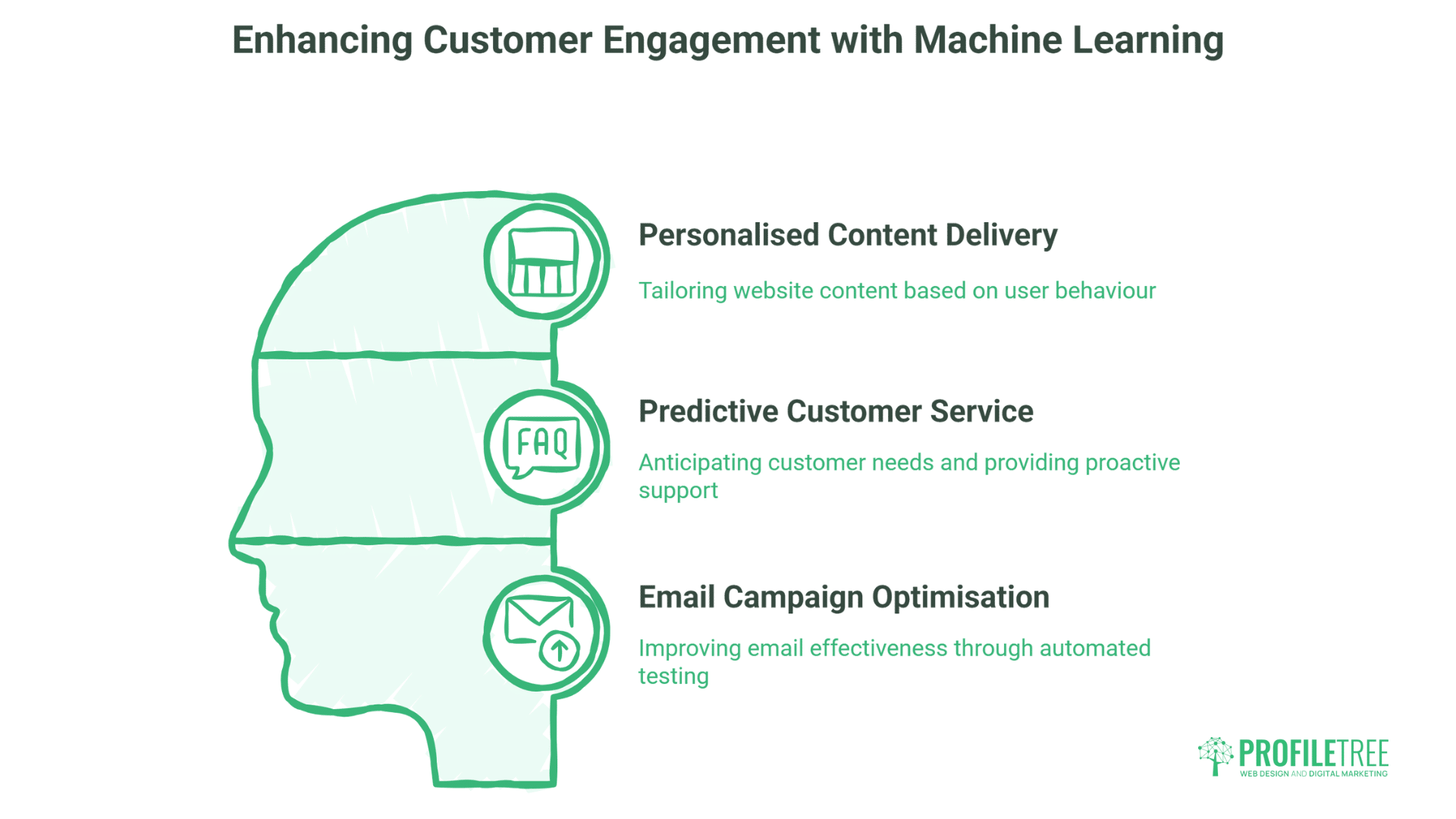
Machine learning has revolutionised how businesses understand and engage customers.
Personalised Content Delivery
Rather than showing all visitors the same website content, ML systems analyse behaviour in real-time and adjust what people see. A visitor researching pricing information sees case studies and ROI calculators, while someone browsing service descriptions sees detailed technical specifications.
ProfileTree implements these intelligent content strategies for clients across Belfast and beyond, helping businesses deliver the right message to the right person at the right time. By analysing visitor patterns, we create dynamic websites that adapt to user intent, improving conversion rates without requiring manual segmentation.
Predictive Customer Service
Machine learning analyses support ticket history, product usage patterns, and customer behaviour to predict when users might need help. Proactive outreach—sending helpful resources or offering assistance before customers encounter problems—reduces support costs whilst improving satisfaction.
Email Campaign Optimisation
ML systems test different subject lines, sending times, and content variations, learning which combinations drive opens, clicks, and conversions for different audience segments. This continuous optimisation beats manual A/B testing by evaluating thousands of variations simultaneously.
Sales and Lead Management
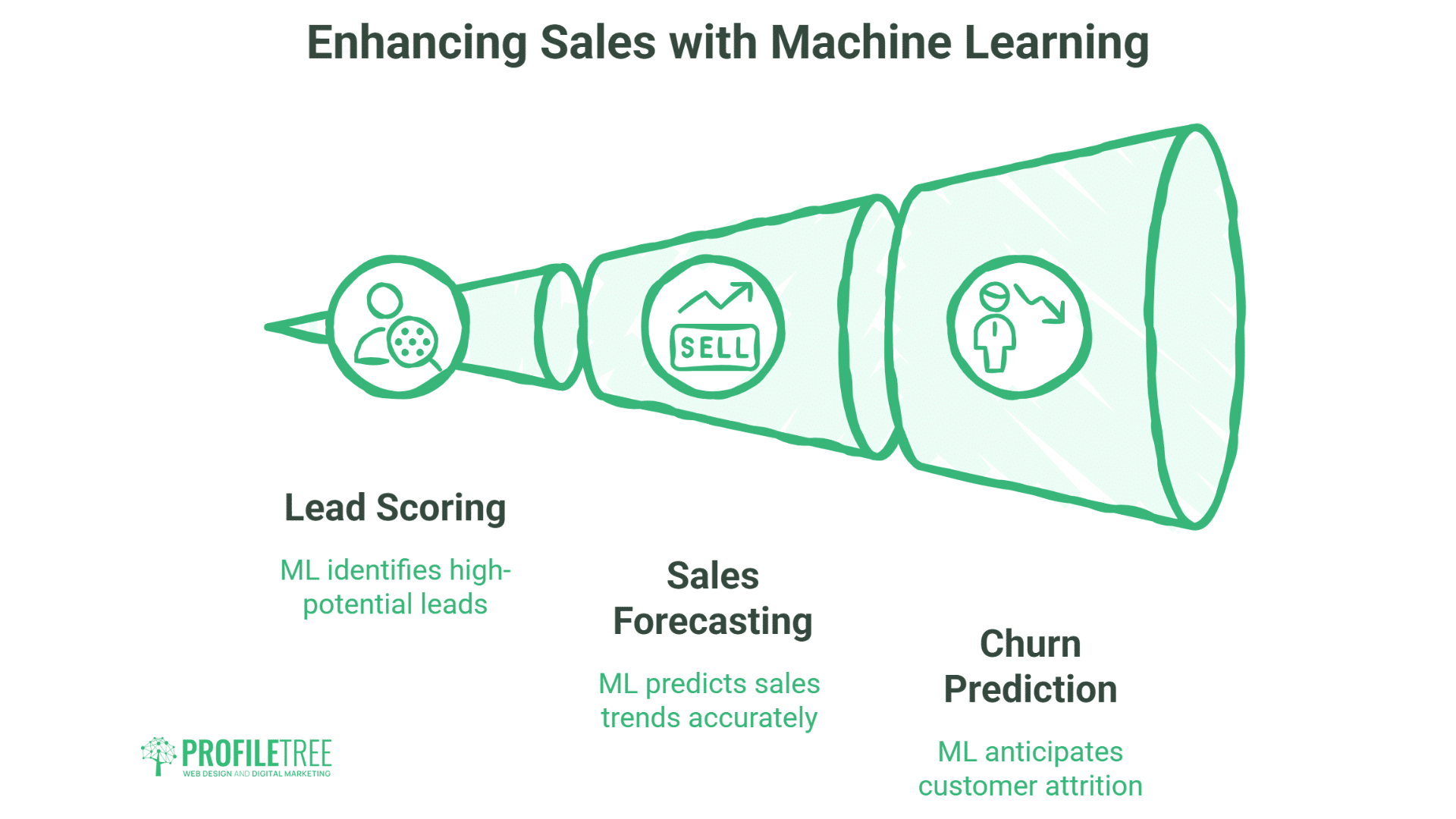
Machine learning helps sales teams focus their efforts where it matters most.
Lead Scoring and Prioritisation
Traditional lead scoring assigns points based on demographic data and basic behaviours. ML-powered lead scoring analyses hundreds of signals—website engagement patterns, email responses, social media interactions, similar customers who converted—to predict which leads are most likely to close.
A Belfast-based B2B company implementing ML lead scoring saw their sales team’s conversion rate improve by 34% within three months. The system identified patterns humans missed: leads who viewed pricing pages multiple times but never downloaded resources were actually more qualified than those who downloaded everything but never visited pricing.
Sales Forecasting
Machine learning improves forecast accuracy by considering variables that traditional methods ignore: market conditions, competitor activity, seasonal patterns, individual sales rep performance, and deal-specific factors. More accurate forecasts mean better resource allocation, inventory planning, and strategic decisions.
Customer Churn Prediction
ML models identify customers at risk of leaving before obvious warning signs appear. These predictions enable retention campaigns targeting specific concerns, potentially saving valuable customer relationships.
Operations and Efficiency
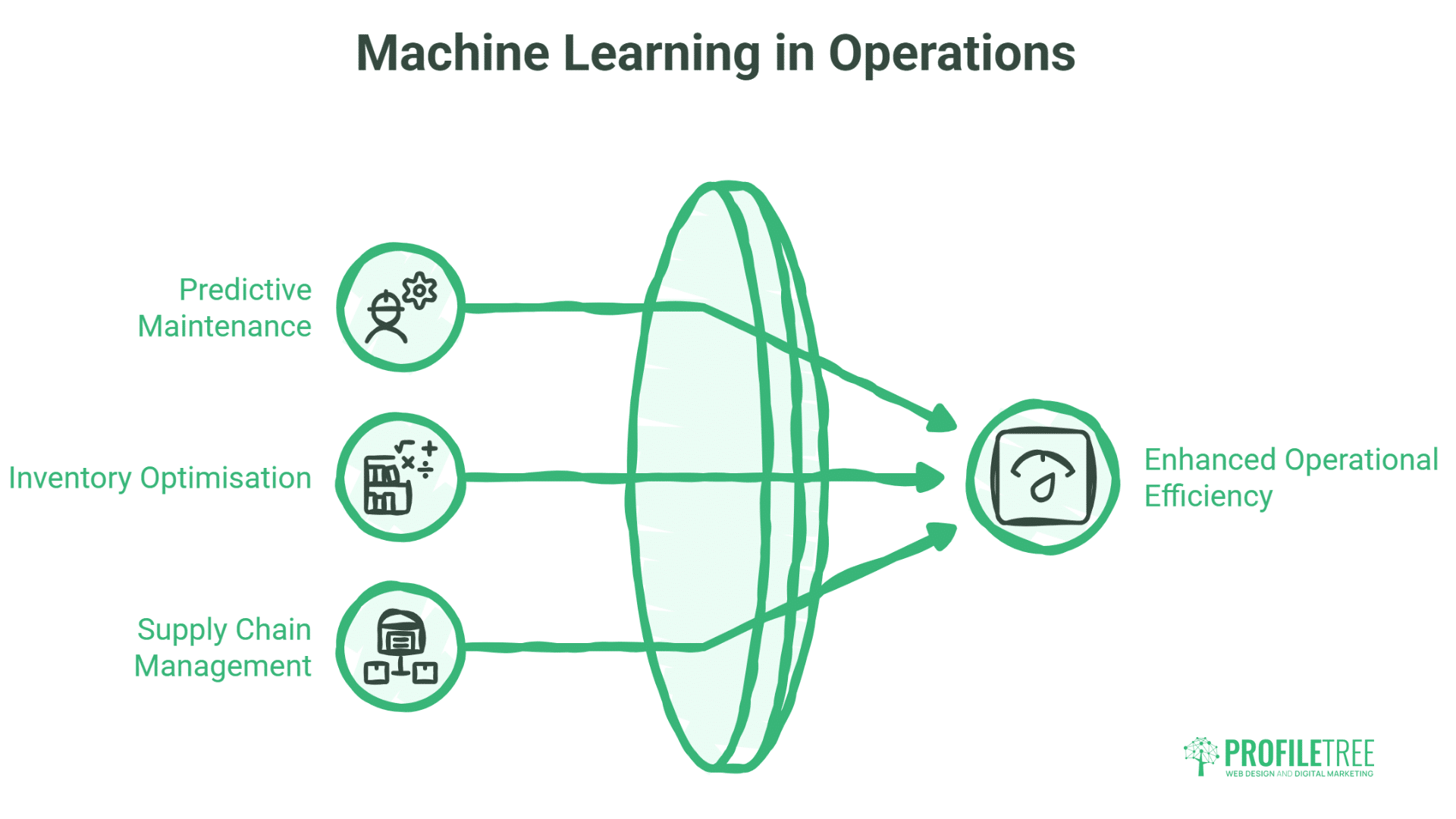
Operational applications of machine learning deliver measurable cost savings and productivity gains.
Predictive Maintenance
Equipment failures disrupt production and incur emergency repair costs. ML systems analyse sensor data, usage patterns, and historical maintenance records to predict when machines will need attention. Scheduling maintenance during planned downtime prevents unexpected breakdowns.
Inventory Optimisation
Balancing inventory levels—avoiding both stockouts and excess inventory costs—challenges retailers and manufacturers. ML systems forecast demand by analysing sales history, seasonal patterns, promotional calendars, weather forecasts, and economic indicators. These sophisticated predictions reduce carrying costs whilst maintaining product availability.
Supply Chain Management
Machine learning optimises logistics by predicting delivery times, identifying bottlenecks, and suggesting alternative routes or suppliers when disruptions occur. Real-time adjustments based on current conditions improve efficiency and customer satisfaction.
Content Creation and Digital Marketing
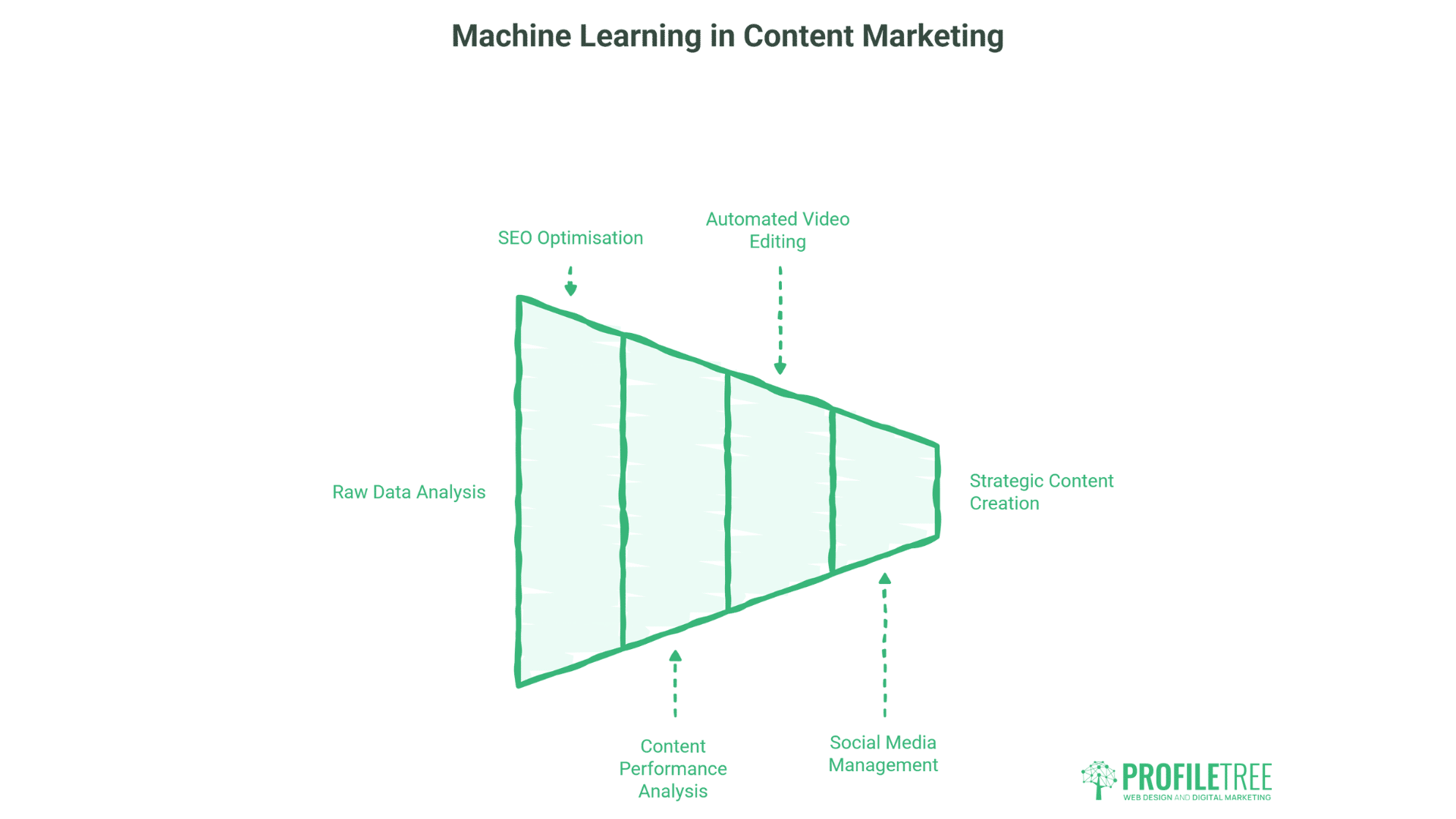
The digital marketing landscape has been transformed by machine learning capabilities.
Search Engine Optimisation
Google’s search algorithms use machine learning to understand user intent and deliver relevant results. SEO strategies must account for these intelligent systems. ProfileTree’s SEO services help businesses in Northern Ireland and across the UK adapt to algorithmic changes, using data analysis to identify ranking opportunities and content gaps.
Content Performance Analysis
ML systems analyse which blog posts, videos, and social media content drive engagement and conversions. These insights inform content strategy, identifying topics, formats, and distribution channels that resonate with target audiences.
Automated Video Editing
Machine learning tools can analyse raw video footage, identifying highlights, removing pauses, and creating rough cuts. Whilst human creativity remains essential, these tools accelerate production workflows. ProfileTree’s video production services combine ML-assisted editing with creative expertise, delivering professional content efficiently.
Social Media Management
ML-powered tools analyse when audiences are most active, which content types perform best, and even suggest optimal posting schedules. Sentiment analysis capabilities track brand perception by analysing comments, reviews, and social media mentions.
Web Design and User Experience
Machine learning is changing how websites are designed and how users interact with them.
A/B Testing Automation
Traditional A/B testing compares two variations. ML-powered multivariate testing evaluates numerous combinations simultaneously, quickly identifying optimal designs for different user segments.
Chatbots and Virtual Assistants
Modern chatbots use machine learning to understand natural language, learn from interactions, and provide helpful responses without human intervention. These systems handle routine enquiries, freeing staff for complex issues.
Accessibility Improvements
ML systems can automatically generate alt text for images, create video captions, and suggest design improvements that make websites more accessible to users with disabilities.
ProfileTree builds websites that incorporate intelligent features suited to each business’s needs. From predictive search to personalised navigation, we help clients throughout Northern Ireland create digital experiences that adapt to users.
Implementing Machine Learning: A Practical Guide for SMEs
Understanding machine learning concepts is one thing; implementing these technologies in your business is another. Here’s how to approach ML adoption strategically.
Assessing Your ML Readiness
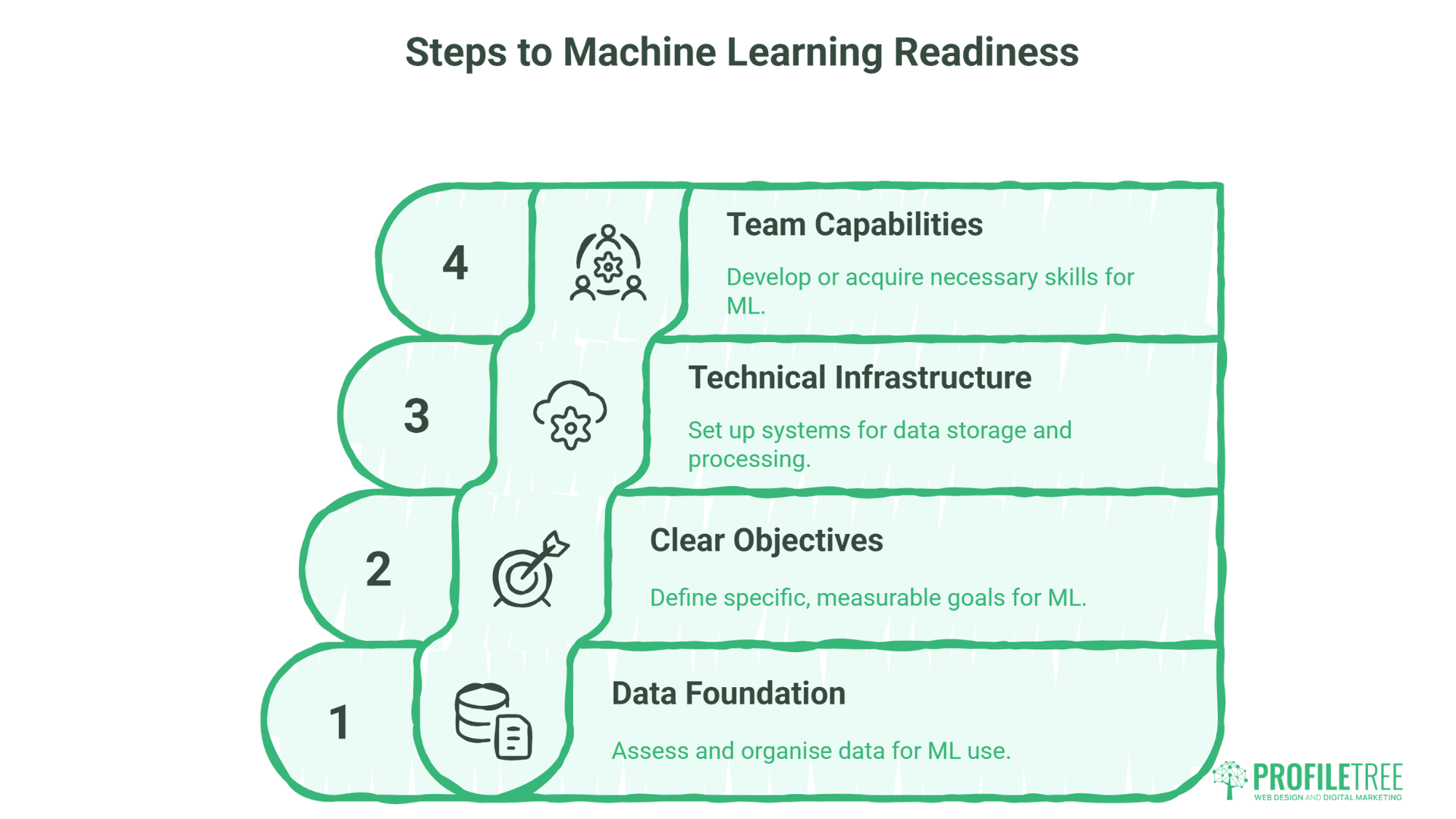
Before investing in machine learning, evaluate whether your organisation is prepared.
Data Foundation
Machine learning requires data—preferably lots of it. Assess what you have:
- Customer information (purchase history, interactions, preferences)
- Operational data (sales figures, inventory levels, production metrics)
- Digital analytics (website traffic, user behaviour, conversion paths)
- Communication records (support tickets, email exchanges, social media interactions)
If your data is scattered across disconnected systems, inconsistently formatted, or poorly documented, you’ll need to address these issues before ML implementation produces meaningful results.
Clear Objectives
Define what you want to achieve. “Implement AI” isn’t a goal; “reduce customer churn by 15% through predictive modelling” is. Specific, measurable objectives guide technology choices and success evaluation.
Technical Infrastructure
Machine learning doesn’t necessarily require extensive infrastructure, but you need systems for data storage, processing, and deployment. Cloud platforms like AWS, Google Cloud, or Azure provide machine learning services without upfront hardware investments, making these technologies accessible to SMEs.
Team Capabilities
Successful ML implementation requires diverse skills:
- Data analysis capabilities to prepare information and interpret results
- Technical knowledge to implement and maintain systems
- Domain expertise to identify opportunities and validate outputs
- Project management to coordinate implementation
You don’t need a full data science team initially. Many businesses start with external consultants or AI training programmes that build internal capabilities gradually.
Choosing the Right ML Projects
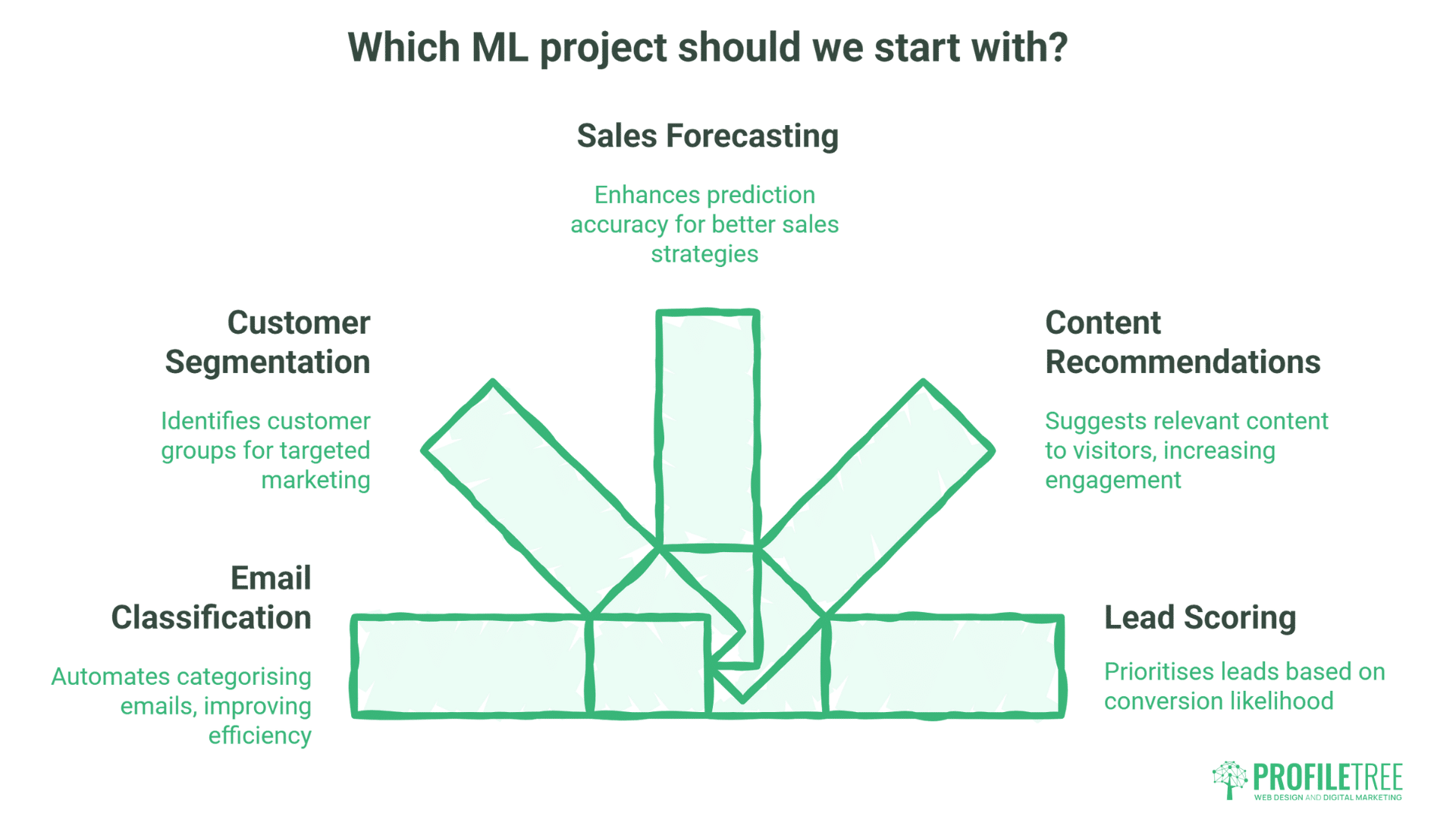
Start with projects that balance impact, feasibility, and learning value.
High-Value, Low-Complexity Starting Points
- Email classification: Automatically categorising customer enquiries by topic or urgency
- Customer segmentation: Identifying natural groupings for targeted marketing
- Sales forecasting: Improving prediction accuracy with ML-enhanced models
- Content recommendations: Suggesting relevant blog posts, products, or resources to website visitors
- Lead scoring: Prioritising sales opportunities based on conversion likelihood
These projects typically use readily available data, produce measurable results quickly, and provide experience without overwhelming complexity.
Ciaran Connolly, Director at ProfileTree, observes: “SMEs often approach AI implementation with either excessive caution or unrealistic expectations. The businesses seeing genuine value start with focused projects addressing specific pain points. They build confidence and capabilities through early wins before tackling more ambitious initiatives.”
Projects to Avoid Initially
- Applications requiring large amounts of specialised training data you don’t have
- High-stakes decisions where errors could be costly or dangerous
- Problems where transparency and explainability are critical but you lack expertise
- Solutions requiring extensive custom development when off-the-shelf alternatives exist
The Machine Learning Workflow for Business
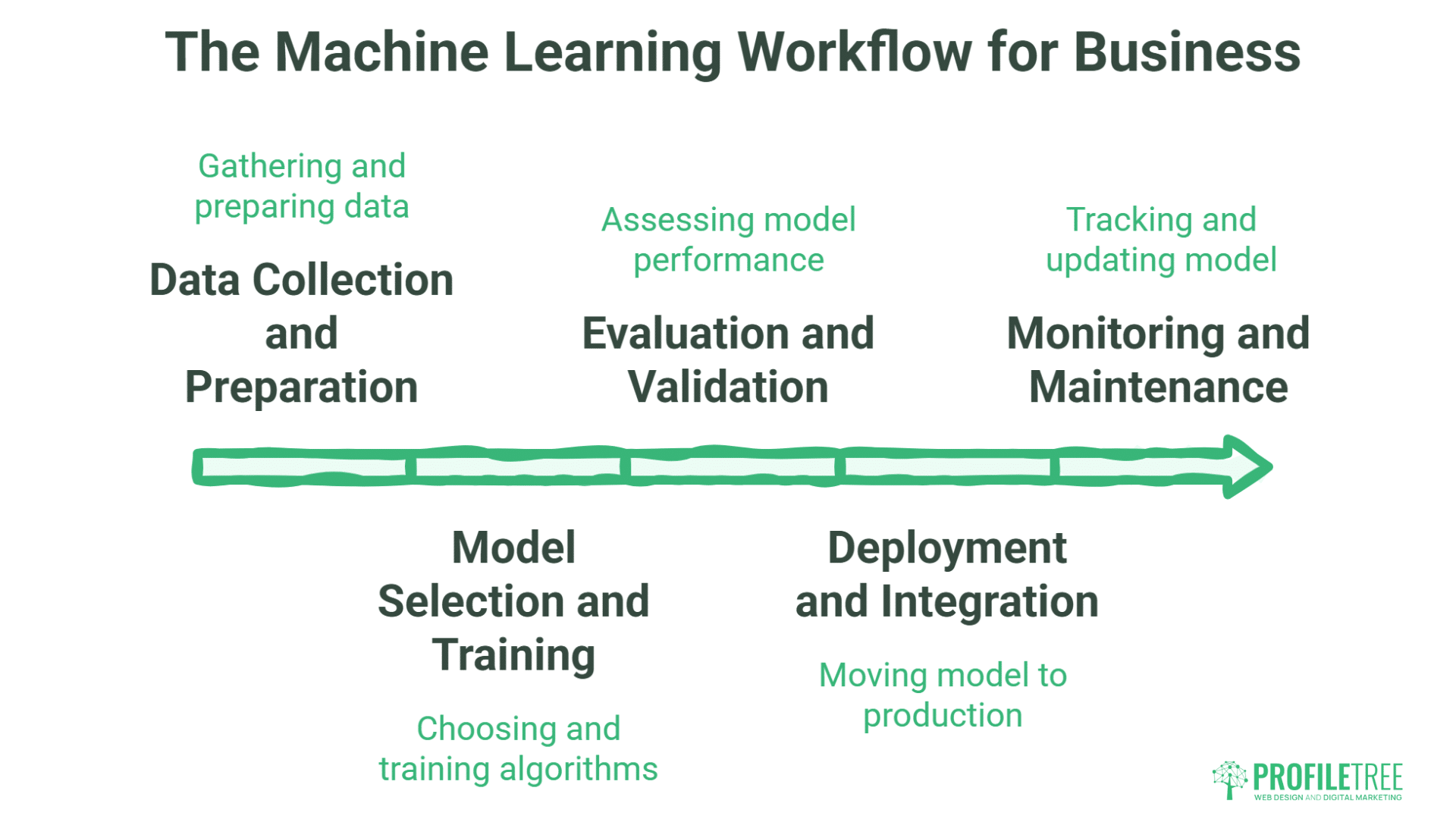
Implementing machine learning follows a structured process.
1. Data Collection and Preparation
Gather relevant data from all available sources. This might include:
- Transactional databases
- CRM systems
- Website analytics
- Email marketing platforms
- Social media metrics
- Customer support systems
Data rarely arrives in usable condition. Preparation involves:
- Cleaning: Removing duplicates, correcting errors, handling missing values
- Transformation: Converting data into consistent formats, standardising units, encoding categorical variables
- Feature Engineering: Creating new variables that might improve model performance (e.g., calculating customer lifetime value from transaction history)
This step typically consumes 60-80% of project time. Quality preparation determines model success.
2. Model Selection and Training
Choose appropriate algorithms based on your problem type (prediction, classification, clustering) and data characteristics. For business applications, start with simpler models—they’re easier to implement, faster to train, and often perform comparably to complex alternatives.
Training involves feeding your prepared data to the algorithm and allowing it to learn patterns. You’ll split data into training sets (to teach the model) and test sets (to evaluate performance on unseen data).
3. Evaluation and Validation
Assess model performance using relevant metrics:
- Accuracy: What percentage of predictions are correct?
- Precision and Recall: For classification problems, how many positive predictions are actually positive (precision), and how many actual positives does the model identify (recall)?
- Mean Squared Error: For regression problems, how far off are predictions on average?
More important than any single metric: does the model provide business value? A model with 85% accuracy that helps sales teams prioritise leads effectively is more valuable than a 95% accurate model that identifies patterns with no actionable application.
4. Deployment and Integration
Move your model from the development environment to production. This involves:
- Creating interfaces that allow other systems to access predictions
- Setting up monitoring to track performance over time
- Establishing protocols for human oversight and intervention
- Documenting how the system works for users and stakeholders
Deployment isn’t the end—it’s the beginning of the model’s working life.
5. Monitoring and Maintenance
ML models degrade over time as patterns in data change. Regular monitoring detects performance decay early:
- Track prediction accuracy on new data
- Monitor for data drift (changes in input data distribution)
- Watch for concept drift (changes in relationships between inputs and outputs)
Plan for periodic retraining with updated data to maintain model effectiveness.
Build vs Buy: Navigating ML Implementation Options
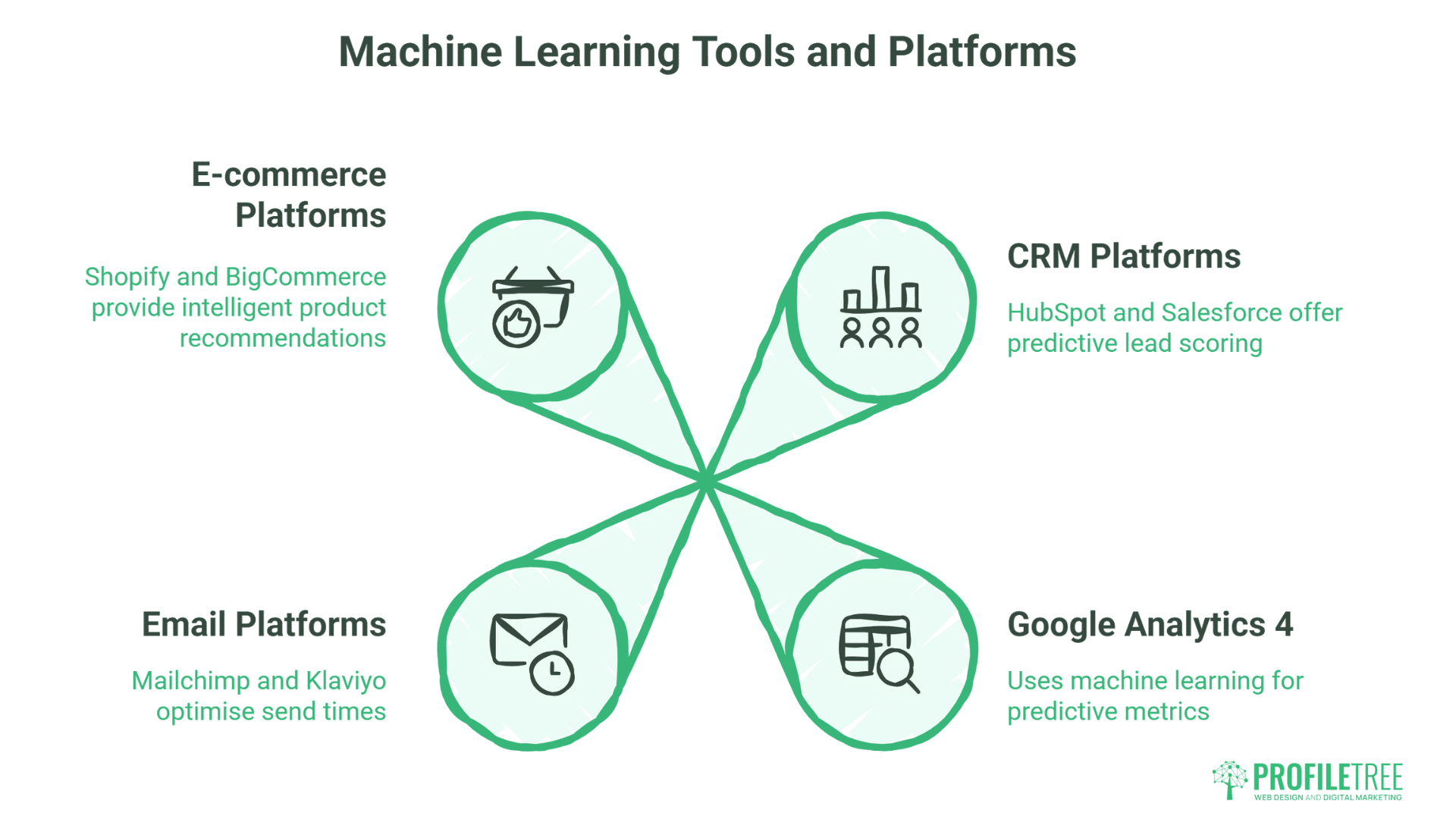
Businesses face a fundamental decision: build custom ML solutions or use existing platforms.
Pre-Built ML Tools and Platforms
Numerous services offer machine learning capabilities without requiring data science expertise:
- HubSpot, Salesforce: CRM platforms with built-in predictive lead scoring and forecasting
- Google Analytics 4: Uses ML for predictive metrics and anomaly detection
- Mailchimp, Klaviyo: Email platforms with ML-powered send time optimisation and content recommendations
- Shopify, BigCommerce:E-commerce platforms with intelligent product recommendations
Advantages
- Quick implementation
- Lower upfront cost
- Proven reliability
- Ongoing maintenance included
Limitations
- Generic solutions may not fit unique business needs
- Limited customisation
- Potential lock-in to specific platforms
Custom ML Development
Building tailored solutions offers maximum flexibility but requires greater investment.
When to Build Custom
- Your competitive advantage depends on proprietary algorithms
- You have unique data or domain requirements existing tools don’t address
- You need specific features or integrations unavailable in off-the-shelf solutions
- You have in-house expertise or budget for external development
ProfileTree’s AI implementation services help businesses evaluate these options. We assess whether existing tools meet your needs or whether custom development delivers sufficient additional value to justify investment. Our approach focuses on practical solutions that generate measurable returns.
AI Training and Capability Building
Technology alone doesn’t create value—you need people who understand how to apply it effectively.
Internal Training Approaches
Role-Based Learning:
- Marketing Teams: Training on ML-powered analytics tools, personalisation platforms, and automated campaign optimisation
- Sales Teams: Education on predictive lead scoring interpretation and CRM intelligence features
- Operations Staff: Instruction on forecasting systems, inventory optimisation, and predictive maintenance tools
- Leadership: Strategic overview of ML capabilities, limitations, and business implications
Progressive Skill Development
- Start with tool-specific training for platforms you’re already using
- Progress to understanding ML concepts and appropriate applications
- Advance to more technical skills for team members showing interest and aptitude
ProfileTree provides digital training and AI training workshops tailored to different roles and skill levels. We help teams throughout Northern Ireland understand not just how to use ML tools, but when to apply them and how to interpret results critically.
Ethical Considerations and Responsible AI
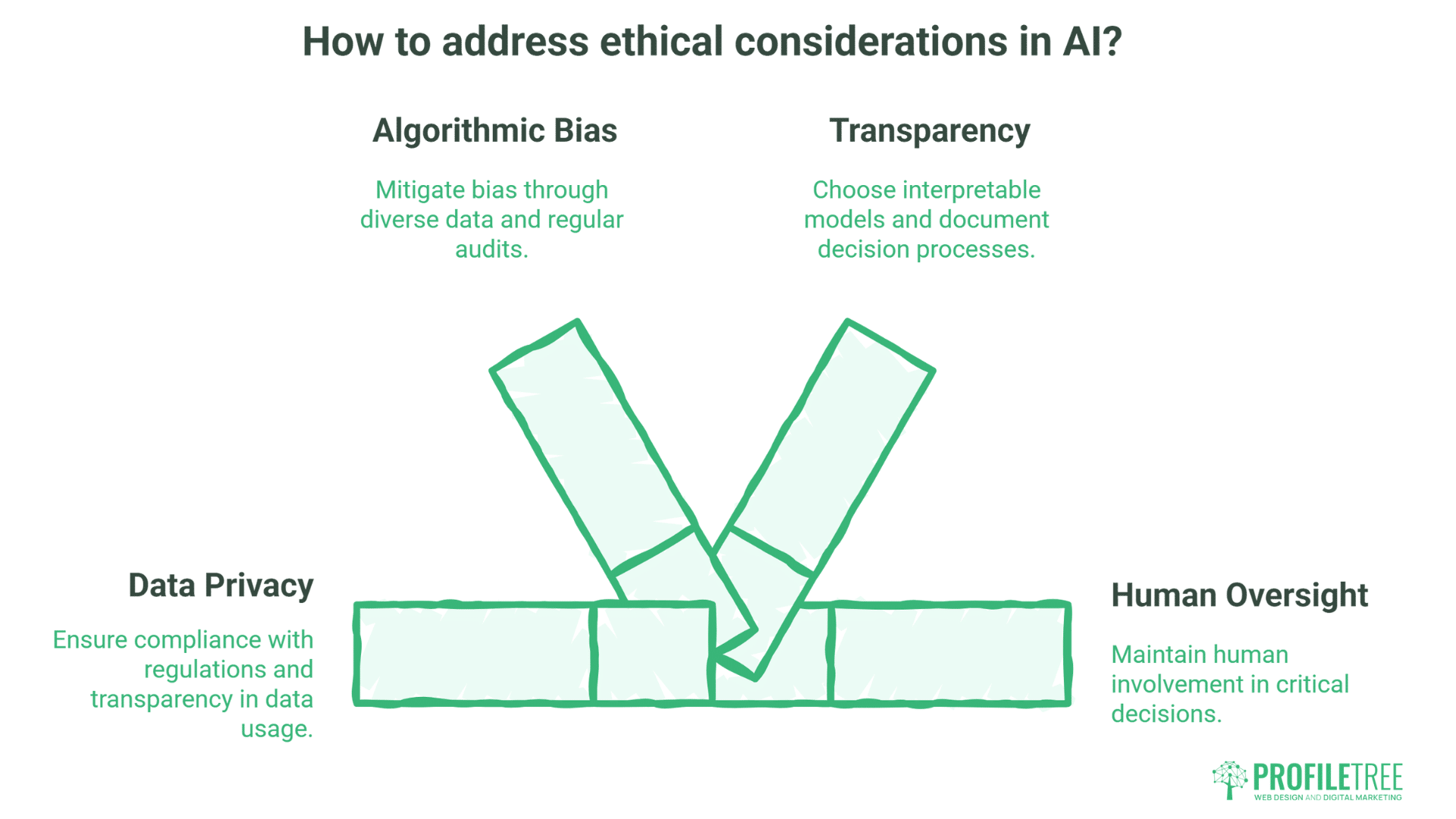
Machine learning raises important ethical questions businesses must address.
Data Privacy
ML systems often require personal information. Comply with GDPR and other privacy regulations by:
- Collecting only necessary data with clear consent
- Implementing strong security measures
- Providing transparency about data usage
- Offering customers control over their information
Algorithmic Bias
ML models learn from historical data. If that data reflects biases—discriminatory hiring practices, unequal service provision—models perpetuate these problems. Mitigate bias through:
- Diverse training data representing all relevant groups
- Regular audits checking for disparate outcomes
- Human oversight of high-stakes decisions
- Transparency about how models make decisions
Transparency and Explainability
Particularly in industries like finance, healthcare, or legal services, stakeholders need to understand why AI systems make specific decisions. Choose interpretable models where explanation is important, and document decision-making processes.
Human Oversight
ML systems should augment human decision-making, not replace it entirely. Maintain meaningful human involvement, particularly for consequential decisions affecting people’s lives, livelihoods, or wellbeing.
Measuring ROI from Machine Learning Investments
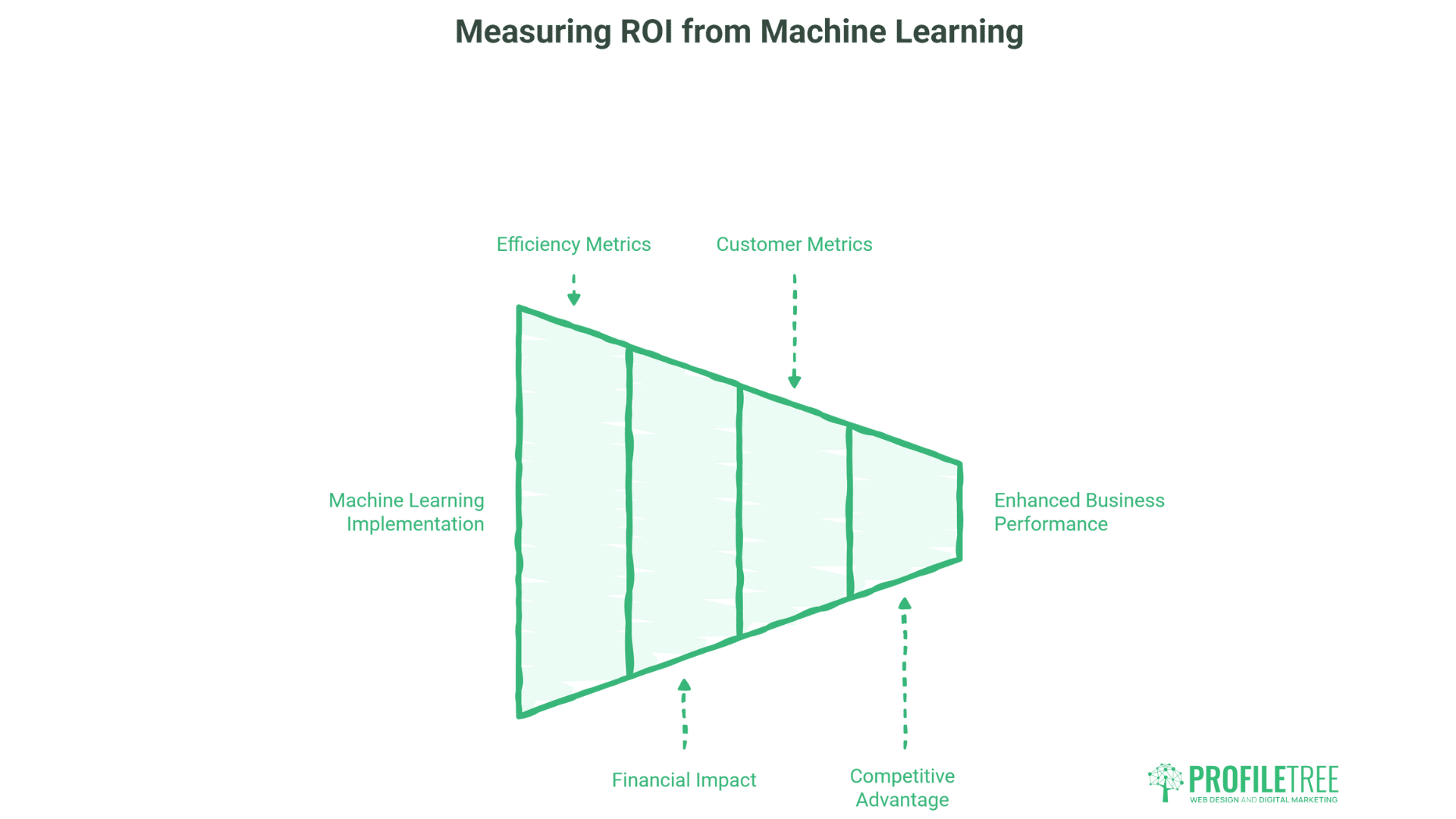
ML initiatives must deliver measurable value. Track these indicators:
Efficiency Metrics
- Time saved on repetitive tasks
- Reduced error rates compared to manual processes
- Faster decision-making cycles
Financial Impact
- Revenue increase from better targeting, personalisation, or forecasting
- Cost reduction through optimised operations or reduced waste
- Improved profit margins from dynamic pricing or inventory management
Customer Metrics
- Increased conversion rates
- Reduced churn
- Higher customer satisfaction scores
- Improved lifetime value
Competitive Advantage
- Market share gains
- Faster time-to-market for new offerings
- Enhanced reputation as an innovative organisation
Set baseline measurements before implementation and track changes over time. Be realistic—ML isn’t magic, and benefits often emerge gradually as systems learn and teams adapt.
Challenges and Limitations: Setting Realistic Expectations
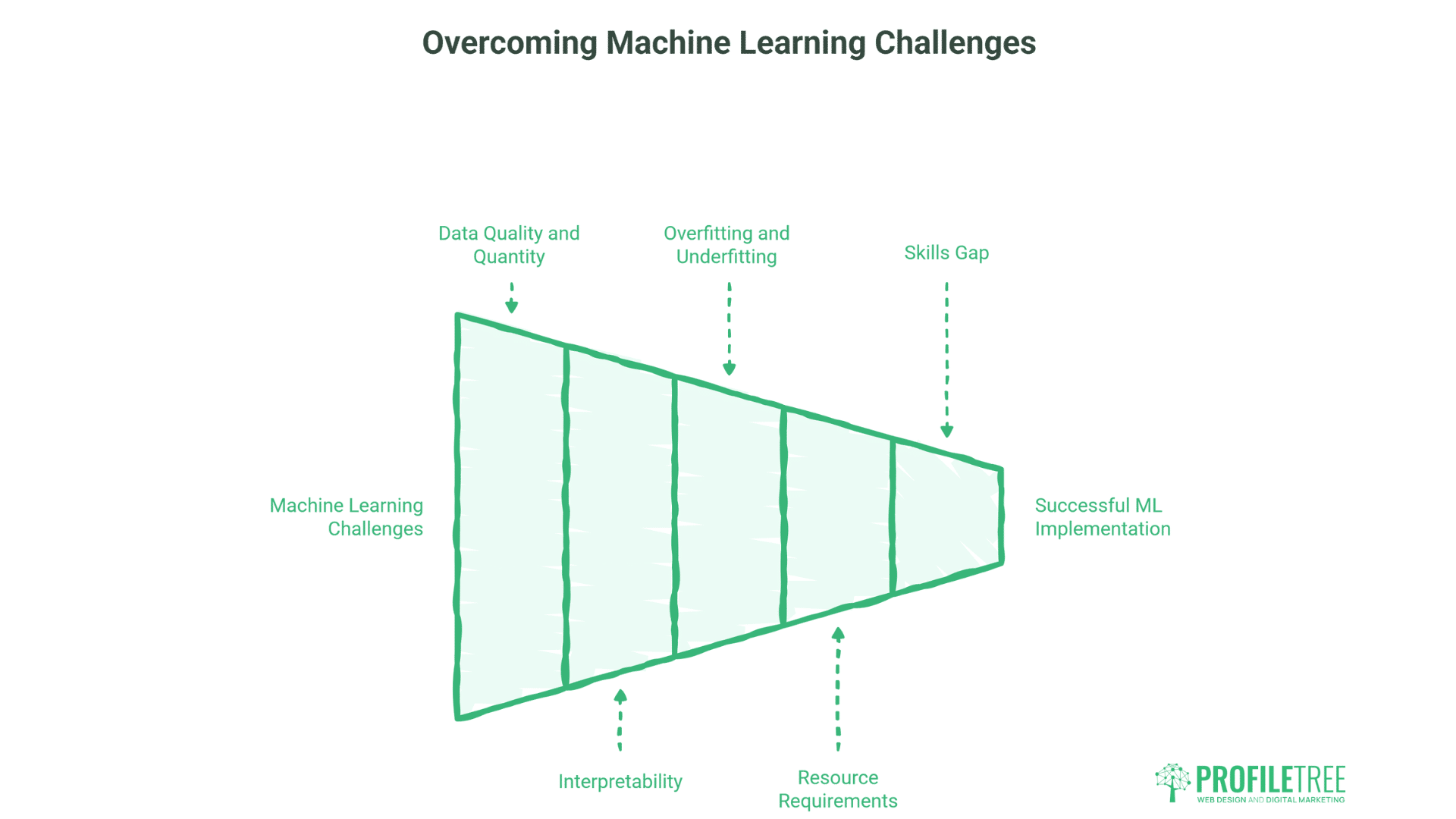
Understanding machine learning’s boundaries is as important as recognising its potential.
Data Quality and Quantity Requirements
Machine learning’s effectiveness depends entirely on data quality. Common challenges include:
- Insufficient Data: Many powerful algorithms, particularly deep learning approaches, require thousands or millions of examples to perform well. SMEs often lack this data volume, making simpler algorithms more appropriate.
- Biased or Unrepresentative Data: If training data doesn’t represent the full range of situations the model will encounter, performance suffers. A customer behaviour model trained only on desktop users will perform poorly when mobile users behave differently.
- Data Drift: Patterns change over time. Customer preferences evolve, market conditions shift, and behaviours adapt to external events. Models trained on historical data gradually lose accuracy as reality diverges from training examples.
Practical Solution:
Start with achievable ambitions. If you have limited data, focus on simpler models and problems. Plan for ongoing data collection to support more sophisticated approaches later. Consider synthetic data generation or transfer learning (using pre-trained models) to supplement limited datasets.
The Interpretability Challenge
Complex ML models, particularly neural networks, act as “black boxes”—they produce accurate predictions but offer little insight into their reasoning process.
Business Implications: When a lending algorithm denies a loan application, regulators and customers expect explanations. “The algorithm said no” isn’t acceptable. Similarly, if an ML system recommends business decisions with significant consequences, leadership needs to understand the reasoning.
Practical Solution:
Choose model complexity appropriate to the stakes and explainability requirements. For customer-facing decisions or regulatory compliance scenarios, prioritise interpretable algorithms like decision trees or logistic regression over neural networks. When using complex models, employ explanation techniques like LIME or SHAP that approximate how models reach conclusions.
Overfitting and Underfitting: Finding the Balance
Overfitting occurs when models learn training data too well, memorising specific examples rather than general patterns. They perform excellently on training data but poorly on new cases.
Underfitting happens when models are too simple to capture underlying patterns, performing poorly on both training and test data.
Practical Solution:
Split data into training, validation, and test sets. Use the validation set to tune models and catch overfitting before deployment. Employ techniques like cross-validation, regularisation, and ensemble methods to improve generalisation.
Resource Requirements
Machine learning, particularly at scale, demands computational resources.
- Training Costs: Complex models can take hours or days to train, requiring powerful processors or cloud computing resources. These costs can surprise organisations unprepared for ongoing computational expenses.
- Inference Costs: Deploying models that make real-time predictions requires infrastructure to handle request volumes. High-traffic applications need careful architecture planning to maintain performance whilst controlling costs.
Practical Solution:
Use cloud services with pay-as-you-go pricing to avoid upfront infrastructure investments. Start with smaller-scale implementations to understand resource requirements before scaling. Consider edge computing for applications where real-time local processing is more efficient than cloud-based inference.
The Skills Gap
Machine learning requires specialised knowledge that many organisations lack.
Data Science Expertise: Understanding algorithms, statistics, and programming requires significant training. Experienced data scientists command high salaries, making dedicated hiring challenging for SMEs.
Practical Solution:
Begin with accessible tools requiring minimal technical knowledge. Platforms like Google’s AutoML, Microsoft Azure ML Studio, or various no-code ML services lower technical barriers. Invest in training existing staff rather than assuming you need dedicated data scientists immediately. Partner with agencies or consultants for specialised projects whilst building internal capabilities.
Future Trends: Machine Learning’s Evolving Landscape
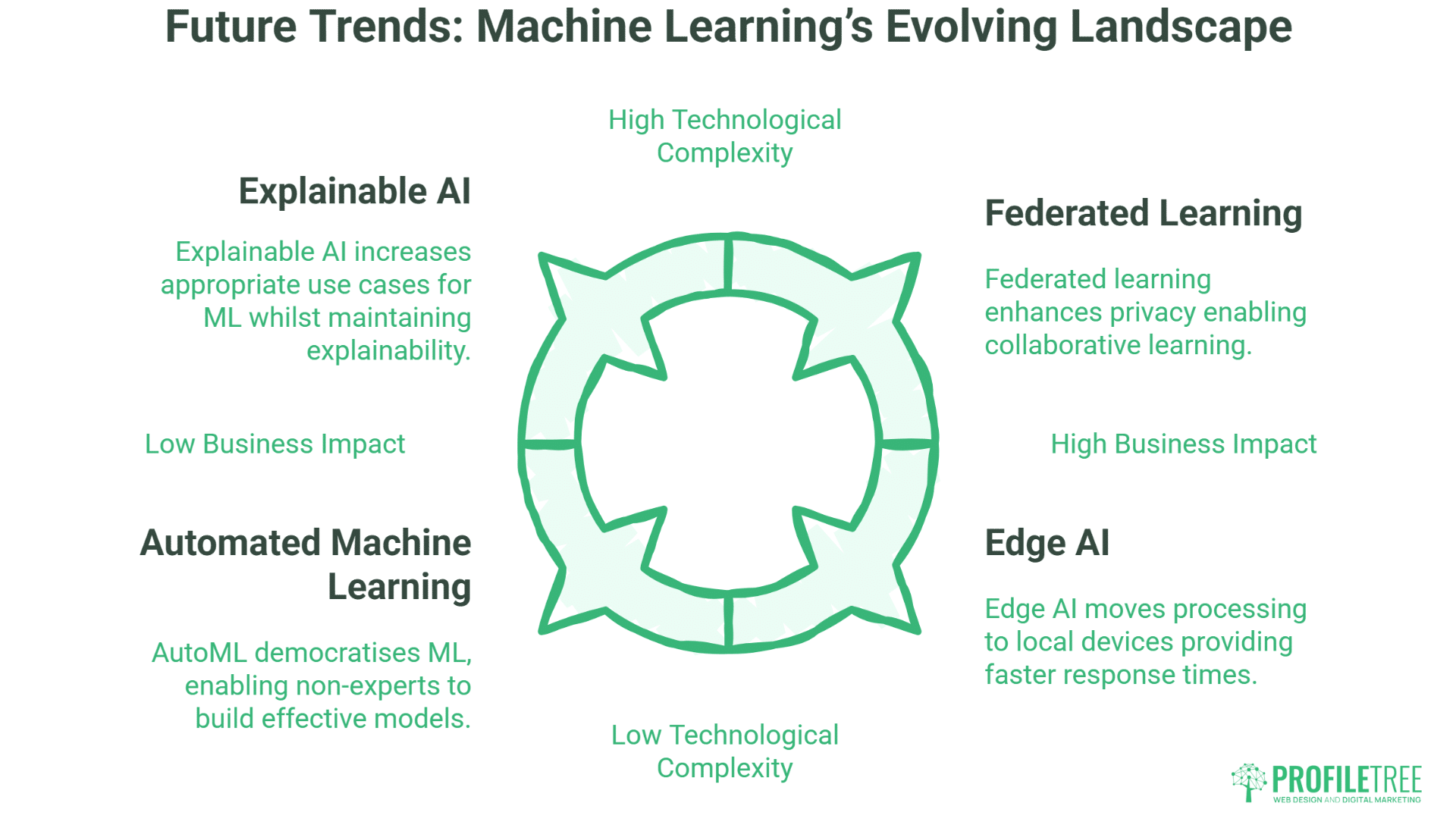
Machine learning continues to advance rapidly. Understanding emerging trends helps businesses prepare for opportunities ahead.
Automated Machine Learning (AutoML)
AutoML platforms automate much of the ML pipeline—from data preprocessing to model selection and hyperparameter tuning. These tools democratise ML, enabling non-experts to build effective models.
SMEs can implement sophisticated ML solutions without data science teams. Marketing managers, operations leaders, and product developers gain direct access to ML capabilities through intuitive interfaces.
Edge AI and On-Device Learning
Traditional ML relies on cloud processing, sending data to remote servers for analysis. Edge AI moves processing to local devices—smartphones, IoT sensors, embedded systems.
Faster response times (no network latency), improved privacy (data stays local), reduced bandwidth costs, and operation in offline scenarios. Applications include real-time inventory scanning, in-store customer behaviour analysis, and industrial equipment monitoring.
Federated Learning
Federated learning trains models across decentralised devices without centralising data. Each device improves the model locally, sharing only model updates rather than raw data.
Enhanced privacy protection whilst enabling collaborative learning. Multiple businesses could jointly improve models without sharing sensitive data, beneficial for industry consortia addressing common challenges.
Explainable AI (XAI)
Research into interpretable machine learning grows as regulatory pressure and ethical concerns increase. New techniques make complex models more transparent.
Organisations can use powerful models in regulated industries or customer-facing applications whilst maintaining explainability. This expansion increases appropriate use cases for machine learning.
Integration with IoT and Sensor Networks
As connected devices proliferate, the volume of sensor data available for ML analysis explodes. Businesses gain unprecedented visibility into operations, customer behaviours, and environmental conditions. Predictive maintenance becomes more accurate, customer experiences more personalised, and resource allocation more efficient.
Sustainability-Focused ML
Growing awareness of ML’s environmental impact—particularly energy consumption from training large models—drives research into efficient algorithms and practices.
Organisations face pressure to adopt sustainable AI practices. Efficient models reduce costs whilst meeting environmental commitments. Green AI could become a competitive differentiator and regulatory requirement.
Getting Started: Next Steps for Your Business
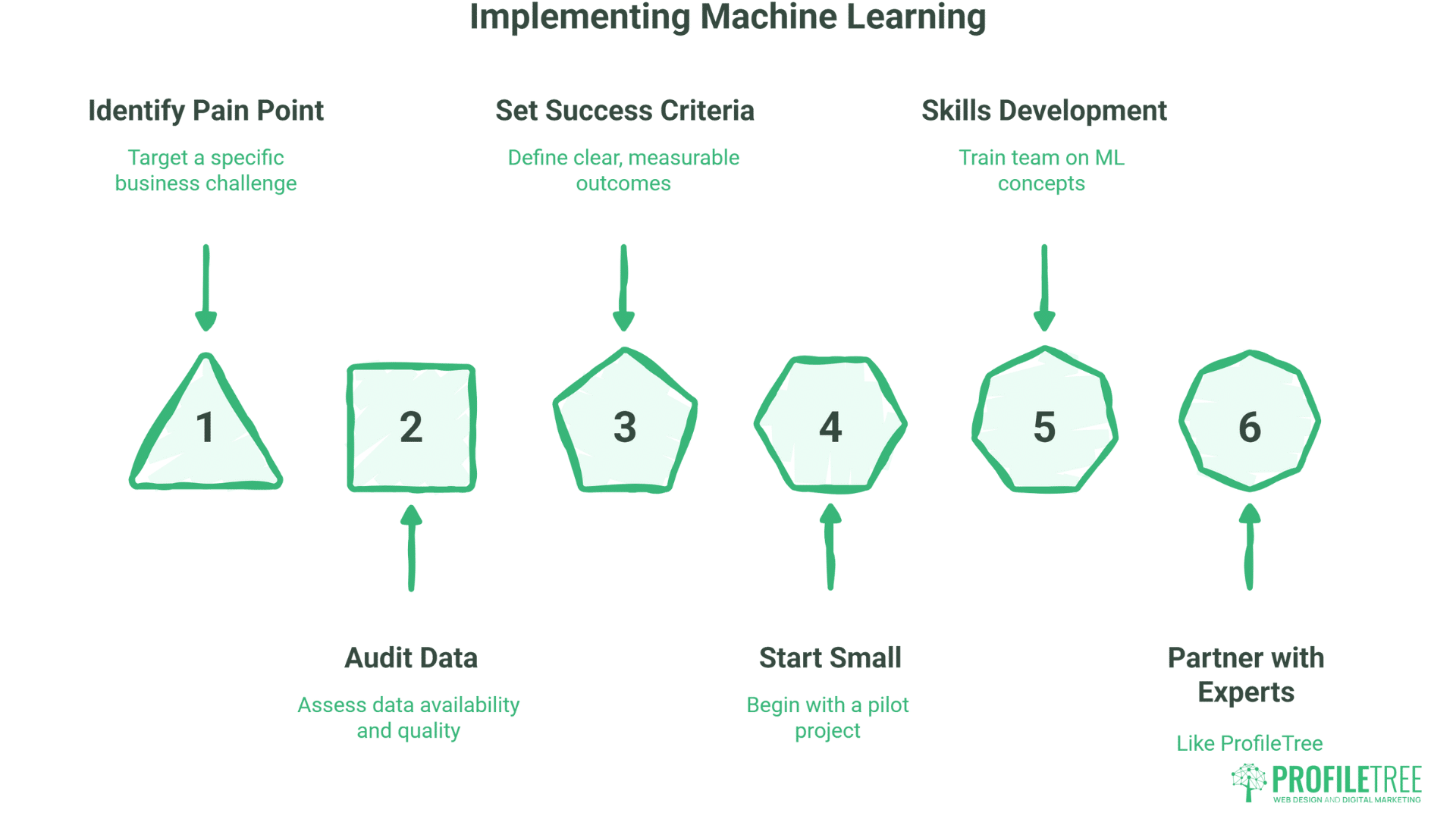
If you’re ready to explore machine learning’s potential for your organisation, follow these steps:
Identify a Specific Pain Point
Rather than broad AI adoption, target a particular challenge where ML could help. Examples:
- “We waste time manually categorising customer enquiries”
- “Our inventory forecasts are consistently inaccurate”
- “We can’t personalise website experiences for different visitors”
- “Sales teams struggle to prioritise leads effectively”
Specific problems lead to focused solutions with measurable outcomes.
Audit Your Data
Assess what information you have and what you need:
- Where does relevant data currently reside?
- Is it accessible and in usable format?
- Are there quality issues requiring attention?
- Do you have enough data, or do you need to collect more?
Be honest about gaps. Addressing data issues before ML implementation prevents wasted effort.
Set Clear Success Criteria
Define what success looks like:
- Quantitative metrics (e.g., “reduce support response time by 25%”)
- Qualitative outcomes (e.g., “enable sales team to focus on high-value opportunities”)
- Timeline expectations (understanding ML projects take months, not weeks)
Clear criteria prevent scope creep and facilitate objective evaluation.
Start Small and Learn
Begin with a pilot project:
- Limited scope
- Defined timeframe (typically 2-4 months)
- Budget that allows experimentation without betting the business
- Team commitment from relevant departments
Use this project to build internal understanding, identify challenges, and demonstrate value before larger investments.
Invest in Skills Development
Technology succeeds when people understand how to use it. Provide team training on:
- ML concepts and terminology
- Specific tools and platforms you’re implementing
- Critical thinking about ML outputs (when to trust predictions, when to question them)
- Ethical considerations and responsible AI use
ProfileTree’s digital training services help businesses throughout Belfast and across Northern Ireland build ML literacy at all organisational levels.
Partner with Experienced Providers
Few SMEs need full-time data scientists initially. Strategic partnerships provide expertise when needed:
- Initial Assessment: External consultants evaluate ML readiness and recommend starting points
- Implementation Support: Specialists handle technical development whilst transferring knowledge to your team
- Ongoing Guidance: Regular check-ins keep projects on track as internal capabilities grow
ProfileTree works with businesses across sectors, implementing AI solutions appropriate to their maturity and objectives. Whether you need comprehensive digital strategy guidance, web development incorporating intelligent features, or training to build internal AI capabilities, we tailor our approach to your situation.
FAQs about Machine Learning
Is machine learning the same as AI?
No, machine learning is a subset of artificial intelligence. AI is a broader concept of machines performing tasks that typically require human intelligence, while machine learning focuses specifically on enabling systems to learn from data without explicit programming.
Do I need to be a math expert to learn machine learning?
While a strong understanding of linear algebra, calculus, and probability helps, you don’t need to be a math expert to start. Many resources explain the concepts intuitively, and practical application often involves using libraries that handle the complex math for you. However, a basic grasp of these areas will deepen your understanding.
What’s the difference between machine learning and deep learning?
Deep learning is a specialised branch of machine learning that uses neural networks with many layers (hence ‘deep’). Deep learning excels at tasks like image recognition, natural language processing, and speech recognition, often requiring more data and computational power than traditional machine learning algorithms.
How long does it take to learn machine learning?
The time it takes varies greatly depending on your background and dedication. You can grasp the basics in a few months, but becoming proficient and staying current is an ongoing process that can take years. Consistent practice and project work are key.
Transform Your Business with Machine Learning
Machine learning explained through this guide demonstrates technology that’s increasingly accessible to businesses of all sizes. From understanding core ML concepts to implementing practical applications, the path to AI adoption no longer requires massive budgets or specialised teams.
The businesses succeeding with machine learning share common characteristics: they start with specific problems rather than vague ambitions, they invest in quality data and team training, and they maintain realistic expectations about timelines and outcomes.
For businesses across Northern Ireland, Ireland, and the UK, machine learning offers genuine competitive advantages. Whether you’re optimising marketing campaigns, improving customer experiences, streamlining operations, or making better forecasts, ML applications deliver measurable value.
ProfileTree supports businesses throughout this journey—from initial AI training and capability building to implementing sophisticated ML-powered websites and digital strategies. Our web design services incorporate intelligent features suited to each client’s needs and maturity. Our digital training programmes build internal understanding, enabling teams to use ML tools effectively and evaluate AI opportunities critically.
Ready to explore how machine learning can transform your business? Contact ProfileTree at our Belfast office to discuss your digital strategy, AI implementation, or training needs. We’ll help you identify practical starting points and build a roadmap suited to your objectives and resources.