
AI and GDPR: How Irish and UK SMEs Stay Compliant
Table of Contents
AI GDPR compliance for SMEs in Ireland and the UK is no longer a grey area. The moment you put a customer name, email, or enquiry into an AI tool, you are processing personal data, and your business stays the data controller even when the software belongs to someone else. This guide gives owners and managers a practical route through it: where the real risks sit, the difference between a browser tool and an API connection, and what Northern Irish businesses serving the Republic need to do twice over.
“Most small businesses already use AI every day. The gap is governance, not technology,” says Ciaran Connolly, founder of ProfileTree, a Belfast-based digital agency. “Get the technical setup and the staff policy right early, and compliance stops being a fear and starts being a competitive edge.”
Why standard AI tools create immediate GDPR risk for SMEs
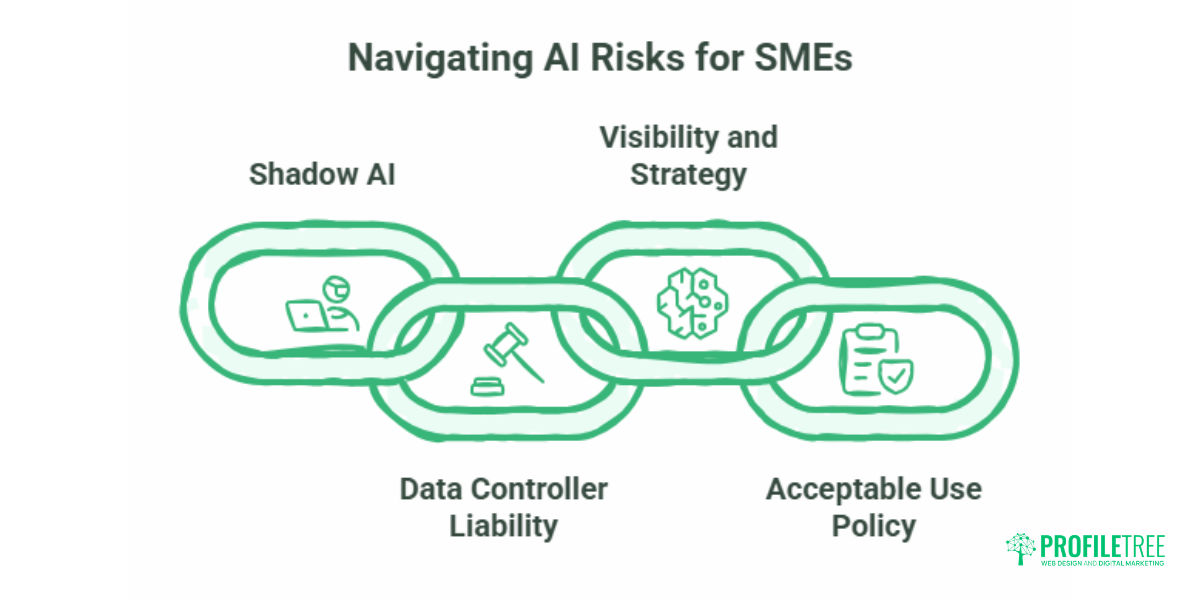
The biggest exposure for most small businesses is not a rogue algorithm. It is staff quietly pasting client data into free consumer AI tools, often called shadow AI. A salesperson drops a customer email into a chatbot to draft a reply. An office manager uploads a spreadsheet of contacts to summarise it. Each action moves personal data into a system the business has not assessed, with no record of where it went.
Under UK GDPR and the EU GDPR, using a third-party tool does not move the liability off your shoulders. You remain the controller. The vendor is your processor. If that processor trains its public models on the text your team enters, you may have shared personal data without a lawful basis and without telling the people it belongs to. That is the data minimisation and transparency problem the regulators care about, and it is the same risk whether you run a law firm in Dublin or a trades business in Lisburn.
The practical fix starts with visibility. You cannot govern tools you do not know are in use. Many SMEs find that an honest audit of AI usage is also the moment they realise how much of the work could be done properly with a managed setup. This is where a clear digital strategy earns its place, mapping which tasks genuinely need AI and which expose data for no real gain. If you are weighing up the wider hurdles first, our guide on AI adoption challenges covers the common blockers SMEs hit.
Shadow AI and the consumer tool trap
Consumer AI tools are designed to be frictionless, which is exactly the problem. There is no procurement step, no contract review, no data processing agreement. Staff adopt them because they work, and nobody flags it because nobody asked. The answer is rarely a ban. Bans push usage further underground. A short, clear, acceptable use policy paired with approved alternatives does far more.
You are still the data controller
The single most expensive misunderstanding is that liability transfers to the software company. It does not. If a customer complains to the Information Commissioner’s Office or the Irish Data Protection Commission, the business that collected the data answers for it. The vendor’s terms matter, but they do not absolve you.
The API versus browser interface: the hidden security divide
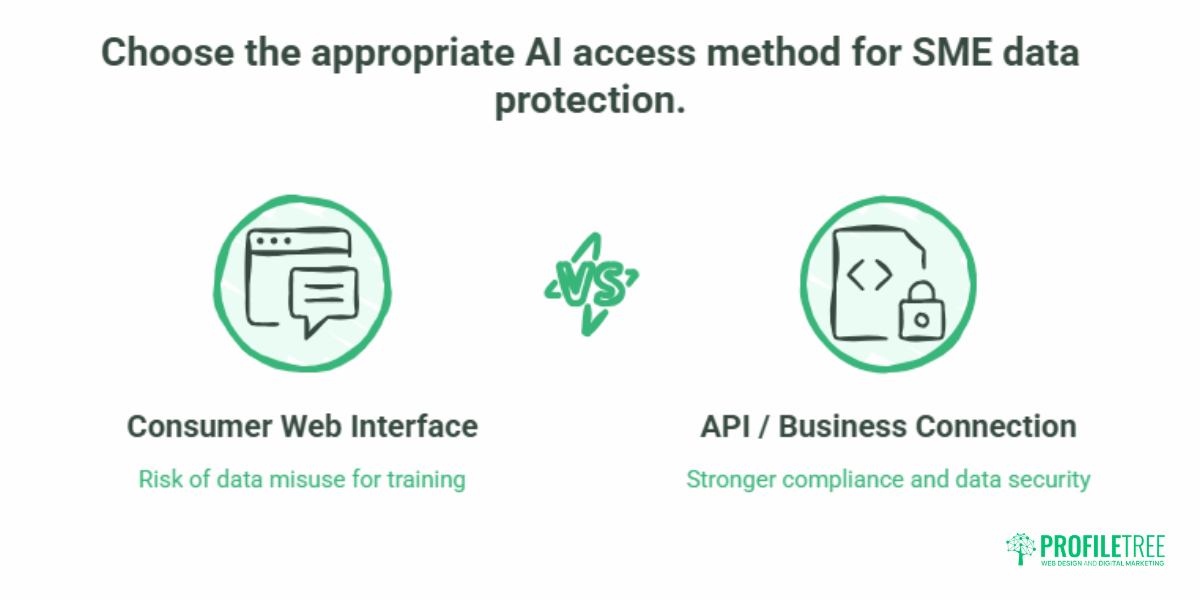
Here is the distinction almost no guide explains, and it changes everything about how an SME can use AI safely. The same AI model behaves very differently depending on how you connect to it. A free web browser interface and a paid API connection are not the same product from a data protection point of view.
How consumer web interfaces handle your data
When your team uses a standard consumer chat interface in a browser, the default behaviour on many free and personal tiers has historically allowed the provider to use those conversations to improve future models. In plain terms, what your staff type can become training material. For a casual question that is harmless. For a customer’s medical details or financial position, it is a data protection problem you may not even know you have created.
Why API connections offer a stronger compliance footing
API access works on different contractual terms. Major providers commit, in their business and developer terms, not to train their models on data sent through the API. The data is processed to return your result and is not folded back into the public model. That single difference gives SMEs a genuine route forward: build AI into your tools through a properly configured API rather than letting staff use the public web version with real customer data.
Setting that up is a development and integration task, not a legal one. A connected, sandboxed AI feature inside your own systems keeps data inside agreed boundaries. This is the kind of work that sits alongside website development and the broader build, and our overview of AI chatbots for SMEs shows how a customer-facing tool can be deployed without scattering personal data across consumer apps.
| Factor | Consumer web interface | API / business connection |
|---|---|---|
| Inputs used to train public models | Often yes on free or personal tiers | No, per business and developer terms |
| Data processing agreement available | Limited or none | Yes, with business or enterprise terms |
| Suitable for real customer data | No | Yes, once configured and documented |
| SME action required | Restrict to non-personal data only | Review the DPA, log the use case, and set retention |
A practical GDPR AI compliance checklist for small organisations
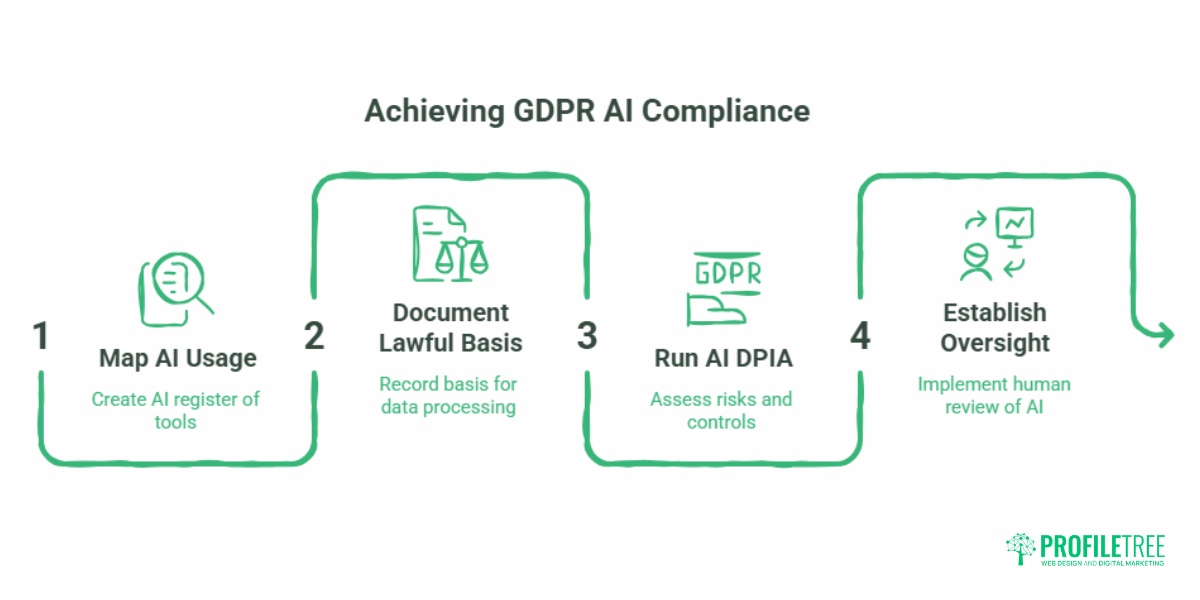
You do not need a legal department to get the basics right. Five steps cover the ground that matters most for a resource-constrained SME.
Step 1: Map your internal AI usage
Build a simple AI register: which tools are in use, by whom, for what, and whether any personal data touches them. Half the value is in the discovery. Most businesses find tools they did not know about. Keep it to a single shared sheet that owners can actually maintain.
Step 2: Confirm and document your lawful basis
Every use of personal data needs a lawful basis. For AI applications, leaning on consent is usually the weakest choice because consent can be withdrawn and is hard to evidence. Legitimate interest or contractual necessity often fits better for operational uses, but you must write down which one applies and why. If you want the foundations first, our guide to data protection for online businesses sets out the basics.
Step 3: Run a simplified AI DPIA
A Data Protection Impact Assessment is mandatory where processing is likely to result in a high risk to people’s rights. AI that handles health, financial, or behavioural data usually meets that bar. Keep it proportionate: outline the data flow, the risks, and the controls, such as access limits and retention rules. The ICO publishes free DPIA templates that an SME can adapt in an afternoon.
Step 4: Establish human-in-the-loop oversight
GDPR Article 22 restricts decisions made solely by automation where they have a legal or similarly significant effect, such as automated recruitment screening, credit scoring, or insurance assessment. The control is meaningful human review, and the proof is documentation. A short oversight log does the job: date, the AI output, the staff member who reviewed it, and whether it was approved, edited, or overridden. That single record turns a vague claim of oversight into evidence that an auditor can accept.
Step 5: Roll out an employee AI policy
A one-page acceptable use policy sets the rules everyone follows: which tools are approved, what data types are prohibited, and the requirement to use approved connections for anything involving customer information. A policy only works if staff understand it, which is why rollout pairs best with short, practical sessions. Structured digital training moves this from a document nobody reads to behaviour that sticks, and our piece on training staff on AI tools goes deeper on the rollout.
Cross-border compliance: the EU AI Act and the Windsor Framework
This is the gap nobody serving Northern Ireland and Irish businesses fills properly. If you operate across the border, you are not picking one rulebook. You are reconciling two.
Does the EU AI Act reach your UK-based SME?
A business based entirely in Great Britain can still fall within the EU AI Act if its AI outputs are used inside the European Union, for example, profiling EU residents or selling AI-assisted services into the Republic of Ireland. Jurisdiction follows the effect, not just the office address. UK SMEs with any EU-facing activity should assume the question applies to them.
Northern Ireland and the Republic: dual compliance
Under the Windsor Framework, Northern Irish businesses sit in a position no other UK region shares. They follow UK GDPR, but their alignment with parts of the EU single market means any AI system tied to cross-border trade or serving customers in the Republic must also meet EU obligations, including the relevant parts of the EU AI Act. For a Newry firm with clients in Dundalk, that is not theoretical. It is a dual-compliance reality that shapes how AI tools should be chosen and documented from the start. The wider commercial backdrop is covered in our look at Brexit’s impact on digital marketing.
Building compliant AI into customer-facing systems
Compliance is easier to design in than to bolt on. The two places SMEs most often collect personal data are web forms and chatbots, and both can be built to meet the rules without hurting conversion.
GDPR-compliant chatbots and consent
A GDPR compliant chatbot starts with a prominent, plain-language consent notice, not a line buried in a policy nobody opens. Tell users what the chatbot does with their input, how long it is kept, and how they can ask for deletion. Where data serves more than one purpose, separate the choices rather than bundling them. For businesses in Ireland specifically, a GDPR compliant chatbot also needs a defensible position on where conversation logs are stored and for how long. Done well, a chatbot collects only what it needs and discards the rest on a fixed schedule.
Consent, retention, and the web forms that feed your CRM
Every contact form and newsletter sign-up is a data collection point. Retaining personal data indefinitely breaks the minimisation principle, so set a retention policy: purge or anonymise records after a defined period, give users a clear route to request deletion, and keep an audit trail of where data flows. This is where good website design and a guide like designing GDPR-compliant web forms pay off, because consent built into the form is far more reliable than consent added later.
Keeping AI and GDPR compliance current
Compliance is a habit, not a one-off project. The rules and the tools both move, so the businesses that stay safe are the ones that review regularly.
Vendor checks and data processing agreements
Before adopting any AI tool that will touch personal data, check where the vendor stores and processes it. If a provider hosts or accesses data outside the EEA, you need a transfer mechanism such as standard contractual clauses. Sign a data processing agreement that names responsibilities and discloses sub-processors. Established providers usually offer these as standard; smaller, unknown tools may not, which is a signal in itself.
Regular audits keep you ahead of GDPR updates in Ireland
Set a quarterly or biannual review. Each cycle, revisit the AI register, confirm retention rules are running, and check for GDPR updates in Ireland and the UK that affect your use cases, including new guidance from the Irish Data Protection Commission and the ICO. As you add AI features, reassess whether a fresh DPIA is needed. Tying these reviews into how you already measure AI’s impact on your business keeps compliance and performance on the same page. For the ethical side of the same coin, see our guide to ethical AI and legal requirements.
Conclusion
AI is a strong operational tool for Irish and UK SMEs, provided personal data is handled with care. Keep visibility of which tools are in use, route customer data through API connections rather than consumer apps, document a lawful basis and human oversight, and check cross-border obligations if you trade across borders. Get the technical setup and the staff policy right, and compliance becomes a trust signal that customers notice. ProfileTree helps businesses across Northern Ireland, Ireland, and the UK build a proper setup.
Frequently asked questions
Can our employees use free AI tools like ChatGPT for work?
Only for tasks with no personal or confidential data. Free consumer interfaces may use inputs to train future models, which can breach GDPR. For anything involving customer information, use an approved, API-based, or sandboxed alternative instead.
Is a GDPR compliant chatbot realistic for a small business in Ireland?
Yes. A GDPR compliant chatbot needs a clear consent notice, a set retention period, EEA-based or safeguarded storage, and an easy deletion route. These are configuration choices, not enterprise-only features, and they suit Irish SMEs running everyday support and enquiry bots.
Does our SME need a Data Protection Officer just because we use AI?
Not automatically. A DPO is required only if your core activities involve large-scale systematic monitoring of individuals or large-scale processing of special category data. Many SMEs using AI for routine tasks do not meet that threshold.
Does the EU AI Act apply to a business based entirely in the UK?
It can. If your AI system’s outputs are used within the EU, for example, profiling EU residents or selling services into the Republic of Ireland, the EU AI Act’s extra-territorial provisions may reach you even without an EU office.
How does the Windsor Framework affect AI compliance in Northern Ireland?
It creates dual compliance. Northern Irish businesses follow UK GDPR, but alignment with EU single market rules means AI systems linked to cross-border trade or Irish customers must also meet EU obligations, including relevant parts of the EU AI Act. AI’s potential while maintaining the trust and confidence of its users.