
Content Marketing for Manufacturers: A Practical Guide
Table of Contents
Content marketing in the manufacturing sector operates under different rules than most industries. Sales cycles run for months, sometimes years. Buyers are engineers, procurement officers, and technical directors who distrust vague language and dismiss anything that reads like a brochure. Building credibility here requires a different kind of content strategy.
This guide covers the mechanics of manufacturing content marketing: how to structure a strategy around long B2B sales cycles, how to extract technical knowledge from your team, which content formats carry weight with industrial buyers, and how UK manufacturers can address sustainability and Industry 4.0 in their marketing.
You will also find practical guidance on measuring results over extended sales timelines, using AI tools without sacrificing technical accuracy, and building a content operation that grows with your business.
Why Manufacturing Content Marketing Works Differently
Standard B2B content advice rarely maps cleanly onto industrial marketing. The audiences, the decisions, and the stakes are all different. Getting this right starts with understanding why.
Long Sales Cycles and Multiple Stakeholders
A capital equipment purchase in manufacturing typically involves several decision-makers across engineering, operations, and finance. The cycle from first enquiry to signed contract can stretch to 12 to 18 months. Content that generates a lead on day one may not influence the final decision until well into the following year.
This means manufacturing content must serve multiple stages simultaneously. A plant manager researching automation options needs different material from a procurement officer comparing suppliers on compliance and lead times. Building content that speaks to both without alienating either requires deliberate planning rather than generic posts aimed at a vague audience.
Technical Credibility Over Brand Personality
In most sectors, brand voice and personality drive engagement. In manufacturing, a single technical inaccuracy in a blog post can permanently damage your credibility with an engineering lead. The first question a technical buyer asks when reading your content is not “do I like this brand?” but “do these people actually know what they are talking about?”
This shifts the priority. Your content must demonstrate specific, verifiable knowledge of tolerances, specifications, compliance frameworks, and process challenges. Broad claims about “innovation” or “quality” carry no weight. Detailed explanations of how a particular process solves a defined engineering problem carry a great deal.
Manufacturers who invest in transparent content marketing consistently build stronger buyer trust than those who default to promotional language.
The Physicality Factor in Industrial Content
Unlike software or services, manufacturing products are physical. They can be filmed, demonstrated, stress-tested, and measured. This creates content opportunities that most advice overlooks. A video of your product operating under load conditions, a time-lapse of your production process, or a before-and-after comparison of component quality are all forms of content that are practically impossible for a competitor to replicate without having done the same work.
Physical demonstration is one of the strongest trust signals available to a manufacturer, and most companies underuse it entirely.
Mapping the UK Industrial Buyer’s Journey
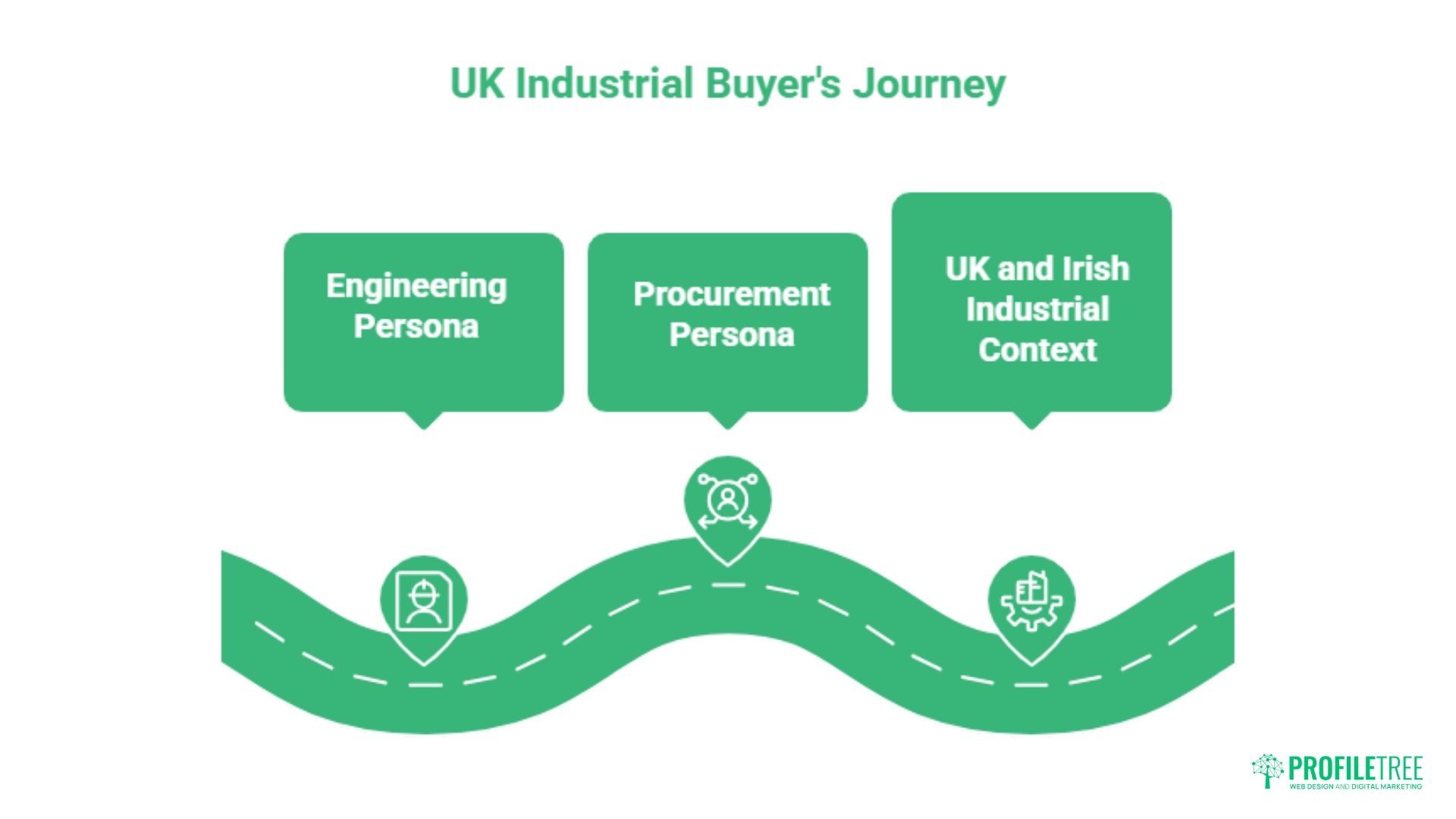
British and Irish manufacturing buyers move through a distinct decision-making process. Understanding each stage determines which content format will actually reach them at the right moment.
The Engineering Persona: Specification and Proof
Engineers want technical data before anything else. Datasheets, tolerance specifications, material certifications, CAD files, and reliability reports all serve this audience directly. Blog content for engineers works best when it explains a specific process, addresses a known failure mode, or compares approaches to a defined technical problem.
What engineers do not want is a post that opens with market trends and spends three paragraphs explaining what a lathe is. Assume knowledge, address specifics, and back every claim with a number or a documented test result.
The Procurement Persona: Risk and Total Cost
Procurement officers are not evaluating technical elegance; they are managing risk. Their concerns centre on supplier reliability, lead times, compliance documentation, warranty terms, and total cost of ownership. Content aimed at this persona should surface those reassurances clearly.
Case studies with measurable outcomes, supply chain transparency reports, and clear pricing frameworks (even indicative ranges) are far more persuasive here than technical specification sheets. A well-structured case study that shows on-time delivery, cost savings, and compliance adherence will move a procurement officer more than any amount of engineering detail.
Understanding how email marketing varies by sector can also help shape how you reach procurement audiences through direct outreach campaigns.
The UK and Irish Industrial Context
UK and Irish manufacturers face a set of market conditions that most US-produced content ignores entirely. Net Zero commitments under the UK’s Climate Change Act create a growing demand for content that demonstrates sustainable manufacturing credentials without veering into greenwashing. EU and UK regulatory divergence post-Brexit has introduced compliance complexity that procurement teams need help navigating.
The UK skills gap in engineering and technical roles means that content addressing recruitment and workforce development also resonates strongly with senior decision-makers. An article that helps a plant manager think through how to attract apprentices through employer branding serves a genuine need and connects naturally to broader content strategy conversations.
Content that speaks directly to these regional pressures performs significantly better with UK industrial buyers than imported strategy guides that reference the US regulatory environment. Northern Ireland, in particular, occupies a unique dual-market position post-Brexit, which creates specific content opportunities for manufacturers operating across both markets. You can read more about the regional industrial context across Northern Ireland’s key cities.
The SME Extraction Framework: Getting Technical Knowledge Out of Your Team
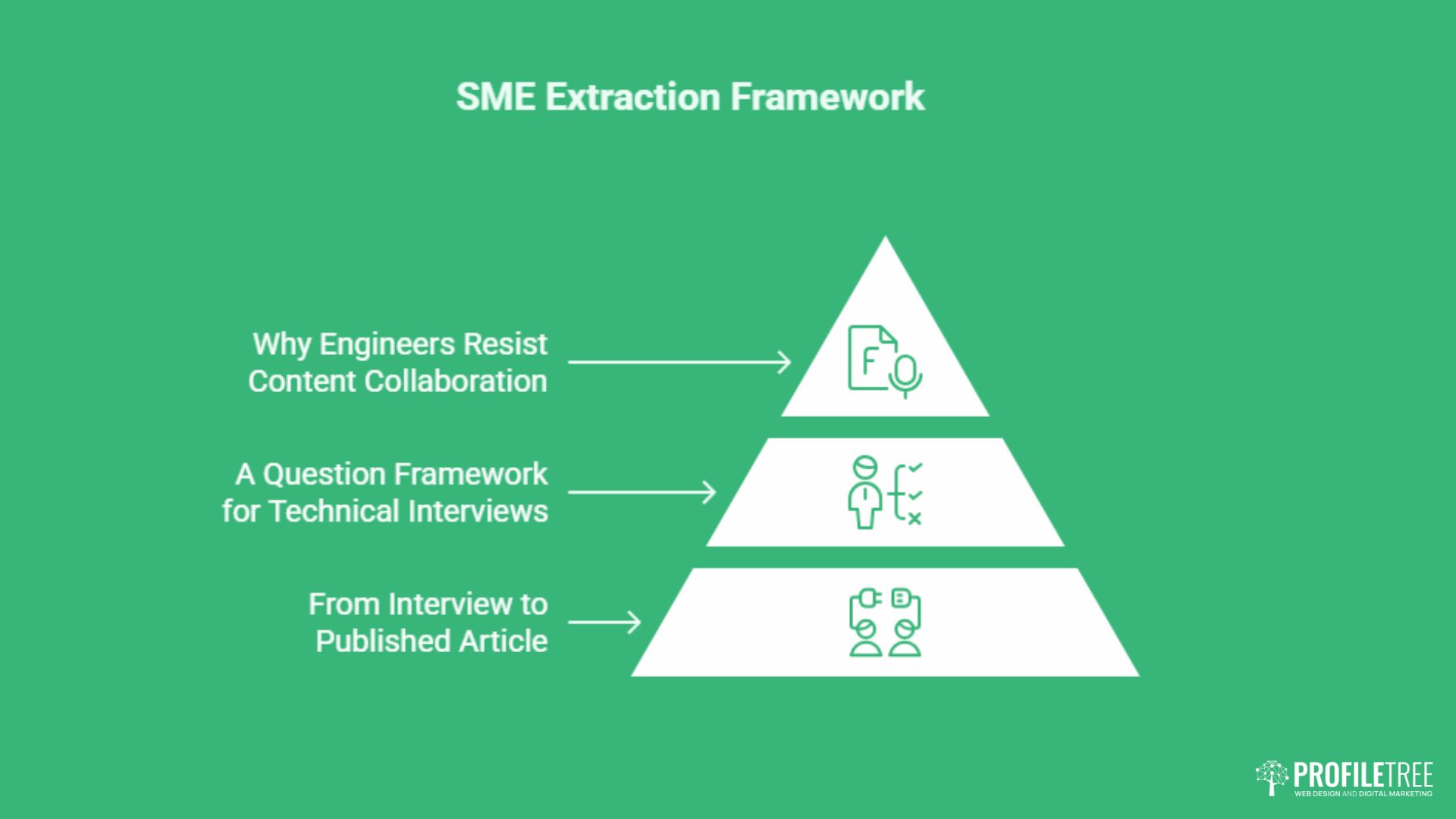
The most common obstacle to manufacturing content is not a lack of valuable knowledge. It is the people who hold that knowledge who are engineers and technical leads who have neither the time nor the inclination to write marketing copy. Solving this is one of the most important operational challenges in industrial content marketing.
Why Engineers Resist Content Collaboration
Most engineers who have encountered marketing teams come away with a clear frustration: the output rarely reflects what they actually said. Technical nuance gets smoothed over, specific claims get generalised into vague benefits, and the final article reads like a brochure rather than something they would stand behind professionally.
The solution is not to ask engineers to write. It is to structure a short, focused interview process that extracts their knowledge efficiently and produces raw material that a content writer or strategist can then shape into a publishable article.
“The most powerful content in manufacturing comes from capturing what an engineer explains informally over five minutes and turning that into structured, searchable material,” says Ciaran Connolly, founder of ProfileTree. “Most manufacturers already have that expertise. The gap is in extracting and publishing it.”
A Question Framework for Technical Interviews
Keep technical interviews to 20 to 30 minutes and focus on specific, answerable questions. The following framework extracts high-value content without demanding too much from busy technical staff.
Start with the problem: “What is the most common mistake you see customers make when specifying this type of component?” Move to your solution: “What does your process do differently to address that?” Then evidence: “Can you give me a real example, even an anonymised one?” Finally, implications: “What should a buyer ask any supplier before committing to a purchase in this category?”
These four questions, answered in plain language, generate enough material for a substantial article, a LinkedIn post series, and a FAQ section. Repeat the process monthly, and you build a content library that is genuinely difficult for competitors to replicate.
From Interview to Published Article
The interview transcript should be treated as source material, not as copy-ready content. A content writer’s job is to organise the information logically, add context for non-specialist readers, verify any factual claims against published standards or specifications, and remove jargon that would confuse a procurement officer without losing the technical substance that would convince an engineer.
The final article should be reviewed by the technical contact before publication. A 15-minute review to confirm accuracy is far more efficient than a full rewrite after publication because of a factual error.
Content Formats That Work for Industrial Audiences
Not every content format earns the same credibility with manufacturing buyers. The formats that consistently perform in this sector share one characteristic: they show rather than tell.
Case Studies and White Papers
Case studies are the most persuasive content format in manufacturing because they document a real problem and a measurable outcome. An effective industrial case study identifies the customer’s challenge (with enough specificity to be credible), describes the solution approach and why alternatives were rejected, and reports outcomes in measurable terms: cycle time reduction, defect rate improvement, cost saving per unit, or downtime reduction.
White papers serve a different purpose. They establish your company’s analytical authority on a defined technical or regulatory topic. A white paper on managing Post-Brexit CE/UKCA marking requirements, for instance, demonstrates expertise that is directly useful to procurement teams and positions your company as a credible resource before any sales conversation begins.
You can see how sector-specific content marketing services adapt these same principles across different industries.
Video for Complex Product Explanation
Video is uniquely suited to manufacturing because it can show physical processes that no written description fully captures. A facility tour, a product stress-test, a 3D render of an internal mechanism, or a time-lapse of a production run all communicate technical capability in a format that engineers and plant managers find immediately credible.
Explainer videos that walk through a specification process, a quality control procedure, or a common installation mistake tend to generate sustained search traffic because they answer questions that buyers search for long after the initial purchase decision.
SEO-Driven Blog Content for Long-Tail Technical Queries
Industrial buyers search with high specificity. Queries like “BS EN ISO 9001 audit preparation checklist” or “CNC machining tolerances for aerospace components” represent genuine purchase-stage intent from qualified buyers. Short, generic content does not rank for these terms; in-depth, technically accurate articles do.
Keyword research for manufacturing content should prioritise long-tail queries that reflect the exact language engineers and procurement officers use in their searches. These terms typically have lower search volume than broad marketing terms but far higher conversion intent.
Applying the principles of solid SEO services to technical content significantly improves discoverability without requiring you to compromise on the depth that industrial buyers demand.
LinkedIn as the Primary Distribution Channel
LinkedIn consistently outperforms other social platforms for B2B manufacturing content. The platform’s industry and job-title targeting allows content to reach plant managers, procurement directors, and technical buyers directly. Articles published natively on LinkedIn also benefit from the platform’s own search visibility, extending reach beyond your existing connections.
The most effective LinkedIn content in manufacturing follows a consistent pattern: a specific, counter-intuitive observation to open, a brief explanation of the underlying problem, and a practical takeaway. Long-form thought leadership posts from named technical leads outperform company-page posts with generic messaging.
Understanding social media marketing reveals how different sectors engage with content on the platform, which informs how manufacturing companies should calibrate their posting frequency and format mix.
Measuring ROI in a 12 to 18 Month Sales Cycle
The most common complaint about content marketing in manufacturing is that results are hard to attribute. When a customer signs a contract 14 months after first reading your white paper, how do you connect the content to the revenue? The answer requires a measurement framework built for long sales cycles rather than borrowed from e-commerce analytics.
Soft Metrics Versus Hard Revenue Attribution
Soft metrics measure engagement and pipeline progression rather than closed revenue. These include white paper downloads, time on technical articles, return visits to specification pages, and email open rates from segmented nurture sequences. Soft metrics matter because they confirm that content is reaching and engaging the right audience, even when the sales cycle means that hard revenue attribution is months away.
Hard attribution in manufacturing typically requires connecting your CRM data to your content analytics. When a new customer enters your CRM, ask how they first encountered your company. If content is a consistent answer, that is directional evidence of ROI even without precise attribution modelling.
Marketing Qualified Leads Versus Sales Qualified Leads
Defining the distinction between a Marketing Qualified Lead (MQL) and a Sales Qualified Lead (SQL) is foundational to measuring manufacturing content performance. An MQL is someone who has engaged meaningfully with your content, for example, by downloading a specification guide or attending a webinar, but has not yet initiated a purchase conversation. An SQL has entered an active sales discussion.
Tracking the volume of MQLs generated by content, the conversion rate from MQL to SQL, and the average time between MQL and SQL gives you a practical view of content’s contribution to the pipeline. Over 12 to 18 months, this data builds into a defensible case for content investment.
Email nurture sequences are one of the most effective tools for moving MQLs through a long sales cycle. A well-structured email marketing keeps your company visible during the long periods between buyer touchpoints without requiring a sales call at every stage.
AI in Manufacturing Content: Practical Limits and Genuine Uses
Generative AI tools can accelerate manufacturing content production in specific ways: drafting initial article structures, generating FAQ question lists, repurposing interview transcripts into multiple formats, and producing first drafts of compliance summaries that are then reviewed by a technical expert.
Where AI becomes a liability in industrial marketing is when it generates specific technical claims without verification. An AI tool that confidently produces an incorrect tolerance specification or a misrepresented compliance standard will cost you credibility that took years to build. The practical rule is that AI accelerates content production but does not replace technical review. Every factual claim in manufacturing content must be verified by a qualified person before publication.
Tools used to check AI-generated content for accuracy and detection signals are increasingly standard in content operations. ProfileTree’s AI training for business equips marketing teams in manufacturing with the practical knowledge to use these tools responsibly, and our AI transformation services support firms integrating AI into their wider content operations.
Building a Digital Strategy Around Content
Manufacturing content marketing does not operate in isolation. It feeds into a broader digital strategy that includes your website’s technical performance, your SEO foundation, your social media presence, and your direct outreach activity. Content that generates traffic to a slow, poorly structured website wastes the effort invested in producing it.
A joined-up digital strategy that integrates content with web performance, SEO, and distribution channels is consistently more effective than a content programme treated as a standalone activity. ProfileTree works with manufacturing and industrial businesses across Northern Ireland, Ireland, and the UK to develop integrated strategies that connect content production to commercial outcomes. Our digital marketing services are built around exactly this kind of joined-up approach.
Conclusion
Manufacturing content marketing is not a quick-return activity. It is a long-term investment in technical credibility, buyer trust, and search visibility that compounds over time. The businesses that commit to extracting genuine expertise from their teams, publishing it consistently, and measuring its contribution to the pipeline will build a durable competitive advantage.
If you want to develop a content strategy built around your technical strengths, get in touch with ProfileTree to discuss what that looks like for your business.
FAQs
Why is the sales cycle in manufacturing so much longer than in other sectors?
Capital equipment and industrial component purchases involve high financial stakes, multiple internal sign-offs, and significant operational risk if the wrong choice is made. Buyers take longer because the consequences of a poor decision are severe. Content marketing addresses this by building trust and providing technical reassurance throughout the extended evaluation period.
How do I get engineers to contribute to content without it becoming a burden?
Use short, structured interviews rather than asking engineers to write. A 20-minute conversation focused on a specific technical problem yields enough material for a substantial article. Keep the process predictable and infrequent, and always show engineers the final article before it is published so they can correct inaccuracies.
Should we publish pricing information in our content?
For standard components and catalogue products, indicative pricing improves content performance with procurement audiences who are conducting initial scoping research. For bespoke engineering work, publishing a clear “factors that affect cost” guide is more useful than a price list and still provides the transparency buyers are looking for. All prices and figures in this guide are indicative UK examples and correct at the time of writing; use them as a benchmark rather than fixed quotations.
What social media platform works best for manufacturing companies?
LinkedIn is the primary platform for industrial B2B content. It offers direct access to engineering, procurement, and operations decision-makers. YouTube is valuable for product demonstration and technical explainer content. Other platforms offer limited ROI for most manufacturers unless the business has a consumer-facing element.
How often should a manufacturing firm publish content?
Technical depth matters more than publishing frequency in this sector. One substantive, well-researched article or case study per month outperforms weekly short-form content that lacks the depth industrial buyers expect. A consistent, lower-frequency schedule is more sustainable and produces better long-term results.