
How to Look Up Hashtags: Platforms, Tools and UK Strategy
Table of Contents
Most social media guides tell you which hashtags to use. Far fewer explain how to actually look up hashtags properly before committing to them: whether a tag is active, oversaturated, restricted by the platform, or relevant to an audience in the UK or Ireland rather than the US. For a small business owner in Belfast, Dublin, or Birmingham, posting the same hashtags as a lifestyle influencer in Los Angeles will yield disappointing results, regardless of how good the content is.
This guide covers how to search for hashtags on every major platform using the native search bar, which free and paid tools give you genuinely useful data, how to identify a restricted or dormant hashtag before it wastes your reach, and where to find UK- and Ireland-specific hashtag communities that larger global guides consistently miss.
Whether you manage your own social channels or you are building a more structured social media content strategy, understanding how to look up hashtags properly is the foundation that makes everything else work.
How to Look Up Hashtags on Every Major Platform
Each platform handles hashtag search differently. Here is exactly how to do it on the four channels where hashtags drive the most reach for UK and Irish businesses.
Instagram: Mobile App and Desktop Search
On mobile, tap the search icon at the bottom of the screen, then select the Tags tab at the top of the search bar. Type your hashtag without the # symbol. Instagram returns the tag along with its total post count and, in many cases, related tags you can explore from the same page.
On desktop, go to instagram.com, click the search icon in the left-hand menu, and type the hashtag into the search bar. Select “Tags” from the filter options to see hashtag results rather than accounts or audio.
Two things matter most when you look up a hashtag on Instagram. First, the total post count: a tag with fewer than 10,000 posts is niche enough to give your content a realistic chance of being discovered; a tag with 50 million posts is so saturated that new content disappears within seconds. Second, look at the most recent posts under the tag. If the last post was three weeks ago, the tag is effectively dormant for your purposes. For a deeper look at how Instagram surfaces and prioritises content, Instagram Search and Explore explains the mechanics behind the platform’s discovery system.
TikTok: Native Search and the Creative Centre
In the TikTok app, tap the Discover or Search icon, then enter your hashtag in the search bar. The results page shows the tag’s total view count rather than post count, which is a more useful signal for potential reach on this platform.
For more granular data, TikTok’s Creative Centre (ads.tiktok.com/business/creativecenter/hashtag) is a free, web-based tool that requires no paid account. It shows trending hashtags by country, including the UK and Ireland, with 7-day and 30-day trend data. This is the most reliable free way to spot seasonal or event-driven hashtag spikes in advance rather than reacting after they have peaked. UK-specific data here is significantly better than anything you will find in a third-party free tool.
To understand how TikTok’s audience and algorithm behave differently from other platforms, TikTok statistics for the UK provide a useful baseline before you build out a hashtag strategy for the channel.
LinkedIn: Searching Professional Hashtags
Type a hashtag directly into the LinkedIn search bar at the top of the page. The results show posts tagged with that term. LinkedIn also displays how many people follow a given hashtag, which is a reasonable proxy for its professional reach. Tags with between 100,000 and 500,000 followers tend to offer the right balance of reach and relevance for B2B businesses in sectors like professional services, construction, and manufacturing in Northern Ireland and the UK.
LinkedIn hashtag search behaves differently from Instagram. Results are filtered by your network and privacy settings, which means you may see fewer posts than actually exist under a given tag. Bear this in mind before concluding that a hashtag has low activity.
X (Twitter): Explore Tab with UK Location Filter
The Explore tab on X shows trending topics and hashtags. To filter by UK trends specifically, go to Explore, click the Settings cog icon near the search bar, and select United Kingdom as the Explore location. This gives you trending hashtags for a UK audience rather than a US-dominated global feed, which matters significantly if your customers are in Belfast or Bristol rather than Boston.
To search for a specific hashtag, type it into the search bar and select “Latest” rather than “Top” from the tab options. Top results are algorithm-weighted toward high-follower accounts; Latest shows real-time activity, which is the more useful signal for gauging whether a tag is currently active.
How to Look Up Hashtags Without an Account
A less-discussed but genuinely useful scenario is researching competitor hashtag strategies or checking tag activity without being logged in. This is relevant for marketing teams doing initial research for new clients, or for anyone who wants to check a competitor’s hashtag approach without their account influencing the results.
Several web-based tools allow you to look up hashtags without a login. Display Purposes (displaypurposes.com) is one of the most reliable free options: enter a hashtag, and it returns related tags, a relevance score, and a visual map of how tags cluster. It requires no account and works directly in any browser.
For Instagram-specific research, navigating to instagram.com/explore/tags/[hashtag]/ in a browser (replacing [hashtag] with your search term) sometimes shows the tag page, including recent posts and related tags, without a logged-in session, though Instagram has progressively tightened this, and results vary.
Hashtagify (hashtagify.me) offers a limited free tier that lets you search any hashtag and see its popularity trend alongside a set of related tags without a paid subscription. It covers both Instagram and X, making it a reasonable starting point for cross-platform research when you need a quick overview without committing to a tool.
Tools for Looking Up and Analysing Hashtags
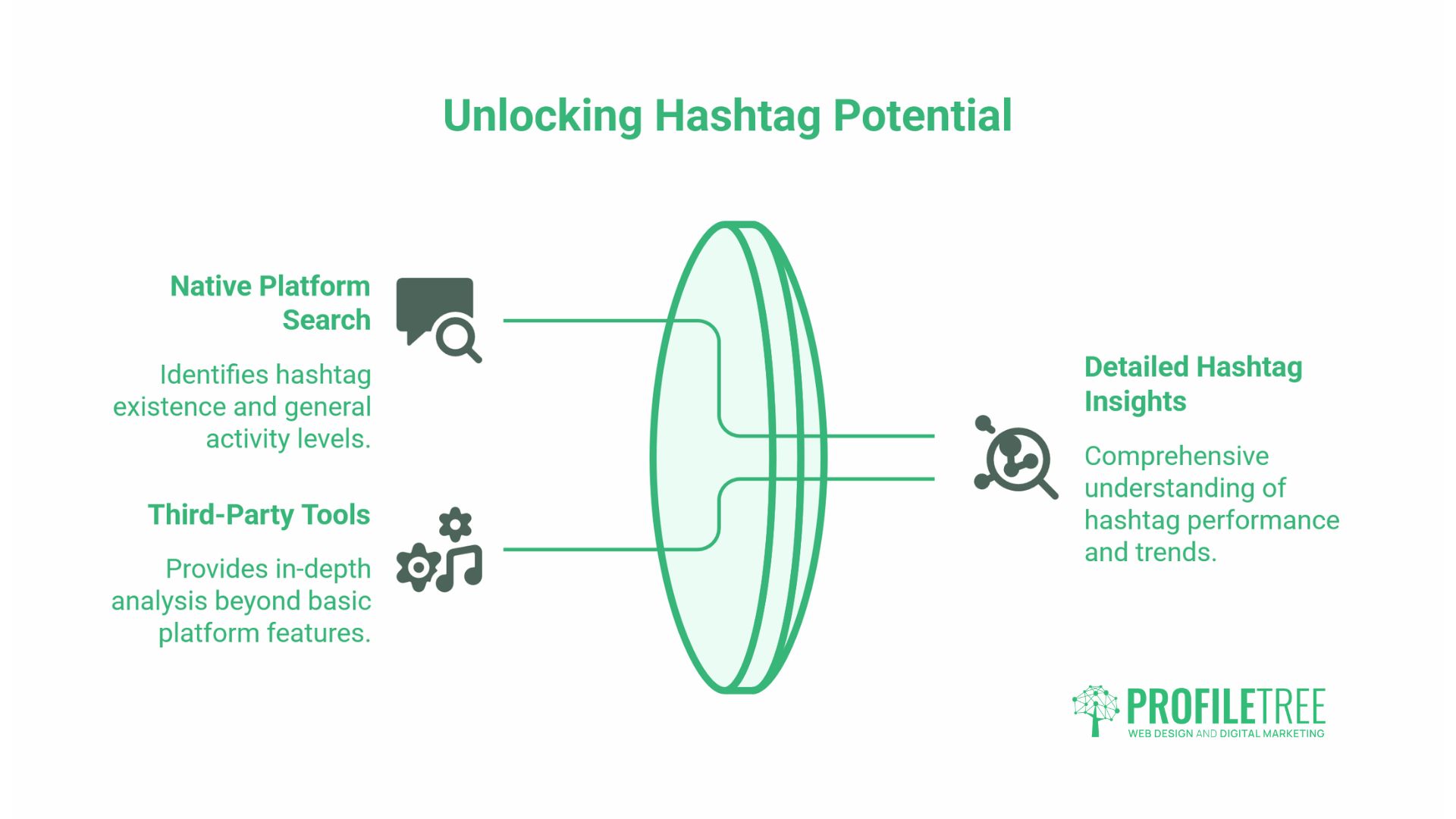
Native platform search tells you whether a hashtag exists and roughly how active it is. For anything beyond that, you need a third-party tool.
Free Tools Worth Using
RiteTag integrates directly with your browser and social scheduling tools. When composing a post, it colour-codes hashtag suggestions in real time: green tags have good current engagement, blue tags build reach more slowly over time, red tags are overused, and grey tags are dormant. For SMEs without a dedicated social media team, this immediate visual feedback removes significant guesswork from the posting process. A free tier is available with limited daily searches.
TikTok Creative Centre (mentioned above under platform search) is a free tool with no paid tier required. For any business with TikTok as part of its content mix, this should be the first stop for hashtag research rather than any third-party alternative.
All Hashtag (all-hashtag.com) generates related hashtag suggestions and shows volume data. Its Hashtag Analytics feature provides a basic breakdown of tag popularity, along with suggested alternatives. It is a reasonable option for initial research, though its data is less granular than paid tools.
Paid Tools for Deeper Analysis
Keyhole specialises in hashtag tracking over time rather than one-off lookups. It shows reach, impressions, and top contributors for a given hashtag, making it particularly useful for tracking campaign-specific tags or monitoring how a branded hashtag performs across a product launch.
Brandwatch takes a social listening approach rather than a simple lookup function. It analyses the conversations happening around a hashtag: sentiment, geographic spread, and associated topics. For businesses running content marketing campaigns and wanting to understand how a topic is being discussed across the UK and Ireland specifically, this level of analysis is more useful than raw volume data alone. The trade-off is cost; Brandwatch is priced for agency teams and marketing departments rather than individual business owners.
Sprout Social includes hashtag reporting as part of its broader social media management platform. If your business already uses a scheduling tool, check whether it has built-in hashtag analytics before paying separately for a standalone product.
Comparison: Free vs Paid Hashtag Lookup Tools
| Tool | Free Tier | Login Required | Best For | UK Data |
|---|---|---|---|---|
| RiteTag | Limited | Yes | Real-time post composition | Good |
| TikTok Creative Centre | Full | No | TikTok trend research | Excellent |
| Display Purposes | Full | No | Related tag discovery | Moderate |
| All Hashtag | Full | No | Quick volume checks | Moderate |
| Hashtagify | Limited | No | Cross-platform research | Moderate |
| Keyhole | Trial only | Yes | Campaign hashtag tracking | Good |
| Brandwatch | No | Yes | Social listening and sentiment | Excellent |
How to Spot Restricted or Broken Hashtags Before You Use Them
One of the most practical things to do when you look up a hashtag is check whether it has been restricted or hidden by the platform. Instagram in particular regularly restricts hashtags associated with spam, inappropriate content, or mass automation. Using a restricted hashtag not only fails to help your reach but, in some cases, suppresses the post across the platform’s discovery systems.
How to Check if an Instagram Hashtag Is Restricted
Search for the hashtag using the Tags tab. If the tag page loads but shows only a small number of “Top posts” with no “Recent posts” section below them, the tag is very likely restricted. A fully active hashtag shows both sections. Some restricted tags display an explicit message: “Recent posts for [hashtag] are currently hidden.” If you see this, do not use the tag.
Well-known examples include hashtags that appear completely harmless. Tags including #workflow, #desk, and #pushups have each been restricted at various points. The restriction is driven by the behaviour of accounts using the tag rather than the tag’s meaning, which is why it catches people off guard. Always check before using a tag, particularly in fitness, food, and lifestyle categories where spam is most common.
A Quick Health Check Before Using Any Hashtag
For any hashtag you plan to use regularly, run through these questions before adding it to your content plan:
- Is the most recent post from within the last 24 hours? If not, the tag may be dormant.
- Does the Instagram tag page show both “Top” and “Recent” sections? In the “Recent” section, there is a restriction signal.
- Is the content under the tag aligned with your industry? If your hashtag has been co-opted by an unrelated community, your posts will appear next to irrelevant content.
- Is the total post volume on Instagram above 50 million? If so, treat it as a brand awareness signal rather than a discovery tool. New posts disappear too quickly for it to drive meaningful reach for smaller accounts.
Finding UK and Ireland-Specific Hashtags
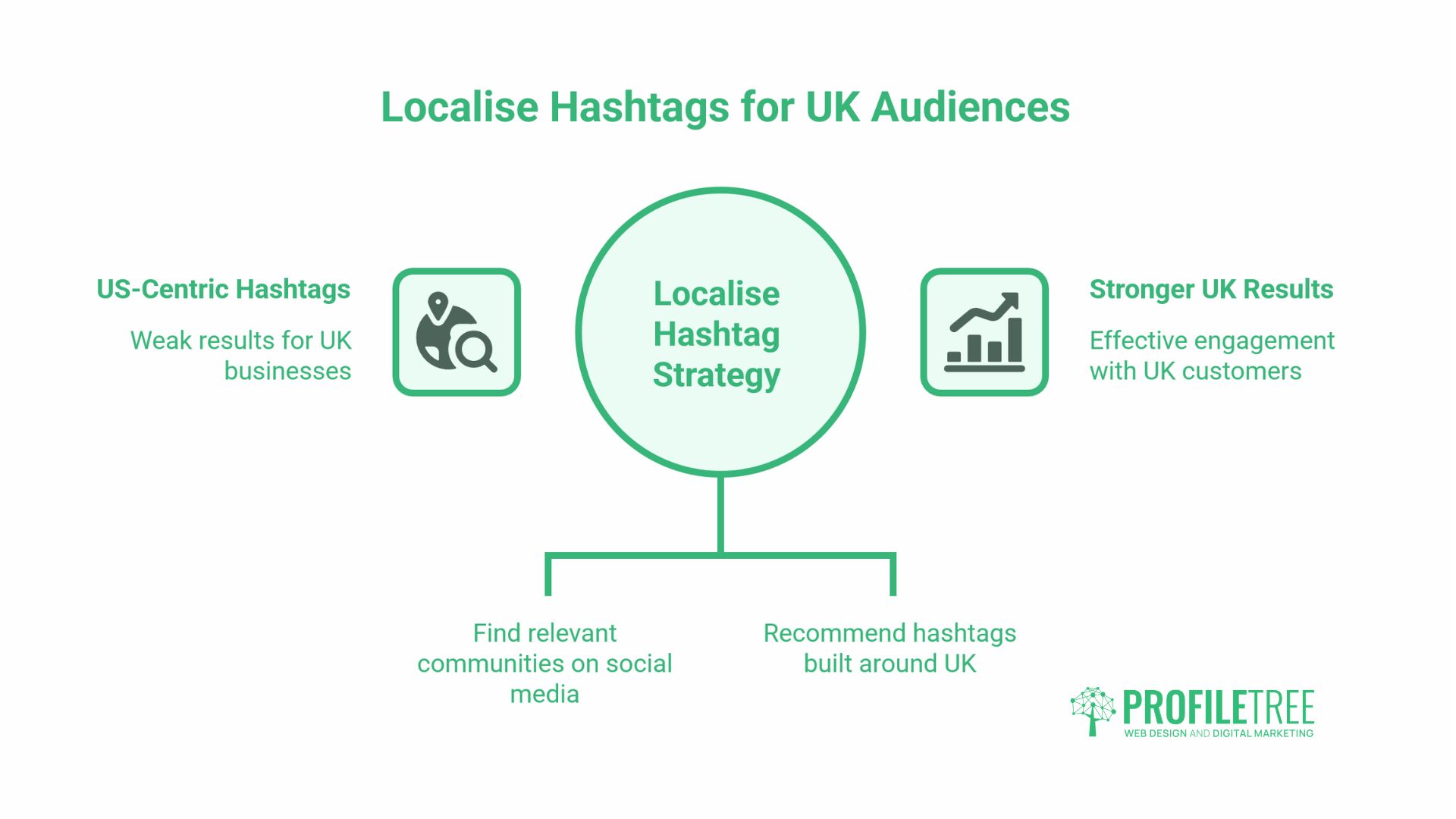
Most hashtag guides are written from a US perspective. The examples, trending topics, and community hashtags they recommend are built around an American audience, which means they produce weaker results for businesses targeting customers in Northern Ireland, Ireland, and the wider UK. A Belfast accountant and a Chicago accountant are both “small businesses,” but their relevant hashtag communities on social media are entirely different.
UK and Irish Business Hashtag Communities
Several established hashtag communities exist specifically for UK and Irish business audiences. #UKSmallBiz and #SmallBizSaturdayUK are active on X and Instagram, particularly around the Small Business Saturday event each December. #IrishBiz and #IrishBizParty are used consistently by a tight-knit community of Irish business owners and entrepreneurs. #BelfastBusiness and #NI are used regularly by Northern Irish business accounts across multiple platforms.
For professional services and B2B businesses, LinkedIn hashtags with strong UK followings include #UKBusiness, #NorthernIreland, and sector-specific tags such as #UKManufacturing or #UKTech.
Hour-Based Twitter/X Communities
Hashtag hour communities are a distinctly UK and Irish social media phenomenon with no direct equivalent in US social media culture. These are regular, scheduled conversations where users post using a specific hashtag at an agreed time each week, creating a concentrated burst of engagement within a defined community. Examples include #YorkshireHour, #ScotlandHour, and #IrishBizParty. To find the current schedule and activity level for any of these, search the hashtag on X and check the timestamps of recent posts to confirm it is still active.
Seasonal and Event-Driven UK Hashtags
UK and Irish seasonal events generate predictable hashtag spikes that businesses can plan around in advance. Bank holidays, sporting events such as the Six Nations and Premier League fixtures, and cultural events like Glastonbury create high-engagement periods where joining the conversation with relevant content can generate meaningful reach. TikTok Creative Centre’s UK trend data is the most reliable free tool for spotting these spikes early, rather than reacting once they have passed.
Ciaran Connolly, founder of ProfileTree, has noted that UK-specific hashtag research consistently comes up as a gap when reviewing social strategies for Northern Irish SMEs: “Most businesses here are using hashtag lists built from US-focused guides. When you dig into the data for their region and sector, you’ll usually find a much more relevant set of tags. They just haven’t been shown where to find them.”
If you want to understand how hashtag strategy connects to your overall social media activity, social media marketing for sales growth covers the strategic framework that sits above individual channel decisions.
How to Build Your Hashtag Mix
Looking up individual hashtags is the research step. Building a usable hashtag mix is the strategy step. The two work together: you cannot build an effective mix without proper research, and doing research without a framework for applying it produces an inconsistent posting approach.
The Four-Category Mix
A practical hashtag mix for most UK and Irish SMEs combines four tag types.
Broad reach tags have high volume (1 million or more posts) and signal topic relevance to platform algorithms. They are unlikely to drive significant discovery on their own because the competition is too intense, but including one or two per post helps the algorithm categorise posts. Use them sparingly.
Mid-tier niche tags have between 10,000 and 500,000 posts and represent the best opportunity for genuine discovery. These are active enough to have an engaged audience but not so saturated that new posts disappear immediately. The majority of your hashtags should sit in this range.
Community and location tags connect your content to specific geographic or professional communities. For Northern Irish businesses, tags such as #Belfast, #NorthernIreland, and #IrishBusiness fit here. For B2B businesses, industry-specific community tags like #UKManufacturing or #AccountancyUK work similarly.
Branded tags are unique to your business or a specific campaign. They build over time as customers and followers pick them up, creating a searchable archive of content associated with your brand.
How Many Hashtags to Use Per Post
Instagram’s own guidance, communicated via its official creator account, points toward three to five highly relevant hashtags for feed posts and Reels rather than maximising the previous 30-tag approach. For TikTok, three to five is the working consensus among practitioners. LinkedIn performs best with one to three hashtags, and X works well with one or two. Stacking more than this tends to look like spam to both the algorithm and to real users scrolling past.
The most important variable is relevance. Ten well-researched, genuinely relevant hashtags consistently outperform thirty randomly assembled ones, which is exactly why knowing how to look up and assess hashtags before using them matters. To track how your chosen hashtags are actually performing over time, free social media analytics tools offer measurement options available without a paid subscription.
Hashtag Research as Part of a Wider Content Strategy
Hashtag research works best when it sits inside a content plan rather than happening post by post at the last minute. An SME with a defined content calendar can research hashtags weeks in advance, aligning tags with campaigns, seasonal events, and product launches rather than adding them as an afterthought at posting time.
For businesses that want to build their own in-house capability in this area, digital skills training covers practical social media management alongside SEO and content creation in a structured programme designed for SMEs in Northern Ireland and the UK.
Teams looking at the broader content production side of their social strategy will find the Instagram Reels strategy and Instagram Stories content creation useful alongside this guide, since hashtag strategy and content format decisions are closely connected on both platforms.
For businesses in Northern Ireland and Ireland building a social media approach from scratch or reviewing an existing one, ProfileTree’s digital marketing strategy services cover how individual channel tactics connect to wider business objectives.
Conclusion
Knowing how to look up hashtags properly (checking activity levels, identifying restricted tags, finding UK-specific communities, and matching volume to your reach goals) is a practical skill that delivers consistent results across every platform. Start with the native search tools on each platform, use TikTok Creative Centre and RiteTag for richer data, and build a four-category mix that prioritises mid-tier niche tags over broad, oversaturated ones. If you want support building a social media strategy that connects hashtag research to measurable business outcomes, speak with the ProfileTree team.
FAQs
How do I look up a specific hashtag on Instagram?
Tap the search icon, select the Tags tab, and type your hashtag without the # symbol. On desktop, use the search bar at instagram.com and filter by Tags. If only Top posts appear with no Recent section, the tag may be restricted.
What is the best free hashtag lookup tool?
TikTok Creative Centre requires no account and gives strong UK trend data. For Instagram, RiteTag’s free tier scores hashtags in real time during composition, and Display Purposes finds related tags without any login.
Can I look up hashtags without creating an account?
Yes. Display Purposes and TikTok Creative Centre both work without registration. Hashtagify’s free tier also requires no login. On Instagram, the URL instagram.com/explore/tags/[hashtag]/ sometimes shows tag data in a browser, though this is inconsistent.
Why can’t I see recent posts for a hashtag I searched on Instagram?
The tag is almost certainly restricted. Instagram restricts tags associated with spam or policy violations, including some that appear harmless. Avoid any tag where the Recent posts section is missing and find an alternative.