
What is Keyword Research? A Guide for Effective SEO Strategy
Table of Contents
Keyword research is the process of identifying the exact words and phrases your potential customers type into search engines when they need a product or service like yours. Get it right, and your website attracts people who are already looking for what you sell. Get it wrong, and you spend months optimising for terms that either nobody searches or that attract the wrong visitors entirely.
This guide answers three questions that matter most to business owners across Northern Ireland, Ireland, and the UK: what keyword research actually is, why it drives every other part of your digital strategy, and what professional keyword research involves when you work with a specialist agency.
Quick definition: Keyword research is the systematic analysis of search query data to identify the terms your target customers use, assess how competitive those terms are, and prioritise the ones most likely to drive qualified traffic and business enquiries.
If you want to go deeper into the practical steps, our guide to eight ways to carry out keyword research covers the methodology in full. This article focuses on the “what” and “why” before you tackle the “how.”
Why Keyword Research Underpins Your Digital Strategy
Most businesses think about keywords in relation to SEO. That is where the process starts, but it extends well beyond rankings. Keyword research is, at its core, market research. It tells you exactly how your customers think about the problems you solve and the language they use when they go looking for answers.
A Belfast-based accountancy firm might assume its customers search for “accountant Belfast” when, in fact, the highest-intent searches in its area are for “self-assessment tax help Northern Ireland” or “HMRC compliance support small business.” Without keyword research, that firm builds its website around the terms its staff use internally rather than the terms its customers actually type.
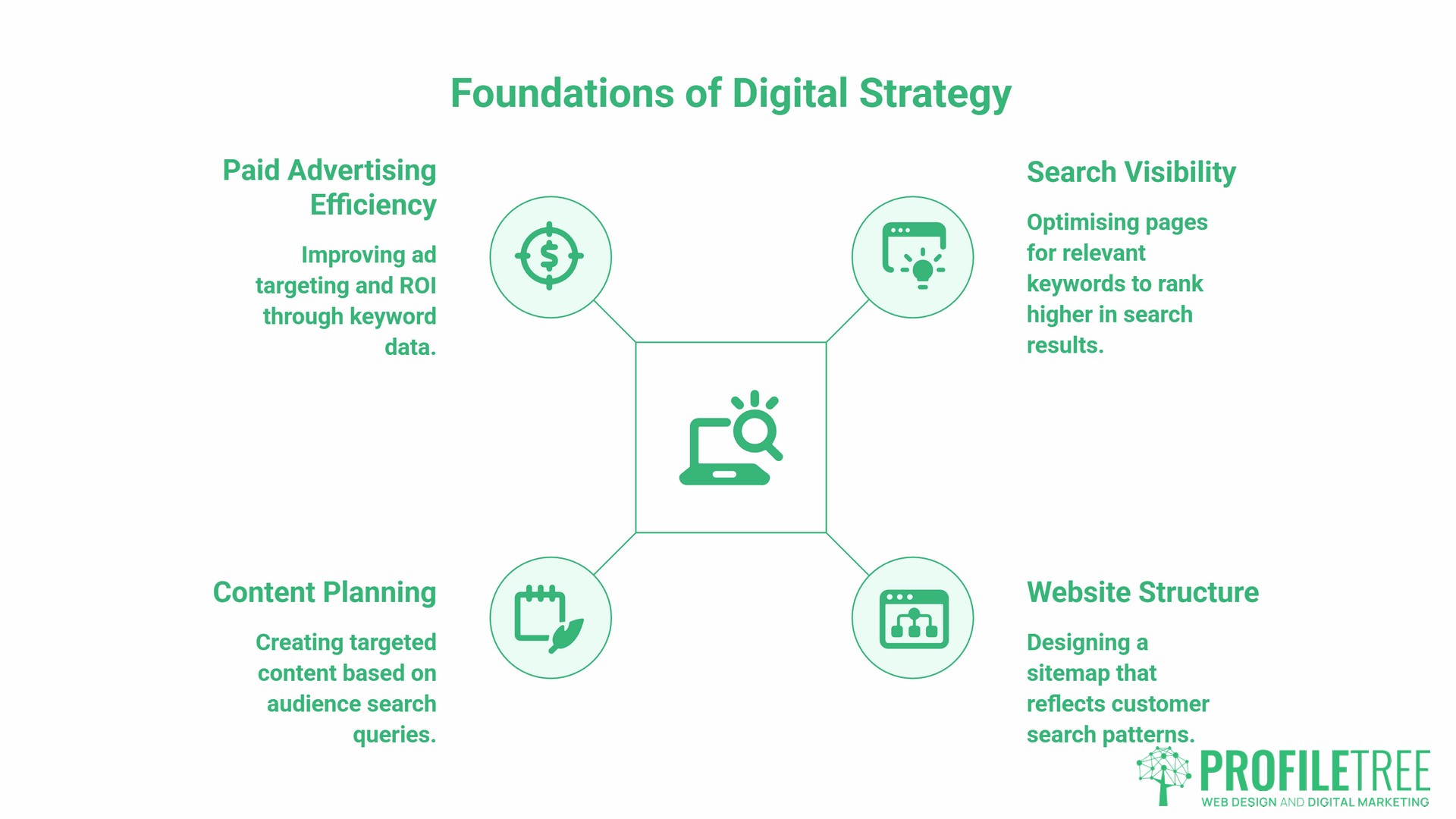
The commercial impact runs across four areas.
- Search visibility. Pages optimised for the right keywords rank. Pages built on assumptions often do not. Keyword research and analysis is the diagnostic step that turns website content from guesswork into targeted material.
- Website structure. The keywords your audience uses determine what pages your site needs. A keyword research and analysis exercise in SEO almost always reveals gaps: service areas with real search demand but no dedicated page, or content covering topics nobody actually searches for. ProfileTree’s web design and development work always begins with keyword data for this reason. The sitemap should reflect how your customers search, not how your internal teams categorise your services.
- Content planning. Once you know what your audience searches for at each stage of their buying journey, content stops being a guessing game. A keyword research and strategy process maps out which articles, guides, and service pages you need to build authority across your topic cluster.
- Paid advertising efficiency. Every pound spent on Google Ads goes further when campaigns are built on keyword research rather than intuition. The same data that informs your organic content directly improves your paid targeting.
“Businesses are treating keyword research as a one-off task rather than an ongoing strategic process, and this is a big mistake. At ProfileTree, we’ve found that companies that regularly review and update their keyword strategies based on performance data consistently outperform those who set and forget,” says Ciaran Connolly, founder of ProfileTree.
The Four Types of Keyword Intent
Understanding keyword intent is what separates effective keyword research from basic keyword collection. Every search query a person types reflects a specific stage in their thinking. Targeting the wrong intent means your page appears to people who are not ready to do what you need them to do.
- Informational intent refers to searches in which the user wants to learn something. Queries beginning with “what is,” “how does,” or “why does” fall into this category. These searches are valuable for building brand awareness and establishing expertise, but they rarely convert directly into sales. This article targets informational intent.
- Navigational intent refers to searches in which the user is looking for a specific website or brand. “ProfileTree Belfast” is a navigational query. You cannot usually rank for competitor navigational queries, and there is limited value in trying.
- Commercial investigation intent covers searches in which someone compares options before making a decision. “SEO agencies Northern Ireland” or “web design Belfast prices” reflect this intent. These are high-value targets because the searcher is close to a buying decision.
- Transactional intent covers searches from people ready to act now. “Hire SEO consultant Belfast” or “book digital training course” are transactional. These terms typically have lower search volumes than informational queries but much higher conversion rates.
| Intent Type | Example Query | User Stage | Typical Value |
|---|---|---|---|
| Informational | “what is keyword research” | Awareness | Brand building |
| Navigational | “ProfileTree website” | Recall | Retention |
| Commercial | “SEO agency Northern Ireland” | Consideration | High |
| Transactional | “hire SEO consultant Belfast” | Decision | Highest |
Keyword Research in the Age of AI Search
One development that every keyword research and strategy process now needs to account for is the rapid growth of AI-generated answers in search results. According to research from SparkToro and Datos, roughly 58.5% of US Google searches and 59.7% of EU searches ended without a click in 2024. Similarweb’s July 2025 report found that figure had risen to 69% across all Google searches in the year since Google’s AI Overviews launched widely.
For context on how that breaks down: Semrush’s analysis of over 10 million keywords found that AI Overviews were triggered on 13.14% of all US desktop queries in March 2025, up from 6.49% in January of the same year. When an AI Overview appears, the search is far more likely to end without a click to any website.
This changes how you should weigh up informational keywords. The value of ranking for a definitional query is no longer just about direct traffic. It is also about appearing in AI-generated answers, building brand recognition at the point of search, and establishing the topical authority that helps your commercial pages rank. A page that earns citations in AI answers is building credibility even when no click occurs.
For SMEs, the practical implication is to focus keyword research on terms where search intent leads to a click. Longer, more specific queries with commercial or investigative intent still reliably drive traffic. Broad informational queries are increasingly answered within the search results themselves, which means content targeting them needs to be structured for AI citation as much as for organic ranking.
The Core Metrics: Volume, Difficulty, and Business Value
Keyword research tools report dozens of metrics, but three drive most decisions for SMEs.
- Search volume is the average number of monthly searches for a given term. High volume sounds attractive, but it is rarely the right starting point for an SME. A term with 50,000 monthly searches dominated by global brands is useless to a Belfast consultancy. A term with 300 monthly searches and clear local intent is often worth more in practice.
- Keyword difficulty estimates how hard it would be to rank on the first page of results for a given term. Tools score this differently, but the underlying logic is consistent: terms dominated by high-authority domains with years of backlinks are harder to compete for than terms where the top-ranking pages are weaker.
- New websites should prioritise lower-difficulty terms. Not because ambition should be limited, but because ranking for 20 lower-competition terms builds the domain authority needed to compete for harder terms later. Keyword research analysis that starts with realistic targets produces results faster than one that chases only high-volume competitive phrases.
- Business value is not a metric that any tool gives you directly. It requires judgement. A keyword might have reasonable volume and manageable difficulty, but if the people searching it are three steps away from a buying decision, it delivers less commercial return than a lower-volume term where searchers are ready to enquire. The best keyword research and analysis in SEO always weighs intent and commercial fit alongside volume and difficulty.
A useful sanity check before committing to any keyword: ask whether someone searching this term could realistically become a paying customer within 30 days. If the answer is no, the keyword may still have value for brand building, but it should not be prioritised over terms where the answer is yes.
Localising Keyword Research for UK and Irish Markets
This is an area where the standard guidance from large international SEO tools consistently falls short, and where local knowledge makes a real difference.
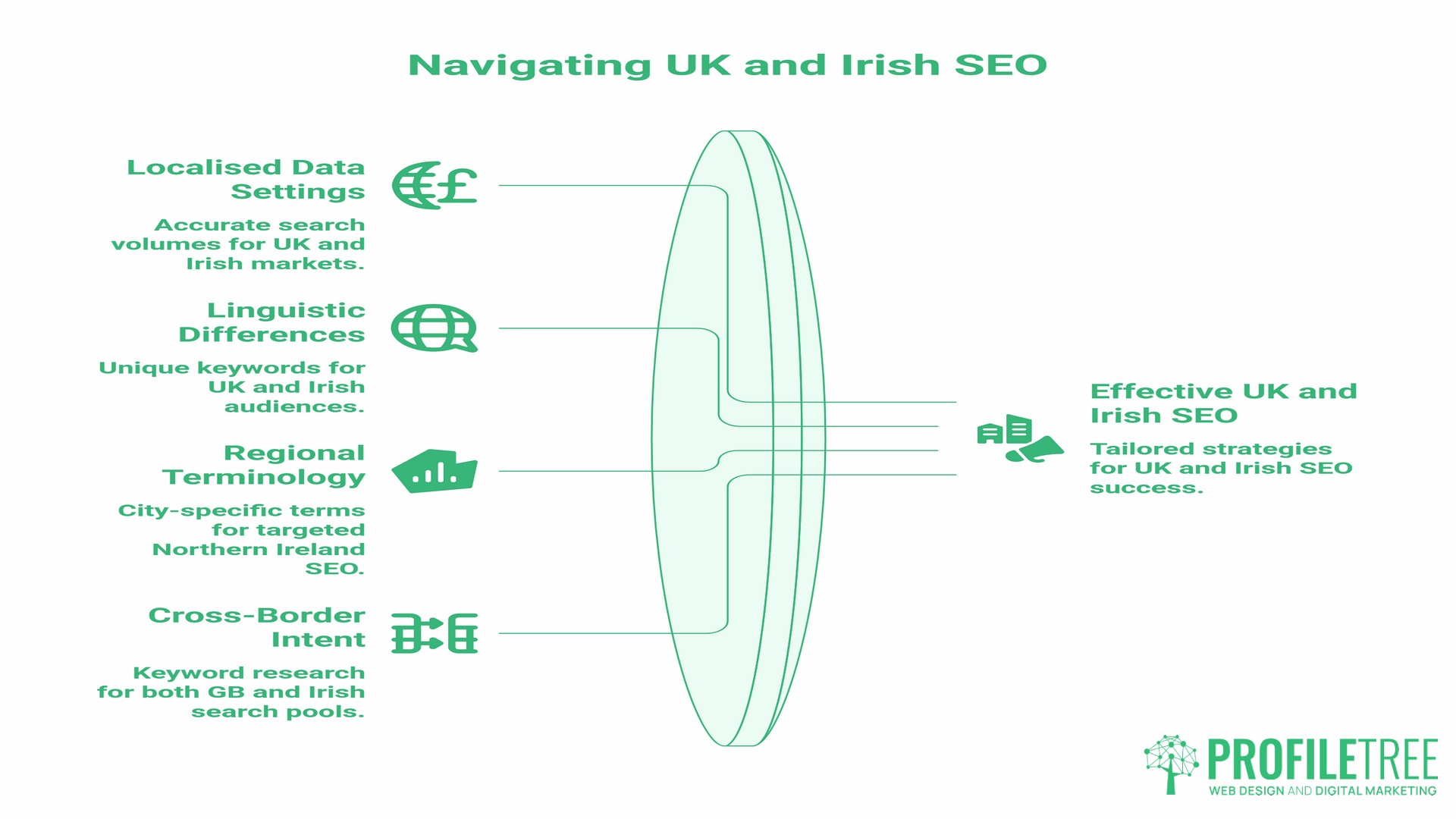
Most keyword research tools report global or US search volumes by default. A term that appears to have 5,000 monthly searches may have 200 in the UK and fewer than 50 in Northern Ireland. Unless your tool is configured to show UK data specifically, volume figures can be significantly misleading.
Beyond the data settings, there are genuine linguistic differences that affect how keyword research in digital marketing needs to be approached for UK and Irish audiences.
Some straightforward examples:
- “Solicitor” versus “lawyer” (solicitor is far more common in UK and Irish search)
- “Flat” versus “apartment” (flat dominates UK property searches)
- “Accountancy” versus “accounting” (accountancy is standard in UK professional services searches)
- “Skip hire” versus “dumpster rental” (the latter is almost entirely a US phrase)
- “Broadband provider” versus “internet service provider” (UK consumers typically search the former)
For businesses serving Northern Ireland specifically, there are additional considerations. Some audiences search within a GB frame of reference; others within an Irish one. A business serving both markets needs keyword research that accounts for both search pools, particularly for services where cross-border intent is genuine.
Regional terminology matters at a granular level too. Belfast businesses sometimes find that city-specific terms perform differently from broader Northern Ireland terms, depending on the service. A solicitor’s firm based in the city centre may find that “Belfast solicitor” outperforms “Northern Ireland solicitor” for their practice areas, while a business offering remote services performs better targeting the broader geographic term.
ProfileTree’s SEO services include localised keyword research as part of every engagement, specifically because UK and Irish market nuances require this level of attention.
Keyword Research for New Websites vs Established Businesses
The practical approach to keyword research differs meaningfully depending on where your website sits in its development.
For new websites with no established authority, the priority is to find terms you can realistically rank for within a reasonable timeframe. This means focusing on:
- Long-tail keywords (three words or more) with lower search volumes but more specific intent
- Location-qualified terms where local relevance gives smaller sites a genuine advantage over national competitors
- Niche topic areas where your specific expertise exceeds what generalist competitors have covered
A new Belfast bakery is not going to rank for “bread” or even “artisan bread Belfast” quickly. But “sourdough bread delivery Belfast” or “gluten-free birthday cakes Belfast” may be genuinely achievable because the competition is thinner and the intent is specific.
For established websites with existing rankings, keyword research and strategy shifts towards protecting and extending what already works. This involves reviewing which terms currently drive traffic, identifying where rankings could be improved with better content, and finding adjacent topics where existing domain authority gives you a head start.
The keyword research methodology is the same in both cases: identify opportunities, assess difficulty against your current authority, and prioritise based on realistic business value. What changes is where the threshold sits between achievable and aspirational.
The video below from ProfileTree covers how keyword strategy connects to broader digital marketing planning for businesses at different stages:
How Professional Keyword Research Works in Practice
Understanding keyword research in SEO is one thing. Knowing what it actually involves when a specialist does it is another, and it is worth being clear about what you should expect.
A professional keyword research process typically works as follows.
- Business and audience analysis. Before opening a keyword tool, a good practitioner needs to understand what your business does, who your customers are, what problems you solve, and why you’re the right choice over alternatives. This context shapes every decision that follows.
- Seed keyword generation. This is the starting point for exploration. Seed keywords are the broad terms that describe your services or topics, before refinement. For a digital marketing training provider in Belfast, seeds might include “digital marketing training,” “SEO training,” “social media training,” and “marketing courses Belfast.”
- Tool-based expansion. Keyword tools take seed terms and return data on related queries, variants, questions, and associated terms that real users search. This expansion phase typically generates hundreds of candidate terms that need to be filtered.
- Intent and difficulty filtering. The long list gets reduced to a shortlist based on intent match (does this term attract our target customer at the right stage?), difficulty (can we realistically compete for this term?), and business value (does ranking for this term lead to enquiries?).
- Mapping to content and pages. Each priority keyword gets assigned to an existing or planned page. This mapping ensures that every page on your site has a clear search purpose and that no two pages compete for the same term. It also identifies gaps where new content is needed.
- Tracking and iteration. Keyword research is not a one-off exercise. Rankings shift, new competitors emerge, and customer language evolves. A well-structured keyword research process includes regular review cycles, with data from Google Search Console informing ongoing decisions.
For SMEs considering whether to handle this internally or work with an agency, the honest answer is that the tools are accessible, but the judgment required to use them well takes time to develop. ProfileTree’s digital training programmes can build this capability in-house if that is the right model for your business. Alternatively, handing the research and ongoing management to a specialist frees your team to focus on delivery while ensuring the strategic foundation is solid.
Keyword Research Across Your Digital Marketing Mix
A point that often gets missed: keyword research is not just an SEO activity. The data it generates feeds into decisions across every channel.
- Web design and site architecture. The structure of your website should reflect how your customers search. If keyword research reveals that “website design for manufacturers” and “ecommerce web design Belfast” are both priority terms, those need to be separate, clearly differentiated pages rather than a single generic web design page. Understanding this at the planning stage saves significant rework later. It is one of the reasons keyword research sits at the start of every web development project at ProfileTree.
- Content marketing. Keyword data tells you which topics your audience actively searches for, which allows content to be planned around genuine demand rather than internal assumptions. A content calendar built on keyword research produces articles that attract qualified traffic rather than filling editorial schedules.
- Digital training. Teams that understand keyword research make better decisions across every marketing activity. When your content writers, social media managers, and account handlers understand intent and search volume, their work aligns with what your potential customers actually need. This is precisely why keyword research features in ProfileTree’s digital marketing training.
- Paid search. The same data that informs organic content directly improves Google Ads targeting. Campaigns built on keyword research insights reduce wasted spend and improve the quality of generated traffic.
Making Keyword Research Work for Your Business
Keyword research sits at the foundation of any digital marketing strategy that produces measurable results. It replaces assumptions with data, aligns your content with how your customers actually think, and ensures your investment in web design, content, and advertising is directed at the terms that matter.
For SMEs across Northern Ireland, Ireland, and the UK, getting this right means working with data that reflects your specific market rather than defaulting to global averages. It means prioritising intent and business value over vanity search-volume metrics. And it means treating keyword research as an ongoing process rather than a task you complete once and set aside.
Whether you handle this internally or work with a specialist, the starting point is always the same: understand what your customers search for before you decide what to build.
Frequently Asked Questions
What is keyword research in SEO?
Keyword research in SEO is the process of identifying the search terms your target customers use, assessing their competitiveness, and selecting the ones most likely to drive qualified traffic to your website. It informs which pages to create, how to structure your content, and where to focus your optimisation efforts. Without it, SEO becomes guesswork. With it, every piece of content has a defined search purpose and a realistic path to visibility.
What is keyword research and analysis?
Keyword research and analysis combine the discovery of candidate search terms with a structured assessment of their value. The research phase generates a list of potential keywords using tools and audience insight. The analysis phase filters that list by search volume, keyword difficulty, user intent, and likely business value. Together they produce a prioritised set of terms that a business can realistically pursue and that are worth pursuing. The analysis step is what separates strategic keyword work from simple term collection.
What are the four types of keywords in SEO?
The four types are informational (the user wants to learn something), navigational (the user is looking for a specific website or brand), commercial (the user is comparing options before a decision), and transactional (the user is ready to take action now). Most business content should target a mix of commercial and informational terms, with service pages focusing on transactional and commercial intent and blog content covering informational queries that build authority.
How many keywords should a single page target?
One primary keyword per page, with three to five closely related secondary keywords that reflect how real users phrase the same search intent. Trying to optimise a single page for unrelated keyword clusters dilutes its relevance signal and confuses both users and search engines. If two distinct keyword topics each have meaningful search volume, they typically warrant separate pages rather than a combined one.
What is a realistic search volume target for an SME?
There is no universal answer, but a useful frame is to prioritise intent over volume. Fifty monthly searches from people who are ready to enquire about your services will outperform five thousand monthly searches from people who have no commercial intent. For most SMEs targeting local or regional markets in Northern Ireland or Ireland, terms with 50 to 500 monthly UK searches are often the most realistic and commercially valuable targets. National or UK-wide terms with thousands of searches are rarely achievable for smaller businesses without significant domain authority.
How often should keyword research be reviewed?
A full keyword research and strategy review should happen at least twice a year. Monthly checks using Google Search Console data allow you to spot ranking movements, identify new query patterns, and adjust content priorities without waiting for a full audit. Businesses launching new products or services, entering new markets, or responding to significant changes in their industry should review their keyword strategy immediately rather than waiting for a scheduled cycle.
Is keyword research still relevant with AI search growing?
Yes, though the way you apply it has shifted. According to Whitehat SEO’s 2026 B2B keyword research guide, organic search still generates 44.6% of all B2B revenue, making it the largest single digital channel. What has changed is which keywords deserve priority. Broad informational terms are increasingly answered directly in search results by AI Overviews, reducing clicks to websites. Commercial and transactional keywords still drive reliable traffic because AI systems are less likely to fully satisfy purchase-ready intent. Keyword research in this environment focuses more heavily on intent qualification and less on volume chasing.