
Java Object-Oriented Programming Explained for Business
Table of Contents
If your developer has mentioned Java Object-Oriented Programming and you nodded along without being entirely sure what they meant, you are not alone. Most explanations of OOP are written for developers, not for the people who commission, manage, and pay for web projects. This guide takes a different approach.
Java Object-Oriented Programming is the structural foundation behind most serious web applications and business software — from customer portals and booking systems to enterprise platforms handling thousands of users. Understanding its core principles will not turn you into a developer, but it will help you ask better questions, assess quotes more critically, and avoid the most common sources of unnecessary cost when working with a development partner.
Whether you are scoping a new build or trying to make sense of an existing one, what follows explains what OOP actually means for your project, your data, and your long-term costs.
What is Object-Oriented Programming in Java?
Object-oriented programming, usually shortened to OOP, is a way of organising code. Instead of writing a long sequence of instructions, a developer using OOP structures their code around objects — self-contained units that represent something meaningful in the real world.
In a customer management system, for example, a “Customer” is an object. It stores data (name, email address, order history) and can perform actions (place an order, update an address, receive a notification). The code for a “Customer” object is written once, defined clearly, and reused throughout the application.
Java is one of the most widely used OOP languages in commercial software development. It is used to build everything from enterprise business applications and banking systems to e-commerce platforms and Android applications. When a development agency recommends Java for a bespoke project, they are usually pointing to its stability, scalability, and the quality of OOP it enables.
For a deeper introduction to how these concepts are applied in practice, our guide to object-oriented programming in Java covers the technical foundations in more detail.
Why Java Remains Widely Used in Web and Application Development
Java has been a dominant language in enterprise development for over two decades. Its staying power comes from a combination of factors: a mature ecosystem of tools and libraries, strong community support, and the fact that Java applications run consistently across different operating systems without modification. For businesses that need a stable, long-term application, these practical advantages are hard for newer languages to match.
The Difference Between Java and Other Languages Your Developer Might Use
When a developer recommends a language for your project, the choice is usually driven by what you are building, not personal preference. Java is well-suited to complex, data-heavy applications: booking platforms, multi-user portals, inventory systems, anything that needs to handle significant logic reliably at scale. PHP (the language underpinning most WordPress sites) is faster and cheaper to deploy for marketing sites and content-driven pages. Python tends to be well-suited for data processing, automation, and AI integration. Knowing which problem each language solves best helps you have a more informed conversation with your development team before work begins.
The Four Principles of OOP — What They Mean for Your Project
OOP is built on four core principles. Every tutorial on the internet explains these in terms of code syntax. This section explains them in terms of their impact on your project costs, your data, and your ability to grow and adapt the application over time.
| OOP Principle | What it means in plain English | Why it matters for your project |
|---|---|---|
| Encapsulation | Data is kept inside a defined boundary and protected from accidental interference | Protects sensitive data; reduces bugs caused by one part of the code disrupting another |
| Inheritance | Code patterns are written once and reused across multiple parts of the application | Reduces development time; makes future updates cheaper because you change one component, not many |
| Polymorphism | Different parts of the application can respond to the same action in different ways | Allows the application to scale and adapt without needing to rebuild core components |
| Abstraction | Complexity is hidden behind a simple interface | Your team uses the application without needing to understand what happens in the code underneath |
Encapsulation — Why Your Data Stays Protected
Encapsulation means that the data inside an object is kept private and can be accessed or changed only through clearly defined routes. In practice, this is what prevents one part of an application from accidentally overwriting data in another.
For businesses operating under the UK GDPR, this matters in concrete ways. Well-encapsulated code makes it far easier to demonstrate that personal data is handled only where it is intended to be handled, that access is controlled, and that changes to one system do not create unintended exposure elsewhere. The ICO’s guidance on data protection by design points directly to the kind of structured, controlled data handling that good encapsulation supports.
When you ask a developer how user data is protected within your application, a sound answer will reference how the codebase isolates and controls access to sensitive fields.
Inheritance — How Good Code Saves You Money on Future Builds
Inheritance allows a developer to create a general template and then build specific variations from it, without rewriting the original. In a retail application, for instance, a general “Product” template might contain the common logic for all items: price, availability, and description. A “DigitalProduct” and a “PhysicalProduct” each inherit from that template and add only the features specific to them.
The business implication is straightforward. When you want to add a new product type or user category six months after launch, a development team working with clean inheritance does not start from scratch. They extend an existing component. That is the difference between a sensible change-request quote and a surprisingly large one.
Polymorphism — Flexibility That Lets Your Application Grow
Polymorphism allows different objects to respond to the same instruction in ways that make sense for each. A payment processing module might handle card payments, bank transfers, and vouchers through the same interface, with each type knowing how to process itself correctly.
For a growing business, this matters because it means new capabilities can be added without rewriting the existing ones. If you want to introduce a new payment method, a new user role, or a new product category, well-written polymorphic code allows the application to accommodate it without rebuilding the structure around it.
Abstraction — Keeping Complexity Behind the Scenes
Abstraction is the principle that a system should expose only what the user needs to see. Your website’s content management panel is a practical example: you can create pages, update products, and manage bookings through a clean interface without knowing anything about the database queries or the server processes running beneath it.
Good abstraction makes applications easier to hand over, easier to train staff on, and easier to expand, because the underlying complexity is managed in one place and does not bleed into every corner of the system.
Why OOP Matters When You Commission a Web Development Project
Understanding the four principles is useful, but the more practical question is what they mean when you are briefing a developer, reviewing a quote, or deciding whether to continue working with an existing development partner.
How OOP Affects Maintainability and Long-Term Costs
The most common source of unexpectedly high change-request costs in SME web projects is poorly structured code from the original build. When an application has not been built to OOP principles, components are often tightly tangled: changing one thing breaks something else, and a developer cannot update one feature without tracing the effects through the whole codebase.
“One of the most common situations we encounter when taking on an inherited project is a codebase where everything depends on everything else,” says Ciaran Connolly, founder of ProfileTree. “What should be a straightforward update becomes a significant piece of work because the original build was not structured to make change easy. Good OOP from the start is not just a technical preference — it directly affects how much a client pays every time they want to develop the application further.”
A codebase built on sound OOP principles is modular: each component has a defined responsibility, changes to one component do not cascade unpredictably, and a new developer can understand the structure without needing to read every line. That modularity has direct cost implications throughout the project’s lifetime.
Questions to Ask Your Developer About Code Structure
You do not need to understand the code itself to ask reasonable questions about its structure. Before signing off on a development project, or when reviewing the work of a current development partner, these are worth raising:
- Is the application built around clearly defined components, and are those components designed to be reused rather than duplicated?
- How are sensitive data fields (user credentials, payment information, personal records) isolated and protected within the codebase?
- If we want to add a new feature or user type in the future, how much of the existing code would need to change?
- Is the code documented well enough that another developer could take it over without needing extended handover support?
- What does the testing process look like, and how are errors in one component prevented from affecting others?
A development team building to OOP principles should be able to answer all of these clearly and confidently.
OOP and Custom Web Applications for SMEs
Java-based OOP is most relevant for businesses that need a bespoke application built to specific requirements: a customer portal, a job management platform, an inventory or booking system, or any application that handles significant user data and logic. For these projects, the structure and maintainability that OOP provides are not optional extras; they are what separate an application that serves the business well for five years from one that becomes expensive to maintain within eighteen months.
ProfileTree’s web development services cover bespoke application builds and marketing sites, and the approach to code structure differs significantly between the two. Understanding what you need is the first conversation worth having.
OOP in Modern Java — What Has Changed in Recent Versions
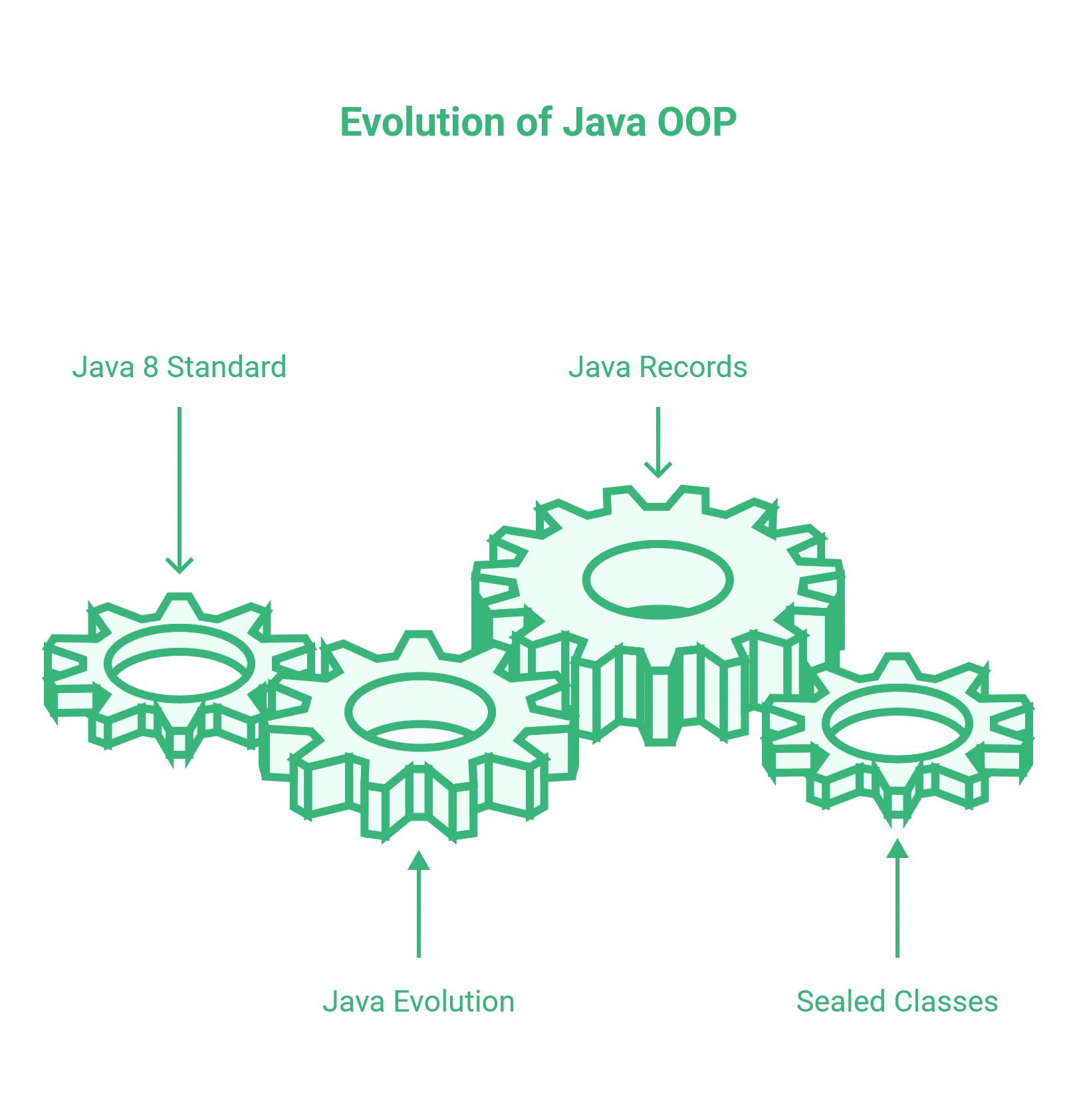
Most online guides to Java OOP were written when Java 8 was the standard. Java has evolved considerably since then, and two additions in particular are worth understanding as a client, because they affect how cleanly and efficiently a modern development team can work.
Java Records — Simpler, Safer Data Handling
Introduced in Java 14 and made permanent in Java 16, Records are a streamlined way to create objects whose sole purpose is to carry data. Before Records, a developer writing a simple “Customer” data object had to write and maintain a significant amount of repetitive code: constructors, getter methods, and equality checks. Records handle all of that automatically, with far fewer lines.
For a client, this means less code to maintain, fewer places for bugs to hide, and a cleaner codebase overall. When evaluating a development partner’s approach, asking whether they use modern Java features, such as Records, on appropriate data structures is a reasonable quality check.
Sealed Classes — Controlled, Auditable Inheritance
Introduced in Java 17, Sealed Classes allow a developer to define exactly which other classes can extend a given component. This might sound like a technical detail, but its practical implications are meaningful: it makes the application’s inheritance structure explicit and auditable. A reviewer or auditor can see precisely how the system’s components are allowed to relate to one another, and no unexpected extensions can be introduced later without deliberate change.
For applications handling regulated data or requiring audit trails, this kind of control is a genuine advantage over older Java codebases that offer no such formal structure.
Our overview of Java programming projects provides more context on how these modern features are being applied in real-world builds.
Is Java the Right Choice for Your Web Project?
Java is not always the right answer. Understanding when it is and when it is not will help you make a more informed decision during the scoping phase of any project.
When Java Makes Sense for a Business Application
Java is well-suited to applications that need to handle large numbers of concurrent users, complex business logic, or significant volumes of data reliably. Multi-tenant platforms, enterprise resource systems, fintech applications, and custom client portals are all areas where Java’s OOP capabilities and stability make it a strong choice. It is also worth considering for projects where long-term maintainability is a higher priority than speed to market.
When Another Language May Be More Practical
For a marketing website, a content-heavy blog, or a standard e-commerce site, Java is rarely the right tool. PHP and the WordPress ecosystem are faster and more cost-effective to build and maintain for these use cases, and the available plugin ecosystem covers most standard requirements without custom development. Python is a better fit for data analysis, machine learning integrations, or automation scripts. A development partner who recommends Java for a straightforward brochure site without a clear justification is worth questioning.
If you are building digital capability across your business and need to understand which technical approaches suit which problems, ProfileTree’s digital training programmes are designed to help business owners and managers make these decisions with confidence.
Conclusion
Java object-oriented programming shapes how your application handles data, scales with your business, and incurs maintenance costs over time. Understanding the four principles does not require a technical background; it requires knowing what questions to ask and what the answers should look like. A well-structured codebase built to OOP principles is one of the most practical investments an SME can make when commissioning a bespoke web application. If you are planning a new build or reviewing an existing one, ProfileTree’s web development team works with businesses across Northern Ireland, Ireland, and the UK to deliver applications built to last.
FAQs
What does object-oriented programming mean in plain English?
Object-oriented programming organises code around real-world entities — a customer, a product, a booking — rather than a sequence of instructions. Each entity holds its own data and behaviour. The four governing principles are encapsulation, inheritance, polymorphism, and abstraction.
Why does it matter whether my developer uses OOP?
The structure of your codebase directly affects the cost of updating your application over time. Code built to OOP principles is modular, so changes to one component do not cascade unpredictably through the rest. This is the most significant factor behind disproportionate change-request quotes on live applications.
Is Java a good choice for building a business web application?
Java suits complex, data-heavy applications that need to scale: client portals, booking platforms, multi-user business systems. For a standard marketing or content site, PHP and WordPress are faster and more cost-effective. The right choice depends on what you are building, not on which language is theoretically “best.”
What are the four pillars of OOP in Java?
Encapsulation protects data within defined boundaries. Inheritance allows code patterns to be reused across related components. Polymorphism allows different components to respond appropriately to the same instruction. Abstraction hides complexity behind a clean interface.
Is Java a pure object-oriented language?
Technically, no, because Java includes primitive data types that are not objects. In practice, this distinction has no bearing on the quality or capability of an application built in Java.
What is the difference between a class and an object in Java?
A class is the template; an object is a specific instance created from it. The class “Customer” defines the structure; an individual customer record is the object.