
Intelligent Content: Transforming Digital Strategy for Businesses
Table of Contents
Information overload defines modern business. Companies struggle to deliver relevant messages across websites, social media, email campaigns and mobile platforms. Intelligent content solves this problem through structured, reusable information assets that adapt automatically to different channels and audiences.
For businesses in Northern Ireland, Ireland and the UK, this approach represents a fundamental shift in digital strategy. Rather than creating separate content for each platform, organisations build modular components once and deploy them everywhere. This method reduces costs, improves consistency and accelerates time-to-market for new campaigns or products.
At ProfileTree, our Belfast-based team works with SMEs across these regions to implement intelligent content strategies within broader web design and digital marketing programmes. This guide explains the core principles, business applications and practical implementation steps for organisations ready to transform their content operations.
What Is Intelligent Content?
Intelligent content comprises structurally rich, semantically tagged information designed for automated processing and multi-channel reuse. Traditional content exists as static documents created for single purposes. Intelligent content breaks down into smaller, independent components tagged with descriptive metadata.
This fundamental difference matters because it determines flexibility. A traditional blog post lives as one file, styled for web display. Reusing a paragraph requires manual copying. Translation means translating the entire document. With intelligent content, that blog post comprises multiple discrete components—introduction, key arguments, case study, call-to-action. Each component exists independently with its own metadata tags.
Systems can automatically pull the introduction for email campaigns, combine arguments with other components for whitepapers, or translate only necessary elements for specific markets. This modularity transforms content from static documents into dynamic information assets.
The Core Principles
Four principles define intelligent content:
Modularity: Information breaks into small, independent units rather than monolithic documents. A product description might separate into name, specifications, features list, benefits and usage instructions as distinct components.
Structure: Content follows predefined schemas like XML or DITA that define elements and relationships. This structure makes content machine-readable, allowing automated systems to understand and process information without human intervention.
Metadata: Descriptive tags provide context about purpose, audience, topic, version and relationships. This information layer enables discovery, personalisation and intelligent reuse across platforms.
Separation from Presentation: The content itself remains distinct from visual styling or formatting. A component contains pure information that systems can render appropriately for websites, mobile apps, print materials or voice interfaces.
Real-World Applications
Technical documentation teams generate product manuals for different models, languages and user roles by assembling relevant components automatically. A manufacturer might maintain thousands of component specifications that combine differently for consumer manuals versus technical service guides.
E-commerce platforms dynamically pull product descriptions, specifications and customer reviews to display on product pages, comparison tools, mobile apps and email campaigns. One source of truth feeds all customer touchpoints, maintaining accuracy and consistency.
Marketing departments personalise campaign messages for different audience segments by combining various headlines, body content and calls-to-action based on user data and behaviour. Regional campaigns adapt automatically whilst maintaining brand consistency.
Healthcare organisations tailor patient information for specific conditions, treatments and languages, presenting only relevant, understandable content to each patient group. Regulatory updates propagate automatically across all affected materials.
For ProfileTree’s clients developing new websites or digital marketing strategies, this approach means content created for one purpose serves multiple channels without duplication. A Belfast retailer’s product information feeds their WordPress website, social media posts, email campaigns and Google Shopping listings from a single content repository.
“Intelligent content revolutionises how businesses operate online,” notes Ciaran Connolly, Director of ProfileTree. “Rather than maintaining separate content for different platforms, companies create once and publish everywhere. This approach dramatically reduces workload for our clients whilst improving consistency across all customer touchpoints.”
The Core Components of Intelligent Content
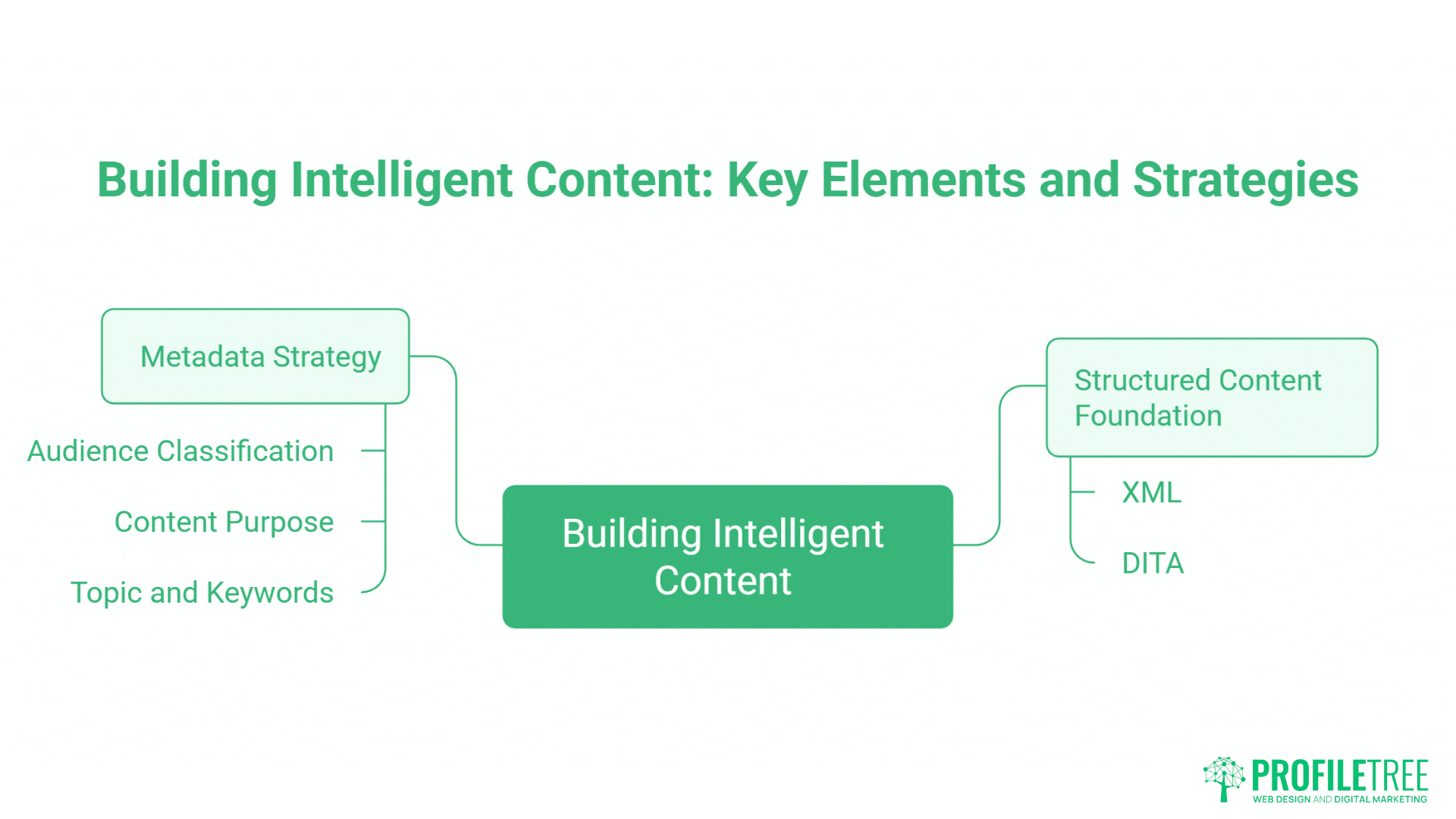
Building intelligent content requires understanding four interconnected elements that work together to create flexible, reusable information assets.
Structured Content Foundation
Structured content organises information according to predefined models or schemas rather than free-form text. Think of it as a database approach to words and media. Instead of one large text block, documents break into distinct, identifiable elements: titles, paragraphs, lists, images, tables.
These elements receive tags using standards like XML (eXtensible Markup Language) or DITA (Darwin Information Typing Architecture). XML provides frameworks for defining custom markup tags, allowing creators to describe meaning and structure. DITA specialises in technical documentation, promoting modularity through distinct topic types: concepts, tasks and references.
In structured product descriptions, you wouldn’t write one paragraph of text. You’d have separate fields for product name, short description, features list and technical specifications. This structure makes content machine-readable, enabling automated processing and intelligent reuse.
For web design projects, ProfileTree implements structured content within WordPress installations, creating custom fields and taxonomies that allow content to flow automatically between pages, widgets and marketing materials. This foundation supports both current websites and future platform migrations.
Metadata Strategy
Metadata describes data. For intelligent content, it provides context and meaning to each component, allowing systems to understand what content represents, who needs it, its purpose and relationships to other information. This understanding powers discovery, personalisation and automated delivery.
Practical metadata examples include:
Audience Classification: Beginner, intermediate, expert, customer, internal staff, partner organisations. This allows systems to serve appropriate complexity levels automatically.
Content Purpose: Inform, instruct, persuade, entertain, support. Different purposes require different approaches and delivery contexts.
Topic and Keywords: SEO terms, subject categories, product associations. These enable search functionality and content recommendations.
Product Version: Critical for technical documentation and release-specific information. Systems filter content based on user’s product version.
Content Type: Article, FAQ, video, image, infographic. Different types require different rendering and display approaches.
Status and Workflow: Draft, under review, approved, published, archived. This metadata manages content lifecycle and governance.
When users search or systems personalise content, metadata determines which components appear and how they combine. For ProfileTree’s digital marketing clients, this means campaign messages automatically adapt based on audience segments defined through metadata tags.
Content Modelling Process
Content modelling defines the structure and relationships within your content ecosystem. It creates blueprints for intelligent content systems, identifying content types, their constituent elements and interconnections.
A content model for “product feature” might specify fields for feature name, description, benefits list, associated images and video demonstrations. It defines relationships where one feature links to multiple product pages, appears in comparison charts and feeds into marketing materials.
This planning phase occurs before content creation, establishing consistency across teams and enabling efficient workflows. Content models answer questions like: What information do we need? How does it relate? Who needs access? Where does it appear?
For SMEs working with ProfileTree on website development, content modelling happens during the strategy phase. We map existing content, identify gaps and design structures that support business goals. A Belfast-based professional services firm might model case studies, service pages, team bios and blog posts as distinct but interlinked content types.
Content Reuse Capabilities
Content reuse represents the most significant advantage of intelligent content. Modular, structured components live in repositories as single instances that appear in multiple contexts, publications and channels. This practice, called single-sourcing, transforms content economics.
Consider safety warnings for products. Instead of writing separately for user manuals, quick-start guides and websites, warnings exist once as components. Systems reference this single component wherever needed. Updates happen in one location and propagate automatically to all instances.
This approach reduces duplication, maintains consistency and saves substantial time and resources in creation, review, translation and updates. For organisations operating across Northern Ireland, Ireland and the UK, this means multilingual content requires translating each component once rather than entire documents repeatedly.
ProfileTree’s content marketing services help clients identify reusable components within existing materials, restructure for modularity and implement systems that maximise reuse. Video production, animation and written content all benefit from this component-based approach.
Benefits of Implementing Intelligent Content
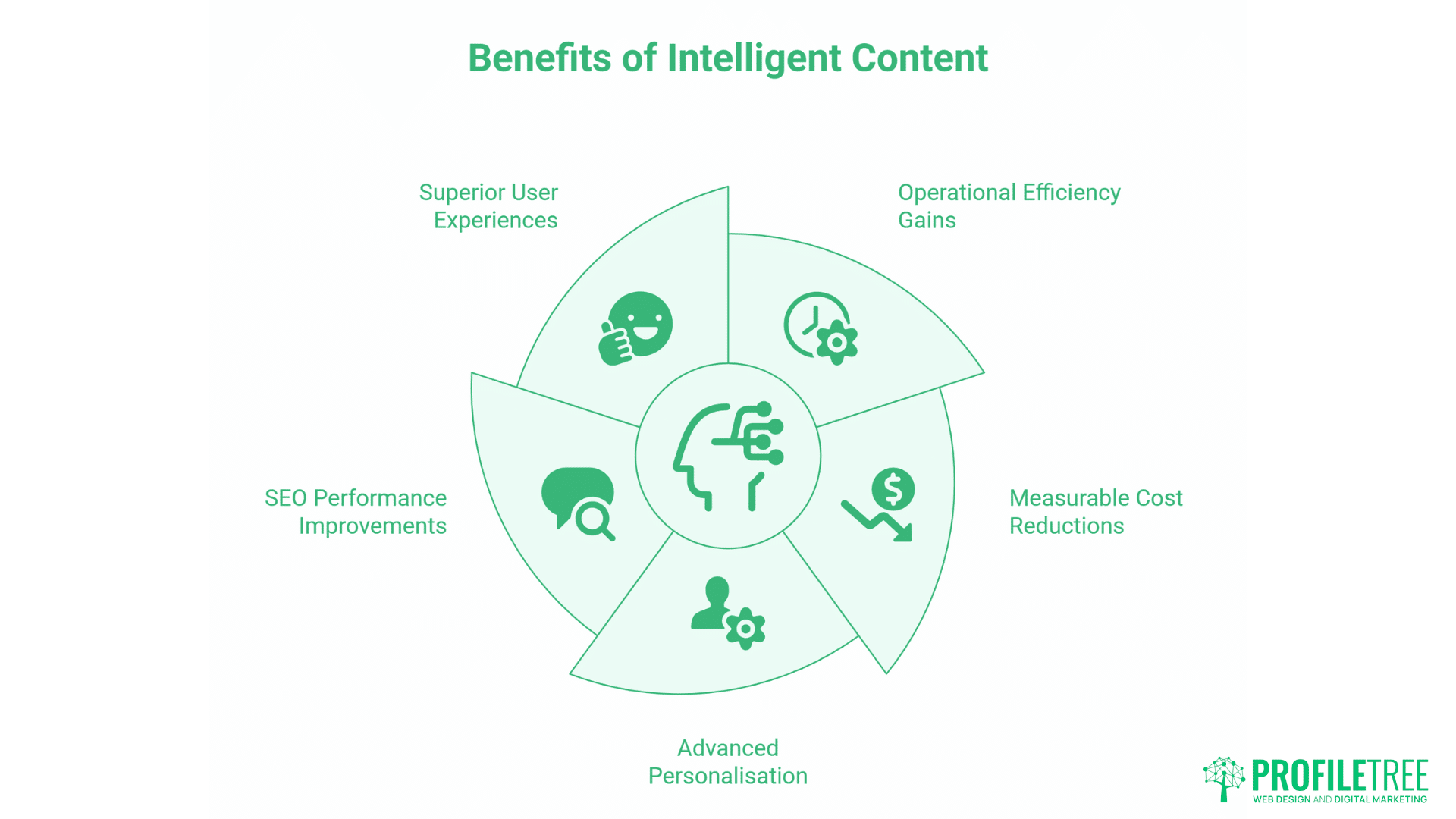
Adopting intelligent content delivers measurable advantages across content operations and business performance. These benefits compound over time as organisations build larger repositories of reusable components.
Operational Efficiency Gains
Modular content streamlines every stage of the content lifecycle. Creators spend less time writing from scratch, instead assembling existing components and focusing on genuinely new information. This accelerates production significantly.
Smaller components simplify review and approval workflows. Teams evaluate focused pieces rather than lengthy documents, speeding decisions and reducing bottlenecks. Updates become faster and more accurate as changes to single components automatically reflect across all instances.
For ProfileTree’s clients launching new products or services, this means marketing materials, website updates and documentation proceed simultaneously using shared components. Time-to-market shrinks whilst consistency improves.
Measurable Cost Reductions
Efficiency gains translate directly to cost savings across multiple areas. Reduced creation time lowers labour expenses. Content reuse drastically cuts translation costs—only new or modified components require translation rather than entire documents for each language or market.
Fewer errors and inconsistencies mean less rework and fewer customer support inquiries. Maintenance costs decrease as updates happen in single locations. For organisations operating internationally, these savings become substantial.
A manufacturing company might save significant amounts annually by translating only unique DITA topics instead of complete product manuals for each region. Retailers reduce costs by maintaining one product database that feeds all channels rather than separate descriptions for websites, printed catalogues and sales materials.
ProfileTree’s web design and hosting services incorporate these principles, allowing clients to manage content efficiently through WordPress installations optimised for component reuse and multi-channel publishing.
Advanced Personalisation
Modern customers expect tailored experiences. Intelligent content delivers personalisation at scale without manual effort for each user. Components tagged with rich metadata allow systems to assemble and deliver relevant information based on preferences, behaviour, location, device or purchase history.
This exceeds simple name insertion. Systems present specific product features to technical users, simplified instructions to beginners, regional pricing to local visitors and mobile-optimised formats to smartphone users—all automatically based on metadata and user data.
For digital marketing campaigns, this means messages adapt dynamically to audience segments. Belfast-based businesses can present different content to Northern Irish customers versus international visitors, all from one content repository.
ProfileTree’s AI implementation services help clients develop personalisation strategies that leverage intelligent content, combining machine learning with structured information to deliver genuinely relevant experiences.
SEO Performance Improvements
Search engines increasingly value structured data and semantic understanding. Intelligent content naturally provides this structure through its metadata and component-based architecture. Search crawlers understand context and meaning more easily, leading to better indexing and improved rankings.
Semantically tagged components become more discoverable for specific queries, including voice searches. FAQ components with clear question-and-answer metadata often appear as featured snippets in search results. Structured product information feeds rich results in shopping searches.
Local SEO benefits particularly from structured content. Belfast businesses can tag components with location metadata, helping search engines connect services to geographic queries. ProfileTree’s SEO services build on structured content foundations, optimising metadata and component relationships for search performance.
Superior User Experiences
Intelligent content ultimately improves what users experience. They receive consistent, accurate, current information regardless of channel or device. Content appears in optimal formats—short answers on mobile, detailed explanations on desktop, audio responses through voice assistants.
This consistency builds trust and satisfaction. Users find what they need easily, achieving their goals without frustration. Consistent brand voice and accurate information across touchpoints create cohesive brand perceptions.
For ProfileTree’s clients across Northern Ireland and beyond, this means customers enjoy seamless experiences whether visiting websites, reading social media posts, watching YouTube videos or engaging through email campaigns. All content originates from the same intelligent foundation, adapted automatically for each context.
How to Build an Intelligent Content Strategy
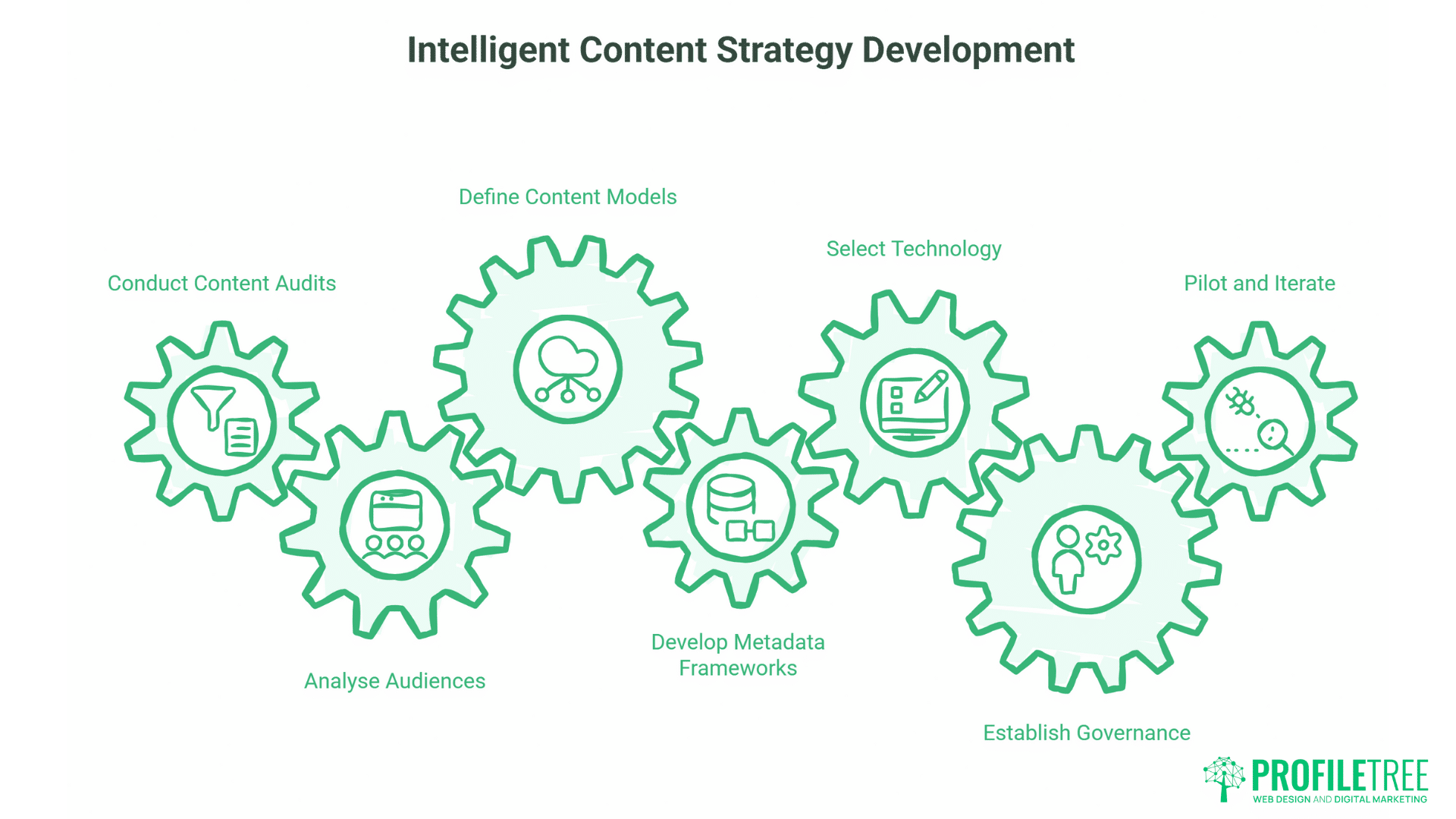
Developing an effective intelligent content strategy requires systematic planning and execution. This represents fundamental change in organisational content approaches, not merely technology implementation.
Conduct Comprehensive Content Audits
Begin by inventorying existing content. What content exists? Where does it live? Is it accurate, current and relevant? Identify redundant, outdated or trivial material that drains resources without delivering value.
This audit reveals the scope of current content assets and highlights improvement opportunities. Categorise content by type, audience and purpose to create clear pictures of what you have versus what you need.
For ProfileTree’s clients beginning digital transformation projects, content audits often reveal significant duplication across websites, brochures and sales materials. One Belfast retailer discovered they maintained seventeen different versions of their returns policy across various platforms, each slightly different and potentially contradictory.
Analyse Audiences and Requirements
Understand who needs your content and what problems they’re solving. Create detailed audience personas outlining goals, pain points, preferred channels and information consumption habits. This analysis guides content modelling, determining what components you need and how they should be structured.
Consider the full customer journey from initial awareness through purchase and beyond. What information does each audience need at each stage? How do different segments vary in their requirements?
ProfileTree’s digital strategy services include audience analysis as a foundation for all web design and content marketing work. We help clients map customer journeys specific to Northern Irish, Irish and UK markets, identifying opportunities for intelligent content to serve multiple segments efficiently.
Define Content Models
Based on audit findings and audience analysis, design content models that define content types, their constituent elements and relationships. This critical step dictates how content gets structured and reused.
For example, a “service page” content type might include fields for service name, short description, detailed explanation, benefits list, pricing information, related case studies, team member associations and call-to-action. It might link to “industry sector” taxonomies and “service category” hierarchies.
Content models should reflect business realities and support actual workflows. Involve content creators, subject matter experts and stakeholders in model development to maintain practical, usable structures.
ProfileTree’s approach to WordPress development centres on custom content models that reflect client business structures. We create custom post types, taxonomies and field groups that allow flexible content management whilst maintaining necessary structure.
Develop Metadata Frameworks
Once content models exist, establish comprehensive metadata strategies. Determine what metadata tags enable necessary functionality—discovery, personalisation, workflow management, publication rules.
Define taxonomies (hierarchical classifications) and controlled vocabularies that maintain consistency. For example, an audience taxonomy might include: Consumers > Residential Customers > First-Time Buyers versus Business > SMEs > Retailers.
Metadata consistency requires governance. Who approves new tags? How are definitions maintained? What quality assurance processes verify correct tagging?
For clients across Northern Ireland and Ireland, ProfileTree helps develop metadata frameworks that support regional variations, language differences and market-specific requirements without creating separate content sets.
Select Appropriate Technology
Choose tools that support your content strategy, not vice versa. Technology should enable your content model and metadata framework, not dictate them. Consider integration capabilities, scalability, user-friendliness and total cost of ownership.
Options range from traditional content management systems with structured content capabilities to specialised Component Content Management Systems (CCMS) designed specifically for intelligent content. Digital Asset Management (DAM) systems handle media components. Content delivery platforms distribute information across channels.
ProfileTree’s WordPress hosting and development services provide structured content capabilities suitable for many SME requirements. We implement custom fields, taxonomies and programmatic content assembly within familiar, manageable platforms. For clients with more complex requirements, we advise on CCMS solutions and integration strategies.
Establish Governance and Workflows
Define clear roles, responsibilities and workflows for content creation, review, approval, publication and archiving. Who maintains content models? Who approves metadata changes? How do updates propagate through systems?
Establish content standards, style guides and quality assurance processes that maintain integrity. Governance frameworks prevent chaos as content volumes grow and teams expand.
Training becomes critical. Teams need skills in structured authoring, metadata application and new tools. Ongoing support helps adoption and addresses issues as they arise.
Pilot and Iterate
Start small with pilot projects that test strategies, content models and technologies. Learn from initial implementations, gather feedback from creators and users, and refine approaches before expanding scope.
Intelligent content represents ongoing refinement and adaptation, not one-time implementation. Build feedback loops that capture lessons and drive continuous improvement. Gradually expand as you demonstrate success and build organisational confidence.
ProfileTree’s digital training services help teams develop necessary skills for intelligent content creation and management. We provide workshops tailored to specific business contexts, covering structured authoring, metadata strategy and content reuse principles relevant to Northern Irish and UK organisations.
Technology and Tools for Intelligent Content
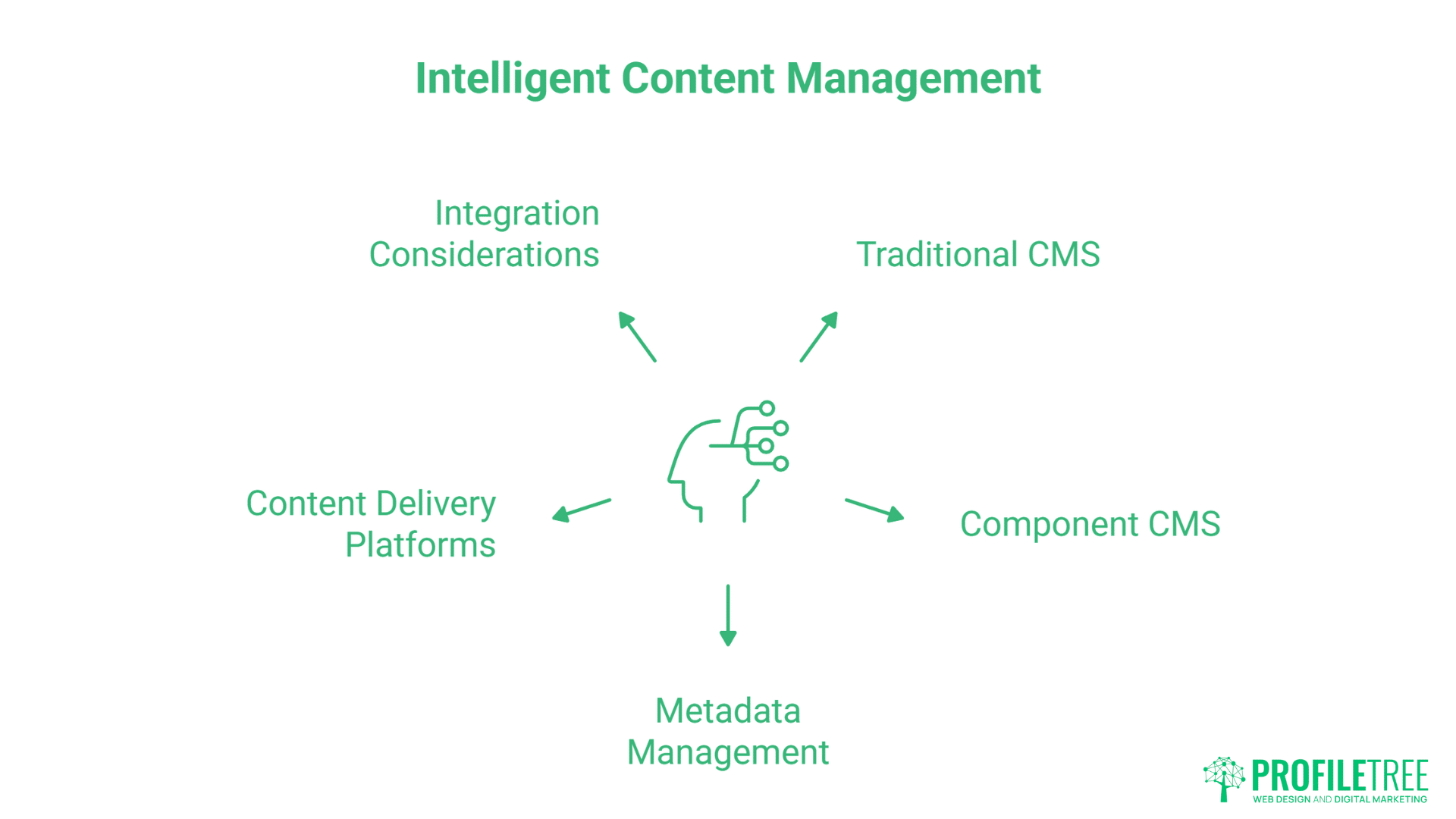
Implementing intelligent content requires appropriate technological infrastructure. Various tools serve different aspects of content lifecycles, from creation through delivery. Selection significantly impacts success.
Content Management Approaches
Traditional Content Management Systems: Platforms like WordPress, Drupal and Adobe Experience Manager excel at managing web pages and documents. They typically treat content as monolithic units, often mixing content with presentation. Modern CMS platforms increasingly offer structured content capabilities through custom fields, taxonomies and content types.
These systems suit organisations with moderate complexity where extensive granular reuse isn’t the primary requirement. They’re familiar, widely supported and integrate well with existing marketing technology stacks.
ProfileTree builds WordPress solutions with intelligent content principles, implementing custom post types, advanced custom fields and taxonomies that provide structure whilst maintaining accessibility for non-technical users. Our Belfast-based team configures WordPress as a headless CMS when clients need to feed content to multiple platforms beyond traditional websites.
Component Content Management Systems: CCMS platforms specifically manage content at component level rather than document or page level. They excel with structured content formats like DITA XML, manage complex metadata and facilitate extensive reuse through single-sourcing.
These systems separate content from presentation entirely, allowing dynamic publishing to multiple outputs from one source. Examples include IXIASOFT DITA CMS, SDL Tridion Docs and Vasont.
CCMS becomes appropriate for organisations with large volumes of complex, frequently updated, highly reusable content—technical documentation, regulatory materials, extensive product information spanning multiple markets and languages.
Metadata Management Systems
Effective metadata underpins intelligent content. Tools for metadata management help define, apply and maintain consistent metadata across components. These range from built-in CCMS features to specialised taxonomy management systems and ontology editors.
They allow organisations to create controlled vocabularies, thesauri and classification schemes, maintaining accurate tagging that enables discovery and reuse. Without robust metadata management, even highly structured content remains difficult to find and reuse effectively.
For ProfileTree’s clients, metadata strategy often begins simply within WordPress taxonomies and custom fields, scaling to more sophisticated systems as requirements grow. We help businesses develop metadata frameworks that balance thoroughness with practicality.
Content Delivery Platforms
Once created and managed, content needs delivery across channels. Content delivery platforms take structured, componentised content and render it appropriately for different outputs:
Web Portals: Dynamically assembling content for websites and knowledge bases based on user characteristics and behaviour.
Mobile Applications: Delivering optimised content for smartphones and tablets, adapting to screen sizes and connectivity.
Print Publications: Generating PDFs for manuals, brochures or catalogues from the same components that feed digital channels.
Chatbots and Voice Assistants: Providing structured answers to user queries through conversational interfaces.
APIs: Allowing other systems to access and display content programmatically, feeding content into CRM systems, mobile apps or partner platforms.
These platforms confirm that appropriate content reaches intended users in suitable formats at optimal times, fulfilling omnichannel delivery promises. Some CCMS platforms include delivery capabilities; others integrate with dedicated delivery solutions.
ProfileTree’s video production and animation services create components designed for multi-channel delivery. Videos produced for YouTube strategies also serve websites, social media, email campaigns and training materials. This component approach maximises return on content investment.
Integration Considerations
Technology selection should consider integration capabilities across your marketing technology stack. Content systems need to connect with customer relationship management platforms, marketing automation tools, analytics systems and e-commerce platforms.
APIs, webhooks and middleware solutions enable these connections, allowing content to flow where needed whilst maintaining single sources of truth. Poor integration creates silos that undermine intelligent content benefits.
For SMEs across Northern Ireland, Ireland and the UK, ProfileTree focuses on practical, cost-effective technology stacks that deliver intelligent content benefits without enterprise-level complexity or investment. Our approach scales with business growth, starting simply and expanding capabilities as requirements develop.
Intelligent Content in Digital Marketing
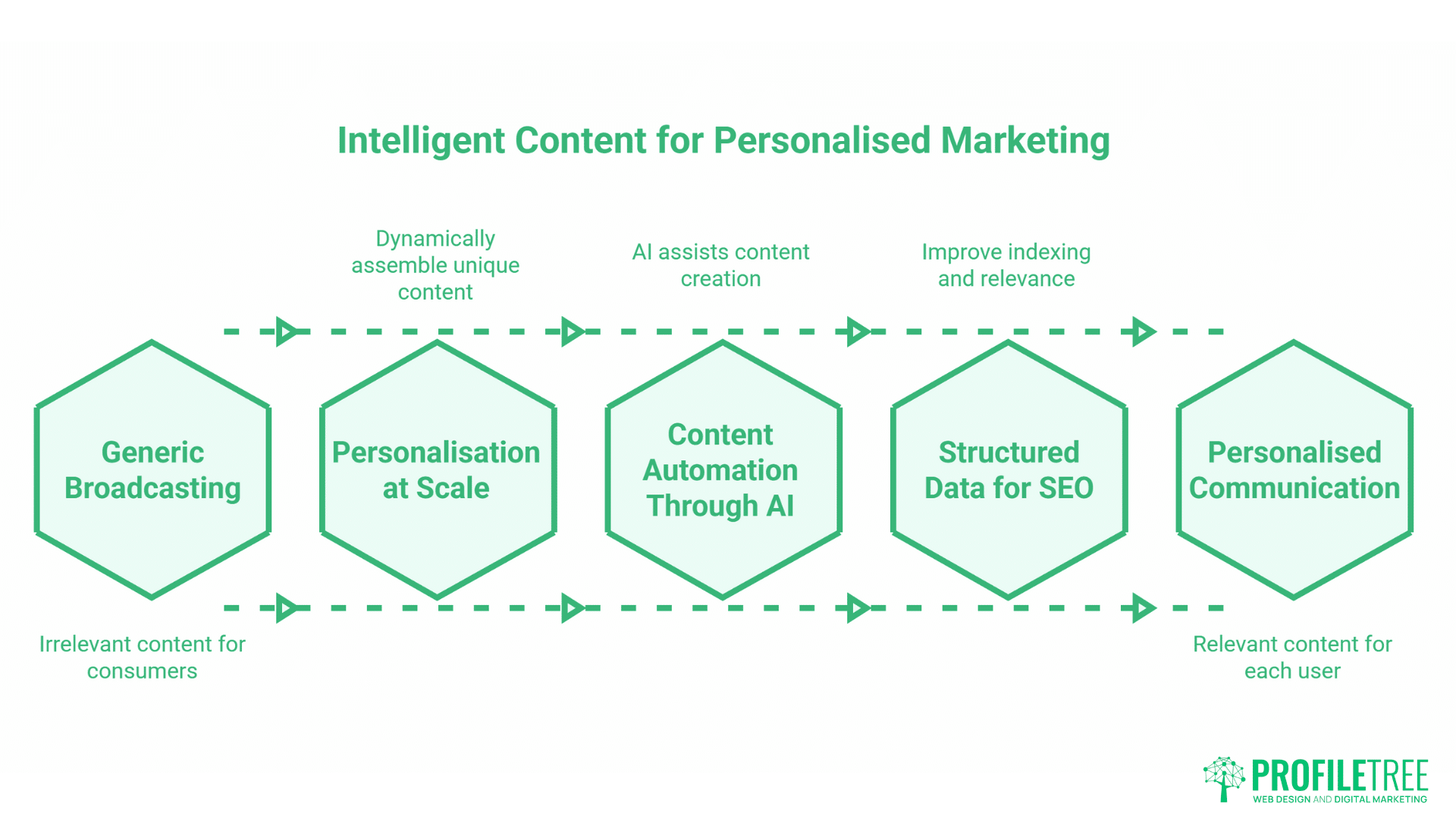
Intelligent content transforms digital marketing from generic broadcasting to personalised, relevant communication at scale. This shift addresses growing consumer expectations for experiences tailored to their specific needs and contexts.
Personalisation at Scale
Future marketing lies in hyper-personalised experiences delivered automatically without manual customisation for each individual. Intelligent content provides the framework through modular components tagged with rich metadata about audience segments, product interests, buyer journey stages and behaviour triggers.
Systems dynamically assemble unique content experiences for each user. Websites automatically display different headlines, product recommendations and calls-to-action based on visitor behaviour or demographic information. Email campaigns adapt content blocks to recipient interests and purchase history.
This goes far beyond mail-merge personalisation. It represents fundamentally different messages composed from different components, all from one content repository. Conversion rates improve because every visitor sees genuinely relevant information.
ProfileTree’s digital marketing training helps businesses understand and implement personalisation strategies. Our workshops cover audience segmentation, metadata strategies and technical implementation through platforms like WordPress and marketing automation tools used by Northern Irish businesses.
Content Automation Through AI
Artificial intelligence and machine learning increasingly integrate with intelligent content systems, enabling various automation forms. AI assists content creation by suggesting relevant components, generating headline variations or drafting basic content from structured data.
More significantly, AI automates content assembly and delivery, determining optimal content for each user at each moment. This frees marketers for strategy, creativity and high-level messaging rather than repetitive production tasks.
ProfileTree’s AI implementation services help SMEs adopt these technologies practically. We focus on accessible AI solutions that deliver measurable value without requiring data science teams or massive investments. Our Belfast-based consultants work with businesses to identify high-value automation opportunities within existing content operations.
Structured Data for Search Visibility
Search engines grow more sophisticated, particularly in understanding semantic meaning and context. Intelligent content, being inherently structured and metadata-rich, aligns perfectly with these developments.
Structured content improves SEO through better indexing, eligibility for rich snippets and enhanced relevance for voice search queries. Content components with clear semantic tagging appear more prominently in search results, particularly for question-based queries.
Local businesses benefit significantly. Structured content tagged with location metadata helps search engines connect services to geographic queries. A Belfast restaurant using intelligent content can serve different menu information to local searchers versus tourists, all improving local SEO performance.
ProfileTree’s SEO services build on structured content foundations. We optimise metadata, implement schema markup and structure content to maximise search visibility for clients across Northern Ireland, Ireland and the UK. Our approach combines technical SEO with content strategy for comprehensive search performance.
Multi-Channel Campaign Management
Modern marketing operates across numerous channels—websites, social media, email, mobile apps, print materials, events. Managing separate content for each channel creates inconsistency and massive workload.
Intelligent content allows single-source, multi-channel campaigns. Core messages exist as components that adapt automatically for each platform’s requirements and audience expectations. Brand voice remains consistent whilst format optimises for context.
A product launch campaign might include detailed web content, condensed social posts, email sequences, sales collateral and video scripts—all derived from one set of content components. Updates to positioning or features propagate automatically across all materials.
ProfileTree’s content marketing services help clients develop and execute multi-channel campaigns efficiently. Our video production, animation, content writing and social media management services work from shared content strategies, maintaining consistency whilst optimising for each platform’s unique characteristics.
Future Directions
Several developments will shape intelligent content’s role in marketing:
Hyper-Adaptive Content: Beyond personalisation, content will adapt in real-time based on user interaction, emotional state and immediate context. Machine learning will optimise content combinations continuously based on performance data.
AI-Driven Content Generation: AI will handle more initial drafting, localisation and variation creation, with human oversight for quality, creativity and brand alignment. This will dramatically increase content production capacity.
Seamless Omnichannel Experiences: Channel distinctions will blur further. Intelligent content will power continuous experiences across all touchpoints, from smart devices to
augmented reality environments, maintaining context as users move between platforms.
Content as a Service: Organisations will increasingly deliver content via APIs to any application needing it, treating content as a service layer rather than managing it within isolated systems.
For businesses working with ProfileTree on digital transformation, these trends inform our strategic recommendations. We help clients build intelligent content foundations that support current needs whilst remaining adaptable for emerging channels and technologies.
Overcoming Implementation Challenges
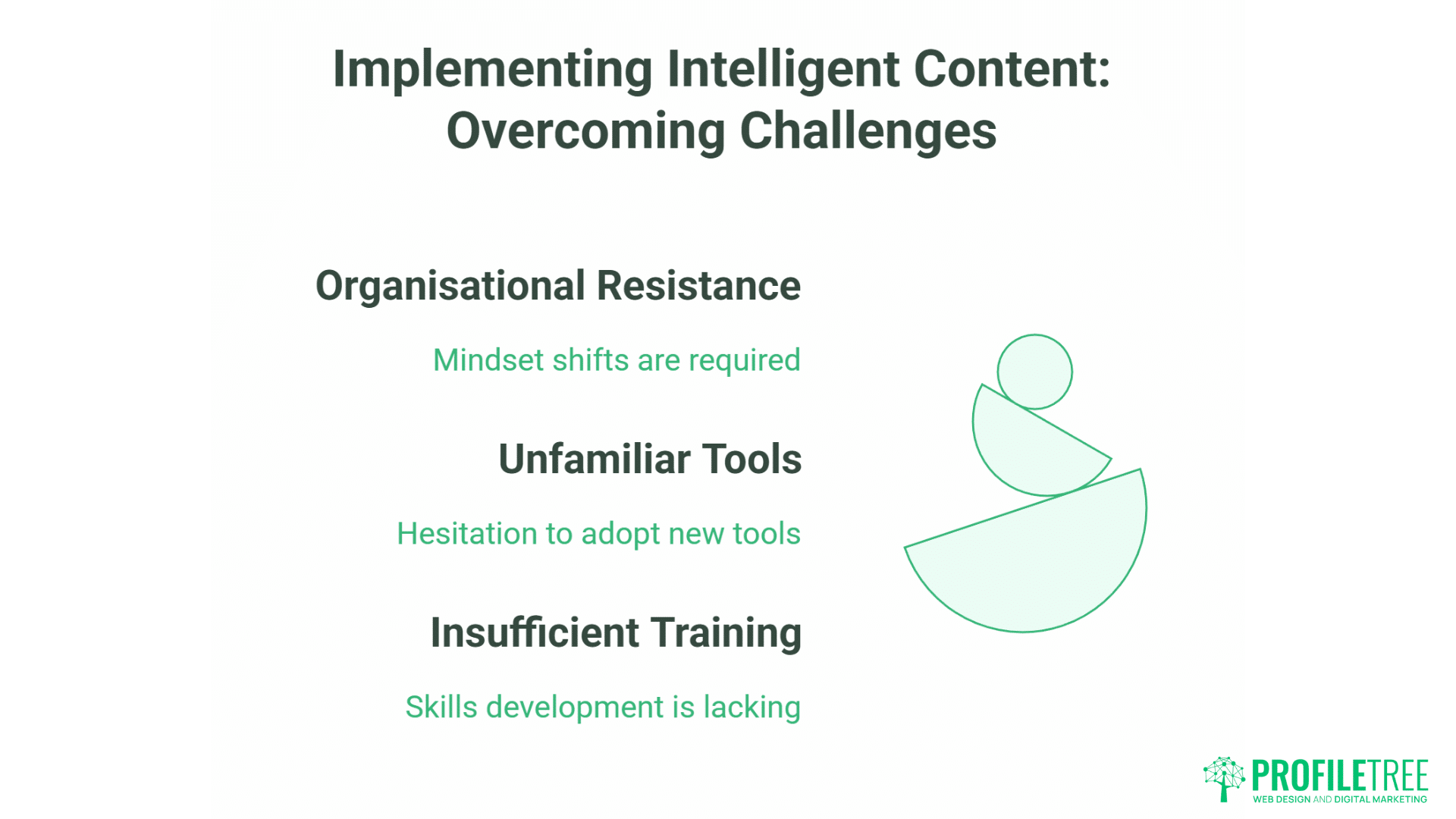
Whilst intelligent content benefits are substantial, implementation faces predictable challenges. Recognising and addressing these obstacles proactively improves success rates significantly.
Managing Organisational Change
The most significant hurdle involves organisational resistance. Moving from traditional content creation to structured, component-based approaches requires mindset shifts, process changes and new role definitions.
Content creators, editors and management accustomed to existing workflows may hesitate to adopt unfamiliar tools and methodologies. Success requires addressing human factors as thoroughly as technical ones.
Communicate Value Clearly: Articulate benefits to all stakeholders, focusing on how intelligent content improves their specific work and supports organisational goals. Frame changes positively.
Start Small with Pilots: Begin with limited projects in specific departments or for particular content types. Demonstrate tangible successes that build internal champions and prove concepts before organisation-wide rollouts.
Provide Comprehensive Training: Offer ongoing training and support to help teams adapt. Skills development should cover not just tools but underlying principles and strategic thinking.
ProfileTree’s digital training services address these change management needs directly. We provide workshops and ongoing support that help teams transition to intelligent content approaches, building confidence and capability incrementally.
Addressing Technology Integration
Selecting and integrating appropriate technology stacks presents complexity. Legacy systems may not integrate smoothly with modern CCMS platforms. Connecting various tools—content management, digital asset management, translation memory, delivery platforms—requires careful planning.
Prioritise Integration Capabilities: Choose tools with robust APIs and proven integration track records. Evaluate vendors’ integration support and community resources.
Implement in Phases: Introduce new technologies gradually, allowing time for integration, testing and team adaptation before expanding scope.
Seek Expert Consultation: Consider external experts or consultants experienced in intelligent content system architecture. Their expertise accelerates implementation and avoids common pitfalls.
ProfileTree’s web development team has extensive experience integrating WordPress with various marketing technology platforms. We help clients design practical technology architectures that support intelligent content whilst working within budget and capability constraints.
Developing Specialised Skills
Intelligent content requires specific expertise not typically present in organisations. Content modellers, metadata specialists, DITA architects and CCMS administrators represent roles that may need development or recruitment.
Invest in Skills Development: Upskill existing content teams in structured authoring, metadata management and content modelling principles through focused training programmes.
Strategic Recruitment: Hire individuals with proven intelligent content experience for key roles. Their expertise accelerates implementation and mentors existing teams.
External Partnerships: Collaborate with agencies or consultants specialising in intelligent content implementation. They provide necessary expertise whilst internal capabilities develop.
ProfileTree offers both training services to develop internal capabilities and consulting services for strategic guidance. Our Belfast-based team works alongside client teams, transferring knowledge whilst delivering practical results.
Justifying Investment and Demonstrating ROI
Implementing intelligent content requires upfront investment in technology, training and process re-engineering. Justifying this investment and demonstrating clear returns can challenge organisations, particularly SMEs with limited budgets.
Quantify Benefits: Project potential cost savings—reduced translation expenses, faster time-to-market, decreased rework—and revenue gains from improved personalisation and conversion rates.
Phased Approach: Break implementation into manageable phases with clear milestones. Demonstrate ROI incrementally rather than waiting for complete implementation.
Highlight Strategic Value: Emphasise long-term advantages beyond immediate cost savings—improved content quality, regulatory compliance, adaptability for future technologies and channels.
For ProfileTree’s clients across Northern Ireland and the UK, we help develop business cases that resonate with decision-makers. Our approach focuses on practical, affordable implementations that deliver measurable value quickly whilst building towards comprehensive intelligent content capabilities.
FAQs
What makes intelligent content different from regular content?
Regular content exists as monolithic documents or pages mixing content with presentation. Intelligent content comprises structured, modular components tagged with metadata, allowing machine understanding, reuse across contexts and automatic adaptation for different channels and audiences.
Can small businesses benefit from intelligent content?
Absolutely. Whilst large organisations with complex content needs see dramatic benefits, intelligent content principles apply to any business size. Even small teams benefit from structured content and metadata for improved efficiency and consistency, particularly as content volumes grow or multi-channel publishing becomes necessary.
How long does intelligent content implementation take?
Timelines vary significantly based on organisation size, content volume, complexity and resources. Full implementations range from several months to a few years. Phased approaches starting with pilot projects demonstrate value and refine processes before broader rollouts.
What’s the first step towards intelligent content?
Begin with comprehensive content audits to understand existing assets, followed by audience analysis defining user needs. This groundwork informs the crucial next step: defining content models and metadata strategies that support your specific business requirements.
Does intelligent content improve SEO performance?
Yes, significantly. Search engines increasingly value structured data and semantic understanding. Intelligent content naturally provides this through metadata and component architecture, leading to better indexing, improved rankings and eligibility for rich search results like featured snippets.
What technology is needed for intelligent content?
Requirements vary based on complexity. Many organisations start with structured content capabilities in platforms like WordPress using custom fields and taxonomies. More complex needs may require Component Content Management Systems (CCMS) designed specifically for intelligent content. The key is selecting technology that supports your content model and metadata strategy.
How does intelligent content support personalisation?
Components tagged with rich metadata about audiences, purposes and contexts allow systems to dynamically assemble relevant content for individual users based on their preferences, behaviour, location or device. This delivers genuine personalisation at scale without manual customisation for each user.
What role does AI play in intelligent content?
AI assists with content creation through component suggestions and variation generation. More significantly, AI automates content assembly and delivery, determining optimal content for each user at each moment based on behaviour and context. This frees marketers for strategy whilst AI handles tactical execution.
Transform Your Content Strategy with ProfileTree
Intelligent content represents fundamental change in how organisations approach information creation and management. This structured, metadata-rich approach delivers efficiency, personalisation and multi-channel capabilities that static documents cannot match.
For businesses across Northern Ireland, Ireland and the UK, implementing intelligent content principles provides competitive advantages through reduced costs, improved consistency and superior customer experiences. Whether you’re developing a new website, launching digital marketing campaigns or transforming your content operations, intelligent content principles deliver measurable value.
ProfileTree’s Belfast-based team helps SMEs implement intelligent content strategies within comprehensive digital transformation programmes. Our services span web design and development, content marketing, SEO, video production, AI implementation and digital training—all informed by intelligent content principles.
We understand the practical realities of implementing advanced content strategies in resource-constrained environments. Our approach focuses on achievable, affordable implementations that deliver quick value whilst building capabilities for long-term success.
Ready to transform your content operations? Contact ProfileTree at our Belfast office in the McSweeney Centre to discuss how intelligent content can support your business goals. Our team will assess your current content assets, identify opportunities and develop practical implementation roadmaps tailored to your specific requirements and budget.
Discover how structured, reusable, intelligent content can reduce costs, improve SEO performance and deliver personalised experiences that drive business growth across all your digital channels.