
The Role of Virtual Reality in Marketing: Guide for UK & Irish SMEs
Table of Contents
Most articles about virtual reality in marketing focus on what Nike or Coca-Cola spent on their last headset campaign. That is not especially useful if you run a furniture business in Belfast, a tourism attraction in Galway, or a property agency in Dublin.
The role of virtual reality in marketing has shifted significantly over the past two years. Full headset experiences are no longer the only entry point. Web-based augmented reality, 360-degree video, and AR product previews now run directly in a mobile browser, with no app download and no specialist hardware required. That changes the calculation for SMEs considerably.
This guide covers what VR and AR actually mean for mid-market businesses in Northern Ireland, Ireland, and the UK, where to start, what it costs in broad terms, and how to measure whether it is working.
VR vs AR: What the Difference Actually Means for Your Business
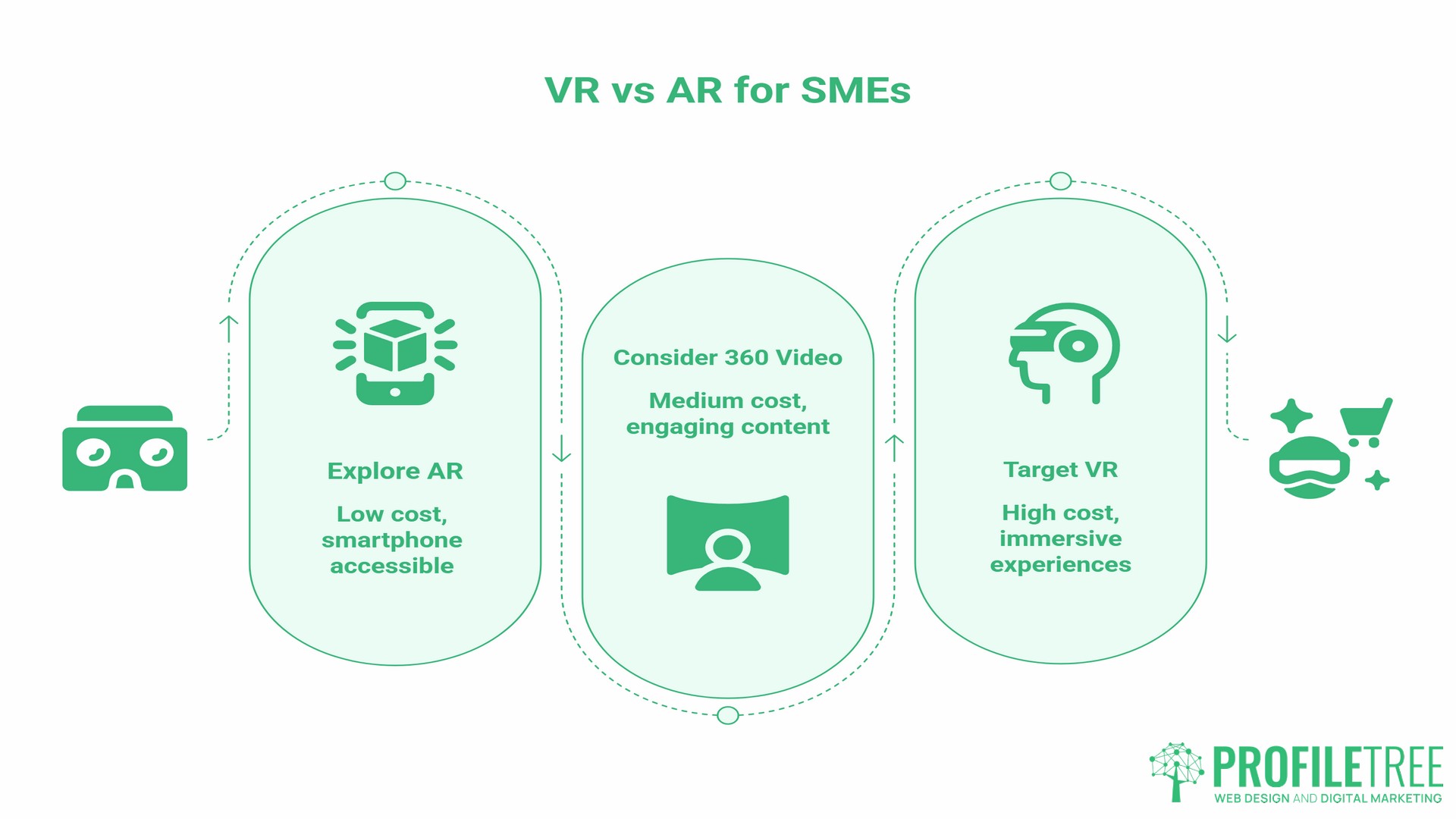
Understanding the role of virtual reality in any marketing plan starts with separating the terms that tend to get conflated.
Virtual reality (VR) places the user inside a fully computer-generated environment. Experiencing it properly requires a headset such as the Meta Quest or PlayStation VR. For most SME marketing applications, full VR is still expensive to produce and depends on your audience owning or borrowing hardware.
Augmented reality (AR) overlays digital content onto the real world, viewed through a smartphone camera or browser-based tools. This is where most of the practical SME opportunity sits right now. No headset, no app download, no significant hardware barrier.
Mixed reality (MR) blends both, anchoring virtual objects into real spaces so they respond to the physical environment. It is more immersive than AR but requires more sophisticated hardware and development work.
| Technology | Device Required | Typical Production Cost | Best SME Use Case |
|---|---|---|---|
| Virtual Reality | Headset | High | Property walkthroughs, trade show demos |
| Augmented Reality | Smartphone or browser | Low to medium | Product previews, retail try-ons |
| 360-Degree Video | Smartphone or browser | Medium | Tourism, hospitality, event marketing |
| Mixed Reality | Specialist headset | High | Manufacturing, complex product demos |
| WebAR | Any modern smartphone | Low | E-commerce, local retail, food and drink |
For most businesses reading this, AR and 360-degree video are the realistic starting points. The role of virtual reality specifically is strongest where a fully immersive environment genuinely changes the buyer’s decision, such as in property, vehicles, and high-value retail. For everything else, AR and 360-degree video deliver comparable engagement at a fraction of the cost.
How VR and AR Are Changing UK and Irish Marketing
The role of virtual reality in digital marketing is no longer theoretical. There are documented commercial applications across retail, tourism, property, and hospitality that UK and Irish businesses can draw from directly.
Virtual Showrooms and the Sales Cycle
The core commercial argument for the role of virtual reality in sales and marketing is straightforward. When a potential buyer can explore a product, space, or experience in detail before committing, purchase confidence increases and decision friction reduces.
For property businesses in Northern Ireland and the Republic, virtual walkthroughs have become a practical tool for reaching buyers based elsewhere in the UK, in Europe, or in the Irish diaspora. A prospective buyer in London can tour a property in Derry or Cork without travelling, thereby widening the addressable market without proportionally increasing the marketing budget.
For retail businesses, AR product placement lets customers see how a sofa looks in their living room, how a light fitting sits in their kitchen, or how a paint colour reads on their walls before ordering. IKEA Place, the AR app that allows users to visualise furniture in their own homes before purchase, is one of the most cited examples of this approach at scale. The principle applies equally to smaller Northern Irish or Irish retailers selling home goods, flooring, or fitted kitchens online.
360-Degree Video Storytelling
360-degree video sits at the more accessible end of the immersive spectrum. Filmed with a specialist camera rig and published to YouTube or embedded on a web page, it allows viewers to control their perspective, looking around a space as if standing in it.
For tourism businesses, hospitality venues, wedding venues, and event spaces, 360-degree video answers a question that standard promotional video cannot: what does it actually feel like to be there? It does this without requiring the viewer to visit in person.
Google’s research into how people use YouTube found that 360-degree video generates stronger viewer engagement than standard video for location and experience-based content, with users spending longer exploring the footage. This is part of why the role of virtual reality and 360-degree video in tourism and hospitality marketing has grown faster than in almost any other sector. For businesses where the physical environment is a selling point, that engagement difference is commercially relevant.
ProfileTree’s video production service covers both standard and 360-degree videos for businesses across Northern Ireland and Ireland. The production process is not dramatically more complex than standard video, but the marketing application is considerably broader for businesses where the physical space or experience is central to the sale.
AR Product Try-Ons and the Returns Problem
For e-commerce businesses, product returns are a persistent cost. Clothing, footwear, eyewear, and accessories carry high return rates driven by uncertainty about fit, colour, and appearance in context.
AR try-on technology addresses this directly. Using a smartphone camera, a customer can see how glasses look on their face, how a jacket fits their frame, or how a watch sits on their wrist before completing a purchase. Brands such as Specsavers and Warby Parker have used this approach in their online retail experiences.
According to Shopify, merchants who added 3D and AR content to their product pages saw a 94% higher conversion rate than those without those features. The underlying technology is now available through WebAR platforms at a fraction of the cost of enterprise deployment three years ago.
For Irish and Northern Irish retailers competing with larger online platforms, this represents a practical differentiator: the ability to offer a try-before-you-buy experience directly from a local brand’s website.
The SME Advantage: Implementing VR and AR Without an Enterprise Budget
The most common misconception about the role of virtual reality in marketing is that it requires a large technology budget. That was broadly true in 2020. It is no longer accurate.
WebAR: The Browser-Based Entry Point
WebAR removes the two biggest barriers to AR adoption: the requirement for a dedicated app and the cost of native development. A WebAR experience runs inside a mobile browser. The customer scans a QR code, points their phone camera at a surface or at themselves, and the AR content loads directly.
Development costs vary depending on complexity, but basic WebAR product placement experiences are now within reach for SMEs with modest digital budgets. The key requirement is not the AR layer itself but the quality of the underlying web infrastructure: a fast, well-structured website that can serve 3D assets efficiently.
This is where web design and development become the practical foundation. A WebAR experience built on top of a slow or poorly structured website will not perform. The immersive layer depends on the technical quality of what sits beneath it.
360-Degree Property and Venue Tours
For businesses where the physical environment is a primary selling point, a 360-degree tour is one of the lowest-cost, highest-impact entry points into immersive marketing. The production cost is manageable, the content can be embedded on a website or shared via YouTube, and it answers buyer questions that static photography cannot.
Property developers, estate agents, hotels, wedding venues, visitor attractions, and restaurants across Northern Ireland and Ireland are already using this format. Matterport, one of the main platforms for virtual property tours, reported that listings with 3D tours received significantly more enquiries than those without, based on data from estate agents using their platform across the UK and Ireland.
Using AI to Reduce VR Content Production Costs
Generative AI tools are being used to build VR environments faster and at lower cost than traditional methods. Rather than commissioning fully custom 3D environments from scratch, developers can use AI-assisted tools to accelerate asset creation, reducing the production time and cost for mid-market VR projects.
For SMEs considering their first VR or AR marketing project, this means the cost ceiling has dropped. It does not mean the costs are negligible, but a scoped project with clear objectives is financially viable for businesses that would have been priced out a few years ago.
ProfileTree’s digital training programmes cover emerging technologies, including AI-assisted content creation, helping business owners and marketing managers understand which tools are production-ready and which are still experimental.
Data Privacy and UK Law: What Immersive Marketing Requires
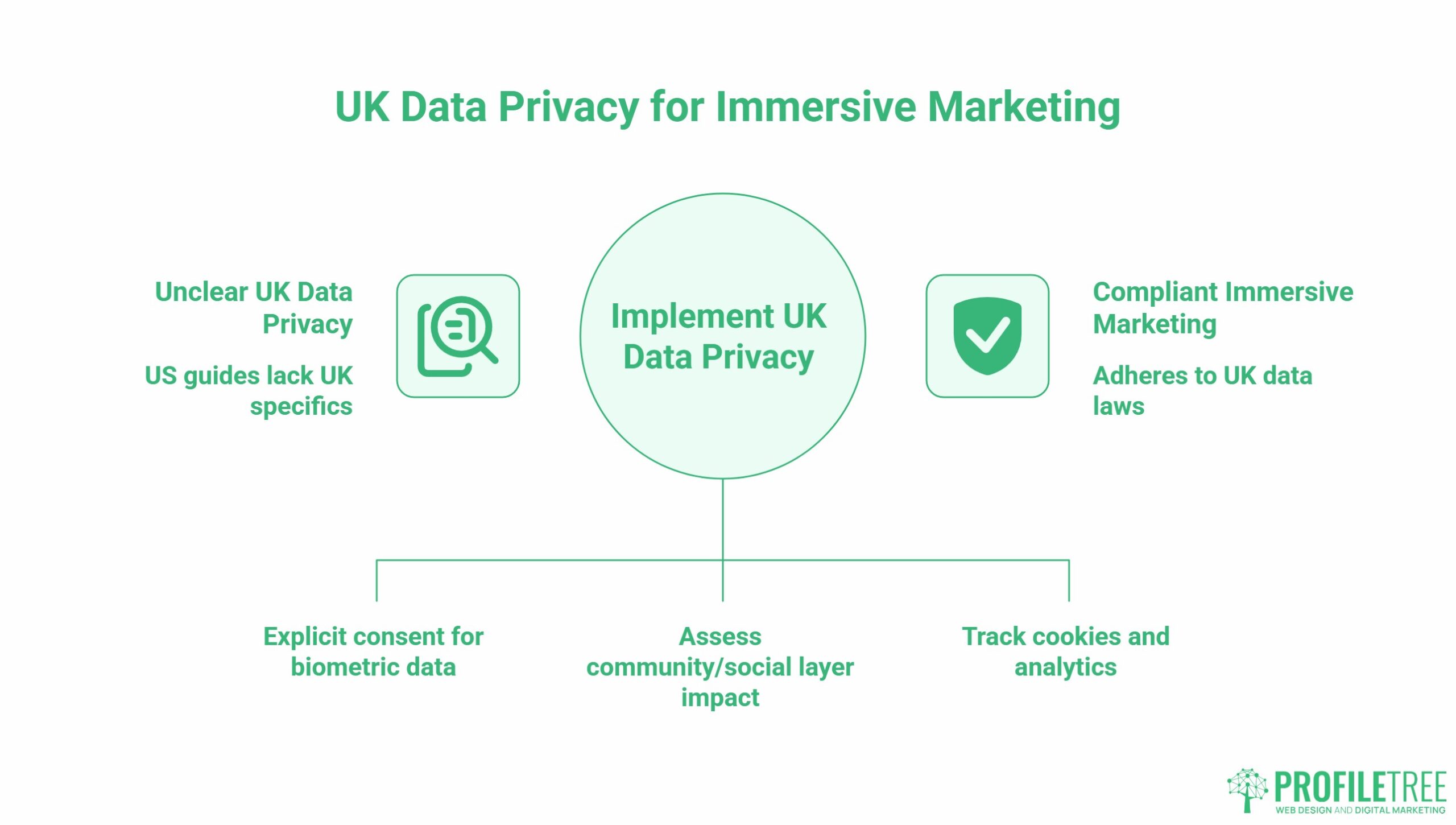
This area is largely absent from US-published guides on VR marketing, but it matters for businesses operating in the UK and the Republic of Ireland.
GDPR and Biometric Data
VR and AR experiences that collect behavioural data, gaze tracking data, or biometric information are subject to strict GDPR obligations. Under Articles 9 of the UK GDPR and the EU GDPR, biometric data processed for the purpose of uniquely identifying a natural person is classified as special category data and requires explicit consent before collection. The Information Commissioner’s Office has published guidance confirming that gaze tracking data collected in immersive environments falls within this classification.
Any business deploying a VR or AR marketing experience that captures interaction, dwell, or physical response data needs a clear privacy notice, a documented lawful basis for processing, and a data retention policy. A generic cookie consent banner does not satisfy these obligations.
The UK Online Safety Act
The Online Safety Act introduces duty-of-care obligations for platforms that host user-generated content or facilitate social interaction, including within immersive environments. For most SME marketing applications, such as virtual tours, AR previews, and 360-degree video, the Act does not impose direct obligations on the business running the experience.
It becomes relevant when a business builds a community or social layer into a VR environment where users can interact with one another. Ofcom, which enforces compliance with the Act, has published guidance on the scope of regulated services to help businesses assess whether their planned deployment falls within scope.
For businesses in Northern Ireland operating under UK law, and for businesses in the Republic operating under Irish and EU legislation, the regulatory landscape differs in detail. Any VR or AR project with a significant data-collection component should be reviewed by a solicitor experienced in GDPR before launch.
PECR Considerations
The Privacy and Electronic Communications Regulations apply to immersive experiences that involve tracking cookies or similar technologies installed on a user’s device. If a WebAR experience uses tracking pixels or third-party analytics tools, those tools trigger PECR obligations in addition to GDPR obligations. The ICO’s guidance on cookies and similar technologies covers this in detail and is the relevant reference for UK-based businesses assessing their compliance position.
Measuring Success: KPIs for Immersive Marketing Campaigns
Dwell Time and Interaction Rate
Standard web analytics measures page views and time on page. VR and AR experiences require a different approach. The relevant metrics are dwell time within the immersive experience, interaction events (which hotspots a user selects, which products they examine, which angles they explore), and completion rate (the percentage of users who complete the full experience rather than abandon it partway).
These metrics indicate whether the experience is compelling enough to hold attention, which is the primary commercial function of immersive content.
Conversion Uplift
For e-commerce applications, the most direct measure is the conversion rate comparison between product pages with AR previews and those without. This requires clean A/B testing methodology and a sufficiently large sample, but it is achievable for businesses with reasonable traffic volumes. The Shopify data cited earlier provides a benchmark for measuring your own results.
Return Rate Reduction
For retail businesses using AR to reduce purchase uncertainty, tracking changes in return rates for products with AR previews versus those without provides a direct commercial measure of impact. This is a more operationally useful metric than engagement rates alone because it connects directly to cost.
The Sustainability Case
Virtual trade show attendance, virtual property viewings, and virtual product demos all reduce the travel required for their traditional counterparts. The Carbon Trust has noted that virtual and hybrid events can significantly reduce the carbon footprint of business marketing and sales activity compared to in-person equivalents, making this a relevant consideration for businesses with ESG commitments or clients who weigh sustainability in procurement decisions.
Building Immersive Marketing Into Your Digital Strategy
The role of virtual reality in marketing is most effective when it connects to a wider digital strategy rather than sitting as a standalone experiment. A 360-degree video that is not properly optimised for YouTube will not be found. A WebAR experience built on a slow website will not perform. AR product previews that are not integrated into the product page journey will not convert.
The technology is increasingly accessible, but deploying it well requires a web foundation that can support 3D and video assets, a content strategy that positions the immersive experience within the buyer journey, and an analytics setup that captures the right signals.
ProfileTree’s digital marketing strategy service works with businesses across Northern Ireland, Ireland, and the UK to map technology decisions to commercial outcomes. The starting question is not “should we use VR?” but “what problem in our sales or marketing process would immersive content solve, and is VR the most cost-effective way to solve it?”
For most SMEs, the honest answer leads toward 360-degree video or WebAR rather than full headset VR. Both are achievable without large technology budgets, and both integrate naturally into an existing web and content presence.
Frequently Asked Questions
Is VR marketing expensive for small businesses?
The role of virtual reality at the enterprise level does carry a high cost, but browser-based AR and 360-degree video have dropped considerably in price. A 360-degree video production for a hospitality venue or retail space is broadly comparable in cost to a standard promotional video shoot. WebAR experiences for product placement start at accessible price points, depending on the complexity of the 3D assets involved. Enterprise-scale budgets are no longer a prerequisite for using immersive formats in marketing.
Do customers need a headset to experience VR marketing?
No. Most practical SME applications of immersive marketing run through a smartphone camera or browser. WebAR requires only a modern smartphone and a web browser. 360-degree video plays in standard YouTube or website embeds and can be explored by moving the phone or dragging the cursor on a desktop. Headsets improve the experience, but are not required for the customer to engage.
What is the best first step into VR marketing for a UK or Irish SME?
For most businesses, 360-degree video is the most practical entry point. It is filmed rather than generated, which keeps production costs manageable, and it can be published to YouTube and embedded on a website without specialist technical work. For e-commerce businesses with physical products, a scoped WebAR product preview is a logical next step.
How does the UK Online Safety Act affect VR marketing?
For most SME VR marketing applications, including virtual tours, AR previews, and 360-degree video, the Online Safety Act does not impose direct obligations. It becomes relevant when a business builds a social or community layer into a VR environment where users interact with each other. All immersive experiences that collect user data carry GDPR obligations, regardless of whether biometric or behavioural data is involved.
Can VR and AR improve my SEO?
Indirectly, yes. Immersive content increases dwell time and reduces bounce rates when well-integrated into the page. A 360-degree video embedded on a location or service page gives users a reason to spend significantly more time on that page than a static image would, which improves engagement signals. The video content itself also generates search visibility through YouTube if properly titled, described, and tagged.
What is the difference between AR and VR for marketing purposes?
VR places the user inside a fully virtual environment and requires a headset. AR overlays digital content onto the real world through a smartphone camera. For marketing, AR is currently the more commercially accessible format for most SMEs because it requires no specialist hardware and runs through a browser. VR has stronger applications in high-consideration purchases such as property, vehicles, and complex equipment, where the depth of the experience justifies the hardware requirement.