
The Future of Affiliate Marketing: What Shifts in AI and Regulation Mean for UK Businesses
Table of Contents
Affiliate marketing has moved a long way from the simple commission-per-click arrangements of the early 2000s. The model that once rewarded volume above everything else is now being reshaped by AI-driven attribution, stricter UK advertising regulations, and a creator economy that blurs the line between influencer and affiliate partner.
For businesses across Northern Ireland, Ireland, and the UK, the shift matters. The future of affiliate marketing industry is projected to reach $40 billion globally by 2030, according to Influencer Marketing Hub’s 2024 benchmarks. But the businesses growing within that figure are operating very differently to those who entered the space a decade ago.
This guide breaks down where affiliate marketing is heading, what the regulatory and technological changes mean in practice, and how UK businesses can build programmes that hold up as the landscape continues to change.
Is Affiliate Marketing Still Worth It?
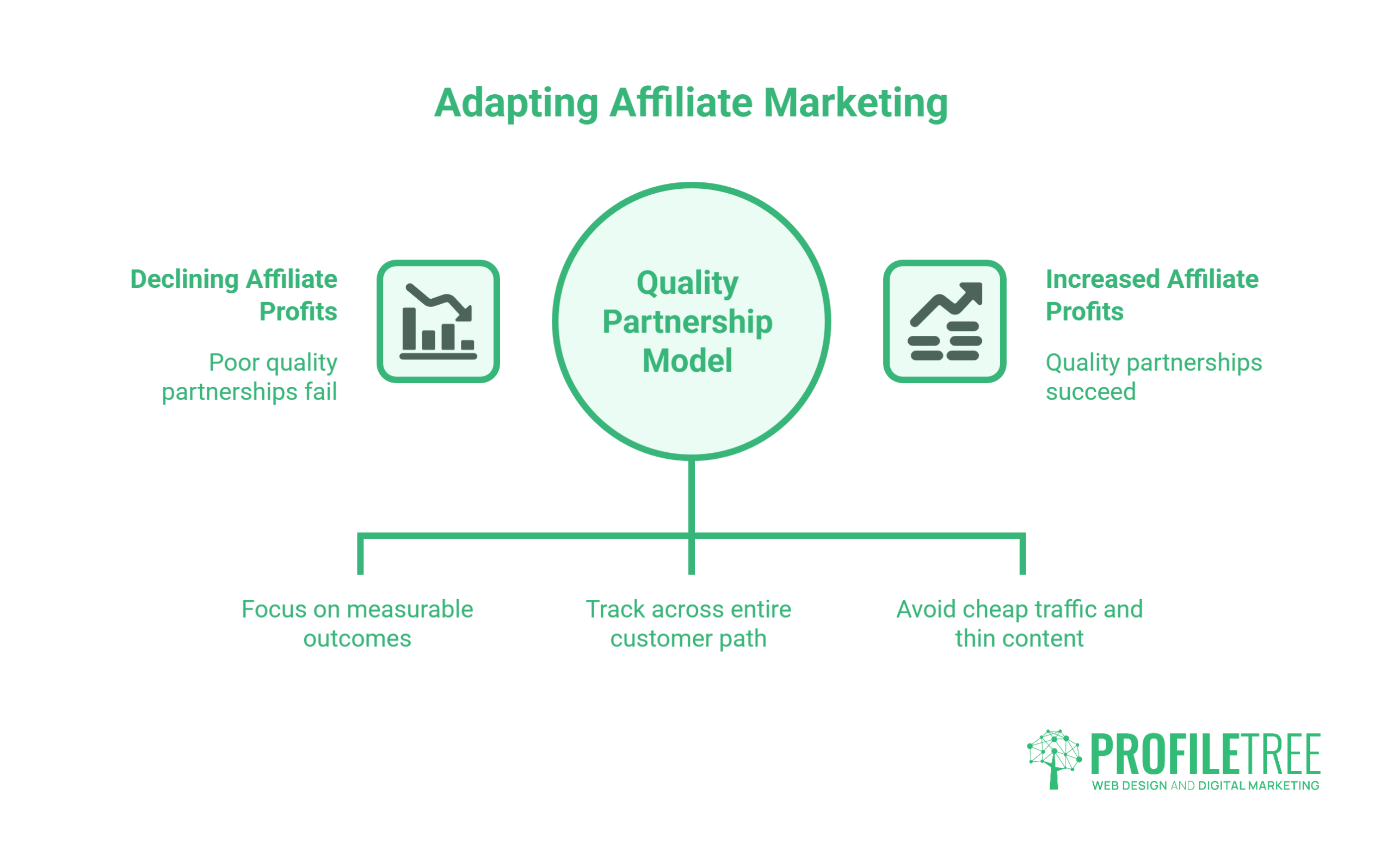
Affiliate marketing is not dying. It is, however, becoming harder to do badly and still profit from it.
The volume-first era, built on coupon sites, discount aggregators, and last-click attribution, is giving way to a model that rewards quality partnerships and measurable outcomes across the full customer journey. Businesses that built affiliate programmes around cheap traffic and thin content are finding that those approaches now work against their SEO and brand positioning simultaneously.
What the Data Actually Shows
The global affiliate marketing industry grew at roughly 10% year-on-year between 2020 and 2024, with growth concentrated in content-led and influencer-based programmes rather than traditional cashback and voucher sites. That concentration tells you something important: the channel itself is healthy; the old tactics within it are the ones under pressure.
For UK businesses specifically, the shift is further accelerated by the Digital Markets, Competition and Consumers (DMCC) Act 2024, which tightened disclosure requirements for paid partnerships and promotional content. Affiliates operating in the UK without clear, upfront disclosure now face enforcement action from the Competition and Markets Authority, not just informal ASA guidance. That regulatory context is reshaping which partnerships brands are willing to maintain.
The Saturation Question
“Is affiliate marketing over-saturated?” appears consistently in search data as a question marketers are genuinely wrestling with. The honest answer is that the generic middle ground is saturated. An affiliate blog covering every product category with thin reviews will struggle. A specialist affiliate site covering, say, sustainable home products for the Irish market or B2B SaaS tools for UK manufacturers is operating in a different environment entirely.
Hyper-specific, audience-first affiliate content is outperforming broad comparison sites across almost every vertical. The saturation problem is a positioning problem more than a volume problem.
AI in Affiliate Marketing: What It Actually Changes
Artificial intelligence is having a genuine effect on affiliate marketing, though not always in the ways the broad claims suggest. The practical applications divide into three areas: content and personalisation, attribution modelling, and fraud detection.
Personalisation at Scale
AI-driven personalisation allows affiliate marketers to serve different product recommendations, landing page variations, and content pathways to different audience segments without manually building each variation. Real-time bidding systems use machine learning to display the most relevant product or offer to a given user based on browsing behaviour, purchase history, and contextual signals.
For businesses running affiliate programmes, this means working with partners who have the capability to personalise their referral content, not just those who can generate the most raw traffic. An affiliate partner who sends 500 highly targeted visitors converts at a meaningfully different rate than one sending 5,000 untargeted ones.
Understanding which partners are actually driving the right audience connects directly to the analytics infrastructure underpinning any serious programme. Social media analytics tools are an entry point, but affiliate-specific attribution platforms go further, tracking the full path from content exposure to conversion.
Predictive Attribution
One of the most concrete changes AI brings to affiliate marketing is in attribution modelling. The old last-click model, where the affiliate who referred the final visit before purchase got full credit, consistently overpaid certain partner types (primarily voucher and cashback sites at the end of the funnel) and underpaid content creators who drove awareness earlier in the journey.
AI-driven multi-touch attribution distributes credit across the customer journey based on actual influence, not just the final touchpoint. This changes the economics of which affiliate partnerships are worth investing in and which are inflating their apparent contribution.
For UK businesses looking at how to apply AI to their broader customer data work, the principles around AI for customer insights translate directly into how you assess affiliate programme performance.
Fraud Detection
Click fraud and conversion fraud remain real problems in affiliate marketing. AI systems can identify anomalous traffic patterns, bot behaviour, and suspicious conversion clusters in ways that manual review cannot match at scale. Any business building a serious affiliate programme should treat fraud detection infrastructure as essential rather than optional.
First-Party Data and the End of Third-Party Cookies
The deprecation of third-party cookies, which Chrome finalised in stages through 2024, has reshaped how affiliate tracking works. Most traditional affiliate tracking relied on third-party cookies to attribute sales back to the referring partner. With those cookies gone, programmes built on that infrastructure have had to adapt.
Server-to-Server Tracking
Server-to-server (S2S) tracking, sometimes called postback tracking, has become the technical standard replacing cookie-based attribution. Rather than relying on a browser cookie to pass conversion data, S2S tracking fires a server-side notification directly from the advertiser’s server to the affiliate network when a qualifying event occurs. It is more reliable, harder to block, and privacy-compliant.
UK businesses working with affiliate networks should confirm their platform supports S2S tracking. Legacy setups still relying on first-party or third-party cookie attribution are operating on foundations that will continue to erode.
Why First-Party Data Is Now the Strategic Asset
Brands that have invested in building their own first-party data ecosystems, through email lists, loyalty programmes, CRM systems, and logged-in user experiences, are significantly better positioned for affiliate marketing than those relying on third-party data signals. First-party data allows for more accurate attribution, better audience segmentation for affiliate partner selection, and compliance with both GDPR and the evolving ICO guidance on data use in marketing.
The businesses winning in affiliate marketing right now are those who treat their own data as infrastructure, not as a side product of their marketing activities.
For businesses navigating the regulatory side of this, the overlap between affiliate marketing compliance and broader data privacy in e-commerce is worth understanding in full, particularly for businesses operating across both GB and Irish regulatory jurisdictions.
The Creator Economy: Influencers as Affiliate Partners
The clearest structural shift in affiliate marketing over the past three years is the convergence of influencer marketing and affiliate partnerships. Creators who once negotiated flat-fee brand deals are increasingly operating on hybrid models that combine upfront fees with performance-based affiliate commissions. This aligns incentives in a way that flat fees do not.
Why Content Creators Are Replacing Coupon Sites
The coupon and cashback site model dominated affiliate marketing for years because it captured customers at the bottom of the funnel, right before they completed a purchase. It looked effective in last-click attribution models. Under multi-touch attribution, however, it becomes clear that many of those conversions would have happened regardless; the coupon site simply inserted itself into the final step.
Content creators, by contrast, drive awareness, consideration, and purchase intent across the full journey. A food blogger in Northern Ireland who consistently recommends kitchen equipment creates genuine purchase intent that a 10%-off voucher code does not.
Understanding the difference between micro and macro influencers matters here. For most UK SMEs, micro-influencers with audiences of 10,000 to 100,000 in a relevant niche will generate better affiliate ROI than macro-influencers with broader, less engaged followings.
TikTok and Short-Form Video in Affiliate Programmes
TikTok has become a significant driver of affiliate traffic, particularly for product-focused categories. The platform’s native commerce features, including in-video product links and TikTok Shop affiliate integration, create a direct path from content discovery to purchase. TikTok’s UK user base and engagement patterns make it a channel UK businesses cannot ignore when planning affiliate content strategy.
The strategic question for brands is not whether to include TikTok in affiliate programmes but how to structure the partnership. Commission structures that reward content quality and engagement, not just direct conversion, tend to produce better long-term creator relationships on video platforms.
Short-form and long-form video serve different roles in the affiliate journey. Understanding short-form versus long-form video strategy helps businesses match content format to the stage in the purchase journey they are trying to influence.
The Importance of Sustained Partnerships
One-off influencer activations rarely build meaningful affiliate volume. The businesses seeing consistent results from creator affiliate programmes are those that treat their top-performing creators as long-term partners, providing early access to products, co-creating content, and structuring commission tiers that reward sustained performance.
“By building genuine, ongoing relationships with content creators rather than transactional arrangements, you create advocates who integrate your brand naturally into their content over time,” says Ciaran Connolly, founder of ProfileTree. “That sustained visibility builds the kind of trust that drives purchase decisions, particularly for higher-ticket products and services.” [FLAG FOR CIARAN APPROVAL]
The process of social influence and what makes certain creators genuinely persuasive is worth understanding before selecting affiliate partners, particularly when commissions will be a meaningful budget line.
UK Regulatory Context: What Affiliate Marketers Must Know
The UK’s approach to affiliate marketing regulation has tightened considerably and is likely to tighten further. Understanding the current landscape is not optional for businesses with UK affiliate programmes.
ASA and CAP Code Compliance
The Advertising Standards Authority requires that paid affiliate promotions are clearly identified as advertising. This applies to influencers, bloggers, and content creators operating affiliate arrangements, not just traditional display advertising. The CAP Code is clear: if a creator has a commercial relationship with a brand that influences their content, that relationship must be disclosed.
The specific requirement is upfront, unambiguous disclosure, typically using “#ad” in a prominent position. Buried disclosures or disclosures appearing only in link descriptions do not meet the standard.
The DMCC Act
The Digital Markets, Competition and Consumers Act 2024 gave the Competition and Markets Authority new enforcement powers covering misleading marketing practices, including affiliate content that presents commercial promotion as an independent editorial recommendation. For businesses running affiliate programmes, this means ensuring your affiliate agreements explicitly require disclosure compliance and that you have a process for monitoring partner content.
GDPR and Cookie Compliance
Affiliate tracking that relies on any form of data collection must comply with UK GDPR and the ICO’s guidance on cookies and tracking. S2S tracking is generally cleaner from a compliance perspective than cookie-based tracking, but the data collected on conversion events still needs to be handled within a lawful basis framework.
Transparency in content marketing has become both a regulatory requirement and a consumer expectation. Programmes built on genuine transparency about commercial relationships perform better in the long run than those treating disclosure as a compliance checkbox.
Building a Future-Proof Affiliate Programme: Practical Steps
Given the shifts in technology, regulation, and creator economics, what does a well-constructed affiliate programme actually look like for a UK business in 2025?
Choose the Right Tracking Infrastructure
Confirm your affiliate platform supports S2S tracking and that your attribution model reflects the full customer journey, not just last-click. Platforms like Impact, Awin, and PartnerStack all offer S2S capabilities. The choice between them depends on your scale and partner mix.
Be Selective About Partners
More affiliates do not automatically mean more revenue. A smaller number of high-quality partners generating targeted traffic will almost always outperform a large network of low-quality ones. Evaluate partners on audience fit, content quality, and engagement rates, not just traffic volume.
Structure Commission Intelligently
Flat commission rates treat all conversions as equal. A tiered structure, where top-performing partners earn higher rates, creates genuine incentive for quality over volume. Consider separate commission structures for content affiliates versus transactional affiliates (voucher, cashback), reflecting the different roles they play in the customer journey.
Monitor for Compliance
Build monitoring into your programme management. Review affiliate content quarterly for disclosure compliance, check for brand guideline adherence, and audit conversion data for fraud patterns. This is administrative work, but it protects both your brand and your programme economics.
For businesses that want support building or optimising a digital marketing strategy that includes affiliate components, ProfileTree’s digital marketing campaigns cover the strategic and execution layers. Understanding how to maximise ROI across digital marketing channels provides the framework for evaluating affiliate performance against other channel investments.
Key Trends Shaping Affiliate Marketing Through 2027
Based on the current trajectory, these are the shifts most likely to define affiliate marketing over the next two to three years.
- First-party data becomes the baseline. Programmes without a first-party data infrastructure will operate at a growing disadvantage for attribution, audience matching, and personalisation.
- AI attribution becomes standard. Multi-touch AI attribution will replace last-click as the default in established programmes, redistributing commission economics toward content creators and early-funnel partners.
- Disclosure enforcement increases. UK and EU regulators will continue to tighten enforcement on inadequate disclosures. Businesses that build compliance into programme structure now will avoid the reputational damage of enforcement action later.
- B2B affiliate marketing grows. SaaS companies, professional services firms, and B2B technology providers are increasingly building affiliate and partner programmes modelled on the B2C playbook. The UK’s professional services sector is underserved in this respect, creating a genuine first-mover opportunity.
- Sustainability and ethics become selection criteria. UK consumers are increasingly choosing which brands to engage with based on ESG positioning. Affiliate partners whose audiences have strong ESG alignment are worth prioritising accordingly. Sustainability in digital marketing is increasingly a business requirement rather than a brand preference.
Frequently Asked Questions
Is affiliate marketing still profitable in 2025?
Affiliate marketing remains profitable when programmes are structured around quality partnerships, accurate attribution, and audience-first content. The model is under pressure in the generic middle ground, where thin comparison content and coupon sites have lost ranking positions and audience trust. Niche-specific, content-led programmes are seeing stronger performance than the broad-market approach that dominated a decade ago. The channel overall continues to grow; what has changed is where within it the returns are concentrated.
Will AI replace affiliate marketers?
No. AI is changing how affiliate marketing operates at a technical level, particularly in attribution, personalisation, and fraud detection, but the strategic and relational dimensions of the work remain human. Identifying the right partners, building genuine creator relationships, and making commercial decisions about programme structure all require judgement that AI tools support rather than replace. The affiliate marketers most at risk are those doing purely mechanical work that automation can replicate; those building expertise in strategy and partnership development are not.
How does the death of third-party cookies affect affiliate tracking?
Third-party cookie deprecation has broken the tracking infrastructure that many affiliate programmes relied on. The replacement standard is server-to-server (S2S) tracking, which passes conversion data directly between servers rather than relying on browser-stored cookies. Businesses running affiliate programmes should confirm their platform supports S2S and that their attribution data has not been compromised by the transition. Programmes that have not migrated are likely underreporting conversions, which distorts commission calculations and partner relationships.
What is the next big thing in affiliate marketing?
The most significant structural change currently in progress is the convergence of creator content and affiliate commerce, particularly through social commerce platforms like TikTok Shop and Instagram’s product tagging features. This is moving affiliate marketing from a link-in-bio or footer arrangement to something integrated directly into content consumption. The second major shift is B2B partner marketing, where the principles of affiliate commission are being applied to lead generation and customer acquisition in professional services and SaaS.
How do I start an affiliate programme in the UK?
Start by selecting a tracking platform that supports S2S tracking and multi-touch attribution. Define your commission structure and the partner types you want to work with. Prepare compliant disclosure requirements as part of your affiliate agreement, ensuring partners understand their ASA/CAP Code obligations. Begin with a small number of carefully selected partners rather than a broad open programme, and build your partner mix based on performance data before scaling.
How do UK advertising regulations affect affiliate marketing?
UK affiliates must comply with ASA and CAP Code disclosure requirements, which mandate clear upfront identification of paid commercial relationships. The DMCC Act 2024 added Competition and Markets Authority enforcement powers over misleading marketing practices that apply to affiliate content. UK GDPR governs data collection associated with affiliate tracking. Businesses running UK affiliate programmes are responsible for ensuring their partners comply with these requirements, making contractual disclosure obligations and compliance monitoring essential programme components.
Conclusion
Affiliate marketing in 2025 is more technically complex, more heavily regulated, and more closely tied to genuine content quality than it was five years ago. For businesses that build programmes on solid attribution infrastructure, authentic creator relationships, and regulatory compliance, it remains a strong channel for both brand development and measurable revenue. If you are reviewing your digital marketing mix and want to understand where affiliate strategy fits alongside SEO, content, and paid channels, get in touch with the ProfileTree team to discuss your options.
Using Big Data to Drive Marketing Decisions