
Social Responsibility and Social Media: A Guide for UK Businesses
Table of Contents
Most businesses understand that corporate social responsibility matters. Fewer know how to communicate it well. Social media has made CSR both more visible and more risky: a well-executed campaign builds real trust with customers and communities, while a poorly executed one invites accusations of greenwashing faster than any press release ever could. For SMEs in the UK and Ireland, the challenge is not whether to engage with corporate social responsibility on social media, but how to do it in a way that is credible, consistent, and commercially grounded.
This guide covers what corporate social responsibility means for businesses today, the four pillars you need to understand, and the specific social media strategies that help UK and Irish organisations communicate their CSR commitments without overreaching.
What is Corporate Social Responsibility?
Corporate social responsibility is the practice of businesses operating in ways that benefit society and the environment, beyond what is required by law. It reflects the idea that a company’s obligations extend to employees, communities, and the broader public not just shareholders. In the UK context, this sits alongside specific legislative requirements, including Section 172 of the Companies Act 2006, which requires directors to act in a way that promotes the long-term success of the company, having regard to its impact on the community and the environment.
The Social Value Act 2012 went further for public sector contractors, requiring organisations bidding for public contracts to demonstrate how their work will improve the economic, social, and environmental well-being of the relevant area. For many Northern Ireland and Irish SMEs involved in government procurement, social responsibility is therefore not purely voluntary; it is a commercial necessity.
The Difference Between Social Responsibility, CSR and ESG
The terms are often used interchangeably, but there is a distinction worth understanding. “Social responsibility” is the broader ethical principle: the idea that organisations have obligations to society. “Corporate social responsibility” (CSR) is the formalised, documented version of that principle, typically involving a policy, reporting structure, and named initiatives. ESG (Environmental, Social, and Governance) takes this further, applying quantitative metrics and formal reporting frameworks that investors and regulators can assess.
For most SMEs, CSR is the appropriate starting point before moving toward a full ESG framework. The table below outlines the key differences.
The Four Pillars of Social Responsibility
Carroll’s pyramid of corporate social responsibility, introduced in 1991 and still widely referenced in business ethics literature, identifies four distinct responsibilities that businesses hold. Understanding these helps organisations structure their CSR activity rather than treating it as a loose collection of good intentions.
Environmental Responsibility
This covers a company’s obligations to reduce harm to the natural environment: managing carbon emissions, reducing waste, sourcing materials responsibly, and considering the environmental impact of supply chain decisions. For digital businesses in particular, this increasingly includes the energy consumption of servers, data centres, and digital infrastructure.
The UK Green Claims Code, enforced by the Competition and Markets Authority, sets out clear rules about what businesses can and cannot claim regarding their environmental credentials. Accuracy in this pillar is especially important for social media content, where environmental claims attract both scrutiny and legal risk. For a wider look at how sustainability connects to digital strategy, the ProfileTree guide to sustainability in digital marketing is a useful starting point.
Ethical Responsibility
Ethical responsibility means operating fairly and honestly: paying fair wages, treating suppliers with integrity, being transparent with customers, and avoiding exploitative practices. It also covers data ethics, which has become increasingly important with the rise of digital marketing. How a business handles customer data, whether it uses personalisation responsibly, and whether it is transparent about its marketing practices all sit within this pillar.
The ethics and legalities of digital marketing overlap directly with this area of CSR. For businesses developing a framework in this area, the ProfileTree ethical marketing strategy guide covers the practical steps.
Philanthropic Responsibility
This is the pillar most people associate with CSR: charitable giving, community sponsorships, volunteering programmes, and partnerships with local causes. For SMEs without large budgets, philanthropic responsibility does not require cash donations. Time, skills, and platforms are equally valid contributions. A Belfast-based web design agency providing pro bono website work for a local charity, or a digital training provider offering free workshops to community groups, both demonstrate philanthropic responsibility in ways that are proportionate and credible.
Business in the Community (BITC) is the UK’s leading organisation supporting responsible business practice and publishes guidance specifically aimed at SMEs.
Economic Responsibility
Economic responsibility means running a financially sustainable business that generates employment, supports local supply chains, and contributes to the economic health of its community. It is the foundation of the pyramid: without economic sustainability, the other three pillars cannot be maintained. For SMEs in Northern Ireland and Ireland, this often means a preference for local suppliers, reinvesting in the local economy, and creating stable employment rather than relying on short-term contracts.
The ProfileTree guide to sustainable business examples covers how businesses across different sectors are putting this pillar into practice.
Building a CSR Social Media Strategy
Social media is where CSR communication either earns credibility or loses it. The same platforms that allow a business to share genuine community impact also expose hollow claims instantly. A structured approach to CSR social media content significantly reduces that risk.
Start with a Content Plan, Not a Reaction
Reactive CSR posting sharing a cause on social media because it is trending reads exactly as opportunistic as it is. A planned content calendar built around your actual CSR activities provides consistency and protects you from the credibility gap that opens when a brand’s social media output doesn’t match its behaviour.
Building that plan involves identifying three to five CSR themes that genuinely connect with your business, then mapping content formats to each: written updates on policy commitments, video for community impact and employee stories, data-led posts on environmental progress, and Q&A formats for transparency on difficult topics. The Chartered Institute of Marketing publishes practical guidance on responsible marketing communications that is worth reviewing when building this plan.
For businesses working on their broader social media presence, the ProfileTree overview of social media for business provides a grounding in building content that performs.
Video is the Most Effective Format for CSR Stories
Video generates higher engagement than static content across every major social platform. For CSR specifically, video works because it makes abstract commitments tangible: a 90-second clip of a team volunteering day communicates more than three paragraphs of text describing the same event. Short-form video for Instagram and TikTok suits moment-in-time content, while longer-form video on YouTube provides a permanent, searchable record of a company’s CSR narrative. The ProfileTree guide to short-form video covers how this format has changed brand storytelling for smaller organisations.
The key distinction in CSR video is between promotional content (which centres the brand) and story-led content (which centres the community, cause, or impact). A CSR video that feels like an advert undermines the message; a CSR video that centres real people and real outcomes builds the kind of trust that no paid advertising can achieve. ProfileTree’s video marketing service covers the strategic considerations in more depth.
Authenticity Requires Specificity
Vague CSR content (“We care about our community”) carries no weight. Specific CSR content (“We spent 40 hours this quarter delivering free digital skills workshops at three Belfast community centres”) is credible precisely because it is verifiable. Every CSR post should contain at least one specific element: a number, a named organisation, a date, a measurable outcome, or a real person involved.
This applies directly to the Green Claims Code. The CMA’s guidance requires that environmental claims be accurate, clear, and substantiable. “We’re a green business” does not meet that standard. “We reduced our server energy usage by switching to a renewable-powered hosting provider in 2024” The ProfileTree guide to SDG greenwashing is worth reading for any business communicating environmental credentials.
Knowing how to tell a story that is both specific and credible is also covered in the ProfileTree guide to brand storytelling.
Engagement is a Two-Way Obligation
CSR communication on social media is not one-directional. Comments, questions, and criticisms directed at your CSR content require responses. An unanswered challenge about a green claim, or a question about labour practices left ignored, signals that the commitment is performative. Designating a team member to monitor CSR-related content and respond within 24 hours is a practical step that most SMEs overlook entirely.
Interactive formats, such as polls asking followers to vote on a community initiative, Q&A sessions on CSR policy, and comment-led discussions on sustainability choices, generate the dialogue that demonstrates genuine engagement rather than broadcast-only communication. The ProfileTree social media marketing service covers how structured engagement drives long-term performance.
Avoiding Greenwashing on Social Media
Greenwashing, the practice of making environmental or social claims that are misleading, exaggerated, or unsubstantiated, is now a regulatory risk in the UK, not just a reputational one. The Competition and Markets Authority has powers to investigate and take action against businesses that make misleading green claims, and the Advertising Standards Authority has upheld complaints about advertising that overstated environmental credentials.
The practical rules for avoiding greenwashing in social media content: only claim what you can evidence, do not imply a benefit is unique to your business when it is standard practice, and avoid vague terms like “eco-friendly” or “sustainable” without qualification. The ProfileTree guide to content creation ethics covers the broader principles that apply here.
Measuring and Reporting CSR Impact
A CSR programme without measurement is a policy document. Measurement turns intention into accountability and gives your social media content the specific, credible detail it needs to be believed.
KPIs for SME CSR Programmes
Large organisations use formal frameworks such as the Global Reporting Initiative (GRI) or the UN Sustainable Development Goals to structure their reporting. For SMEs, a simpler set of self-selected KPIs is more practical, provided they are specific and tracked consistently.
Useful starting categories:
Environmental: energy consumption (kWh), paper use reduction, travel emissions, waste diverted from landfill. Social: volunteer hours contributed, community organisations supported, employee wellbeing survey scores. Economic: percentage of suppliers based within the local region, apprenticeships or traineeships created. Ethical: training hours on data protection and ethical marketing, customer complaints resolved within the target timeframe.
Even tracking three or four of these consistently over 12 months provides the material for credible, specific social media content and an annual impact update that builds stakeholder trust.
Sustainability Reporting on Social Media
An annual impact report does not need to be a PDF document. Many businesses now produce their CSR reporting entirely through social content: a LinkedIn article summarising the year’s highlights, a series of Instagram posts covering each pillar, and a short video pulling together team and community voices. This approach is more accessible than a formal report and more likely to reach the audiences whose trust matters most.
A planned content series around an annual CSR report with scheduled posts across platforms in the weeks following publication generates far more visibility than a single announcement post. This is the kind of structured approach that the ProfileTree guide to transparency in content marketing covers in detail.
B-Corp Certification in the UK and Ireland
B-Corp certification, awarded by B Lab, is the most widely recognised third-party validation of a company’s social and environmental performance. Certification requires a minimum score of 80 on the B Impact Assessment, which covers governance, workers, community, environment, and customers. The process typically takes 12 to 18 months and requires documentary evidence across all five areas.
In the UK and Ireland, B-Corp status has become increasingly visible as a trust signal, particularly for B2C businesses and those in sectors where consumers make purchasing decisions based on values. The B Lab UK website provides the free self-assessment tool and full certification guidance.
For businesses working through the intersection of AI tools and responsible digital practice, the ProfileTree guide to AI and sustainability is relevant to the environmental pillar of CSR planning.
How a Digital Agency Supports CSR Communication
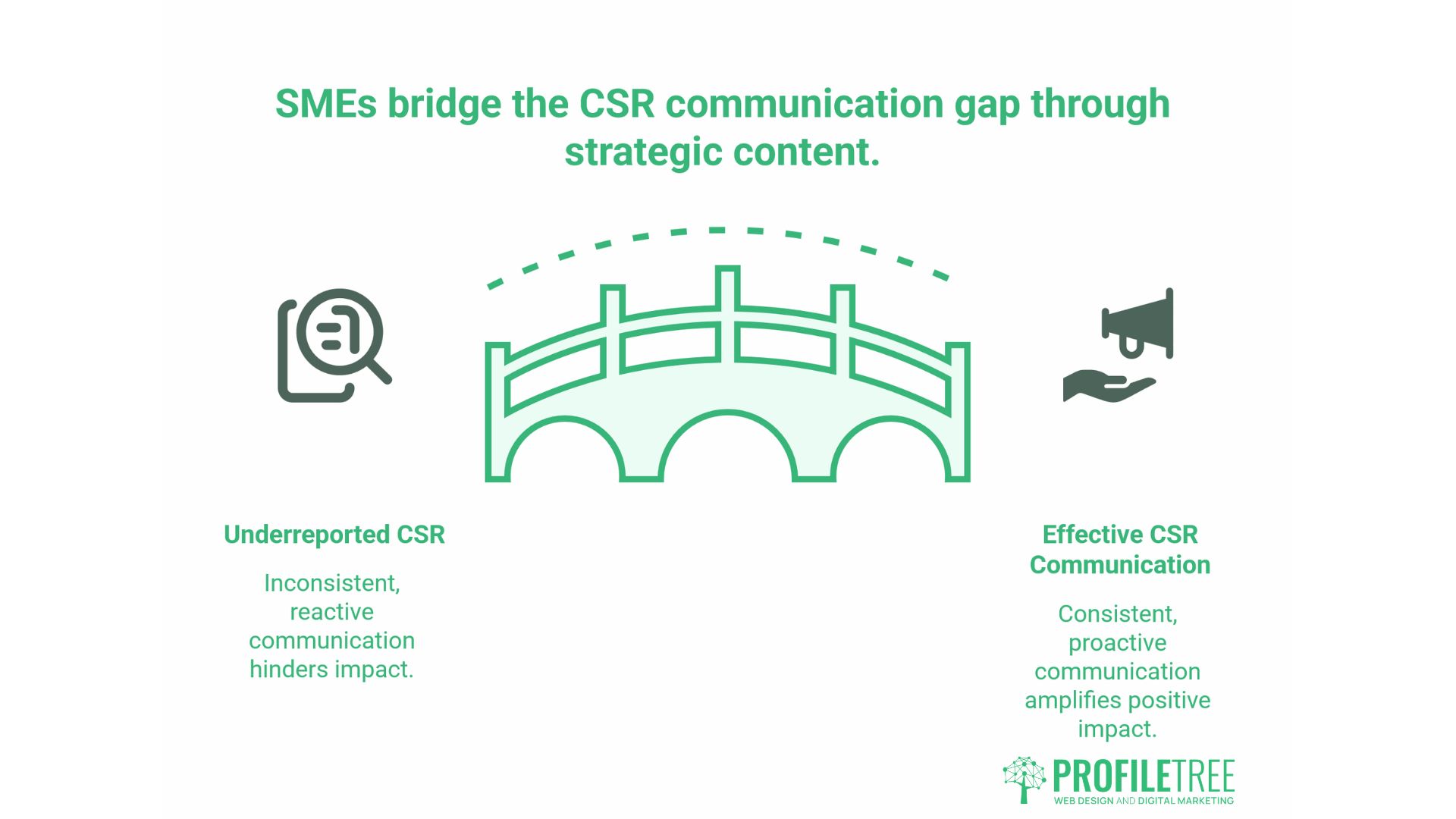
The gap between having a genuine CSR commitment and communicating it effectively is almost always a content and channel problem. Most SMEs doing good work in their communities are underreporting it, using inconsistent formats, or posting reactively rather than from a plan.
Closing that gap involves three practical steps: building a content strategy that maps CSR activity to social channels throughout the year; creating the video, written, and visual content that brings that strategy to life; and using SEO and digital marketing to ensure CSR content reaches the audiences it is meant to reach rather than disappearing into the feed.
“In the digital space, the businesses that build lasting reputations are those that tell their story consistently and honestly over time. CSR gives businesses genuinely meaningful material to communicate. The challenge is turning that material into content that finds and resonates with the right audience,” says Ciaran Connolly, ProfileTree Founder.
For Northern Ireland and Irish businesses that want a more structured approach to CSR communication, that means considering digital training for in-house teams as much as it means commissioning content. The skills to plan a content calendar, film a short social video on a smartphone, or write a LinkedIn post that avoids greenwashing pitfalls are all learnable. ProfileTree’s guide to digital marketing strategy is a practical starting point for businesses building that capability in-house.
Conclusion
Corporate social responsibility is no longer a side project for large companies with dedicated sustainability teams. For SMEs across the UK and Ireland, it is becoming a factor in procurement decisions, talent attraction, and customer trust. Social media is where that commitment either becomes visible and credible or is exposed as performative. The businesses that get this right share one characteristic: they treat CSR communication with the same planning and consistency they bring to any other part of their marketing. Start with the four pillars, build a content plan around what you can actually evidence, and let specificity do the work that vague good intentions never can.
FAQs
What is the main idea of social responsibility?
Social responsibility is the principle that a business’s obligations extend beyond profit to cover its impact on employees, communities, and the environment.
What are the four types of social responsibility?
Environmental (reducing harm to the natural environment), ethical (operating fairly and transparently), philanthropic (contributing to the community through time, skills, or resources), and economic (running a sustainable business that supports local employment and supply chains).
Is social responsibility mandatory for UK companies?
Broadly, CSR is voluntary. However, Section 172 of the Companies Act 2006, the Social Value Act 2012, and the Modern Slavery Act 2015 make specific aspects legally binding for certain business sizes and sectors. Smaller businesses are not bound by most of these but may choose to adopt voluntary standards such as B-Corp certification.
How do businesses use social media to communicate their CSR initiatives?
LinkedIn suits policy updates and stakeholder reporting; Instagram works well for visual community content; YouTube provides a permanent, searchable record of impact stories. Across all platforms, credible CSR content names specific organisations, dates, and measurable outcomes rather than making generic claims.