
DreamHost Domain Review: Pricing, Privacy and UK Verdict
Table of Contents
DreamHost is a well-established US hosting provider that doubles as a domain registrar, offering registration across hundreds of TLDs including the .co.uk and .uk extensions that UK businesses rely on. For a small business owner weighing up where to register their first domain, or a growing company considering whether to consolidate domain and hosting under one roof, the decision deserves more than a headline price comparison.
This DreamHost domain review focuses specifically on the registrar service rather than hosting: what it costs in real terms for UK and Irish customers, what features come included, where it falls short, and whether it makes practical sense for an SME that wants a domain to sit beneath a professionally built website.
Quick verdict: DreamHost is a reasonable choice for straightforward domain registration, particularly if you already use their hosting. Free WHOIS privacy is a genuine plus. Renewal pricing is higher than budget registrars and all costs are listed in US dollars, which adds a layer of uncertainty for UK buyers. It works well for one or two domains; less so at scale.
DreamHost Domain Pricing: What UK Businesses Actually Pay
The most common reason businesses search for this review is pricing — specifically the gap between introductory rates and renewal costs, which catches a lot of first-time buyers off guard.
DreamHost lists all domain pricing in US dollars. UK and Irish customers will pay in GBP or EUR at their card provider’s prevailing exchange rate, with any applicable VAT added at checkout for UK VAT-registered businesses purchasing B2B services from a US supplier. That dollar-to-sterling conversion matters: a .com listed at $19.99 per year on renewal currently works out at roughly £16 to £17, depending on the rate at the time of payment.
Introductory vs Renewal Rates
The table below shows DreamHost’s current pricing across the extensions most relevant to UK and Irish SMEs. Introductory prices apply to the first registration period only. Always check the renewal column before committing — this is where the long-term cost of ownership sits.
| TLD | Register | Renew | Transfer |
|---|---|---|---|
| .com | $7.99 (sale) | $19.99 | $9.99 |
| .net | $10.99 (sale) | $17.99 | $13.95 |
| .org | $11.99 (sale) | $17.99 | $13.95 |
| .co.uk | $11.95 | $11.95 | $11.95 |
| .me.uk | $9.99 | $9.99 | $9.99 |
| .org.uk | $9.95 | $9.95 | $9.95 |
| .eu | $9.95 | $9.95 | $9.95 |
| .info | $13.95 (sale) | $17.99 | $13.95 |
| .xyz | $1.99 (sale) | $12.99 | $12.99 |
| .biz | $16.99 | $16.99 | $16.99 |
Prices should be verified against DreamHost’s live pricing page before acting on them, as rates are subject to change. All figures are in USD.
One useful distinction in UK ccTLD pricing: .co.uk, .me.uk, and .org.uk all share the same register, renew, and transfer prices. There is no introductory discount trap on these extensions, which makes the long-term cost more predictable than it is for .com.
How DreamHost Domain Pricing Compares
The table below compares DreamHost against two commonly evaluated alternatives for UK SMEs, based on publicly listed pricing. Privacy protection cost is included as a line item because it materially affects total cost of ownership.
| Registrar | .com First Year | .com Renewal | WHOIS Privacy | .co.uk Renewal |
|---|---|---|---|---|
| DreamHost | ~$7.99 | ~$19.99 | Free (included) | ~$11.95 |
| GoDaddy | ~$2.99 | ~$17.99 | ~$9.99/yr extra | ~£9.99 |
| Namecheap | ~$8.88 | ~$9.88 | Free (WhoisGuard) | ~£9.98 |
Namecheap is the stronger value option for .com renewals at scale. DreamHost’s advantage is the included WHOIS privacy and the consolidated management dashboard if you’re already using their hosting. GoDaddy’s low introductory price is offset by the additional privacy fee and higher renewal costs.
Key Features: What DreamHost Includes with Every Domain
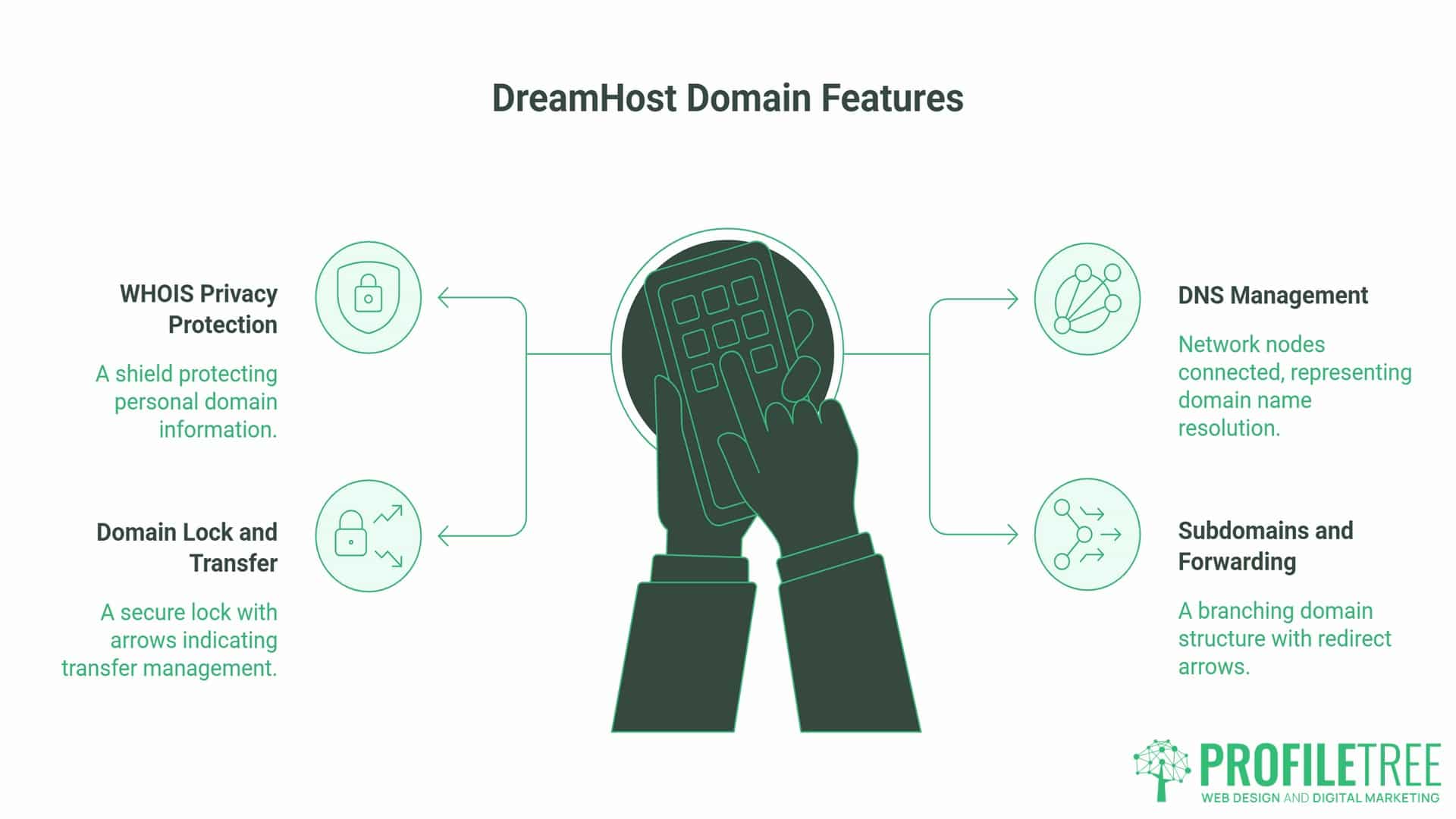
Domain pricing gets most of the attention when businesses are comparing registrars, but the features bundled with each registration often matter just as much. A low headline price can quickly lose its appeal once you add the cost of WHOIS privacy, find that DNS management requires a separate login, or discover that basic tasks are more complicated than they need to be.
DreamHost’s feature set is more generous than most registrars at a comparable price point: privacy protection is included as standard, DNS management sits within the same dashboard as hosting, and domain security controls like locking and forwarding come without additional fees. The sections below cover each in practical terms.
Free WHOIS Privacy Protection
Every domain registered through DreamHost includes free private registration. Your personal contact details — name, address, phone number — are replaced in the public WHOIS record with DreamHost’s proxy information. This prevents your details from being scraped by spam lists and cold-callers targeting new domain registrations.
This feature costs extra with several major registrars, so its inclusion here is a practical benefit rather than a marketing claim. For a UK business owner registering a domain for the first time, it removes one decision and one recurring cost.
DNS Management
DreamHost’s control panel gives you full access to DNS records: A records, CNAMEs, MX records, TXT records, and nameserver configuration. For most SME use cases — pointing a domain to a website, configuring professional email through Google Workspace or Microsoft 365, setting up SPF and DKIM for email authentication — the interface handles it adequately.
One limitation worth noting: if you’re migrating a live website and need rapid DNS propagation, DreamHost’s default TTL settings are on the higher side. Propagation times can be longer than with dedicated registrars. For a straightforward new domain, this is a non-issue; for a website migration with a hard go-live deadline, it’s worth factoring in.
Domain Lock and Transfer Management
DreamHost lets you lock your domain against unauthorised transfer requests — a basic but important security measure. Unlocking for a legitimate transfer is straightforward through the control panel. Transfer authorisation codes are generated within the dashboard.
DreamHost is an ICANN-accredited registrar, which means they meet the standards body’s requirements for transfer handling and customer fund management.
Subdomains and Domain Forwarding
DreamHost supports free subdomains and domain forwarding. For a business running a primary site at example.co.uk while redirecting an older domain or a campaign URL, both functions are available without additional cost. The redirect domains setup is managed through the same control panel as DNS.
The UK and Ireland Angle: What US Reviews Miss
Almost every high-ranking review of DreamHost is written from a US perspective, with dollar pricing, references to US phone support, and no mention of the TLDs that matter most to businesses in Northern Ireland, Ireland, and the rest of the UK.
.co.uk and .uk Registration
DreamHost supports both .co.uk and .uk registration. The .co.uk extension remains the default choice for most UK businesses. Registering a .uk domain through DreamHost follows the same process as registering a .co.uk domain, though Nominet (the official registry for .uk domains) requires that registrant details are accurate and match the intended use. DreamHost’s proxy privacy service replaces public WHOIS details but the underlying registrant data is still held and verifiable by Nominet if required.
Support Hours and GMT
DreamHost’s customer support operates primarily on US Pacific time. For a business owner in Belfast or Dublin dealing with a DNS issue at 9 AM on a Monday morning, live chat and ticket response times will reflect that time zone difference. DreamHost does offer 24/7 chat support, but resolution times for domain-specific technical issues — particularly transfers and propagation queries — can vary. This is less of a concern for routine management and more relevant if you’re working to a tight deadline.
A Note on .ie Domains
DreamHost does not currently support .ie domain registration directly. Irish businesses requiring a .ie domain will need to register through an IEDR-accredited registrar separately and can then point it to any hosting provider. This is a genuine gap for Irish SMEs who want to manage everything in one place.
From Domain to Live Website: What Comes Next
Registering a domain is the first step, not the last. A domain without a well-built website behind it creates no business value. This is where a lot of SMEs underestimate the work involved.
The domain is the address. The website is the premises. Getting those two things right together — a clean domain that supports your brand and SEO goals, sitting beneath a site built for conversion and search visibility — is the combination that actually drives enquiries.
“The domain decision seems minor, but it has real consequences for SEO and long-term brand clarity,” says Ciaran Connolly, founder of ProfileTree, a Belfast-based web design and digital marketing agency. “We see businesses come to us with three or four legacy domains pointing at the same site, inconsistent nameserver configurations, and no clear primary URL. Sorting that out before we build is always easier than sorting it out after.”
ProfileTree’s web development services cover the full journey from domain configuration through to site build and launch, working with businesses across Northern Ireland, Ireland, and the UK. For businesses thinking beyond just getting online and into how their digital presence supports growth, the agency also delivers digital training programmes that cover domain strategy, hosting choices, and the fundamentals of how websites and search visibility connect.
Understanding how your TLD choice affects local search is also worth thinking through early. A .co.uk signals geographic relevance to Google for UK-based searches in a way that a .com does not always do automatically — a detail covered in more depth in ProfileTree’s guide to SEO and technical search factors.
DreamHost Domain Review: Pros, Cons and Who It Suits
No registrar is the right choice for every business, and DreamHost is no exception. For a specific type of buyer — typically one already within the DreamHost hosting ecosystem, registering a small number of domains and prioritising simplicity over the lowest possible cost — it performs well.
For others, particularly Irish businesses needing .ie domains, those managing larger domain portfolios, or buyers who want sterling-denominated pricing without currency conversion uncertainty, the limitations become more significant. The pros and cons below are drawn from the features and pricing covered throughout this review, not from unverifiable user quotes or generalised opinion.
Pros
- Free WHOIS privacy included with every domain
- Consistent renewal pricing on UK ccTLDs (.co.uk, .org.uk, .me.uk)
- ICANN-accredited registrar with a reliable DNS network
- Consolidated management with DreamHost hosting
- Domain lock and forwarding are included at no extra cost
Cons
- All pricing listed in USD — no GBP or EUR display option
- .com renewal rates are higher than dedicated budget registrars
- No .ie domain support
- Support is US-timezone primary; live resolution of complex domain issues may be slower for UK and Irish customers
- DNS propagation can be slower than dedicated registrars for time-critical migrations
Who DreamHost domain registration suits: Businesses already using DreamHost hosting who want everything in one place. Those registering one or two domains who value included privacy protection. Teams are comfortable managing dollar-denominated costs.
Who should look elsewhere: Businesses registering .ie domains. Those building a large portfolio of domains where per-unit renewal costs compound quickly. Businesses that need dedicated registrar-level support for complex transfers or tight migration timelines. For .co.uk registrations with lower renewal costs and sterling-denominated pricing, Namecheap and Hover are worth comparing directly.
Choosing the right domain is one part of building an online presence that works. If you’re ready to move from domain registration to a site that generates real enquiries, ProfileTree’s web design team works with SMEs across the UK and Ireland to build and optimise websites that support business growth.
Frequently Asked Questions
What does this DreamHost domain review cover?
This DreamHost domain review covers domain registration pricing, WHOIS privacy, DNS management, UK and Irish TLD support, and how DreamHost compares to Namecheap and GoDaddy for SMEs.
How much does a domain name cost on DreamHost?
DreamHost lists all pricing in US dollars, so UK and Irish buyers will pay the GBP or EUR equivalent at their card provider’s rate on the day of purchase. A .com registration is currently available from around $7.99 as an introductory rate, renewing at approximately $19.99 per year — roughly £16 to £17 at current exchange rates, though this will vary. UK ccTLDs (.co.uk, .org.uk) register and renew at a consistent $9.95 to $11.95 per year with no introductory pricing gap, which works out at approximately £8 to £9.50 at the time of writing. Always check the live total at checkout before completing your purchase.
Does DreamHost offer free domain privacy?
Yes. WHOIS privacy protection is included at no additional cost with every DreamHost domain registration. Your personal contact details are replaced in the public WHOIS record with DreamHost’s proxy information.
Can I register a .co.uk domain through DreamHost?
Yes. DreamHost supports .co.uk, .uk, .me.uk, and .org.uk registration. .ie domains are not currently available through DreamHost.
Is DreamHost cheaper than GoDaddy for UK businesses?
On .com renewals, DreamHost and GoDaddy are broadly comparable. Where DreamHost pulls ahead is on privacy: GoDaddy charges separately for WHOIS protection, which adds to the annual cost. Over a three-year period, the total cost of ownership is often lower with DreamHost for privacy-conscious buyers, even if the headline renewal rate appears similar.
What happens to my domain if I cancel DreamHost hosting?
Your domain registration is separate from your hosting account. Cancelling hosting does not automatically cancel your domain. You can keep the domain registered with DreamHost and point it to a different hosting provider, or transfer it to another registrar. Domain and hosting are billed independently.
How do I point my DreamHost domain to a different hosting provider?
Log in to your DreamHost panel, navigate to the Domains section, and update the nameservers to those provided by your new hosting provider. Changes typically propagate within a few hours, though full global propagation can take up to 48 hours depending on TTL settings.