
Corporate AI Workshops UK and Ireland: Transform Your Business
Table of Contents
Corporate AI workshops delivered across the UK and Ireland are transforming how businesses operate, compete, and grow. From Belfast boardrooms to Dublin innovation centres, from Manchester manufacturing floors to Edinburgh financial districts, companies investing in structured AI workshop programmes report average productivity gains of 35% and ROI exceeding 400% within 12 months.
The difference between companies thriving with AI and those struggling isn’t access to technology—it’s quality of training. Professional corporate workshops provide the structured learning, hands-on experience, and strategic guidance that transform AI from a buzzword into a business advantage. Yet most corporate training programmes fail because they’re generic, theoretical, and disconnected from real business challenges.
This changes with properly designed corporate AI workshops that address specific industry needs, respect time constraints, and deliver immediate value. Whether you’re training five executives or 500 employees or are based in Belfast or Birmingham, the right workshop programme unlocks AI potential while avoiding costly mistakes that plague self-directed attempts.
Why Corporate AI Workshops Deliver Superior Results
Corporate AI workshops deliver superior results compared to online courses or self-directed learning because they provide immediate expert feedback, collaborative problem-solving opportunities, and hands-on application within your specific business context rather than generic theoretical scenarios. Interactive workshop environments enable participants to ask industry-specific questions, work through real company challenges, and benefit from peer insights while building internal networks of AI champions who can support implementation and troubleshoot issues long after formal training concludes.
Structured Learning Beats Random Exploration
Corporate AI workshops systematically progress through AI concepts, tools, and applications. Unlike scattered online tutorials or vendor-specific training, professional seminars build a comprehensive understanding from foundations to advanced applications. Participants develop connected knowledge rather than fragmented skills.
Structured programmes systematically address AI adoption. Day one establishes shared vocabulary and understanding. Day two explores specific applications relevant to your industry. Day three involves hands-on implementation with real data. This progression ensures that every participant achieves competency regardless of starting point.
Belfast technology companies report 67% faster AI implementation after structured workshops than self-directed learning. Dublin financial services firms achieve 45% better adoption rates through workshop programmes versus online courses. Manchester manufacturers reduce implementation errors by 78% following professional workshop training.
Time efficiency makes workshops particularly valuable for busy professionals. Condensed learning in focused environments achieves more in two days than months of sporadic self-study. Dedicated time away from daily operations enables deep focus that is impossible during regular workdays.
Collaborative Learning Accelerates Understanding
Corporate workshops bring together diverse perspectives that enrich learning experiences. Finance professionals share ROI calculation approaches. Operations managers explain process optimisation needs. Marketing teams demonstrate customer application possibilities. This cross-pollination generates innovations that individual learning never achieves.
Peer learning during workshops addresses real challenges rather than theoretical scenarios. When participants share their inventory forecasting struggles, others contribute solutions from their experience. When someone demonstrates successful automation, colleagues immediately see applications in their departments. Real problems get real solutions.
Network effects multiply workshop value beyond immediate learning. Relationships formed during intensive training create ongoing support networks. Participants continue sharing experiences, solutions, and opportunities long after workshops conclude. These connections often prove more valuable than the technical knowledge gained.
Group dynamics in workshops maintain momentum when individual motivation might flag. Peer pressure encourages completion of challenging exercises. Competitive elements make learning engaging rather than arduous. Collaborative successes build confidence for independent implementation.
Expert Facilitation Ensures Practical Application
Professional facilitators bring years of implementation experience to corporate workshops. They’ve seen what works, what fails, and why. This practical knowledge transforms theoretical AI concepts into actionable business strategies. Participants learn from others’ mistakes rather than making their own.
Expert facilitators adapt content to participant needs in real time. When discussions reveal specific challenges, examples shift to address them. When certain concepts prove difficult, alternative explanations emerge. When opportunities appear, exploration goes deeper. This responsiveness ensures relevance, which is impossible with pre-recorded content.
Industry-specific expertise distinguishes quality workshops from generic training. Facilitators who understand manufacturing constraints provide relevant automation examples. Those familiar with financial regulations ensure compliance considerations. Retail-experienced trainers focus on customer experience applications. Domain knowledge ensures practical applicability.
Ongoing support from expert facilitators extends learning beyond workshop walls. Post-workshop consultations address implementation challenges. Email support handles specific questions. Follow-up sessions ensure successful adoption. This continued relationship dramatically improves success rates.
Corporate AI Workshop Formats and Structures
Corporate AI workshop formats range from intensive single-day sessions covering AI fundamentals and immediate implementation strategies to multi-week programs that provide deep skill development through progressive learning modules and hands-on project work. Workshop structures can be customised for different organisational needs, including executive briefings focused on strategic AI adoption, department-specific training tailored to particular business functions, and comprehensive company-wide programs that ensure consistent AI knowledge across all levels while maintaining operational continuity throughout the training period.
Executive Strategy Workshops
Executive AI workshops focus on strategic opportunity identification and investment decision-making. C-suite participants need knowledge different from that of implementation teams. These workshops emphasise competitive positioning, ROI evaluation, and organisational transformation rather than technical details.
Half-day executive briefings provide essential AI literacy for senior leaders. Understanding possibilities and limitations enables informed decision-making. Recognising industry applications identifies competitive threats and opportunities. Grasping implementation requirements supports realistic planning. These condensed sessions respect executive time constraints while delivering crucial insights.
Two-day executive immersions develop comprehensive AI strategies. Day one explores the AI landscape and applications, and day two focuses on organisation-specific opportunities and implementation planning. Participants leave with clear roadmaps, budget requirements, and success metrics. This intensive format builds consensus and commitment, crucial for successful adoption.
Board-level workshops address governance and risk considerations. Directors must understand AI implications for competitive positioning, regulatory compliance, and stakeholder value. These specialised sessions cover oversight responsibilities, ethical considerations, and strategic risks. Proper board education ensures appropriate support and governance for AI initiatives.
Department-Specific Training Workshops
Departmental workshops deliver targeted training for specific business functions. Sales teams learn lead scoring and opportunity prediction, marketing departments master content generation and campaign optimisation, and operations groups focus on process automation and quality control. Targeted training ensures immediate applicability.
Two-day departmental intensives provide comprehensive functional training. Morning sessions cover concepts and tools. Afternoons involve hands-on exercises with departmental data. Participants implement actual solutions during workshops rather than hoping to apply concepts later. This practical focus delivers immediate value.
Workshop customisation addresses unique departmental needs. HR workshops emphasise recruitment automation and employee analytics while maintaining human connection. Finance sessions focus on fraud detection and forecasting while ensuring audit trails. IT workshops cover integration and security while building maintainable systems. Customisation ensures relevance.
Cross-functional workshops bring related departments together. Sales and marketing align on lead management AI. Operations and quality assurance coordinate on inspection automation. Finance and procurement collaborate on spend analysis. These joint sessions ensure integrated implementations rather than departmental silos.
Technical Implementation Workshops
Technical workshops provide hands-on training for staff implementing and maintaining AI systems. While requiring no programming expertise, these sessions go deeper into configuration, integration, and optimisation. Participants learn to maximise AI tool capabilities while avoiding common pitfalls.
Three-day implementation bootcamps transform novices into competent practitioners. Day one covers tool selection and setup. Day two focuses on integration and workflow design. Day three addresses monitoring, optimisation, and troubleshooting. This intensive format builds practical skills quickly.
Advanced workshops address specific technical challenges. API integration sessions enable system connectivity. Data preparation workshops ensure quality inputs for AI systems. Model training sessions teach customisation for specific needs. These specialised workshops solve particular technical requirements.
Train-the-trainer workshops develop internal AI training capabilities. Selected employees learn to deliver AI training within organisations. This multiplier effect extends workshop impact throughout companies. Internal trainers provide ongoing support and knowledge transfer. Building internal capability ensures sustainable AI adoption.
Innovation and Ideation Workshops
Innovation workshops focus on identifying and developing novel AI applications for competitive advantage. Rather than implementing standard solutions, participants create unique applications addressing specific business challenges or market opportunities.
Design thinking workshops apply creative problem-solving to AI opportunities. Participants identify customer pain points, ideate AI solutions, prototype concepts, and test feasibility. This structured innovation process generates practical applications beyond obvious use cases.
Hackathon-style workshops challenge teams to develop AI solutions under time pressure. Competitive elements drive creativity and collaboration. Rapid prototyping proves concept viability. Presentation requirements build communication skills. These intensive sessions generate energy and enthusiasm for AI adoption.
Future-scanning workshops explore emerging AI capabilities and their business implications. Participants learn about natural language processing, computer vision, and predictive analytics developments. Understanding future possibilities enables proactive positioning rather than reactive responses.
Industry-Specific Workshop Programmes

Industry-specific workshop programmes address unique sector challenges and regulatory requirements. Healthcare organisations receive training on HIPAA-compliant AI applications, while financial services firms learn about risk management and fraud detection systems tailored to banking regulations. Manufacturing workshops focus on predictive maintenance and quality control automation, retail programs emphasise inventory optimisation and customer behaviour analysis, and professional services training covers document automation and client communication enhancement that addresses specific industry workflows and compliance standards rather than generic business applications.
Financial Services and Banking
Financial sector workshops address unique regulatory, security, and accuracy requirements. Participants learn AI applications for risk assessment, fraud detection, and customer service while maintaining compliance with FCA, PRA, and Central Bank requirements.
Belfast financial institutions focus workshops on customer experience enhancement through AI chatbots and personalisation engines. Dublin’s IFSC companies emphasise algorithmic trading and risk modelling applications. Regional banks across the UK concentrate on branch automation and loan decision support systems.
Compliance considerations permeate financial workshops. Every AI application must maintain audit trails, ensure fairness, and protect customer data. Workshops teach implementation approaches that satisfy regulators while delivering business value. Participants learn to balance innovation and compliance.
Case studies from successful implementations guide learning. For example, Ulster Bank reduced fraud losses by 45% through transaction monitoring AI, Allied Irish Banks accelerated loan approvals by 60% using automated credit assessment, and Santander UK improved customer satisfaction through predictive service. Real examples demonstrate achievable outcomes.
Manufacturing and Engineering
Manufacturing workshops focus on operational efficiency, quality improvement, and predictive maintenance. Participants learn to implement AI solutions addressing production challenges while maintaining safety standards and quality requirements.
Quality control applications dominate manufacturing interest. Computer vision systems detect defects invisible to human inspectors. Pattern recognition identifies process drift before it affects output. Predictive models anticipate equipment failures weeks in advance. Workshops teach the practical implementation of these powerful capabilities.
Supply chain optimisation through AI addresses ongoing challenges. Demand forecasting reduces inventory costs while preventing stockouts. Supplier performance prediction improves procurement decisions. Logistics optimisation lowers transportation costs. Participants learn to implement integrated supply chain AI.
Industry 4.0 integration workshops connect AI with IoT sensors, robotics, and automation systems. Participants learn to create smart factories where AI orchestrates production optimisation. Real-time adaptation to demand changes, quality issues, and equipment status becomes possible. These advanced workshops position manufacturers for future competition.
Retail and E-commerce
Retail workshops emphasise customer experience, inventory management, and omnichannel integration. Participants learn AI applications that compete with Amazon while maintaining local advantages.
Personalisation engines transform customer engagement. Recommendation systems increase average order values by 23%. Dynamic pricing optimises margins while remaining competitive. Customer service chatbots handle 60% of enquiries automatically. Workshops teach the implementation and optimisation of these crucial capabilities.
Inventory management AI prevents costly stockouts and excess inventory. Demand forecasting accounts for seasonality, trends, and external factors. Automated reordering maintains optimal stock levels. Markdown optimisation maximises recovery from slow-moving inventory. Practical exercises use real retail data for immediate applicability.
Belfast retailers learn to compete with online giants through AI-powered local advantages. Dublin shops discover how AI enables unique customer experiences. Regional chains across the UK implement AI for multi-location coordination. Workshops address specific retail contexts from fashion to grocery to electronics.
Healthcare and Life Sciences
Healthcare workshops balance AI innovation with patient safety and regulatory requirements. Participants learn applications that improve patient outcomes while maintaining trust and compliance.
Clinical decision support systems augment medical expertise without replacing clinical judgment. Diagnostic assistance AI helps identify conditions earlier. Treatment optimisation algorithms personalise care plans. Administrative automation frees staff for patient interaction. Workshops teach responsible implementation, respecting healthcare’s unique requirements.
Private clinics and dental practices focus on operational efficiency. Appointment scheduling AI reduces no-shows by 40%. Patient communication automation maintains a personal touch while saving staff time. Treatment planning AI ensures consistency across practitioners. These applications deliver immediate value without clinical risk.
Pharmaceutical and biotech companies explore AI for research acceleration. Drug discovery workshops cover molecular modelling and clinical trial optimisation. Quality assurance sessions address batch testing and deviation prediction. Regulatory workshops ensure compliance throughout AI implementation.
Customising Workshops for Your Organisation
Customising workshops for your organisation requires a comprehensive pre-training assessment that examines current skill levels, specific business objectives, existing technology infrastructure, and industry constraints to design curricula that address actual workplace challenges rather than generic AI concepts. Effective customisation involves collaborating with department heads to identify priority use cases, adapting training materials to reflect company terminology and processes, and establishing realistic implementation timelines that align with organisational capacity and change management requirements while ensuring maximum practical value from workshop investment.
Needs Assessment and Programme Design
Effective workshop customisation begins with a comprehensive needs assessment. Understanding current capabilities, desired outcomes, and constraints enables targeted programme design. Generic workshops waste time on irrelevant content while missing crucial requirements.
Pre-workshop surveys identify participant knowledge levels and learning objectives. Skills assessments reveal capability gaps requiring attention. Stakeholder interviews uncover organisational priorities and concerns. Data audits determine what information exists for hands-on exercises. This preparation ensures workshop relevance.
Programme design balances breadth with depth based on organisational needs. Some companies need broad AI awareness across many employees. Others require deep expertise in specific applications. Most benefit from combinations: executive awareness, departmental training, and technical deep-dives. Modular design enables flexible configuration.
Industry context significantly shapes workshop content. Manufacturing examples resonate poorly with financial services participants, and healthcare scenarios confuse retail audiences. Effective customisation uses industry-specific cases, addresses sector regulations, and speaks participant language. Relevance drives engagement and application.
Scheduling and Logistics Optimisation
Workshop scheduling must balance learning effectiveness with business disruption. Two-day intensives minimise time away but require focused attention. Weekly half-day sessions spread learning but risk momentum loss. Monthly full-day workshops balance both concerns. Optimal scheduling depends on organisational culture and operational demands.
Location decisions affect workshop success. On-site delivery ensures convenience but may suffer from workplace distractions. Off-site venues provide focus but require travel. Hybrid approaches use nearby hotels or conference centres. Virtual workshops eliminate travel but reduce interaction. Consider trade-offs when selecting venues.
Group composition influences learning dynamics. Mixing seniority levels can inhibit participation. Combining competing departments may restrict sharing. However, diversity often enriches discussions. Optimal composition brings together participants with shared challenges but diverse perspectives. Careful selection maximises workshop value.
Technology requirements vary by workshop type and depth. Introductory awareness sessions need only projection and Wi-Fi. Hands-on implementation workshops require laptops with specific software. Advanced technical sessions might need cloud computing access. Ensure infrastructure supports planned activities to avoid frustrating delays.
Integrating with Existing Training Programmes
AI workshops should complement rather than duplicate existing training initiatives. Many organisations already invest in training in digital skills, change management, and process improvement. AI workshops build on these foundations rather than starting from zero.
Learning pathway integration ensures logical progression. Digital literacy training precedes AI workshops. Change management programmes prepare organisations for AI transformation. Process mapping exercises identify AI opportunities. Coordinated training multiplies impact beyond individual programmes.
Certification and credentialing considerations matter for professional development. Some employees need formal AI certifications for career advancement. Others benefit from informal recognition. Workshops leading to recognised credentials provide additional value. Consider certification options when designing programmes.
Knowledge management systems capture and extend workshop learning. They document key insights for future reference, record demonstrations for review, create resource libraries for ongoing support, and build internal wikis to share implementation experiences. Systematic knowledge capture ensures lasting value from workshop investments.
Measuring Workshop Success and ROI
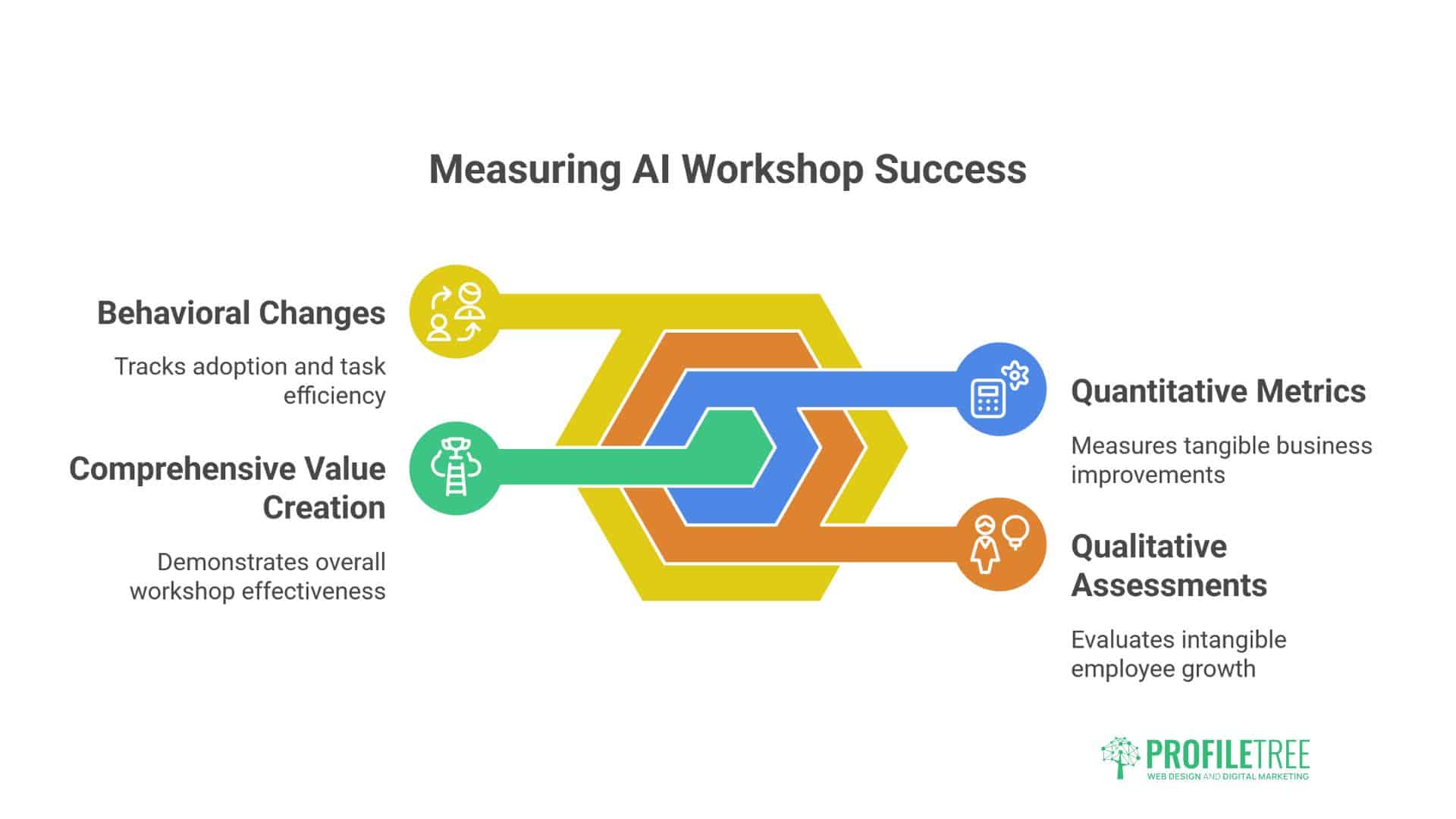
Measuring workshop success requires tracking specific behavioural changes and business outcomes, including tool adoption rates, task completion time improvements, and measurable productivity gains, rather than relying on participant satisfaction scores that don’t correlate with actual workplace implementation. Effective ROI measurement frameworks combine quantitative metrics such as reduced operational costs, increased revenue from AI-enhanced processes, and time savings with qualitative assessments, including employee confidence levels and decision-making quality improvements, demonstrating comprehensive value creation beyond immediate training completion.
Immediate Learning Outcomes
Workshop success measurement begins with an immediate learning assessment. Pre- and post-workshop evaluations quantify knowledge gained. Practical exercises demonstrate skill development. Participant feedback indicates engagement and satisfaction. These immediate metrics predict implementation success.
Knowledge assessments should test practical application rather than memorisation. Can participants identify appropriate AI applications for their challenges? Do they understand implementation requirements? Can they evaluate vendor proposals intelligently? Practical assessment reveals true learning rather than surface recall.
Skill demonstrations during workshops provide direct evidence of capability development. Participants successfully configuring AI tools, interpreting AI outputs, or designing automation workflows prove competency. Hands-on success predicts post-workshop implementation achievement. Document these successes for stakeholder communication.
Participant confidence measurements indicate readiness for implementation. Do attendees feel prepared to champion AI initiatives? Will they actively pursue AI projects? Can they influence colleagues toward adoption? Confidence correlates strongly with actual implementation rates.
Implementation and Adoption Metrics
True workshop success appears in post-training implementation rates. Track how many participants launch AI projects within 30 days. Monitor which workshop concepts get applied first. Measure time from training to first successful implementation. These metrics reveal workshop practical value.
Adoption velocity indicates organisational AI momentum. How quickly do AI applications spread beyond initial implementers? Do non-participants request training after seeing results? Does AI become part of standard operating procedures? Viral adoption suggests successful workshop outcomes.
Quality of implementations matters more than quantity. Are AI applications solving real business problems or just checking boxes? Do implementations follow best practices taught in workshops? Are appropriate governance and controls in place? Quality assessment ensures sustainable success.
Support request patterns reveal workshop effectiveness gaps. Frequent questions about covered topics suggest unclear instructions. Requests for basic help indicate insufficient hands-on practice. Advanced questions show participants pushing boundaries. Analyse support patterns to improve future workshops.
Business Impact Measurement
Ultimate workshop success appears in improving business metrics. Productivity gains, cost reductions, revenue increases, and customer satisfaction improvements justify workshop investments. Connect these improvements to specific workshop-inspired implementations for a clear ROI demonstration.
Productivity metrics show efficiency gains from AI automation: hours saved through automated reporting, faster processing of customer requests, reduced error rates requiring correction, and increased output per employee. These improvements directly link to workshop-taught applications.
Financial returns from workshop-inspired AI implementations provide compelling ROI evidence. Calculate cost savings from process automation. Measure revenue increases from AI-powered personalisation—document expense reductions from predictive maintenance. Financial impact validates workshop investments.
Competitive advantages gained through AI adoption represent strategic workshop value. These include market share gains from superior customer experience, talent attraction through innovative reputation, and partnership opportunities from AI capabilities. These strategic benefits often exceed direct financial returns.
ProfileTree’s Corporate AI Workshop Excellence
ProfileTree’s corporate AI workshop excellence stems from combining deep technical expertise with practical business implementation experience gained through training over 500 organisations across diverse UK and Irish sectors. Our workshop methodology emphasises hands-on learning with real company data and challenges, ensuring participants develop immediately applicable skills while receiving ongoing mentorship support that continues beyond formal training sessions to guarantee successful AI adoption and measurable business outcomes.
Our Unique Approach to Corporate Training
At ProfileTree, we’ve developed corporate AI workshops that deliver fundamental business transformation, not just theoretical knowledge. Our Belfast-based team combines deep AI expertise with practical business experience across Ireland and the UK markets. We understand the unique challenges facing organisations in our region and design workshops that address them directly.
Our workshop methodology emphasises immediate practical application. Participants work with their data, address challenges, and implement real solutions during sessions. This isn’t about hypothetical scenarios or generic examples—it’s about solving your specific business problems using AI tools and techniques that work.
We excel at making complex AI concepts accessible to business audiences. Whether training CEOs or customer service representatives, we adapt our communication to ensure understanding without oversimplification. Technical accuracy meets business practicality in every workshop we deliver.
Ciaran Connolly, ProfileTree founder, explains: “Most corporate AI training fails because it’s either too technical for business audiences or too superficial for practical implementation. We’ve spent years perfecting the balance—delivering sophisticated workshops to drive real transformation, but accessible enough for any professional to understand and apply. Our participants are equipped with knowledge, working AI implementations, and clear roadmaps for expansion.”
Proven Workshop Outcomes
Our corporate workshops consistently deliver measurable results. Participants report average productivity improvements of 35% within three months. Implementation success rates exceed 85%, compared to industry averages below 40%. ROI typically reaches 400% within the first year.
Belfast technology companies credit our workshops with accelerating their AI adoption by 6-12 months. Dublin financial firms achieve compliance-ready AI implementations through our guidance. Manufacturing companies across the UK reduce defect rates and downtime using techniques learned in our sessions.
Beyond metrics, our workshops transform organisational cultures. Sceptical employees become AI champions. Resistant departments request additional training. Innovation becomes embedded in daily operations. These cultural shifts ensure sustainable AI advancement beyond initial implementations.
Post-workshop support distinguishes ProfileTree from one-off training providers. We maintain relationships with client organisations, providing ongoing guidance as they scale AI implementations. Our alum network enables peer learning and support. Regular follow-up sessions ensure continued progress.
Comprehensive Service Integration
Our AI workshops integrate seamlessly with ProfileTree’s broader digital transformation services. AI training connects to our web development expertise, showing how AI enhances online presence. Our SEO knowledge demonstrates how AI amplifies search visibility. Our content marketing experience reveals AI applications for engagement and conversion.
This integrated approach means AI adoption doesn’t happen in isolation. We show how AI tools complement existing marketing automation. We demonstrate AI enhancement of current websites. We reveal AI optimisation of established workflows. Integration multiplies value beyond standalone training.
We also provide implementation services for organisations needing additional support. From initial setup to system integration to ongoing optimisation, our team ensures successful AI deployment. This end-to-end capability gives clients confidence that support exists throughout their AI journey.
Getting Started with Corporate AI Workshops
Getting started with corporate AI workshops begins with an initial consultation to assess your organisation’s current AI readiness, specific training objectives, and preferred delivery format while establishing realistic timelines and success metrics that align with business goals. The process typically involves scheduling a discovery call to discuss team size, skill levels, and priority use cases, followed by customised proposal development that outlines workshop structure, content focus, and implementation support to ensure maximum value from your AI training investment.
Initial Consultation Process
Your corporate AI workshop journey begins with a comprehensive consultation to understand your unique needs. We assess current capabilities, identify priority opportunities, and design customised programmes delivering maximum value. This initial investment of time ensures workshops address real challenges rather than generic topics.
Discovery sessions explore your organisational context. What industry challenges do you face? What competitive pressures exist? What transformation goals drive AI interest? Understanding your situation enables targeted workshop design that resonates with participants and delivers relevant outcomes.
Stakeholder alignment discussions ensure workshop success. Who needs training? What outcomes matter most? How will success be measured? When can training occur without disrupting operations? Addressing these questions early prevents later complications.
Programme design proposals outline recommended workshop structure, content, and logistics. We present options balancing comprehensive coverage with time and budget constraints. Clear proposals enable informed decision-making about your AI training investment.
Workshop Booking and Preparation
Once you’ve selected your workshop programme, preparation ensures maximum value delivery. Pre-workshop materials prime participants for learning. Logistics coordination minimises disruption. Data preparation enables hands-on exercises. Proper preparation differentiates exceptional workshops from adequate ones.
Participant selection significantly influences workshop success. Choose individuals with influence to champion AI adoption. Include skeptics whose buy-in proves crucial. Balance seniority levels appropriately. Mix departments for cross-pollination. Thoughtful selection multiplies workshop impact.
Pre-workshop assignments accelerate learning during sessions. Reading materials establish baseline knowledge. Assessment tools identify individual needs. Data collection enables relevant exercises. Use case brainstorming generates discussion topics. Preparation homework ensures productive workshop time.
Technology setup prevents frustrating delays. Ensure Wi-Fi handles multiple simultaneous connections. Test software installations before workshops begin. Prepare backup equipment for failures. Configure security permissions for cloud access. Technical preparation enables smooth delivery.
Post-Workshop Implementation Support
Through comprehensive implementation support, workshop value extends far beyond the training room. Follow-up consultations address emerging challenges. Resource libraries provide ongoing reference. Community connections enable peer support. Continued engagement ensures successful AI adoption.
30-day implementation check-ins maintain momentum. Review progress against plans made during workshops. Address obstacles preventing implementation. Celebrate early successes to build confidence. Adjust approaches based on initial experiences. Regular contact prevents stagnation.
Quarterly progress reviews assess broader transformation, evaluate business impact from implementations, identify additional AI opportunities, plan capability expansion, and address organisational changes affecting AI strategy. Structured reviews ensure continued advancement.
Alumni community membership provides ongoing value. Connect with other organisations on similar journeys. Share experiences and solutions. Learn from others’ successes and failures—access exclusive resources and events. Community membership extends learning indefinitely.
FAQs
What’s the typical investment for corporate AI workshops in the UK and Ireland?
Corporate AI workshops typically cost £2,000-5,000 per day for groups up to 20 participants, with two-day programmes costing £4,000-10,000. Customised workshops addressing specific organisational needs cost £8,000-15,000 for comprehensive programmes. Large-scale initiatives training 100+ employees across multiple sessions cost £25,000-50,000. Investment levels depend on customisation depth, participant numbers, and ongoing support requirements.
How many employees should attend corporate AI workshops for maximum impact?
Optimal workshop group sizes range from 8 to 15 participants for interactive sessions. Executive strategy workshops work best with 5-8 senior leaders. Department training accommodates 10-20 staff members. Technical implementation sessions are limited to 8-12 for hands-on attention. Training 10-15% of the total workforce creates critical mass for cultural change. Start with influential early adopters, then expand based on initial success.
Can workshops be delivered remotely, or do they require in-person attendance?
While in-person workshops provide superior interaction and networking, virtual delivery works effectively for many situations. Remote workshops suit awareness training and executive briefings. Hybrid models combine virtual instruction with local hands-on sessions. Pure virtual works for geographically distributed teams. In-person remains optimal for intensive implementation training and innovation workshops. We offer all formats based on client needs.
How quickly can businesses implement AI after completing workshops?
Most participants implement initial AI applications during workshops, seeing immediate value. Simple automations go live within days. More complex implementations typically launch within 2-4 weeks. Department-wide rollouts are completed within 2-3 months. Organisation-wide transformation is achieved within 6-12 months. Success depends on organisational readiness and support structures. Our post-workshop support accelerates implementation timelines.
Take Action: Book Your Corporate AI Workshop Today
The competitive advantages available through AI adoption today won’t exist tomorrow. Every week, your organisation delays AI training, and competitors gain ground that becomes increasingly difficult to recover. Government support available now may disappear. First-mover advantages in your industry remain available but not indefinitely.
Corporate AI workshops represent the fastest, most effective path to AI transformation. Rather than months of trial and error, achieve competency in days. Instead of fragmented online learning, receive a comprehensive, structured education. Replace confusion and uncertainty with confidence and clear direction.
ProfileTree’s corporate AI workshops deliver the knowledge, skills, and support your organisation needs for successful AI adoption. Our proven methodology, experienced facilitators, and comprehensive support ensure you achieve promised returns rather than expensive disappointments.
Your competitors are already exploring AI advantages, market leaders are implementing advanced applications, and customers increasingly expect AI-enhanced experiences. The question isn’t whether to adopt AI but how quickly you can build capabilities before falling behind.
Start your AI transformation journey today:
Immediate Actions:
- Schedule a consultation to discuss your organisation’s AI training needs
- Assess your team’s current capabilities and identify priority opportunities
- Review available workshop dates and reserve spaces for key personnel
- Apply for government grants supporting AI training initiatives
- Visit ProfileTree’s AI training services to explore workshop options
- Call our Belfast office to discuss customised corporate programmes
- Please email our team to schedule your initial consultation
- Connect with recent workshop alumni to hear their experiences
Don’t let another quarter pass while competitors build AI advantages. The organisations thriving in 2030 will trace success to AI investments made today. Your corporate AI workshop journey starts with a single decision—make it now.
Transform your organisation’s future through professional AI education. Book your corporate AI workshop with ProfileTree today and join the ranks of businesses winning with artificial intelligence.