
How to Improve Decision-Making for Leaders
Table of Contents
Decision-making for leaders is a learnable skill, not a fixed trait. Strong leaders rely on clear frameworks, accurate data, emotional control, and structured input from their teams to make timely choices under pressure. This guide covers the core components, common pitfalls, and practical tools you can apply straight away.
Leaders face complex situations every day that ask them to balance competing priorities, weigh risk, and commit to a path while the clock runs. The quality of those choices shapes business results and decides whether teams, stakeholders, and clients trust the person in charge.
Decision-making can be developed through practice, reflection, and the right methods. As Ciaran Connolly, founder of ProfileTree, puts it: “The best leaders I work with aren’t the ones who always feel certain. They’re the ones who’ve built a repeatable process, so even a hard call follows a method rather than a mood.”
Core Components of Decision-Making for Leaders
Good decisions rest on a handful of cognitive and analytical skills, plus the discipline to spot and control bias. Master these, and you reduce errors, handle complexity, and make better-informed calls.
Strategic Thinking
Leaders make decisions that solve the problem in front of them while still serving wider business goals. Strategic thinking means seeing how each choice fits the larger vision, accounting for market trends, competition, and long-term growth. Leaders with this skill connect daily decisions to bigger objectives, which keeps the organisation consistent over time.
This is also where outside expertise earns its place. A clear digital strategy gives leaders a documented framework to test decisions against, rather than judging each one in isolation.
Critical Analysis
Good decisions need an accurate, unbiased reading of the data. Critical analysis breaks information into its parts, questions assumptions, and tests how reliable each source really is. Leaders sift through data, opinions, and projections to separate fact from noise, then decide on the evidence rather than a gut feeling.
Problem-Solving
Problem-solving sits at the heart of decision-making: diagnosing the issue, exploring options, and acting on the best one. Strong leaders don’t just react. They anticipate challenges, trace root causes, and build proactive plans to reduce risk before it grows.
Effective problem-solving needs creativity and adaptability, too. The best leaders stay open to unconventional ideas while keeping one eye on what is actually workable, so solutions are both useful and feasible.
Risk Assessment
Every decision carries risk. Effective leaders weigh the possible rewards against the downsides of each option, identifying weak points, forecasting obstacles, and judging how likely and how severe a bad outcome could be. Leaders skilled at this are neither reckless nor frozen by caution; they balance risk against opportunity.
Recognising Cognitive Biases
Even experienced leaders are not immune to cognitive biases, the unconscious shortcuts that shape how we read information. Left unchecked, they lead to poor judgment, missed opportunities, and a narrow set of perspectives.
Some of the most common biases in leadership decisions:
- Confirmation bias: favouring information that supports what you already believe and ignoring what contradicts it.
- Anchoring bias: leaning too heavily on the first piece of information you receive, even when it is outdated.
- Overconfidence bias: overestimating your own knowledge or your ability to predict an outcome.
- Status quo bias: preferring options that keep things as they are, even when change is needed.
- Groupthink: going along with the majority to keep the peace, even when the consensus is flawed.
Common Challenges Leaders Face in Decision-Making
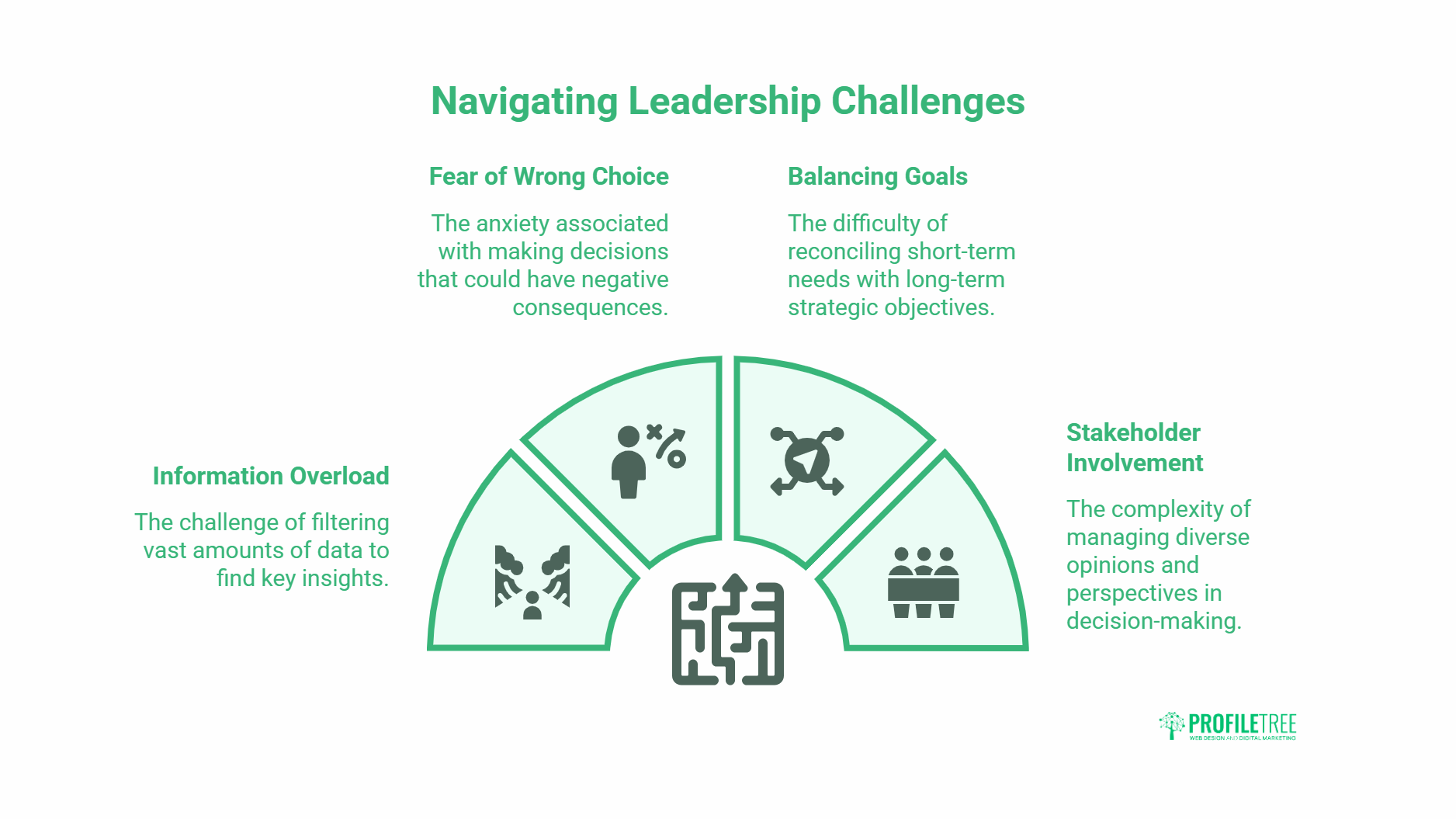
Even capable leaders hit obstacles. Leadership means working through ambiguity, managing competing interests, and acting under pressure while staying confident in the call. Here are the challenges that come up most.
Information Overload
Modern leaders are flooded with data: internal reports, market research, customer feedback, and real-time analytics. Access is useful, but too much information becomes noise, and filtering for the few high-impact insights gets hard. The result is slower decisions, more second-guessing, and analysis paralysis.
The fix is to prioritise a small set of key metrics, delegate data-gathering, and use dashboards or visualisation tools that cut the analysis time. AI tools now do a lot of this filtering automatically, which is one reason many SMEs invest in AI training for their teams to get value from the data they already hold.
Fear of Making the Wrong Choice
Decisions that affect revenue, reputation, or people’s livelihoods can trigger a fear of failure. That fear shows up as indecision, excessive caution, or hiding behind consensus to avoid personal accountability. Leaders wait for perfect information that never arrives, and opportunities pass.
The answer is getting comfortable with uncertainty and accepting that not every decision will be right. Focus on learning from outcomes, good and bad, and the mindset shifts from fear to steady improvement.
Balancing Short-Term and Long-Term Goals
Short-term needs often clash with long-term strategy. Cutting costs can lift this quarter’s profit while hurting innovation or morale later. Investing in long-term upgrades can strain current budgets. That tension makes it hard to commit, especially under shareholder or executive pressure.
Involving Stakeholders and Seeking Diverse Perspectives
Leaders rarely decide in isolation. They gather input from senior leadership, employees, customers, and partners, and managing those voices gets complicated when opinions clash. Push for too much agreement, and you risk groupthink; dismiss too many views, and you alienate people.
A structured input process helps: define who advises and who decides, use anonymous surveys to surface candid views, and actively invite dissent to expose blind spots. The leader still owns the final call and communicates it openly, even when not every voice is accommodated.
Practical Strategies for Improving Decision-Making
Decision-making skills aren’t static. Even strong leaders keep refining how they analyse information, manage emotions, and involve others. Here are strategies you can adopt now.
Enhancing Analytical Abilities
Good decisions start with good information. Ask the right questions, find credible sources, and discard anything irrelevant or outdated. Breaking a complex issue into smaller parts makes evaluation clearer.
Use both quantitative data (metrics, trends, performance indicators) and qualitative insight (employee feedback, customer sentiment). Dashboards, predictive analytics, and benchmarking reports help you spot patterns and forecast outcomes. A structured approach (define the problem, gather data, generate options, evaluate, choose) brings consistency, and root cause analysis keeps you fixing causes rather than symptoms.
Cultivating Emotional Intelligence
Decisions affect people, teams, and culture. Leaders with high emotional intelligence recognise their own triggers and biases, which makes their choices more balanced. Empathy lets them anticipate how a decision lands with others, which builds buy-in and morale.
This matters most under pressure. Before acting on a high-stakes call, pause and check your emotional state. Techniques like a short walk, deep breathing, or simply stepping away help you avoid impulsive choices driven by stress. Reading cues such as hesitation or resistance also tells you how the team feels, so you can address concerns early.
Implementing Decision-Making Frameworks
Frameworks give you structured ways to weigh options and reach a logical conclusion. Useful ones include:
| Framework | Best for | What it does |
|---|---|---|
| SWOT analysis | Strategic planning | Maps strengths, weaknesses, opportunities, threats |
| Decision matrix | Choosing between vendors or platforms | Scores options against weighted criteria |
| Pareto analysis | Prioritising effort | Focuses on the 20% of actions driving 80% of results |
| Cost-benefit analysis | Financial trade-offs | Weighs costs against expected gains |
The right framework depends on the decision. Standardising the process for recurring or high-impact choices removes guesswork, creates a clear audit trail, and lets you review past decisions and refine your approach.
Fostering Collaborative Decision-Making
Leaders don’t always have every answer, and collective intelligence often produces better outcomes. Structure group discussions by setting clear objectives and criteria upfront, using brainstorming to gather ideas, appointing a neutral facilitator to manage dominant voices, and inviting constructive dissent.
Not every decision needs full consensus. Judge the scope, impact, and urgency. High-impact strategic calls benefit from broad consultation; routine or time-sensitive ones may need a decisive individual. Whichever you choose, explain why, since transparency strengthens team trust.
Continuous Learning and Reflection
Treat every decision as a learning opportunity. Regular post-mortems give teams space to review what worked, what didn’t, and how the process itself can improve. Seek honest feedback from mentors, peers, and team members to find your blind spots, and stay informed through industry reports and professional networks so your judgment keeps pace with change.
Practical Decision-Making Exercises and Tools
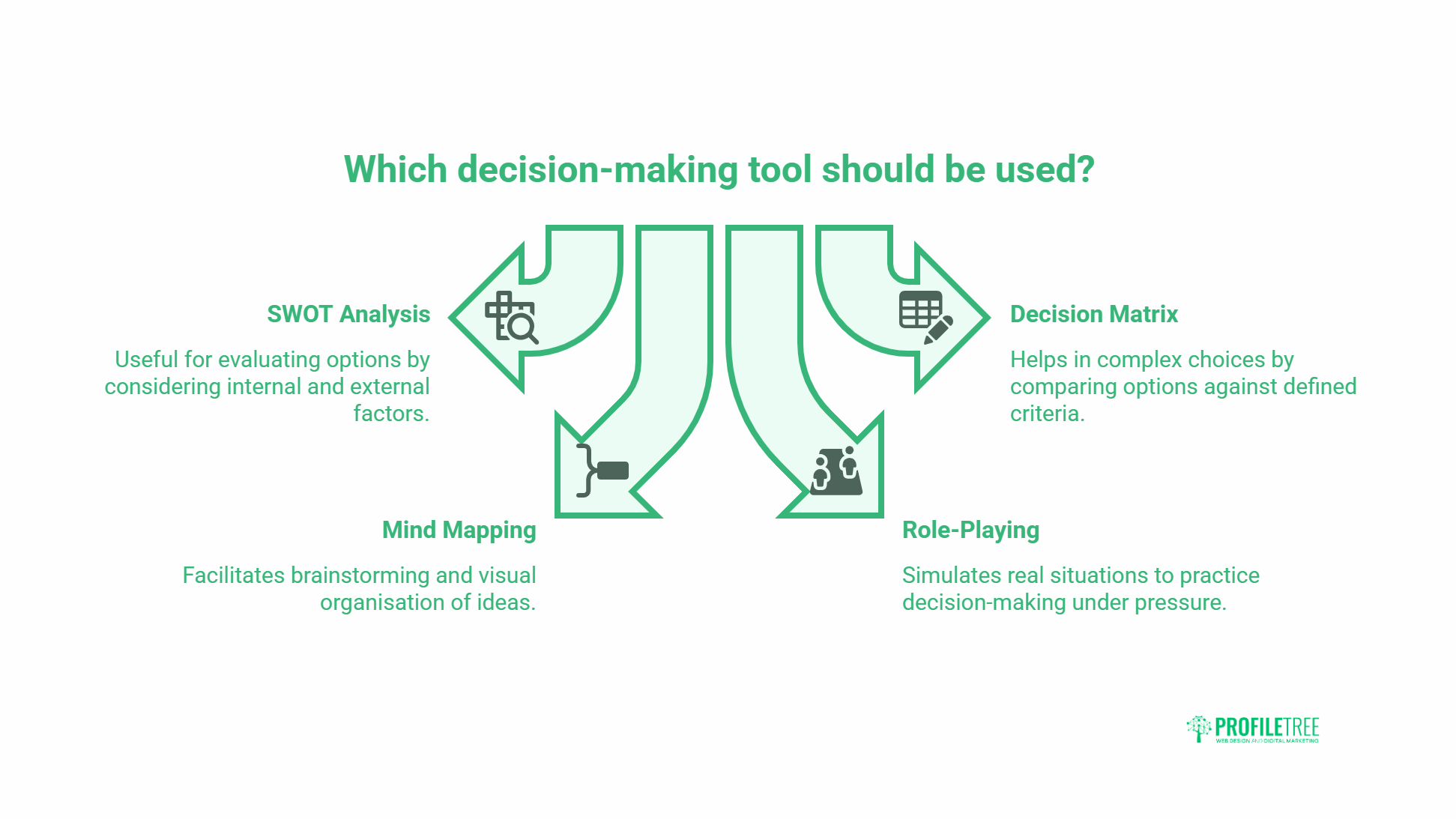
Leaders sharpen their judgement through regular practice and proven tools. These four give you frameworks for evaluating situations, clarifying options, and thinking more strategically.
SWOT Analysis for Evaluating Options
SWOT is a simple, effective way to assess a decision by examining strengths, weaknesses, opportunities, and threats. It works well when you need to weigh internal factors (capabilities, resources) against external ones (market trends, competition) before committing.
By forcing you to look at all sides, SWOT reduces blind spots and curbs overly optimistic thinking. Use it like this:
- Strengths: What advantages does this option give you, and what resources support it?
- Weaknesses: what internal limits could hold it back?
- Opportunities: what external shifts or openings could you use?
- Threats: what external risks could derail it?
A leader weighing entry into a new market, for example, can use SWOT to set revenue potential against operational and competitive challenges.
Decision Matrix for Complex Choices
A decision matrix evaluates several options against defined criteria, which helps when many factors compete. It reduces subjective bias by bringing a data-driven view, so options stack up objectively rather than on instinct.
List your options (vendors, platforms), define the criteria that matter (cost, scalability, ease of implementation), assign each criterion a weight, then score every option against each one. Multiply scores by weights, total them up, and the strongest option becomes clear.
Mind Mapping for Brainstorming
A mind map helps you organise thoughts visually, explore ideas, and surface hidden connections. It is most useful in early-stage brainstorming, where free exploration matters. Start with the central decision in the middle of the page, branch out with related ideas, risks, and considerations, then keep adding sub-branches. Colours and grouping make patterns easier to spot.
Role-Playing Scenarios
Role-playing simulates real leadership situations and asks participants to decide in the moment, often under time pressure. Run them with teams, mentors, or coaches. Pick a challenging scenario such as a crisis or an interdepartmental conflict, assign roles (the leader, key stakeholders, external parties), and add time limits to mirror real urgency. Debrief afterwards to review the approaches, discuss emotional responses, and pull out lessons.
How Better Data and Tools Support Leadership Decisions
Much of the friction in leadership decisions comes down to data: too much of it, poorly organised, or trapped in formats nobody can read quickly. This is where the right digital setup earns its keep.
Clear reporting, well-built dashboards, and AI-assisted analysis turn raw numbers into something a leader can act on in minutes rather than days. ProfileTree, a Belfast-based digital agency, works with SMEs across Northern Ireland, Ireland, and the UK on exactly this: practical AI tools that support marketing and business decisions, and AI chatbots that handle routine queries so leaders can focus on the calls that matter. For teams wanting to build the skill in-house, digital training covers how to read, trust, and act on the data you already collect.
Conclusion
Strong decision-making shapes everything from daily operations to long-term strategy. Leaders who develop the skill through analytical technique, emotional intelligence, and structured frameworks handle complexity with more confidence. Building the habit of seeking diverse input, reflecting on past calls, and staying open to learning becomes a real advantage. If your team needs better data and tools to support those decisions, talk to ProfileTree about digital strategy and AI training.
Frequently Asked Questions
What is the most important decision-making skill for leaders?
There isn’t a single one, but recognising and controlling cognitive bias underpins the rest. Without it, even good data and strong frameworks produce skewed conclusions.
How can leaders make decisions faster without lowering quality?
Standardise a framework for recurring decisions and prioritise a small set of key metrics. This removes repeated deliberation and reserves deep analysis for genuinely high-impact choices.
Which decision-making framework should I use?
It depends on the decision. SWOT suits strategic planning, a decision matrix suits choosing between vendors or platforms, and cost-benefit analysis suits financial trade-offs.
Can AI tools improve leadership decision-making?
Yes. AI helps filter large volumes of data, surface patterns, and forecast outcomes, which reduces information overload. Teams usually get the most value with some training on how to interpret the results.