
Consistent Content Updates: The UK SME Guide
Table of Contents
Most UK businesses understand they should regularly update their website content. Far fewer have a system for deciding what to update, when to update it, or how to measure whether the effort paid off. The result is a site that grows stale while rankings quietly slip, often without anyone noticing until traffic has already dropped.
This guide covers the practical mechanics of consistent content updates: why Google rewards fresh, well-maintained content, how to identify which pages need attention first, and what a realistic update workflow looks like for a small marketing team with limited time.
Why Consistent Content Updates Matter for SEO
Search engines don’t just evaluate what your content says when they first crawl it. They return repeatedly to check whether it has changed, and pages that show regular, substantive improvements tend to benefit from increased crawl frequency over time.
Google’s systems assess content freshness as one of many signals. For time-sensitive topics, recent publication dates carry obvious weight. For evergreen subjects, freshness matters differently: a guide that still cites 2021 statistics and links to pages that no longer exist sends quality signals in the wrong direction.
The Content Decay Problem
Traffic decay is the gradual decline in organic visits that affects almost every page that goes untouched for long enough. The pattern is predictable: a page ranks well at publication, holds position for some months, then slowly slides as competitors update their equivalent pages, new content enters the SERP, and search intent shifts.
Spotting decay early is straightforward using Google Search Console. Compare performance over two equal periods, for example, the last three months against the previous three, and filter for pages where impressions or average position have dropped without a corresponding drop in overall site traffic. Those pages are your priority update queue.
Crawl Frequency and Internal Linking
One practical benefit of consistent updates is increased crawl frequency. When Googlebot finds that a site regularly refreshes its content, it allocates more crawl budget to that site. This matters particularly for larger sites where new pages can sit unindexed for days after publication.
Internal linking plays a direct role here. Pages that receive links from frequently updated content get re-crawled more often as a side effect. If you update a high-authority pillar page and add a new internal link to a recently published article, that article is likely to be recrawled shortly after. This is one reason why updating existing content has a compounding effect that publishing new posts alone doesn’t replicate.
The Content Refresh vs. New Content Decision
For an SME with limited content resources, a single marketing manager, or a small team splitting time across several channels, the choice between refreshing existing content and publishing new articles is a real constraint, not a theoretical one.
A useful starting point is to examine two variables for each existing page: current traffic level and current ranking position.
| Traffic Level | Ranking Position | Recommended Action |
|---|---|---|
| High traffic | Strong (positions 1–10) | Protect: minor updates only, keep structure intact |
| High traffic | Slipping (positions 11–20) | Priority refresh: update statistics, improve intent alignment, strengthen internal links |
| Low traffic | Strong position | Investigate: good ranking but poor CTR may indicate a title or meta description problem |
| Low traffic | Weak (beyond position 20) | Full refresh or consolidation: assess whether this topic warrants a rebuild or a merge |
Most established SME websites have more content in the bottom two rows than they realise. Before commissioning new articles, it’s worth running this audit. The quick wins from refreshing slipping pages often deliver better results in less time than publishing from scratch.
Balancing Updates with New Publishing
A rough guide that works for most small teams: for every three new articles published, one existing article should be refreshed. This ratio varies with the site’s age. A site with a substantial archive built before 2022 may need to temporarily invert that balance more, updating rather than creating, until the most valuable existing pages are brought up to standard.
For SMEs in Northern Ireland and Ireland, this is particularly relevant around the UK financial year. Content tied to business planning, budgeting, and regulatory topics (VAT rates, Companies House filings, HMRC deadlines) benefits from being reviewed and updated each spring and autumn, regardless of whether the core advice has changed. Keeping those pages current helps maintain their rankings during peak search periods.
A Step-by-Step Content Refresh Workflow
A content refresh doesn’t need to take hours. With a clear process, most updates to an existing blog post can be completed in under two hours. Here is a practical sequence.
Step 1: Audit the Page’s Current Performance
Before touching anything, pull the page’s data from Google Search Console. Note the queries it currently ranks for, the average position for each, and whether impressions have been rising or falling over the past 90 days. This tells you which keyword equity you must protect.
Step 2: Check the Content Against Current Search Intent
Search your target keyword and read the top five results. Has the dominant format changed? Are competitors now answering a slightly different question than the one your page addresses? If search intent has shifted, the article may need structural changes, not just a text update.
Step 3: Update Statistics, Links, and References
Replace any statistics older than two years with current figures from named primary sources. Check every external link to confirm it still resolves to a relevant, live page. Remove or replace links to pages that have moved, been redirected, or changed focus.
Step 4: Strengthen Internal Links
Add internal links to any newer, relevant pages on your site that didn’t exist when the original article was written. This benefits both the updated page and the pages you link to. Review existing internal links to confirm they point to the most appropriate current destination.
Step 5: Improve Readability and Structure
Break up any paragraphs running longer than four lines. Check that each H2 section has a short introductory sentence before any subheadings. If sections have grown unwieldy since the original publication, consider splitting them. Add a comparison table that would help readers make a decision.
Step 6: Update the Metadata
Rewrite the title tag and meta description to reflect the current content and search intent. Check the title is under 60 characters and the description is under 155. Neither should contain year references unless the topic is genuinely date-specific.
Step 7: Request Re-indexing
Once changes are saved, use the URL Inspection tool in Google Search Console to request indexing. This prompts Googlebot to recrawl the page promptly rather than waiting for its next scheduled visit.
For teams managing a large backlog of updates, ProfileTree’s content marketing services include structured content audits that prioritise pages by their improvement potential, so effort goes where it will have the most impact.
Adapting to the UK and Irish Business Calendar
One differentiation available to UK and Irish businesses is timing content updates around regional business cycles that competitors based elsewhere tend to miss.
Several predictable peaks drive search behaviour in Northern Ireland and the Republic of Ireland, which don’t align with the US content calendar most SEO guides are written around.
The start of the April financial year reliably drives searches for business planning, budgeting tools, and accounting software in the weeks before and after. Any content touching these subjects should be reviewed and updated no later than mid-February to give it time to recrawl and re-rank before the peak.
The autumn back-to-business period (September to October) sees a consistent uptick in searches for digital marketing, training, and strategy content among SMEs. This is a natural window to refresh educational or introductory content that may have gone stale over the summer.
Black Friday and Q4 retail peaks are well understood, but the post-Christmas period in January is often underserved. Search intent for business planning and digital strategy rises sharply in the first two weeks of January, and content that is already ranking well going into that period captures traffic that freshly published content cannot.
Building a simple update calendar that maps your highest-traffic evergreen pages to these seasonal windows means the work is planned and scheduled rather than reactive.
Measuring Whether Content Updates Are Working
The most common mistake after refreshing content is checking rankings too soon. A recrawl triggers a reassessment, but the full effect of substantive content improvements typically takes three to eight weeks to stabilise in search results.
The metrics worth tracking after each update are: change in average position for the page’s target keywords, change in impressions over the 30- and 90-day periods following the update, and change in organic click-through rate (CTR). If position improves but CTR doesn’t, the title or meta description is likely the problem. If impressions grow but position stays flat, the page may be capturing new query variants without breaking into page one for the primary term.
Tracking these changes doesn’t require specialist tools. Google Search Console provides all the data needed, and the Compare function makes period-over-period analysis straightforward. ProfileTree’s Google Analytics for content marketing guide covers how to set up the views and segments that make this tracking routine rather than ad hoc.
For teams looking to build in-house capability around content performance measurement, ProfileTree Academy’s digital marketing training covers Google Search Console and Analytics as core modules, with practical exercises built around real SME scenarios.
Content Consistency Across Your Website, Not Just Your Blog
Blog posts receive most of the attention in discussions of content updates, but they are often not the most commercially important pages on a site. Service pages, landing pages, and location pages carry the highest conversion potential and deserve a regular review cycle of their own.
A service page last updated in 2022 may describe a process, pricing structure, or technology stack that has since changed. Even if the underlying service is the same, search intent for that query may have evolved, and the page may no longer match what a prospective client in Belfast, Dublin, or Manchester is actually looking for.
A practical rule: any page that appears in your top 20 for commercial queries should be reviewed at least twice per year, regardless of whether there is an obvious reason to update it. The review may conclude that nothing needs changing, but deliberately making that judgment is different from leaving a page untouched by default.
Building a Sustainable Update Programme for Small Teams
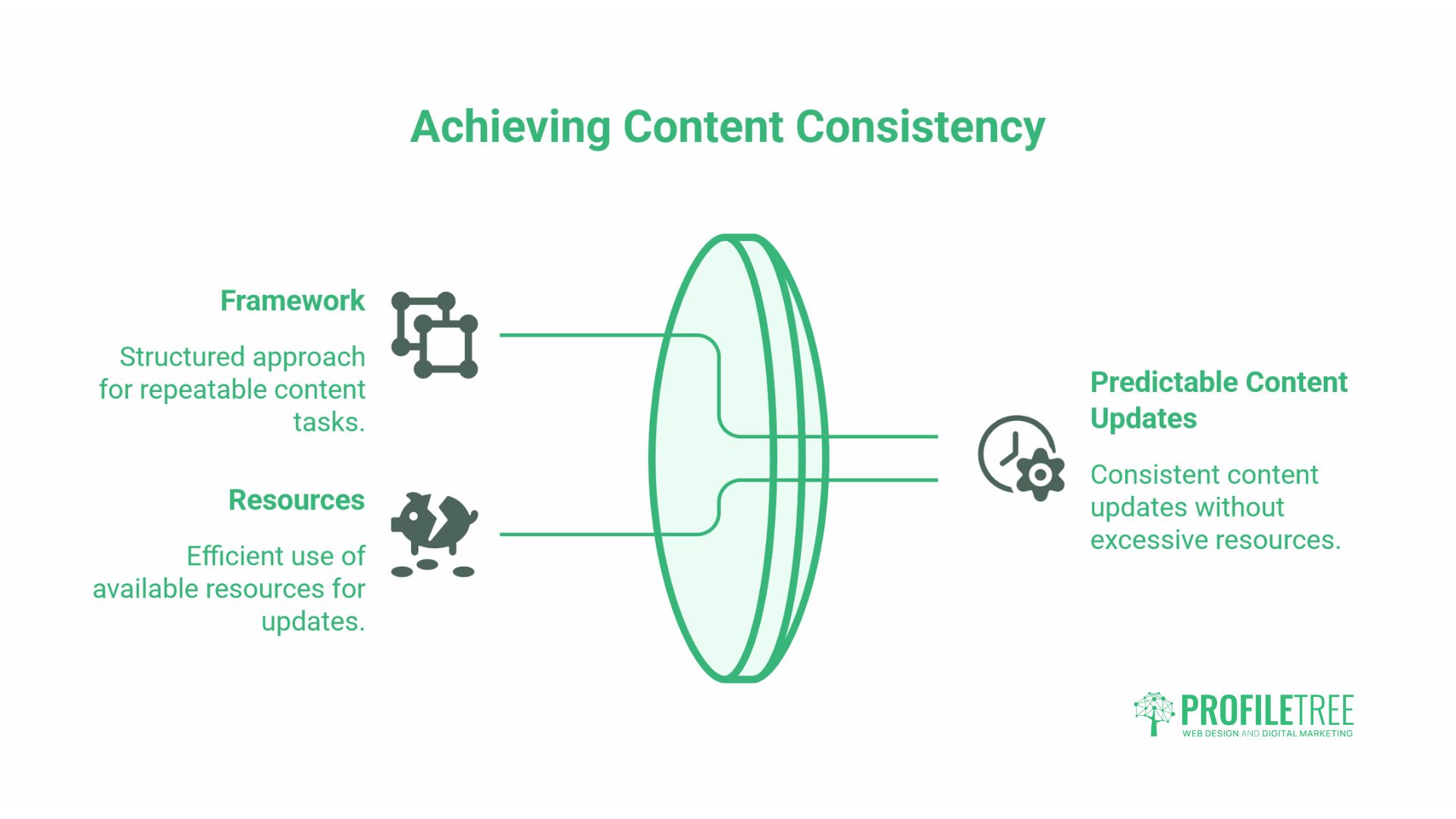
Consistency doesn’t require large resources. It requires a system that makes the work predictable and repeatable.
The simplest version: a spreadsheet listing every page on the site, the date it was last substantively updated, the primary keyword it targets, and its current average position. Review this list once a month. Sort by last-updated date, and pick the five pages furthest from a recent review that sit in positions 11–30, the zone where a refresh is most likely to produce visible movement.
This approach keeps the work manageable, creates a clear record of what has been done, and prevents the common pattern of updating the same few high-profile pages repeatedly while neglecting the long tail of content that collectively drives a significant share of organic traffic.
For businesses that have built up a substantial archive over several years, a content audit is worth running before building any update schedule. An audit establishes the current state of each page, flags those with duplicate intent, identifies candidates for consolidation, and produces a prioritised list that the update programme can systematically work through.
Talk to ProfileTree’s content team about SEO services for Northern Ireland and UK businesses if your team needs external support managing a content update programme at scale.
Keeping Content Consistent Across Channels
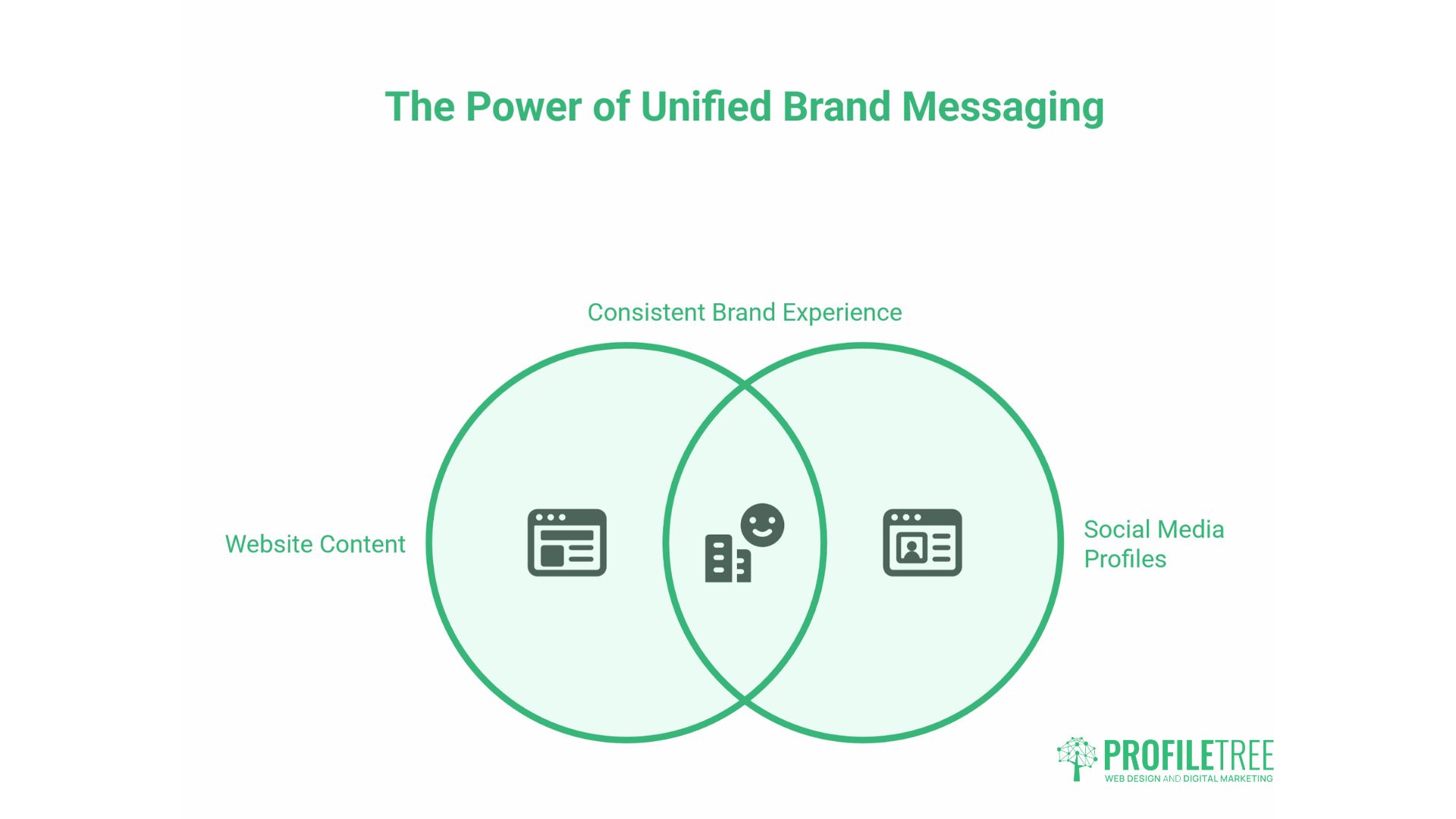
Website content doesn’t exist in isolation. A business that maintains a detailed, well-optimised site but leaves its LinkedIn profile describing services it no longer offers, or its YouTube channel full of videos offering outdated advice, sends mixed signals to anyone who encounters the brand across multiple touchpoints.
The highest-risk areas for content drift are the platforms that carry most weight in early-stage research: Google Business Profile descriptions, LinkedIn company pages, and YouTube video descriptions. These are typically written once and then forgotten. For a prospective client in Northern Ireland or Ireland who finds your website through search and then checks your social profiles before making contact, inconsistencies between those sources introduce doubt at exactly the wrong moment.
The most practical fix is to bring social and profile content into the same update cycle used for the website. When you refresh a service page or a pillar guide, use that as a prompt to check the corresponding platform bios, pinned posts, and video descriptions. For YouTube specifically, add a pinned comment to outdated videos directing viewers to the current article rather than editing the video itself.
Consistency across channels also means maintaining a reliable publishing rhythm. An SME that posts daily for three weeks and then goes silent for two months will generally underperform one that publishes less frequently but predictably. The social media content strategy guide covers how to set a cadence that holds up over twelve months rather than burning out after six.
Conclusion
Consistent content updates are not a one-off project. They are a maintenance discipline, and, like most maintenance, businesses that build it into a routine get better results than those that treat it as something to address only when things go wrong. Start with a simple audit of your highest-traffic pages, identify the ones sitting in positions 11–30, and work through them methodically.
Extend that discipline to the profiles and platforms where your audience finds you beyond the website. The cumulative effect of small, regular improvements compounds over time, whereas sporadic large efforts rarely replicate. For SMEs in Northern Ireland and the wider UK market, that consistency is often the differentiator between a site that holds its ground and one that quietly loses it. Get in touch with ProfileTree’s content team if you’d like support building a structured update programme for your site.
FAQs
How often should I update my blog for SEO?
It depends on the content type. News and opinion pieces can stand as published records unless factual information becomes inaccurate. Evergreen guides should be reviewed every six to twelve months. High-traffic pages sitting in positions 11–20 warrant attention sooner, as those are most likely to respond to a targeted refresh.
Does changing the published date actually help rankings?
Not on its own. Changing a date without making substantive changes is sometimes called “date spoofing,” and Google’s quality systems are designed to detect it. Update the date when you make real improvements; don’t update it as a substitute for making them.
How do I find which pages are losing traffic?
In Google Search Console, go to Performance, click “Date” and select “Compare.” Set the last three months against the previous three months, then sort the Pages tab by “Difference” in clicks or impressions. The pages showing the steepest decline are your priority refresh candidates.
Do content updates affect social media performance?
Not directly. Social media algorithms operate independently of Google. Updating a page won’t move its search position because of social activity. The indirect benefit is real though: a refreshed article gives you a genuine reason to reshare it, which can drive renewed referral traffic to the updated page.