
Metaverse Marketing Opportunities: Navigating Digital Frontiers
Table of Contents
The metaverse is not a single platform you can sign up to next Tuesday. It is an evolving collection of immersive, connected digital spaces where people interact through avatars, participate in virtual events, and purchase digital goods. For most UK and Irish SME owners, the honest question is not “should we be in the metaverse?” but “what parts of it are actually worth our time and budget right now?”
This guide cuts through the hype. It focuses on the tactics that are genuinely accessible to small businesses today, from free augmented reality filters on Instagram and TikTok to 360-degree virtual tours that strengthen your local SEO. It also covers the compliance requirements that no other guide aimed at UK businesses seems to mention.
Below, you will find a platform comparison table, a tiered budget breakdown, a section on GDPR in virtual spaces, and a practical step-by-step framework for building your first immersive campaign. All prices and figures in this guide are indicative UK examples and correct at the time of writing; use them as a benchmark rather than fixed quotations.
What Is the Metaverse? The SME Definition
Strip away the hype, and the metaverse is, at its core, the next layer of the internet. Where today’s web is primarily 2D (pages, images, video), the metaverse adds a third dimension: persistent, interactive environments where users can move around, meet others, and take actions that have real consequences, including financial ones.
It is not one product owned by one company. Meta’s Horizon Worlds is one expression of it. Roblox is another. The AR filter you see on a brand’s Instagram account is a simpler, mobile-first version of the same idea. Think of the metaverse less as a destination and more as a direction of travel for digital interaction.
Virtual Reality vs Augmented Reality: What Is the Difference?
These two terms are often conflated, but the distinction matters when you are making budget decisions.
Virtual reality (VR) immerses the user entirely in a computer-generated environment, typically through a headset. Augmented reality (AR) overlays digital content onto the real world, most commonly through a smartphone camera. For SMEs, AR is almost always the more practical starting point: it requires no specialist hardware, reaches a far larger audience, and can be deployed through platforms your customers already use.
Extended Reality and the Spectrum of Immersive Experience
Extended reality (XR) is the umbrella term for the full spectrum: VR, AR, and mixed reality (MR), which blends digital and physical elements in real time. You do not need to master all three. Most small businesses will find their best return at the AR end of the spectrum, at least in the near term.
To understand how immersive content fits within a broader digital marketing strategy, it helps to see it as an extension of the content formats you are probably already using, not a replacement for them.
Why UK and Irish SMEs Should Pay Attention
The case for metaverse marketing is not about chasing trends. It is about where consumer attention is shifting and what that means for businesses that depend on digital channels. The move from static content to interactive, immersive formats has been gradual but consistent, and the pace is accelerating.
The Shift from 2D to 3D Content Consumption
Short-form video already dominates social media feeds across the UK and Ireland. The logical next step in that progression is content that is not just watched but experienced. Brands that build fluency with immersive formats now will be better positioned as those formats become mainstream.
The rise of short-form video demonstrated that when the barrier to participation drops, adoption accelerates faster than most businesses expect. The same pattern is visible with AR filters, which have gone from a novelty to a standard feature of consumer brand campaigns in a relatively short period.
Why Gen Z and Millennial Buyers Are the Bridge
If your business sells to customers under 35, the metaverse is not a distant consideration. Younger consumers are already habituated to blended digital and physical experiences: trying on glasses through an app, attending live-streamed product launches, and purchasing digital items within games. Meeting them in those environments is not a gimmick; it is a reasonable channel decision.
For businesses targeting professional buyers, the B2B case is equally straightforward. Virtual networking events and immersive product demonstrations have become established formats for reaching decision-makers who are reluctant to commit travel time to traditional trade shows.
The First-Mover Advantage in Regional Markets
Almost all published guidance on metaverse marketing is US-centric and focuses on large brand budgets. For SMEs in Belfast, Dublin, Manchester, or Edinburgh, that gap is an opportunity. A local independent business that builds a credible immersive presence now faces far less competition than one that waits until the format is saturated.
Cities across Northern Ireland and Ireland are home to a growing cluster of digital-native businesses and consumers. If you are exploring how that regional context connects to digital opportunity, the cities of Northern Ireland offer a useful context for understanding the local market.
Five Low-Barrier Entry Points for Small Businesses
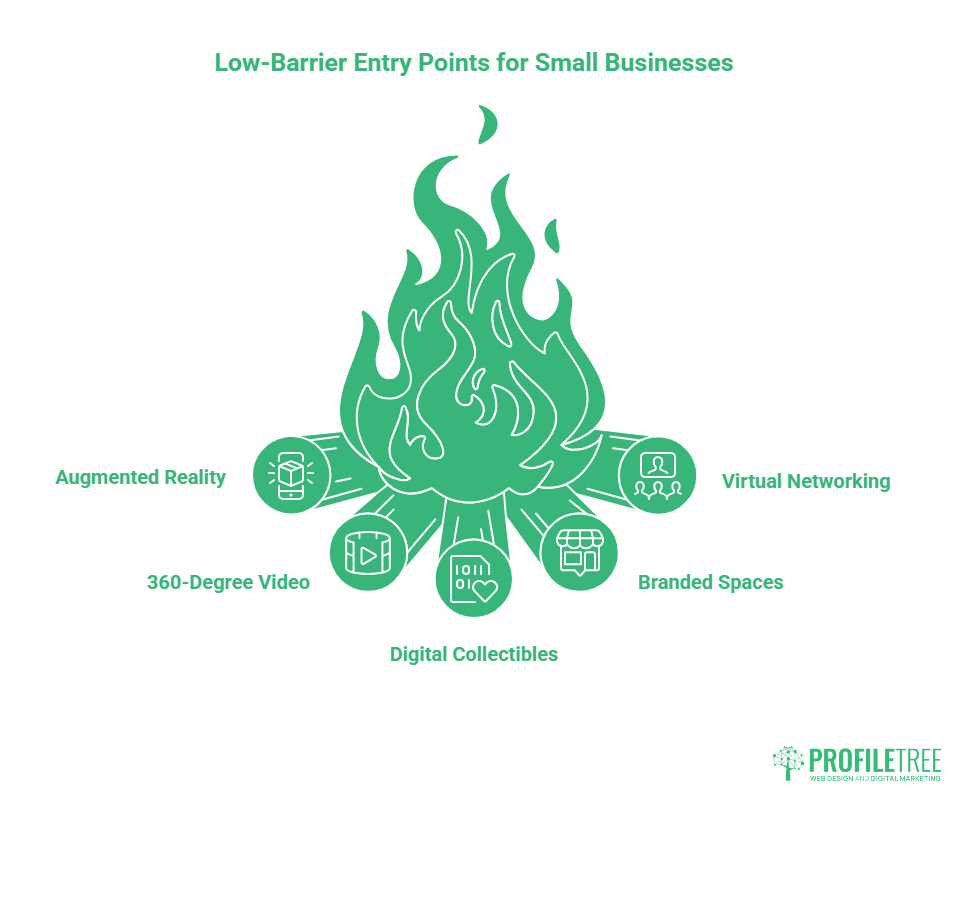
Not every metaverse tactic requires a significant budget or technical team. The following five options represent realistic starting points for SMEs, ordered broadly from lowest to highest complexity and cost.
Platform Comparison: Where Should Your SME Start?
| Platform / Format | Entry Cost | Primary Audience | Best For |
|---|---|---|---|
| Instagram / TikTok AR Filters | Low (£0 to £800) | All ages, UK / IE mainstream | Retail, hospitality, beauty, food |
| 360-Degree Video / Virtual Tours | Low to Medium (£500 to £3,000) | Property, tourism, events audiences | Local SEO, property, venues |
| Snapchat AR Lenses | Low (£0 to £1,000) | Under-35s | Events, product launches, retail |
| Roblox / Rec Room | Medium (£5,000+) | Under-25s, gaming audience | Youth brands, entertainment, FMCG |
| Meta Horizon Worlds | Medium to High | Tech-savvy adults, VR headset owners | B2B events, tech brands |
| Decentraland | High (land purchase + development) | Crypto / Web3 audience (niche) | Not recommended for most SMEs currently |
Augmented Reality via Instagram and TikTok
This is the most practical starting point for the overwhelming majority of SMEs. Both platforms allow businesses to create custom AR filters and effects through their native creator tools (Meta Spark for Instagram and Effect House for TikTok), and both have sizeable, established UK and Irish user bases.
A simple branded filter, perhaps one that places your product in the user’s environment or applies a themed visual overlay, can be created by a freelance AR developer for between £400 and £800. Once live, it is shareable, discoverable, and generates user-created content at no ongoing cost. This is the “£0 metaverse strategy” that competitors are not talking about: your customers become the distribution channel.
Understanding how these formats fit within a content plan is where most businesses get stuck. Our guide to creating interactive content covers how immersive formats connect to the broader content strategy decisions your business is already making.
360-Degree Video and Virtual Tours for Local SEO
A professionally shot 360-degree virtual tour of your premises does two things simultaneously. It gives prospective customers an immersive preview of your space, and it can be embedded in your Google Business Profile, which influences how your listing performs in local search results.
For a restaurant in Belfast, a boutique in Dublin, or a hotel in the Lake District, this is one of the few immersive formats where the ROI is relatively straightforward to measure: fewer “what does your venue look like?” enquiries, higher booking conversion rates, and a stronger local search presence. Our work in virtual tours for property marketing demonstrates how this format translates directly into commercial outcomes.
Digital Collectables as Loyalty Programmes
NFTs (non-fungible tokens) had a difficult public reputation during the 2021 to 2022 speculation cycle. Set aside the speculative angle, and what remains is a genuinely useful mechanism for building customer loyalty programmes with genuine scarcity and verifiable ownership.
A craft brewery might release a limited run of digital membership tokens that give holders access to exclusive tasting events or early product releases. A fashion boutique might tie a digital collectable to a physical purchase, creating a hybrid product with both tangible and digital value. Neither requires the business to touch cryptocurrency; platforms exist that handle the technical layer invisibly. The connection to AI-enhanced loyalty programmes is worth exploring for businesses considering how to make these systems smarter over time.
Branded Spaces in Accessible Platforms
If your audience skews young and you sell a consumer product, Roblox and Rec Room are worth investigating as brand activation platforms. Both have large UK user bases and have hosted successful campaigns from food and beverage brands, sports companies, and entertainment brands.
The investment required for a meaningful branded experience starts at around £5,000 for a basic activation and rises significantly for anything custom. This is not the right starting point for most SMEs, but it is worth understanding as part of a longer-term digital plan.
Virtual Networking and Events
For B2B businesses, virtual events remain one of the most underused tools in the immersive marketing kit. Platforms such as Hopin, Gather, and LinkedIn Events allow businesses to host interactive online events that go well beyond a standard video call, with spatial audio, breakout rooms, and networked environments that replicate much of what makes an in-person event valuable.
A digital training provider in Northern Ireland, for example, could run a monthly virtual networking session for its client base at near-zero cost, building community and reinforcing the brand without requiring anyone to travel. This connects naturally to the broader value of team-level digital training as a strategic investment. https://www.youtube.com/embed/Tv_GSreYhBU
The Cost of Entry: Budgeting for Immersive Marketing
One of the most persistent myths about metcustom-brandedng is that it requires enterprise-level budgets. It does not. The spectrum runs from genuinely free to significant investment, and most SMEs will find their best return at the lower end of that range, at least initially.
What a £500 Metaverse Budget Gets You
At this level, your most realistic option is a branded AR filter for Instagram or TikTok. A freelance developer working with Meta Spark or Effect House can produce a functional, on-brand filter in this range. You will not get a complex interactive experience, but you will get a shareable, discoverable asset that your customers can use and pass on.
Alternatively, if your business has an interesting physical space, a 360-degree photograph (as opposed to a full video) can be created for a similar figure and embedded in your Google Business Profile. This is low complexity, high relevance, and directly measurable through Google Business Profile analytics.
What a £2,000 to £5,000 Budget Opens Up
At this level, you can commission a professional 360-degree video tour of your premises, a more sophisticated AR filter with interactive elements, or a short animated 3D product showcase. Animation and 3D asset creation have become significantly more affordable due to AI-assisted tools that reduce production time.
ProfileTree’s animated video production service operates in this space: producing motion content that works across social platforms, embedded web pages, and virtual environments. For an SME with a physical product it wants to showcase in three dimensions, a professionally produced animation is often a more versatile investment than a one-off virtual event.
When to Consider £5,000 and Beyond
Higher budgets open up custom-branded spaces on gaming platforms, full virtual event production, and integrated AI personalisation within immersive environments. These are appropriate for businesses with a clear strategic rationale: a brand that sells primarily to under-25s, a company launching a new product line, or an agency building a case study for its own portfolio.
At this level, it is worth working with a specialist digital agency that can assess whether the investment matches your audience and commercial objectives. The cost-benefit analysis of AI implementation is a useful framework to apply here: the same rigour that applies to AI adoption decisions should apply to any significant immersive marketing investment.
GDPR and Compliance in Virtual Spaces
This is the section that competing guides consistently omit. If you are a UK or Irish business running any form of immersive marketing campaign, GDPR applies to the data you collect. The fact that data collection happens inside a virtual environment does not create any exemption.
What Data Do Immersive Environments Collect?
This is where the risk is more significant than many businesses realise. AR and VR platforms can collect data that goes well beyond what traditional digital channels capture: biometric information (facial geometry used to map AR overlays), spatial behaviour (how a user moves through a virtual space), voice data (in platforms with spatial audio), and real-time gaze data (in headset-based environments).
Under the UK GDPR and the EU GDPR (which applies to any campaign targeting Irish or EU consumers), biometric data is classified as special category data and subject to stricter processing conditions. If your AR filter captures facial geometry to function, that triggers compliance obligations that most businesses are not currently meeting.
Updating Your Privacy Policy for Virtual Campaigns
Before launching any immersive campaign, your privacy policy needs to be reviewed and updated to reflect the specific data collected, the legal basis for processing it, and how long it is retained. This is not optional. The Information Commissioner’s Office (ICO) has made clear that its enforcement scope extends to new digital formats as they emerge.
Practically speaking, the safest approach for most SMEs is to use AR formats that do not capture and store biometric data server-side: basic filters that process imagery on-device in real time, rather than those that upload and retain facial geometry data. Our resource on data privacy in e-commerce provides useful context on how these obligations play out in practice for smaller businesses.
Consent in Virtual Environments
The standard rules on consent apply: it must be freely given, specific, informed, and unambiguous. In a virtual event context, that means being explicit about what data is collected at the point of registration, not burying it in terms and conditions. For AR filters, the platform’s own consent mechanisms (Meta’s, TikTok’s) provide a first layer of compliance, but they do not absolve your business of its own data controller obligations.
If you are building any customer-facing virtual experience that involves data collection, a review of your team’s GDPR awareness is a sensible parallel step. Our GDPR training for teams covers the key topics relevant to digital marketing contexts.
Step-by-Step: Building Your First Immersive Campaign
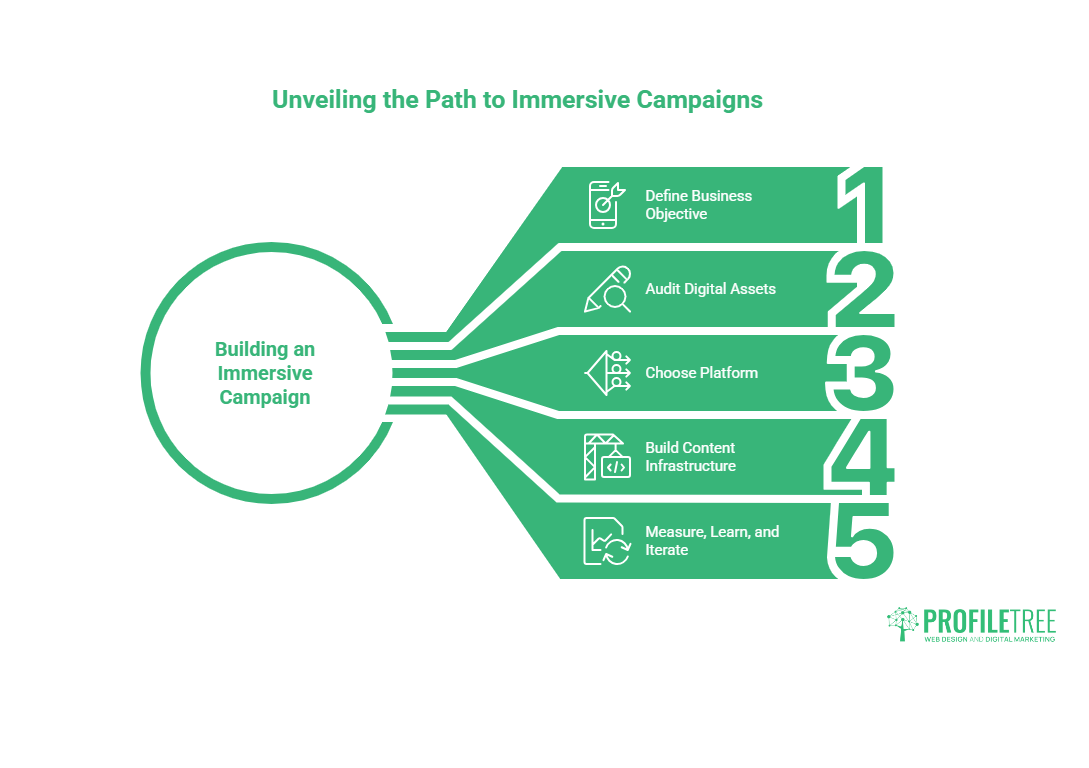
The following framework applies whether you are launching a simple AR filter or planning a more involved virtual event. It is designed for SMEs working without a dedicated in-house digital team.
Step 1: Define the Business Objective First
An immersive campaign without a clear objective is an expensive experiment. Before choosing a format, define what you are trying to achieve: increased foot traffic, higher e-commerce conversion, better brand recall among a specific age group, or stronger community engagement with existing customers. The objective determines the format, not the other way around.
A Belfast café wanting to drive lunchtime footfall from nearby office workers has a completely different objective from a software company wanting to run a virtual product launch for a UK-wide audience. Both can use immersive formats, but they should not use the same ones.
Step 2: Audit Your Existing Digital Assets
Before commissioning new content, take stock of what you already have. Do you have high-quality product photography that could be used to build 3D assets? Do you have an existing video library that could be repurposed into 360-degree content? Is your brand identity consistent and documented in a way that a developer can work from?
This matters because AI-assisted tools can now generate 3D assets from 2D photography at a fraction of the cost of traditional modelling. If you have good product imagery, you may already have the raw material for an immersive product showcase. Understanding the connection between AR and AI is increasingly relevant here.
Step 3: Choose Your Platform Based on Your Audience
Refer back to the platform comparison table in section three. If your primary customer is a 28-year-old consumer in Dublin, Instagram AR is your starting point. If you sell professional services to businesses across Northern Ireland, a virtual networking event on a platform your clients already use makes more sense than a Roblox activation.
Resist the temptation to choose the most technically impressive option. The most effective campaign is the one your actual customers will engage with, on a platform they are already comfortable using.
Step 4: Build the Supporting Content Infrastructure
An immersive activation does not exist in isolation. It needs supporting content: a landing page that explains the experience, social posts that drive awareness, an email sequence for existing customers, and clear calls to action that connect the immersive experience to a commercial outcome.
This is where social media drives sales as part of a connected system rather than a standalone tactic. The immersive element should sit within a broader campaign structure, not float independently of your other marketing activity.
Step 5: Measure, Learn, and Iterate
Define your success metrics before you launch, not after. For an AR filter, relevant metrics include uses (how many people activated the filter), saves, shares, and resulting profile visits or website clicks. For a virtual event, track registration to attendance conversion, session duration, and post-event enquiries.
Most SMEs will not get their first immersive campaign right. That is fine. The goal of an initial activation is to generate real data about how your specific audience responds to immersive formats, then use that data to improve the next one. The framework for maximising digital marketing ROI applies here as much as it does to any other channel.
Conclusion
Metaverse marketing for small businesses is not about buying virtual land or building a headquarters in Decentraland. For most UK and Irish SMEs, it is about choosing the immersive formats that match their audience, their budget, and their commercial objectives. Start with AR filters or a 360-degree virtual tour, get your GDPR house in order, and build from there. The businesses that treat this as a tool rather than a trend will be the ones that benefit from it.
ProfileTree works with SMEs across Northern Ireland, Ireland, and the UK on video marketing strategy, content production, and digital marketing planning. If you would like to discuss how immersive formats could fit your business, get in touch with our team.
FAQs
Is the metaverse only relevant to large companies?
No. AR filters on Instagram and TikTok, and 360-degree virtual tours are well within reach of small businesses. Most SMEs will find their best entry point at the social AR end of the spectrum, where costs are low, and audiences are already established.
What is the difference between VR and the metaverse?
VR is a headset-based technology that immerses users in a computer-generated environment. The metaverse is a broader concept: the network of persistent, interconnected digital spaces where people interact. Most SME-relevant metaverse marketing, including AR filters and virtual events, does not require a headset.
Does GDPR apply to metaverse marketing campaigns?
Yes. UK and EU GDPR apply fully to data collected in virtual environments. Some platforms capture special category data, such as biometric information. Privacy policies must be updated before any immersive campaign goes live, and a valid legal basis for processing must be in place.
Which platform is best for UK small businesses?
For B2C, Instagram and TikTok AR are the most practical starting points. For B2B, virtual networking events on Hopin or LinkedIn Events tend to deliver stronger results. Decentraland is not recommended for most SMEs given its limited mainstream audience and high entry costs.
Do I need a VR headset to market in the metaverse?
No. AR filters run through a standard smartphone camera, 360-degree videos play in any browser, and virtual events are accessible via laptop or tablet. Building a campaign that requires headset ownership significantly limits your audience reach.