
Social Media Compliance for Business
Table of Contents
Social media compliance means operating your business accounts in line with the legal, regulatory, and platform-specific rules that govern online communication. For UK and Irish SMEs, getting this wrong can mean fines under GDPR, advertising bans from the FCA or ASA, and the kind of public backlash that damages a brand for years. This guide covers the core obligations, the most common pitfalls, and the practical steps businesses can take to stay on the right side of the rules.
Compliance is not just a legal checkbox. The businesses that handle data carefully, label their sponsored content correctly, and manage intellectual property honestly tend to build more durable online audiences. Every section below connects the regulation to real commercial behaviour, so you can act on it.
Understanding compliance is one part of building a sound digital presence. ProfileTree’s digital marketing services are built around approaches that protect client brands as well as grow them.
Understanding Social Media Compliance
Social media compliance covers a broad set of obligations: data protection law, advertising standards, intellectual property rights, financial promotion rules, and platform terms of service. Each of these applies simultaneously, and a single post can touch several at once. For most businesses, the risk is not wilful non-compliance but simply not knowing which rules apply to which type of content.
What Social Media Compliance Actually Covers
The scope is wider than most marketing managers assume. Compliance applies to organic posts, paid advertising, influencer partnerships, competitions, customer data collected through social channels, and the content other people tag you in or post on your behalf. It also applies to how your team uses social media in a professional capacity, not just what your brand account publishes.
For UK businesses, the primary frameworks are the UK GDPR (retained from EU law post-Brexit), the FCA’s financial promotions rules for financial services firms, the ASA’s CAP Code for advertising, the ICO’s guidance on email and online tracking, and the platform-specific policies of whichever networks you use. For businesses operating in Ireland or the EU, the original GDPR applies directly.
Why the Regulatory Environment Has Tightened
Regulatory enforcement has become more active across the UK and EU since 2022. The ICO has issued significant fines for unlawful data processing, the FCA has tightened rules on financial promotions following concerns about social media advertising by unregulated firms, and the ASA has introduced a rolling monitoring programme specifically targeting influencer content. The platform operators themselves face regulatory pressure, which means their own policies have become stricter and more actively enforced.
For businesses, this means the informal approach that may have worked in 2018 carries real risk today. Compliance is no longer something you can address reactively after a complaint; it needs to be built into how content is planned and approved.
The Commercial Case for Getting It Right
“Businesses that build genuine trust with their audience through transparent, compliant social media practices are far better placed to convert followers into customers than those that cut corners. Compliance is not a barrier to good marketing; it’s part of what makes marketing credible,” says Ciaran Connolly, founder of ProfileTree.
Beyond avoiding fines, compliant businesses attract and keep audiences more effectively. Data-conscious consumers notice when a brand handles their information with care. Advertisers and platforms increasingly favour accounts that operate within the rules. And when compliance failures do happen, the reputational cost typically far exceeds any regulatory fine.
Privacy and Data Protection on Social Media
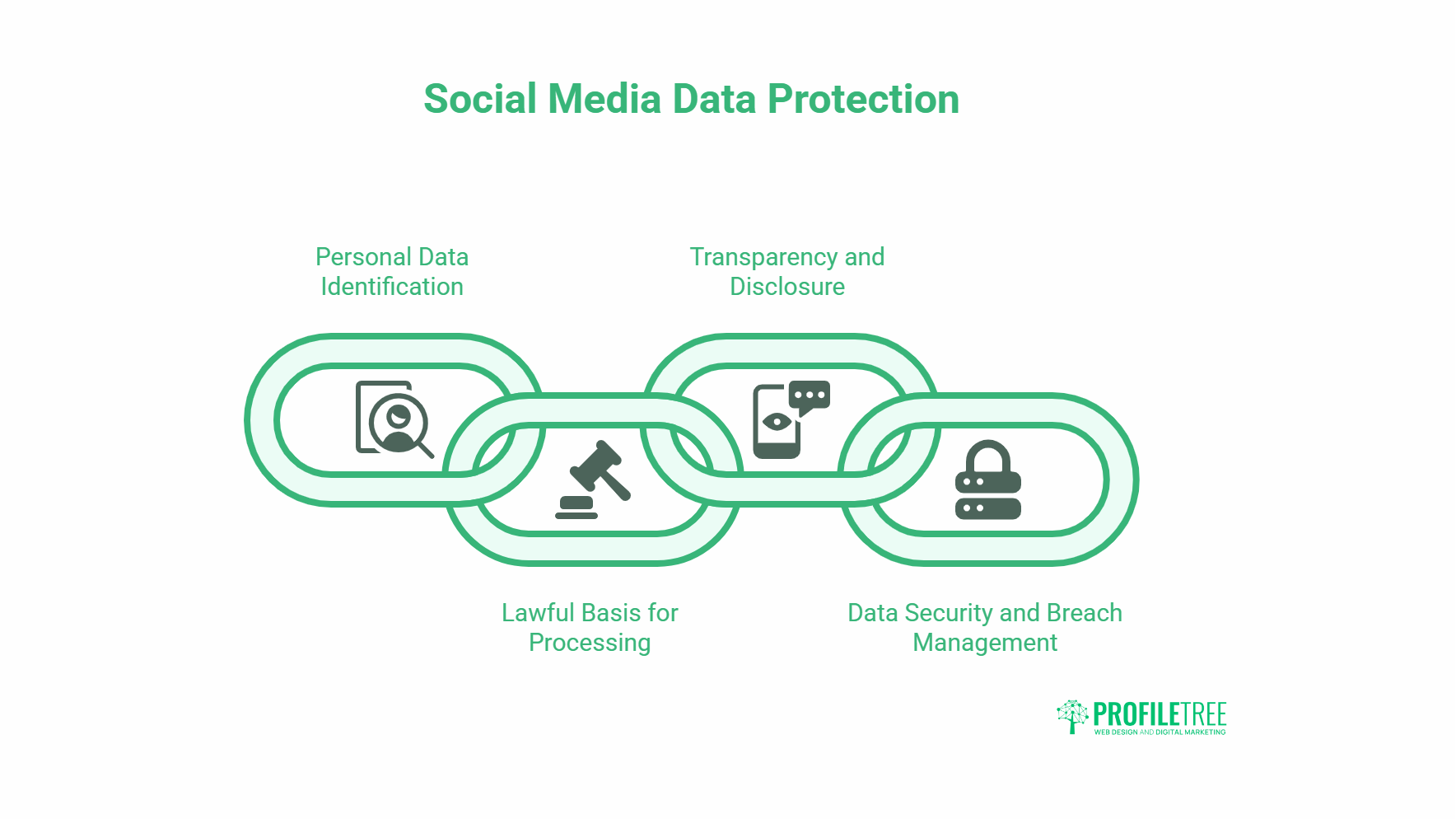
Data protection is the compliance area most likely to affect every business with a social media presence, regardless of sector. If you collect any information about people through social channels, you have obligations under UK GDPR or EU GDPR.
What Counts as Personal Data in a Social Media Context
Personal data is any information that can identify a living individual, directly or indirectly. On social media, this includes names, profile handles, email addresses collected via lead generation forms, direct message content, IP addresses captured through tracking pixels, and behavioural data gathered through retargeting tools. Even aggregate analytics can become personal data if combined with other information that enables identification.
This matters practically because businesses routinely collect personal data through social channels without realising it. Running a competition that asks people to comment and tag a friend? You are processing personal data. Saving DMs for customer service purposes? Same. Retargeting website visitors through Meta’s pixel? The pixel triggers data collection the moment someone lands on your site.
Consent, Transparency, and Lawful Basis
UK GDPR requires a lawful basis for every instance of personal data processing. For most social media marketing activities, the relevant bases are consent, legitimate interests, or contract performance. Consent must be freely given, specific, informed, and unambiguous. Pre-ticked boxes do not count. Silence does not count. Bundling consent to marketing with consent to terms and conditions does not count.
Transparency obligations mean your privacy policy must explain clearly what data you collect through social channels, why you collect it, how long you keep it, who you share it with, and what rights individuals have. The ICO’s guidance specifically addresses social media data and is worth reading alongside the general UK GDPR requirements.
Data Security and Breach Management
Protecting personal data collected through social channels requires technical and organisational measures appropriate to the risk. For most SMEs, this means access controls on social accounts (so that only the right team members can see DMs and form submissions), a clear retention policy (how long do you keep leads before deleting them?), and a documented breach response process.
Under UK GDPR, a personal data breach that is likely to result in risk to individuals must be reported to the ICO within 72 hours of discovery. Social media accounts are a target for account takeovers, phishing, and unauthorised access. Two-factor authentication on every business account is the minimum standard; many compliance failures in this area start with a compromised account rather than a deliberate data breach.
Intellectual Property and Content Rights
Copyright and trademark issues on social media are genuinely common and genuinely consequential. The fact that content is freely visible online does not mean it is free to use. Reposting, remixing, or sharing without permission can expose a business to takedown notices, legal claims, and reputational damage.
Copyright Rules for Social Media Content
Copyright protects original creative works automatically from the moment they are created. This includes photographs, videos, written posts, music, and graphic design. You do not need to see a copyright notice for a work to be protected. The practical implication is straightforward: if you did not create the content and you do not have a licence to use it, do not post it.
This applies to background music in videos, images sourced from Google image search, other accounts’ graphics shared without credit, and stock photographs used beyond the terms of the licence. Platforms like Instagram, TikTok, and YouTube have automated content ID systems that detect unlicensed music and can result in videos being muted, removed, or monetised by the rights holder rather than you.
Trademark Issues and Brand Protection
Using another company’s trademark in your social media content can constitute infringement, particularly where there is a risk of consumer confusion about the relationship between the two brands. This most commonly arises when businesses use brand names in hashtags, product comparisons, or promotional content in ways the trademark holder has not approved.
From the other direction, businesses should monitor social media for unauthorised use of their own trademarks. Impersonation accounts, counterfeit product promotion, and unofficial brand mentions can dilute brand value and mislead consumers. Platforms have trademark violation reporting mechanisms that most business owners are not aware of.
User-Generated Content and Rights Management
User-generated content (UGC) presents a specific challenge. When a customer posts a photo featuring your product, and you want to reshare it, you need their permission. Liking or commenting on a post is not permission. The safest approach is a direct message asking for explicit consent before reposting, and keeping a record of that consent. Some businesses use a hashtag-based system where the terms and conditions make clear that using the hashtag constitutes consent to resharing; this approach carries legal risk and should only be used with proper legal review of the terms.
Advertising, Endorsements, and Sponsored Content
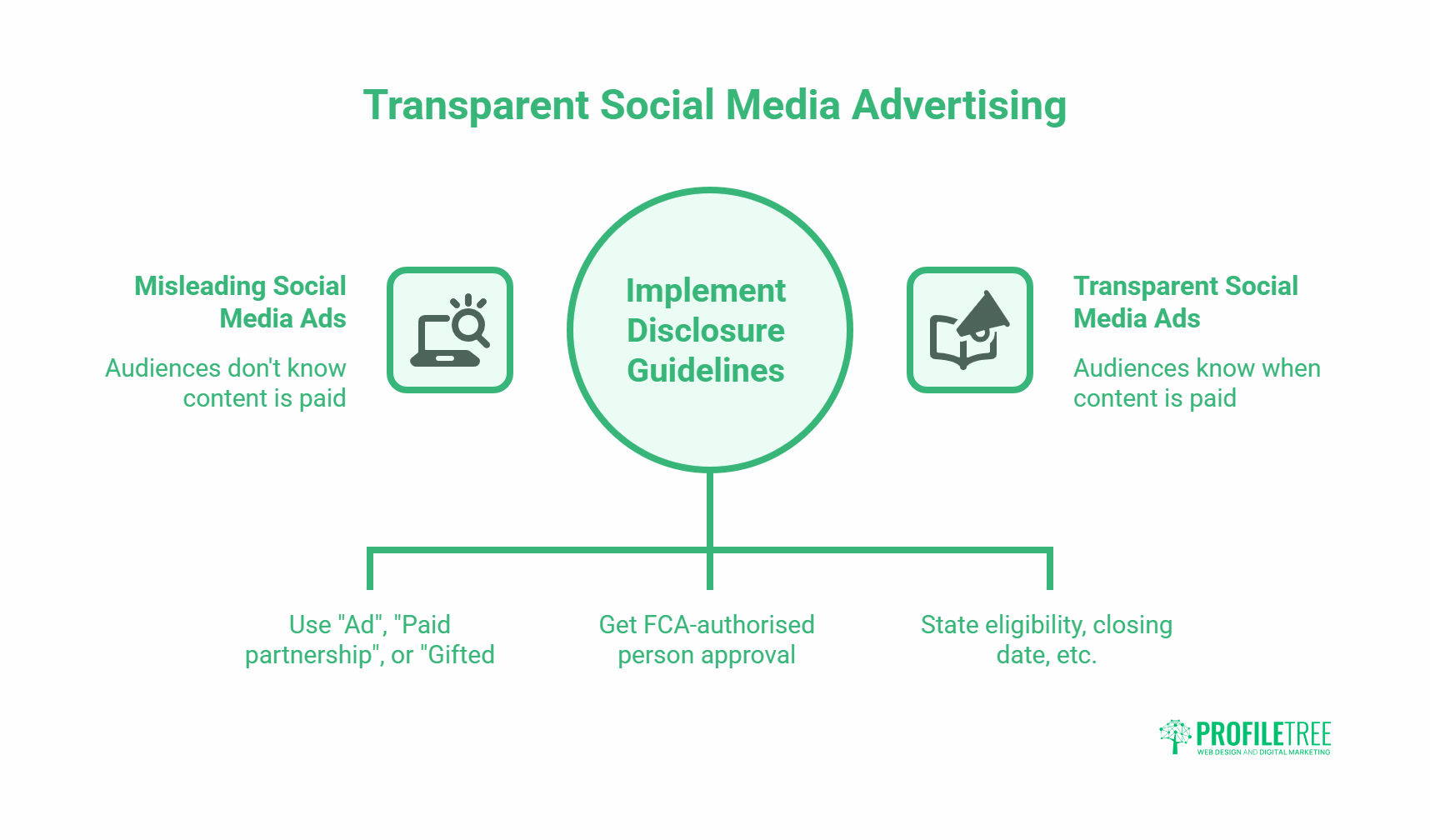
The rules on advertising disclosure are among the most actively enforced compliance areas on social media. The ASA in the UK has published detailed guidance, issued many rulings, and operates a name-and-shame system for repeat non-compliance. The basic principle is transparency: audiences have a right to know when content is paid for or incentivised.
When Disclosure Is Required
Disclosure is required whenever there is a material connection between the person posting and the brand being promoted. This includes paid partnerships, gifted products, free services, commission arrangements, and family or business relationships that could influence the endorsement. The disclosure must be clear and upfront. Placing #ad in a block of ten hashtags at the bottom of a caption does not meet the ASA’s standard. Verbal disclosure buried at the end of a 60-second video does not meet it either.
The ASA’s current guidance requires that ads are “obviously identifiable as ads.” In practice, this means labels like “Ad”, “Paid partnership”, or “Gifted” are placed prominently at the start of captions or at the beginning of video content. Instagram’s paid partnership tool, which displays “Paid partnership” below the account name, meets the standard when used correctly.
Producing genuinely useful content that builds audience trust without relying on misleading promotion is a more sustainable approach in any case. ProfileTree’s content marketing services are built around this principle.
Financial Promotions and Sector-Specific Rules
Financial services firms face an additional layer of regulation. The FCA’s financial promotions regime applies to social media content that promotes regulated financial products or services. This means posts about investment products, credit facilities, insurance, and similar must be approved by an FCA-authorised person before publication, include required risk warnings, and not be misleading in any respect.
The FCA’s crackdown on social media financial promotions has been significant since 2022, with particular focus on “finfluencer” content promoting high-risk investments. Even businesses that are not FCA-regulated themselves can fall foul of these rules if they share or promote content from firms that are operating outside the rules.
Competitions, Promotions, and Prize Draws
Competitions and giveaways on social media are subject to the Gambling Act 2005 in the UK and must be structured carefully to avoid constituting an illegal lottery. The basic rule is that a prize draw is lawful if it is free to enter or if the paid entry is a genuine purchase at its normal price. Requiring a follow, a like, or a share as the entry mechanic has been treated differently by different platforms; some prohibit it entirely in their terms of service.
All promotions should include clear terms and conditions stating eligibility, the closing date, how winners are selected and notified, and any restrictions on the prize. Failure to publish adequate terms and conditions is one of the most common compliance failures in social media marketing and one of the easiest to fix.
Building a Social Media Compliance Framework
Compliance becomes manageable when it is built into processes rather than treated as a post-publication checklist. Most social media compliance failures are preventable with a clear internal policy, basic training, and a sensible approval workflow.
Writing a Social Media Policy
A social media policy for business should cover what employees can and cannot post about the company, its clients, and competitors in both personal and professional contexts. It should define who can post on behalf of the business, what approval is required for different content types, how sensitive topics are handled, and what to do when something goes wrong. Policies that run to 40 pages are rarely read; a clear, practical two-page document that people actually understand is far more effective.
The policy should be reviewed at least annually and updated when platforms change their terms or when new regulatory guidance is published. Responsibility for maintaining it should sit with a named person rather than being assumed to be everyone’s job.
Approval Workflows and Content Sign-Off
For most SMEs, a two-stage approval process is sufficient: the person creating the content, and a second person responsible for compliance review before publication. In regulated sectors, a qualified compliance officer or external legal review may be required for certain content types. The approval process should be documented, with a record of who approved each piece of content and when.
A well-structured digital presence supports compliance as well as visibility. ProfileTree’s web design and development services include privacy-compliant infrastructure as standard.
Training and Staying Current
Regulatory requirements change, and platform policies change faster still. Staff involved in social media management need baseline training in data protection, advertising disclosure rules, and the specific regulations relevant to your sector. This does not mean a full legal qualification; it means understanding the practical dos and don’ts well enough to flag a potential problem before it becomes a problem.
Staying current means subscribing to ICO updates, ASA rulings (published weekly and often instructive even when they involve other sectors), and the policy update announcements from the platforms you use. Platforms typically give little notice of policy changes, and compliance failures after a policy update are treated no differently from pre-existing ones.
Using AI Tools in Social Media Compliance
AI tools are increasingly used in social media management for drafting content, monitoring mentions, and scheduling posts. Each use case carries its own compliance considerations. AI-generated content that makes factual claims about products or services carries the same disclosure and accuracy obligations as human-written content. AI sentiment analysis tools that process social media data involving identifiable individuals are processing personal data under UK GDPR. Automation tools that post on behalf of the account must comply with platform terms, which generally prohibit inauthentic activity.
ProfileTree’s AI transformation services include guidance on deploying AI tools in ways that remain compliant with data protection and platform requirements.
Responding to Compliance Failures
When something goes wrong on social media, the response matters as much as the original error. A quick, transparent correction typically limits damage; a slow, defensive response amplifies it.
Handling a Regulatory Complaint
If an ASA complaint is upheld or an ICO investigation is opened, take legal advice immediately. Do not delete posts or communications that may be relevant to the investigation; this can make a regulatory issue significantly worse. Be cooperative with the regulator, respond within the deadlines specified, and put in place any remedial measures promptly. Most regulators distinguish between businesses that engage constructively and those that do not.
Managing Public Complaints on Social Channels
Customer complaints on social media should be handled professionally and promptly. Do not delete complaints unless they contain genuinely prohibited content (hate speech, personal information about third parties, or malicious falsehoods). Acknowledge the complaint, take the detailed conversation to a private channel, and follow up publicly once the matter is resolved. This approach demonstrates accountability and is more likely to result in a positive outcome for both the customer and the brand.
Post-Incident Review
After any compliance incident, however minor, review the process that allowed it to happen. Update the policy if needed. Retrain the team. Document what happened and what changed. Regulators and courts take a more lenient view of businesses that can demonstrate a systematic approach to learning from failures than those that treat each incident as an isolated event.
Social Media Compliance: Frequently Asked Questions
What are the main legal requirements for businesses using social media in the UK?
UK businesses using social media must comply with UK GDPR for any data collected through social channels, the ASA’s CAP Code for advertising and sponsored content, the Consumer Protection from Unfair Trading Regulations 2008 for commercial communications, and sector-specific rules such as the FCA’s financial promotions regime where applicable. Platform terms of service add a further contractual layer of obligations. Most social media compliance requirements ultimately come back to three principles: transparency with audiences, accurate and non-misleading content, and lawful handling of personal data.
Does GDPR apply to social media business accounts?
Yes. UK GDPR applies to any processing of personal data by a business, regardless of where that processing takes place. Collecting leads through a Facebook form, saving DM conversations, running retargeting campaigns using a tracking pixel, and using social listening tools that capture data about identifiable individuals all constitute personal data processing subject to UK GDPR. You need a lawful basis for each activity, a clear privacy notice covering social media data collection, and appropriate security measures on your accounts.
When do I need to disclose that social media content is an advertisement?
Disclosure is required whenever there is any commercial relationship between the person posting and the brand being promoted: paid partnerships, gifted products, free services, discount codes, affiliate arrangements, or any business or family relationship that could influence the endorsement. The disclosure must be clear and prominent, placed at the start of captions rather than buried in hashtags, and presented in a way that is obvious before the audience engages with the content. The ASA has upheld complaints against content where #ad appeared below the fold or in a list of hashtags.
Can I repost customer photos and user-generated content?
Not without permission. Copyright in a photograph belongs to the person who took it, regardless of where it was posted. You need explicit consent from the creator before reposting their content on your business account. The safest approach is a direct message asking for permission and keeping a record of the response. Some businesses use competition mechanics or hashtag terms and conditions to obtain consent; these approaches need careful legal review to be reliable.
What should a social media policy for a small business include?
A practical social media policy for an SME should cover: who is authorised to post on behalf of the business; what approval process is required for different content types; rules on disclosing commercial relationships; guidance on handling data collected through social channels; what employees can and cannot say about the business in personal posts; how to handle customer complaints received via social media; and what to do if a compliance issue arises. The policy should name a responsible person and set a review schedule. Two to three pages is adequate for most small businesses.
Are there specific compliance rules for social media competitions?
Yes. UK law requires that prize draws be genuinely free to enter or based on a genuine purchase to avoid constituting an illegal lottery under the Gambling Act 2005. Competitions requiring a follow, like, or share as the sole entry mechanic may breach both UK law and platform terms of service. All promotions should publish clear terms, including eligibility criteria, closing date, how winners are chosen and notified, and prize details. The ASA and the Competition and Markets Authority both have the ability to take action over misleading or unlawful social media promotions.